Ai Overview
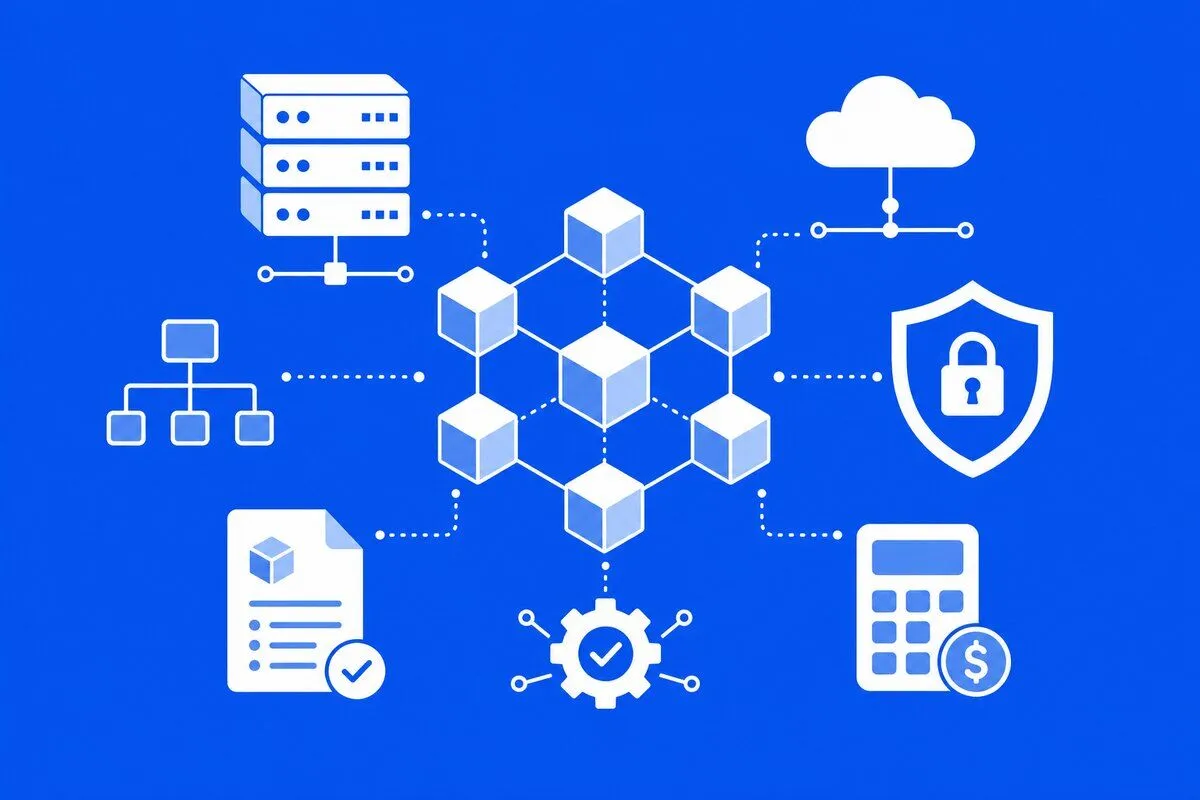
Enterprise blockchain has moved far beyond testing stages and now powers real-world systems handling billions in transactions, supply chains, and digital assets worldwide. This rapid growth has increased the need for a reliable blockchain development company that can build secure and scalable solutions. From our 8+ years of experience in delivering blockchain development services, one thing is clear—technology alone is not enough.
Enterprise blockchain has moved far beyond testing stages and now powers real-world systems handling billions in transactions, supply chains, and digital assets worldwide. This rapid growth has increased the need for a reliable blockchain development company that can build secure and scalable solutions.
From our 8+ years of experience in delivering blockchain development services, one thing is clear—technology alone is not enough. Without strong compliance frameworks, even the most advanced blockchain systems can fail under regulatory pressure.
As blockchain adoption expands across regulated industries, businesses must focus on building systems that handle data privacy, financial regulations, operational risks, and cross-border legal requirements effectively.
This guide explores key compliance strategies, governance models, and best practices that help enterprises build secure, scalable, and regulation-ready blockchain solutions across global markets.
Key Takeaways
- Enterprise blockchain compliance requires embedding regulatory controls at the architectural level rather than retrofitting compliance as afterthought functionality in production systems.
- Multi-jurisdiction deployments across USA, UK, UAE, and Canada demand flexible compliance frameworks adapting to divergent regulatory requirements without compromising core functionality.
- KYC and AML integration within enterprise blockchain compliance must balance regulatory obligations with privacy-preserving techniques maintaining user data confidentiality across distributed networks.
- Tokenized securities and digital assets require comprehensive compliance addressing securities laws, custody regulations, and investor protection rules varying significantly across jurisdictions.
- Data residency and sovereignty requirements create complex technical challenges requiring enterprise blockchain compliance architectures supporting localized data storage with distributed ledger benefits.
- Smart contract auditing standards within enterprise blockchain compliance extend beyond security vulnerabilities into regulatory compliance verification and legal enforceability validation.
- On-chain governance mechanisms enable enterprise blockchain compliance evolution matching regulatory changes without requiring disruptive protocol migrations or system rebuilds.
- Regulatory reporting automation through enterprise blockchain compliance reduces operational overhead while providing regulators with unprecedented transparency into institutional blockchain activities.
- Identity management infrastructure supporting enterprise blockchain compliance must integrate with existing enterprise IAM systems while maintaining blockchain-specific privacy and security requirements.
- Operational resilience frameworks within enterprise blockchain compliance ensure business continuity during incidents while maintaining regulatory reporting obligations throughout disruptions.
Enterprise Blockchain Compliance in Institutional-Grade Architectures
Institutional-grade blockchain architectures embed enterprise blockchain compliance throughout every layer of technical infrastructure, from consensus mechanisms ensuring regulatory-compliant validator selection through smart contract frameworks enforcing policy rules automatically. Unlike retail-focused blockchain implementations prioritizing decentralization above all else, enterprise architectures must balance distributed trust with regulatory accountability, operational control with auditability, and innovation with risk management. Leading financial institutions in New York, London, Dubai, and Toronto deploy permissioned blockchain networks where compliance controls integrate at the protocol level, enabling granular access management, comprehensive transaction monitoring, and regulatory reporting capabilities meeting institutional standards. These architectures implement defense-in-depth compliance strategies where multiple independent control layers must fail simultaneously before regulatory violations occur. The complexity increases exponentially when institutions require cross-border operations subject to conflicting regulatory regimes, demanding flexible compliance frameworks adapting to jurisdiction-specific requirements without fragmenting into incompatible regional deployments. Enterprise blockchain compliance architecture decisions made during initial design phase determine whether institutions can scale blockchain implementations across business units and geographies or remain constrained to limited pilots unable to deliver transformational value justifying substantial infrastructure investment.
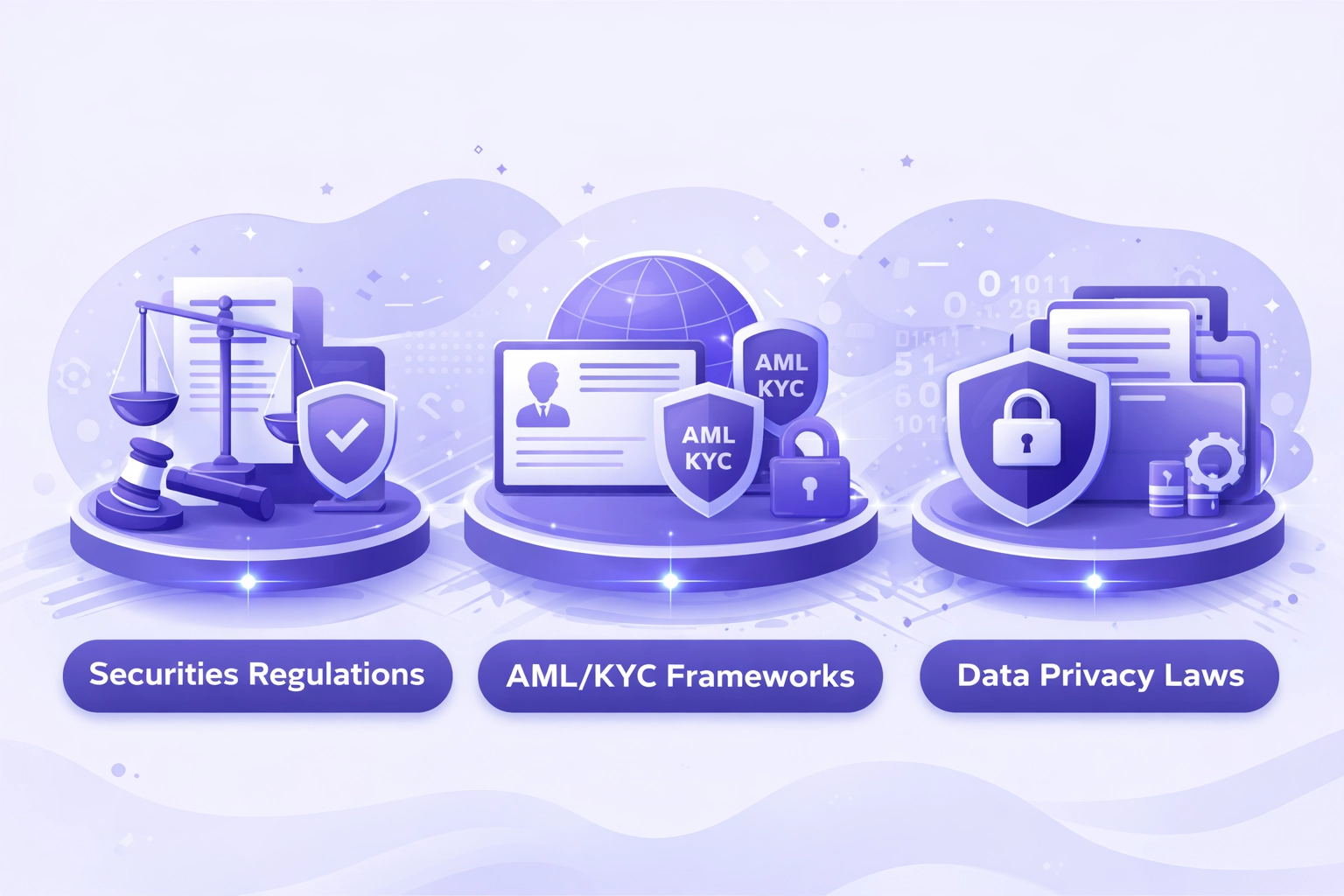 Aligning Enterprise Blockchain Compliance With Global Financial Laws
Securities Regulations
- SEC requirements in USA for tokenized securities including registration, disclosure, and trading restrictions
- UK FCA rules governing crypto assets and investment token classifications
- MiFID II implications for blockchain-based trading venues and transaction reporting
- Prospectus requirements for token offerings across multiple jurisdictions
AML/KYC Frameworks
- FATF Travel Rule implementation for cross-border crypto transactions
- FinCEN requirements for US-based virtual asset service providers
- UK Money Laundering Regulations applying to crypto asset businesses
- VARA Dubai standards for customer due diligence and ongoing monitoring
Data Privacy Laws
- GDPR requirements including right to erasure challenging blockchain immutability
- PIPEDA compliance for Canadian blockchain implementations processing personal data
- CCPA obligations for California-based enterprises using blockchain systems
- UAE Personal Data Protection Law affecting Dubai blockchain deployments
Enterprise Blockchain Compliance for Cross-Border Transaction Systems
Cross-border transaction systems present the most complex enterprise blockchain compliance challenges as institutions must simultaneously satisfy conflicting regulatory requirements across multiple jurisdictions lacking harmonized blockchain regulations. A payment system processing transactions between the USA and UAE must comply with FinCEN regulations, OFAC sanctions, VARA licensing requirements, and UAE Central Bank oversight simultaneously while maintaining compliance with SWIFT standards for correspondent banking relationships. Enterprise blockchain compliance frameworks for cross-border systems implement jurisdiction-aware smart contracts that apply appropriate regulatory rules based on transaction participants’ locations, transaction types, and asset classes involved. The technical complexity multiplies when considering that regulatory classifications vary dramatically between jurisdictions, with identical digital assets potentially qualifying as securities in one country while treated as commodities or utility tokens elsewhere. Institutions deploying cross-border blockchain systems must maintain comprehensive legal analysis documenting regulatory compliance logic for each supported jurisdiction, preparing detailed responses to inevitable regulatory inquiries questioning compliance approaches. The operational challenge extends beyond initial deployment into ongoing regulatory monitoring, as law changes in any jurisdiction may require system modifications affecting global operations. Despite these challenges, cross-border blockchain systems offer compelling value propositions through reduced settlement times, lower transaction costs, and enhanced transparency compared to legacy correspondent banking networks, justifying substantial enterprise blockchain compliance investments.
Privacy-Preserving Techniques in Enterprise Blockchain Compliance Models
Privacy-preserving techniques enable enterprise blockchain compliance by balancing regulatory transparency requirements with data protection obligations and competitive confidentiality concerns. Zero-knowledge proofs allow institutions to prove transaction validity and regulatory compliance without revealing sensitive transaction details to all network participants, critical for competitive commercial relationships. Confidential transactions using cryptographic techniques like homomorphic encryption enable mathematical operations on encrypted data, allowing compliance checks and reporting while maintaining transaction privacy. Private channels in permissioned blockchain networks restrict transaction visibility to authorized participants, satisfying confidentiality requirements while maintaining audit trails for regulatory examination. These techniques prove essential for enterprises in London, New York, Dubai, and Toronto operating in competitive markets where transaction details constitute valuable commercial intelligence requiring protection from competitors participating in shared blockchain networks. The challenge lies in convincing regulators that privacy-preserving techniques provide adequate transparency for supervisory oversight despite limiting general participant visibility. Institutions must demonstrate that authorized regulators retain complete access to transaction data through designated audit interfaces while other participants see only information necessary for their specific roles. Successfully implementing privacy-preserving enterprise blockchain compliance requires sophisticated cryptographic expertise, regulatory education initiatives explaining technical approaches, and operational procedures ensuring regulatory access functions reliably when supervisory authorities require transaction examination during investigations or routine audits.
Permissioned vs Public Network Enterprise Blockchain Compliance Comparison
| Compliance Aspect | Permissioned Networks | Public Networks |
|---|---|---|
| Identity Verification | Mandatory KYC for all participants with verified identity linkage | Pseudonymous addresses requiring external identity protocols |
| Transaction Monitoring | Real-time AML screening with automated compliance rules | Post-hoc analysis through blockchain forensics tools |
| Regulatory Access | Direct regulator integration with complete data access | Requests routed through participant entities |
| Governance Control | Consortium governance with regulatory consultation | Decentralized governance with no central authority |
| Compliance Enforcement | Protocol-level enforcement through access controls | Application-layer enforcement with varying adoption |
Embedding KYC and AML Controls Into Enterprise Blockchain Compliance
Identity Verification Integration
Integrate third-party KYC providers or build internal verification systems linking blockchain addresses to verified real-world identities through cryptographic attestations.
Transaction Monitoring Rules
Deploy smart contract logic and off-chain monitoring systems flagging suspicious transaction patterns based on velocity, amount thresholds, and counterparty risk profiles.
Sanctions Screening Automation
Implement automated screening against OFAC, UN, and EU sanctions lists before transaction execution, preventing prohibited transfers at protocol level.
Suspicious Activity Reporting
Establish workflows generating suspicious activity reports meeting FinCEN and FCA requirements, integrating with existing institutional SAR filing processes.
Travel Rule Implementation
Deploy FATF Travel Rule compliance solutions transmitting originator and beneficiary information for transactions exceeding regulatory thresholds across jurisdictions.
Enhanced Due Diligence Triggers
Configure risk-based triggers requiring enhanced due diligence for high-risk customers, politically exposed persons, or elevated transaction volumes.
Ongoing Monitoring Mechanisms
Implement continuous monitoring analyzing transaction patterns, detecting behavioral changes, and triggering periodic customer information updates meeting regulatory requirements.
Regulatory Reporting Automation
Automate regulatory reporting generation from blockchain transaction data, providing supervisors with timely, accurate compliance information through standardized formats.
Enterprise Blockchain Compliance for Tokenized Securities and Assets
Tokenized securities represent one of the most heavily regulated enterprise blockchain compliance domains, requiring adherence to comprehensive securities laws governing issuance, trading, custody, and reporting across the USA, UK, UAE, and Canada. Enterprise blockchain compliance for security tokens must address SEC registration requirements or applicable exemptions, implement transfer restrictions enforcing accredited investor limitations, maintain detailed shareholder registries, and enable regulatory reporting of beneficial ownership. Smart contracts encoding securities laws automatically enforce compliance rules including transfer restrictions, holding period requirements, and accredited investor verification before transaction execution. The complexity increases when tokenized securities trade across multiple jurisdictions with different regulatory frameworks, requiring sophisticated compliance logic determining applicable rules based on issuer location, investor domicile, and trading venue jurisdiction. Enterprises tokenizing real estate, private equity, or debt instruments must ensure blockchain implementations satisfy existing securities infrastructure requirements including DTCC integration, broker-dealer regulations, and custodian oversight. The regulatory scrutiny intensifies for tokenized securities given concerns about investor protection, market manipulation, and systemic risk, requiring enterprise blockchain compliance frameworks demonstrating equivalent or superior protections compared to traditional securities infrastructure. Leading financial institutions in major markets increasingly deploy tokenized securities platforms but only after comprehensive legal analysis confirming regulatory compliance and securing appropriate licenses or exemptions authorizing operations within established securities regulatory frameworks.
Data Residency and Sovereignty Challenges in Enterprise Blockchain Compliance
Data residency and sovereignty requirements create profound technical challenges for enterprise blockchain compliance as many jurisdictions mandate that citizen data remains within national borders under local legal authority. GDPR’s data localization preferences, China’s data sovereignty laws, and Russia’s data storage requirements conflict fundamentally with blockchain’s distributed architecture where data replicates across all nodes regardless of geographic location. Enterprise blockchain compliance strategies addressing residency requirements implement hybrid architectures where sensitive personal data stores in jurisdiction-specific databases while blockchain records contain only cryptographic hashes or references to off-chain data. This approach satisfies residency requirements while maintaining blockchain benefits for transaction immutability and multi-party coordination. Alternatively, institutions deploy regional blockchain instances serving specific geographic markets with controlled data sharing mechanisms when cross-border coordination requires limited information exchange. The compliance complexity increases when regulations change, requiring institutions to migrate data between jurisdictions or implement new localization controls without disrupting ongoing operations. Financial institutions serving customers across the USA, UK, UAE, and Canada must design enterprise blockchain compliance architectures accommodating current residency requirements while remaining flexible enough to adapt as governments impose new data sovereignty restrictions responding to national security concerns and growing digital protectionism across global markets.[1]
Enterprise Blockchain Compliance Framework Selection Criteria
| Selection Criteria | Evaluation Factors | Enterprise Requirements | Priority |
|---|---|---|---|
| Regulatory Alignment | Framework supports target jurisdiction regulations | Multi-jurisdiction compliance across USA, UK, UAE, Canada | Critical |
| Privacy Controls | Privacy-preserving techniques with audit transparency | GDPR compliance with regulatory access mechanisms | Critical |
| Identity Integration | KYC/AML control integration capabilities | Enterprise IAM system compatibility and SSO support | High |
| Audit Capabilities | Comprehensive logging and forensic analysis tools | SOC 2, ISO 27001 audit trail requirements | High |
| Governance Flexibility | Configurable policies adapting to regulatory changes | On-chain governance with emergency override capabilities | Moderate |
| Vendor Ecosystem | Compliance tool availability and integration support | Third-party KYC, monitoring, reporting solutions | Moderate |
Enterprise Blockchain Compliance for Institutional Custody Solutions
Institutional custody solutions face particularly stringent enterprise blockchain compliance requirements as they manage customer assets subject to fiduciary duties, capital requirements, and comprehensive regulatory oversight. Qualified custodians must satisfy SEC custody rules, implement segregated account structures preventing commingling of client assets, maintain insurance coverage protecting against theft or loss, and undergo regular audits verifying asset existence and control procedures. Enterprise blockchain compliance for custody extends beyond technical security into operational controls including multi-signature authorization workflows, physical security for key material storage, disaster recovery procedures, and succession planning ensuring asset access continues despite personnel changes. The regulatory complexity increases for cross-border custody operations where institutions must satisfy home country regulations plus requirements in jurisdictions where they hold client assets. Major custodians in New York, London, Dubai, and Toronto implement hybrid custody models combining traditional secure storage for private keys with blockchain-based transaction authorization and settlement, achieving regulatory compliance while capturing blockchain efficiency benefits. The emergence of regulatory frameworks specifically addressing digital asset custody, including Wyoming’s special purpose depository institutions and UAE’s virtual asset service provider licensing, provides clearer compliance pathways but requires continuous monitoring as standards evolve responding to custody failures and regulatory concerns about systemic risks from concentrated digital asset custody.
Risk Management Frameworks Supporting Enterprise Blockchain Compliance
Operational Risk Controls
- Process documentation meeting Basel operational risk standards
- Change management procedures for protocol upgrades
- Incident response plans addressing blockchain-specific scenarios
- Business continuity planning for validator failures or network disruptions
Technology Risk Assessment
- Smart contract security audits by independent third parties
- Consensus mechanism attack vector analysis and mitigation
- Integration point vulnerability assessments
- Cryptographic key management and protection strategies
Compliance Risk Monitoring
- Regulatory horizon scanning identifying emerging requirements
- Periodic compliance assessments validating control effectiveness
- Transaction monitoring for suspicious activity patterns
- Regulatory reporting quality assurance and timeliness tracking
Enterprise Blockchain Compliance Across Multi-Jurisdiction Deployments
Multi-jurisdiction blockchain deployments represent the pinnacle of enterprise blockchain compliance complexity as institutions must simultaneously satisfy often conflicting requirements from multiple regulatory regimes without fragmenting into disconnected regional systems. A global financial institution deploying blockchain infrastructure across the USA, UK, UAE, and Canada faces SEC securities regulations, FCA financial promotion rules, VARA virtual asset standards, and Canadian provincial securities laws simultaneously applying to different aspects of the same blockchain system. Enterprise blockchain compliance architectures addressing multi-jurisdiction requirements implement modular policy engines where jurisdiction-specific rules activate based on transaction participant locations, asset types, and operational contexts. This flexibility enables global interoperability while maintaining regional regulatory compliance through dynamic rule application rather than static geographic partitioning. The governance challenge involves coordinating compliance decisions across regional legal teams, satisfying local regulatory expectations while maintaining consistent global standards, and responding promptly when regulators in one jurisdiction impose requirements conflicting with obligations in another market. Institutions must maintain comprehensive documentation explaining compliance approaches to each regulator, demonstrating that systems satisfy local requirements without violating rules in other jurisdictions. The operational complexity continues indefinitely as regulatory frameworks evolve independently across markets, requiring continuous monitoring and adaptation maintaining compliance as global regulatory landscape shifts unpredictably responding to technology advances and policy priorities changing with political cycles.
Authoritative Enterprise Blockchain Compliance Governance Standards
Standard 1: Establish compliance as architectural requirement during design phase rather than feature addition after technical implementation completion.
Standard 2: Maintain comprehensive documentation mapping regulatory requirements to technical controls enabling audit validation and regulatory examination.
Standard 3: Implement continuous regulatory monitoring processes identifying emerging requirements before they become mandatory compliance obligations.
Standard 4: Engage legal counsel and compliance officers throughout blockchain implementation lifecycle from planning through ongoing operations.
Standard 5: Deploy privacy-preserving techniques balancing regulatory transparency requirements with data protection obligations across jurisdictions.
Standard 6: Conduct independent third-party audits validating compliance controls before production deployment and periodically throughout operation.
Standard 7: Establish governance mechanisms enabling rapid compliance response to regulatory changes without requiring complete system rebuilds.
Standard 8: Maintain comprehensive audit trails supporting regulatory investigations and enabling forensic analysis during security incidents or compliance breaches.
On-Chain Governance Mechanisms for Enterprise Blockchain Compliance
On-chain governance mechanisms enable enterprise blockchain compliance evolution by encoding policy decision-making directly into blockchain protocols, allowing compliance frameworks to adapt as regulatory requirements change without requiring complete system migrations. Effective governance balances stakeholder representation with compliance oversight, ensuring protocol changes satisfy regulatory requirements while respecting participant interests and operational continuity. Enterprise governance models typically implement tiered voting structures where compliance officers maintain veto authority over changes risking regulatory violations while operational decisions follow democratic or weighted voting among participants. The governance framework must address emergency scenarios requiring immediate compliance responses to regulatory orders, unexpected security incidents, or operational failures threatening network stability. Smart contract-based governance automatically enforces approved policy changes across all network participants simultaneously, preventing fragmentation where different nodes apply inconsistent rules. However, governance mechanisms themselves require careful compliance design ensuring that protocol changes follow appropriate approval processes, maintain audit trails documenting decision rationale, and preserve regulatory oversight capabilities throughout governance-driven evolution. The challenge intensifies for permissioned consortiums where competing institutions must coordinate governance decisions affecting shared infrastructure while maintaining individual regulatory accountability to home supervisors who may disagree about appropriate policy directions.
Identity Management Infrastructure for Enterprise Blockchain Compliance
Identity management infrastructure supporting enterprise blockchain compliance must integrate blockchain-specific requirements with existing enterprise identity and access management systems maintaining consistent authentication and authorization across hybrid environments. The architecture links blockchain addresses to verified real-world identities through cryptographic attestations enabling regulatory compliance while preserving operational privacy through selective disclosure mechanisms. Self-sovereign identity models allow individuals to control personal data sharing, providing verified credentials to enterprises without centralized identity providers creating single points of failure or privacy risks. However, regulatory requirements for customer due diligence, sanctions screening, and law enforcement cooperation necessitate institutional identity verification capabilities beyond pure self-sovereign approaches. Enterprise blockchain compliance therefore implements hybrid identity architectures combining self-sovereign user control with institutional verification and oversight meeting regulatory obligations. The technical complexity increases when supporting cross-border operations where identity verification standards, acceptable documentation types, and privacy regulations vary significantly between the USA, UK, UAE, and Canada. Identity infrastructure must also address lifecycle management including identity updates following name changes or relocations, identity recovery when users lose authentication credentials, and identity revocation when relationships terminate or sanctions apply. The convergence of digital identity standards through initiatives like eIDAS in Europe and emerging frameworks in other jurisdictions promises greater interoperability but requires continuous architecture adaptation as standards evolve.
Comprehensive Enterprise Blockchain Compliance Checklist
| Compliance Domain | Required Controls | Validation Method |
|---|---|---|
| Identity Verification | KYC processes meeting FATF standards with document verification | Independent audit of verification procedures and testing |
| Transaction Monitoring | Automated AML screening with suspicious activity detection | Historical transaction analysis and false positive review |
| Data Protection | GDPR compliance including data minimization and access controls | Privacy impact assessment and penetration testing |
| Smart Contract Security | Third-party security audit before production deployment | Formal verification and ongoing monitoring post-deployment |
| Operational Resilience | Business continuity plans with disaster recovery testing | Annual DR exercises and incident response drills |
| Regulatory Reporting | Automated generation of jurisdiction-specific compliance reports | Regulatory submission tracking and accuracy verification |
Operational Resilience and Incident Response in Enterprise Blockchain Compliance
Operational resilience frameworks within enterprise blockchain compliance ensure business continuity during disruptions while maintaining regulatory reporting obligations and customer service commitments throughout incidents. Resilience planning addresses blockchain-specific failure scenarios including validator outages, consensus failures, smart contract exploits, oracle manipulation, and network partitions requiring specialized response procedures beyond traditional IT incident management. Institutions must maintain redundant infrastructure supporting rapid failover when primary systems experience issues, implement comprehensive monitoring detecting anomalies before they escalate into service disruptions, and establish clear escalation procedures engaging appropriate technical experts and executive leadership during critical incidents. Regulatory obligations continue regardless of operational disruptions, requiring enterprises to maintain compliance reporting capabilities, transaction monitoring systems, and customer communication channels even when primary blockchain infrastructure fails. The incident response framework integrates legal counsel and compliance officers alongside technical teams, ensuring response actions satisfy regulatory expectations and documentation requirements for subsequent regulatory examination of incident handling. Financial institutions operating across USA, UK, UAE, and Canada must coordinate incident response across time zones and regulatory jurisdictions, notifying appropriate supervisors within mandated timeframes while managing public communications protecting reputation without triggering unnecessary panic among customers or market participants. Post-incident analysis drives continuous improvement identifying root causes, implementing preventive controls, and updating response procedures based on lessons learned.
Enterprise Blockchain Compliance for Banking and Capital Markets
Payment Systems
- Payment Services Directive compliance for EU operations
- FinCEN money transmitter licensing in applicable US states
- Real-time transaction monitoring for fraud and AML
- Settlement finality guarantees meeting banking regulations
Securities Trading
- Alternative Trading System registration with SEC
- MiFID II transaction reporting and best execution
- Market abuse prevention and surveillance systems
- Clearing and settlement interoperability with DTCCs
Trade Finance
- Letter of credit authentication and fraud prevention
- Documentary compliance verification automation
- Sanctions screening for all trade counterparties
- Cross-border payment transparency for regulators
Regulatory Sandboxes and Their Role in Enterprise Blockchain Compliance
Regulatory sandboxes provide controlled environments where institutions test innovative blockchain solutions under regulatory supervision with temporary relief from certain compliance requirements during experimentation. Major financial centers including the UK’s FCA, UAE’s ADGM and DIFC, Singapore’s MAS, and Canada’s CSA operate blockchain-focused sandboxes enabling participants to validate compliance approaches before committing to full-scale production deployments. Sandbox participation offers invaluable benefits including direct regulatory dialogue clarifying ambiguous requirements, testing compliance technologies and processes with regulatory feedback, and demonstrating commitment to responsible innovation building regulator trust. Enterprises use sandboxes to pilot cross-border payment systems validating AML controls, test tokenized securities platforms confirming investor protection measures, and experiment with decentralized identity solutions demonstrating privacy preservation. However, sandbox graduation doesn’t guarantee regulatory approval for broader operations, and learnings may not transfer to other jurisdictions with different regulatory philosophies. The sandbox environment’s artificial constraints including participant limits, transaction caps, and geographic restrictions prevent comprehensive testing under realistic production conditions. Despite limitations, regulatory sandboxes accelerate enterprise blockchain compliance by reducing regulatory uncertainty, establishing practical implementation precedents, and building regulatory comfort with blockchain technology supporting broader policy framework creation enabling mainstream institutional adoption across financial services, capital markets, and payment systems globally.
Build Compliant Enterprise Blockchain Solutions
Partner with compliance experts who understand regulatory requirements across global markets and enterprise blockchain architectures.
Frequently Asked Questions
Q1.Q1: What is enterprise blockchain compliance and why is it critical for institutional adoption?
Enterprise blockchain compliance refers to the comprehensive framework ensuring blockchain implementations meet regulatory requirements, industry standards, and legal obligations across multiple jurisdictions. This encompasses KYC/AML controls, data privacy regulations like GDPR, securities laws, financial reporting standards, and sector-specific requirements. For institutional adoption, compliance is non-negotiable because financial institutions, banks, and corporations cannot risk regulatory penalties, license revocations, or reputational damage. Institutions operating in the USA, UK, UAE, and Canada face stringent oversight from regulators like SEC, FCA, VARA, and OSC. Without robust compliance infrastructure embedded into blockchain architecture from inception, enterprises expose themselves to catastrophic legal and financial consequences that could derail entire digital transformation initiatives.
Q2.Q2: How does enterprise blockchain compliance differ between permissioned and public blockchain networks?
Permissioned enterprise blockchain networks offer greater compliance control through restricted access, known validator identities, and configurable governance mechanisms enabling direct regulatory oversight. Organizations can implement role-based permissions, enforce KYC requirements for all participants, and maintain comprehensive audit trails meeting institutional standards. Public blockchains present significant compliance challenges due to pseudonymous participants, decentralized governance lacking clear accountability, and inability to enforce jurisdiction-specific regulations. However, public networks offer transparency and censorship resistance valuable for certain use cases. Enterprise blockchain compliance strategies increasingly utilize hybrid models combining permissioned consortiums for sensitive operations with public blockchain anchoring for transparency. The choice depends on regulatory requirements, data sensitivity, operational control needs, and stakeholder trust assumptions specific to each enterprise deployment scenario.
Q3.Q3: What are the main regulatory frameworks governing enterprise blockchain compliance globally?
Multiple overlapping regulatory frameworks govern enterprise blockchain compliance across jurisdictions. In the USA, SEC regulations apply to tokenized securities, FinCEN oversees AML requirements, and CFTC regulates digital commodities. The UK’s FCA provides comprehensive crypto asset guidance and financial promotion rules. UAE’s VARA in Dubai establishes virtual asset service provider licensing and operational standards. Canada’s securities regulators coordinate through CSA on crypto asset trading platform requirements. Additionally, GDPR affects all enterprises processing EU citizen data, Basel III impacts banks implementing blockchain solutions, and MiCA will harmonize EU crypto regulation. Industry-specific frameworks like PCI DSS for payments, HIPAA for healthcare data, and SOX for financial reporting add layers of compliance complexity. Enterprise blockchain compliance requires navigating this regulatory maze while anticipating emerging requirements as frameworks evolve continuously.
Q4.Q4: How can enterprises implement KYC and AML controls within blockchain compliance frameworks?
Implementing KYC and AML controls in enterprise blockchain compliance requires identity verification infrastructure integrated at the protocol level or through permissioned access layers. Enterprises utilize digital identity solutions linking blockchain addresses to verified real-world identities, enabling transaction monitoring and suspicious activity reporting. Smart contracts can enforce compliance rules automatically, restricting transactions from non-verified addresses or flagging patterns matching AML risk indicators. Many enterprises implement tiered access where lower-risk operations permit pseudonymous participation while high-value transactions require full KYC completion. Integration with third-party compliance providers enables real-time sanctions screening, adverse media checks, and politically exposed person identification. The challenge lies in balancing regulatory requirements with blockchain’s privacy benefits, often resolved through zero-knowledge proofs enabling compliance verification without exposing sensitive personal data unnecessarily across distributed networks.
Q5.Q5: What role do regulatory sandboxes play in advancing enterprise blockchain compliance?
Regulatory sandboxes provide controlled environments where enterprises test innovative blockchain solutions under regulatory supervision without full compliance burden during experimentation phases. Authorities in the UK, UAE, Singapore, and Canada operate blockchain-focused sandboxes allowing participants to validate compliance approaches, test regulatory reporting mechanisms, and refine governance models with regulator feedback. Sandboxes accelerate enterprise blockchain compliance by clarifying ambiguous regulations, establishing practical implementation guidance, and building regulator familiarity with blockchain technology reducing approval friction for subsequent deployments. Participants gain competitive advantages through early regulatory relationships, refined compliance processes, and demonstrated commitment to responsible innovation. However, sandbox participation doesn’t guarantee post-graduation approval, and learnings may not transfer across jurisdictions with different regulatory philosophies. Nevertheless, sandboxes represent valuable pathways for enterprises navigating complex compliance requirements while advancing blockchain innovation responsibly.
Explore Services
Related Services
Reviewed by

Aman Vaths
Founder of Nadcab Labs
Aman Vaths is the Founder & CTO of Nadcab Labs, a global digital engineering company delivering enterprise-grade solutions across AI, Web3, Blockchain, Big Data, Cloud, Cybersecurity, and Modern Application Development. With deep technical leadership and product innovation experience, Aman has positioned Nadcab Labs as one of the most advanced engineering companies driving the next era of intelligent, secure, and scalable software systems. Under his leadership, Nadcab Labs has built 2,000+ global projects across sectors including fintech, banking, healthcare, real estate, logistics, gaming, manufacturing, and next-generation DePIN networks. Aman’s strength lies in architecting high-performance systems, end-to-end platform engineering, and designing enterprise solutions that operate at global scale.