Ai Overview
Over the past several years, multi-level marketing has gone through a significant shift. On a network with 50,000 active participants, you could be looking at tens of thousands of transactions per day, all of them moving tokens through the system. The platform allocates a fixed percentage of revenue, usually 5 to 15%, to buy tokens from the open market and permanently remove them from circulation.
Key Takeaways
- Liquidity pools are the backbone of any sustainable MLM token ecosystem, keeping token markets active and reliable without depending on a central exchange.
- Automated Market Makers (AMMs) allow decentralized token swapping using a mathematical formula, not order books, which is far better suited to high-frequency MLM payout environments.
- Smart contracts handle everything from pool management to reward distribution, removing the need for manual intervention and reducing trust risks between participants.
- Buyback-and-burn mechanisms are a proven tool for controlling token inflation in MLM platforms, particularly important when large referral networks generate continuous sell pressure.
- Treasury-backed liquidity pools act as a financial buffer during large withdrawal events, keeping the token price from collapsing under concentrated redemption pressure.
- Cross-chain liquidity bridges and AI-driven pool management are emerging as the next generation of infrastructure for MLM token ecosystems scaling across multiple blockchains.
1. Introduction: Why MLM Token Ecosystems Need Strong Liquidity Architecture
Over the past several years, multi-level marketing has gone through a significant shift. What started as a word-of-mouth sales model has become, for many platforms, a token-based economy running entirely on blockchain infrastructure. Network participants earn tokens for referrals, purchases, and activity milestones. Those tokens are supposed to have real value, which means they need to be tradable, stable, and liquid enough that participants can actually use them.
That is where most projects run into trouble. Building a token is not the hard part. Getting that token to function like a reliable store of value inside an MLM ecosystem is the real challenge. Without a well-thought-out liquidity architecture, even the best-designed MLM platform can collapse under the weight of its own reward structure. Token prices tank. Confidence drops. Participants leave.
If you are curious about what MLM structures look like in today’s global regulatory landscape, it helps to start from a clear understanding of the model before getting into the technical mechanics. Once you have that foundation, the question of liquidity management becomes much more concrete.
This article breaks down liquidity pool architecture specifically for MLM token platforms. We cover how it works, why it matters, what it takes to build one properly, and what the future of this infrastructure looks like. Our team has worked with over a dozen blockchain-based MLM projects in the last eight years, and the patterns we describe here come from direct experience with real deployments, not just theory.
2. Understanding Liquidity Pools in Blockchain
What a Liquidity Pool Actually Is
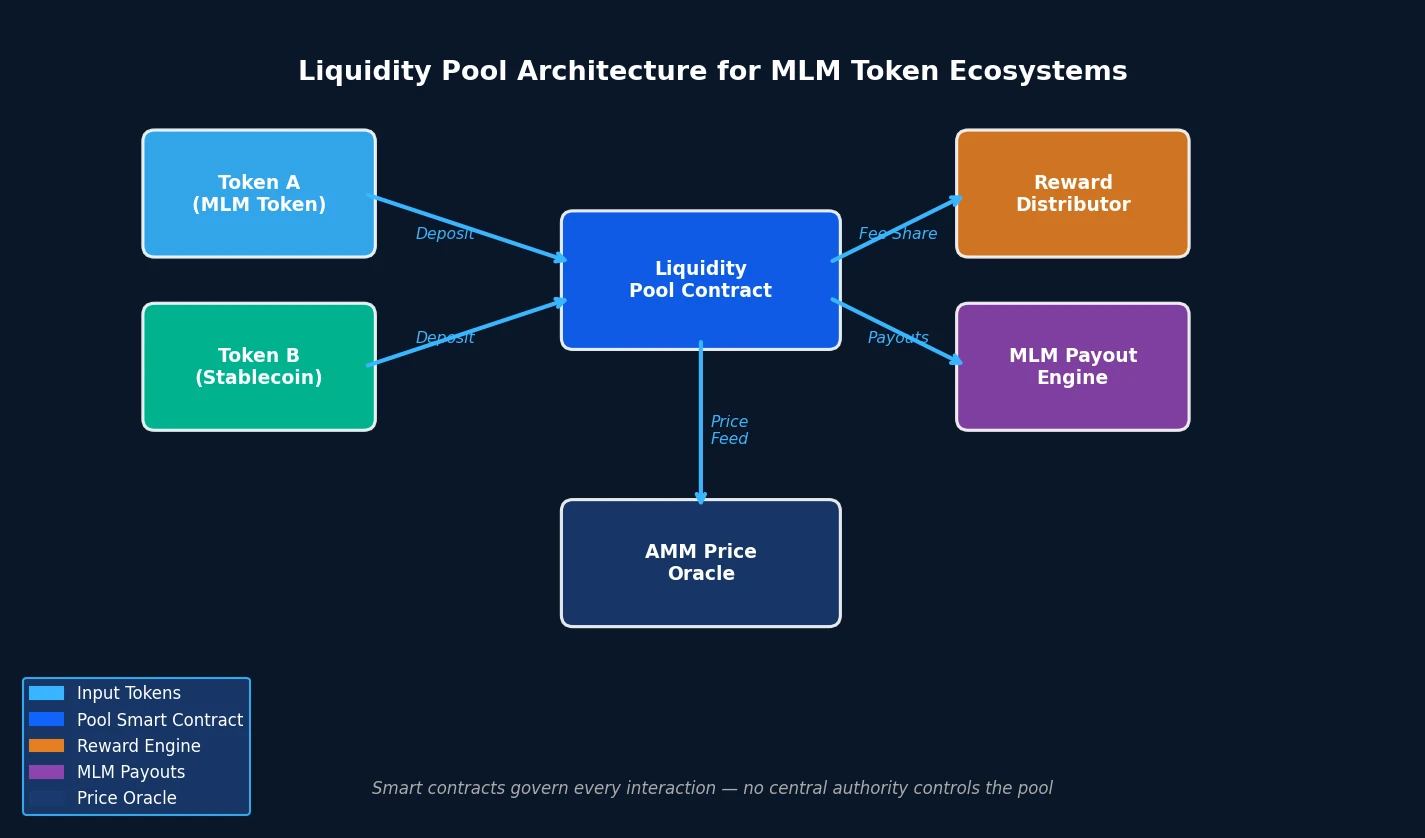
A liquidity pool is a smart contract that holds two tokens in a fixed reserve ratio. When someone wants to swap Token A for Token B, they interact with the pool rather than finding another trader on the other side of the deal. The pool itself handles the exchange, adjusting the price based on how much of each token remains in reserve.
This is a fundamentally different model from traditional order book exchanges. In an order book system, you need a buyer and a seller to be present at the same time for a trade to complete. In a liquidity pool, the reserves provide constant availability. The trade happens any time, at any block, without waiting.
How Automated Market Makers Work
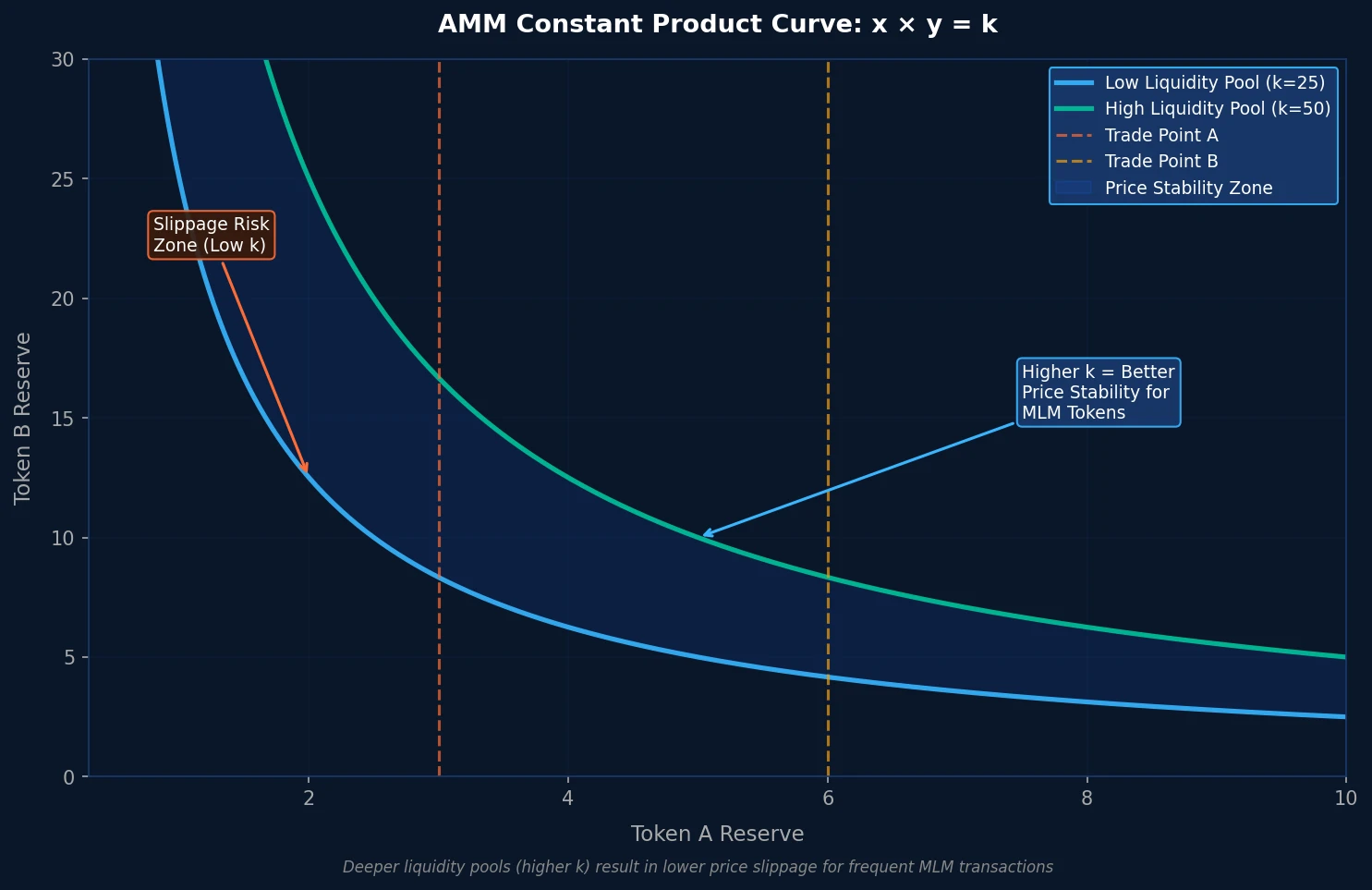
The pricing logic in most liquidity pools is governed by an Automated Market Maker (AMM). The most widely used formula is the constant product model, expressed as x × y = k, where x and y are the token reserves and k is a constant value. When a trader takes Token A out of the pool, Token B goes in, and the price adjusts to keep k constant.
The deeper the pool (that is, the higher the value of k), the less price movement each individual trade causes. This is called slippage, and minimizing it is one of the central goals of good liquidity architecture. For MLM platforms, where hundreds or thousands of small transactions happen every hour, even small slippage on each trade adds up quickly.
Liquidity providers (LPs) deposit equal values of both tokens into the pool in exchange for LP tokens representing their share. They earn a percentage of every swap fee generated by the pool. This fee-sharing mechanism is what incentivizes people to deposit liquidity in the first place, and it is a core part of how sustainable pools are funded.
3. Why MLM Tokens Require a Specialized Liquidity Architecture
Most generic liquidity pool designs are built around low-to-medium transaction volumes with a relatively stable trading population. An MLM token ecosystem does not fit that profile. The combination of high frequency, continuous payouts, and an expanding user base creates a completely different set of pressures on any liquidity infrastructure.
High Transaction Frequency and Reward Payouts
In a typical MLM structure, commissions and bonuses are distributed across multiple levels with every qualifying purchase or referral. On a blockchain platform, each of those distribution events is a transaction. On a network with 50,000 active participants, you could be looking at tens of thousands of transactions per day, all of them moving tokens through the system. Each payout is a potential sell event. When too many participants convert rewards to stablecoins or native blockchain currency at once, the token price falls, which erodes the perceived value of the reward for everyone else.
This is why a well-structured blockchain-based MLM network needs a liquidity layer that can absorb regular sell pressure without a dramatic price impact. A standard Uniswap-style pool with a small reserve simply cannot handle this reliably.
Preventing Token Price Volatility
Token volatility in an MLM ecosystem is not just a financial problem. It is a trust problem. When people join a network because they believe the token has real value, a sharp drop in price can trigger panic exits, which causes more selling, which causes more price drops. The only way to break this cycle is to have enough depth in the liquidity pool that no single actor or group of actors can move the price significantly in one direction.
Specialized liquidity architecture for MLM platforms typically includes mechanisms like tiered withdrawal delays, reserve pool buffers, and dynamic fee structures that increase when sell pressure is abnormally high. These are not features you find in off-the-shelf DeFi templates.
4. Core Components of Liquidity Pool Architecture for MLM Platforms
Building a liquidity pool for an MLM token is not a copy-paste job from the nearest DeFi template. Each component needs to be designed with the specific behaviors of an MLM ecosystem in mind. Here is what the core architecture typically looks like, along with what each part is responsible for.
Smart Contracts for Pool Management
Every interaction with the liquidity pool, from depositing tokens to claiming fees to executing swaps, is governed by smart contracts. For MLM platforms, these contracts often need to be more complex than standard pool contracts because they must also interface with the compensation plan logic. A commission payout triggered by a referral event, for example, may need to pull tokens from a specific pool reserve rather than the open market.
The contracts must also enforce rules around withdrawal timings, minimum liquidity ratios, and emergency pause mechanisms. If you are evaluating cryptocurrency MLM software solutions for your platform, verifying whether the liquidity module includes these controls is one of the most important questions to ask.
Token Pair Selection and Reserve Balancing
Not every token pair is a good choice for an MLM liquidity pool. Pairing the MLM token against a volatile asset means the pool itself is unstable. Pairing against a stablecoin like USDT or USDC gives more predictable price dynamics. Some platforms use a dual-pool structure, with one MLM/stablecoin pool for everyday transactions and a separate MLM/ETH or MLM/BNB pool for broader DeFi integration.
Reserve balancing matters too. If one side of the pool becomes significantly heavier than the other due to consistent one-directional trading, the implied price deviates from market fair value. Rebalancing mechanisms, either through arbitrage incentives or automated injection from treasury reserves, are needed to keep the pool healthy.
Liquidity Provider Incentives
No pool survives without liquidity providers willing to lock up capital. For MLM platforms, provider incentives typically go beyond simple swap fees. They often include bonus token distributions, tiered staking rewards, and governance rights. The goal is to attract long-term LPs who will not pull out during minor market fluctuations.
| Component | Role in MLM Pool | Key Feature Required | Risk if Absent |
|---|---|---|---|
| Pool Smart Contract | Governs all deposits, swaps, and withdrawals | Emergency pause, reentrancy guards | Exploitable, uncontrolled fund flow |
| AMM Pricing Engine | Sets token exchange rates based on reserves | Low slippage tolerance at high volume | Price manipulation, unfair payouts |
| Reserve Balancer | Maintains healthy token pair ratios | Automated rebalancing triggers | Pool imbalance, rising slippage |
| LP Incentive Module | Rewards liquidity providers with fees and tokens | Tiered staking, bonus programs | Shallow pool, high volatility |
| Price Oracle | Feeds real-time price data to contracts | Tamper-resistant, multi-source feeds | Flash loan attacks, manipulated payouts |
| Treasury Integration | Injects liquidity during low-reserve events | Programmable treasury drawdown limits | Liquidity crises during mass withdrawals |
5. Integrating Liquidity Pools with MLM Compensation Plans
This is where things get interesting, and where many projects make serious mistakes. A compensation plan defines how tokens flow through the network. A liquidity pool defines how those tokens can be traded and valued. When these two systems are not designed to work together, the result is usually runaway inflation or sudden token collapse.
Direct Commissions and Liquidity Flow
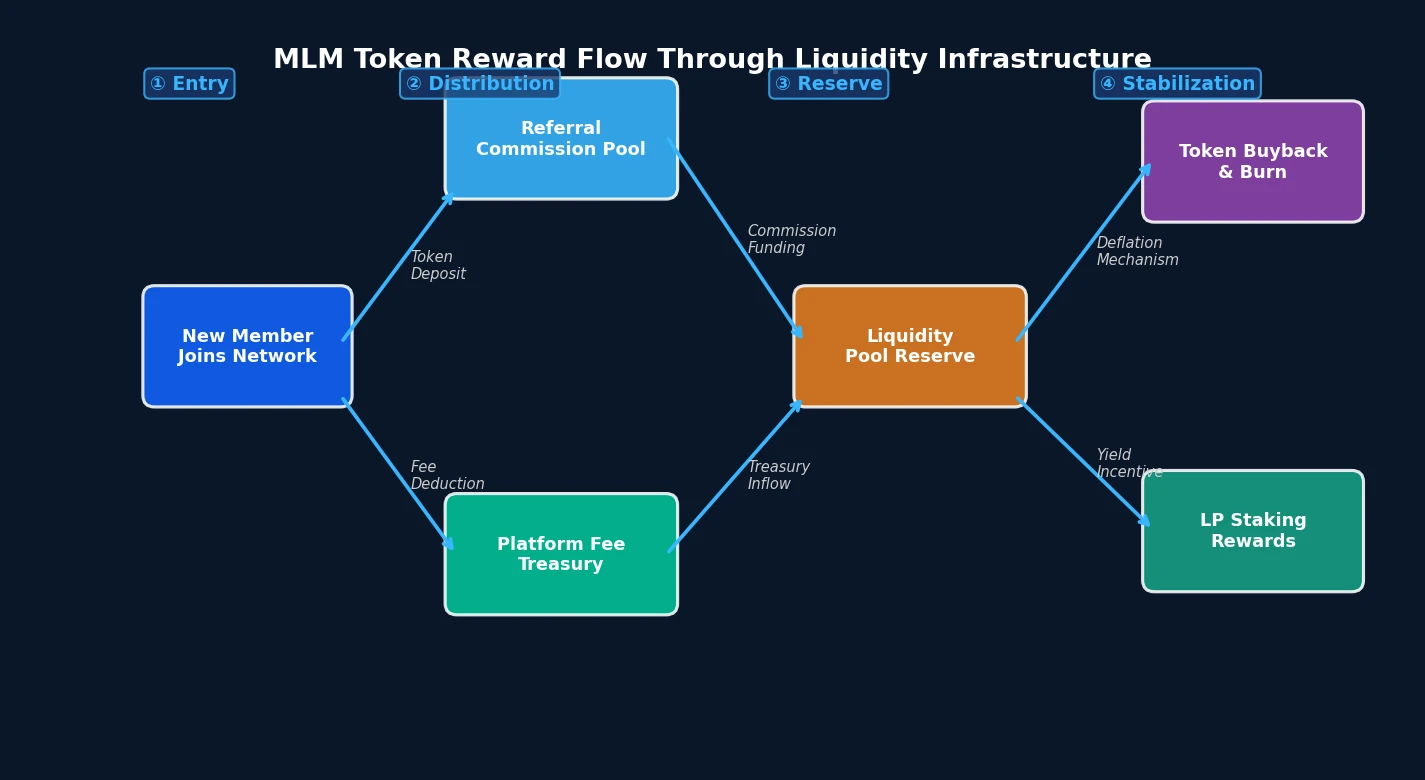
Every time a commission is paid out on a blockchain MLM platform, tokens move from a holding or staking contract into a member’s wallet. From there, the member has several options: hold, spend within the platform, or sell. If the majority of participants choose to sell, and the liquidity pool is not deep enough to absorb that pressure, the price drops for everyone.
One approach that works well is routing a portion of each commission through a time-release vesting contract. Instead of the full reward being immediately liquid, 40-50% vests over 30 to 90 days. This spreads the sell pressure across time rather than concentrating it in a single block period. To understand how trustless MLM payout systems manage token flows on-chain, vesting mechanics are one of the most important architectural details.
Token Buyback and Burn Mechanisms
A buyback-and-burn program is one of the most effective tools for managing long-term token supply. The platform allocates a fixed percentage of revenue, usually 5 to 15%, to buy tokens from the open market and permanently remove them from circulation. This reduces total supply over time, which supports price appreciation as the network grows.
For this to work, the buyback contract needs direct integration with the liquidity pool. When the contract executes a buyback, it needs to interact with the pool in a way that does not itself cause a price spike or front-running opportunity. Phased buybacks executed in small increments across multiple blocks, rather than single large transactions, are the standard approach for handling this.
Pool Funding Through Platform Fees
Every major action on the platform, such as registrations, upgrades, purchases, and withdrawals, can carry a small fee that flows into the liquidity pool treasury. Even a 1-2% fee on platform transactions creates a meaningful inflow that keeps the pool growing with the user base. This is self-reinforcing: more users create more fee revenue, which deepens the pool, which reduces volatility, which builds confidence for new users.
Design a Liquidity Pool Built for Your MLM Network
With over 8 years of hands-on experience, our team builds custom cryptocurrency MLM software solutions that include pool architecture, smart contract auditing, and compensation plan integration from the ground up.
6. Security and Transparency in Liquidity Pool Design
Security in a liquidity pool is not just about protecting funds. It is about protecting the trust that underpins the entire MLM network. One exploit or rug pull can destroy years of community building in hours. The architecture decisions you make here are not optional extras; they are foundational requirements.
Smart Contract Audits
Before any liquidity pool goes live on a production network, its smart contracts should be reviewed by at least two independent security firms. An audit checks for common vulnerabilities like reentrancy attacks, integer overflow, flash loan exploits, and oracle manipulation. The audit report should be publicly published so that participants and potential LPs can review it themselves.
Post-deployment, the contracts should include on-chain governance mechanisms that allow for non-emergency upgrades through multi-signature or DAO voting processes. Emergency pause functions, controlled by a multi-sig wallet held by different keyholders, provide a circuit breaker in case an exploit is detected mid-attack. The role of distributed ledger technology in giving MLM platforms verifiable on-chain transparency cannot be overstated when it comes to user confidence.
Preventing Rug Pulls and Manipulation
Rug pulls happen when the team behind a project drains the liquidity pool and disappears. The standard protection against this is a locked liquidity mechanism, where LP tokens are held in a time-locked contract for a defined period, often 12 to 24 months. This prevents anyone, including the founding team, from pulling liquidity out during that period.
On-chain transparency also means publishing the wallet addresses of all treasury and reserve accounts, so any participant can track fund movements using a blockchain explorer. Platforms that resist this kind of transparency are almost always hiding something worth knowing.
Timelocks, Multi-Sig, and Circuit Breakers
Timelocks enforce a mandatory delay, typically 24 to 72 hours, between when a governance change is proposed and when it takes effect. This gives the community time to react if a malicious proposal is submitted. Multi-signature wallets require multiple independent approvals before any funds can move from sensitive addresses. Circuit breakers automatically halt trading or withdrawals if price movements exceed a defined threshold within a short time window. Together, these three mechanisms form the minimum security baseline for a serious MLM liquidity pool.
7. Strategies to Maintain Long-Term Liquidity
Getting a liquidity pool launched is step one. Keeping it healthy over 12, 24, and 36 months is the real test. Many projects front-load their liquidity and then see gradual LP withdrawal as initial incentive periods end. Here are the strategies that work for sustained liquidity depth.
Staking and Yield Farming Incentives
Yield farming rewards participants for providing liquidity by offering additional token rewards on top of standard swap fees. In an MLM context, this can be structured so that network members who are also liquidity providers earn both trading fee income and enhanced referral bonuses. This alignment of incentives gives active participants a strong reason to keep their capital in the pool rather than withdrawing it to chase other opportunities.
Staking programs with lock-up periods of 30, 90, or 180 days offer progressively higher yields in exchange for longer commitment. This creates a predictable baseline of locked liquidity that does not evaporate with market sentiment shifts.
Treasury-Backed Liquidity Pools
A platform treasury that maintains a reserve of stablecoins and native tokens can act as a liquidity backstop. When market conditions cause LPs to withdraw, the treasury can inject capital to maintain minimum pool depth. The treasury is funded through ongoing platform fee allocations, typically in the range of 10 to 20% of all platform revenue.
The key discipline here is defining strict rules for when and how the treasury can intervene. Uncontrolled treasury spending erodes the reserve over time. A well-designed treasury governance contract specifies maximum drawdown percentages, cooldown periods between interventions, and mandatory replenishment timelines.
Automated Liquidity Injection Models
Some platforms build automated liquidity injection directly into the transaction lifecycle. A fixed percentage of every on-platform transaction, not just a periodic treasury action, is automatically routed to the liquidity pool. This creates a constant inflow that scales with platform activity. The more the network grows, the deeper the pool becomes without requiring any manual action from the team.
This model, sometimes called auto-liquidity, was popularized in DeFi token designs and has been adapted effectively for MLM token ecosystems by teams building with composable smart contract frameworks.
| Strategy | Liquidity Impact | Risk Level | Best For | Implementation Complexity |
|---|---|---|---|---|
| Staking Incentives | High long-term depth | Medium | Established networks | Moderate |
| Yield Farming | Very high short-term | High | Launch phase | High |
| Treasury Backing | Stable floor depth | Low | All stages | High |
| Auto-Liquidity | Grows with platform | Low | Active platforms | Moderate |
| Buyback and Burn | Stabilizes price floor | Medium | Revenue-positive platforms | Moderate |
8. Challenges in Building Liquidity Pools for MLM Token Ecosystems
Building this type of infrastructure is genuinely difficult. The challenges are not just technical; they are economic, legal, and organizational. Teams that underestimate these hurdles often build systems that work perfectly in test conditions and fail spectacularly at scale.
Managing Token Inflation
MLM platforms are reward-heavy by design. Every referral, every sale, and every rank advancement generates token payouts. Without a deflationary mechanism to offset this, the token supply grows faster than the user base, and the token price declines. The challenge is calibrating the emission rate carefully enough that rewards feel meaningful but do not flood the market faster than demand can absorb them.
There is no universal formula for this. It depends on the platform’s growth rate, the conversion rate from earning to selling, and the depth of available liquidity. Our team has run simulations on dozens of emission schedules across different MLM models, and the consistent finding is that platforms that launch with overly generous initial rewards almost always face an inflation crisis within the first 18 months. The reward structure needs to be conservative early and scale up as liquidity depth grows.
Handling Large Withdrawal Events
Even with a treasury backstop, a large coordinated withdrawal can strain a pool significantly. This most often happens when a major influencer or leader within the network announces they are leaving, triggering panic selling from their downline. Liquidity pool architecture needs to account for these scenarios with tiered exit fees that increase as a percentage of total pool reserves is withdrawn within a short period, effectively discouraging large rapid exits.
Regulatory and Compliance Considerations
MLM platforms that issue tradeable tokens are operating in a space that regulators are watching closely. Depending on jurisdiction, these tokens could be classified as securities, which triggers very specific disclosure and registration requirements. The liquidity pool itself may also be subject to anti-money laundering (AML) regulations, particularly if it facilitates conversion between the MLM token and stablecoins or fiat-backed assets. Understanding how regulatory clarity is affecting blockchain MLM adoption globally is a prerequisite for any serious platform launch.
| Challenge | Root Cause | Recommended Solution | Implementation Notes |
|---|---|---|---|
| Token Inflation | High reward emission rate | Vesting schedule + buyback-burn | Cap initial emissions at 3-5% monthly supply growth |
| Large Withdrawal Events | Panic or coordinated exit | Tiered exit fees + treasury injection | Trigger escalating fees if >5% pool withdrawn per hour |
| Price Manipulation | Shallow pool, flash loans | TWAP oracle + flash loan guard | Require 5-block price average for on-chain decisions |
| Smart Contract Exploit | Unaudited code, logic gaps | Dual audit + bug bounty program | Minimum $50K bug bounty, 2 audit firms required |
| Regulatory Action | Token classified as security | Legal structure review pre-launch | KYC/AML layer on withdrawal above threshold |
Lifecycle of an MLM Liquidity Pool: From Launch to Maturity
Understanding how a liquidity pool evolves over time helps platform builders make better decisions at each stage. Here is a realistic view of the four phases every MLM liquidity pool goes through.
Team and early investors provide initial pool depth. High yield farming incentives attract external LPs. Goal is reaching a safe minimum liquidity threshold.
Platform fees begin flowing into the pool. Auto-liquidity injections activate. Network members start participating as LPs for bonus rewards.
Pool depth is self-sustaining. Buyback-burn cycles are running. Treasury has a meaningful reserve. Slippage is low even for large transactions.
Liquidity bridges to other chains. Integration with broader DeFi ecosystems. AI-powered management keeps reserve ratios optimal across multiple networks.
9. Future Trends in MLM Token Liquidity Models
The liquidity infrastructure that most MLM platforms are running today will look outdated within three years. The pace of innovation in DeFi and cross-chain technology is moving faster than most MLM builders realize, and the platforms that are designing their architecture with these trends in mind will have a significant competitive advantage.
Cross-Chain Liquidity Solutions
Today, most MLM tokens are confined to a single blockchain, typically Ethereum, BNB Smart Chain, or Polygon. This limits the addressable market to that chain’s user base. Cross-chain bridges and omnichain token standards are now mature enough to deploy in production, which means an MLM token could maintain liquidity pools simultaneously on three or four chains, each serving a different regional user base.
For a platform with participants in Southeast Asia, Latin America, and Europe, this makes a real practical difference. Users in regions where one chain has significantly lower fees or better infrastructure can participate on their preferred network while still interacting with the same token ecosystem. Given how rapidly Web3 is disrupting traditional network marketing models, cross-chain capability is no longer a luxury feature.
AI-Driven Liquidity Management
Automated systems that monitor pool health, predict withdrawal patterns, and dynamically adjust fee structures are moving from research papers into production deployments. AI-driven liquidity managers can analyze network activity in real time, detect unusual patterns that may signal a coordinated exit, and trigger defensive mechanisms before damage occurs.
For MLM platforms specifically, AI can also optimize the allocation between pool depth and treasury reserves based on network growth rate, historical payout patterns, and external market conditions. This reduces the need for manual treasury governance interventions, which are often slow and sometimes politically fraught within DAOs.
Integration with Broader DeFi Ecosystems
As MLM tokens mature, the most sophisticated platforms will integrate their liquidity pools with wider DeFi protocols. Treasury reserves can earn yield through money markets. LP positions can serve as collateral for decentralized lending. Pool tokens can be used within governance frameworks that span multiple protocols.
This kind of composability, where the MLM token infrastructure plugs into the broader DeFi financial system rather than existing as an island, is the path to genuine long-term liquidity sustainability. It is also how MLM token ecosystems gain credibility with the broader crypto community.
10. Conclusion
Liquidity pool architecture is not a feature you add to an MLM token ecosystem. It is the foundation the entire token economy stands on. Without sufficient liquidity depth, reward tokens lose their value too quickly to motivate participants. Without proper security architecture, the pool becomes a target. Without long-term incentive structures, liquidity providers leave and the pool dries up.
Getting this right requires understanding the specific behaviors of an MLM network, which are very different from the trading-focused user bases that most DeFi tools are designed for. It requires compensation plan integration, tiered security mechanisms, treasury governance, and a clear roadmap from launch through cross-chain maturity.
The platforms that invest in serious liquidity architecture from day one are the ones that sustain growth beyond the initial excitement phase. They create token ecosystems that genuinely reward participants, attract serious liquidity providers, and maintain credibility with both regulators and the broader crypto community.
If you are building, or planning to build, a blockchain-based MLM platform and want to make sure the token liquidity infrastructure is designed correctly from the start, the decisions you make in the first few months will determine the ceiling of what your platform can become.
Frequently Asked Questions
Q1.What is a liquidity pool in the context of a crypto MLM platform?
Q2.How does token inflation affect MLM liquidity pools?
Q3.What is an Automated Market Maker and why does it matter for MLM tokens?
Q4.How can MLM platforms prevent rug pulls from their liquidity pools?
Q5.What percentage of platform revenue should go into the liquidity treasury?
Q6.Can an MLM token liquidity pool be integrated with external DeFi protocols?
Explore Services
Related Services
Reviewed by

Aman Vaths
Founder of Nadcab Labs
Aman Vaths is the Founder & CTO of Nadcab Labs, a global digital engineering company delivering enterprise-grade solutions across AI, Web3, Blockchain, Big Data, Cloud, Cybersecurity, and Modern Application Development. With deep technical leadership and product innovation experience, Aman has positioned Nadcab Labs as one of the most advanced engineering companies driving the next era of intelligent, secure, and scalable software systems. Under his leadership, Nadcab Labs has built 2,000+ global projects across sectors including fintech, banking, healthcare, real estate, logistics, gaming, manufacturing, and next-generation DePIN networks. Aman’s strength lies in architecting high-performance systems, end-to-end platform engineering, and designing enterprise solutions that operate at global scale.