Ai Overview
Before talking about the solution, it helps to understand the problem. In a mid-sized mlm marketing network with 10,000 active distributors, a single product sale can generate 6 to 12 on-chain transactions depending on how the compensation structure is coded. Scale that to 500 sales per day and you are looking at 3,000 to 6,000 blockchain transactions daily, all competing for the same block space. The cost of minting 1,000 reward tokens on Layer 2 is comparable to minting one token on Layer 1.
Key Takeaways
- Layer 2 solutions process MLM transactions off-chain and batch them before settling on Layer 1, which cuts costs by up to 99% and reduces confirmation times from seconds to milliseconds.
- High-volume multi level marketing platforms that pay out thousands of commissions daily are the biggest beneficiaries of Layer 2 adoption, as Layer 1 alone is simply too slow and expensive for that volume.
- ZK-Rollups provide the strongest cryptographic security among all Layer 2 options and are increasingly the preferred choice for serious crypto MLM company deployments.
- State channels are the most practical Layer 2 option for real-time, bilateral commission payments between MLM users who transact frequently with each other.
- Smart contract automation on Layer 2 removes manual steps from the payout cycle, which reduces human error and builds trust among distributors in any network marketing company.
- The global Layer 2 ecosystem is maturing fast; adoption for MLM and DeFi platforms is accelerating, with major networks like Polygon, Arbitrum, and zkSync already processing billions in monthly volume.
If you run or build on a blockchain-based multi level marketing platform, you have already felt the pain. A distributor earns a commission. The smart contract fires. Then comes the wait, the gas fee notification, and sometimes the failed transaction during network congestion. For small networks, this is an inconvenience. For a multi level marketing company processing thousands of payouts a day, it is a serious operational problem.
At our firm, we have spent over eight years building cryptocurrency MLM software for network marketing companies across four continents. We have watched Layer 1 blockchains hit their ceiling repeatedly during peak MLM growth periods. We have also watched Layer 2 solutions change that story completely.
This article walks through what Layer 2 scaling actually is, how it works for MLM transaction systems specifically, which solution types fit which MLM structures, and what the trade-offs look like in the real world. No fluff, no jargon walls. Just a clear picture of the technology and why it matters for your network marketing company.
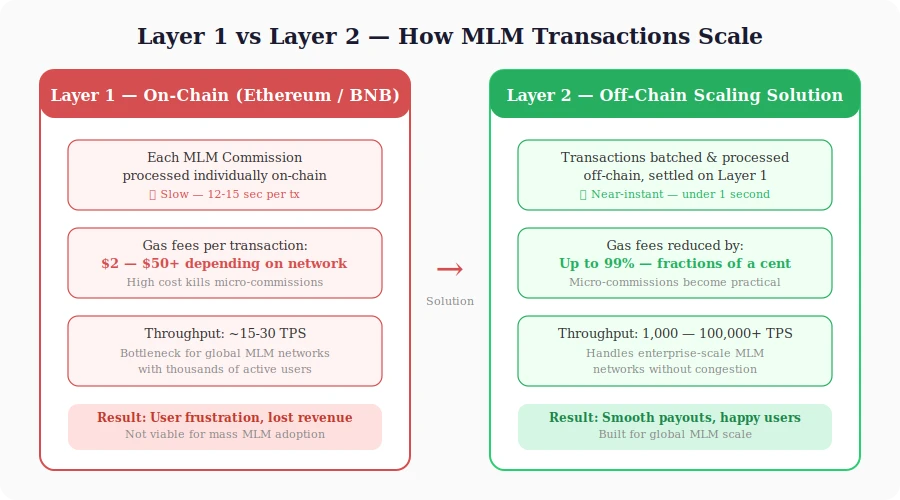
Layer 1 vs Layer 2: How the two layers handle MLM transaction volume differently
Understanding High-Volume MLM Transactions
Before talking about the solution, it helps to understand the problem. A typical multi level marketing compensation plan does not just move money from one wallet to another. Each sale or referral triggers a cascade of micro-transactions: direct commissions to the referring distributor, level bonuses to upline members across multiple tiers, matching bonuses, pool allocations, rank advancement checks, and sometimes token rewards on top of standard payouts.
In a mid-sized mlm marketing network with 10,000 active distributors, a single product sale can generate 6 to 12 on-chain transactions depending on how the compensation structure is coded. Scale that to 500 sales per day and you are looking at 3,000 to 6,000 blockchain transactions daily, all competing for the same block space.
On Ethereum’s mainnet, each transaction costs gas. During peak hours in 2021 and 2023, gas fees regularly spiked above $20 per transaction. A $5 referral commission that costs $15 to send is not a product anyone wants. Even on faster Layer 1 chains like BNB Smart Chain or Solana, the combination of speed limits and fee variability creates friction at MLM scale. For more on how these chains compare, read our guide on Ethereum vs BNB vs Solana for MLM blockchain.
The core issue is that Layer 1 blockchains were designed for security and decentralization first. Throughput comes third. That design works for store-of-value use cases. It does not work for an application that needs to move micro-commissions to hundreds of wallets per minute. This is where Layer 2 comes in.
What Are Layer 2 Scaling Solutions?
According to Wikipedia’s overview of blockchain scaling, a Layer 2 solution is a secondary framework or protocol built on top of an existing blockchain (Layer 1) to improve transaction throughput and reduce fees, while still inheriting the security of the underlying chain.
In plain terms: Layer 2 does the heavy lifting off-chain, then sends a compressed proof or final state back to Layer 1 for permanent record-keeping. The base chain does not process every individual transaction. It only sees the final summary, which takes far less space and costs far less gas.
Think of it like a bar tab. Instead of swiping your card for every drink (Layer 1), you run a tab all night and settle the one final bill at the end (Layer 2). The bank still records the transaction. You just avoided a dozen individual authorization fees.
For an mlm company paying commissions at scale, this model is transformative. Hundreds of individual payouts get batched into a single on-chain settlement. Fees drop. Speed increases. The user experience improves dramatically. And the underlying blockchain still provides the security and immutability that makes the whole system trustworthy.
Types of Layer 2 Solutions for MLM Platforms
Not every Layer 2 solution works the same way, and not every type is the right fit for every MLM structure. Here is a breakdown of the four main categories, with practical MLM relevance for each.
State Channels
State channels let two parties open a private payment tunnel between their wallets. They can transact back and forth as many times as they want, instantly and for free, and then close the channel to record the final balance on-chain. For an MLM network where a top distributor pays ongoing micro-bonuses to a fixed group of downline members, state channels make a lot of sense. The channel stays open, transactions happen in real-time, and the blockchain only gets involved at the start and end.
Sidechains
A sidechain is a separate blockchain that runs parallel to the main chain, connected by a bridge. It has its own consensus rules, which can be optimized for speed and low fees. Polygon PoS is the most well-known example. For an mlm marketing platform that wants full application deployment without building its own chain from scratch, a sidechain offers a practical middle ground. The trade-off is that the sidechain’s security is not directly backed by Layer 1. It depends on its own validator set, which requires trust in those validators.
Rollups: Optimistic and ZK
Rollups are currently the most popular and most technically robust Layer 2 category. They bundle hundreds of transactions into a single batch and post that batch to Layer 1 with a proof of validity. Optimistic Rollups assume transactions are valid and allow a challenge period (usually 7 days) during which fraud proofs can be submitted. ZK-Rollups (Zero-Knowledge Rollups) generate a cryptographic proof that the transactions are valid before posting, so there is no challenge period. For commission-intensive blockchain MLM networks, ZK-Rollups offer the best combination of speed and security. Arbitrum (Optimistic) and zkSync (ZK) are two live examples of this category in production.
Plasma
Plasma creates a tree of child chains, each capable of processing its own transactions. These child chains periodically commit their state to the main chain. For hierarchical MLM structures with multiple regional sub-networks, Plasma is conceptually aligned with the network topology. However, Plasma has largely been superseded by rollups in most new deployments because the exit mechanism can be complex for end users.
| Layer 2 Type | Speed | Cost Reduction | Security Level | Best MLM Use Case |
|---|---|---|---|---|
| State Channels | Instant | ~100% | High (on-chain open/close) | Recurring micro-commissions |
| Sidechains | Very Fast | 90-98% | Medium (own validators) | Full MLM platform deployment |
| Optimistic Rollups | Fast (7-day finality) | Up to 100x cheaper | High (fraud proofs) | Daily batch payouts |
| ZK-Rollups | Fast (near-instant finality) | Up to 100x cheaper | Highest (ZK proofs) | High-security commission flows |
| Plasma | Fast | High | Medium-High | Multi-regional MLM sub-networks |
Benefits of Layer 2 in MLM Systems
The benefits are not theoretical. Networks that have migrated commission systems to Layer 2 report measurable improvements across every key metric. Here is what those improvements actually look like in practice for any network marketing company.
Faster Transaction Processing
Layer 1 Ethereum processes roughly 15 to 30 transactions per second. ZK-Rollup networks like zkSync Era have demonstrated throughput exceeding 2,000 TPS in production and have a theoretical ceiling well above that. For an mlm company with a large global distributor base, this difference is not just a performance stat. It is the difference between distributors seeing their earnings within seconds versus waiting minutes or hours during congestion.
Dramatically Reduced Transaction Fees
According to data from L2Fees.info, which tracks real-time Layer 2 costs, sending a token transfer on Arbitrum or zkSync typically costs under $0.02 compared to $1 to $20+ on Ethereum mainnet. For an mlm marketing platform distributing commissions to 500 wallets daily, even a $1 per-transaction saving adds up to $500 per day, $180,000 per year, directly back into the business or back to distributors.
Better Handling of Micro-Transactions
Many MLM compensation plans include small bonus amounts, sometimes as low as a few cents per referral click or team volume point. On Layer 1, these micro-transactions are economically impossible to send. The gas fee costs more than the payment itself. Layer 2 makes them viable again. This opens up new compensation structures that simply could not exist on-chain before, including real-time volume-based micro-rewards and point accumulation systems.
Enhanced Scalability for Global Networks
When an mlm company goes from 1,000 to 100,000 distributors, the transaction volume does not scale linearly. It scales exponentially as more nodes interact. Layer 2 architectures are designed to absorb this growth without degrading performance. A well-architected Layer 2 system can onboard an order of magnitude more users without the existing user base noticing any slowdown.
| Metric | Layer 1 Only | With Layer 2 | Improvement |
|---|---|---|---|
| Confirmation Time | 12-60 seconds | < 1 second | 60x faster |
| Average Fee (ETH network) | $1 – $25+ | $0.01 – $0.05 | 99%+ reduction |
| Transactions per Second | 15-30 TPS | 2,000 – 100,000+ TPS | 100x to 3,000x |
| Micro-payment Viability | Not viable (<$1) | Fully viable | New use cases unlocked |
| Global Scale Capacity | Limited (congestion) | Enterprise-grade | Unlimited horizontal scale |
Use Cases in Crypto MLM Platforms
Theoretical benefits only matter if they translate to real workflows. Here are four concrete use cases where Layer 2 changes the game for production-level MLM systems.
Real-Time Commission Distribution
Traditional crypto MLM platforms often run commission distribution as a batch job, daily or weekly, to keep Layer 1 gas costs manageable. With Layer 2, real-time distribution becomes practical. The moment a sale is recorded, the compensation engine fires, Layer 2 processes the payout cascade instantly, and every eligible distributor sees their earnings update within a second. This shift from delayed to real-time payouts has a measurable effect on distributor motivation and retention.
Automated Smart Contract Payouts
Smart contracts on Layer 2 can encode the entire compensation plan, from binary matching bonuses to unilevel depth payouts. The contract executes automatically when conditions are met, with no manual processing required. This removes the administrator from the payout loop, which is exactly what builds trust in an mlm company. Distributors know their money moves on code, not on someone clicking a button. Learn more about how blockchain smart contracts are reshaping the regulatory landscape in our article on blockchain MLM regulation.
Token-Based Reward Systems
Many modern network marketing companies issue proprietary tokens as part of their compensation and incentive structure. These tokens need to be minted, distributed, and traded, all of which generate significant transaction volume. Layer 2 makes token economies sustainable. The cost of minting 1,000 reward tokens on Layer 2 is comparable to minting one token on Layer 1. This gives mlm marketing platforms the freedom to design generous token reward structures without worrying about whether the gas economics make them viable.
Cross-Border Payments
A multi level marketing company by nature is global. A distributor in Nigeria, their upline in Malaysia, and their regional manager in Brazil may all receive commissions from the same transaction. On traditional financial rails, cross-border payments take days and cost significant fees. On Layer 2, a wallet in any country receives the same near-instant, near-free transfer as a wallet next door. According to the World Bank’s remittance data, global remittance costs average around 6.2%. Layer 2 brings this cost below 0.01% for token transfers, which is a transformative improvement for multi level marketing companies with international distributor bases.
Security Considerations in Layer 2 MLM Systems
The first question any serious operator asks about off-chain processing is: what happens if something goes wrong? It is a fair question. The answer is that Layer 2 security is well-thought-out, but it varies by solution type and requires active management.
Fraud Prevention and Validation
Optimistic Rollups include a challenge period during which anyone can submit a fraud proof if they detect an invalid transaction in a batch. ZK-Rollups do not require this waiting period because the cryptographic proof is verified before settlement. For an mlm company that needs fast finality, ZK-Rollups are the stronger option. The system guarantees that no invalid commission can be posted to Layer 1 without the math being right.
Smart Contract Audits on Layer 2
Layer 2 smart contracts carry the same risks as any smart contract: bugs, logic errors, and reentrancy vulnerabilities. The difference is that bugs on Layer 2 can potentially be exploited at much higher speed due to the throughput advantage. Any mlm company deploying smart contracts on Layer 2 must commission a professional audit from a firm like CertiK or OpenZeppelin before going live. This is not optional, and the cost is trivial relative to the assets at risk.
Data Availability and Auditability
For regulatory compliance, particularly in markets covered by our overview on blockchain MLM regulation, maintaining a full audit trail is important. Most reputable Layer 2 solutions post full transaction data to Layer 1 (or to a data availability layer), meaning the history is permanent and auditable. This is important for multi level marketing companies that need to demonstrate transparent commission calculations to regulators or to their own distributors.
Challenges and Limitations
Honest evaluation means covering the limitations too. Layer 2 is not a magic fix that you add to an existing system with no trade-offs.
Integration Complexity
Migrating an existing MLM smart contract system from Layer 1 to Layer 2 is not trivial. Contract logic may need to be rewritten to be compatible with the specific Layer 2’s EVM implementation. Wallets need to be bridged. The UI/UX needs to surface Layer 2 addresses properly. Most Layer 2 networks are EVM-compatible, which helps, but the bridging and migration process still requires careful engineering.
Dependency on Layer 1 Security
Layer 2 inherits Layer 1’s security, which sounds like an advantage, and it is, but it also means Layer 2 is dependent on Layer 1 remaining healthy. If Ethereum mainnet experienced a catastrophic issue, every rollup built on it would be affected. For sidechains, the dependency is on the sidechain’s own validators, which is a different but real risk. No distributed system is risk-free, and operators should have contingency plans.
Liquidity Fragmentation
When MLM tokens exist on multiple Layer 2 networks, liquidity is split. A user on Arbitrum cannot directly interact with an asset on zkSync without a bridge. For network marketing companies that want to maintain a single liquid token market, this fragmentation can create friction. The solution is to pick one or two Layer 2 networks for primary operations and use cross-chain bridges thoughtfully. The bridging infrastructure is maturing quickly, but it is still an area that requires monitoring.
User Adoption Barriers
Many MLM distributors are not crypto-native. Asking them to understand Layer 2 bridge transactions, gas on a different network, and wallet network switching is a recipe for support tickets. The platform UX must abstract all of this complexity away. From the distributor’s perspective, they should only ever see their earnings and a simple withdrawal button. The Layer 2 infrastructure should be entirely invisible to the end user.
The Future of Layer 2 in the MLM Ecosystem
The trajectory is clear. Layer 2 adoption is accelerating. According to data aggregated by L2Beat, the total value locked across all Layer 2 networks crossed $40 billion in 2024 and has continued growing. More importantly for MLM operators, the developer tooling, wallet support, and regulatory clarity around Layer 2 are all improving simultaneously.
AI and Automation on Layer 2
The next evolution is the combination of AI-driven compensation logic with Layer 2 execution speed. Imagine a smart contract that adjusts commission percentages in real time based on distributor performance metrics, market conditions, and network health, then executes those adjusted payouts instantly via Layer 2. This is not a distant concept. The infrastructure for it exists today. The challenge is in encoding business logic that was designed for human administrators into verifiable, auditable smart contract code.
Decentralized Data Management and IPFS Integration
As MLM networks grow, the data associated with distributor profiles, genealogy trees, transaction histories, and compliance records grows with them. Storing all of this on-chain is prohibitively expensive. The practical solution is to use decentralized storage like IPFS for off-chain data while using Layer 2 for the actual value transfers. Our detailed guide on IPFS decentralized storage for MLM data management covers how these two technologies work together to give MLM platforms both performance and data integrity.
Layer 3 and Application-Specific Chains
Beyond Layer 2, the concept of application-specific rollups (sometimes called Layer 3 or “app-chains”) is gaining traction. In this model, an mlm company could deploy its own dedicated rollup, customized entirely for its compensation logic, with its own gas token and its own governance. This is already possible today using frameworks like the OP Stack (used by Coinbase’s Base chain). For the largest multi level marketing companies, this level of customization could become the standard within the next three to five years.
Optimize Your MLM Platform with Layer 2 Technology
We have built high-volume crypto MLM systems for over 8 years. Let us help you implement Layer 2 scaling that cuts your transaction costs, speeds up commission payouts, and keeps your distributors happy.
Final Thoughts
Layer 1 blockchains gave crypto-based multi level marketing companies something valuable: transparent, trustless, immutable records of every commission and payout. But they also gave them slow speeds, unpredictable fees, and hard throughput limits that simply do not work at MLM scale.
Layer 2 fixes the operational problems without sacrificing the properties that make blockchain valuable in the first place. ZK-Rollups, Optimistic Rollups, State Channels, and Sidechains each serve a different slice of the MLM use-case spectrum. The right choice depends on your network’s transaction patterns, your user base’s technical sophistication, and your regulatory environment.
What is not debatable is that any serious network marketing company building on blockchain in the next five years will need a Layer 2 strategy. The platforms that adopt it now will have lower operating costs, faster distributor payouts, and a better user experience than those that delay. That combination, lower costs plus better experience, is a competitive advantage that compounds over time.
If you are evaluating Layer 2 options for your mlm company, the best starting point is a technical audit of your current transaction volume, your compensation plan’s complexity, and the Layer 2 ecosystems that align with your primary distributor geography. We have built this analysis process into our standard engagement model at our firm, and it consistently identifies which Layer 2 architecture delivers the best return for each specific use case.
Frequently Asked Questions
Q1.What is the difference between Layer 1 and Layer 2 in blockchain MLM?
Layer 1 is the base blockchain (like Ethereum or BNB Chain) where all transactions are recorded permanently. Layer 2 is a secondary framework that processes transactions off-chain in bulk and only sends the final summary to Layer 1. For an MLM platform, this means you get the security of the base chain plus dramatically lower fees and higher speed for commission payouts.
Q2.Which Layer 2 solution is best for a high-volume multi level marketing company?
For most high-volume MLM platforms, ZK-Rollups (such as zkSync Era or Polygon zkEVM) offer the best balance of speed, cost reduction, and security. If your compensation plan involves recurring micro-payments between specific wallet pairs, State Channels can also be very effective. The right answer depends on your specific commission structure and transaction patterns.
Q3.Is Layer 2 secure enough for handling real money in MLM commission payouts?
Yes, when implemented correctly. Rollup-based Layer 2 solutions inherit the security of their underlying Layer 1 blockchain. ZK-Rollups in particular use cryptographic zero-knowledge proofs to validate every batch before settlement, which means invalid transactions cannot be posted. Smart contract audits before deployment add an additional layer of protection specific to your MLM payout logic.
Q4.How much can a network marketing company save on transaction fees by using Layer 2?
Fee reductions of 95% to 99% are typical when moving from Ethereum mainnet to a Layer 2 rollup. A transaction that costs $5 on Layer 1 may cost $0.02 to $0.05 on Layer 2. For an MLM company processing 500 payouts per day, that difference can represent $150,000 to $200,000 in annual savings, money that can stay with distributors or reinvested in growth.
Q5.Do my distributors need to understand Layer 2 to use the platform?
No, and they should not have to. A well-built crypto MLM platform abstracts all Layer 2 complexity away from the end user. Distributors should only see their wallet balance, their earnings history, and a simple withdrawal button. The bridging, gas management, and network selection should all happen behind the scenes automatically.
Q6.Can an existing MLM blockchain platform migrate to Layer 2, or does it require rebuilding from scratch?
Migration is possible without a full rebuild for most EVM-compatible MLM platforms, since most Layer 2 networks (Arbitrum, Optimism, zkSync, Polygon) are EVM-compatible. This means existing Solidity smart contracts can be redeployed on Layer 2 with relatively minor modifications. The bigger effort is typically in wallet integration, UI changes, and ensuring proper data migration for existing distributor records and genealogy trees.
Explore Services
Related Services
Reviewed by

Aman Vaths
Founder of Nadcab Labs
Aman Vaths is the Founder & CTO of Nadcab Labs, a global digital engineering company delivering enterprise-grade solutions across AI, Web3, Blockchain, Big Data, Cloud, Cybersecurity, and Modern Application Development. With deep technical leadership and product innovation experience, Aman has positioned Nadcab Labs as one of the most advanced engineering companies driving the next era of intelligent, secure, and scalable software systems. Under his leadership, Nadcab Labs has built 2,000+ global projects across sectors including fintech, banking, healthcare, real estate, logistics, gaming, manufacturing, and next-generation DePIN networks. Aman’s strength lies in architecting high-performance systems, end-to-end platform engineering, and designing enterprise solutions that operate at global scale.