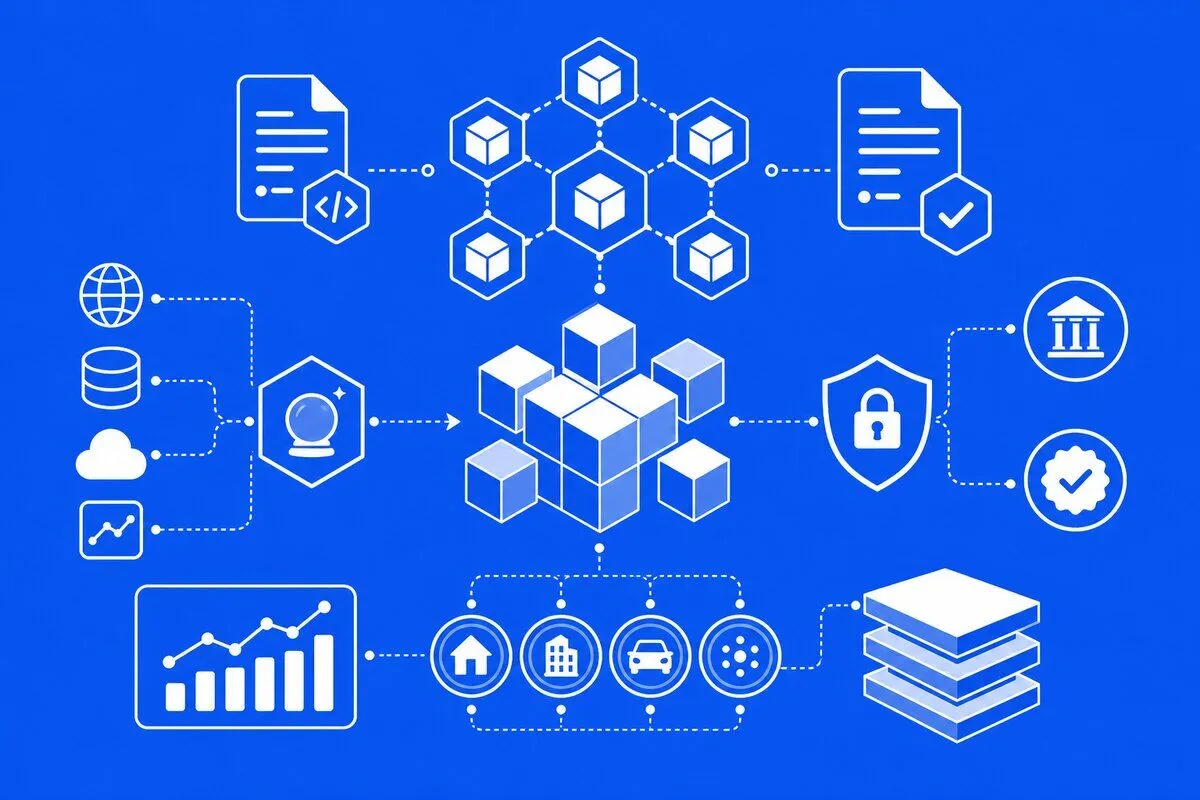
Ai Overview
At its most fundamental level, Generative AI Explained refers to a category of artificial intelligence systems that are designed to generate new content. Unlike traditional software that follows a fixed set of rules, generative AI produces outputs it was never explicitly programmed to create. It does this by identifying and reproducing patterns found in the data it was trained on.
Key Takeaways
- 01. Generative AI explained simply means AI that creates original content including text, images, audio, and code by learning patterns from large training datasets.
- 02. Understanding how does generative AI work requires knowing that it uses transformer architectures and neural networks trained on billions of data points to produce outputs.
- 03. AI vs Generative AI is a critical distinction: traditional AI classifies and predicts, while generative AI creates entirely new and contextually relevant content outputs.
- 04. Businesses in Dubai and India are actively adopting generative AI to streamline marketing, customer support, legal drafting, and financial analysis workflows at scale.
- 05. Core generative AI concepts like tokens, embeddings, prompts, and inference are foundational building blocks every business leader and practitioner should understand clearly.
- 06. Generative AI learns from data through a process called pre-training, followed by fine-tuning on domain-specific datasets to improve accuracy and relevance significantly.
- 07. How does generative AI work in real-life applications spans industries like healthcare, retail, education, and finance, automating creative and analytical tasks efficiently.
- 08. The UAE’s Vision 2031 and India’s Digital India initiatives are both major policy frameworks accelerating enterprise-level generative AI adoption across public and private sectors.
- 09. Responsible use of generative AI requires clear data governance, bias auditing, output validation, and human oversight to maintain trust and accuracy across all use cases.
- 10. Organizations with over eight years in the AI space consistently find that generative AI provides the highest ROI when integrated with existing workflows rather than deployed in isolation.
Over the past eight years, our team has witnessed artificial intelligence transition from a niche research subject into one of the most transformative forces reshaping global business. But nothing has accelerated this shift quite like the rise of Generative AI. From the boardrooms of Dubai’s financial districts to the startup hubs of Bengaluru and Mumbai, the conversation has moved from “what is this?” to “how do we implement it today?”
With this guide, we offer a thorough breakdown of Generative AI Explained in a way that is accessible, practical, and grounded in real-world application. Whether you are a business owner in the UAE exploring AI solutions, a product manager in India looking to understand how does generative AI work, or a technology leader seeking deeper clarity on generative AI concepts, this article is written for you.
We will cover the core mechanics, the learning processes, practical use cases, and the key distinctions between AI vs Generative AI. Let us start from the very beginning.
What Generative AI Explained Means in Simple Terms
At its most fundamental level, Generative AI Explained refers to a category of artificial intelligence systems that are designed to generate new content. Unlike traditional software that follows a fixed set of rules, generative AI produces outputs it was never explicitly programmed to create. It does this by identifying and reproducing patterns found in the data it was trained on.
Think of it this way: if you showed someone thousands of paintings, music tracks, and books, they would eventually begin to understand the structure, style, and patterns that make those works what they are. Generative AI does the same thing, but at a scale of billions of data points and with mathematical precision.
Text Generation
Articles, emails, code, summaries, legal content and more created on demand.
Image Creation
Original visuals, product mockups, and design assets generated from text prompts.
Audio and Music
Voiceovers, soundtracks, and music compositions tailored to brand or mood.
Code Writing
Functional software code, scripts, and API integrations built from natural language input.
In India, startups and enterprises alike are using generative AI explained to produce multilingual content, automate customer interactions in regional languages, and build sophisticated knowledge bases. In Dubai and across the UAE, generative AI explained is being used in fintech, real estate marketing, tourism, and government service delivery. The simplest takeaway is this: generative AI is a machine that creates.
Why Generative AI Works Differently from Normal AI
To truly grasp Generative AI Explained, you first need to understand what makes it distinct from conventional artificial intelligence. Traditional AI systems are built for tasks like image recognition, spam filtering, fraud detection, or product recommendations. These systems are discriminative: they analyse input and produce a label, classification, or prediction.
Generative AI, on the other hand, does not just classify. It creates. When you ask a generative AI tool to write a business proposal, it does not search a database. It generates each word based on what it has statistically learned about language, context, and meaning. This difference in function is what separates the two approaches at a fundamental architectural level.
AI vs Generative AI: A Clear Comparison
Traditional AI
- Classifies and predicts
- Works with structured data
- Outputs a label or score
- Rule-based or supervised
- Limited creative ability
Generative AI
- Creates new original content
- Works with unstructured data
- Outputs text, images, audio, code
- Self-supervised and adaptive
- Highly creative and versatile
This is why the AI vs Generative AI explained distinction matters so much in business strategy. Companies in Hyderabad, Pune, and Abu Dhabi that previously deployed AI for analytics are now layering generative AI on top to handle content creation, conversational interfaces, and decision support. The two types of AI complement each other rather than compete.
How Generative AI Works Step by Step
Understanding how does generative AI explained work at a process level removes a lot of the mystery that surrounds this technology. Here is a simplified step-by-step breakdown of what happens from the moment a model is created to the moment it produces an output for you.
Data Collection
Vast amounts of text, images, code, or other content are gathered from diverse sources including books, websites, research papers, and databases to form the training corpus.
Pre-Training
The model is trained on the collected data using powerful computing infrastructure. It learns to predict the next word, pixel, or token based on context, building a deep representation of patterns.
Fine-Tuning
The pre-trained model is then refined using smaller, domain-specific datasets. This helps the model perform better in areas like medical writing, legal text, customer support, or financial analysis.
Prompt Input
The user provides a prompt, question, or instruction in natural language. This input is converted into tokens, which the model processes through its layers to understand the intent and context.
Output Generation
The model generates a response token by token, word by word, using probability distributions learned during training. The result is a coherent, contextually accurate output delivered to the user.
How Generative AI Learns from Data
One of the most important aspects of Generative AI Explained is the learning process. The model does not memorize data like a database. Instead, it learns statistical relationships between elements of data. This is why generative AI can produce content that feels original even though it has never encountered that exact combination of words or ideas before.
During training, the model adjusts billions of internal parameters called weights. These weights are modified through a process called backpropagation, where the model compares its predictions to the correct outputs and gradually reduces its error rate. After millions of iterations, the model becomes capable of generating highly accurate and contextually relevant content.
Key Learning Mechanisms in Generative AI
Self-Supervised Learning
Model learns by predicting missing or next parts of data without human labeling.
Reinforcement from Feedback
Human raters evaluate outputs, and the model is tuned to align with human preferences.
Transfer Learning
Knowledge from general training is transferred and applied to specialized tasks or industries.
Loss Minimization
The model iteratively reduces prediction error through mathematical optimization techniques.
This approach to learning from data is what gives generative AI its remarkable versatility. A model trained on general knowledge can be fine-tuned to become an expert assistant for an insurance company in Mumbai, a hospitality brand in Dubai, or a logistics firm in Chennai. With learned data, AI can understand customer behavior and how they interact with their products and services. Business can use this to identify where they are losing market share and make changes to remain competitive.
How Generative AI Understands Human Input
A common question when exploring how does generative AI work is: how does it understand what we are saying? The answer lies in a combination of tokenization, embeddings, and attention mechanisms that are at the heart of modern language models.
When you type a message to a generative AI explained system, that text is first broken down into smaller units called tokens. A token can be a word, part of a word, or even a single character. Each token is then converted into a numerical vector called an embedding, which captures the semantic meaning of that token in relation to all other tokens the model has learned.
The transformer architecture then applies a mechanism called attention, which allows the model to weigh the relevance of each token in context of the others. This is why generative AI explained can answer nuanced questions, maintain conversation flow, and produce contextually appropriate responses even for complex business scenarios. Enterprises in Sharjah and Bengaluru deploying generative AI explained for customer service benefit directly from this ability to interpret human intent with high accuracy.
What Makes Generative AI Able to Create Content
The creative ability of generative AI explained is not magic. It stems from a specific class of deep learning models that are particularly well-suited for generating content. These include Large Language Models (LLMs) for text, Diffusion Models for images, Variational Autoencoders (VAEs), and Generative Adversarial Networks (GANs). Each of these architectures uses different mathematical strategies to produce new content from learned distributions.
LLMs like GPT-4, Gemini, and Claude are trained to predict the probability of the next token given all previous tokens. Over billions of training steps, this simple objective leads to a model that can write coherent paragraphs, follow complex instructions, summarize documents, and engage in nuanced dialogue.
For image generation, diffusion models learn to reverse a process of gradually adding noise to an image. When given a text prompt, the model starts with random noise and progressively refines it into a coherent image that matches the description. This is how does generative AI work when creating visual content for marketing agencies in Dubai or product design teams in Delhi.
Basic Ideas Behind Generative AI Concepts
There are several foundational generative AI concepts that every business leader should understand before deciding to adopt this technology. These are not deeply technical in nature, but they are essential for having informed conversations with AI vendors, technology teams, and strategy consultants.
Core Generative AI Concepts at a Glance
| Concept | What It Means | Why It Matters |
|---|---|---|
| Token | A small unit of text (word or subword) the AI processes | Determines how AI reads and generates text |
| Embedding | Numerical representation of meaning in vector space | Enables semantic understanding of language |
| Prompt | The instruction or question you give to the AI model | Quality of prompt directly affects output quality |
| Inference | The process of generating output from a trained model | Speed and cost of inference affect deployment |
| Parameters | Billions of internal values the model has learned | More parameters often means greater capability |
| Hallucination | When AI generates confident but factually incorrect content | Requires human review in high-stakes applications |
Key Parts That Power Generative AI Systems
Behind every generative AI explained system is a combination of hardware, software, architecture, and data infrastructure. Understanding these components helps leaders in India and UAE make better sourcing, build-vs-buy, and partnership decisions when exploring how does generative AI explained work within their organizations.
Foundation Model
The large pre-trained model such as GPT, Gemini, or Claude that forms the intelligence backbone of any generative AI product.
GPU Infrastructure
Graphics Processing Units provide the massive parallel computation power required to both train and run generative AI models at scale.
API Layer
Application Programming Interfaces allow businesses to connect generative AI models to their existing platforms, apps, and workflows without rebuilding from scratch.
Vector Database
Stores embeddings for fast retrieval, enabling AI to access company-specific knowledge and context dynamically during generation.
Simple Breakdown of Generative AI Working Process
Let us make the generative AI working process even more concrete. Imagine you run a real estate company in Dubai and you want to use generative AI explained to write property listings. Here is exactly what happens when an agent types a prompt into your AI tool:
The entire process from prompt to output can happen in under two seconds for most modern systems. This speed, combined with quality, is why generative AI is becoming central to operational workflows rather than just experimental pilots. For markets like India where scale and speed are both critical, this efficiency is a game-changer for teams producing content at volume.
According to a 2026 report on enterprise AI adoption, businesses integrating generative AI explained into their content and operations workflows reported significant reductions in time-to-output and substantial cost savings compared to traditional methods.[1]
AI vs Generative AI in Simple Way
We often get asked by clients in Gurugram and Abu Dhabi: is generative AI just a smarter version of regular AI? The answer is nuanced. AI vs Generative AI explained is less about intelligence level and more about purpose and output type. Traditional AI is optimized to analyse and decide. Generative AI is optimized to imagine and produce.
AI vs Generative AI: Detailed Feature Comparison
| Feature | Traditional AI | Generative AI |
|---|---|---|
| Primary Task | Classify and Predict | Create and Generate |
| Data Type | Structured, labeled | Unstructured, diverse |
| Output Format | Score, label, decision | Text, image, audio, code |
| Example Use | Fraud detection, recommendation engines | Content writing, image creation, chatbots |
| Training Approach | Supervised learning | Self-supervised at scale |
| Human Interaction | Indirect, backend | Direct, conversational |
How Generative AI Produces Text, Images, and More
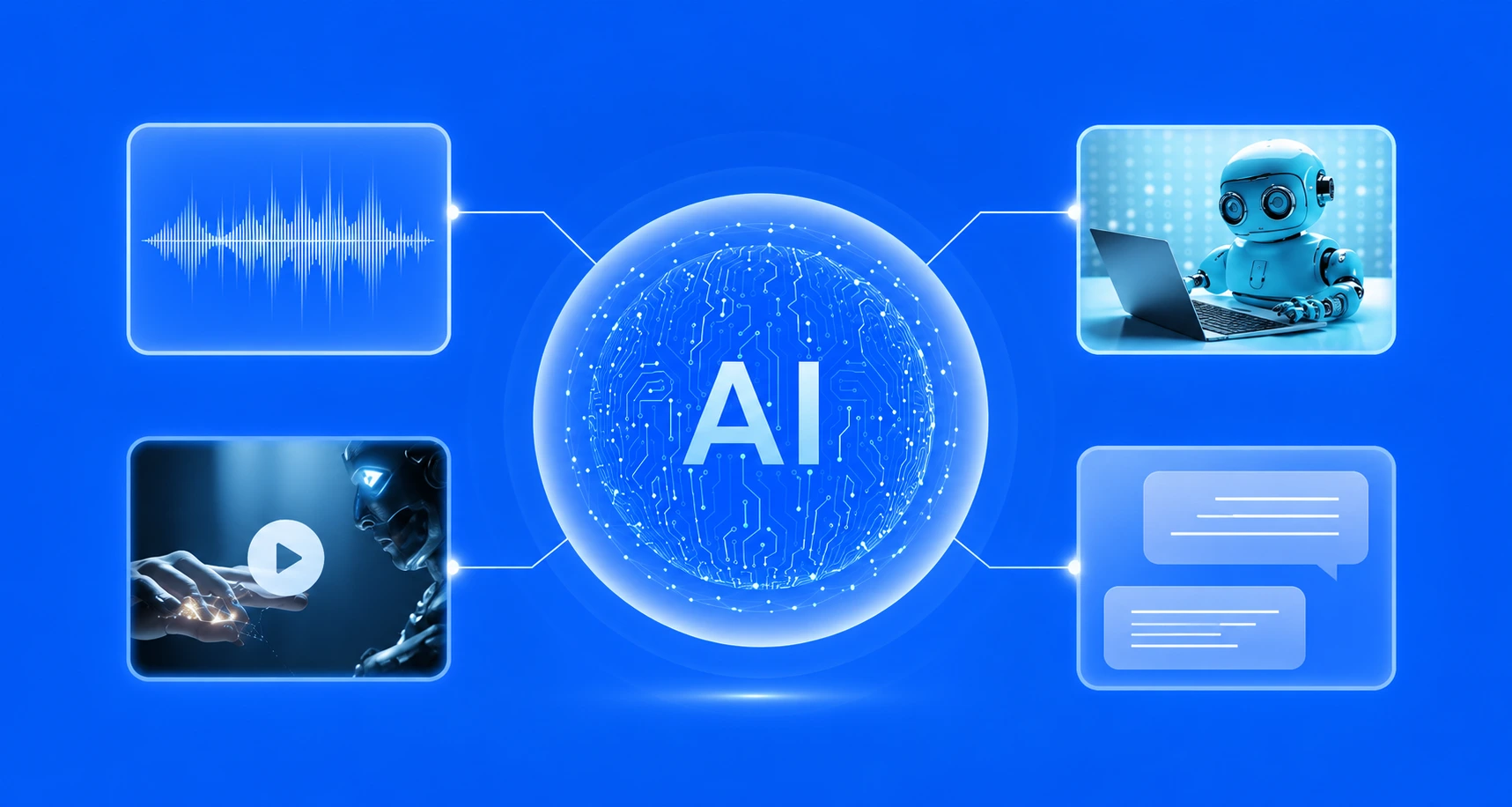
Different types of content require different generative AI architectures. The multi-modal capabilities of modern generative AI systems are one of the reasons adoption is accelerating so rapidly across India and the UAE. Let us look at how each major content type is produced.
Text Generation
Large Language Models predict the most statistically probable next token in a sequence, producing fluent paragraphs, emails, reports, code, and conversational responses at scale.
Image Generation
Diffusion models and GANs learn visual patterns during training and generate entirely new images from text prompts. Advertising agencies in Dubai use this for campaign asset creation at a fraction of traditional costs.
Audio and Voice
Text-to-speech and audio generation models create realistic voiceovers, music scores, and sound effects that businesses use for media production, accessibility tools, and interactive applications.
Code and Software
Models trained on vast code repositories can write, debug, and explain software in multiple programming languages, dramatically accelerating technology teams in India’s IT sector and UAE’s growing tech ecosystem.
Real Uses of Generative AI in Business Work
Across our eight years of working with enterprise clients, we have observed that the gap between understanding Generative AI Explained and actually deriving value from it comes down to implementation context. Generative AI is not a tool you deploy once. It is a capability that weaves into your business operations at multiple points.
Industry Applications of Generative AI Across UAE and India
| Industry | Application | Business Outcome |
|---|---|---|
| Banking and Finance | Automated report writing, risk summaries | Faster compliance and decision-making |
| Real Estate | Property listings, virtual tours, lead responses | Higher engagement, reduced agent workload |
| Healthcare | Clinical note summarization, patient communication | Improved care coordination and throughput |
| Retail and E-commerce | Product descriptions, personalized recommendations | Increased conversion and catalog efficiency |
| Legal and Compliance | Contract drafting, legal research summarization | Reduced billable hours, faster turnaround |
| Education | Personalized tutoring, exam prep content | Improved learner outcomes at lower cost |
How Generative AI Helps in Everyday Tasks
One of the most compelling aspects of Generative AI Explained is how quickly it integrates into daily workflows. You do not need to be a data scientist to benefit. In fact, millions of professionals across India and UAE are already using generative AI tools every day without fully realizing how the technology works behind the scenes.
Email Drafting
Write professional client emails in seconds with the right tone and structure.
Report Summarization
Compress 50-page documents into concise executive summaries within moments.
Translation
Accurately translate content across Hindi, Arabic, English, and 100+ other languages.
Meeting Notes
Turn recorded meetings into structured notes, action items, and follow-up tasks automatically.
Social Media
Generate platform-optimized captions, hashtags, and content calendars for brands of all sizes.
Research Assistance
Gather, synthesize, and present findings from multiple sources in a coherent format fast.
How Generative AI Works in Real-Life Applications
The question of how does generative AI explained work in real-life applications is best answered through concrete examples rather than abstract theory. Across our client base spanning Mumbai, Delhi, Dubai, and Sharjah, we have implemented generative AI across a wide range of real-world scenarios.
A leading bank in the UAE was manually reviewing thousands of client support queries daily. By deploying a generative AI-powered response system, they reduced first-response time from hours to under two minutes while maintaining contextual accuracy and regulatory compliance. The same model was later fine-tuned to handle Arabic-language queries, making it one of the most language-inclusive financial AI deployments in the Gulf region.
In India, a major e-commerce platform integrated generative AI into its product catalog system. The AI now produces localized product descriptions in Hindi, Tamil, Marathi, and English simultaneously, reducing catalog upload time and increasing regional conversion rates significantly. This is a direct result of understanding how does generative AI work and aligning it with a real business bottleneck.
Generative AI Impact Metrics We Have Observed
Easy Understanding of Generative AI Concepts
As we bring this guide on Generative AI Explained to a close, it is worth crystallizing the most important generative AI concepts into a simple framework any professional or business leader can use to navigate this space confidently.
Think of generative AI explained as a three-layer system. At the base is data, enormous in volume and diverse in type. In the middle is the model, a mathematical system trained to understand patterns within that data. At the top is the application, the interface or workflow through which users interact with the model to produce value for their business.
When business leaders in Dubai, Noida, or Hyderabad approach generative AI explained with this three-layer mental model, they make clearer decisions. They know what to procure at the data layer, what to evaluate at the model layer, and what to design at the application layer. This clarity is what separates successful generative AI adoption from expensive experiments that fail to deliver returns.
Our Expert Perspective
After more than eight years of working with AI technology, our experience consistently shows that the organizations that succeed with generative AI are not those with the biggest budgets. They are the ones with the clearest understanding of what generative AI is, how it works, and where in their operations it creates the most meaningful impact. Generative AI Explained is not just a topic for data scientists. It is essential knowledge for every leader in 2026 and beyond.
Start Your Generative AI Journey Today
From strategy to deployment, our team guides businesses in India and UAE through every step of their generative AI adoption with proven results.
People Also Ask
Q1.1. What is Generative AI explained in simple terms?
Generative AI explained is a type of artificial intelligence that can create new content like text, images, audio, or code by learning patterns from large amounts of existing data, and then producing something original based on those patterns.
Q2.2. How does Generative AI work exactly?
Generative AI explained works by training on massive datasets, learning statistical patterns within that data, and then using those learned patterns to generate new outputs when given a prompt or instruction from the user.
Q3.3. What is the difference between AI vs Generative AI?
Traditional AI is built to recognize, classify, or predict based on data. Generative AI explained goes a step further and actually creates new content, making it far more versatile for tasks like writing, designing, and coding.
Q4.4. What are the most common Generative AI concepts I should know?
Key generative AI concepts include large language models, neural networks, transformers, training data, tokens, embeddings, prompts, and inference. Understanding these helps you use generative AI explained tools more effectively.
Q5.5. Is Generative AI safe to use for business in India or UAE?
Yes, when used responsibly with proper data governance. Businesses in India and Dubai are already using Generative AI explained for customer support, marketing, legal drafting, and finance with clear compliance frameworks in place.
Q6.6. What kind of content can Generative AI create?
Generative AI explained can produce written articles, marketing copy, images, videos, music, programming code, product descriptions, chatbot responses, translations, and even legal or medical document summaries.
Q7.7. How is Generative AI different from a search engine?
A search engine retrieves existing content from the web. Generative AI explained creates brand-new content by synthesizing knowledge from its training data, making it capable of answering questions in a conversational and context-aware way.
Q8.8. Can small businesses benefit from Generative AI?
Absolutely. Small businesses in India and the UAE are using Generative AI explained to automate customer service, write product listings, generate social media content, and reduce operational costs without hiring large teams.
Q9.9. Does Generative AI learn from every conversation I have?
Not in real time. Most Generative AI explained tools do not update their core model during user conversations. They use their pre-trained knowledge to respond, though some tools allow fine-tuning or memory features.
Q10.10. What industries are using Generative AI the most right now?
Healthcare, finance, retail, education, legal, real estate, and media are among the top sectors using Generative AI explained in both India and the UAE to automate processes, personalize experiences, and boost productivity.
Explore Services
Related Services
Reviewed by

Aman Vaths
Founder of Nadcab Labs
Aman Vaths is the Founder & CTO of Nadcab Labs, a global digital engineering company delivering enterprise-grade solutions across AI, Web3, Blockchain, Big Data, Cloud, Cybersecurity, and Modern Application Development. With deep technical leadership and product innovation experience, Aman has positioned Nadcab Labs as one of the most advanced engineering companies driving the next era of intelligent, secure, and scalable software systems. Under his leadership, Nadcab Labs has built 2,000+ global projects across sectors including fintech, banking, healthcare, real estate, logistics, gaming, manufacturing, and next-generation DePIN networks. Aman’s strength lies in architecting high-performance systems, end-to-end platform engineering, and designing enterprise solutions that operate at global scale.