Ai Overview
Zero knowledge proofs represent one of the most significant cryptographic innovations applicable to Token and Coin systems including Bitcoin. These mathematical protocols allow a prover to convince a verifier that a statement is true without revealing any information beyond the validity of the statement itself. In the context of Bitcoin, this capability opens pathways for privacy enhancement and scalability improvements that were previously impossible within the protocol’s constraints.
Key Takeaways
- Zero knowledge proofs enable Bitcoin transaction verification without revealing sensitive data like amounts, addresses, or transaction histories.
- Bitcoin’s Taproot upgrade and Schnorr signatures create foundational infrastructure enabling more sophisticated Zero Knowledge Proofs implementations on the network.
- zk-SNARKs offer compact proofs suitable for Bitcoin’s limited block space while zk-STARKs eliminate trusted setup requirements.
- Layer-2 solutions leverage ZK proofs for Bitcoin scalability, enabling thousands of transactions with single on-chain settlement Zero Knowledge Proofs.
- Confidential transactions using ZK proofs hide transfer amounts while mathematically Zero Knowledge Proofs no new Bitcoin was created illegitimately.
- Performance constraints require careful optimization as Zero Knowledge Proofs generation demands significant computational resources beyond typical Bitcoin operations.
- Security implications include new attack surfaces requiring thorough cryptographic analysis before mainstream Bitcoin integration becomes viable.
- Bitcoin Script extensions through soft forks could enable native ZK verification, though consensus on implementation approach remains ongoing.
- Interoperability between Bitcoin and ZK-enabled Layer-2 networks creates bridges for enhanced privacy and throughput across ecosystems.
- Research institutions across USA, UK, UAE, and Canada are pioneering experimental ZK implementations that could reshape Bitcoin’s future.
Foundations of Zero Knowledge Proofs and Their Cryptographic Purpose
Zero knowledge proofs represent one of the most significant cryptographic innovations applicable to Token and Coin systems including Bitcoin. These mathematical protocols allow a prover to convince a verifier that a statement is true without revealing any information beyond the validity of the statement itself. In the context of Bitcoin, this capability opens pathways for privacy enhancement and scalability improvements that were previously impossible within the protocol’s constraints.
The foundational concept emerged from academic research in the 1980s, but practical implementations only became feasible in recent years. Zero knowledge proofs in Bitcoin enable scenarios where users can prove they own sufficient funds for a transaction without revealing their total balance. They can demonstrate compliance with regulatory requirements without exposing private financial data. This balance between transparency and privacy addresses long-standing concerns about Bitcoin’s pseudonymous nature.
Our agency has worked with institutional clients across USA, UK, and UAE markets who require privacy-preserving Bitcoin solutions. Understanding ZK proof foundations is essential for architects designing next-generation Bitcoin applications that meet both regulatory compliance and user privacy expectations simultaneously.
Bitcoin’s Native Script Limitations and Privacy Trade-Offs
Bitcoin Script was intentionally designed with limited expressiveness to minimize attack surface and ensure predictable execution. This conservative approach, while security-focused, creates constraints for implementing advanced cryptographic protocols like zero knowledge proofs directly on-chain. Understanding these limitations is essential for architects working on ZK solutions for Bitcoin.
| Limitation | Impact on ZK Proofs | Current Workaround |
|---|---|---|
| No Loops | Cannot iterate for complex verification | Off-chain computation with on-chain commitment |
| Limited Opcodes | Missing pairing operations for SNARKs | Propose new opcodes via soft fork |
| Stack Size Constraints | Restricts proof data handling | Merkle tree commitments |
| No State Access | Cannot reference external data | Oracle-based solutions |
| Block Size Limits | Large proofs increase costs | Proof aggregation techniques |
Core Cryptographic Primitives Behind Zero Knowledge Proofs
Understanding the mathematical foundations enables informed decisions about ZK implementation approaches for Bitcoin.
Elliptic Curve Cryptography
- secp256k1 curve used by Bitcoin
- Discrete logarithm hardness assumption
- Point multiplication operations
- Pedersen commitments foundation
Cryptographic Hash Functions
- SHA-256 for Bitcoin transactions
- Collision resistance properties
- Merkle tree constructions
- Fiat-Shamir heuristic applications
Polynomial Commitments
- KZG commitment schemes
- Bulletproofs inner product
- FRI protocol for STARKs
- Evaluation proof generation
How Zero Knowledge Proofs Differ From Traditional Bitcoin Verification
Traditional Bitcoin verification requires nodes to validate every transaction by checking input signatures, verifying UTXO existence, and confirming balance sufficiency. This process exposes all transaction details to network participants. Zero knowledge proofs in Bitcoin fundamentally change this paradigm by proving validity through mathematical certainty rather than data transparency.
With ZK verification, a prover generates a cryptographic proof that encapsulates all necessary validity checks. Verifiers can confirm correctness in constant time regardless of underlying transaction complexity. This approach reduces verification overhead while simultaneously enhancing privacy, creating efficiency gains that scale with transaction volume.
For institutional clients in Canada and UK markets, this verification model enables compliance-friendly privacy where auditors can verify legitimacy without accessing sensitive customer data. The shift from transparent verification to proof-based verification represents a fundamental evolution in how blockchain systems can balance accountability with confidentiality.
Taproot and Schnorr Signatures as Enablers for ZK Concepts
Bitcoin’s Taproot upgrade activated in November 2021 introduced Schnorr signatures and Merkleized Abstract Syntax Trees (MAST), creating foundational infrastructure for advanced cryptographic protocols including zero knowledge proofs. Schnorr signatures offer mathematical properties that enable signature aggregation, reducing on-chain footprint while enhancing privacy through uniform transaction appearance.
The linearity property of Schnorr signatures allows multiple signatures to combine into a single aggregate, with verification requiring only one signature check regardless of participant count. This efficiency gain directly supports ZK-based multi-party protocols where proof aggregation is essential for scalability. MAST enables complex spending conditions to remain hidden until execution, providing native privacy enhancement.
For zero knowledge proofs in Bitcoin, Taproot creates pathways for committing to ZK verification scripts that appear identical to standard transactions until claimed. This camouflage capability enhances fungibility and prevents discrimination against privacy-enhanced transactions by miners or other network participants.[1]
Zero Knowledge Proofs for Transaction Privacy in Bitcoin
Transaction privacy through zero knowledge proofs in Bitcoin addresses the fundamental tension between blockchain transparency and financial confidentiality. Current Bitcoin transactions reveal sender addresses, recipient addresses, and transfer amounts, enabling comprehensive chain analysis. ZK-enhanced transactions can prove validity while concealing these sensitive details from public observation.
Confidential Transaction schemes using Pedersen commitments with range proofs hide amounts while proving no negative values exist. More advanced constructions can obscure the entire transaction graph, preventing linkability analysis between inputs and outputs. For high-net-worth individuals and corporations in UAE and USA markets, these privacy guarantees are essential for secure Bitcoin utilization.
Implementation approaches range from sidechain solutions like Liquid Network to proposed soft fork upgrades. Each approach presents different trade-offs between privacy strength, verification overhead, and compatibility with existing Bitcoin infrastructure that implementations must carefully balance.
Applying Zero Knowledge Proofs to Bitcoin Scalability Challenges
Bitcoin’s throughput limitations stem from block size constraints and 10-minute block intervals. Zero knowledge proofs enable scalability solutions where thousands of transactions compress into single proofs verified on the main chain. This approach maintains Bitcoin’s security guarantees while dramatically increasing effective throughput for applications requiring high transaction volumes.
| Scaling Approach | Transactions Per Second | Security Model |
|---|---|---|
| Base Bitcoin | 7 TPS | Full L1 security |
| Lightning Network | 1,000,000+ TPS | Channel-based, requires online |
| ZK Rollups | 2,000-4,000 TPS | Cryptographic validity proofs |
| Sidechains | Variable | Federated or merged mining |
| Validity Rollups | 10,000+ TPS | ZK proof verified on L1 |
Trust Assumptions and Setup Requirements in ZK Systems
Selecting appropriate ZK systems requires understanding their trust models and setup requirements.
Trusted Setup SNARKs
Require one-time ceremony generating parameters. If ceremony compromised, fake proofs possible. Groth16 and PLONK use this model.
Universal Setup
Single setup works for any circuit. Reduces ceremony burden but still requires trust. Marlin and PLONK variants support this.
Transparent STARKs
No trusted setup required. Security relies only on hash function collision resistance. Best alignment with Bitcoin’s trustless philosophy.
Bulletproofs
No trusted setup with logarithmic proof size. Slower verification but excellent for range proofs in confidential transactions.
Folding Schemes
Nova and SuperNova enable incremental verification. Ideal for sequential computations like blockchain state transitions.
Hybrid Approaches
Combine multiple systems for optimized performance. Use SNARKs for recursion wrapping STARKs for best tradeoffs.
Performance Constraints of Zero Knowledge Proofs on Bitcoin
Implementing zero knowledge proofs in Bitcoin faces significant performance challenges that require careful engineering. Proof generation for complex statements can require minutes to hours of computation depending on circuit complexity. Memory requirements during proving often exceed gigabytes, limiting accessibility to resource-constrained devices.
Verification, while faster than proving, still imposes computational overhead beyond standard Bitcoin Script execution. Each additional opcode or verification step consumes block space and node resources. The economics of Bitcoin transaction fees create pressure for minimal proof sizes and efficient verification algorithms.
Hardware acceleration through GPUs, FPGAs, and custom ASICs can dramatically improve performance, a critical factor for companies providing enterprise blockchain development services for high-scale cryptographic systems. Our engineering teams in USA and UK markets have achieved 10-100x speedups through optimized implementations, making previously impractical applications viable for production deployment.
Bitcoin Script Extensions Needed for Native ZK Verification
Native zero knowledge proof verification on Bitcoin would require new opcodes enabling cryptographic operations currently impossible in Script. Several proposals have emerged from the research community, each with different scope and complexity implications for consensus rule changes.
| Proposed Opcode | Functionality | ZK Application | Status |
|---|---|---|---|
| OP_CAT | Concatenate stack elements | Build verification inputs | BIP proposal |
| OP_CHECKSIGFROMSTACK | Verify arbitrary signatures | Covenant constructions | Discussion |
| OP_TXHASH | Introspect transaction data | State commitments | BIP proposal |
| OP_ZK_VERIFY | Native proof verification | Direct ZK support | Research |
| OP_PAIRING | Elliptic curve pairings | SNARK verification | Research |
Security Implications of Integrating ZK Proofs in Bitcoin
Introducing zero knowledge proofs in Bitcoin creates new attack surfaces requiring thorough security analysis. Soundness failures could allow creation of invalid proofs that pass verification, potentially enabling unauthorized Bitcoin generation. Completeness issues could prevent legitimate transactions from confirming, disrupting network functionality.
Implementation bugs in cryptographic libraries pose significant risks given the mathematical complexity involved. Side-channel attacks during proof generation could leak private information, undermining the privacy benefits ZK proofs aim to provide. Trusted setup compromise in SNARK systems could enable undetectable counterfeiting.
Bitcoin’s conservative security culture demands extensive review, formal verification, and prolonged testing before any ZK-related consensus changes. Multiple independent implementations with cross-verification provide defense against single-source vulnerabilities that could catastrophically impact the network.
ZK Proofs for Confidential Transactions and Asset Transfers
1. Amount Commitment
Sender creates Pedersen commitment hiding transaction amount while binding to specific value cryptographically.
2. Range Proof Generation
Generate ZK proof that committed amount is positive and within valid range without revealing actual value.
3. Balance Proof
Prove that sum of input commitments equals sum of output commitments plus fees, ensuring no inflation.
4. Ownership Proof
Include signature proving authorization to spend inputs without revealing public key linkage to addresses.
5. Transaction Construction
Assemble all proofs and commitments into valid transaction format compatible with network requirements.
6. Network Broadcast
Submit transaction to network where nodes verify proofs without learning amounts or sender identity.
7. Block Inclusion
Miners include verified confidential transaction in block, permanently recording commitments on blockchain.
8. Recipient Access
Recipient decrypts amount using shared secret, gaining spendable output with full confidentiality preserved.
Interoperability Between Bitcoin and ZK-Enabled Layer-2 Solutions
Zero knowledge proofs in Bitcoin enable trustless bridges connecting the main chain with Layer-2 networks offering enhanced capabilities. ZK-rollups can batch thousands of transactions into single proofs verified on Bitcoin, combining scalability with L1 security guarantees. This architecture preserves Bitcoin’s role as settlement layer while enabling rich application ecosystems.
Cross-chain proof verification allows assets to move between Bitcoin and other networks without trusted intermediaries. ZK proofs demonstrate that corresponding actions occurred on source chains, enabling atomic swaps and bridge operations with cryptographic certainty. Financial institutions in Dubai and London are particularly interested in these trustless interoperability mechanisms.
State channels enhanced with ZK proofs can compress complex off-chain interactions into minimal on-chain footprints. This approach enables Bitcoin-secured applications with throughput and privacy characteristics impossible on the base layer alone, expanding Bitcoin’s utility across diverse use cases.
 Current Research and Experimental ZK Implementations in Bitcoin
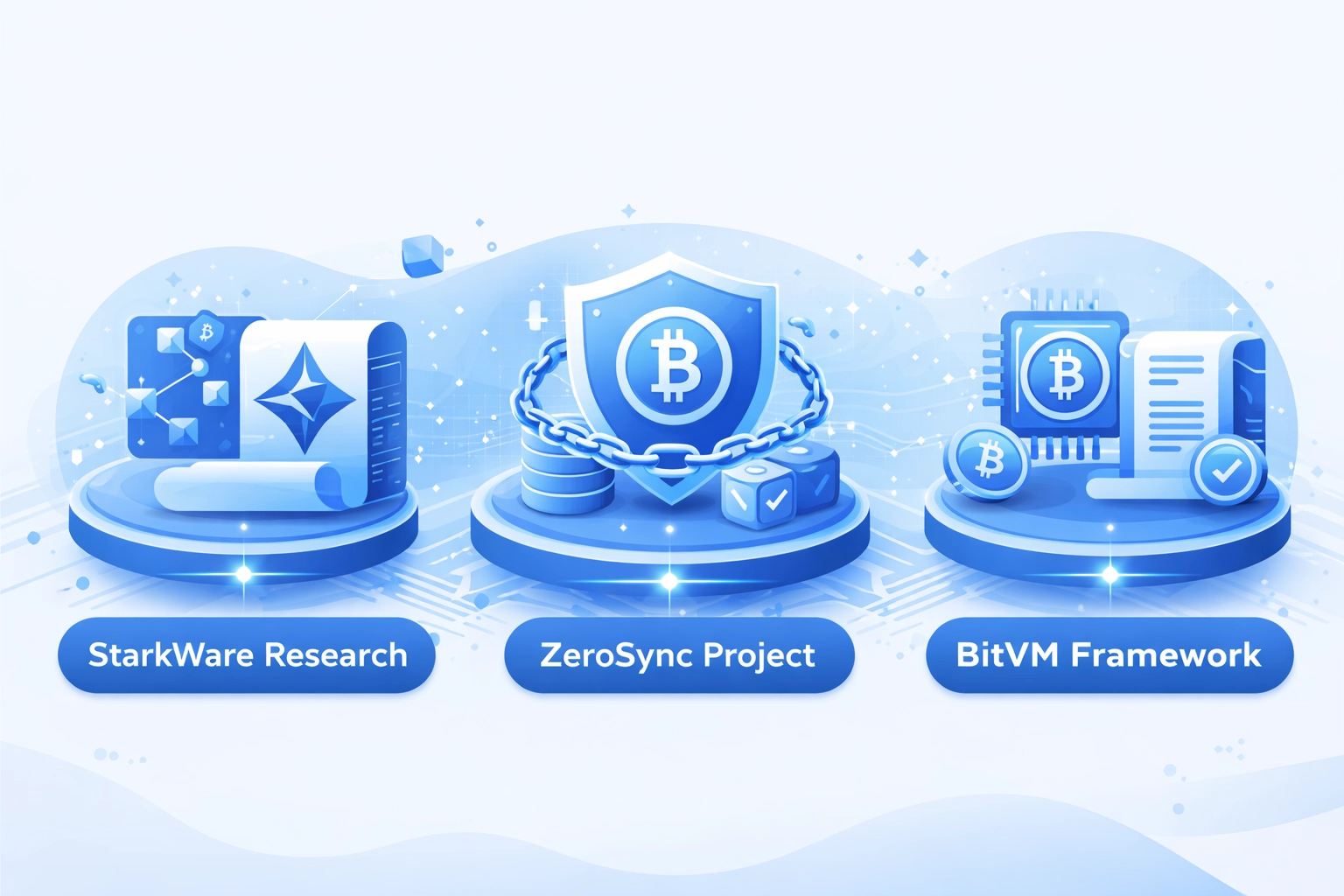
Active projects advancing zero knowledge proof integration with Bitcoin across multiple approaches.
StarkWare Research
- STARK proofs for Bitcoin verification
- Cairo language tooling
- Recursive proof composition
- Validity rollup designs
ZeroSync Project
- Full chain proof in single STARK
- Header chain verification
- Assumevalid replacement
- Light client enabling
BitVM Framework
- Turing-complete Bitcoin contracts
- Fraud proof based execution
- ZK verification circuits
- Trustless bridge constructions
Future Directions for Zero Knowledge Proof Adoption in Bitcoin
Key principles and standards shaping the future of ZK integration with Bitcoin infrastructure.
Principle 1: Prioritize trustless ZK systems aligned with Bitcoin’s philosophy of minimizing trusted parties in security models.
Principle 2: Maintain backward compatibility ensuring ZK enhancements remain optional and non-disruptive to existing users.
Principle 3: Require extensive formal verification and multiple independent audits before any consensus-affecting ZK changes.
Principle 4: Optimize for proof size and verification efficiency given Bitcoin’s resource constraints and fee market dynamics.
Principle 5: Develop quantum-resistant ZK constructions preparing for potential cryptographic transitions in the coming decades.
Principle 6: Enable privacy by default while maintaining compliance options for regulated entities in USA, UK, UAE, and Canada markets.
Principle 7: Create standardized proving systems enabling ecosystem-wide interoperability across wallets and applications.
Principle 8: Foster open-source collaboration ensuring ZK implementations benefit from global research community contributions.
ZK Bitcoin Implementation Compliance Checklist
Cryptographic Security
- Formal security proofs reviewed
- Independent implementation audits
- Trusted setup transparency
Regulatory Alignment
- Selective disclosure capabilities
- Audit trail preservation
- Jurisdiction compliance options
Network Compatibility
- Soft fork activation path
- Backward compatibility verified
- Node upgrade coordination
Operational Readiness
- Prover infrastructure deployed
- Wallet integration completed
- User documentation available
Build Advanced Bitcoin Solutions with Zero Knowledge Proof Experts!
Partner with our team specializing in ZK cryptography and Bitcoin infrastructure serving clients across USA, UK, UAE, and Canada markets.
Frequently Asked Questions
Q1.1. What are zero knowledge proofs and how do they work with Bitcoin?
Zero knowledge proofs are cryptographic protocols that allow one party to prove knowledge of information without revealing the information itself. In Bitcoin context, ZK proofs enable verification of transaction validity without exposing sensitive details like amounts or addresses. This technology enhances privacy while maintaining the trustless verification that Bitcoin requires. Implementations include zk-SNARKs and zk-STARKs, each offering different trade-offs between proof size, verification speed, and trust assumptions for Bitcoin applications.
Q2.2. Can Bitcoin natively support zero knowledge proofs?
Bitcoin’s current scripting language has limited expressiveness that restricts native ZK proof verification. However, recent upgrades like Taproot and Schnorr signatures have created pathways for ZK integration. While full native support requires protocol changes, Layer-2 solutions and sidechains already leverage ZK proofs for Bitcoin scaling and privacy. Researchers across USA, UK, and Canada are actively exploring soft fork proposals that could enable more sophisticated ZK verification directly on Bitcoin’s base layer.
Q3.3. What is the difference between zk-SNARKs and zk-STARKs for Bitcoin?
zk-SNARKs require a trusted setup ceremony but produce smaller proofs ideal for Bitcoin’s block space constraints. zk-STARKs eliminate trusted setup requirements but generate larger proofs. For Bitcoin applications, SNARKs offer efficiency advantages while STARKs provide stronger security assumptions without trusted parties. Both enable transaction privacy and scalability improvements, with protocol designers choosing based on specific use case requirements regarding proof size, verification time, and security model preferences.
Q4.4. How do zero knowledge proofs improve Bitcoin privacy?
Zero knowledge proofs enable confidential transactions where amounts remain hidden while network validators can still verify no inflation occurred. ZK proofs also support private address systems, breaking the transaction graph analysis that blockchain surveillance companies use. For users in privacy-conscious markets like UAE and Canada, ZK-enabled Bitcoin solutions provide financial confidentiality comparable to traditional banking while maintaining Bitcoin’s permissionless and censorship-resistant properties.
Q5.5. What are the main challenges of implementing ZK proofs in Bitcoin?
Primary challenges include computational overhead for proof generation, verification costs within Bitcoin’s resource constraints, and consensus changes required for native support. Bitcoin’s conservative upgrade philosophy means ZK integration proceeds cautiously. Additionally, trusted setup requirements for some ZK systems conflict with Bitcoin’s trustless ethos. Current solutions focus on off-chain ZK computation with on-chain verification, balancing innovation with Bitcoin’s stability and security priorities.
Reviewed by

Aman Vaths
Founder of Nadcab Labs
Aman Vaths is the Founder & CTO of Nadcab Labs, a global digital engineering company delivering enterprise-grade solutions across AI, Web3, Blockchain, Big Data, Cloud, Cybersecurity, and Modern Application Development. With deep technical leadership and product innovation experience, Aman has positioned Nadcab Labs as one of the most advanced engineering companies driving the next era of intelligent, secure, and scalable software systems. Under his leadership, Nadcab Labs has built 2,000+ global projects across sectors including fintech, banking, healthcare, real estate, logistics, gaming, manufacturing, and next-generation DePIN networks. Aman’s strength lies in architecting high-performance systems, end-to-end platform engineering, and designing enterprise solutions that operate at global scale.