Ai Overview
The blockchain industry has evolved from experimental code repositories into a multi-trillion-dollar global infrastructure layer. In 2023 alone, smart contract exploits cost the industry over $1. ☑ Automated Coverage Thresholds: Configure minimum test coverage thresholds (recommended 90%+) enforced in CI pipelines to prevent under-tested code from reaching mainnet.
Key Takeaways
- Hardhat leads in JavaScript/TypeScript ecosystem integration, making it the preferred Web3 smart contract framework for teams in the USA, UK, and Canada already using Node.js tooling.
- Truffle was the original pioneering smart contract testing framework, offering a complete suite including Ganache for local blockchain simulation and Drizzle for frontend integration.
- Foundry, written in Rust, delivers the fastest compilation and testing speeds among all three frameworks, making it ideal for performance-critical decentralized application projects.
- Choosing between Truffle vs Hardhat vs Foundry depends heavily on your team’s language preference: JavaScript for Hardhat/Truffle, Solidity-native for Foundry.
- Web3 developer toolkits like these frameworks reduce audit costs and accelerate deployment timelines by enabling robust automated testing before mainnet launches.
- Foundry’s fuzz testing capabilities significantly outperform the other two frameworks for catching edge-case vulnerabilities in complex DeFi and NFT protocols.
- Hardhat’s plugin ecosystem, including Hardhat Ignition and ethers.js integration, makes it the most extensible option for large enterprise projects across UAE and global markets.
- Truffle’s Ganache remains the most beginner-friendly local blockchain simulation tool, lowering the barrier to entry for new Web3 engineers globally.
- All three frameworks support Solidity and Vyper, but Foundry uniquely allows writing tests directly in Solidity, eliminating context-switching for smart contract engineers.
- The smart contract testing framework you select today will shape your protocol’s security posture, CI/CD pipeline efficiency, and long-term maintainability for years ahead.
Introduction
The blockchain industry has evolved from experimental code repositories into a multi-trillion-dollar global infrastructure layer. Across the USA, UK, UAE, and Canada, enterprises, startups, and independent engineers are racing to build Web3 applications that are secure, scalable, and production-ready. At the heart of every successful blockchain project lies a robust smart contract framework – and the choice between Hardhat, Truffle, and Foundry is one of the most consequential architectural decisions a team will make. These three tools represent the leading Web3 smart contract frameworks available today, each with distinct philosophies, strengths, and ideal use cases. Understanding the nuances of hardhat-vs-truffle-vs-foundry is no longer optional; it is a strategic imperative for any serious blockchain engineering team.
The Growing Importance of Smart Contract Frameworks
As decentralized application projects grow in complexity, the tooling surrounding smart contract authorship has become as critical as the contracts themselves. Web3 smart contract frameworks provide the scaffolding that allows engineers to write, compile, test, deploy, and maintain on-chain logic with confidence. Without reliable blockchain tooling, even the most elegant Solidity code can harbor devastating vulnerabilities that put user funds at risk. In 2023 alone, smart contract exploits cost the industry over $1.8 billion, underscoring why rigorous tooling selection matters.[1] Markets in the USA and UAE are now demanding institutional-grade security practices, pushing developers toward frameworks that natively support comprehensive testing pipelines, gas optimization analysis, and automated deployment scripts.
Why Developers Need Reliable Blockchain Tooling?
Reliable blockchain tooling is the difference between a protocol that thrives and one that becomes a cautionary tale. Much like a Web Development Framework standardizes how applications are built and maintained, Decentralized application tools serve multiple functions simultaneously: they manage local network simulation, handle compiler version pinning, automate migration scripts, and generate coverage reports. For teams spread across London, Toronto, Dubai, and San Francisco, consistent tooling ensures that every engineer on a distributed team operates within the same reproducible environment. Web3 developer toolkits also dramatically reduce onboarding time for new hires, a critical factor as the global talent shortage in blockchain engineering continues. A well-chosen smart contract framework enforces best practices by design, making secure patterns the path of least resistance rather than an afterthought.
Understanding Smart Contract Frameworks
Before diving into the hardhat-vs-truffle-vs-foundry debate, it is essential to build a shared understanding of what a smart contract framework actually is and why the category exists. These tools have transformed blockchain engineering from a bespoke, error-prone craft into a disciplined software engineering practice.
What Is a Smart Contract Framework?
A smart contract framework is a structured collection of tools, libraries, configuration systems, and runtime environments designed to streamline the full lifecycle of on-chain contract engineering. These frameworks abstract away the complexity of interacting directly with EVM JSON-RPC interfaces, compiler binaries, and network providers. Instead, they expose clean APIs and CLI commands that allow engineers to focus on business logic rather than infrastructure plumbing. At their core, Web3 smart contract frameworks solve three fundamental problems: reproducibility (ensuring code behaves identically across environments), observability (providing visibility into execution traces and state changes), and automation (eliminating manual steps that introduce human error). Choosing the right framework is equivalent to choosing the right programming language for a given problem – the decision shapes every subsequent technical choice.
Key Functions of Blockchain Tools
Blockchain tools perform a rich set of interrelated functions. Compilation management ensures that the correct Solidity or Vyper compiler version is used for each contract, preventing compatibility issues across different EVM versions. Local network simulation creates an in-memory or persistent blockchain that mimics mainnet behavior without real economic consequences. Test execution environments run unit, integration, and fuzz tests against compiled bytecode, catching logic errors before deployment. Migration and deployment scripting automates the sequencing of contract deployments, ensuring that constructor arguments, ownership transfers, and initialization calls execute in the correct order. Gas profiling identifies expensive operations that could make contracts economically unviable at scale. Together, these capabilities form the backbone of professional decentralized application projects across all major markets.
Overview of Hardhat
Hardhat, maintained by Nomic Foundation, has become the dominant Web3 smart contract framework for professional engineering teams. Since its emergence from the Buidler project, it has accumulated over 5 million monthly downloads on npm, reflecting its widespread adoption across global blockchain ecosystems.
Core Concept and Architecture
Hardhat is built around the concept of a flexible, task-based architecture layered on top of the Node.js runtime. Its central innovation is Hardhat Network, a local Ethereum implementation specifically designed for contract testing. Unlike external simulators, Hardhat Network is embedded directly into the testing runtime, enabling features like console.log() within Solidity code – an invaluable debugging capability. The architecture separates concerns cleanly: configuration lives in hardhat.config.js or hardhat.config.ts, tasks are composable units of automation, and plugins extend core functionality via well-defined interfaces. This extensibility model has enabled a thriving ecosystem where community plugins address nearly every conceivable workflow requirement, from gas reporting to contract size checking and coverage analysis.
Key Features of Hardhat
Hardhat’s Standout Capabilities
Debugging Tools
- Solidity console.log() support
- Detailed stack traces on revert
- Custom error decoding
- Transaction call traces
Testing Infrastructure
- Mocha + Chai integration
- TypeScript-first test suites
- ethers.js / viem compatibility
- Fixtures and snapshots
Plugin System
- hardhat-gas-reporter
- hardhat-contract-sizer
- solidity-coverage
- Hardhat Ignition deployer
Advantages of Using Hardhat
Hardhat’s primary advantage is its seamless integration with the JavaScript and TypeScript ecosystem that most web engineers already know. Teams in Toronto, London, and Dubai who are expanding their Web3 capabilities can hire developers with strong JavaScript backgrounds and get them productive on Hardhat within days. Its TypeScript support is first-class, enabling autocomplete, type checking, and IDE integration that dramatically reduce runtime errors. Hardhat Network’s forking capability allows teams to test against the exact state of mainnet or any public testnet, enabling realistic integration testing without deploying to live networks. The framework’s modular architecture means it can grow with a project from a simple ERC-20 token to a sophisticated multi-contract DeFi protocol without requiring a tooling migration.
Overview of Truffle
Truffle, created by Truffle Suite (now part of Consensys), was the original professional-grade smart contract framework for Ethereum. It introduced structured migration scripts, integrated test runners, and network management conventions that shaped the standards every subsequent tool has built upon.
Core Concept and Architecture
Truffle’s architecture follows a convention-over-configuration philosophy inspired by Ruby on Rails. Projects are organized into standardized directories: contracts/, migrations/, test/, and build/. This opinionated structure means that any developer familiar with Truffle can navigate any Truffle project immediately, reducing onboarding friction significantly. Truffle’s migration system is its most distinctive architectural element – numbered JavaScript files in the migrations/ directory execute sequentially, providing a trackable history of deployment operations. The framework communicates with networks via Web3.js providers, giving it compatibility with virtually every Ethereum-compatible network and wallet provider in the ecosystem. Truffle’s design prioritizes clarity and convention over raw flexibility, which makes it particularly well suited for teams that value consistency over customization.
Key Features of Truffle
Truffle’s feature set has been refined over nearly a decade of production use. Its built-in contract abstractions automatically handle deployment addresses, ABI management, and provider injection, eliminating boilerplate that clutters test suites in lower-level tools. The Truffle Console provides an interactive JavaScript REPL connected to any configured network, enabling rapid manual testing and exploration. Truffle integrates natively with Ganache, its companion local blockchain simulator, providing a one-click Ethereum environment for both CLI and GUI users. The framework also supports automated testing via Mocha and Chai for JavaScript tests, as well as native Solidity test files, giving teams flexibility in how they structure their smart contract testing framework workflows. Truffle’s built-in gas usage reporting provides immediate feedback on optimization opportunities.
Advantages of Using Truffle
Truffle’s greatest strength is its maturity and the breadth of educational resources surrounding it. With eight-plus years of tutorials, Stack Overflow answers, YouTube courses, and official documentation, Truffle remains the easiest framework to learn from publicly available material. For enterprises in the UAE and USA building their first blockchain applications on tight timelines, this wealth of existing knowledge significantly reduces risk. Truffle’s Ganache GUI provides a visual representation of blocks, transactions, and accounts that is invaluable for workshops, demos, and onboarding non-technical stakeholders. Its Drizzle library, while now less actively maintained, offers React integration patterns that many frontend engineers still reference as architectural templates for decentralized application projects.
Core Concept and Architecture
Foundry’s architecture is built around a suite of Rust binaries: Forge for testing and compilation, Cast for interacting with EVM networks, Anvil for local blockchain simulation, and Chisel for interactive Solidity REPL. This binary distribution model eliminates Node.js as a runtime dependency entirely, which dramatically simplifies environment setup and CI/CD configuration. Forge’s testing model is its most radical departure from predecessors – tests are written as Solidity contracts that inherit from a base Test contract, enabling the use of cheatcodes via the vm object. These cheatcodes allow tests to manipulate block timestamps, impersonate accounts, fork mainnet state, and assert on complex state transitions without leaving the Solidity context. This architecture makes Foundry the only framework in the hardhat-vs-truffle-vs-foundry comparison where the test code is subject to the same compiler checks as production code.
Advantages of Using Foundry
Foundry’s primary advantage is sheer speed. In benchmark tests conducted by teams across multiple DeFi protocols, Foundry completes test suites 5x to 10x faster than equivalent Hardhat suites, which directly translates to shorter feedback loops and faster iteration cycles. For teams working on complex DeFi protocols in London or managing large-scale NFT platforms in the UAE, this speed advantage compounds over thousands of CI/CD runs. Foundry’s fuzz testing with property-based invariant checks catches entire classes of bugs that deterministic unit tests miss – a capability that has prevented production exploits at multiple high-profile protocols. Writing tests in Solidity also eliminates the impedance mismatch between test logic and contract logic, making tests easier to audit and more likely to accurately model real on-chain behavior.
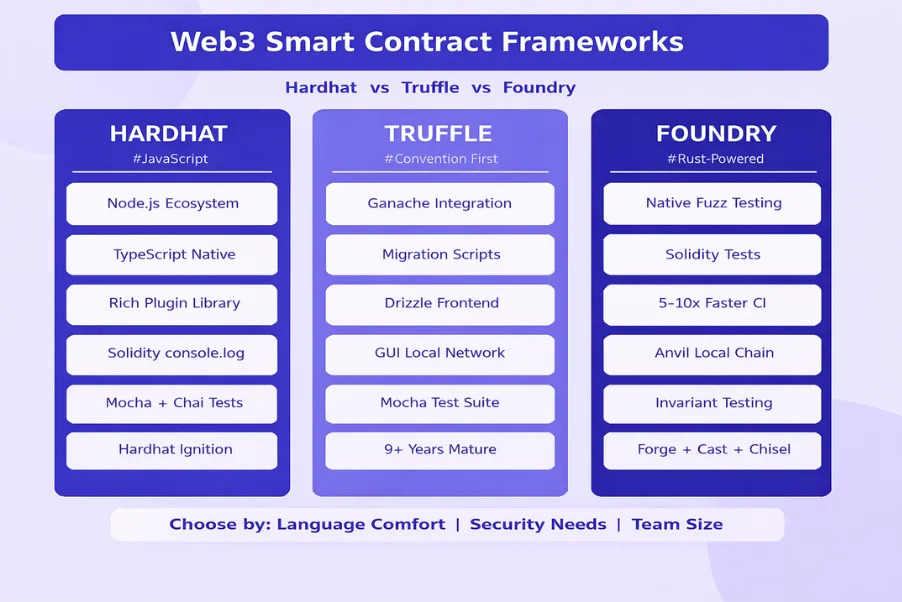
Hardhat vs Truffle vs Foundry: Feature Comparison
Environment and Tooling
When evaluating decentralized application tools from an environment setup perspective, each framework takes a meaningfully different approach. Hardhat leverages the ubiquitous Node.js ecosystem, making it immediately familiar to the largest pool of potential contributors. Truffle similarly relies on Node.js but adds opinionated directory conventions that reduce configuration overhead. Foundry requires only its Rust binaries via foundryup, making it the fastest to install from scratch – a significant advantage in automated CI environments. Hardhat’s Ignition deployment framework represents the most sophisticated declarative deployment system of the three, while Truffle’s numbered migration scripts remain simple and auditable. Foundry’s Cast CLI provides the richest set of EVM interaction utilities, handling everything from function encoding to ENS resolution in a single tool.
| Feature | Hardhat | Truffle | Foundry |
|---|---|---|---|
| Language | JS / TypeScript | JS / TypeScript | Solidity / Rust |
| Local Network | Hardhat Network | Ganache | Anvil |
| Test Runner | Mocha + Chai | Mocha + Chai | Forge (native) |
| Fuzz Testing | via plugins | Limited | Native |
| Compilation Speed | Medium | Medium | Very Fast |
| Plugin Ecosystem | Extensive | Moderate | Growing |
| Mainnet Forking | Yes | Yes | Yes |
| Gas Reporting | Plugin | Built-in | Built-in |
| Solidity Tests | No | Partial | Yes (native) |
| Learning Curve | Low-Medium | Low | Medium-High |
Testing and Debugging Capabilities
The smart contract testing framework capabilities of each tool diverge significantly at the advanced level. Hardhat’s integration with the Hardhat Network enables rich debugging: every failed transaction produces a full stack trace with line numbers pointing to the exact Solidity source location of the revert. This feature alone saves hours of debugging time on complex protocol interactions. Truffle’s debugger, while capable, requires a separate invocation and is less tightly integrated with the test runner. Foundry’s testing model shines brightest here: its fuzzer runs thousands of randomized inputs against each test function automatically, discovering edge cases that would never appear in manually written test cases. Foundry also supports invariant testing, where global properties of a contract system are checked across sequences of random operations – a technique that has become the gold standard for DeFi protocol security validation.
Deployment and Automation Tools
Deployment automation is where the maturity differences between the three Web3 smart contract frameworks become most apparent. Hardhat Ignition, introduced as the successor to hardhat-deploy, provides a declarative module system where deployment relationships are expressed as dependency graphs rather than imperative scripts. This approach makes deployments more reproducible and easier to verify against on-chain state. Truffle’s migration system, while simpler, has the advantage of being immediately understandable to any developer who has seen numbered database migration files before. Foundry’s deployment story, using forge script with Solidity-based scripts, is the most powerful for complex deployments but requires the deepest Solidity knowledge to leverage effectively. All three frameworks support multi-network deployment configuration and environment variable management for sensitive credentials.
Performance Comparison: Framework Benchmarks
Compilation Speed: Foundry compiles a 50-contract project in under 3 seconds using incremental caching. Hardhat averages 8-12 seconds. Truffle averages 10-15 seconds for equivalent suites.
Testing Efficiency: Foundry’s parallel test execution runs suites 5-10x faster than sequential JavaScript runners. Hardhat supports parallel test files; Truffle runs tests sequentially by default.
Resource Utilization: Foundry’s Rust binaries consume significantly less memory and CPU than Node.js-based alternatives, enabling faster CI pipelines on standard cloud runners.
Fuzz Throughput: Foundry’s native fuzzer executes 1,000+ randomized runs per test function by default with no additional configuration, catching vulnerabilities missed by manual test cases.
Fork Performance: All three support mainnet forking, but Foundry’s Anvil processes fork requests with the lowest latency, critical for integration tests against live protocol state.
Startup Time: Hardhat Network starts in under 1 second. Anvil starts almost instantly. Ganache has the longest startup time, particularly in GUI mode, impacting rapid iteration workflows.
Ease of Use and Learning Curve
Beginner Friendliness
For newcomers to blockchain engineering in markets like Canada and the UK, where Web3 bootcamps and university programs are proliferating, Truffle remains the most beginner-accessible smart contract testing framework. Its opinionated structure means there are fewer decisions to make upfront, and the Ganache GUI provides immediate visual feedback that reinforces learning. Hardhat is a close second for beginners with JavaScript backgrounds – its npx hardhat init command scaffolds a complete example project in seconds, and its error messages are exceptionally informative. Foundry has the steepest learning curve because it requires comfort with Solidity beyond basic syntax, familiarity with the Rust toolchain for installation, and an understanding of the cheatcode paradigm. However, experienced Solidity engineers often report that Foundry feels more natural precisely because everything lives within the language they already use every day.
Documentation and Community Support
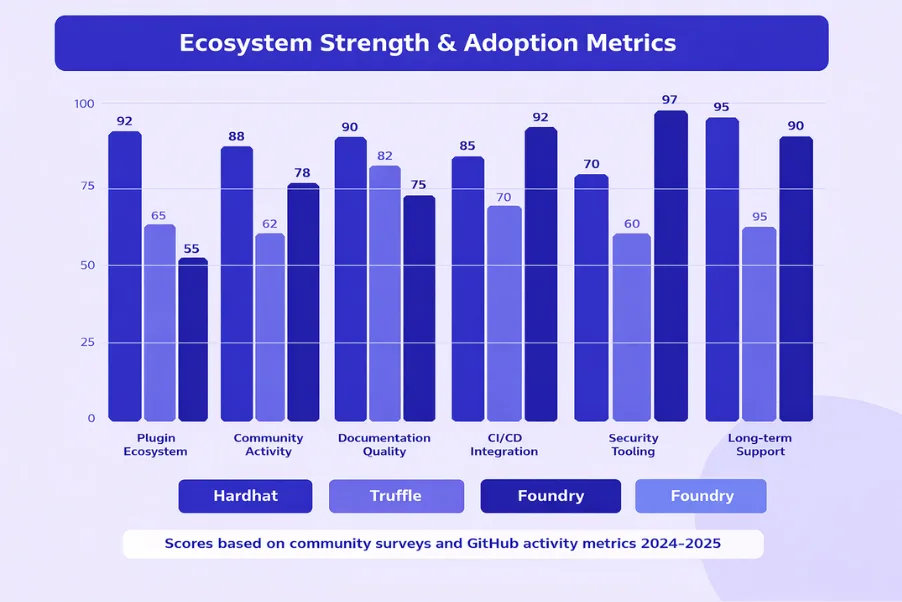
All three Web3 developer toolkits maintain active documentation portals, but their community characteristics differ meaningfully. Hardhat’s documentation is the most comprehensive and consistently updated, with official examples covering everything from basic deployment to complex proxy upgrade patterns. The Hardhat Discord community is exceptionally active, with core contributors responding to questions within hours – a significant advantage for teams shipping on tight deadlines. Truffle benefits from the largest body of third-party tutorials, Stack Overflow threads, and YouTube walkthroughs accumulated over its eight-year history. Foundry’s documentation, while excellent in technical depth, assumes more prior knowledge and has fewer beginner-oriented resources. However, the Foundry community on Twitter/X and Telegram is intensely engaged, and the official Foundry book is a thorough reference for intermediate and advanced practitioners.
Integration with Other Web3 Tools
The ability to integrate with broader decentralized application tools is a critical selection factor for teams building full-stack Web3 applications. Hardhat integrates naturally with every major Web3 library including ethers.js, viem, web3.js, and wagmi, as well as deployment verification services like Etherscan and Sourcify. Its compatibility with OpenZeppelin’s tooling, including the Upgrades plugin for transparent and UUPS proxy management, makes it the default choice for enterprise-grade contracts. Truffle’s integration with Drizzle provides a React state management layer for contract data, while its Consensys parentage ensures smooth integration with MetaMask and Infura. Foundry integrates with ethers.js and Cast for external interactions, and its forge coverage command generates LCOV reports compatible with all major coverage visualization tools used in professional CI/CD pipelines.
Ecosystem and Plugin Support
Hardhat Plugin Ecosystem
Hardhat’s plugin registry contains hundreds of community-maintained extensions covering gas optimization, contract verification, proxy management, coverage analysis, and deployment automation. The hardhat-etherscan plugin enables one-command Etherscan verification across all EVM-compatible chains, while hardhat-abi-exporter simplifies frontend integration by automatically outputting clean ABI files.
Truffle + Ganache + Drizzle
Truffle’s ecosystem is deeply integrated with its sibling tools. Ganache provides both CLI and GUI local blockchain simulation with deterministic account generation and configurable block timing. Drizzle offers a Redux-based React integration layer for contract state synchronization, while Truffle Teams (now deprecated) pioneered automated testing pipelines for blockchain projects.
Foundry’s Developer-Focused Toolset
Foundry’s toolset prioritizes power-user workflows. The Cast CLI supports ABI encoding/decoding, ENS resolution, event log parsing, and direct contract calls without writing any code. Chisel provides an interactive Solidity REPL for rapid prototyping. The forge-std library provides a rich set of base contracts and utilities that make common testing patterns concise and expressive.
Use Cases for Each Framework
Best Use Cases for Hardhat
Hardhat is the optimal choice for enterprise teams building complex, multi-contract systems where TypeScript type safety, rich debugging, and an extensive plugin ecosystem are paramount. It excels for DeFi protocols that require mainnet forking to test against live liquidity pool states, for NFT projects that need gas optimization analysis across large minting operations, and for any team where multiple engineers with varying blockchain experience must collaborate effectively. Real-world examples include Uniswap V3’s development, Aave’s protocol upgrades, and numerous Layer 2 bridge implementations. For companies in the USA and Canada expanding existing JavaScript-heavy engineering teams into Web3, Hardhat’s alignment with familiar tooling makes it the lowest-friction path to productive smart contract engineering.
Best Use Cases for Truffle
Truffle remains the best choice for educational contexts, rapid prototyping, and teams that prioritize convention and visual tooling over raw performance. It is particularly well suited for organizations running internal blockchain workshops where the Ganache GUI can demonstrate transaction flows to non-technical stakeholders. Enterprise teams in the UAE that are piloting their first blockchain POC benefit from Truffle’s structured approach, which produces organized, auditable codebases that compliance teams can more easily review. Truffle is also the preferred framework for projects that have been built on it historically and where the cost of migrating tooling exceeds the performance benefits of switching – a realistic consideration for large codebases with thousands of lines of existing migration scripts.
Best Use Cases for Foundry
Foundry is the definitive choice for security-critical DeFi protocols, audit-focused teams, and any project where testing thoroughness takes priority over tooling familiarity. It is the preferred framework for professional auditing firms, who value the ability to write proof-of-concept exploits directly in Solidity within the test suite. Foundry excels for AMMs, lending protocols, and yield aggregators where invariant violations could result in catastrophic fund loss. Teams building on high-throughput chains like Optimism, Arbitrum, or Base benefit from Foundry’s speed advantage because their CI pipelines run hundreds of times per day. The British DeFi ecosystem, including multiple prominent London-based hedge funds tokenizing traditional assets, has largely standardized on Foundry for its security-first philosophy and performance characteristics.
Framework Selection Criteria: A 3-Step Model
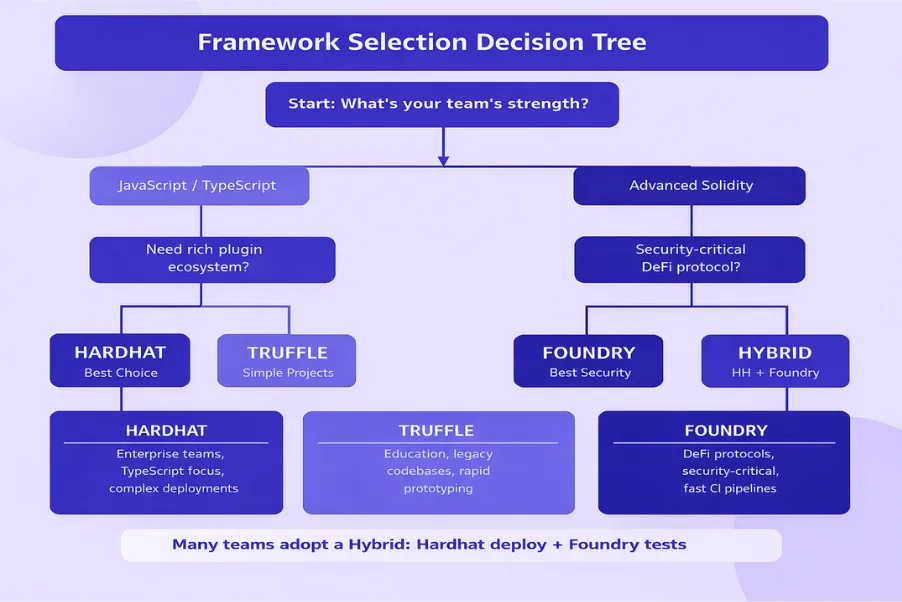
Step 1: Assess Team Language Proficiency
Evaluate whether your team’s primary strength is JavaScript/TypeScript (favors Hardhat or Truffle) or advanced Solidity (favors Foundry). Language comfort determines productivity more than any feature difference between these Web3 smart contract frameworks.
Step 2: Define Security and Performance Requirements
If your protocol will manage significant user funds or require professional security audits, Foundry’s fuzz and invariant testing capabilities are not optional extras but essential risk controls. If your priority is rapid iteration and rich debugging, Hardhat’s toolset provides the best developer experience.
Step 3: Evaluate Ecosystem and Long-Term Fit
Consider the plugins, integrations, and community resources your project will depend on over a 2-3 year horizon. Hardhat’s plugin ecosystem is the most mature; Foundry’s is growing fastest. Truffle’s ecosystem has contracted since Consensys’s restructuring, a long-term maintenance consideration for new projects.
Factors to Consider When Choosing a Smart Contract Framework
Project Requirements and Complexity
The complexity of your smart contract system should be the primary driver of your framework selection within the hardhat-vs-truffle-vs-foundry decision matrix. Simple ERC-20 tokens or basic NFT contracts are well served by any of the three frameworks. Mid-complexity projects like multi-signature wallets, token vesting contracts, or simple AMMs benefit most from Hardhat’s debugging capabilities and TypeScript integration. Highly complex systems like full-featured lending protocols, cross-chain bridges, or liquid staking derivatives demand Foundry’s invariant testing and fuzzing capabilities – the security stakes are simply too high to rely on deterministic unit tests alone. Teams in the UAE deploying financial instruments on-chain must also consider regulatory compliance requirements that may influence framework choice based on available audit tooling integrations.
| Factor | Hardhat | Truffle | Foundry |
|---|---|---|---|
| Team Size | Any size | Small-Medium | Medium-Large |
| Project Complexity | Medium-High | Low-Medium | High |
| Security Priority | High | Medium | Very High |
| Speed to Market | Fast | Fastest | Medium |
| Audit Readiness | Good | Adequate | Excellent |
| Long-term Maintenance | Excellent | Fair | Excellent |
Developer Experience and Team Size
Team size introduces important ergonomic considerations that are often underweighted in framework evaluations. Small teams of one to three engineers can absorb the learning curve of any framework and often prefer Foundry for its raw power and speed. Medium-sized teams of four to fifteen engineers benefit most from Hardhat’s TypeScript integration and plugin ecosystem, which enforces consistency across contributors. Large organizations with dedicated blockchain infrastructure teams in multiple time zones – common in USA-based financial institutions building Web3 products – tend to standardize on Hardhat because its conventions and plugin system scale predictably across large, distributed codebases. Truffle is increasingly being used as a teaching tool in these organizations rather than as the primary production framework for new projects.
Long-Term Scalability and Maintenance
Long-term maintenance is perhaps the most underappreciated factor in the hardhat-vs-truffle-vs-foundry decision. Framework choice creates path dependencies that become increasingly expensive to change as a codebase grows. Hardhat and Foundry are both actively maintained by well-funded organizations with strong community backing – Hardhat by Nomic Foundation and Foundry by the open-source community with Paradigm support. Truffle’s long-term trajectory is less clear following Consensys’s 2023 workforce reduction, which led to reduced active maintenance of the Truffle Suite. New projects in the UK, USA, UAE, and Canada should factor this maintenance uncertainty into their selection process, particularly for systems expected to operate for five or more years.
Future of Smart Contract Frameworks
The landscape of Web3 smart contract frameworks is evolving rapidly, driven by the maturation of the broader blockchain ecosystem, increasing regulatory pressure in established markets, and the emergence of new execution environments beyond the EVM. Understanding where the tooling is heading helps teams make forward-looking framework investments today.
Emerging Trends in Blockchain Tooling
Several converging trends are reshaping the decentralized application tools space. Formal verification integration is moving from an exotic academic practice to a practical engineering requirement for high-value protocols. Tools like Certora’s Prover and Halmos are being integrated into both Hardhat and Foundry workflows, enabling mathematical proofs of contract properties alongside traditional testing. Multi-chain native tooling is becoming essential as protocols deploy across dozens of EVM-compatible networks simultaneously. The emergence of ZK-EVM networks like Polygon zkEVM and zkSync introduces new compilation targets that existing frameworks are adapting to support. Additionally, the rise of Account Abstraction and ERC-4337 wallets is creating demand for new testing infrastructure that can simulate complex multi-operation transaction bundles – an area where all three frameworks are actively investing.
Increasing Focus on Performance and Security
The industry-wide push toward higher security standards is accelerating the adoption of Foundry’s testing model even among teams that prefer Hardhat for their primary workflow. Many professional teams in the USA and UK now maintain a hybrid approach: using Hardhat for its debugging and deployment tooling while running their test suites in Foundry for the fuzz testing benefits. This hybrid pattern, enabled by the compatibility of Hardhat and Foundry with the same Solidity codebase, is likely to become the dominant production pattern for serious protocol engineering. Performance improvements are also coming to the JavaScript-based frameworks: Hardhat’s incremental compilation has improved significantly in recent versions, and community work on Rust-based JavaScript runtimes like Bun and Deno may eventually reduce the speed gap between Node.js-based and Rust-based frameworks.
Authoritative Industry Standards for Smart Contract Tooling
Standard 1: All production smart contracts must pass a minimum 85% branch coverage threshold verified by automated tooling before any external audit engagement begins.
Standard 2: DeFi protocols managing over $5M in user assets should implement Foundry invariant testing across all core financial functions before mainnet launch.
Standard 3: Compiler version pinning is mandatory across all environments. Floating pragma statements like ^0.8.0 are prohibited in production contract repositories.
Standard 4: Every deployment script must be reproducible and idempotent. Re-running a deployment against an already-deployed system should produce no state changes or errors.
Standard 5: Mainnet fork tests must execute against pinned block numbers to ensure reproducibility across CI runs and prevent flaky test results from state changes.
Standard 6: Gas usage benchmarks should be recorded and compared across every PR merge to detect regressions before they compound into economically unviable contract operations.
Standard 7: Access control tests must cover all privileged function combinations across all role permutations. Missing access control tests are the single most common source of critical smart contract vulnerabilities.
Standard 8: Upgrade pattern tests must verify that storage layout is preserved across all proxy upgrades. Storage collision bugs have caused multi-million dollar losses in production protocols.
Ready to Build Secure Smart Contracts?
Our expert team helps enterprises in the USA, UK, UAE, and Canada select, configure, and scale the right Web3 smart contract framework for their exact needs.
Frequently Asked Questions
Q1.What is the best Web3 smart contract framework for beginners?
Truffle is generally considered the most beginner-friendly smart contract framework because of its convention-over-configuration structure and the Ganache GUI, which visually displays blocks, transactions, and accounts. Its nine-plus year history means there is an enormous library of tutorials, YouTube videos, and Stack Overflow threads to draw from. However, Hardhat is a close second for beginners with JavaScript experience, since its scaffolding command generates a complete working project instantly.
Q2.How does Foundry differ from Hardhat and Truffle?
Foundry is written in Rust and allows engineers to write tests directly in Solidity, eliminating the need for JavaScript. Its native fuzz testing and invariant testing capabilities run thousands of randomized inputs automatically, catching edge-case vulnerabilities that hand-written tests miss. Foundry’s Rust binaries compile and test 5 to 10 times faster than Node.js-based alternatives, making it the preferred choice for security-critical DeFi protocols.
Q3.Can you use Hardhat and Foundry together?
Yes, many professional teams use a hybrid approach: Hardhat handles deployment scripting, TypeScript integration, and plugin-based workflows, while Foundry handles the test suite for its fuzz and invariant testing capabilities. Both frameworks support the same Solidity codebase, so teams can run Hardhat for deployment and Foundry for testing without maintaining separate contract codebases, getting the best of both toolkits.
Q4.Is Truffle still worth using in 2025 and 2026?
Truffle remains useful for educational contexts, legacy codebases, and teams that rely on the Ganache GUI for stakeholder demonstrations. However, following Consensys’s restructuring and reduced maintenance activity, new projects are generally advised to choose Hardhat or Foundry. Truffle’s ecosystem has contracted compared to its peak, and its long-term maintenance trajectory introduces risk for projects with multi-year lifespans.
Q5.Which framework do professional blockchain auditors prefer?
Professional security auditors increasingly prefer Foundry because tests are written in Solidity, making them easier to audit alongside the production code. Foundry’s fuzz testing and invariant capabilities allow auditors to write property-based tests that mathematically verify protocol correctness. Many leading audit firms including Spearbit and Trail of Bits have standardized internal tooling around Foundry’s forge test runner for protocol security assessments.
Q6.What is the performance difference between Hardhat and Foundry?
In benchmark comparisons across real DeFi protocol codebases, Foundry consistently compiles a fifty-contract project in under three seconds versus eight to twelve seconds for Hardhat. Foundry’s test execution is five to ten times faster due to parallel execution and native Rust performance. For CI/CD pipelines running hundreds of times daily, this speed advantage translates to significant cloud compute cost savings and shorter feedback loops for engineering teams.
Q7.Which Web3 smart contract framework is best for DeFi protocols?
Foundry is the consensus choice for DeFi protocols managing significant user assets. Its native fuzz testing runs over a thousand randomized inputs per test function, invariant testing validates system-wide properties across random operation sequences, and its Solidity-native test environment eliminates context-switching. For DeFi teams in the USA and UK managing multi-million dollar protocols, Foundry’s security tooling is not an optional extra but an essential risk management practice.
Explore Services
Related Services
Reviewed by

Aman Vaths
Founder of Nadcab Labs
Aman Vaths is the Founder & CTO of Nadcab Labs, a global digital engineering company delivering enterprise-grade solutions across AI, Web3, Blockchain, Big Data, Cloud, Cybersecurity, and Modern Application Development. With deep technical leadership and product innovation experience, Aman has positioned Nadcab Labs as one of the most advanced engineering companies driving the next era of intelligent, secure, and scalable software systems. Under his leadership, Nadcab Labs has built 2,000+ global projects across sectors including fintech, banking, healthcare, real estate, logistics, gaming, manufacturing, and next-generation DePIN networks. Aman’s strength lies in architecting high-performance systems, end-to-end platform engineering, and designing enterprise solutions that operate at global scale.