Ai Overview
Building applications on Ethereum demands more than functional smart contracts. As the ecosystem matures and user expectations rise, high-performance Ethereum development has become essential for creating Web3 solutions that can compete with traditional applications. Performance encompasses transaction throughput, gas efficiency, response times, and the overall user experience that determines whether users adopt decentralized alternatives or return to centralized options.
Key Takeaways
- Truffle Framework provides a comprehensive suite for Ethereum smart contracts including compilation, testing, deployment, and frontend integration through Ganache and Drizzle
- High-performance Ethereum development requires optimized smart contract architecture, gas-efficient execution, and performance-focused design patterns from the start
- Automated testing with Truffle catches bugs early through JavaScript and Solidity test frameworks with clean room environments and deterministic execution [1]
- Truffle migrations enable version-controlled, repeatable deployments across testnets and mainnet with network-specific configurations and dependency management
- Ganache provides instant blockchain simulation for rapid iteration, allowing teams to test transactions and debug contracts without gas costs or confirmation delays
- Gas optimization techniques including storage minimization, optimizer settings, and efficient data structures significantly reduce transaction costs in production
- Drizzle simplifies frontend integration by managing Web3 instantiation, contract state, and real-time synchronization with blockchain data automatically
- Truffle supports Layer 2 solutions and evolving Ethereum standards, enabling scalable applications that leverage both L1 security and L2 performance
Introduction to High-Performance Ethereum App Development
Building applications on Ethereum demands more than functional smart contracts. As the ecosystem matures and user expectations rise, high-performance Ethereum development has become essential for creating Web3 solutions that can compete with traditional applications. Performance encompasses transaction throughput, gas efficiency, response times, and the overall user experience that determines whether users adopt decentralized alternatives or return to centralized options.
The Truffle Framework has emerged as one of the most trusted Web3 development frameworks for teams building production-grade Ethereum applications. Its comprehensive tooling addresses the full lifecycle of Ethereum dApp development, from initial contract creation through deployment and frontend integration. Understanding how to leverage Truffle effectively unlocks the ability to build scalable, maintainable, and high-performing decentralized applications.
Evolution of Ethereum Web3 Applications
Ethereum Web3 development has evolved dramatically from early experiments to sophisticated applications managing billions in value.
Growing Demand for Scalable Ethereum Apps
The explosion of DeFi, NFTs, and decentralized governance has created unprecedented demand for Ethereum applications that perform reliably under load. Early dApps could tolerate slow transactions and high costs because users had few alternatives, but today’s competitive landscape requires applications that deliver smooth experiences. Users expect sub-second interface updates, reasonable transaction costs, and reliability that matches centralized services they are accustomed to using.
This demand drives investment in both infrastructure improvements like Layer 2 solutions and application-level optimizations that extract maximum performance from existing capabilities. Teams building for scale must consider performance from initial architecture through every development decision.
Performance Challenges in Traditional dApps
Traditional dApps face inherent performance challenges including blockchain confirmation times, gas costs that spike during network congestion, and the complexity of maintaining consistent state between on-chain and off-chain components. Poorly optimized contracts can become prohibitively expensive during high-demand periods, while inefficient frontend architectures create laggy experiences that frustrate users. These challenges require systematic approaches to optimization across the entire application stack.
Role of Truffle in Modern Web3 Development
Truffle addresses performance challenges by providing structured tooling that encourages best practices throughout the development process.
Why Truffle Is Widely Used for Ethereum Development
Truffle Ethereum development has become standard practice because the framework reduces complexity while enabling sophisticated applications. Its integrated approach means teams spend less time configuring tools and more time building features. The large community provides extensive documentation, tutorials, and third-party plugins that accelerate development. Many auditors and security professionals are familiar with Truffle project structures, streamlining the security review process.
Truffle Framework Overview
The Truffle Framework encompasses smart contract compilation, automated testing, scriptable deployment through migrations, and network management. It integrates with Ganache for local blockchain simulation and Drizzle for frontend state management. This comprehensive approach ensures consistency across development stages while providing flexibility for project-specific requirements.
Understanding Truffle Framework for Ethereum Development
Deep understanding of Truffle’s architecture enables teams to leverage its full capabilities for building optimized applications.
What Is Truffle Framework
Truffle Framework provides the foundational tooling that professional Ethereum projects require.
Definition and Core Features of Truffle
Truffle Framework is a comprehensive development environment, testing framework, and asset pipeline for Ethereum that aims to make blockchain development easier. Core features include built-in smart contract compilation with configurable optimization, automated contract testing with Mocha and Chai integration, scriptable deployment and migration management, and network lifecycle management for deploying to any Ethereum network. These features combine to provide an end-to-end solution for Solidity development.
Truffle Suite Components
The Truffle Suite extends beyond the core framework to include complementary tools that address the complete application lifecycle. Ganache provides personal blockchain simulation for rapid local testing. Drizzle offers reactive frontend libraries for React applications. Together, these Truffle Suite tools create an integrated ecosystem where each component works seamlessly with others.
| Component | Purpose | Key Features |
|---|---|---|
| Truffle Core | Contract compilation and deployment | Migrations, testing, network config |
| Ganache | Local blockchain simulation | Instant mining, state snapshots, forking |
| Drizzle | Frontend state management | React integration, real-time sync |
| Truffle Teams | DevOps and monitoring | CI/CD, deployment tracking, alerts |
How Truffle Supports Web3 Solutions
Truffle’s architecture directly addresses the requirements of production Web3 solutions.
Smart Contract Lifecycle Management
Truffle manages the complete smart contract lifecycle from initial compilation through deployment and upgrades. The migration system tracks which contracts have been deployed to which networks, preventing duplicate deployments and ensuring consistency across environments. This lifecycle management is essential for teams maintaining contracts across testnets and mainnet while iterating on new features.
Seamless Integration with Web3 Tools
Truffle integrates seamlessly with the broader Ethereum tooling ecosystem including OpenZeppelin contracts, various wallet providers, block explorers, and monitoring services. This interoperability means teams can adopt Truffle without abandoning existing tools or workflows. Organizations seeking to build enterprise Ethereum applications and DeFi platforms leverage this integration flexibility to create comprehensive solutions.
High-Performance Ethereum App Development Using Truffle
Achieving high performance requires intentional design and optimization throughout the development process.
Building Scalable Ethereum Applications
Scalability begins with architecture decisions that accommodate growth without requiring complete rewrites.
Optimized Smart Contract Development
Optimized smart contract architecture separates concerns appropriately, minimizes on-chain storage, and designs for upgradeability where requirements may evolve. Truffle’s project structure encourages modular contract design where functionality splits across focused contracts that can be tested and upgraded independently. This modularity improves both maintainability and gas efficiency by deploying only the code needed for specific functionality.
Performance-Focused Architecture Design
Performance-focused architecture considers the entire application stack including off-chain components that can reduce on-chain load. Patterns like lazy evaluation, batch processing, and strategic caching reduce transaction frequency while maintaining data integrity. Truffle’s testing framework enables thorough validation of these optimization strategies before deployment.
Important: Performance optimization should never compromise security. Every optimization must be thoroughly tested, and gas savings that introduce vulnerabilities cost far more than the savings are worth. Always prioritize security over micro-optimizations.
Gas-Efficient Smart Contract Execution
Gas efficiency directly impacts user experience and application viability in production environments.
Gas Optimization Techniques
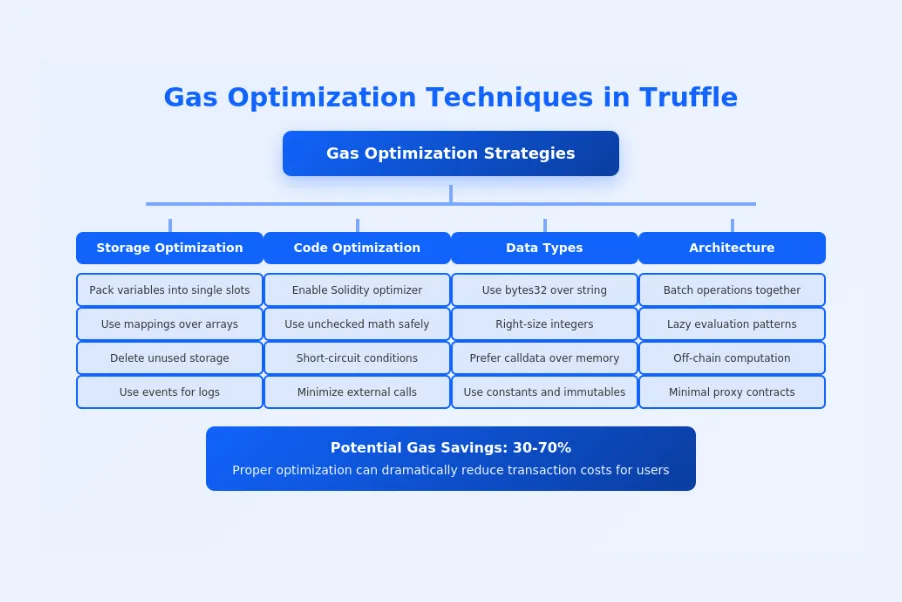
Gas optimization encompasses multiple techniques including storage packing, memory versus storage selection, loop optimization, and efficient data structure choices. Truffle’s compilation settings allow enabling the Solidity optimizer with configurable run counts balancing deployment costs against execution costs. The framework’s gas reporting during testing identifies expensive operations that warrant optimization attention.
Reducing Transaction Costs in Ethereum Apps
Transaction cost reduction involves both individual operation optimization and architectural decisions that minimize required transactions. Batch operations combine multiple actions into single transactions where appropriate. Event-based architectures use logs instead of storage for data that only needs off-chain access. These patterns, tested thoroughly in Truffle’s environment, can reduce costs by orders of magnitude.
Smart Contract Development and Testing with Truffle
Robust testing forms the foundation of reliable, high-performance smart contracts.
Writing Smart Contracts with Solidity
Solidity development within Truffle follows established patterns that promote quality and maintainability.
Smart Contract Structure and Best Practices
Well-structured Ethereum smart contracts follow consistent patterns for state variable ordering, function visibility, and modifier usage. Truffle projects organize contracts in the contracts directory with clear naming conventions and logical grouping. Interface definitions, abstract contracts, and inheritance hierarchies enable code reuse while maintaining clarity about contract capabilities and dependencies.
Security-Oriented Development Approach
Security-oriented Solidity development integrates security considerations from initial design rather than treating security as an afterthought. This approach includes using established patterns from OpenZeppelin, implementing checks-effects-interactions ordering, applying principle of least privilege to access control, and designing for fail-safe defaults. Truffle’s testing framework enables comprehensive security testing as part of the standard development workflow.
Testing and Debugging Smart Contracts
Comprehensive testing with Truffle catches issues before they reach production.
Automated Testing with Truffle
Automated testing with Truffle leverages Mocha test framework with Chai assertions, providing familiar patterns for JavaScript developers. Tests run against Ganache for instant feedback without gas costs. Clean room environments ensure each test starts from known state, preventing test interdependencies that mask bugs. Both JavaScript tests for integration scenarios and Solidity tests for internal logic validation are supported.
Debugging and Error Handling
Truffle provides debugging capabilities including transaction tracing, stack traces for failed transactions, and integration with Ganache’s debugging features. The truffle debug command enables stepping through transaction execution to identify exactly where and why failures occur. Proper error handling in contracts combined with descriptive revert messages makes debugging production issues faster.
| Phase | Stage | Truffle Commands | Outputs |
|---|---|---|---|
| 1 | Initialization | truffle init | Project structure and config |
| 2 | Contract Writing | Edit .sol files in /contracts | Solidity source files |
| 3 | Compilation | truffle compile | ABI and bytecode artifacts |
| 4 | Testing | truffle test | Test results and gas reports |
| 5 | Migration | truffle migrate | Deployed contract addresses |
| 6 | Verification | truffle run verify | Verified source on explorer |
Deployment and Configuration of Ethereum Apps
Proper deployment configuration ensures reliable transitions from testing to production.
Ethereum App Deployment Using Truffle
Truffle’s deployment system provides structured, repeatable processes for all network targets.
Deploying Contracts on Testnet and Mainnet
Deploying contracts on testnet and mainnet follows identical processes with different network configurations. Truffle migrations execute in order, deploying contracts and recording addresses for reference by subsequent migrations. This deterministic process ensures that the same contracts deploy the same way regardless of target network, reducing environment-specific bugs.
Network Configuration and Environment Setup
The truffle-config.js file defines network endpoints, gas settings, and account configurations for each target environment. Environment variables secure sensitive data like private keys and API endpoints. This separation of configuration from code enables secure, flexible deployments across development, staging, and production environments.
Continuous Integration and Deployment
CI/CD automation ensures consistent quality and reduces deployment risks.
CI/CD Pipelines for Ethereum Web3 Projects
CI/CD pipelines for Ethereum Web3 projects automate compilation, testing, security scanning, and deployment across environments. Truffle integrates with standard CI platforms like GitHub Actions, GitLab CI, and CircleCI through command-line execution. Automated pipelines catch regressions immediately, enforce code quality standards, and provide audit trails for all deployments.
Version Control and Deployment Automation
Version control best practices include committing compiled artifacts, maintaining deployment records, and tagging releases that correspond to mainnet deployments. Automation scripts handle common tasks like gas price monitoring before deployment, verification on block explorers, and notification of successful deployments. This automation reduces human error and ensures consistent processes.
Selecting Ethereum Frameworks: Key Criteria
When choosing between Truffle and alternative frameworks, consider these essential factors:
- Team Experience: Truffle’s established patterns suit teams familiar with JavaScript testing frameworks
- Project Complexity: Full-suite tools benefit complex projects; simpler projects may prefer lighter options
- Testing Requirements: Evaluate testing speed, debugging capabilities, and coverage reporting needs
- Frontend Integration: Drizzle provides value for React-based frontends requiring reactive state
- Community Support: Consider available tutorials, plugins, and community responsiveness
- L2 Compatibility: Ensure framework supports target Layer 2 networks and deployment patterns
Enhancing Web3 Solutions with Truffle Tools
The broader Truffle Suite provides specialized tools that enhance development productivity and application quality.
Ganache for Local Blockchain Development
Ganache accelerates development through instant, controllable blockchain simulation.
Simulating Ethereum Networks
Ganache simulates Ethereum networks with configurable parameters including block time, gas limits, and account balances. The simulation supports both instant mining for fast testing and timed blocks for realistic behavior testing. Forking mode allows testing against mainnet state with local modifications, enabling realistic integration testing against real contract deployments.
Faster Development and Testing Cycles
Instant transaction confirmation eliminates waiting that slows development on live networks. State snapshots enable reverting to known states for repeated testing scenarios. These capabilities transform testing from a slow, expensive process to rapid iteration that encourages thorough coverage and experimentation.
Drizzle for Frontend Integration
Drizzle bridges the gap between smart contracts and user interfaces.
Connecting Smart Contracts to UI
Drizzle abstracts Web3 complexity by managing provider instantiation, contract initialization, and method calls through a clean API. React components access contract data through hooks and higher-order components that handle loading states and error conditions. This abstraction lets frontend developers focus on user experience rather than blockchain connection details.
Real-Time Data Synchronization
Real-time synchronization keeps the UI current with blockchain state through event subscriptions and polling strategies. Drizzle’s caching layer optimizes performance by avoiding redundant reads while ensuring data freshness. This synchronization is essential for applications where users expect immediate feedback on their actions.
Streamlined Ethereum Development with Truffle
Leverage Truffle to streamline Ethereum development, enhance smart contract quality, and accelerate Web3 product launches.
Security and Best Practices in Truffle-Based Development
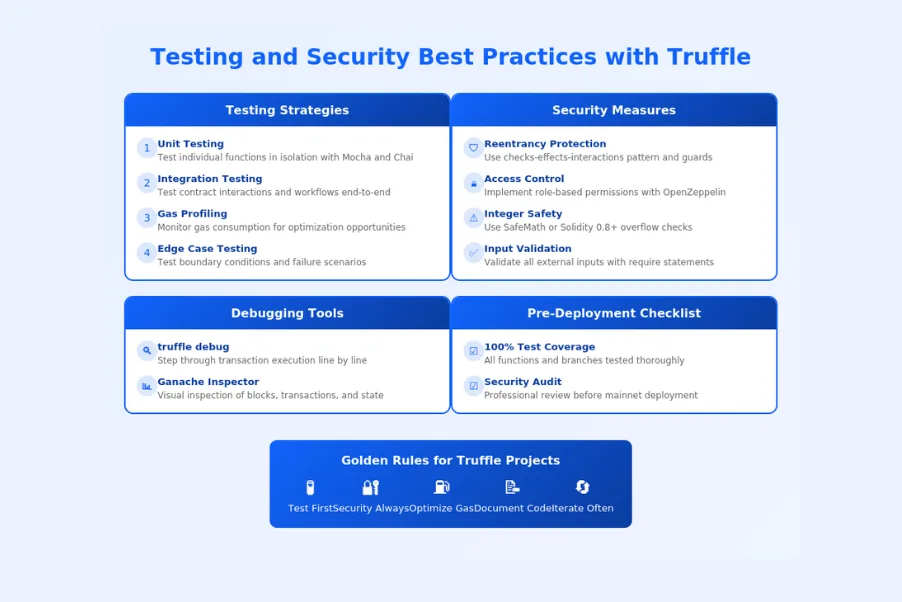
Security considerations must permeate every stage of Truffle-based development.
Smart Contract Security Considerations
Security-first development prevents costly vulnerabilities in production contracts.
Preventing Common Ethereum Vulnerabilities
Common vulnerabilities including reentrancy, integer overflow, and access control failures require systematic prevention through established patterns. Truffle projects typically import OpenZeppelin contracts that implement battle-tested security patterns. Comprehensive testing including edge cases and attack scenarios validates that contracts behave correctly under adversarial conditions.
Secure Access Control Mechanisms
Access control mechanisms restrict sensitive functions to authorized callers using role-based permissions, multi-signature requirements, or time-locked execution. Truffle tests verify that access control works correctly by testing both authorized and unauthorized access attempts. These mechanisms prevent unauthorized modifications while enabling legitimate administrative actions.
| Feature | Truffle | Hardhat |
|---|---|---|
| Compilation Speed | Standard | Faster with caching |
| Local Network | Ganache (separate tool) | Built-in Hardhat Network |
| Debugging | truffle debug command | console.log in Solidity |
| Frontend Tools | Drizzle included | Separate integration needed |
| TypeScript Support | Supported | First-class support |
| Plugin Ecosystem | Established | Growing rapidly |
Best Practices for High-Performance Web3 Apps
Best practices ensure applications remain maintainable and performant as they evolve.
Code Optimization and Maintainability
Code optimization balances gas efficiency with readability and maintainability. Clear naming conventions, comprehensive documentation, and consistent patterns make contracts easier to audit and maintain. Truffle’s project structure encourages organization that scales with project complexity while remaining navigable for new team members.
Auditing and Monitoring Smart Contracts
Professional security audits before mainnet deployment identify vulnerabilities that internal testing may miss. Post-deployment monitoring tracks contract behavior, detecting anomalies that could indicate attacks or unexpected conditions. Truffle Teams provides monitoring capabilities, while various third-party services offer specialized blockchain monitoring.
Use Cases of Truffle in Web3 Solutions
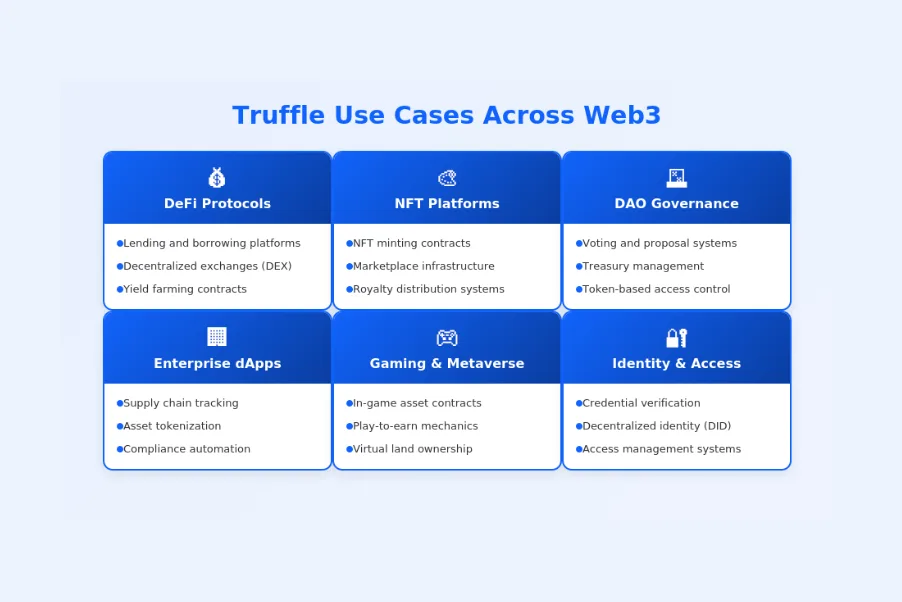
Truffle powers diverse Web3 solutions across DeFi, NFTs, and enterprise applications.
DeFi and Financial Applications
DeFi applications demand the highest standards for security and performance that Truffle supports.
High-Performance DeFi Smart Contracts
High-performance DeFi smart contracts require gas optimization for user affordability and architectural efficiency for protocol sustainability. Truffle’s testing framework enables thorough validation of complex financial logic including edge cases around rounding, overflow, and economic attacks. Many leading DeFi protocols were built and continue to be maintained using Truffle.
Secure Transaction Processing
Secure transaction processing in DeFi requires atomic operations, proper access control, and economic security against manipulation. Truffle tests simulate attack scenarios to verify contracts behave correctly under adversarial conditions. This security focus is essential when contracts manage significant value.
NFTs, DAOs, and Enterprise dApps
Beyond DeFi, Truffle serves diverse application categories with varying requirements.
NFT Marketplace Development
NFT marketplace applications require efficient metadata handling, royalty distribution logic, and auction mechanisms. Truffle’s testing capabilities validate complex marketplace logic including bid processing, escrow management, and fee distribution. Gas optimization is particularly important for NFT operations that users may perform frequently.
Enterprise-Grade Ethereum Applications
Enterprise applications require compliance features, access control hierarchies, and integration with existing systems. Truffle’s structured approach appeals to enterprise teams familiar with conventional development practices, including experienced app developers working within established workflows. The framework’s maturity and extensive documentation support enterprise adoption where stability and predictability are priorities.
Future of Ethereum App Development with Truffle
Truffle continues evolving to support emerging Ethereum capabilities and development practices.
Truffle’s Role in Next-Generation Web3
Truffle adapts to support the evolving Ethereum ecosystem including Layer 2 scaling and new standards.
Supporting Layer 2 Solutions
Layer 2 deployment through Truffle requires network configuration updates but preserves familiar workflows. Teams deploy identical contracts to L1 and L2 networks, testing on both to ensure consistent behavior. This L2 support enables building high-performance applications that leverage scaling solutions while maintaining Truffle’s productivity benefits.
Compatibility with Evolving Ethereum Standards
Truffle maintains compatibility with evolving Ethereum standards including new EIPs, Solidity versions, and ecosystem tools. Regular updates ensure teams can adopt new capabilities without framework changes. This ongoing compatibility protects investment in Truffle expertise and existing codebases.
Trends in High-Performance Web3 Development
Emerging trends shape how teams will build high-performance Web3 applications.
Scalable and Modular Ethereum Apps
Modular architectures separate concerns across specialized contracts and layers, enabling independent scaling and upgrading. Truffle’s migration system supports these architectures by managing complex deployment dependencies. The trend toward modularity aligns with Truffle’s structured approach to project organization.
Enterprise Adoption of Web3 Solutions
Enterprise adoption accelerates as Web3 solutions mature and tooling like Truffle makes development more accessible. Enterprises value Truffle’s established patterns, comprehensive documentation, and familiar JavaScript-based workflows. As enterprises build more blockchain applications, frameworks that reduce learning curves and implementation risks will see increased adoption.
Final Thoughts on Building Scalable Web3 Solutions
Building scalable Web3 solutions requires intentional architecture, thorough testing, and continuous optimization throughout the development lifecycle. Truffle Ethereum development provides the structured environment that supports these practices while remaining flexible enough for diverse project requirements. As Ethereum continues evolving with Layer 2 solutions and new standards, Truffle’s ongoing updates ensure teams can leverage new capabilities without abandoning familiar workflows.
The future of high-performance Ethereum development belongs to teams that combine solid fundamentals with modern tooling. Truffle Framework represents one proven path to building applications that perform reliably, scale appropriately, and deliver the user experiences that drive Web3 adoption. For teams committed to excellence in Ethereum dApp development, mastering Truffle provides capabilities that translate directly to production success.
Frequently Asked Questions
Q1.What is Truffle Framework in Ethereum development?
Truffle Framework is a comprehensive suite of tools designed to streamline Ethereum smart contract creation, testing, and deployment. It provides a structured environment with built-in compilation, linking, deployment management, and automated testing capabilities for Solidity projects. Truffle has become one of the most widely adopted Web3 development frameworks due to its robust feature set and active community support.
Q2.How does Truffle help with smart contract testing?
Truffle provides an integrated testing framework that supports both JavaScript and Solidity-based tests, allowing teams to write comprehensive test suites for their smart contracts. It includes a built-in assertion library, clean room testing environments, and the ability to test against Ganache for fast, deterministic results. Automated testing with Truffle catches bugs early and ensures contract behavior matches specifications before deployment.
Q3.What is Ganache and how does it work with Truffle?
Ganache is a personal blockchain simulator that is part of the Truffle Suite, providing a local Ethereum network for rapid testing without spending real gas or waiting for block confirmations. It offers both a graphical interface (Ganache UI) and command-line version (Ganache CLI) that integrate seamlessly with Truffle projects. Teams use Ganache to simulate various network conditions, test transaction behaviors, and debug contracts in a controlled environment.
Q4.What are Truffle migrations and why are they important?
Truffle migrations are JavaScript files that define how smart contracts should be deployed, including order, constructor arguments, and dependencies between contracts. They provide version-controlled deployment history that tracks which migrations have run on which networks, preventing duplicate deployments. Migrations enable consistent, repeatable deployments across different environments from local testing to production mainnet.
Q5.How can I optimize gas usage when developing with Truffle?
Truffle supports gas optimization through its compilation settings, allowing teams to configure the Solidity optimizer for production deployments. The framework provides gas reporting during testing to identify expensive operations, and teams can analyze deployment costs before going to mainnet. Best practices include minimizing storage operations, using appropriate data types, and leveraging Truffle’s optimization settings in truffle-config.js.
Q6.What security features does Truffle provide for smart contract development?
Truffle integrates with security analysis tools and supports comprehensive testing that helps identify vulnerabilities before deployment. The framework encourages best practices through its project structure and testing patterns that catch common issues like reentrancy and access control problems. While Truffle itself is not a security tool, its ecosystem includes plugins for static analysis and integration with professional audit services.
Explore Services
Related Services
Reviewed by

Aman Vaths
Founder of Nadcab Labs
Aman Vaths is the Founder & CTO of Nadcab Labs, a global digital engineering company delivering enterprise-grade solutions across AI, Web3, Blockchain, Big Data, Cloud, Cybersecurity, and Modern Application Development. With deep technical leadership and product innovation experience, Aman has positioned Nadcab Labs as one of the most advanced engineering companies driving the next era of intelligent, secure, and scalable software systems. Under his leadership, Nadcab Labs has built 2,000+ global projects across sectors including fintech, banking, healthcare, real estate, logistics, gaming, manufacturing, and next-generation DePIN networks. Aman’s strength lies in architecting high-performance systems, end-to-end platform engineering, and designing enterprise solutions that operate at global scale.