Ai Overview
Not legal by default: Smart contracts are self-executing programs, not legal documents. Their legal validity depends on local laws and supporting agreements. Security is not automatic: Smart contracts are not 100% secure by default. Believing they are 100% secure can make users careless and lead to financial losses.
Key Takeaways: Smart Contract Myths and Facts
- Not legal by default: Smart contracts are self-executing programs, not legal documents. Their legal validity depends on local laws and supporting agreements.
- Security is not automatic: Smart contracts are not 100% secure by default. Proper coding, testing, and professional audits are essential to prevent vulnerabilities.
- No direct real-world access: Smart contracts cannot fetch real-world data on their own. They rely on oracles for information like prices, weather, or delivery status.
- Humans are still essential: Developers, auditors, legal experts, and communities design, review, and govern smart contracts to ensure safety and fairness.
- Upgradability is possible: Not all smart contracts are permanent. Many modern contracts support upgrades through smart design or governance mechanisms.
- Automation reduces middlemen: Smart contracts automate payments, ownership transfers, and agreements—saving time and operational costs.
- Widely used in 2026: Smart contracts power DeFi, NFTs, gaming, insurance, supply chains, DAOs, and digital identity systems.
- They don’t fully replace legal systems: Smart contracts work alongside traditional contracts to improve efficiency and transparency.
- Understanding myths prevents risk: Knowing the difference between myths and facts helps avoid financial loss, legal issues, and security mistakes.
- Future is human + tech: The future of smart contracts lies in collaboration between human judgment and automated blockchain systems.
Smart contracts have changed the way digital agreements work. Instead of depending on banks, lawyers, or middlemen, these contracts run automatically on blockchain networks. They are now used in many areas such as finance, NFTs, gaming, insurance, supply chains, and online payments. Because they handle money, ownership, and important business actions, people often expect them to be perfect.
However, there is still a lot of confusion about what smart contracts can and cannot do. Some people think they are legally valid everywhere, completely secure, or able to replace humans. Others believe they are risky or only useful for cryptocurrency. These misunderstandings can lead to poor decisions, financial loss, and security problems.
This blog explains the real truth behind smart contracts by separating common myths from real facts. It also compares smart contracts with traditional contracts and shows their actual state in 2026. By understanding how smart contracts truly work, users, businesses, and developers can use them more safely, wisely, and effectively.
Why Smart Contract Myths and Facts Matter
Smart contracts are programs on a blockchain that automatically execute agreements when certain conditions are met. They are used in finance, gaming, insurance, supply chains, NFTs, and more. However, many people still have wrong ideas about them. Some believe they are completely safe, legally binding everywhere, or can replace humans entirely. Others think they are too risky or only useful for cryptocurrency.
Knowing the facts about smart contracts is important because these misconceptions can lead to financial losses, security risks, and poor decisions. For example, assuming a contract is perfectly secure might make someone invest without checking for errors, which can lead to theft. Believing a contract is legally valid everywhere might result in problems if a dispute arises in a country where blockchain contracts are not recognized.
Understanding the real facts helps users, businesses, and developers make smart choices. It ensures proper auditing, governance, and testing are done. It also helps people set realistic expectations about what smart contracts can and cannot do.
Smart Contract Myths and Facts in 2026
Some people think smart contracts are always legal, completely safe, or replace humans. The truth is they are automated programs on blockchain that need good coding, checks, and human help to work properly and safely. Here’s what is true and what is not:
Common Smart Contract Myths
Even in 2026, many people still misunderstand what smart contract services really are and how they work. Because they deal with money, ownership, and automated agreements, wrong ideas can lead to serious problems. Let’s look at the most common myths about smart contracts and understand the truth behind them.
1. “They are legally valid everywhere automatically.”
Many people believe that if a contract is written on a blockchain, it is automatically a legal contract. This is not true. A smart contract is mainly a technical program, not a legal document. Whether it is legally enforceable depends on the laws of your country and whether it is connected to a traditional legal agreement.
For example, two businesses might use a smart contract to handle payments. But if a dispute arises, a court may not accept the blockchain contract alone unless there is a proper legal agreement supporting it. This myth is dangerous because it can make people skip legal steps that are still necessary.
2. “Smart contracts are completely secure.”
Another common belief is that smart contracts are perfectly safe and cannot be hacked. While blockchains themselves are highly secure, smart contracts are written by humans, and humans can make mistakes. A small error in the code can allow attackers to exploit the contract.
There have been many cases where hackers drained funds from DeFi platforms because of bugs or poorly written logic. This does not mean smart contracts are unsafe, but it shows that security depends on good coding, testing, and auditing. Believing they are 100% secure can make users careless and lead to financial losses.
3. “They can access real-world data by themselves.”
Some people think smart contracts can directly check things like weather, prices, delivery status, or flight delays. In reality, smart contracts cannot access external information on their own. They only work with data that exists on the blockchain.
According to 101blockchains, To use real-world data, smart contracts rely on oracles, which are services that bring outside information onto the blockchain. If the oracle provides wrong or manipulated data, the smart contract will still act on it. This shows that smart contracts are powerful, but they are not independent of external systems.
4. “Once deployed, they cannot be changed.”
Many believe that smart contracts are permanent and can never be updated. While early smart contracts were often rigid, modern designs are much more flexible. Today, many smart contracts are built with upgrade mechanisms, governance systems, or modular structures.
For example, a DeFi platform may allow changes through community voting or developer approval. This helps fix bugs, improve features, and respond to security risks. However, contracts can only be changed if they were designed for upgrades from the beginning. So, while they are not always unchangeable, updates must be carefully planned.
5. “They replace humans entirely.”
A very common myth is that smart contracts eliminate the need for people. In reality, humans are essential at every stage. People write the code, test it, audit it for security, and manage governance systems. Legal experts are still needed for compliance, and business leaders are required to make strategic decisions.
Smart contracts automate execution, not thinking or judgment. They follow rules exactly as written. If the rules are wrong, the outcome will also be wrong. This means smart contracts work with humans, not instead of them.
Common Smart Contract Facts
Smart contracts are often surrounded by confusion, but there are some clear facts that explain how they really work. Understanding these facts helps people use blockchain technology safely, wisely, and effectively. Below are the most important truths about smart contracts in simple words.
1. They are self-executing programs
A smart contract is a computer program stored on a blockchain. It automatically performs actions when certain conditions are met. There is no need for a person, company, or middleman to approve or process the smart contract transaction.
For example, in a digital escrow system, once the buyer sends payment and the seller delivers the product, the smart contract automatically releases the money. Everything happens according to the rules written in the code. This makes transactions faster, more accurate, and free from human delay or bias.
2. Automation reduces middlemen
One of the biggest benefits of smart contracts is that they remove the need for intermediaries such as banks, brokers, agents, or payment processors. Traditional systems often depend on these parties to verify, approve, and complete transactions.
With smart contracts, the blockchain itself enforces the agreement. This reduces paperwork, waiting time, and service fees. For example, in international payments, money can be transferred directly between two parties through a smart contract without passing through multiple banks. This makes processes quicker and more cost-effective.
3. They are secure if properly audited
Smart contracts run on secure blockchain networks, but their safety depends on how well the code is written. Errors in programming are the main source of risk. If a smart contract contains a bug, hackers may exploit it.
This is why audits, testing, and code reviews are essential. Before a contract is used with real money or assets, experts check the code for vulnerabilities. When smart contracts are carefully designed and audited, they can be highly secure and reliable. Security is not automatic, it comes from good development practices.
4. They rely on oracles for real-world data
Smart contracts cannot see or understand the outside world by themselves. They only work with information available on the blockchain. To use real-world data such as weather conditions, flight delays, delivery confirmation, or price updates, they depend on oracles.
Oracles are services that bring external data onto the blockchain in a trusted way. For example, an insurance smart contract may use an oracle to check if a flight was delayed before paying compensation. This system allows smart contracts to connect digital agreements with real-world events.
5. Humans are essential
Although smart contracts automate execution, humans are still necessary at every stage. People design the contract logic, write the code, test it, audit it for security, and manage governance systems.
Smart contracts do not think, judge, or understand context. They only follow instructions exactly as written. If the rules are wrong, the result will also be wrong. This is why human oversight is critical to ensure fairness, accuracy, and legal compliance.
6. Some contracts are upgradeable
Many believe that smart contracts can never be changed. In reality, modern smart contracts can be designed with upgrade mechanisms or governance controls. This allows developers or communities to fix bugs, improve features, or adapt to new rules while keeping the original transaction history safe and transparent.
For example, a decentralized finance platform may update its contract logic through community voting. This flexibility makes smart contracts more practical for long-term use.
Build Smart Contracts Based on Facts, Not Myths
Knowing the truth about smart contracts is important. Nadcab Labs helps businesses create, check, and improve smart contracts so they work safely, correctly, and without hidden risks.
Smart Contract Myths and Facts Table
The table clearly shows the difference between what people believe about smart contracts and how smart contracts actually work. It helps readers understand the real capabilities, limits, and responsibilities involved in using smart contracts.
| Topic | Fact | Myth |
|---|---|---|
| Definition | Smart contracts are self-executing programs stored on a blockchain. | They are the same as legal contracts. |
| Automation | They execute actions automatically when conditions are met. | They can think or make judgments like humans. |
| Security | They are secure only if properly coded, tested, and audited. | They are 100% hack-proof. |
| Legal Status | Their legal validity depends on local laws and jurisdiction. | They are legally binding everywhere automatically. |
| Immutability | They can be upgradeable if designed properly. | They can never be changed at all. |
| External Data | They depend on oracles to receive real-world data. | They can access real-world data by themselves. |
| Human Role | Humans design, audit, monitor, and govern smart contracts. | They completely replace humans. |
| Costs | They reduce intermediaries and operational costs. | They always work with zero cost. |
| Use Cases | Used in DeFi, NFTs, supply chains, insurance, gaming, and DAOs. | Useful only for cryptocurrency. |
Smart Contracts and Traditional Contracts Table
The table compares how smart contracts and traditional contracts work in terms of automation, speed, cost, and trust. It helps readers quickly understand why smart contracts are faster and more transparent, while traditional contracts still rely on manual processes and intermediaries.
| Aspect | Smart Contracts | Traditional Contracts |
|---|---|---|
| Execution | Run automatically when conditions are met | Require manual action by people or institutions |
| Trust | Based on code and blockchain rules | Based on legal systems and intermediaries |
| Speed | Complete in seconds or minutes | May take days or weeks |
| Cost | Lower costs due to fewer intermediaries | Higher costs because of legal and processing fees |
| Transparency | Public and tamper-resistant | Usually private or centrally controlled |
| Security | Secure if properly coded and audited | Depends on document handling and enforcement |
| Legal Recognition | Depends on local laws and jurisdiction | Widely enforceable under existing laws |
| Flexibility | Strictly follows code; upgradeable if designed | Can be interpreted or amended by courts |
| Human Role | Design, audits, monitoring, and governance | Creation, enforcement, and dispute handling |
| Best Use Cases | DeFi, NFTs, DAOs, automation, escrow | Employment, real estate, corporate agreements |
The Real State of Smart Contracts in 2026
In 2026, smart contracts are no longer just a new idea. They are now used in real businesses, finance, gaming, NFTs, supply chains, and digital identity systems. Many companies use smart contracts to automate payments, verify ownership, and manage agreements without needing middlemen.
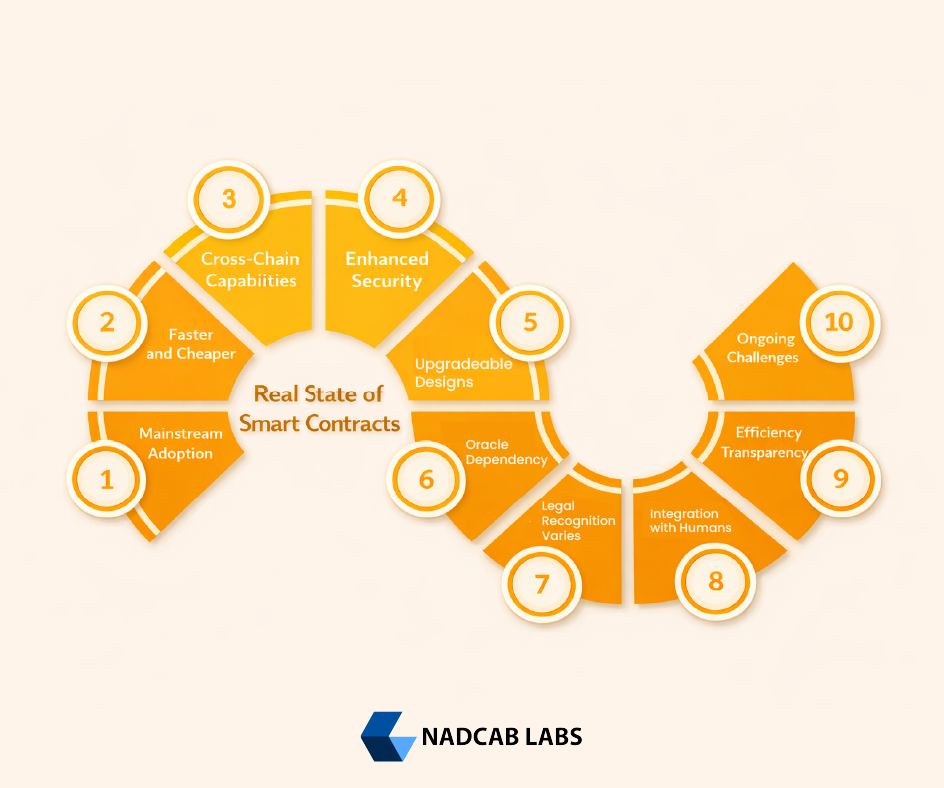
Technology has improved a lot over the years. Today’s smart contracts are faster, cheaper, and more secure than before. Better tools, professional audits, and strong testing methods have reduced coding mistakes and hacking risks. Many platforms also use upgradeable contracts, which means errors can be fixed and new features can be added without breaking the system.
However, smart contracts are still not perfect. They cannot understand real-world events on their own and must rely on oracles to bring outside data. Legal acceptance also depends on local laws, so not every smart contract is automatically valid in every country.
Humans are still very important. Developers write the code, auditors check security, and communities manage updates through governance. Overall, in 2026, smart contracts are powerful, useful, and widely adopted, but they work best with strong security, clear rules, and human supervision.
Final Words
Smart contracts are one of the most powerful tools in modern blockchain technology. They automate agreements, reduce costs, remove middlemen, and increase transparency. In 2026, they will be widely used across industries and continue to improve with better security, audits, and upgrade systems.
At the same time, smart contracts are not magical or risk-free. They are not automatically legal everywhere, they are not always unchangeable, and they cannot work without human design, testing, governance, and real-world data from oracles. Believing myths about smart contracts can lead to mistakes, losses, and legal problems.
By understanding the real facts, people can set realistic expectations and use smart contracts responsibly. When combined with strong security practices, proper legal planning, and human oversight, smart contracts become reliable tools for automation and digital trust. The future of smart contracts is not about replacing humans, but about working with them to build safer, smarter, and more efficient systems.
FAQs - Smart Contract Myths and Facts
Q1.Why is it important to understand smart contract myths and facts?
Understanding myths and facts helps avoid mistakes, financial loss, and security risks. Many people have wrong ideas about smart contracts, like thinking they are automatically legal or fully secure. Knowing the truth helps users, developers, and businesses make safe and smart decisions when using blockchain technology.
Q2.Are smart contracts the same as traditional legal contracts?
No, smart contracts are not the same as traditional legal contracts. They are computer programs that run on a blockchain and execute rules automatically. Traditional contracts rely on law, courts, and intermediaries, while smart contracts focus on automation and trustless execution. Both can work together for real-world agreements.
Q3.Are smart contracts legally valid everywhere?
No, smart contracts are not automatically legal everywhere. Their legal enforceability depends on local laws and supporting agreements. Some countries may recognize blockchain agreements, while others may not. To be safe, smart contracts should be backed by traditional legal contracts if used in business or financial transactions.
Q4.Do smart contracts replace humans?
No, smart contracts do not replace humans. People are needed to design the rules, write code, audit security, manage governance, and ensure legal compliance. Smart contracts automate execution, but humans provide oversight, make decisions, and fix problems when errors occur. They work with humans, not instead of them.
Q5.Can a smart contract be changed after deployment?
Some smart contracts can be changed if they are designed to be upgradeable. Modern contracts often use governance systems or proxy structures to allow updates. Early contracts were permanent, but today, upgrades help fix bugs, improve features, or adapt to new rules while keeping blockchain records safe and transparent.
Q6.Are smart contracts completely safe from hacking?
No, smart contracts are not automatically safe. Bugs or mistakes in the code can allow hackers to steal funds. Security depends on proper coding, professional audits, and extensive testing. Well-audited contracts are usually secure, but users must always check reliability and avoid assuming any contract is 100% hack-proof.
Q7.Do smart contracts always reduce costs to zero?
No, smart contracts do not reduce all costs to zero. They cut out middlemen like banks or brokers, saving fees and time. However, there are still costs like blockchain network fees, development, testing, and auditing. Smart contracts reduce costs significantly, but they are not completely free.
Q8.Are smart contracts only useful for cryptocurrency?
No, smart contracts are used far beyond cryptocurrency. In 2026, they are widely applied in DeFi, NFTs, gaming, insurance, supply chains, DAOs, and digital identity systems. They automate processes, increase transparency, and enforce agreements in many industries, making them versatile tools for digital business.
Explore Services
Related Services
Reviewed by

Aman Vaths
Founder of Nadcab Labs
Aman Vaths is the Founder & CTO of Nadcab Labs, a global digital engineering company delivering enterprise-grade solutions across AI, Web3, Blockchain, Big Data, Cloud, Cybersecurity, and Modern Application Development. With deep technical leadership and product innovation experience, Aman has positioned Nadcab Labs as one of the most advanced engineering companies driving the next era of intelligent, secure, and scalable software systems. Under his leadership, Nadcab Labs has built 2,000+ global projects across sectors including fintech, banking, healthcare, real estate, logistics, gaming, manufacturing, and next-generation DePIN networks. Aman’s strength lies in architecting high-performance systems, end-to-end platform engineering, and designing enterprise solutions that operate at global scale.