Ai Overview
The global entertainment and media industry generated USD 2. 36 billion in 2024 and is projected to reach USD 2,208. 72% of media and entertainment executives using generative AI in production are already seeing return on investment on at least one use case, with 63% reporting annual revenue increases. According to Google Cloud research, 72% of media and entertainment executives running generative AI in production reported seeing return on investment on at least one use case.
Key Takeaways: Digital Transformation in Entertainment Industry
- The global entertainment and media industry generated USD 2.9 trillion in revenue in 2024, with projections to reach USD 3.5 trillion by 2029, growing at a compound annual growth rate of 3.7%.[1]
- The AI in media and entertainment market was valued at USD 25.98 billion in 2024 and is projected to reach USD 99.48 billion by 2030, growing at a CAGR of 24.2%.[2]
- Netflix reached 282.7 million paid subscribers worldwide as of Q3 2024, with the EMEA region becoming its largest market at approximately 96 million subscribers.[3]
- The global video streaming market was valued at USD 129.26 billion in 2024 and is projected to reach USD 416.8 billion by 2030, growing at a CAGR of 21.5%.[4]
- The Blockchain in Media, Advertising, and Entertainment Market was valued at USD 0.58 billion in 2024 and is expected to reach USD 48.50 billion by 2030, growing at a CAGR of 78.49%.[5]
- Digital video piracy costs the global media and entertainment industry approximately USD 75 billion annually, with predictions to escalate to USD 125 billion by 2028.[6]
- The global esports market was valued at USD 2.13 billion in 2024 and is projected to reach USD 7.46 billion by 2030, growing at a CAGR of 23.1%.[7]
- The Augmented Reality and Virtual Reality market was valued at USD 22.12 billion in 2024 and is expected to reach USD 96.32 billion by 2029, growing at a CAGR of 34.2%.[8]
- The global 5G services market was valued at USD 125.36 billion in 2024 and is projected to reach USD 2,208.25 billion by 2030, with entertainment applications representing a key growth driver.[9]
- 72% of media and entertainment executives using generative AI in production are already seeing return on investment on at least one use case, with 63% reporting annual revenue increases.
Entertainment Industry Digital Transformation
The entertainment industry stands at a defining crossroads where traditional business models converge with emerging technologies to create entirely new possibilities for content creation, distribution, and consumption. What began as simple digitization of analog media has evolved into a comprehensive reimagining of how stories are told, how audiences engage with content, and how value is captured across the entertainment value chain. This transformation extends far beyond moving physical products to digital formats; it represents a fundamental shift in the relationship between creators, distributors, and audiences.
From major film studios to independent content creators, from traditional broadcasters to streaming platforms, every participant in the entertainment ecosystem faces both unprecedented challenges and remarkable opportunities. The convergence of cloud computing, artificial intelligence, blockchain technology, and high-speed connectivity has created an environment where innovation occurs at an accelerating pace, leaving organizations that fail to adapt increasingly marginalized. Understanding these dynamics is essential for anyone seeking to navigate, compete, or invest in this rapidly evolving landscape.
Understanding the Scale of Digital Transformation in Media and Entertainment
The magnitude of digital transformation in media and entertainment becomes clear when examining market valuations and growth trajectories. According to PwC’s Global Entertainment and Media Outlook 2025 to 2029, global entertainment and media revenues reached USD 2.9 trillion in 2024, representing a 5.5% increase from the previous year. The industry is projected to continue expanding to USD 3.5 trillion by 2029, adding an additional USD 577 billion in revenues over the five year forecast period.
Digital formats now command a dominant position within this market. Digital distribution channels accounted for 45% of the total media and entertainment market share in 2024, representing approximately USD 1.33 trillion. This proportion continues to grow as consumers increasingly favor on-demand access over traditional scheduled programming. The advertising sector within entertainment has also undergone substantial digital migration, with digital advertising revenues projected to grow at a 6.1% compound annual growth rate through 2029, significantly outpacing consumer spending growth at just 2.0%.
Regional variations in digital adoption reveal interesting patterns. North America maintains leadership with approximately 35% of the global market share, driven by mature digital infrastructure and high consumer spending. However, Asia Pacific regions demonstrate the fastest growth rates, fueled by expanding internet penetration, rising disposable incomes, and growing middle-class populations eager for digital entertainment options. Countries like China, India, and Indonesia represent particularly dynamic markets where digital transformation in entertainment is occurring at a remarkable speed.
Cloud-Based Entertainment Platforms Reshaping Content Delivery
Cloud-based entertainment platforms have fundamentally altered how content reaches audiences, eliminating many traditional barriers associated with physical distribution and enabling global reach for creators of all sizes. The global video streaming market exemplifies this transformation, with valuations reaching USD 129.26 billion in 2024 and projections indicating growth to USD 416.8 billion by 2030, representing a compound annual growth rate of 21.5%.
Several key developments characterize the current cloud streaming landscape. First, the subscription video on demand segment continues maturing, with major platforms like Netflix, Disney+, and Amazon Prime Video competing intensely for subscriber loyalty through original content investments and geographic expansion. Netflix alone reached approximately 282.7 million paid subscribers worldwide by the third quarter of 2024, with its Europe, Middle East, and Africa region becoming the largest subscriber base at roughly 96 million users.
The Rise of Hybrid Monetization Models
Traditional subscription models are evolving toward hybrid approaches that combine advertising-supported tiers with premium subscription options. This shift reflects both market saturation in mature regions and the need to address diverse consumer preferences regarding price sensitivity and advertising tolerance. Netflix’s launch of its ad-supported tier demonstrates this trend, with reports indicating that nearly one in three new sign-ups by late 2023 selected the advertising-supported plan.
Live Streaming and Real-Time Content
The live video streaming segment captured approximately 62.5% of market share within video streaming in 2024, highlighting growing demand for real-time content across entertainment, sports, gaming, and business events. Platforms like Twitch, YouTube Live, and Facebook Live have opened real-time broadcasting capabilities to individuals and organizations, enabling content ranging from esports tournaments to concert performances to reach global audiences simultaneously.
Cloud Infrastructure Investment
Major technology companies continue to make substantial investments in cloud infrastructure specifically optimized for media workloads. Amazon Web Services, Microsoft Azure, and Google Cloud all offer specialized services for content delivery, encoding, and analytics. These investments reduce barriers for smaller content creators and distributors who can leverage enterprise-grade infrastructure without massive capital expenditure.
You may also like:
UI UX Design in Healthcare: Key Challenges for Modern Applications
AI in Media and Entertainment: Transforming Creation and Distribution
Artificial intelligence has emerged as perhaps the most transformative technology within entertainment industry’s digital transformation, affecting nearly every aspect of content creation, curation, and monetization. The global AI in media and entertainment market reached USD 25.98 billion in 2024 and is projected to grow to USD 99.48 billion by 2030, expanding at a compound annual growth rate of 24.2%.
North America leads AI adoption in entertainment, accounting for approximately 33.6% of the global market share in 2024. This leadership stems from significant investments in AI research and development, robust technology infrastructure, and the presence of major technology companies driving innovation. However, Asia Pacific regions are witnessing rapid growth in AI driven entertainment solutions, particularly in gaming and content personalization applications.
Content Personalization and Recommendation
AI-powered recommendation systems represent one of the most visible and impactful applications within digital transformation in media and entertainment. These systems analyze user behavior, viewing history, and preferences to deliver personalized content suggestions that increase engagement and reduce churn. Netflix’s recommendation engine, built on deep learning models analyzing member data, reportedly saves the company approximately USD 1 billion annually by reducing subscriber cancellations through improved content discovery.
Automated Content Production
Generative AI has seen sharp adoption across the entertainment industry, rising from 33% to 71% usage among organizations between 2022 and 2024. AI tools now assist with scriptwriting, video editing, music composition, and visual effects generation, creating new opportunities for a music app development company to build smarter entertainment platforms. These capabilities enable production teams to achieve results faster and at lower costs while maintaining quality standards. According to Morgan Stanley Research, major media companies could potentially reduce overall programming expenses by around 10% as they begin implementing generative AI tools.
Content Moderation and Rights Management
The global content moderation solutions market reached USD 8.53 billion in 2024, with AI playing a central role in automating review processes. AI systems screen content for policy violations, copyright infringement, and inappropriate material using computer vision and natural language processing. These capabilities prove essential for platforms handling millions of daily uploads where manual review would be impractical.
Measuring AI Return on Investment
Industry surveys reveal encouraging results for AI investments. According to Google Cloud research, 72% of media and entertainment executives running generative AI in production reported seeing return on investment on at least one use case. Additionally, 63% of those organizations saw annual revenue increases, and 83% successfully transformed a generative AI use case idea into production within six months.
Digital Transformation Technologies and Their Entertainment Applications
| Technology | Primary Entertainment Application | Market Value 2024 | Projected Growth Rate | Key Industry Players |
|---|---|---|---|---|
| Cloud Streaming | On-demand content delivery and live broadcasting | USD 129.26 billion | 21.5% CAGR to 2030 | Netflix, Disney Plus, Amazon |
| Artificial Intelligence | Personalization, content creation, and analytics | USD 25.98 billion | 24.2% CAGR to 2030 | AWS, Google, Microsoft, IBM |
| Blockchain | Rights management, royalty distribution, NFTs | USD 0.58 billion | 78.49% CAGR to 2030 | IBM, Microsoft, SAP |
| AR and VR | Immersive experiences, gaming, virtual events | USD 22.12 billion | 34.2% CAGR to 2029 | Meta, Sony, Apple, Microsoft |
| 5G Networks | Mobile streaming, low-latency gaming, and live events | USD 125.36 billion | 62.2% CAGR to 2030 | Verizon, AT&T, T-Mobile |
| Esports Platforms | Competitive gaming, live tournaments, streaming | USD 2.13 billion | 23.1% CAGR to 2030 | Twitch, YouTube Gaming, Activision |
| Gaming NFT | Digital collectibles, in-game asset ownership | USD 4.8 billion | 24.8% CAGR to 2034 | Axie Infinity, Polygon, Immutable |
Blockchain in Entertainment Industry: Rights, Royalties, and New Revenue Models
Blockchain technology is emerging as a potentially transformative force within digital transformation in media and entertainment, often implemented with the support of a blockchain development company, though its adoption remains at relatively early stages compared to AI or cloud technologies.
The Blockchain in Media, Advertising, and Entertainment Market was valued at approximately USD 0.58 billion in 2024 and is projected to reach USD 48.50 billion by 2030, representing one of the highest growth rates among entertainment technologies at 78.49% CAGR.
Digital Rights Management Revolution
One of blockchain’s most promising applications lies in transforming how intellectual property rights are managed and enforced. Traditional rights management involves complex webs of intermediaries, leading to delayed payments and disputed ownership claims. Blockchain enables transparent, immutable records of ownership and usage rights, potentially streamlining royalty distribution and reducing disputes. Smart contracts can automate royalty payments when predetermined conditions are met, ensuring creators receive compensation more quickly and accurately.
NFTs and Digital Collectibles
Non-fungible tokens have created entirely new categories of entertainment products and revenue streams. The gaming NFT market reached USD 4.8 billion in 2024, with in-game assets representing approximately 42% of total market value. NFTs enable verifiable ownership of digital items that can be bought, sold, and potentially used across different platforms. While the initial NFT boom experienced significant volatility, the technology continues to find practical applications in gaming, music, and visual arts.
Blockchain Gaming Growth
The blockchain gaming market demonstrates particularly strong growth dynamics, with projections indicating growth from USD 24.4 billion in 2025 to potentially USD 1,172.8 billion by 2033 at a CAGR of 62.59%. This growth reflects increasing consumer interest in play-to-earn models where gaming activity generates real economic value. Asia Pacific leads adoption with approximately 28.7% market share in 2024, driven by strong mobile gaming cultures and enthusiasm for digital asset ownership.
Combating Piracy and Fraud
Blockchain offers potential solutions to the entertainment industry’s ongoing piracy challenges. Digital video piracy costs the global media and entertainment industry approximately USD 75 billion annually, with projections suggesting this could rise to USD 125 billion by 2028. Blockchain-based content authentication and distribution systems could help reduce unauthorized copying and ensure genuine products reach consumers while creators receive appropriate compensation.
You may also like:
The Gaming and Esports Transformation
Gaming represents one of the most dynamic segments within entertainment industry digital transformation, combining multiple emerging technologies to create experiences that blur traditional boundaries between entertainment categories. The global video game industry reached USD 260 billion in revenue in 2025, with projections indicating growth to USD 320 billion by 2030. This market now exceeds the combined revenues of the film and music industries, highlighting gaming’s dominant position in modern entertainment. This market now exceeds the combined revenues of the film and music industries, highlighting gaming’s dominant position in modern entertainment. The rapid evolution of digital platforms is also reshaping the Film Industry, creating new opportunities for content creation, distribution, and audience engagement.
Mobile Gaming Dominance
Mobile gaming recorded USD 92.6 billion in revenue during 2024, marking a 3.1% increase from the previous year. This platform maintains the largest market share at 49% of total gaming industry revenue. Smartphones serve as the primary gaming device for 68% of players worldwide, democratizing access to gaming experiences that previously required expensive dedicated hardware.
Esports Professionalization
The esports segment has evolved from grassroots competitions into a professionalized industry with structured leagues, franchised teams, and substantial prize pools. The global esports market was valued at USD 2.13 billion in 2024 and is projected to reach USD 7.46 billion by 2030, growing at a CAGR of 23.1%. Sponsorship and advertising dominate revenue generation, contributing more than 40% of total esports revenue, with major brands including Red Bull, Intel, and Mercedes-Benz maintaining significant investments.
Cloud Gaming Evolution
Cloud gaming adoption has grown substantially, allowing players to access high-performance games on lower-end devices by streaming content from powerful remote servers. This model eliminates the need for expensive gaming hardware, potentially expanding the addressable market for premium gaming experiences. The rapid rise in cloud gaming adoption represents a primary catalyst for the game streaming industry, which reached USD 10.85 billion in 2024 with projections to reach USD 31.63 billion by 2033.
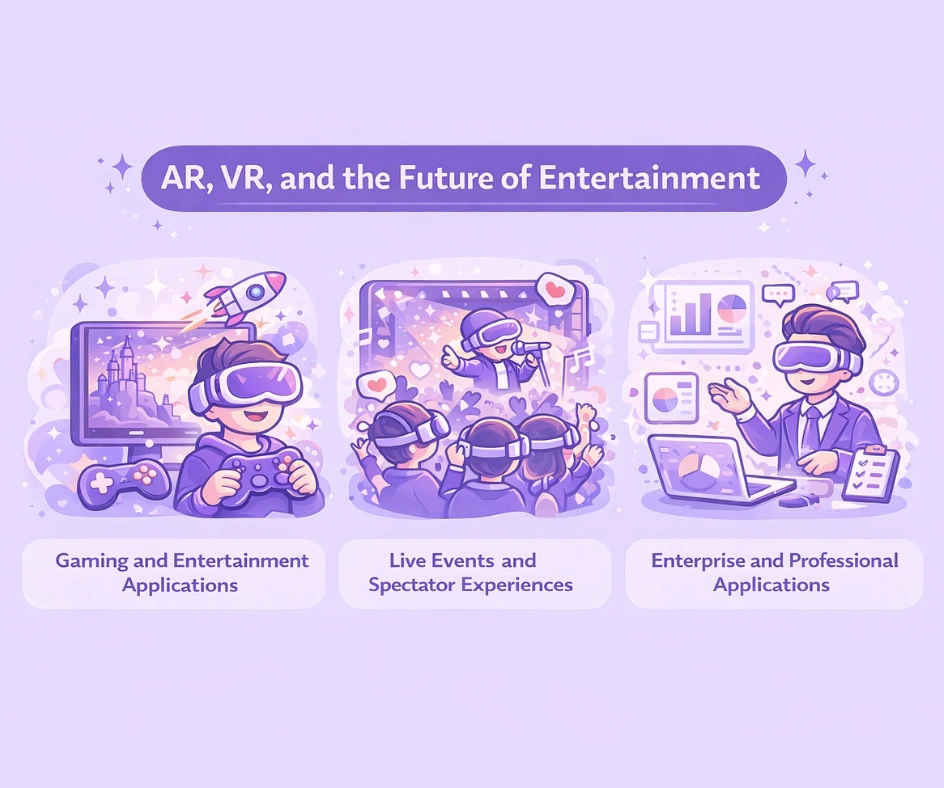
Immersive Technologies: AR, VR, and the Future of Entertainment
Augmented reality and virtual reality technologies are creating entirely new categories of entertainment experiences that extend beyond traditional screens. The combined AR and VR market was valued at USD 22.12 billion in 2024 and is expected to reach USD 96.32 billion by 2029, growing at a CAGR of 34.2%. These technologies are finding applications across gaming, entertainment, education, healthcare, and enterprise training.
Gaming and Entertainment Applications
The consumer electronics segment, which includes gaming and entertainment applications, led the AR VR market with approximately 31.2% of revenue share in 2024. Virtual reality technology dominated overall with 55.4% market share, driven by its widespread application in gaming, simulation training, and immersive entertainment experiences. Over 196 million active VR users and 257 million active AR users engaged with these technologies globally in 2024.
Live Events and Spectator Experiences
Immersive technologies are transforming live event experiences both for in-person attendees and remote viewers. 5G-enabled wireless headsets and glasses provide ultra-rich visual experiences overlaid on real-world events, while remote viewers can experience concerts, sporting events, and performances through VR with unprecedented levels of presence and engagement. Research indicates that 5G users spend, on average, one hour more per week in metaverse-related services compared to 4G users.
Enterprise and Professional Applications
Beyond consumer entertainment, AR and VR are gaining traction in professional applications that support the entertainment industry itself. Virtual production techniques using these technologies are transforming film and television production, enabling real-time visualization of digital environments during filming. Training simulations for technical crew and safety personnel also leverage immersive technologies for more effective skill development.
5G Networks: The Infrastructure Enabling Next Generation Entertainment
Fifth-generation wireless technology serves as foundational infrastructure enabling many digital transformation initiatives within entertainment. The global 5G services market was estimated at USD 125.36 billion in 2024 and is projected to reach USD 2,208.25 billion by 2030, growing at a CAGR of 62.2%. Media and entertainment applications represent a key driver of this growth, with projections suggesting that 5G-enabled entertainment experiences could generate up to USD 1.3 trillion in revenue by 2028.
Enhanced Streaming Capabilities
5G networks offer speeds up to 10 times faster than 4G, enabling streaming of high definition and 4K/8K content with minimal buffering. Reduced latency ensures that live streaming events can be broadcast with minimal delay, providing viewers with experiences closer to real time. Mobile video traffic in markets with widespread 5G coverage has demonstrated significant increases, with average session lengths extending as users take advantage of improved streaming quality.
Mobile Gaming Transformation
The enhanced mobile broadband segment of 5G services led the market with approximately 39.41% revenue share in 2024, driven by applications including high-speed cloud-based gaming, AR VR experiences, and ultra-high definition video streaming. 5G enables console-quality gaming experiences on mobile devices by supporting real-time streaming of graphically intensive content from cloud servers.
Live Event Innovation
5G deployment in stadiums and venues enables entirely new fan experiences. Partnerships between telecommunications providers and sports leagues have demonstrated capabilities including real-time streaming with AR VR graphics, multiple camera angle selections, and interactive data overlays. These applications showcase how 5G can transform passive viewing into active, personalized experiences.
Monetization Models in the Digital Entertainment Era
| Monetization Model | Description | Revenue Contribution 2024 | Growth Trend | Platform Examples |
|---|---|---|---|---|
| Subscription (SVOD) | Recurring monthly or annual fees for unlimited access | 49% of streaming traffic | 8% CAGR through 2030 | Netflix, Disney Plus, Spotify |
| Advertising (AVOD) | Free content supported by advertising revenue | 52% of total market | 6.1% CAGR through 2029 | YouTube, Pluto TV, Tubi |
| Hybrid (HVOD) | Tiered pricing with ad-supported and premium options | Growing rapidly | Fastest-growing model | Netflix, Hulu, Peacock |
| In App Purchases | Microtransactions for virtual goods and content | USD 71.1 billion (gaming) | 4.6% growth to 2025 | Fortnite, Candy Crush, Roblox |
| Transactional (TVOD) | Pay-per-view or rental for individual content | Declining share | Stable with premium content | Apple TV, Google Play, Vudu |
| Sponsorship | Brand partnerships for events and content | 40% of esports revenue | Strong growth in esports | League of Legends, Twitch |
| Creator Economy | Direct monetization through tips, memberships, and merchandise | Growing rapidly | Projected to approach USD 500 billion by 2027 | Patreon, YouTube Super Chat |
Challenges and Considerations in Digital Transformation
While digital transformation in media and entertainment creates substantial opportunities, organizations face significant challenges in navigating this evolving landscape. Understanding these obstacles is essential for developing effective strategies and realistic expectations.
Content Piracy and Revenue Protection
Digital piracy remains a persistent threat to entertainment revenue streams. In 2024, MUSO recorded 216.3 billion visits to piracy websites globally. While this represented a modest 5.72% decline from 2023, the scale of illegal consumption continues to impact industry revenues significantly. The fragmentation of content across multiple competing platforms may inadvertently encourage piracy as consumers resist subscribing to numerous services.
Data Privacy and Regulatory Compliance
Personalization engines that drive engagement also create data privacy obligations. Approximately 28% of media companies faced challenges complying with data privacy regulations such as GDPR in 2024, limiting some aspects of personalized content delivery. Organizations must balance the benefits of data-driven personalization against privacy requirements and consumer expectations.
Technology Investment and Talent
Implementing advanced technologies requires substantial investment in both infrastructure and skilled personnel. Content fragmentation across platforms creates integration challenges, with over 40 software development kits used in the extended reality domain alone. The shortage of specialized talent compounds these challenges, with relatively few professionals globally specializing in areas like immersive content development compared to industry demand.
Consumer Attention and Market Saturation
The proliferation of entertainment options creates intense competition for consumer attention. With over 1,390 million people globally engaging with streaming platforms across multiple devices as of 2024, audiences face overwhelming choices. This abundance challenges content creators and platforms to differentiate their offerings and capture meaningful engagement.
You may also like:
Healthcare IT Transformation: Data Protection, Compliance & Performance
Future Outlook and Emerging Opportunities
The trajectory of digital transformation in entertainment points toward continued acceleration of technology adoption and business model innovation. Several trends appear likely to shape the coming years.
Convergence Acceleration
Boundaries between entertainment categories continue to blur. Gaming increasingly incorporates social features and live events. Streaming platforms experiment with interactive and gaming elements. Social media platforms become entertainment destinations, and tools like a Social Media Post Generator help creators engage audiences across formats. This convergence creates opportunities for organizations that can operate across traditional category boundaries while presenting challenges for those tied to specific formats.
AI Integration Deepening
AI applications will extend beyond current use cases into more aspects of creative production and business operations. While concerns about AI’s impact on creative jobs warrant serious attention, the technology’s ability to enhance human creativity and reduce production friction suggests increasing adoption. Organizations that develop effective human AI collaboration models may gain competitive advantages.
Regional Market Expansion
Emerging markets in Asia, Africa, and Latin America represent significant growth opportunities. Rising internet penetration, expanding middle classes, and growing mobile device adoption create new audiences for digital entertainment. Success in these markets often requires localized content strategies and pricing models adapted to regional economic conditions.
Immersive Experience Evolution
As AR, VR, and mixed reality technologies mature and costs decline, immersive entertainment applications will expand beyond current niche audiences. The combination of improved hardware, faster networks, and more compelling content could drive mainstream adoption of spatial computing entertainment experiences.
Transform Your Entertainment Platform with Expert Development
Whether you need a streaming platform development strategy, AI-powered content recommendation systems, cloud infrastructure migration, or blockchain-based rights management solutions, our experienced development team delivers audience-focused implementations tailored to your organization’s requirements. We combine deep expertise in entertainment technology with advanced digital solutions to build platforms your audiences will love.
Final Thoughts
Digital transformation in media and entertainment represents one of the most comprehensive industry transformations in modern business history. The combination of cloud computing, artificial intelligence, blockchain technology, immersive experiences, and high-speed connectivity is reshaping every aspect of how entertainment is created, distributed, and consumed. Market valuations confirm the scale of this transformation, with the global entertainment and media industry generating USD 2.9 trillion in 2024 and projections indicating continued growth toward USD 3.5 trillion by 2029.
For industry participants, success increasingly depends on the ability to embrace technological change while maintaining focus on fundamental entertainment value. Technologies themselves are tools; their value comes from how they enhance creative expression, improve audience experiences, and enable sustainable business models. Organizations that view digital transformation as a means to better serve audiences rather than as an end in itself will be best positioned to thrive.
The pace of change shows no signs of slowing. AI capabilities continue advancing rapidly, immersive technologies are improving while costs decline, and global connectivity continues expanding. For creators, distributors, and technology providers, the current moment offers both unprecedented challenges and remarkable opportunities. Those who navigate this transformation successfully will help define how future generations experience entertainment.
Frequently Asked Questions
Q1.What is digital transformation in media and entertainment?
Digital transformation in media and entertainment refers to the comprehensive integration of digital technologies into all aspects of the entertainment industry, including content creation, distribution, monetization, and audience engagement. This includes adopting cloud platforms for content delivery, using AI for personalization and production, implementing blockchain for rights management, and leveraging immersive technologies for new entertainment experiences.
Q2.How is AI changing the entertainment industry?
AI is transforming entertainment through multiple applications, including content personalization and recommendation systems, automated content production tools, content moderation, predictive analytics for audience preferences, and enhanced visual effects. The AI in media and entertainment market reached USD 25.98 billion in 2024 and is projected to grow to USD 99.48 billion by 2030, reflecting the technology’s expanding role across the industry.
Q3.What role does blockchain play in the entertainment industry?
Blockchain in entertainment industry applications primarily focuses on digital rights management, royalty distribution automation through smart contracts, anti piracy measures, and enabling new revenue models through NFTs and digital collectibles. The technology provides transparent, immutable records of ownership and transactions, potentially streamlining complex rights management processes.
Q4.How are cloud based entertainment platforms changing content consumption?
Cloud-based entertainment platforms have enabled on-demand access to vast content libraries, eliminated geographic barriers to distribution, and created new monetization models, including subscription, advertising-supported, and hybrid approaches. The video streaming market reached USD 129.26 billion in 2024 and continues growing as consumers increasingly prefer flexible access over traditional scheduled programming.
Q5.What impact does 5G have on entertainment experiences?
5G technology enables enhanced entertainment experiences through faster streaming speeds supporting 4K and 8K content, reduced latency for live events and gaming, improved mobile entertainment quality, and support for immersive AR and VR applications. The technology serves as foundational infrastructure for next-generation entertainment experiences, including cloud gaming and immersive live events.
Q6.What are the main challenges facing digital transformation in entertainment?
Key challenges include persistent content piracy costing approximately USD 75 billion annually, data privacy compliance requirements, substantial technology investment needs, talent shortages in specialized areas, market saturation leading to intense competition for consumer attention, and the complexity of operating across multiple platforms and technologies simultaneously.
Explore Services
Related Services
Reviewed by

Aman Vaths
Founder of Nadcab Labs
Aman Vaths is the Founder & CTO of Nadcab Labs, a global digital engineering company delivering enterprise-grade solutions across AI, Web3, Blockchain, Big Data, Cloud, Cybersecurity, and Modern Application Development. With deep technical leadership and product innovation experience, Aman has positioned Nadcab Labs as one of the most advanced engineering companies driving the next era of intelligent, secure, and scalable software systems. Under his leadership, Nadcab Labs has built 2,000+ global projects across sectors including fintech, banking, healthcare, real estate, logistics, gaming, manufacturing, and next-generation DePIN networks. Aman’s strength lies in architecting high-performance systems, end-to-end platform engineering, and designing enterprise solutions that operate at global scale.