Ai Overview
In simple terms, it means connecting physical objects to the internet so they can send and receive data on their own without a person having to do it manually. North America holds the largest share of this market at 41%, with the US market alone valued at USD 6. That one small insight, applied across 55,000 drivers, adds up to enormous savings. ORION processes over 250 million data points every single day and evaluates around 30,000 route alternatives for each driver before the driver even leaves the facility.
Key Takeaways
- The IoT in logistics market was valued at USD 53.25 billion in 2024 and is expected to reach USD 61.17 billion in 2025, growing at a CAGR of 14.84%, with projections showing the market reaching USD 161.17 billion by 2032.[1]
- UPS’s ORION route optimization system, powered by big data analytics, processes over 250 million data points daily and has saved the company approximately 100 million miles driven and 10 million gallons of fuel per year, with annual cost savings of USD 300 to 400 million.[2]
- DHL has 92% of its facilities equipped with digital solutions, including big data analytics, using IoT sensors and AI to get a 360-degree view of equipment and predict maintenance needs before breakdowns occur.[3]
- IoT-enabled tracking devices have improved delivery times by 40%, IoT adoption has led to a 20 to 30 percent reduction in logistics costs, and predictive analytics powered by IoT have helped prevent up to 75% of supply chain disruptions.[4]
- Businesses using AI and IoT in logistics have reported a 20 to 30 percent increase in operational efficiency and a 40 percent reduction in shipments that were lost or delayed, according to McKinsey and Company research from 2024.[5]
- Fleet management solutions dominate the IoT logistics market, holding 32.47% market share in 2024, while cellular technologies accounted for 54.32% of connectivity in the IoT-powered logistics market in the same year.[6]
- Between 2020 and 2024, global investments in logistics-focused IoT solutions surged by 45%, with over USD 58 billion allocated to device integration, network infrastructure, and cloud-based analytics platforms.[7]
Think about the last time you ordered something online. You probably got a notification when your package left the warehouse, another when it was out for delivery, and maybe a live map showing exactly where the delivery person was. That level of detail did not exist a decade ago. Today, it is almost expected. The technology making all of this possible is a combination of IoT in logistics tracking and big data in logistics.
Logistics is one of the most complex industries in the world. Thousands of trucks, ships, and planes are moving goods across hundreds of countries at the same time. Keeping track of all of that, avoiding delays, and making sure goods arrive in good condition is a massive challenge. IoT devices and big data analytics have stepped in to solve exactly this problem, and the results have been dramatic for companies that have adopted them.
This blog covers everything you need to know about how IoT in logistics and big data in logistics work together, what they actually do, which companies are using them, what the numbers look like, and where things are headed next.
What Is IoT in Logistics Tracking and Why Does It Matter
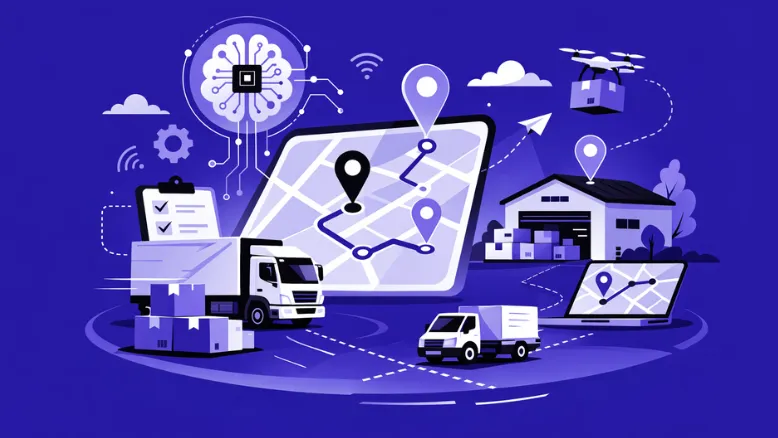
IoT stands for Internet of Things. In simple terms, it means connecting physical objects to the internet so they can send and receive data on their own without a person having to do it manually. In logistics, these connected objects include GPS trackers on vehicles, temperature sensors inside refrigerated containers, RFID tags on packages, smart shelves in warehouses, and cameras at loading docks. Many modern transport and logistics software development solutions integrate these IoT devices so companies can automatically collect and manage operational data in real time.
All of these devices collect data in real time. That data then travels to a central platform where it is organized, analyzed, and shown to the people managing the supply chain. This is what makes smart logistics tracking possible. Instead of waiting for a truck driver to call in or a warehouse worker to manually count inventory, the system already knows where everything is and what condition it is in.
IoT in logistics tracking is especially powerful because it removes the guesswork. A logistics manager no longer needs to estimate when a shipment will arrive. The system gives a precise location updated every few minutes. If something goes wrong, like a temperature spike in a cold chain shipment, an alert goes out immediately rather than when the goods arrive damaged.
1. The Scale of the Market Shows How Serious This Is
The numbers behind IoT in logistics are hard to ignore. According to Research and Markets, the IoT in logistics market was valued at USD 53.25 billion in 2024 and jumped to USD 61.17 billion in 2025. The same report projects the market will reach USD 161.17 billion by 2032, growing at a CAGR of 14.84%. That kind of growth does not happen unless the technology is genuinely delivering results.
North America holds the largest share of this market at 41%, with the US market alone valued at USD 6.65 billion in 2024. This is not surprising given the number of large logistics companies in the US and the level of investment in connected technologies. However, the Asia-Pacific region is growing fastest as manufacturing and export-heavy economies like China, India, and South Korea push hard into digital supply chain management.
2. Real-Time Logistics Tracking Changes How Decisions Are Made
Before IoT, logistics decisions were made based on incomplete information. A manager might know that a shipment left a warehouse in the morning but have no idea where it was by afternoon. This lack of visibility led to delays, missed deliveries, lost goods, and frustrated customers.
Real-time logistics tracking through IoT solves this by giving a continuous stream of location data, condition data, and status updates. Decisions can be made in the moment rather than after the fact. If a truck is stuck in traffic, the system can reroute another vehicle. If a container temperature rises above a safe level, a cooling fix can be triggered before the goods spoil.
Logistics & Transportation Digital Solutions: Automation & Cost Reduction
How IoT Devices Actually Work in a Logistics Operation
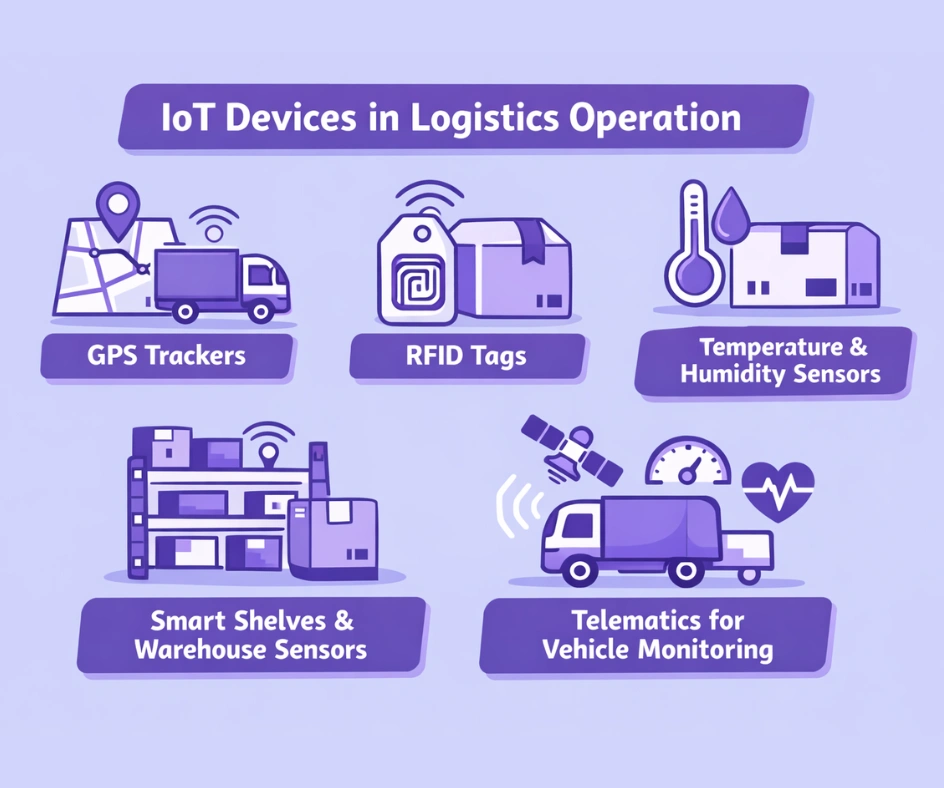
Understanding how IoT works in logistics does not require a technical background. At its core, it is a three-step process: collect, transmit, and act. IoT devices collect data from their environment, transmit that data to a central system, and the system uses it to trigger actions or provide information to decision makers.
Here is a breakdown of the main IoT devices used in logistics today and what each one does.
1. GPS Trackers
GPS trackers are placed on vehicles, containers, and individual packages. They send location updates at regular intervals, sometimes every few seconds for high-value shipments. This is the backbone of real-time logistics tracking. GPS trackers today are small, long-lasting, and capable of working in remote areas where cellular coverage is weak, using satellite or low-power wide-area network technologies.
2. RFID Tags
RFID stands for Radio-Frequency Identification. RFID tags are small chips that store information about a product, like its identity, origin, and destination. When a tagged item passes through an RFID reader at a warehouse gate or checkpoint, the system automatically logs the event. This eliminates the need for manual barcode scanning and speeds up inventory counting from hours to minutes.
3. Temperature and Humidity Sensors
These sensors are critical for cold chain logistics, which involve moving food, medicine, vaccines, and other temperature-sensitive goods. The sensors monitor conditions inside containers and trucks continuously. If the temperature goes outside the acceptable range, an alert is sent immediately. This prevents spoilage and keeps pharmaceuticals and food products safe during transit.
4. Smart Shelves and Warehouse Sensors
In warehouses, IoT devices automate inventory management. Smart shelves use weight sensors to know exactly how many items are on them at any time. Cameras and motion sensors track which areas of a warehouse are busy and which are idle. This data helps managers organize stock better, reduce picking errors, and speed up order fulfillment.
5. Telematics for Vehicle Monitoring
Telematics devices in trucks and vans track not just location but also vehicle health. They monitor engine temperature, fuel consumption, speed, braking patterns, and tire pressure. This data feeds into predictive maintenance systems that can flag a potential breakdown days before it happens, saving the company from unplanned downtime and expensive roadside repairs.
Key IoT Devices Used in Logistics Tracking and Their Functions
| IoT Device | Primary Use in Logistics | Key Benefit |
|---|---|---|
| GPS Trackers | Real-time location tracking of vehicles, containers, and packages | Eliminates blind spots and enables live delivery updates for customers |
| RFID Tags | Automatic identification of goods at checkpoints and warehouses | Replaces manual scanning, speeds up inventory counts, and reduces human error |
| Temperature Sensors | Monitoring cold chain shipments for food, medicine, and vaccines | Prevents spoilage with instant alerts when the temperature goes out of range |
| Telematics Devices | Tracking vehicle health, including fuel use, engine status, and driving behavior | Enables predictive maintenance that prevents unexpected breakdowns |
| Smart Shelves | Automated stock level monitoring inside warehouses and retail storage areas | Triggers restocking alerts automatically and reduces out-of-stock situations |
| Shock and Vibration Sensors | Detecting rough handling of fragile goods during transit | Helps resolve damage claims and improves packaging decisions over time |
| 5G-Enabled Cameras | Visual monitoring of loading docks, warehouse zones, and vehicle interiors | Catches loading errors, theft, and safety violations in near real time |
What Big Data in Logistics Actually Means and How It Works
IoT devices are excellent at collecting data, but data on its own does not improve anything. This is where big data in logistics comes in. Big data refers to the process of storing, organizing, and analyzing large amounts of information that comes from many different sources at the same time.
In logistics, the sources of this data are incredibly varied. You have GPS coordinates from hundreds of vehicles, temperature readings from thousands of sensors, RFID scans from warehouses, customer order data, traffic feeds, weather reports, port status updates, and more. All of this data comes in at high speed and in different formats. Traditional spreadsheets and databases simply cannot handle it. Big data platforms can.
Big data in logistics is typically described using what researchers call the five Vs. These are Volume (the sheer size of the datasets), Variety (data coming in many different forms), Velocity (information being generated and needed in real time), Veracity (keeping the data accurate and trustworthy), and Value (using the data to actually improve outcomes). When a logistics company builds a system that handles all five of these, it gains a powerful tool for running operations more precisely.
1. Predictive Analytics: Knowing What Will Happen Before It Does
One of the most valuable things big data does in logistics is power predictive analytics. This means using historical data combined with current conditions to forecast what is likely to happen next. For example, a company can look at past delivery patterns to predict which routes will face congestion during a holiday period, or use sensor data to forecast when a piece of warehouse equipment is likely to fail.
McKinsey reports that companies using logistics data analytics for demand forecasting can reduce supply chain errors by 20 to 50 percent and cut lost sales by up to 65 percent. That is not a small improvement. Those numbers represent real cost savings and better customer experiences. The key is that the predictions are based on real data, not gut feelings or rough estimates.
2. Route Optimization Using Data at Scale
Figuring out the best route for a delivery driver sounds simple, but when you have thousands of drivers, millions of packages, changing traffic conditions, vehicle capacity limits, and customer time windows to consider, it becomes one of the hardest problems in logistics. Big data analytics handles this by processing all of the variables at once and identifying the optimal solution.
UPS built a system called ORION (On-Road Integrated Optimization and Navigation) specifically for this purpose. ORION processes over 250 million data points every single day and evaluates around 30,000 route alternatives for each driver before the driver even leaves the facility. The result is that ORION has saved UPS approximately 100 million miles driven per year, 10 million gallons of fuel annually, and an estimated USD 300 to 400 million in annual operational costs. One of the clever insights behind ORION is that it avoids left turns whenever possible, since left turns against traffic require more idle time than right turns. That one small insight, applied across 55,000 drivers, adds up to enormous savings.
3. Inventory Management and Demand Forecasting
Big data helps logistics companies know how much stock to keep and where to keep it. By analyzing purchasing patterns, seasonal trends, regional demand, and historical restocking cycles, analytics systems can recommend exactly how much inventory to hold at each location. This reduces the cost of holding too much stock in the wrong place while also preventing the frustration of being out of stock when demand spikes.
Amazon has taken this concept further than most. The company processes over 1.6 million packages daily using big data analytics, and its predictive shipping model analyzes browsing patterns, purchase history, and regional demand to pre-position inventory in warehouses closest to where orders are likely to come from. This is why Amazon can sometimes deliver packages within hours of an order being placed.
Cloud Platforms for Logistics Operations
How IoT and Big Data in Logistics Work Together as One System
IoT and big data are most powerful when they are connected. IoT devices are the data collection layer. They are the eyes and ears of the logistics operation, constantly gathering information from the physical world. Big data platforms are the intelligence layer. They take that raw information and turn it into something useful: insights, predictions, alerts, and recommendations.
Think of IoT devices as reporters and big data as the newsroom editor. The reporters send in raw information from all over. The editor organizes it, finds the important stories, and publishes the ones that matter. Without reporters, the newsroom has nothing to work with. Without the editor, the raw reports never become useful information.
In a real logistics operation, this combination works like this. GPS sensors on trucks send location data every few minutes. Temperature sensors in refrigerated containers send condition readings every few seconds. RFID scanners at warehouse doors log every item that enters or exits. All of this data flows into a central big data platform where machine learning models analyze it continuously. Those models can detect that a shipment is running behind schedule based on current traffic data, trigger a rerouting recommendation, send an alert to the customer about a revised delivery time, and update inventory records to reflect the delay, all without any human involvement.
1. Edge Computing Makes the Combination Even Faster
One challenge with sending all IoT data to a central platform is the time it takes for data to travel. In some situations, like an autonomous vehicle that needs to make a split-second decision, even a fraction of a second of delay is too long. This is where edge computing comes in. Edge computing means processing data at or near the IoT device itself rather than sending it all to a distant server.
In logistics, edge computing allows a vehicle’s onboard system to make immediate routing decisions based on sensor data without waiting for instructions from a central server. The processed summary is then sent to the main platform for longer-term analysis. This combination of edge processing for speed and central analysis for depth is becoming standard in advanced IoT logistics systems.
2. 5G Connectivity Is Accelerating Both IoT and Big Data in Logistics
The rollout of 5G networks is making IoT and big data in logistics significantly more powerful. 5G offers much higher data transfer speeds and lower latency compared to 4G. This means IoT devices can send more data more quickly, and real-time analytics can work with fresher information. According to data from Telenor IoT, data traffic from cellular IoT connections is projected to reach 110.8 exabytes by 2028, with logistics and transportation being one of the main drivers of that growth.
Faster data transmission also means that more sensors can be active on a single network at the same time without congestion. A warehouse that might have been limited in how many IoT devices it could run simultaneously can now deploy far more sensors, creating a much more detailed and accurate picture of operations.
Real-World Use Cases of IoT and Big Data in Logistics Tracking
It is easy to talk about IoT and big data in abstract terms, but the real proof is in how these technologies are being used right now by actual companies across different parts of the logistics industry. The following use cases show just how broad and practical the applications already are.
1. Cold Chain Monitoring in Pharmaceuticals and Food
Cold chain logistics involves moving goods that must stay within specific temperature ranges throughout the entire journey. Vaccines need to stay cold. Frozen food needs to stay frozen. Fresh produce needs to stay cool without freezing. Even a short period outside the right temperature range can make goods unsafe or worthless.
Maersk, one of the world’s largest shipping companies, uses IoT sensors inside refrigerated containers to monitor temperature and humidity in real time. The data is sent to a cloud-based platform that Maersk’s supply chain managers can access from anywhere in the world. If a sensor detects a problem, the system immediately alerts the relevant people so corrective action can be taken before goods are damaged. This approach is critical for pharmaceutical supply chains where a single temperature violation can mean an entire shipment of vaccines must be discarded.
2. Fleet Management and Driver Behavior Tracking
IoT telematics in commercial vehicles tracks far more than just location. They monitor driver behavior, including speeding, hard braking, aggressive acceleration, and how long a driver has been on the road. This data serves two purposes. First, it helps fleet managers identify drivers who need additional training before they cause an accident or damage a vehicle. Second, it feeds into predictive maintenance systems that can flag vehicle problems early.
Lineas, the largest private rail freight operator in Europe, implemented a Bosch fleet management solution using IoT and managed to increase the capacity utilization of its fleet by more than 40 percent. The company’s project leader summed up the impact by noting that their visibility into where wagons were located, which routes could be optimized, and where savings could be found for customers improved dramatically once IoT data was in play.
3. Smart Warehouse Operations
Modern warehouses are increasingly run with the help of IoT and big data. Sensors track the location of every item in a large facility, reducing the time workers spend searching for stock. Autonomous mobile robots guided by IoT systems move goods through warehouses without human direction. Drone-based inventory scanning can count and locate thousands of items in a warehouse in a fraction of the time it would take human workers.
DHL, which has 92% of its facilities equipped with digital solutions, including big data analytics, uses a portable box with sensors that it places on conveyor lines to detect vibrations and potential damage. The company also uses noise sensors for predictive maintenance of its sorting machines. By turning raw sensor readings into actionable intelligence, DHL prevents the majority of maintenance-related issues and cuts upkeep costs across its global network.
4. Last-Mile Delivery Optimization
The last mile, meaning the final leg of a delivery from a local distribution center to the customer’s door, is the most expensive part of logistics. It accounts for a large portion of total delivery costs because it involves many small, individual deliveries in unpredictable urban environments. IoT tracking combined with big data route optimization software is one of the main tools companies use to make last-mile delivery more affordable.
Real-time traffic data, customer availability windows, vehicle capacity, and historical delivery patterns all feed into algorithms that plan the most efficient sequence of stops for each delivery driver. The result is fewer miles driven, faster deliveries, and lower costs per package.
5. Port and Shipping Container Tracking
Large shipping ports handle thousands of containers every day. Knowing exactly where each container is, what condition it is in, and when it will be ready for loading or unloading is a logistical puzzle that IoT solves with asset tracking technology. Siemens and Maersk announced a strategic partnership in 2024 to implement IoT sensors and analytics for real-time tracking and monitoring of shipping containers across Maersk’s global fleet, with the goal of improving supply chain visibility and operational efficiency.
The Measurable Benefits of IoT in Logistics: What the Data Says
Claims about technology improving logistics are easy to make. What makes IoT and big data different is that there is solid, verifiable data showing the actual results companies are experiencing. Here is what the research shows.
1. Cost Reductions Across the Board
IoT adoption has led to a 20 to 30 percent reduction in overall logistics costs, according to market research data. These savings come from multiple areas: fewer lost shipments, lower fuel consumption through route optimization, reduced warehouse labor costs through automation, and less spoilage through better condition monitoring. Companies across the industry consistently report overall logistics cost reductions of 10 to 15 percent after implementing big data systems, with individual use cases like UPS showing savings at the hundreds of millions level.
2. Faster and More Reliable Deliveries
IoT-enabled tracking devices have improved delivery times by 40 percent, according to market research from 2024. This improvement comes from better route planning, real-time problem detection, and faster response when something goes wrong. Customers are also less likely to experience complete delivery failures because issues are caught and addressed while the shipment is still in transit, rather than after it has already failed.
3. Supply Chain Disruption Prevention
Predictive analytics powered by IoT data has helped companies prevent up to 75 percent of supply chain disruptions, according to IoT market analysis. This is particularly significant because supply chain disruptions are extremely costly. In 2024 alone, global supply chain disruptions cost businesses a staggering USD 1.6 trillion. Having the ability to see a potential problem coming and take action before it escalates into a full disruption is one of the most economically valuable things IoT and big data can do for a logistics company.
4. Stronger Customer Satisfaction and Trust
A Deloitte study found that 70 percent of logistics professionals said end-to-end visibility is the main reason they use digital solutions. This matters because visibility directly affects what customers experience. When a customer can see exactly where their order is and receive accurate delivery estimates, their satisfaction increases. When a company can proactively notify a customer of a delay before the customer has to call and ask, trust goes up. These are the kinds of outcomes that IoT tracking makes possible at scale.
Fleet Management Software Architecture
Big Data Analytics Applications in Logistics Tracking
| Analytics Application | How It Works in Logistics | Proven Business Outcome |
|---|---|---|
| Route Optimization | Analyzes millions of delivery combinations using traffic, distance, and time window data | UPS ORION saved 100 million miles driven annually and USD 300 to 400 million per year |
| Demand Forecasting | Uses purchase history, seasonal trends, and regional data to predict future demand | Reduces supply chain errors by 20 to 50 percent and cuts lost sales by up to 65 percent |
| Predictive Maintenance | Analyzes vehicle and equipment sensor data to flag upcoming maintenance needs | Reduces vehicle downtime, lowers emergency repair costs, and keeps fleet on schedule |
| Cold Chain Analytics | Monitors and records temperature and humidity data throughout a shipment’s journey | Prevents spoilage, ensures pharmaceutical compliance, and reduces insurance claims |
| Inventory Analytics | Tracks stock levels across all locations and predicts when replenishment is needed | Reduces inventory holding costs by up to 20 percent through smarter positioning |
| Disruption Prediction | Combines weather, port, traffic, and geopolitical data to flag upcoming supply chain risks | Predictive analytics has helped prevent up to 75 percent of supply chain disruptions |
| Customer Experience Analytics | Analyzes delivery performance data to identify patterns in delays and customer complaints | Enables proactive communication and continuous service improvement based on real patterns |
Challenges in Adopting IoT and Big Data in Logistics
The benefits are real, but that does not mean the path to adoption is without obstacles. Companies looking to implement IoT in logistics tracking and big data systems face some genuine challenges that need to be understood and planned for.
1. High Initial Investment Costs
Setting up IoT infrastructure requires purchasing hardware, installing devices across vehicles and warehouses, building or subscribing to data platforms, and training staff. For smaller logistics companies, these upfront costs can be a barrier. The good news is that cloud-based IoT services with subscription pricing have made entry more accessible, and the long-term return on investment is well-documented.
2. Data Security and Privacy Risks
A logistics operation running hundreds of IoT devices is generating enormous amounts of data, and all of that data needs to be protected. Cybersecurity threats to IoT devices are a real concern, particularly because many low-cost sensor manufacturers do not prioritize security in their device design. Building end-to-end cybersecurity frameworks for interconnected IoT environments is now considered one of the most important aspects of smart logistics deployment.
3. Integration With Existing Systems
Most logistics companies have been running on legacy software systems for years or even decades. Connecting new IoT platforms to old transportation management systems (TMS) or enterprise resource planning (ERP) software can be complex and costly. Without proper integration, the data collected by IoT devices cannot reach the people and systems that need it, which defeats the purpose.
4. Skilled Workforce Gap
Operating advanced IoT and big data systems requires people who understand both logistics and technology. This skill combination is not easy to find, and there is a recognized shortage globally. Companies need to invest in training existing employees and attracting people with data skills if they want to get the most out of their technology investments.
5. Data Overload Without the Right Analysis Tools
IoT devices generate enormous volumes of data continuously. Without the right analytics tools, this data becomes noise rather than insight. Companies that install sensors without investing in the software and expertise needed to analyze the data often find themselves overwhelmed. The solution is to start with clearly defined questions, meaning you know what decisions you want the data to support, and build the analytics pipeline around those questions.
Industry-Specific Applications of IoT and Big Data in Logistics Tracking
Different industries use IoT and big data in logistics in ways that are specific to their needs. Here is how several major sectors are putting these technologies to work right now.
1. E-Commerce and Retail
The retail and e-commerce sector captured a 32.46 percent share of the IoT-powered logistics market in 2024, making it the largest end-user segment. Online retailers depend on IoT tracking to manage high order volumes, keep customers informed about their deliveries, and handle returns efficiently. Smart shelves in physical stores alert staff when items need restocking and track which products are moving fastest, giving retailers real-time inventory intelligence.
2. Automotive Manufacturing
Car manufacturers like Volvo and Nissan have implemented IoT-based systems to track components across their global supply chains. Volvo uses IoT to track vehicle shipments to international customers, while Nissan implemented an IoT-based warehouse management system at its UK factory. The automotive industry requires precision in parts delivery because a missing component can halt an entire production line, making real-time tracking especially valuable.
3. Food and Agriculture
In food logistics, IoT sensors and blockchain-integrated systems allow both consumers and regulators to trace food from the farm to the store shelf. Temperature and humidity monitoring throughout the cold chain prevents spoilage and supports food safety compliance. Smart storage solutions powered by big data analytics can predict demand at different distribution points, reducing waste and keeping fresh inventory available.
4. Pharmaceutical and Healthcare Logistics
Pharmaceutical logistics may be the most demanding cold chain environment of all. Vaccines and temperature-sensitive drugs must be kept within very specific ranges throughout transit. Even a brief temperature deviation can make an entire batch unusable. IoT sensors provide continuous monitoring and compliance records that are often legally required for drug transport. Honeywell launched a dedicated IoT platform for cold chain monitoring in pharmaceuticals in Q4 2024, offering real-time alerts and compliance reporting specifically designed for this sector.
Blockchain in Cross-Border Logistics
The Future of IoT and Big Data in Logistics: What Is Coming Next
The current state of IoT in logistics tracking is already impressive, but the technology is still evolving rapidly. Several developments are expected to further change logistics operations in the years ahead.
1. Digital Twins for Logistics Simulation
A digital twin is a virtual replica of a physical system. In logistics, this means creating an exact digital model of a warehouse, fleet, or supply chain network and then running simulations on it. Companies can test what happens if they add another warehouse location, change their carrier mix, or face an unexpected disruption, all in the virtual model without any real-world risk. Digital twins are already being used by major logistics companies and are expected to become much more common as the underlying IoT data infrastructure matures.
2. Autonomous Vehicles and Drones
Self-driving trucks and delivery drones represent the next frontier for logistics. These vehicles rely entirely on IoT sensors and real-time data processing to navigate safely. They are already being tested in controlled environments, and their widespread adoption would fundamentally change last-mile delivery costs. Startups specializing in autonomous mobile robots, inventory drones, and smart racking systems raised USD 3.6 billion globally in 2023 alone, signaling serious investment confidence in this direction.
3. Blockchain for Immutable Tracking Records
Blockchain technology is being integrated with IoT to create tracking records that cannot be altered or disputed. When a shipment passes through a checkpoint, the IoT sensor records the event, and the blockchain creates a permanent, tamper-proof log of that event. This is particularly valuable in industries where supply chain transparency is a legal requirement or where fraud and counterfeiting are risks. The blockchain supply chain market is projected to grow at a CAGR of 39.19% from 2024 to 2032, according to Market Research Future.
4. AI-Powered Autonomous Supply Chains
The combination of IoT data streams and advanced AI is moving logistics toward what some industry analysts call autonomous supply chains, where many operational decisions are made automatically by software without human intervention. Route adjustments, inventory reorders, maintenance scheduling, and carrier selection can all be handled by AI systems that are continuously learning from the data generated by IoT devices. UPS announced a partnership with Microsoft in Q1 2025 to integrate AI and IoT technologies to enable predictive maintenance and dynamic route optimization across its delivery fleet.
Build Your IoT Logistics Tracking System Today:
We bring deep expertise in IoT development, big data integration, and logistics software to every project we take on. Our specialized team handles everything from sensor-level architecture to real-time analytics dashboards, making sure your logistics operation gets the visibility and intelligence it needs to compete. Whether you need a fleet tracking platform, a cold chain monitoring system, or a full supply chain analytics solution, we build it for growth and accuracy.
Final Thoughts
IoT in logistics tracking and big data in logistics are no longer technologies being tested in pilot programs by a handful of forward-thinking companies. They are now standard tools for serious logistics operations that want to remain competitive. The market numbers confirm this clearly. The IoT logistics sector, valued at over USD 53 billion in 2024 and growing toward USD 161 billion by 2032, reflects an industry that has decided these tools are necessary, not optional.
What makes the combination of IoT and big data particularly powerful is that each one makes the other more useful. IoT devices without analytics are just sensors generating unread numbers. Analytics without IoT data are just running on old, incomplete information. Together, they create a system that sees the physical world in real time and turns that vision into smart decisions. Whether that is UPS saving hundreds of millions of dollars per year by optimizing driver routes, Maersk keeping vaccines cold across ocean shipping lanes, or a regional delivery company finally knowing where every truck is at every moment, the outcomes are real and measurable.
The companies that invest in building this kind of infrastructure today are the ones that will have a structural cost and service advantage over those that wait. As autonomous vehicles, digital twins, and AI-driven supply chains become more common, the data foundation built through IoT will become the starting point for every next wave of logistics improvement. The question is not whether to adopt these technologies. The question is how quickly and how well.
Frequently Asked Questions
Q1.What is IoT in logistics tracking and how does it work?
IoT in logistics tracking means using connected physical devices, such as GPS trackers, RFID tags, and sensors, to collect real-time data about the location, condition, and status of goods as they move through a supply chain. These devices send their data to a central platform where it is analyzed and used to improve decisions, prevent problems, and keep customers informed about their deliveries.
Q2.How does big data improve logistics operations?
Big data allows logistics companies to analyze large volumes of information from many sources at the same time. This includes IoT sensor data, customer order histories, traffic feeds, and weather reports. By processing all of this together, analytics systems can optimize delivery routes, predict equipment failures, forecast demand, and detect supply chain risks before they cause disruptions. Companies using logistics analytics have seen cost reductions, fewer lost shipments, and faster deliveries as a result.
Q3.What types of IoT devices are most commonly used in logistics?
The most widely used IoT devices in logistics include GPS trackers for real-time location monitoring, RFID tags for automatic item identification, temperature and humidity sensors for cold chain monitoring, telematics devices for vehicle health tracking, and smart shelf sensors for warehouse inventory management. 5G-enabled cameras and shock sensors are also increasingly common in modern logistics operations.
Q4.What are the biggest challenges in implementing IoT for logistics?
The main challenges include the upfront cost of hardware and platform setup, cybersecurity risks from having many connected devices, difficulty integrating new IoT platforms with older logistics management software, and a shortage of workers who have both logistics knowledge and data analysis skills. Starting with a clear plan, defined use cases, and experienced technology partners helps companies navigate these challenges more effectively.
Q5.Which industries benefit most from IoT and big data in logistics tracking?
E-commerce and retail, pharmaceutical and healthcare, food and agriculture, and automotive manufacturing are among the industries that benefit most. E-commerce depends on IoT for delivery visibility at scale. Pharmaceuticals rely on it for cold chain compliance. Food logistics uses it to prevent spoilage. Automotive manufacturers use it to track components across global supply chains and prevent production line stoppages.
Q6.What is the future outlook for IoT and big data in logistics?
The IoT logistics market is expected to reach USD 161.17 billion by 2032. Upcoming developments include digital twins that simulate entire supply chain networks, autonomous delivery vehicles and drones guided by IoT data, blockchain integration for tamper-proof tracking records, and increasingly autonomous supply chains where AI systems make operational decisions automatically based on continuous data from IoT devices. Companies investing in IoT infrastructure now are building the foundation for all of these future capabilities.
Explore Services
Related Services
Reviewed by

Aman Vaths
Founder of Nadcab Labs
Aman Vaths is the Founder & CTO of Nadcab Labs, a global digital engineering company delivering enterprise-grade solutions across AI, Web3, Blockchain, Big Data, Cloud, Cybersecurity, and Modern Application Development. With deep technical leadership and product innovation experience, Aman has positioned Nadcab Labs as one of the most advanced engineering companies driving the next era of intelligent, secure, and scalable software systems. Under his leadership, Nadcab Labs has built 2,000+ global projects across sectors including fintech, banking, healthcare, real estate, logistics, gaming, manufacturing, and next-generation DePIN networks. Aman’s strength lies in architecting high-performance systems, end-to-end platform engineering, and designing enterprise solutions that operate at global scale.