Ai Overview
Token burning has become a fundamental mechanism in cryptocurrency tokenomics, permanently removing tokens from circulation to create scarcity and enhance value. A 10-15% burn, like Pudgy Penguins’ $357 million burn in 2025, creates substantial market impact. The $PENGU token burn destroyed $357 million worth of tokens, cutting nearly 14% of total supply.
Token burning has become a fundamental mechanism in cryptocurrency tokenomics, permanently removing tokens from circulation to create scarcity and enhance value. This comprehensive guide explores how token burning works, why crypto projects implement burn strategies, and the real-world impact on cryptocurrency Development and market dynamics. Understanding token burning is crucial for anyone involved in crypto token Development or blockchain project Development.
Key Takeaways
- Permanent Removal: Token burning sends cryptocurrency to inaccessible burn addresses, permanently removing tokens from circulating supply.
- Deflationary Mechanism: Burning creates scarcity in cryptocurrency by reducing total supply, potentially increasing remaining token value.
- Inflation Control: Projects use burns to offset new token issuance and maintain healthy tokenomics without diluting holder value.
- Multiple Burn Types: Manual burns, automatic token burns, and buyback and burn strategies serve different Development goals.
- Stablecoin Stability: Algorithmic stablecoins use stablecoin burn mechanisms to maintain dollar pegs through supply adjustments.
- Market Confidence: Regular, transparent burns build market confidence in crypto projects by demonstrating long-term commitment.
- 2025 Examples: Major burns include OKX ($7.6B), PayPal PYUSD (600M tokens), and Pudgy Penguins ($357M worth).
- Not Guaranteed Success: Effects of token burning on crypto prices depend on demand, utility, and project fundamentals—burns alone cannot guarantee value increase.
What is Token Burning?
Token burning is the permanent removal of cryptocurrency tokens from the circulating supply. This process involves sending tokens to a burn address—a wallet with no private key, making retrieval impossible. Once tokens reach this address, they’re effectively destroyed forever, reducing the total available supply.
The burn address functions like a digital black hole. No one controls it, and tokens sent there cannot be accessed, spent, or transferred. This irreversible action is verified on the blockchain, ensuring complete transparency for all participants.
How Does Token Burning Work?
The token burning process follows a straightforward mechanism that ensures permanent removal from circulation.
Burn Address Mechanism
A burn address is a specially designed wallet that only receives tokens but can never send them. These addresses lack private keys, making it cryptographically impossible to access the funds. Common burn addresses include sequences like “0x000000000000000000000000000000000000dEaD” on Ethereum-based networks. Proper Development of burn addresses ensures security and irreversibility in the token burning process.
Types of Token Burns
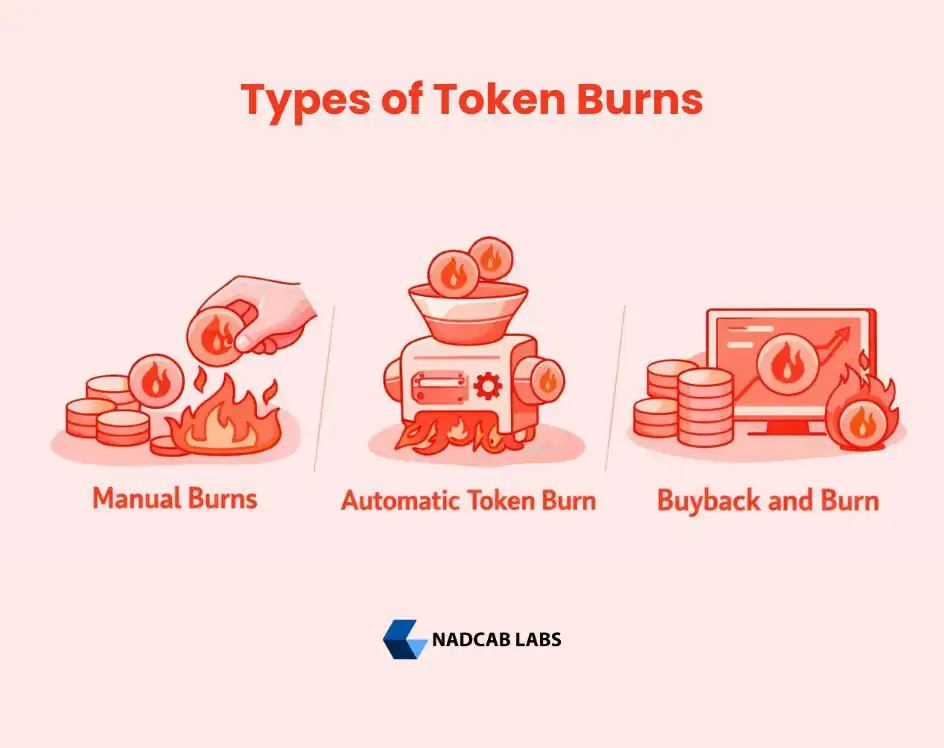
Token burns can be manual automatic or buyback and burn each method strategically reduces supply to enhance scarcity and token value.
Manual Burns
Project teams decide to burn specific token amounts at designated times. These strategic burns often coincide with milestones, product launches, or quarterly events to maximize market impact.
Automatic Token Burn
Built into smart contracts, automatic burns trigger based on predefined conditions. Transaction fees, trading volume, or time intervals can activate these scheduled or automatic token burns without manual intervention.
Buyback and Burn
Projects repurchase their tokens from the open market before burning them. This strategy demonstrates team commitment while simultaneously reducing supply and supporting token value through market buying pressure.
Why Do Crypto Projects Burn Tokens?
Understanding why projects implement token burning reveals strategic tokenomics decisions aimed at long-term value creation and community trust.
Creating Scarcity in Cryptocurrency
Reducing circulating supply creates scarcity, a fundamental economic principle. When fewer tokens exist and demand remains constant or grows, each remaining token theoretically increases in value. This scarcity mechanism mirrors precious metals like gold, where limited supply drives perceived worth.
Inflation Control Crypto
Many blockchain projects initially mint large token quantities for ecosystem Development. Without supply management, continuous minting creates inflation, diluting holder value. Token burning acts as a deflationary counterforce, maintaining healthy tokenomics by offsetting new issuance. Strategic Development of burning mechanisms helps projects maintain long-term value stability.
Building Market Confidence in Crypto
Regular burns signal long-term project commitment. When Development teams permanently destroy their own token holdings, they demonstrate confidence in the project’s future and alignment with community interests. This transparency builds investor trust and distinguishes serious projects from speculative ventures. Consistent Development efforts combined with strategic burns create powerful market signals.
Stablecoin Burn Mechanisms
Algorithmic stablecoins use burning to maintain dollar pegs. When the stablecoin trades above $1, the protocol mints new tokens. When it falls below $1, the protocol burns tokens to restore the peg. This dynamic balance keeps prices stable relative to fiat currencies.
Effects of Token Burning on Crypto Prices
While burning reduces supply, the price impact depends on multiple interconnected factors that token development solutions must consider.
Supply and Demand Dynamics
Basic economics suggests reduced supply with steady demand increases value. However, cryptocurrency markets are complex. A burn announcement might create temporary hype, but sustained value requires genuine utility and adoption.
Market Perception Matters
How the community interprets burns significantly affects outcomes. A well-planned burn from a strong project builds confidence. The same burn from a struggling project might signal desperation, causing investors to question fundamentals rather than celebrate supply reduction.
Burn Size and Frequency
A burn of 0.1% supply barely registers. A 10-15% burn, like Pudgy Penguins’ $357 million burn in 2025, creates substantial market impact. Frequency also matters—predictable schedules allow markets to price in burns, while surprise burns generate immediate reactions.
Project Fundamentals Trump Burns
Token burning cannot compensate for poor project fundamentals. Real-world utility, active Development, strong partnerships, and genuine adoption drive sustainable value. Burns amplify strong projects but cannot rescue failing ones. Continuous Development and innovation remain the foundation of successful crypto projects.
Real-World Token Burn Examples in 2025
Recent high-profile burns demonstrate diverse strategic applications across the crypto ecosystem.
OKX’s $7.6 Billion Autoburn
OKX burned 65.26 million OKB tokens worth approximately $7.6 billion, introducing an innovative autoburn feature linked to network activity. This mechanism automatically adjusts burn rates based on platform usage, creating a self-regulating deflationary model.
PayPal’s PYUSD Stability Management
PayPal burned 600 million PYUSD stablecoin tokens to maintain the dollar peg. This demonstrates how burning supports price stability rather than price appreciation, showing the mechanism’s versatility across different token types.
Pudgy Penguins’ Strategic Supply Cut
The $PENGU token burn destroyed $357 million worth of tokens, cutting nearly 14% of total supply. Unclaimed airdrop tokens were sent to the burn address, permanently removing them while rewarding active community members.
Benefits of Token Burning for Blockchain Networks
Strategic burning delivers multiple advantages when integrated into comprehensive Token Curated Registry and governance frameworks.
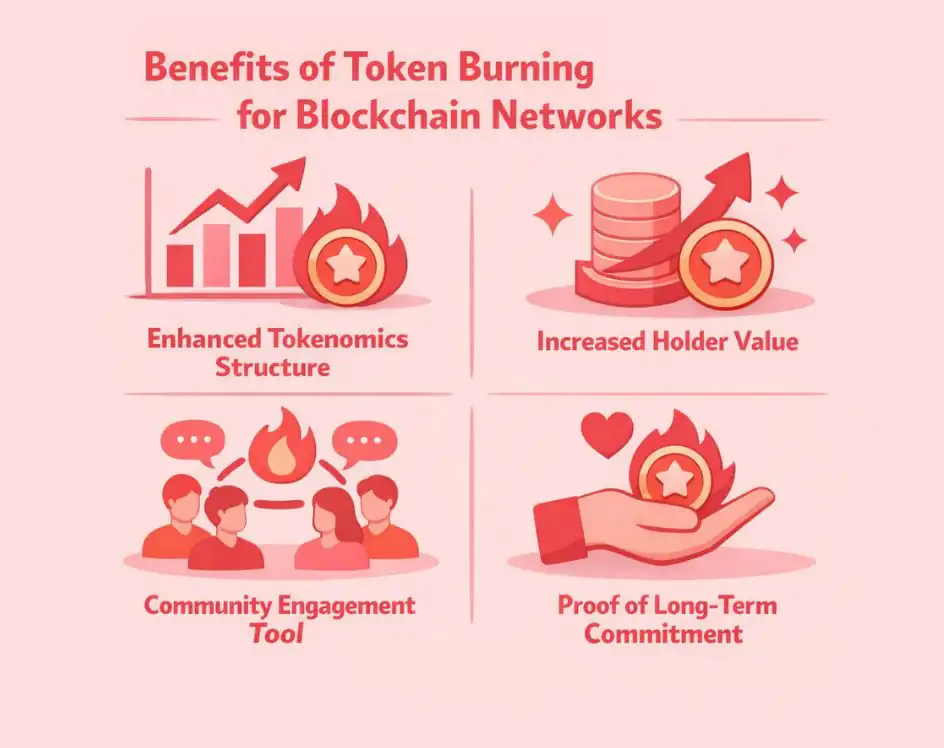
Enhanced Tokenomics Structure
Burning creates healthier token economics by balancing supply with demand. This equilibrium prevents excessive inflation while maintaining sufficient liquidity for ecosystem operations and user transactions.
Increased Holder Value
Deflationary tokens benefit existing holders by increasing their proportional ownership. If a project burns 10% of supply, each remaining token represents a larger percentage of the total ecosystem, potentially increasing value without additional investment.
Community Engagement Tool
Burn events create community excitement and participation opportunities. Projects often allow Governance Tokens holders to vote on burn schedules, amounts, and conditions, fostering active engagement and shared ownership.
Proof of Long-Term Commitment
When development teams burn their own allocations, they signal unwavering commitment to the project’s success. This action aligns team incentives with community interests, reducing concerns about token dumps or abandonment.
Token Burning Implementation in Development
Implementing effective burning mechanisms requires careful planning during token Development and smart contract creation. Professional Development teams ensure burn functions are secure, transparent, and aligned with project goals.
Smart Contract Integration
Developers embed burn functions directly into token smart contracts. For ERC-721 Token standards and other blockchain protocols, these functions execute burns automatically based on predetermined conditions, ensuring consistency and removing human error.
Burn Transparency and Verification
Every burn transaction is recorded on the blockchain, creating an immutable audit trail. Users can verify burns by checking burn addresses on blockchain explorers, ensuring projects cannot falsely claim burns without proof.
Customizable Burn Schedules
Token development solutions allow projects to create flexible burn schedules tailored to their specific needs. Some choose quarterly burns tied to revenue, while others implement continuous micro-burns on every transaction, creating constant deflationary pressure.
Risks and Criticisms of Token Burning
Despite benefits, token burning carries risks and limitations that investors and developers must understand.
No Guaranteed Price Increase
Burning reduces supply but cannot force demand creation. Without genuine project growth, utility expansion, or user adoption, burns may fail to impact prices meaningfully. Markets eventually recognize this disconnect, leading to disappointment.
Transparency Concerns
Some projects announce burns without providing verifiable proof. Others burn tokens while simultaneously minting new ones elsewhere, creating false scarcity narratives. Communities must verify burn transactions independently rather than trusting announcements.
Over-Reliance on Burns
Projects focusing exclusively on burns while neglecting product Development, user acquisition, or ecosystem growth ultimately fail. Burning should complement strong fundamentals, not substitute for them.[1] Successful projects balance burn strategies with continuous Development efforts.
Liquidity Reduction
Aggressive burning can reduce available liquidity, making it harder for users to buy or sell tokens. This creates price volatility and poor user experiences, potentially harming the project despite good intentions.
How Crypto Token Development Companies Implement Burns
Professional crypto development company teams approach burning strategically, integrating it into comprehensive tokenomics models.
Strategic Planning
Expert cryptocurrency development company professionals analyze project goals, token distribution, and market conditions before designing burn mechanisms. They calculate optimal burn rates that create scarcity without harming liquidity or utility.
Technical Implementation
Skilled developers create secure smart contracts with burn functions that prevent exploits or errors. They conduct rigorous audits to ensure burns execute correctly and tokens are permanently removed rather than temporarily locked. Quality Development practices are essential for reliable burning mechanisms.
Community Communication
Transparent communication distinguishes professional development teams. They announce burns in advance, explain the reasoning, and provide verification details post-burn. This openness builds the market confidence in crypto projects that drives long-term success.
Ongoing Monitoring
Token development doesn’t end at launch. Crypto development company teams monitor burn effectiveness, tracking metrics like circulating supply reduction, price impact, trading volume changes, and community sentiment to refine strategies over time.
Token Burning vs. Other Supply Management Strategies
Burning is one of several supply management approaches, each with distinct characteristics and use cases.
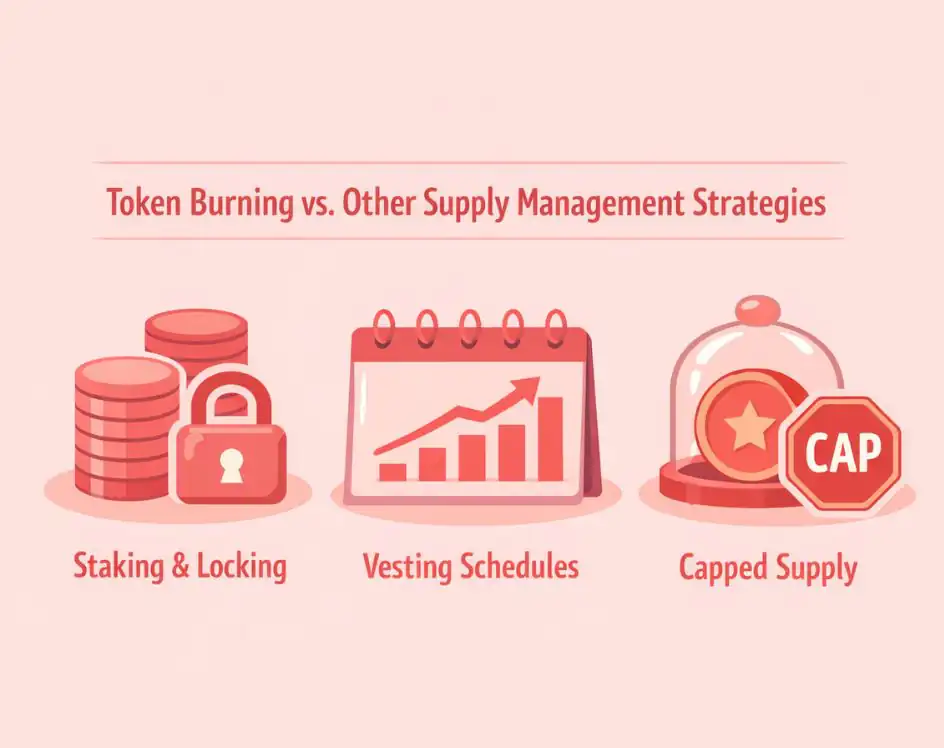
Staking and Locking
Staking temporarily removes tokens from circulation without permanent destruction. Users lock tokens to earn rewards, reducing liquid supply while maintaining total supply. Unlike burning, staked tokens can return to circulation.
Vesting Schedules
Vesting controls when tokens become available rather than destroying them. Team allocations might vest over 2-4 years, preventing immediate selling pressure while preserving total supply for future distribution.
Capped Supply
Some projects like Bitcoin use fixed maximum supplies without burning. The 21 million Bitcoin cap creates scarcity through limitation rather than destruction, proving burns aren’t the only path to deflationary tokenomics.
Future of Token Burning in Crypto Development
Token burning continues evolving as projects innovate with new burning mechanisms and strategies.
Automated Burning Protocols
Future token Development will likely feature more sophisticated automatic burn systems that adjust rates based on market conditions, network activity, or algorithmic formulas. These self-regulating mechanisms remove human decision-making, creating predictable deflationary pressure. Advanced Development in this area promises more efficient and responsive burning mechanisms.
Cross-Chain Burns
As interoperability grows, cross-chain burning mechanisms may emerge. Burning tokens on one blockchain could trigger actions on another, creating complex multi-chain tokenomics and expanding burn utility beyond single ecosystems.
Regulatory Considerations
Increased regulatory scrutiny may require more transparent burn reporting and verification. Crypto token Development standards could emerge, defining best practices for burn implementation, disclosure, and community communication. Development teams must stay ahead of evolving regulatory requirements.
Final Thoughts
Token burning is a powerful but nuanced tool in cryptocurrency tokenomics. By permanently removing tokens from circulation, projects create scarcity, control inflation, and demonstrate long-term commitment. The mechanism’s effectiveness depends on proper implementation, transparent communication, and integration with strong project fundamentals.
From OKX’s $7.6 billion autoburn to stablecoin peg maintenance, 2025 has shown burning’s versatility across different token types and objectives. However, burning alone cannot guarantee success—it must complement genuine utility, active Development, and growing adoption.
For projects considering token burns, partnering with experienced cryptocurrency Development professionals ensures strategic planning, secure implementation, and optimal results. Whether you’re launching a new crypto token, managing a Solana token, or exploring token Development solutions, understanding burning mechanics is essential for creating sustainable, value-driven tokenomics in today’s competitive blockchain landscape. Expert Development guidance makes the difference between superficial burns and strategic value creation.
Frequently Asked Questions
Q1.What is cryptocurrency token burning?
Token burning permanently removes tokens from circulation by sending them to an inaccessible burn address, reducing supply and creating scarcity to support potential value increase and deflationary tokenomics.
Q2.How do burn addresses work in crypto?
Burn addresses are wallets with no private keys, making tokens sent there irretrievable. This ensures permanent removal from supply, verifiable on blockchain for transparency and accountability.
Q3.Why do projects implement token burning?
Token burning creates scarcity, controls inflation, and builds market confidence by permanently reducing circulating supply, signaling long-term commitment to holders and encouraging sustainable ecosystem growth.
Q4.What are the types of token burns?
Token burns include manual burns by project teams, automatic burns triggered by smart contracts, and buyback-and-burn strategies where tokens are repurchased from markets before destruction.
Q5.Does burning guarantee token price increase?
No. While burning reduces supply, price depends on demand, project utility, adoption, and market perception. Burns amplify value only when fundamentals are strong.
Q6.How do crypto companies implement token burns?
Professional teams design burn mechanisms strategically, integrate secure smart contracts, communicate transparently with the community, monitor effectiveness, and adjust schedules to ensure deflation benefits without harming liquidity.
Explore Services
Related Services
Reviewed by

Aman Vaths
Founder of Nadcab Labs
Aman Vaths is the Founder & CTO of Nadcab Labs, a global digital engineering company delivering enterprise-grade solutions across AI, Web3, Blockchain, Big Data, Cloud, Cybersecurity, and Modern Application Development. With deep technical leadership and product innovation experience, Aman has positioned Nadcab Labs as one of the most advanced engineering companies driving the next era of intelligent, secure, and scalable software systems. Under his leadership, Nadcab Labs has built 2,000+ global projects across sectors including fintech, banking, healthcare, real estate, logistics, gaming, manufacturing, and next-generation DePIN networks. Aman’s strength lies in architecting high-performance systems, end-to-end platform engineering, and designing enterprise solutions that operate at global scale.