Ai Overview
Not every crypto exchange works the same way. Some handle billions of dollars in daily trades; others struggle with thin order books and frequent downtime. This blog explains clearly what makes Tier 1 exchanges stand apart and why the benefits of Tier 1 crypto exchanges matter for anyone who trades seriously. Centralized exchanges as a category handle around 99% of all crypto transactions worldwide.
Not every crypto exchange works the same way. Some handle billions of dollars in daily trades; others struggle with thin order books and frequent downtime. When you compare platforms, the difference between a Tier 1 exchange and a smaller one shows up quickly — in how fast your order fills, how safe your funds are, and whether the platform is operating within the law. This blog explains clearly what makes Tier 1 exchanges stand apart and why the benefits of Tier 1 crypto exchanges matter for anyone who trades seriously.
Key Takeaways
- Definition: Tier 1 exchanges are the top-ranked global crypto trading platforms evaluated on volume, security, liquidity, and regulatory standing.
- High Liquidity: Deep order books allow large trades to fill quickly with minimal price movement or slippage.
- Strong Security: Cold storage, 2FA, regular audits, and proof-of-reserves protect user funds more reliably than smaller platforms.
- Regulatory Compliance: Tier 1 exchanges operate under recognized legal frameworks across multiple jurisdictions, reducing legal risk for traders.
- Wide Asset Selection: Hundreds to over a thousand trading pairs give traders access to both established and emerging tokens.
- Advanced Trading Tools: Stop-loss orders, margin trading, futures, and analytics dashboards support all levels of traders.
- Token Credibility Boost: Projects listed on Tier 1 exchanges gain visibility, trust, and access to a massive global user base instantly.
- Lower Long-Term Costs: Competitive fee structures, native token discounts, and volume-based tiers reduce trading costs at scale.
- Reliable Uptime: High operational infrastructure means less downtime, especially during volatile market conditions.
What Is a Tier 1 Crypto Exchange?
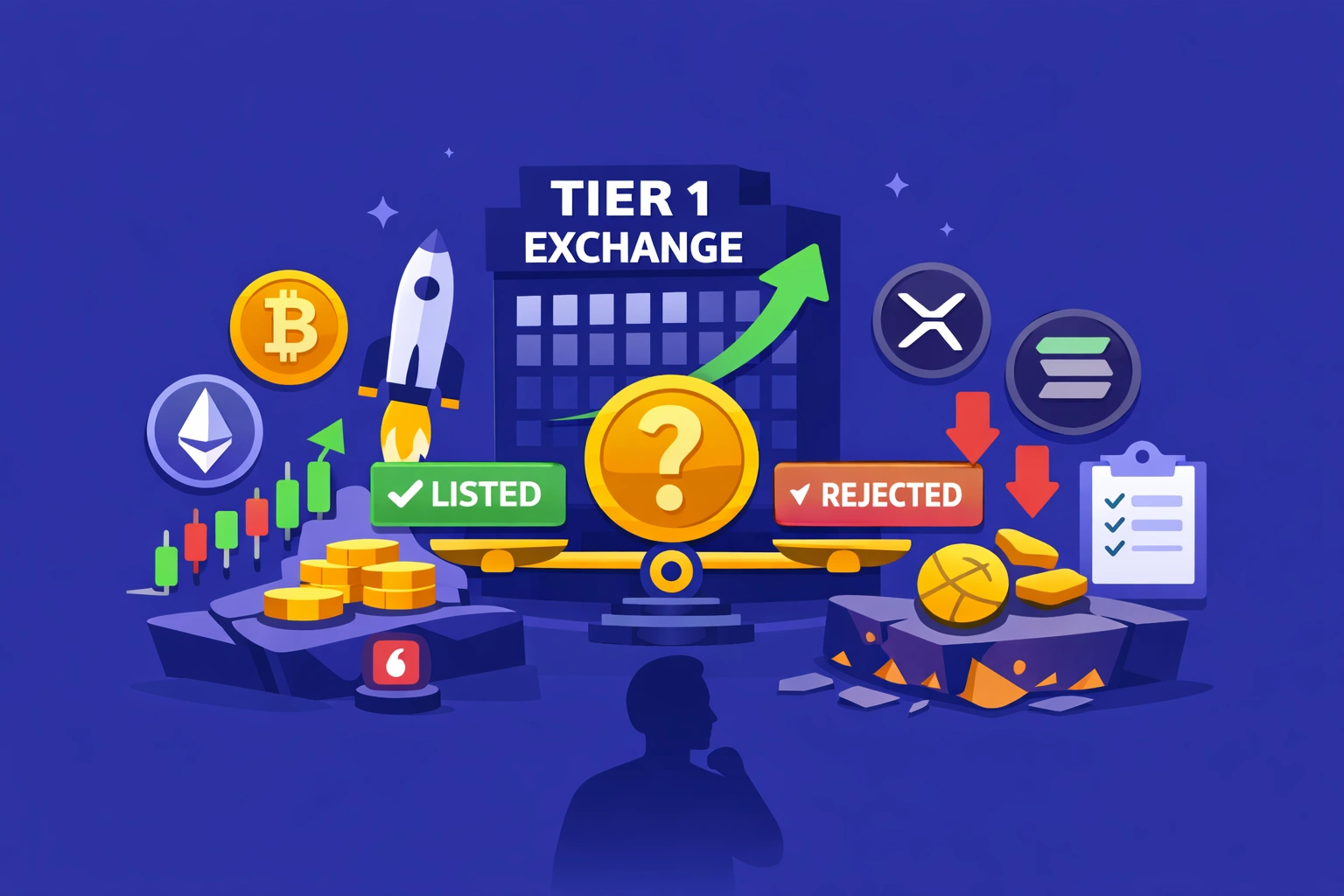
A Tier 1 crypto exchange is a top-ranked centralized cryptocurrency trading platform that consistently performs well across several key criteria: daily trading volume, order book depth, security infrastructure, regulatory compliance in multiple regions, and overall reputation among users and institutions.[1]
As of 2025 and 2026, the exchanges most consistently classified as Tier 1 include Binance, Coinbase, Kraken, OKX, and Bybit. These platforms rank highest on trust scores from CoinGecko and CoinMarketCap, and they account for the majority of global crypto trading volume. Centralized exchanges as a category handle around 99% of all crypto transactions worldwide.
The “tier” system is not an official rating but is widely recognized in the industry to help traders, projects, and institutions identify which platforms meet the highest standards. A Tier 2 exchange may be reputable in a specific region but lacks the global depth and compliance footprint of a Tier 1 platform. Tier 3 exchanges are smaller, lightly regulated, and generally carry more risk for users.[2]
Search Intent: What People Want to Know
This blog targets informational search intent. Users searching for “why Tier 1 crypto exchanges are better” or “advantages of Tier 1 crypto exchanges” are not ready to buy a product. They want to understand what sets these platforms apart, what real trading benefits they get, and whether switching to a Tier 1 exchange is worth it. The content here answers those questions directly, with facts and clear reasoning.
Benefits of Tier 1 Crypto Exchanges for Traders
1. Deep Liquidity Means Faster and Fairer Trades
Liquidity is the most practical reason to choose a Tier 1 exchange. High liquidity means there are enough buyers and sellers active at any moment so that your order fills at or very close to the price you see. On a low-liquidity exchange, a large trade can shift the price noticeably before it completes — a problem called slippage.[3]
Tier 1 exchanges maintain deep order books, meaning there are many open buy and sell orders stacked at different price levels. This allows even large trades to execute without causing significant price movement. Institutional investors and high-volume retail traders depend on this reliability. For everyday traders, it means the price shown is closer to the price they actually pay.
2. Security Standards Are Measurably Higher
Tier 1 exchanges invest heavily in security. Common measures include cold storage for the majority of user funds (keeping assets offline and away from hackers), two-factor authentication (2FA), SSL encryption, regular third-party security audits, and proof-of-reserves reporting. Platforms like Kraken are specifically recognized for their proof-of-reserves audits, which allow users to verify that the exchange holds the funds it claims to hold.
Smaller exchanges often lack the budget or the regulatory pressure to implement these layers. The 2025 Bybit incident, where a $1.5 billion breach occurred, highlighted how security vulnerabilities can affect any platform — but also how Tier 1-level infrastructure and response capability make a significant difference in outcome and user protection.[4]
3. Regulatory Compliance Protects You Legally
Trusted cryptocurrency exchanges at the Tier 1 level operate under recognized legal frameworks. Coinbase, for example, is licensed and compliant with U.S. regulations. Binance holds operating licenses in more than 175 countries, though some services are restricted based on local laws. Kraken complies with requirements across Europe and the United States.
This matters for traders because regulatory oversight means the exchange must follow rules around user fund protection, AML (anti-money laundering) compliance, KYC (know-your-customer) verification, and financial reporting. These requirements reduce the chance of fraud, sudden shutdowns, or misuse of user funds. Platforms operating without regulatory oversight carry a higher risk of unexpected collapses.[5]
Tier 1 vs Tier 2 vs Tier 3 Exchanges: Key Differences
| Feature | Tier 1 Exchange | Tier 2 Exchange | Tier 3 Exchange |
|---|---|---|---|
| Daily Trading Volume | Very High (billions USD) | Moderate | Low |
| Liquidity Depth | Deep order books | Moderate depth | Thin, prone to slippage |
| Security Infrastructure | Cold storage, 2FA, audits, PoR | Basic security measures | Minimal or unclear |
| Regulatory Compliance | Multi-jurisdiction licenses | Limited regions | Minimal or none |
| Token Listings | 400–1700+ assets | 100–400 assets | Fewer than 100 |
| Trading Tools | Advanced (futures, margin, analytics) | Basic to moderate | Basic only |
| Global Reach | 175+ countries | Regional | Very limited |
| Institutional Support | Yes | Partial | Rarely |
4. Wide Range of Tradable Assets
The best Tier 1 crypto exchanges list hundreds of assets. Binance offers over 400 cryptocurrencies. Gate.io lists over 1,700 tokens. This breadth lets traders access both major assets like Bitcoin and Ethereum and newer tokens with growth potential — all within one account.
On smaller exchanges, traders are often limited to a narrow selection. If they want to diversify into different sectors of crypto — DeFi, layer-2 tokens, gaming tokens — they must spread across multiple platforms, each requiring separate accounts, verification, and fee structures. Tier 1 exchanges consolidate this into one platform.[6]
5. Advanced Trading Features Support All Trader Types
High liquidity crypto exchanges at the Tier 1 level offer trading features that go well beyond basic buy and sell orders. These include:
- Stop-loss and take-profit orders: Automatically close a trade at a set price to limit losses or lock in gains.
- Margin trading: Borrow funds to increase position size, available at controlled risk levels.
- Futures and derivatives: Trade contracts based on price expectations without holding the underlying asset.
- Staking: Earn passive rewards on certain assets held on the platform.
- Analytics dashboards: View live price charts, volume data, and historical patterns to support trading decisions.
These tools are essential for traders who want to manage risk precisely and trade more than simple spot positions. Tier 2 and Tier 3 exchanges typically offer only a fraction of these features.
6. Competitive Fee Structures Reward Active Traders
On Tier 1 platforms, fees are typically tiered based on trading volume. Binance charges spot trading fees starting at 0.1% for both makers and takers. This drops further when users pay fees using BNB (Binance’s native token) or qualify for volume-based discounts. Kraken and Coinbase use similar volume tier systems.
While lower-tier exchanges may advertise very low or zero fees, these often come with hidden costs through wider bid-ask spreads. The price at which you buy or sell may not be the best available, resulting in a hidden cost that exceeds what you would have paid on a transparent Tier 1 fee model.
7. Reliable Uptime During Market Volatility
During high-activity events — a major price move, a token listing, or a market-wide surge — exchange infrastructure is tested. Smaller platforms frequently go offline or slow down during exactly these periods, leaving traders unable to act. Tier 1 exchanges have the technical infrastructure to handle traffic spikes reliably. Their systems are built for scale, with redundant servers and active load management.[7]
For a trader, downtime during a market move can mean a missed trade or an unprotected position. Platform reliability is not a minor convenience — it directly affects trading outcomes.
Why Token Projects Benefit from Tier 1 Exchange Listings
For crypto projects, getting listed on a Tier 1 exchange is one of the most impactful steps they can take. When a token appears on a platform like Binance or Coinbase, it immediately reaches hundreds of millions of users worldwide. This access would otherwise take years to build independently.
Beyond visibility, a Tier 1 listing signals that the project passed a serious vetting process. Exchanges review smart contract audits (from firms like CertiK or OpenZeppelin), tokenomics, team credentials, trading history, and legal classification of the token before approving a listing. This review builds trust with retail traders, institutional buyers, and potential partners who might otherwise hesitate.
Liquidity also improves immediately after a Tier 1 listing. Market makers active on these platforms post tight bid-ask spreads, which means tokens can be traded in large amounts without major price disruption. This is important for token utility and long-term price stability. Learn more about the steps and requirements involved in token listing on Tier 1 exchanges to understand what qualifies a project for these platforms.
Safest Crypto Exchanges for Trading: What to Look For
When evaluating the safest crypto exchanges for trading, these are the specific factors to verify:
Cold Storage Ratio
A high percentage of user funds stored in cold wallets (offline) means less exposure to online hacks. Look for exchanges that publish this figure or provide proof-of-reserves reports.
Proof-of-Reserves Audits
Proof-of-reserves verification allows any user to confirm that the exchange holds the assets it claims to. Kraken and several other Tier 1 platforms publish these audits regularly. Exchanges without this transparency carry higher counterparty risk.
Regulatory Licensing
An exchange with licenses in recognized jurisdictions — such as the U.S., EU, UK, or Singapore — is subject to oversight, reporting requirements, and fund protection rules. These create accountability that unregulated platforms do not have.
Multi-Factor Authentication
Account-level security features like 2FA, withdrawal address whitelisting, and anti-phishing codes protect individual users. These are standard on Tier 1 platforms and often optional or absent on smaller exchanges.
Best Tier 1 Crypto Exchanges in 2025
The following platforms are consistently recognized as the best Tier 1 crypto exchanges based on CoinGecko and CoinMarketCap trust scores, trading volume, and user adoption:
| Exchange | Known For | Spot Fee (Base) | Countries Available |
|---|---|---|---|
| Binance | Highest global volume, 400+ assets | 0.10% | 175+ |
| Coinbase | U.S. regulatory compliance, beginner-friendly | Varies by product | 100+ |
| Kraken | Security focus, proof-of-reserves | 0.16% (maker) / 0.26% (taker) | 180+ |
| OKX | Derivatives depth, flexible listing criteria | 0.08% (maker) | 100+ |
| Bybit | Derivatives, institutional-grade tools | 0.10% | 160+ |
Each platform has strengths suited to different user needs. Binance is the largest by volume. Coinbase is the most regulated in the U.S. Kraken is widely regarded for security. OKX and Bybit lead in derivatives coverage. The right choice depends on your trading style, geography, and priorities. You can explore Tier-1 Exchange Listings to understand how these platforms differ in listing standards and access.
📌 Trend to Watch (2025–2026)
Regulatory frameworks like the EU’s MiCA (Markets in Crypto-Assets Regulation) and the U.S. GENIUS Act are shaping how Tier 1 exchanges operate. Exchanges without strong compliance foundations are being limited or excluded from key markets. As regulations tighten, the advantage of choosing a compliant Tier 1 platform grows stronger for traders in regulated regions.
Common Misconceptions About Tier 1 Exchanges
Misconception 1: Higher-Tier Means Higher Fees Always
This is not accurate. Tier 1 exchanges often have lower effective costs than smaller platforms because their fee structures are transparent, they offer volume-based discounts, and their tight spreads mean you get the actual market price on trades. On smaller exchanges, hidden spread costs can exceed what a Tier 1 fee would have charged.
Misconception 2: All Exchanges Are Equally Safe
The security gap between Tier 1 and Tier 3 exchanges is significant. Cold storage ratios, security audits, regulatory obligations, and incident response capability vary widely. Using a Tier 3 exchange for large amounts of funds carries risks that a Tier 1 exchange largely eliminates through both technical and compliance measures.
Misconception 3: Tier 1 Exchanges Are Only for Professionals
Platforms like Coinbase and Binance are designed to serve beginners as well as experienced traders. They provide educational resources, simple interfaces for basic trades, and advanced tools that users can access gradually as they gain experience.
Get Your Token Listed on a Tier 1 Exchange
Nadcab Labs helps crypto projects prepare and execute listings on top-tier global exchanges. From smart contract audits and tokenomics review to compliance documentation and market-making strategy, we handle the technical and regulatory groundwork needed to pass Tier 1 listing reviews.
Frequently Asked Questions
Q1.What qualifies an exchange as Tier 1?
A Tier 1 exchange is defined by high daily trading volume, deep liquidity, strong security infrastructure, regulatory compliance across multiple jurisdictions, and a proven track record of user fund protection. Platforms like Binance, Coinbase, Kraken, OKX, and Bybit consistently meet these criteria and are recognized as Tier 1 by industry sources like CoinGecko and CoinMarketCap.
Q2.Are Tier 1 exchanges safer than smaller platforms?
Yes. Tier 1 exchanges use cold storage for the majority of user funds, require 2FA, conduct third-party security audits, and publish proof-of-reserves reports. Smaller exchanges often lack these measures. The security gap is significant, especially for traders holding large balances.
Q3.Why does liquidity matter in crypto trading?
High liquidity means your trade executes at or near the displayed price. On low-liquidity exchanges, large orders cause slippage — the price shifts before the full order fills. This directly affects the actual cost of every trade. Tier 1 exchanges maintain deep order books that minimize slippage for both retail and institutional traders.
Q4.Can beginners use Tier 1 crypto exchanges?
Yes. Platforms like Coinbase and Binance are designed for both beginners and professional traders. They offer simple interfaces for basic trades, educational materials, and mobile apps. Advanced features like margin trading or futures are available but not required for basic use.
Q5.Which Tier 1 exchange has the most assets?
Gate.io lists over 1,700 cryptocurrencies, making it the broadest in terms of asset selection among commonly cited Tier 1 platforms. Binance lists over 400 assets with the highest global trading volume. The right choice depends on whether you prioritize volume depth or asset variety.
Explore Services
Related Services
Reviewed by

Naman Singh
Co-Founder & CEO, Nadcab Labs
Naman Singh is the Co-Founder and CEO of Nadcab Labs, where he drives the company’s vision, global growth, and strategic expansion in blockchain, fintech, and digital transformation. A serial entrepreneur, Naman brings deep hands-on experience in building, scaling, and commercializing technology-driven businesses. At Nadcab Labs, Naman works closely with enterprises, governments, and startups to design and implement secure, scalable, and business-ready Web3 and blockchain solutions. He specializes in transforming complex ideas into high-impact digital products aligned with real business objectives. Naman has led the development of end-to-end blockchain ecosystems, including token creation, smart contracts, DeFi and NFT platforms, payment infrastructures, and decentralized applications. His expertise extends to tokenomics design, regulatory alignment, compliance strategy, and go-to-market planning—helping projects become investor-ready and built for long-term sustainability. With a strong focus on real-world adoption, Naman believes in building blockchain solutions that deliver measurable value, solve practical problems, and unlock new growth opportunities for organizations worldwide.