Ai Overview
Crypto Index Funds are investment products that track baskets of cryptocurrencies, allowing investors to gain exposure to multiple digital assets through single positions. These mechanisms combine smart contract automation, liquidity pools, and oracle systems to create self-operating investment vehicles. Automation through smart contracts eliminates the need for fund managers while ensuring consistent execution of investment rules. 5-2% annually, often lower than traditional crypto fund alternatives.
Key Takeaways
- Crypto Index Funds provide diversified exposure to multiple cryptocurrencies through single tokens, simplifying crypto portfolio diversification for investors.
- Crypto Index Funds in DEX platforms operate through smart contract-based index funds that automatically manage basket compositions without centralized intermediaries.
- Decentralized Index Funds use on-chain portfolio rebalancing mechanisms to maintain target allocations, ensuring the fund tracks its intended index accurately.
- DEX Index Funds leverage automated market makers and liquidity pools to enable trading, providing continuous access to fund tokens without traditional order books.
- Tokenized Index Funds offer transparency through blockchain-based index funds where all holdings, transactions, and rebalancing activities are publicly verifiable.
- DeFi Index Funds incorporate governance tokens allowing community control over fund parameters, asset selection, and protocol upgrades.
- On-chain index funds typically offer lower costs compared to centralized alternatives, though gas fees and slippage must be considered in total cost calculations.
- Smart contract risks, oracle dependencies, and market volatility represent key challenges that investors must evaluate when participating in crypto index fund platforms.
The intersection of traditional finance concepts with decentralized technology has created innovative investment vehicles that combine the diversification benefits of index funds with the transparency and accessibility of blockchain. Understanding how crypto index funds work in DEX platforms reveals how these instruments democratize portfolio investing while maintaining the trustless, permissionless nature that defines decentralized finance.
What Are Crypto Index Funds?
Crypto Index Funds are investment products that track baskets of cryptocurrencies, allowing investors to gain exposure to multiple digital assets through single positions. Like the S&P 500 index tracks leading stocks, crypto indices track selected cryptocurrencies based on market capitalization, sector focus, or other criteria. These funds simplify cryptocurrency investing while spreading risk across multiple assets.
Understanding Crypto Index Funds
Understanding crypto index funds begins with recognizing their role in portfolio management. Rather than researching and purchasing individual cryptocurrencies, investors buy index tokens representing proportional ownership of underlying baskets. This approach provides instant diversification, professional curation of holdings, and automatic rebalancing to maintain target allocations as market conditions change.
Crypto Index Funds in DEX platforms add decentralization to this model. Instead of trusting centralized fund managers, smart contracts handle all operations transparently on blockchain. This combination of traditional index investing principles with decentralized technology creates accessible, transparent vehicles for crypto portfolio diversification.
Difference Between Crypto Index Funds and Traditional Index Funds
The difference between crypto index funds and traditional index funds extends beyond underlying assets to fundamental operational models. Traditional index funds operate through regulated financial institutions with custodians, administrators, and fund managers. Crypto index funds, especially decentralized versions, operate through code executing on public blockchains, eliminating intermediaries while enabling 24/7 global access.
Transparency differs significantly between models. Traditional fund holdings are reported periodically, while on-chain index funds display all holdings in real-time through public blockchain data. Settlement also differs, with traditional funds taking days while blockchain transactions settle in minutes. Understanding decentralized exchange protocol architecture provides context for these operational differences.
Crypto Index Funds vs ETFs
Crypto index funds and ETFs represent different approaches to similar goals. ETFs trade on regulated exchanges, require custody arrangements, and often face regulatory restrictions on direct cryptocurrency holdings. Many crypto ETFs hold futures or related securities rather than actual tokens. Decentralized index funds hold actual cryptocurrencies on-chain, providing direct exposure without regulatory intermediaries.
Access also differs substantially. ETFs require brokerage accounts and operate during market hours. DeFi index funds are accessible to anyone with a blockchain wallet, trading 24/7 without account requirements or geographic restrictions. This accessibility makes decentralized index funds particularly valuable for global investors underserved by traditional financial infrastructure.
Investment Principle: Index funds succeed by providing broad market exposure at low cost. Decentralized versions add transparency and self-custody while eliminating counterparty risk from fund managers. These advantages come with new risks including smart contract vulnerabilities that investors must evaluate carefully.
Role of Decentralized Exchanges (DEXs) in Index Funds
Decentralized Exchanges play crucial roles in crypto index fund operations, providing infrastructure for trading, liquidity, and price discovery. Without DEXs, decentralized index funds would lack the mechanisms needed for token trading and portfolio rebalancing. This symbiotic relationship enables the existence of truly decentralized index fund platforms.
What Is a Decentralized Exchange (DEX)?
A Decentralized Exchange is a platform enabling cryptocurrency trading without centralized intermediaries. Unlike traditional exchanges that hold user funds and match orders through central systems, DEXs execute trades directly between users through smart contracts. This approach eliminates custody risk while providing permissionless access to trading services.
Most DEXs use automated market maker models where liquidity pools replace order books. Understanding order book and AMM trading mechanisms reveals how these systems provide the continuous liquidity that index funds require for operations.
Why Crypto Index Funds Operate on DEX Platforms
Crypto index funds operate on DEX platforms because these venues provide the trustless, permissionless infrastructure that decentralized finance requires. DEXs enable index funds to execute rebalancing trades, facilitate user transactions, and maintain liquidity without depending on centralized services that could censor, halt, or manipulate operations.
The composability of DeFi also matters significantly. DEX Index Funds can integrate with other protocols, enabling users to stake index tokens, use them as collateral, or participate in yield strategies. This interoperability creates additional utility that centralized alternatives cannot match.
How Crypto Index Funds Work in DEX Platforms
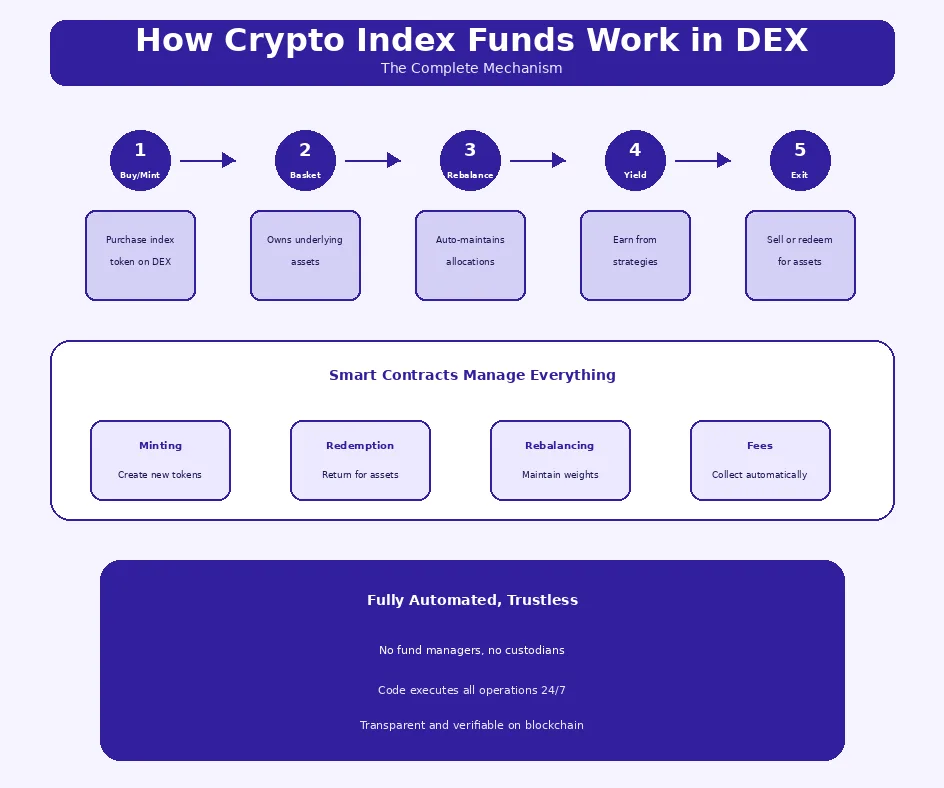
Understanding how crypto index funds work in DEX platforms requires examining the technical mechanisms enabling decentralized portfolio management. These mechanisms combine smart contract automation, liquidity pools, and oracle systems to create self-operating investment vehicles. Building crypto exchanges with index fund capabilities requires sophisticated integration of these components.
Tokenized Index Fund Structure
Tokenized index funds structure holdings as baskets represented by tradeable tokens. When users purchase index tokens, they gain proportional claims on underlying assets held by the smart contract. This tokenization enables the index to trade as a single asset while representing diversified exposure to multiple cryptocurrencies.
Basket of Cryptocurrencies in Index Funds
The basket of cryptocurrencies in index funds is determined by the index methodology, which specifies selection criteria and weighting schemes. Common approaches include market cap weighting (larger assets receive higher allocations), equal weighting (all assets receive equal allocations), or custom formulas based on specific criteria. Governance processes typically control methodology updates.
Basket composition directly affects fund performance and risk characteristics. DeFi-focused indices track decentralized finance tokens, while large-cap indices focus on established cryptocurrencies. Thematic indices might track specific sectors like metaverse, gaming, or layer-1 blockchains. Understanding yield optimization in decentralized exchanges reveals how some indices incorporate yield-bearing strategies.
Smart Contract-Based Index Funds
Smart contract-based index funds execute all operations through code deployed on blockchain. These contracts handle deposits, withdrawals, rebalancing, and fee collection without human intervention. Once deployed, smart contracts operate according to their programmed logic, providing consistent, predictable behavior that users can verify by examining the code.
Automation Through Smart Contracts
Automation through smart contracts eliminates the need for fund managers while ensuring consistent execution of investment rules. Rebalancing triggers execute automatically when conditions are met. Fee calculations and distributions occur programmatically. This automation reduces costs, eliminates human error, and ensures the fund operates exactly as designed.
Smart contract automation also enables innovations impossible in traditional finance. Funds can incorporate complex strategies, integrate with multiple protocols, and respond to market conditions in real-time. This programmability distinguishes blockchain-based index funds from their traditional counterparts.
Liquidity Pools and AMM-Based Index Funds
Liquidity pools and AMM-based index funds use automated market maker mechanisms to enable trading and rebalancing. Some index funds operate as specialized AMM pools where the pool itself represents the index. Others trade through external AMM pools, accessing DEX liquidity for rebalancing operations.
Role of Liquidity Providers
Liquidity providers play essential roles in index fund ecosystems. They supply the capital that enables index token trading on DEXs. Without sufficient liquidity, users would face high slippage when entering or exiting positions. Many protocols incentivize liquidity provision through token rewards, ensuring adequate market depth for fund operations.
On-Chain Portfolio Rebalancing
On-chain portfolio rebalancing maintains target allocations as market prices change. When asset weights drift from targets due to price movements, rebalancing mechanisms restore intended proportions by selling overweight assets and buying underweight ones. This process keeps the index tracking its intended composition.
Automated Portfolio Rebalancing Mechanism
Automated portfolio rebalancing mechanisms trigger based on defined conditions. Time-based rebalancing occurs at regular intervals (daily, weekly, monthly). Threshold-based rebalancing triggers when allocations drift beyond specified percentages from targets. Some protocols combine approaches, using periodic reviews with threshold triggers for significant deviations.
Rebalancing involves trading through DEXs, so gas costs and slippage affect fund economics. Efficient protocols optimize rebalancing frequency to balance tracking accuracy against transaction costs. This optimization represents a key differentiator between crypto index fund platforms.
Crypto Index Fund Types Comparison
| Index Type | Structure | Rebalancing | Best For |
|---|---|---|---|
| Market Cap Weighted | Larger assets = larger weight | Periodic | Broad market exposure |
| Equal Weighted | Same allocation per asset | Frequent | Small cap exposure |
| AMM Pool Index | Pool is the index | Continuous | Active liquidity needs |
| Yield-Enhanced | Productive assets only | Strategy-based | Income generation |
Key Components of Decentralized Index Funds
Key components of decentralized index funds work together to create functional, transparent investment vehicles. Understanding these components helps investors evaluate different crypto index fund platforms and assess their relative strengths and risks.
Price Oracles in DeFi Index Funds
Price oracles in DeFi index funds provide the market data needed for calculating net asset values and triggering rebalances. Reliable oracle infrastructure is critical because incorrect prices could cause improper trades or enable manipulation. Most protocols use established oracle networks like Chainlink to ensure data accuracy and manipulation resistance.
Oracle selection affects fund security significantly. Centralized price feeds create single points of failure, while decentralized oracle networks distribute risk. Time-weighted average prices (TWAPs) help resist manipulation by smoothing out short-term price spikes.
Governance Tokens and Community Control
Governance tokens enable community control over decentralized index fund parameters. Token holders vote on asset additions or removals, allocation methodology changes, fee adjustments, and protocol upgrades. This distributed governance replaces traditional fund manager authority with transparent, democratic decision-making.
Governance participation requires understanding both token mechanics and fund strategy. Active communities monitor proposals, debate changes, and ensure the fund continues serving user interests. Understanding token launch mechanisms provides context for how governance tokens are distributed and function.
Yield Optimization Strategies
Yield optimization strategies enhance returns beyond simple price appreciation. Some indices hold yield-bearing assets like staked tokens or LP positions that generate ongoing returns. Others deploy idle assets to lending protocols or yield farms. These strategies increase potential returns but add complexity and risk layers.
Sophisticated funds automate yield strategies through smart contracts, continuously optimizing deployment across available opportunities. This automation captures yields efficiently but requires robust security measures to protect against exploits targeting yield aggregation mechanisms.
Index Fund Investment Lifecycle
| Step | Phase | Actions | Outcome |
|---|---|---|---|
| 1 | Research | Evaluate indices, review methodology | Selected target fund |
| 2 | Acquisition | Buy on DEX or mint directly | Hold index tokens |
| 3 | Holding | Tokens auto-rebalance | Diversified exposure |
| 4 | Optimization | Stake for yield (optional) | Enhanced returns |
| 5 | Monitoring | Track NAV, governance | Informed position |
| 6 | Exit | Sell on DEX or redeem | Realized returns |
Benefits of Crypto Index Funds on DEXs
Benefits of crypto index funds on DEXs combine traditional diversification advantages with blockchain-native features. These benefits make decentralized index funds attractive alternatives to centralized investment products for investors seeking crypto exposure with enhanced transparency and control.
Crypto Portfolio Diversification
Crypto portfolio diversification through index funds spreads risk across multiple assets with single transactions. Rather than managing numerous individual positions, investors hold one token representing a professionally curated basket. This simplification reduces operational complexity while achieving diversification goals that would otherwise require significant time and transaction costs.
Diversification benefits compound with automatic rebalancing. As markets move, the index maintains target allocations, systematically selling winners and buying losers. This disciplined approach removes emotional decision-making while capturing potential mean-reversion benefits.
Transparency and On-Chain Visibility
Transparency and on-chain visibility distinguish decentralized index funds from traditional alternatives. All holdings, transactions, and rebalancing activities are publicly visible on blockchain. Investors can verify exactly what assets the fund holds at any moment, ensuring reported compositions match reality.
This transparency extends to fee structures and governance decisions. Users can audit fee collection, examine rebalancing efficiency, and track governance votes. Such visibility enables informed investment decisions based on verifiable data rather than trust in fund manager reports.
Lower Costs Compared to Centralized Funds
Lower costs compared to centralized funds result from eliminating intermediaries and automating operations. Without fund managers, administrators, and custodians taking fees, more returns flow to investors. Streaming fees for decentralized funds typically range 0.5-2% annually, often lower than traditional crypto fund alternatives.
However, total costs include gas fees for blockchain transactions. High gas periods can make small investments costly. Layer 2 solutions and alternative chains with lower fees help address this issue, making index funds accessible to broader investor segments.
Index Fund Selection Criteria
When evaluating crypto index funds, consider:
- Methodology: Asset selection criteria and weighting scheme
- Track Record: Historical performance and protocol age
- Security: Audit status and incident history
- Fees: Streaming fees, entry/exit costs, gas impact
- Liquidity: Trading depth for entry and exit
- Governance: Community activity and responsiveness
Risks and Challenges of Crypto Index Funds in DEX Platforms
Risks and challenges of crypto index funds in DEX platforms require careful consideration before investing. While these instruments offer compelling benefits, they also carry unique risks that investors must understand and accept. Informed risk assessment enables appropriate position sizing and risk management.
Smart Contract Risks
Smart contract risks represent the primary technical concern for DeFi index funds. Bugs, vulnerabilities, or exploits in fund contracts could result in complete loss of deposited assets. Even audited contracts have suffered exploits, making this risk ever-present despite mitigation efforts. Diversifying across multiple protocols helps limit exposure to any single contract failure.
Liquidity and Slippage Issues
Liquidity and slippage issues affect both trading and rebalancing. Insufficient liquidity for index tokens causes high slippage when entering or exiting positions. Rebalancing also faces slippage costs that impact fund performance. Smaller or newer funds with limited liquidity may underperform due to these frictions.
Market Volatility in DeFi Index Funds
Market volatility in DeFi index funds reflects the inherent volatility of underlying cryptocurrency assets. While diversification reduces individual asset risk, crypto markets often move together during stress periods. Index funds provide no protection against broad market downturns that affect all holdings simultaneously.
Important Notice: Crypto index funds involve significant risks including smart contract exploits, market volatility, and potential total loss of invested capital. These products are not suitable for all investors. Conduct thorough research, understand all risks, and never invest more than you can afford to lose. Past performance does not guarantee future results.
Use Cases of DeFi Index Funds
Use cases of DeFi index funds span from passive retail investing to sophisticated institutional strategies. The versatility of these instruments makes them valuable tools for various investor profiles and objectives. Understanding appropriate use cases helps investors determine whether index funds suit their needs.
Passive Crypto Investing
Passive crypto investing represents the primary use case for index funds. Investors seeking crypto exposure without active management find index funds ideal. Buy and hold strategies require minimal ongoing attention while capturing broad market returns. This approach suits investors who believe in crypto’s long-term potential but lack time or expertise for active trading.
Institutional and Retail Investor Use Cases
Institutional and retail investor use cases differ in scale but share common motivations. Retail investors appreciate simplicity and accessibility. Institutions value the transparent, auditable nature of on-chain funds for compliance purposes. Both benefit from diversification, automatic rebalancing, and the operational efficiency that smart contracts provide.
Future of Crypto Index Funds in DeFi
The future of crypto index funds in DeFi involves continued innovation in fund structures, cross-chain capabilities, and integration with emerging DeFi primitives. As the ecosystem matures, index funds will likely become standard components of crypto portfolios, just as traditional index funds dominate conventional investment markets.
Growth of Blockchain-Based Index Funds
Growth of blockchain-based index funds will accelerate as DeFi adoption expands. Improved infrastructure, better user interfaces, and regulatory clarity will attract mainstream investors. Cross-chain capabilities will enable funds tracking assets across multiple blockchains, expanding investable universes beyond single-chain limitations.
Innovation in Decentralized Index Fund Platforms
Innovation in decentralized index fund platforms continues advancing capabilities. New structures include actively managed decentralized funds, thematic indices tracking emerging sectors, and hybrid funds combining index strategies with yield optimization. These innovations expand investor options while maintaining decentralization principles.
Crypto Index Fund Creation on DEX Platforms
Creating crypto index funds on DEX platforms requires sophisticated smart contract engineering and deep understanding of DeFi mechanics. Organizations launching index products need comprehensive technical capabilities and security expertise to build reliable, secure fund infrastructure.
Smart Contract Engineering for Index Funds
Smart contract engineering for index funds demands expertise in token standards, oracle integration, and DEX interactions. Contracts must handle minting, redemption, rebalancing, and fee collection securely while integrating with external protocols. Understanding exchange platform architecture provides foundation for index fund construction.
DeFi Index Fund Creation Services
Professional services for DeFi index fund creation encompass smart contract engineering, security auditing, deployment, and ongoing maintenance. Comprehensive solutions address all technical requirements while ensuring regulatory considerations are addressed appropriately.
Build Advanced DEX-Based Crypto Index Fund Solutions
Launch secure, scalable crypto index funds on DEX platforms with our expert DEX development services, smart contracts, and DeFi-ready architecture.
Launch Your Exchange Now
Role of a Blockchain Technology Company
Blockchain technology companies provide the technical expertise required to build secure, efficient index fund platforms. Their role spans architecture design, smart contract creation, testing, audit coordination, and deployment. Experienced teams understand the nuances of DeFi integration, security best practices, and operational requirements that distinguish successful fund platforms from vulnerable implementations.
Index Fund Platform Comparison
| Feature | Centralized Fund | Decentralized Index |
|---|---|---|
| Custody | Fund holds assets | Smart contract holds |
| Transparency | Periodic reports | Real-time on-chain |
| Access | Account required | Wallet only |
| Trading Hours | Market hours | 24/7/365 |
| Governance | Manager controlled | Token holder votes |
Final Thoughts
Crypto index funds on DEX platforms represent a significant evolution in investment products, combining traditional diversification principles with blockchain’s transparency and accessibility. These instruments enable crypto portfolio diversification through single token purchases while smart contracts handle rebalancing and fund management automatically.
Understanding how these funds work through tokenized structures, smart contract automation, and AMM integration helps investors evaluate opportunities appropriately. The benefits of transparency, lower costs, and self-custody come with risks including smart contract vulnerabilities and market volatility that require careful consideration.
As DeFi matures, decentralized index funds will likely grow in sophistication and adoption. Innovations in cross-chain capabilities, yield optimization, and governance models will expand investor options while maintaining the trustless, permissionless nature that distinguishes these instruments from traditional alternatives.
Frequently Asked Questions
Q1.What are crypto index funds?
Crypto index funds are investment vehicles that track a basket of cryptocurrencies, allowing investors to gain diversified exposure to the crypto market through a single token or position. Like traditional index funds that track stock indices, crypto index funds automatically balance holdings across multiple digital assets. This approach simplifies investing while spreading risk across the cryptocurrency ecosystem.
Q2.How do crypto index funds work on DEX platforms?
Crypto index funds on DEX platforms work through smart contracts that automatically manage a basket of tokens representing the index. Users purchase index tokens that represent proportional ownership of the underlying assets. The smart contracts handle rebalancing, maintain target allocations, and enable trading through automated market maker pools without centralized intermediaries.
Q3.What is the difference between a crypto index fund and a crypto ETF?
Crypto index funds, especially decentralized versions, operate on blockchain through smart contracts with transparent, on-chain management. Crypto ETFs are regulated financial products traded on traditional stock exchanges, often involving custodians and fund managers. ETFs require regulatory approval and may not hold actual crypto, while DeFi index funds provide direct on-chain exposure to underlying assets.
Q4.Are decentralized index funds safe?
Decentralized index funds carry both benefits and risks. Benefits include transparency, non-custodial control, and elimination of counterparty risk from centralized managers. Risks include smart contract vulnerabilities, oracle manipulation, and market volatility. Safety depends on protocol audit status, track record, and the security of underlying smart contract infrastructure.
Q5.What are the best crypto index fund platforms?
Popular crypto index fund platforms include Index Coop (DPI, MVI tokens), Set Protocol (TokenSets), and Indexed Finance. These platforms offer various indices tracking DeFi, metaverse, and large-cap cryptocurrencies. The best platform depends on desired exposure, fee structure, chain preference, and whether you prioritize established protocols or newer innovative offerings.
Q6.How do tokenized index funds maintain their target allocations?
Tokenized index funds maintain allocations through automated rebalancing mechanisms triggered by smart contracts. When asset prices cause allocations to drift beyond thresholds, the protocol automatically trades to restore target weights. Some use time-based rebalancing (daily, weekly), while others rebalance when drift exceeds percentage thresholds, minimizing unnecessary trading costs.
Explore Services
Related Services
Reviewed by

Aman Vaths
Founder of Nadcab Labs
Aman Vaths is the Founder & CTO of Nadcab Labs, a global digital engineering company delivering enterprise-grade solutions across AI, Web3, Blockchain, Big Data, Cloud, Cybersecurity, and Modern Application Development. With deep technical leadership and product innovation experience, Aman has positioned Nadcab Labs as one of the most advanced engineering companies driving the next era of intelligent, secure, and scalable software systems. Under his leadership, Nadcab Labs has built 2,000+ global projects across sectors including fintech, banking, healthcare, real estate, logistics, gaming, manufacturing, and next-generation DePIN networks. Aman’s strength lies in architecting high-performance systems, end-to-end platform engineering, and designing enterprise solutions that operate at global scale.