Ai Overview
A CRM lifecycle encompasses all stages of a customer’s journey, from initial awareness and lead generation through qualification, conversion, onboarding, engagement, support, and retention. Many companies focus heavily on the sales funnel but neglect the lifecycle stages after the sale, leaving significant revenue on the table. Companies with strong CRM lifecycle management grow revenue 34 percent faster. Upsell and cross sell opportunities identified through engagement stages drive incremental revenue.
Key Takeaways
- 1. CRM lifecycle consists of six main stages: lead generation, qualification, conversion, onboarding, engagement, and retention.
- 2. A well-managed CRM lifecycle increases customer lifetime value by an average of 40 percent across all industries.
- 3. Businesses that automate their customer relationship management workflows see 60 percent faster response times to customer inquiries.
- 4. Lead qualification saves sales teams up to 25 percent of their time by filtering out poor quality prospects early.
- 5. Customer onboarding directly impacts retention, with companies that excel at onboarding seeing 50 percent higher retention rates.
- 6. Personalized customer engagement increases conversion rates by 36 percent compared to generic interactions.
- 7. Customer retention is 5 to 25 times more cost effective than acquiring new customers in most business models.
- 8. CRM automation reduces manual data entry by 70 percent, allowing teams to focus on strategy and relationship building.
- 9. Real time visibility into customer interactions helps businesses identify upsell and cross sell opportunities earlier in the relationship.
- 10. Implementing a systematic CRM lifecycle approach typically delivers ROI within 6 to 12 months through improved efficiency and revenue growth.
Every business faces a critical challenge: how to convert a stranger into a loyal customer and keep them coming back. Without a structured approach to managing customer relationships, companies lose track of prospects, miss sales opportunities, and struggle to retain valuable clients. This is where understanding the CRM lifecycle becomes a game changer.
A CRM lifecycle is the complete journey your customer takes with your business, from the first moment they discover you until they become a long-term advocate. Think of it like a restaurant’s relationship with its customers: from the first time someone walks through the door (lead generation), to deciding whether to order (qualification), placing their first order (conversion), enjoying their meal and coming back regularly (retention), and eventually recommending it to friends (advocacy).
In today’s competitive business environment, companies that master their CRM lifecycle are 3x more likely to exceed revenue goals. Let’s explore how this systematic approach transforms customer relationships into sustainable business growth.
What is CRM Lifecycle?
A CRM lifecycle encompasses all stages of a customer’s journey, from initial awareness and lead generation through qualification, conversion, onboarding, engagement, support, and retention. It’s a structured process that helps businesses organize, automate, and optimize how they interact with customers at every touchpoint.
Why CRM Lifecycle Matters for Modern Business
Imagine running a retail store without a system to track customer preferences, purchase history, or loyalty. You’d be treating every customer like a stranger, missing opportunities to provide personalized service, and unable to predict what they might buy next. This is exactly what happens to businesses that ignore the importance of a structured customer relationship management lifecycle.
The CRM lifecycle matters because it creates a roadmap for every interaction you have with a customer. Instead of random, disconnected touchpoints, businesses can orchestrate a coordinated experience that builds trust and loyalty over time.
Key reasons why CRM lifecycle is essential:
- Alignment across teams: Sales, marketing, and customer support teams all work from the same customer data, ensuring consistency.
- Predictable revenue: Understanding which leads convert and which customers stick around helps forecast revenue accurately.
- Reduced churn: By identifying at risk customers early, you can intervene before they leave.
- Efficiency gains: Automating repetitive tasks in the customer journey frees your team to focus on high value activities.
- Better decision making: Data driven insights into customer behavior guide strategic business decisions.
Understanding the Six Stages of CRM Lifecycle
The CRM lifecycle isn’t just one stage, it’s a continuous journey with distinct phases. Each phase has specific goals, challenges, and activities. Let’s break down each stage in detail so you understand what happens at every step of the customer relationship.
CRM Lifecycle Stages and Objectives
| Stage | Primary Objective | Key Activities |
|---|---|---|
| Lead Generation | Attract potential customers | Content marketing, ads, social media, events |
| Qualification | Identify serious buyers | Lead scoring, assessment calls, email qualification |
| Conversion | Turn prospects into buyers | Sales presentations, negotiations, deal closure |
| Onboarding | Ensure successful product adoption | Setup, training, account management, support |
| Engagement | Maximize customer value | Regular communication, upsells, feature education |
| Retention | Keep customers long term | Support, loyalty programs, feedback collection |
Stage 1: Lead Generation and Discovery
Lead generation is where your customer journey begins. It’s about making potential customers aware that your solution exists and that it might solve their problems. In the CRM lifecycle, this is your first impression.
Think of it like a coffee shop advertising on a busy street. The poster catches someone’s eye who doesn’t yet know they want coffee. That’s lead generation: creating awareness among people who might become your customers.
Common lead generation methods include:
- Content marketing through blog articles, whitepapers, and guides
- Paid advertising on Google, social media platforms, and industry publications
- Social media outreach and community engagement
- Email newsletter sign ups and webinar registrations
- Networking events, trade shows, and industry conferences
- Referral programs from existing happy customers
- Search engine optimization to attract organic traffic
The key metric here is volume. You want to generate as many qualified leads as possible, but quality matters more than quantity. A SaaS company might use a free trial to generate leads, while a consulting firm might attract leads through thought leadership articles.
Stage 2: Lead Qualification and Segmentation
Not every lead is a good fit for your business. This is where lead qualification comes in. During this stage of the CRM lifecycle, you assess each lead to determine if they have a real need, sufficient budget, and the authority to make a purchase decision.
Imagine a furniture store with two customers: one browsing casually and another measuring a room for a complete office renovation. Both are leads, but the second one is far more qualified and likely to make a purchase.
Lead qualification typically involves:
- Lead scoring: Assigning points based on behaviors like email opens, website page visits, and demo requests
- Demographic assessment: Checking if they match your ideal customer profile
- Need identification: Understanding their pain points and whether your solution addresses them
- Budget confirmation: Ensuring they have resources to purchase your product or service
- Segmentation: Grouping leads by industry, company size, geography, or product interest
Many modern CRM systems automate lead qualification through scoring rules, allowing your sales team to focus on the most promising opportunities. This is where the CRM lifecycle becomes a revenue accelerator for your business.
Stage 3: Customer Conversion and Sales
The conversion stage is where a prospect becomes a paying customer. This is when your sales team engages directly, makes presentations, answers objections, and closes deals. It’s the critical moment in the CRM lifecycle where interest becomes action.
Think of the online shopping experience: you’ve browsed products (lead generation), read reviews and specifications (qualification), and now you’re in the checkout process (conversion). The friction at this stage determines whether you complete the purchase.
Key activities during conversion include:
- Discovery calls to understand customer needs in detail
- Product demos tailored to the prospect’s specific use case
- Proposal preparation with pricing and implementation timeline
- Negotiation and objection handling
- Contract review and final deal closure
- Payment processing and order confirmation
The average sales cycle varies dramatically by industry. Enterprise software might take 6 to 12 months, while a SaaS product might convert in 2 to 4 weeks. What matters is having clear milestones and actions to move prospects forward efficiently through this stage of the CRM lifecycle.
Stage 4: Customer Onboarding and Activation
Getting a customer to sign a contract is only the beginning. The onboarding stage of the CRM lifecycle is critical for ensuring customers successfully adopt your product and realize value quickly. It’s like the crucial first weeks when a new employee learns systems and culture at a company.
Poor onboarding is a leading cause of customer churn. Customers who don’t see value early tend to cancel their subscriptions or walk away from their purchases. Excellent onboarding sets the stage for long term success.
Effective onboarding includes:
- Welcome and kick off meeting to align expectations
- Account setup and configuration based on customer needs
- User training and education on product features
- Creation of success milestones and goals
- Dedicated support contact for the first 30 to 60 days
- Regular check ins to address questions and challenges
- Documentation and best practices guides
Companies that structure onboarding carefully see significantly higher adoption rates. A fintech app might use in app tutorials and email sequences to onboard users, while a B2B software company might assign dedicated onboarding specialists. Regardless of approach, this stage of the CRM lifecycle directly impacts retention.
Stage 5: Ongoing Customer Engagement
Once your customer is successfully onboarded, the focus shifts to keeping them engaged and expanding your relationship. Customer engagement in the CRM lifecycle is about maintaining regular, meaningful interactions that deliver value and build deeper relationships.
Consider your relationship with your bank: they don’t just leave you alone after opening an account. They proactively offer relevant financial products, update you on new features, and reach out when they notice unusual activity. That’s strategic customer engagement.
Engagement activities include:
- Regular business reviews to discuss performance and ROI
- Educational content and training on advanced features
- Upsell and cross sell opportunities aligned with customer needs
- Personalized communication based on customer behavior and preferences
- Community access and peer networking opportunities
- Feedback collection and feature requests
- Exclusive early access to new products or features
Engagement is where many companies see significant revenue growth. Customers who feel engaged and supported are far more likely to spend more, renew their contracts, and recommend you to peers. This stage of the CRM lifecycle is where customer lifetime value significantly increases.
Stage 6: Customer Retention and Loyalty
The final stage of the CRM lifecycle is retention, and it’s arguably the most valuable. Keeping an existing customer costs a fraction of acquiring a new one, and loyal customers provide consistent revenue, referrals, and growth opportunities.
Think about your favorite restaurant. You keep going back because of the experience and service. That loyalty is built over time through consistent quality and attention. Customer retention works the same way in business.
Retention strategies include:
- Proactive customer success monitoring to catch issues early
- Loyalty programs offering discounts or exclusive benefits for long term customers
- Regular check ins and relationship building with key accounts
- Quick response to issues and complaints with resolution
- Surprise and delight initiatives like personalized gifts or recognition
- Win back campaigns targeting at risk customers
- Community building to create network effects and switching costs
Companies that excel at retention see dramatically better economics. A subscription business with 5 percent monthly churn faces very different unit economics than one with 2 percent churn. The CRM lifecycle doesn’t end at the sale; it strengthens the relationship and extends the customer lifetime value.
CRM Lifecycle Workflow Flowchart
Here’s a visual representation of how the complete CRM lifecycle flows from start to finish, showing decision points and feedback loops:
CRM Lifecycle Flow
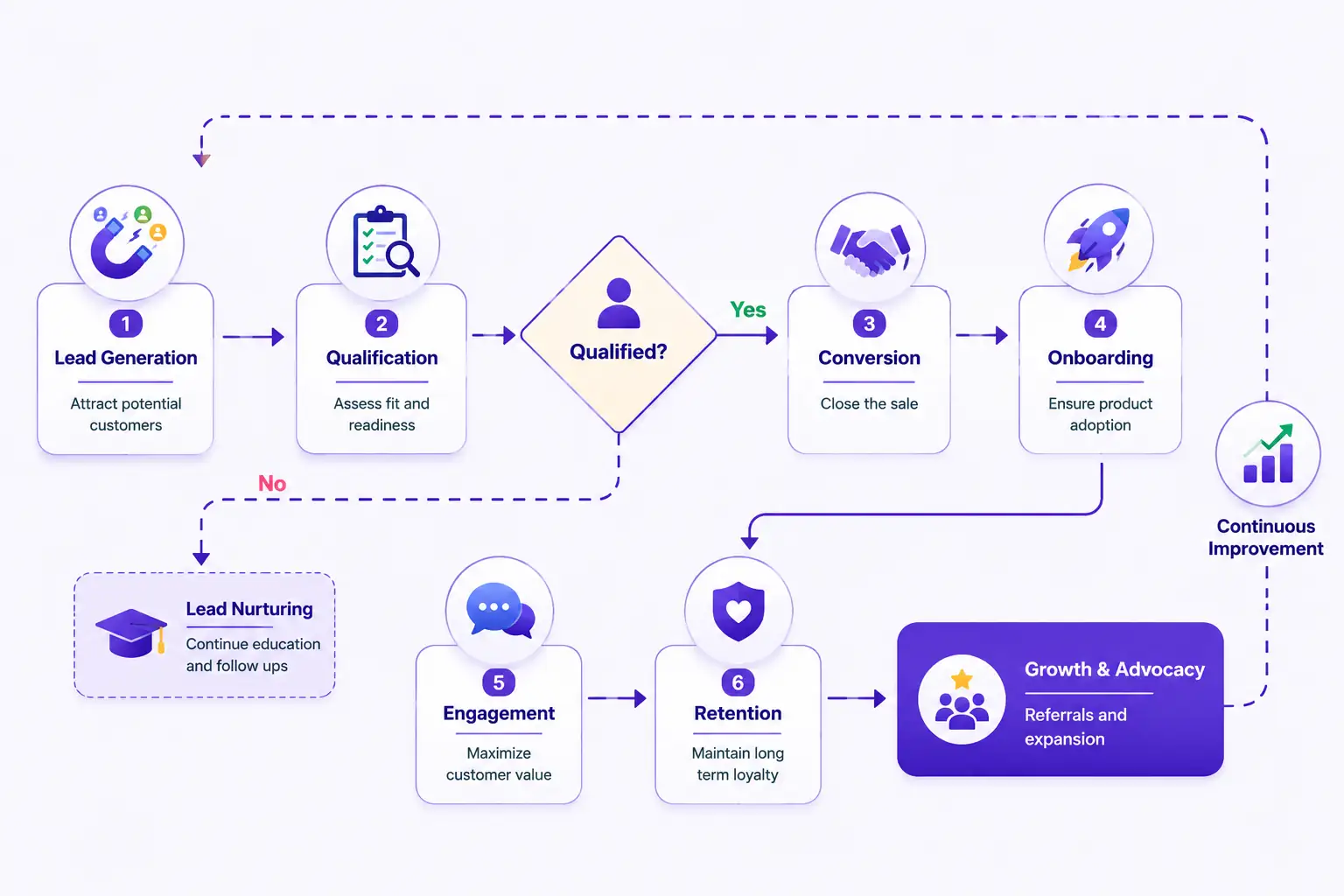
This flowchart shows how the CRM lifecycle operates as both a linear progression and a continuous improvement cycle. Notice how unsuccessful leads feed into nurturing, and how the feedback loop from retention back to the top shows that success enables growth and new opportunities.
Step by Step: How CRM Lifecycle Works in Practice
Let’s walk through a real world example of how the CRM lifecycle operates. Consider an e-commerce software company selling order management systems to online retailers.
Step 1: Lead Generation (Weeks 1-4)
The company publishes a blog post titled “How to Scale Your E-Commerce Order Management.” This article targets online store owners searching for solutions. They also run Google Ads for relevant keywords. Within a month, they have 500 website visitors and 50 people download their free “Order Management Playbook” guide.
Step 2: Qualification (Weeks 5-8)
Their CRM automatically scores these 50 leads based on company size, industry, and engagement level. The system identifies 15 high quality leads whose companies process over 100 orders daily. A sales rep emails these 15 prospects inviting them to a personalized demo. Five respond positively.
Step 3: Conversion (Weeks 9-16)
The sales team schedules demos with these five companies, discovers their specific pain points, and customizes product presentations. After discussions about pricing, integrations, and implementation, three companies decide to move forward. All three sign annual contracts worth $48,000 total.
Step 4: Onboarding (Weeks 17-24)
A dedicated onboarding specialist guides each customer through system setup, imports their product catalog and existing orders, trains their team on key features, and establishes success metrics. After two weeks, all three companies are processing orders in the new system.
Step 5: Engagement (Months 3-11)
The customer success team conducts monthly business reviews, identifies opportunities for advanced features, and notices that one customer is struggling with fulfillment reporting. They schedule training and introduce them to the analytics module, increasing feature adoption and satisfaction.
Step 6: Retention (Month 12 and beyond)
As renewal time approaches, the team proactively reaches out to review the customer’s success metrics, showing 32 percent efficiency improvement and 200 hours saved monthly. Two customers renew immediately for another year. The third asked about advanced integrations, opening an upsell opportunity.
Real World Examples of CRM Lifecycle in Action
Let’s examine how different types of businesses execute the CRM lifecycle:
SaaS Productivity Platform
Lead Generation: Free tool that solves a specific problem, generates thousands of signups.
Qualification: In app behavior tracking identifies power users.
Conversion: Personalized upgrade offers to heavy users.
Onboarding: Interactive tutorial and feature walkthroughs.
Engagement: Regular feature releases and user community events.
Retention: Email campaigns highlighting user achievements and ROI.
B2B Consulting Firm
Lead Generation: Thought leadership articles and speaking at industry conferences.
Qualification: Executive discovery calls assess organizational fit.
Conversion: Custom proposal and workshop sessions.
Onboarding: Dedicated engagement manager and kickoff workshop.
Engagement: Quarterly business reviews and strategic recommendations.
Retention: Exclusive client advisory board and long term retainer relationships.
E-Commerce Retailer
Lead Generation: Email list building, social media ads, seasonal campaigns.
Qualification: Purchase history and browsing behavior segmentation.
Conversion: Personalized product recommendations and checkout optimization.
Onboarding: Welcome email series with product guides and discounts.
Engagement: Retargeting campaigns and loyalty program enrollment.
Retention: VIP tier benefits, birthday discounts, and exclusive early access to new products.
CRM Lifecycle vs Sales Funnel: Key Differences
Many people confuse the CRM lifecycle with the sales funnel, but they’re different concepts serving different purposes. Understanding the distinction helps you implement both effectively.
| Aspect | CRM Lifecycle | Sales Funnel |
|---|---|---|
| Scope | Entire customer relationship from awareness to advocacy | Only the sales portion from lead to deal close |
| Timeline | Multi year customer journey with continuous cycles | Single transaction cycle from prospect to customer |
| Focus | Building relationships and maximizing lifetime value | Converting prospects into immediate sales |
| Teams Involved | Marketing, sales, support, success, operations | Primarily sales team |
| Key Metric | Customer lifetime value and retention rate | Win rate and sales cycle length |
| End Goal | Loyal advocates who expand and refer | Closed won deal with signed contract |
A successful organization implements both: the sales funnel to efficiently convert prospects, and the CRM lifecycle to maximize value from each customer over time. Many companies focus heavily on the sales funnel but neglect the lifecycle stages after the sale, leaving significant revenue on the table.
Key Benefits of Implementing CRM Lifecycle Management
Companies that systematically manage their customer relationship management lifecycle experience measurable benefits across every dimension of their business:
Revenue Growth
Companies with strong CRM lifecycle management grow revenue 34 percent faster. Upsell and cross sell opportunities identified through engagement stages drive incremental revenue.
Improved Retention
Proactive customer engagement and support reduce churn rates by 27 percent on average. Lower churn directly improves customer lifetime value and business predictability.
Operational Efficiency
Automation of routine tasks in the CRM lifecycle reduces manual work by 70 percent, freeing team members for high value activities like strategic planning and relationship building.
Better Data Quality
A structured CRM lifecycle ensures consistent data collection and organization. Better data enables better decision making and more accurate forecasting throughout the organization.
Team Alignment
When marketing, sales, and support all follow the same CRM lifecycle framework, communication improves and teams work toward common goals instead of conflicting priorities.
Customer Insights
Tracking interactions across the entire CRM lifecycle reveals patterns about what drives success. These insights guide product development and marketing strategy.
Common CRM Lifecycle Challenges and Solutions
While the benefits are substantial, implementing an effective CRM lifecycle isn’t without challenges. Let’s examine common obstacles and practical solutions:
Challenge: Poor Data Quality
Problem: Inconsistent data entry, duplicate records, and missing information plague many CRM systems, making analysis unreliable.
Solution: Implement data validation rules, establish clear naming conventions, conduct regular data audits, and provide team training on proper data entry protocols.
Challenge: Lack of Team Adoption
Problem: Teams resist using the CRM system because it feels like extra work, or they don’t see personal benefit.
Solution: Connect system usage to team metrics and incentives, provide comprehensive training and ongoing support, customize the system to match existing workflows, and celebrate early wins to build momentum.
Challenge: Disconnected Systems
Problem: Customer data lives in multiple systems (email, accounting, support tickets) without integration, creating silos and inconsistency.
Solution: Invest in system integrations and middleware, implement an API first architecture, establish a single customer view, and ensure data synchronization across platforms.
Challenge: Unclear Lifecycle Stages
Problem: Ambiguous stage definitions and transition criteria cause confusion about where prospects and customers are in their journey.
Solution: Define clear, measurable criteria for each stage, document processes thoroughly, use automation to move records between stages when criteria are met, and regularly review and refine definitions based on actual data.
Challenge: Inadequate Resources
Problem: Teams lack the budget, skills, or bandwidth to implement and maintain an effective CRM lifecycle.
Solution: Start with core processes and expand gradually, use automation to maximize impact with limited resources, consider managed services or consulting for implementation, and invest in team training to build internal capability.
AI and Automation in Modern CRM Lifecycle Systems
Artificial intelligence and automation are revolutionizing how companies manage the CRM lifecycle. What once required manual processes and constant human attention can now be handled intelligently by technology, freeing teams to focus on relationship building and strategy.
How AI enhances each stage of the CRM lifecycle:
- Lead Generation: AI powered content recommendations and personalized landing pages increase conversion rates by 20 to 30 percent by showing each visitor the most relevant value proposition.
- Qualification: Machine learning algorithms analyze hundreds of data points to identify which prospects are most likely to close, dramatically improving sales team efficiency and reducing wasted effort on poor fits.
- Conversion: Predictive analytics identify the optimal time to make an outreach call or send a proposal. AI chatbots handle initial qualification conversations, passing only genuinely interested leads to sales.
- Onboarding: Automated workflows ensure every new customer completes required setup steps on schedule. AI detects when customers are struggling and triggers additional support proactively.
- Engagement: Recommendation engines suggest upsell and cross sell opportunities based on customer behavior patterns. Automated email campaigns deliver personalized content based on customer segment and stage.
- Retention: AI monitors customer health scores, identifying at risk customers before they cancel. Automated win back campaigns target recent churners with targeted offers.
Companies implementing AI driven CRM lifecycle management see impressive results: 40 percent increase in qualified leads, 30 percent faster sales cycles, 25 percent improvement in customer satisfaction scores, and 35 percent reduction in customer acquisition costs.
The key to successful implementation is ensuring AI augments human judgment rather than replacing it. Sales professionals, customer success managers, and marketing teams use AI powered insights to make better decisions and focus on high value activities.
Future Trends in CRM Lifecycle Management
The customer relationship management landscape continues to evolve. Here are key trends shaping the future of CRM lifecycle management:
Composable CRM Stacks
Instead of monolithic enterprise CRM systems, companies are building modular stacks of best of breed point solutions connected via APIs. This approach offers greater flexibility and allows businesses to customize their CRM lifecycle to their specific needs.
Unified Customer View Across Channels
Customers interact with businesses through dozens of channels: web, mobile app, email, social media, chat, phone. Modern CRM systems are moving toward a truly unified view that sees customers across all touchpoints.
Ethical Data Usage and Privacy
With regulations like GDPR, CCPA, and others, responsible data handling is becoming a competitive advantage. Customers increasingly expect transparency about how their data is used in the CRM lifecycle.
Voice and Conversational Interfaces
Natural language interaction with CRM systems is becoming mainstream. Team members will interact with CRM through voice commands and conversational AI rather than traditional interfaces.
Predictive and Prescriptive Analytics
Moving beyond describing what happened or predicting what will happen, advanced CRM systems will prescribe optimal actions at each stage of the lifecycle, essentially acting as a coach guiding sales and success teams.
How CRM Software Improves Customer Experience
At its core, the CRM lifecycle is about delivering exceptional experiences. When implemented well, CRM software dramatically improves how customers feel about interacting with your business.
Here’s how CRM enables better customer experiences:
- Faster response times: CRM systems automatically route customer inquiries to the right person and provide context about previous interactions, enabling quick, knowledgeable responses.
- Personalization: By tracking customer preferences, purchase history, and behavior, CRM systems enable personalized recommendations and communications that feel relevant to each individual.
- Consistency: Whether a customer speaks with your sales team or support team, they encounter consistent service because both teams access the same customer information and follow the same processes.
- Proactivity: Instead of waiting for customers to report problems, CRM systems identify issues early and enable your team to address them proactively.
- Self-service options: Modern CRM systems power customer portals where customers can view their account status, submit requests, and access resources without requiring staff assistance.
- Loyalty recognition: CRM systems track customer tenure and value, enabling your team to offer special recognition or perks to your most valuable customers.
Companies that excel at customer experience consistently implement sophisticated CRM lifecycle management. These companies recognize that every interaction is an opportunity to strengthen relationships and build loyalty.
Ready to Master Your CRM Lifecycle?
Modern businesses need more than just a CRM system. They need a complete, intelligent approach to managing customer relationships at every stage. Nadcab Labs specializes in building custom CRM solutions that automate your customer lifecycle, improve team efficiency, and accelerate business growth.
Whether you’re a startup scaling your sales process, an enterprise optimizing complex workflows, or a business seeking workflow automation and enhanced customer engagement, our team of CRM experts can design and build a solution tailored to your unique needs.
Building a Competitive Advantage Through CRM Lifecycle Management
In today’s competitive business environment, understanding and optimizing your CRM lifecycle is no longer optional. It’s a fundamental requirement for sustainable growth. The companies winning in their markets are those that systematically manage customer relationships from initial awareness through lifelong advocacy.
The CRM lifecycle framework we’ve explored provides a roadmap for achieving this. From lead generation that creates consistent top of funnel volume, through qualification that ensures sales efficiency, conversion that closes deals, onboarding that drives adoption, engagement that maximizes value, and retention that builds loyalty, each stage has specific objectives and activities.
What separates exceptional companies from average ones isn’t necessarily the complexity of their CRM systems. It’s their commitment to systematic process, consistent data quality, team alignment, and continuous improvement. Even small businesses with spreadsheet based processes outperform larger competitors with expensive systems if they execute the fundamentals well.
The modern CRM lifecycle is being transformed by artificial intelligence and automation, enabling companies to scale relationships that were previously only possible through manual effort. Machine learning identifies patterns humans would miss. Automation ensures nothing falls through cracks. Predictive analytics recommend optimal actions at each stage.
Yet technology is only as good as the strategy and discipline behind it. Before investing in advanced systems, master the fundamentals of your CRM lifecycle. Define clear stage criteria. Establish consistent processes. Commit to data quality. Align your teams toward shared goals.
Whether you’re a startup founder scaling sales, an ecommerce business managing thousands of customers, an enterprise optimizing complex workflows, or a service company building client loyalty, mastering your CRM lifecycle delivers measurable returns: faster sales cycles, higher conversion rates, improved retention, increased revenue, and better customer experiences.
Frequently Asked Questions
Q1.How long does the complete CRM lifecycle typically take for a B2B company?
The timeline varies significantly by industry and sales complexity. Enterprise software sales cycles might span 6 to 12 months from initial lead generation through conversion. Once a customer is acquired, the engagement and retention stages continue indefinitely as long as the relationship is active. Lead generation and qualification typically take 2 to 8 weeks, conversion 1 to 6 months, onboarding 4 to 12 weeks, and engagement and retention are ongoing processes managed strategically to maximize customer lifetime value.
Q2.What percentage of leads typically convert to customers in a healthy CRM lifecycle?
Conversion rates vary widely by business model and industry. B2B SaaS companies typically see 2 to 5 percent conversion rates from visitor to customer. High performing companies with strong qualification processes see 8 to 12 percent. E-commerce businesses often achieve 1 to 3 percent conversion from website visitor to purchase. B2B services might see 15 to 30 percent of qualified leads convert. The key is not absolute percentage but whether your conversion rate improves over time as you optimize your CRM lifecycle process.
Q3.How do you measure success in customer retention stage of CRM lifecycle?
Key metrics for measuring retention success include churn rate (percentage of customers who stop using your product each period), customer lifetime value (total revenue expected from a customer), net retention rate (revenue retention including expansion), customer satisfaction and NPS scores, and customer health scores that predict risk. Track these metrics monthly or quarterly to identify trends. Healthy retention looks like churn below 2 to 5 percent monthly, positive net retention showing expansion within existing accounts, and increasing NPS scores over time.
Q4.Can small businesses with limited budgets implement an effective CRM lifecycle?
Absolutely. Small businesses can implement effective CRM lifecycle management by starting with core processes and expanding gradually. Begin with lead management and qualification to improve sales efficiency, then add customer communication and engagement features. Use affordable CRM platforms like HubSpot free tier, Pipedrive, or Zoho CRM that scale with your business. Focus on consistency and completeness in data entry rather than advanced features. Even a simple spreadsheet with disciplined process execution beats an expensive system that teams don’t use properly. As your business grows, upgrade to more sophisticated solutions.
Q5.What's the difference between customer onboarding and customer engagement in CRM lifecycle?
Onboarding is the short term phase immediately after purchase, typically lasting 4 to 12 weeks, focused on helping customers successfully implement your solution and achieve initial success. Engagement is the ongoing phase that continues throughout the customer relationship, focused on deepening the relationship, maximizing product usage, identifying growth opportunities, and maintaining satisfaction. Onboarding has a clear end when the customer is successfully live and independent. Engagement is continuous and evolves as customer needs and business situations change.
Q6.How should you handle leads that don't qualify during the qualification stage?
Disqualified leads shouldn’t be discarded. Instead, implement a lead nurturing program to keep them engaged through educational content, monthly newsletters, or periodic check ins. Market conditions, budgets, and company needs change. A prospect unqualified today might be perfect next year. Tag these leads in your CRM as “nurture track” and automate sending relevant content. Occasionally reach out personally to see if circumstances have changed. Many high value deals come from leads that were nurtured for 6 to 18 months before becoming qualified. This approach keeps your sales pipeline healthy and maximizes the return on your lead generation investment.
Q7.What role does marketing automation play in CRM lifecycle management?
Marketing automation is essential for efficiently scaling customer relationship management lifecycle at every stage. It enables lead scoring to automatically identify qualified prospects, email nurture sequences to keep unqualified leads engaged, behavioral triggers that send timely messages based on customer actions, segmentation to deliver personalized communication, and lead to sales handoff workflows. When integrated with your CRM, marketing automation provides salespeople with pre qualified leads and context about prospect engagement. It also enables personalized communication at scale that wouldn’t be possible with manual processes. Marketing automation typically improves lead quality by 50 percent and reduces manual work by 70 percent.
Q8.How do you identify which customers are at risk of churning?
Identify at risk customers by monitoring multiple warning indicators: decreased product usage or login frequency, declining engagement with your team and communications, reduced feature usage suggesting diminished value realization, delayed or unpaid invoices indicating cash flow problems, negative sentiment in support tickets or surveys, failure to attend business reviews or training sessions, and lack of expansion purchases. Use CRM systems to calculate customer health scores combining these factors. Customers with declining health scores trigger proactive outreach from your success team. Some advanced systems use machine learning to predict churn risk weeks or months in advance, enabling earlier intervention before customers decide to leave.
Q9.What's the best way to integrate your sales and customer success teams in CRM lifecycle?
Successful integration requires clear role definition, shared goals, and open communication. Define a specific handoff point where a customer moves from sales ownership to customer success ownership. Typically this occurs after contract signing, but some companies hand off earlier. Align compensation to shared outcomes: if both sales and success are measured on customer retention and expansion revenue, they naturally work together. Share a unified CRM where both teams can see complete customer interaction history. Hold regular cross team meetings to discuss customer issues, expansion opportunities, and feedback. Create shared dashboards showing customer health, expansion pipeline, and retention metrics. When sales and success teams operate from the same playbook using the same customer data, customer outcomes and company revenue both improve significantly.
Q10.How frequently should you review and optimize your CRM lifecycle process?
CRM lifecycle optimization should be continuous, but structured review should occur monthly and quarterly. Monthly reviews focus on tactical metrics: conversion rates at each stage, average time in stage, win and loss reasons, and team activity metrics. Quarterly reviews go deeper: Are stage definitions still accurate? Do milestone criteria reflect reality? Are automation workflows performing as expected? Are new customer segments requiring different processes? Annual strategic reviews should question fundamental assumptions about your CRM lifecycle: Has market positioning changed? Are new competitor solutions forcing better engagement practices? Should you add new stages or remove outdated ones? Successful companies view their CRM lifecycle as a living system requiring continuous improvement, not a static process set once and forgotten.
Explore Services
Related Services
Reviewed by

Naman Singh
Co-Founder & CEO, Nadcab Labs
Naman Singh is the Co-Founder and CEO of Nadcab Labs, where he drives the company’s vision, global growth, and strategic expansion in blockchain, fintech, and digital transformation. A serial entrepreneur, Naman brings deep hands-on experience in building, scaling, and commercializing technology-driven businesses. At Nadcab Labs, Naman works closely with enterprises, governments, and startups to design and implement secure, scalable, and business-ready Web3 and blockchain solutions. He specializes in transforming complex ideas into high-impact digital products aligned with real business objectives. Naman has led the development of end-to-end blockchain ecosystems, including token creation, smart contracts, DeFi and NFT platforms, payment infrastructures, and decentralized applications. His expertise extends to tokenomics design, regulatory alignment, compliance strategy, and go-to-market planning—helping projects become investor-ready and built for long-term sustainability. With a strong focus on real-world adoption, Naman believes in building blockchain solutions that deliver measurable value, solve practical problems, and unlock new growth opportunities for organizations worldwide.