Ai Overview
Think of it as a digital filing system combined with a personal assistant. Research shows CRM implementation increases sales productivity by 25-30%, meaning your team closes more deals in less time. See which sales strategies work, which customer segments are most profitable, and where revenue growth is coming from. This reduces manual work by up to 90%, saves teams 5-8 hours per week, and ensures nothing falls through the cracks.
Key Takeaways
- CRM software centralizes all customer data in one accessible platform, eliminating information silos
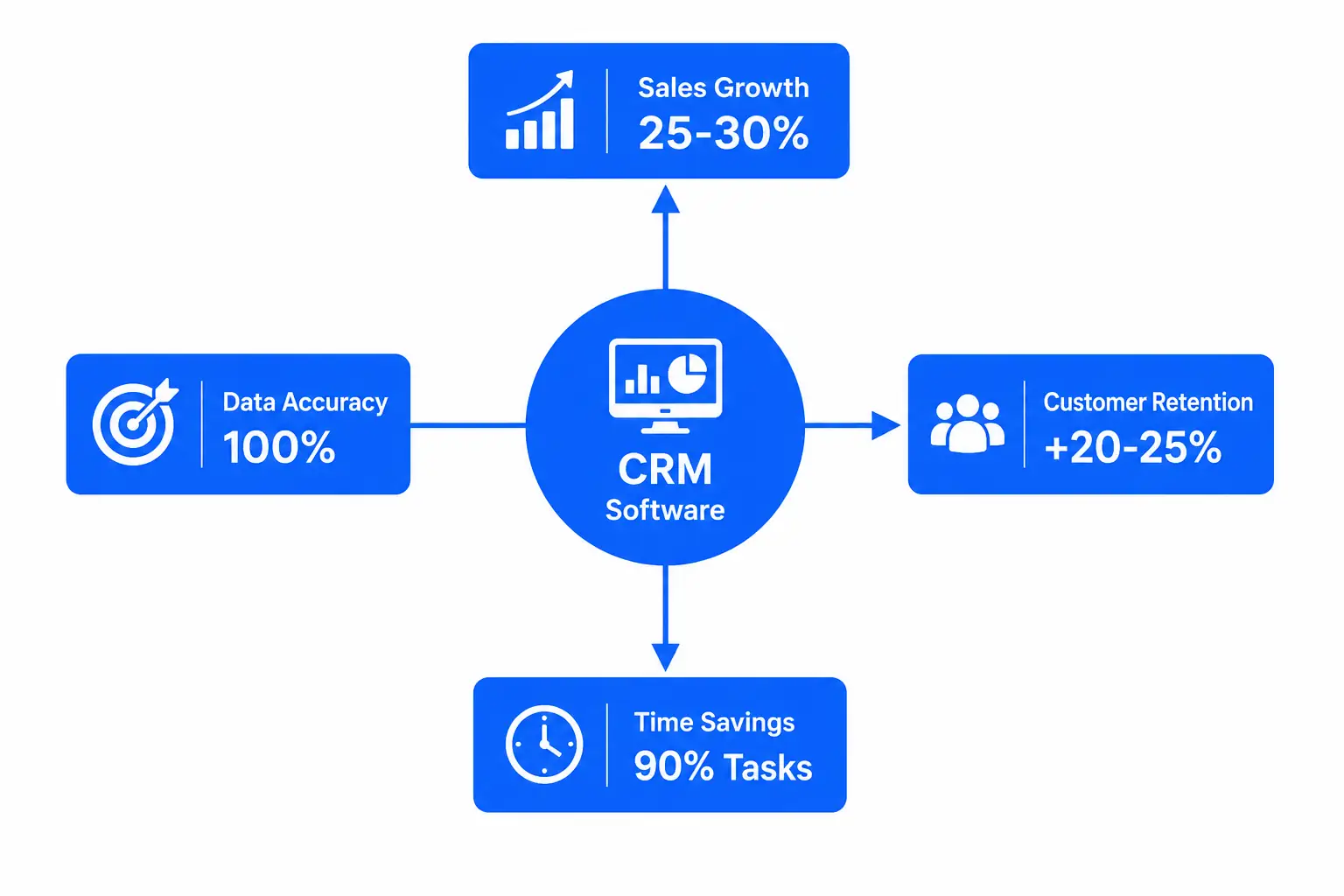
- Benefits of CRM software include 25-30% improvement in sales productivity and 20-25% increase in customer retention rates
- Automation features reduce manual data entry by up to 90%, saving teams 5-8 hours per week
- Real-time analytics and reporting help businesses make data-driven decisions faster
- Small businesses see faster ROI with CRM adoption, often within 3 to 6 months
- Integration with email, calendar, and marketing tools creates a unified workspace for teams
- AI-powered CRM software predicts customer behavior and identifies upsell opportunities automatically
- Mobile accessibility ensures sales teams can access customer information anytime, anywhere
- Better customer insights lead to personalized interactions that improve loyalty and lifetime value
- Compliance and data security features protect sensitive customer information with enterprise-grade encryption
Are you struggling to keep track of customer information scattered across spreadsheets, emails, and sticky notes? Are your sales teams missing follow-up opportunities because data is disorganized? Without proper systems, businesses lose valuable leads, miss customer needs, and waste countless hours on manual work. This is where benefits of CRM software become transformative. A Customer Relationship Management system consolidates all customer data into one intelligent platform, helping businesses streamline operations, improve customer satisfaction, and dramatically increase revenue. In this guide, we explore how CRM software revolutionizes the way modern businesses operate.
What Is CRM Software and How Does It Work?
CRM stands for Customer Relationship Management. Think of it as a digital filing system combined with a personal assistant. Instead of keeping customer information in scattered folders, emails, and notebooks, CRM software brings everything together into one organized hub.
Imagine you’re running a retail store. When a customer visits, you’d want to know their purchase history, preferences, and past conversations with your team. Now imagine doing this for thousands of customers instantly. That’s what CRM software does. It stores every interaction, purchase, note, and preference about each customer in one searchable database.
A CRM system is essentially a business intelligence platform that helps companies:
- Store and organize customer information securely
- Track every interaction and communication history
- Automate repetitive tasks and workflows
- Generate actionable insights from data
- Collaborate across teams seamlessly
- Forecast sales and pipeline growth accurately
How CRM Software Works: Step-by-Step Process
Understanding how CRM software operates helps you see why it delivers such impressive benefits of CRM software. Let’s walk through a real-world example with an e-commerce startup:
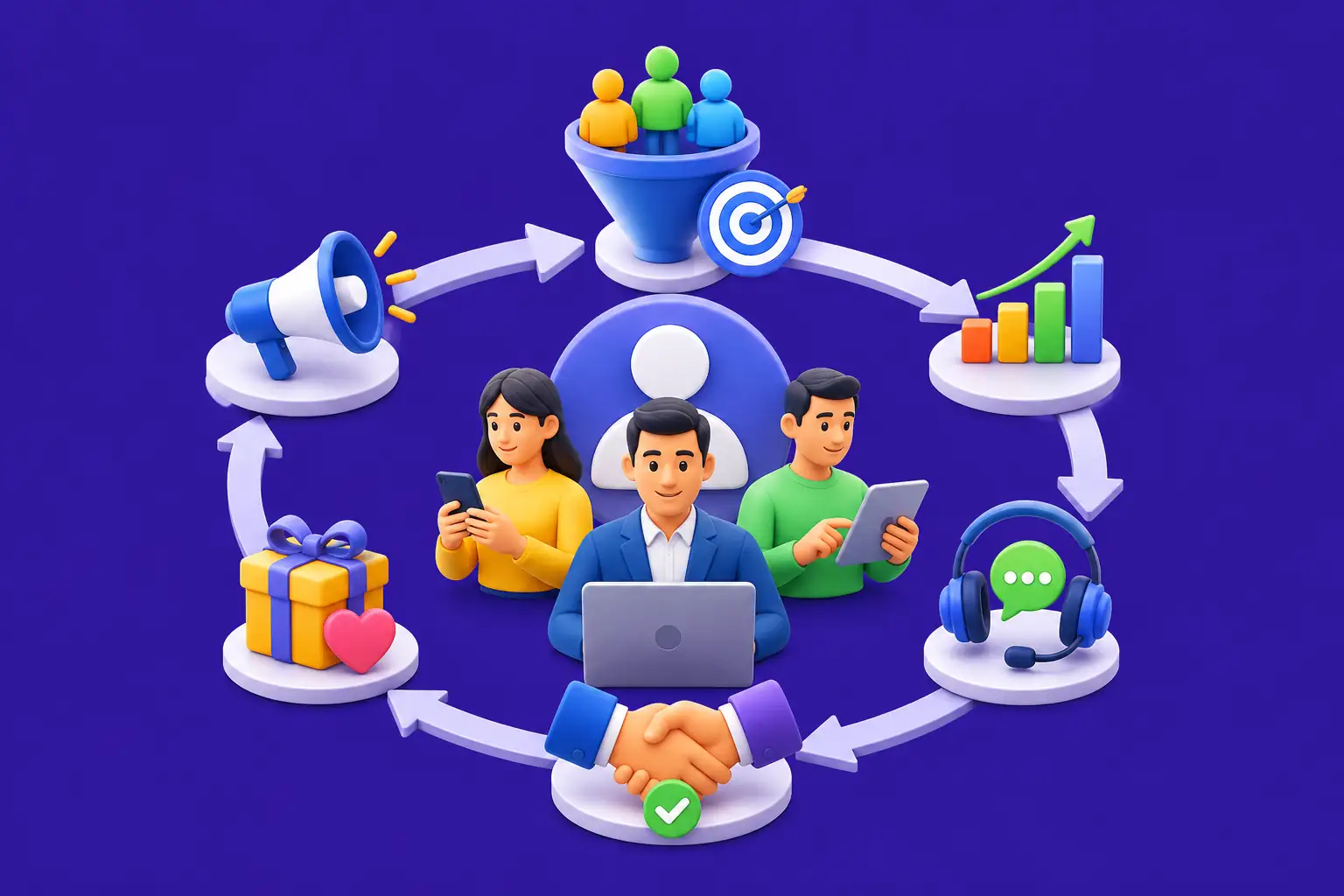
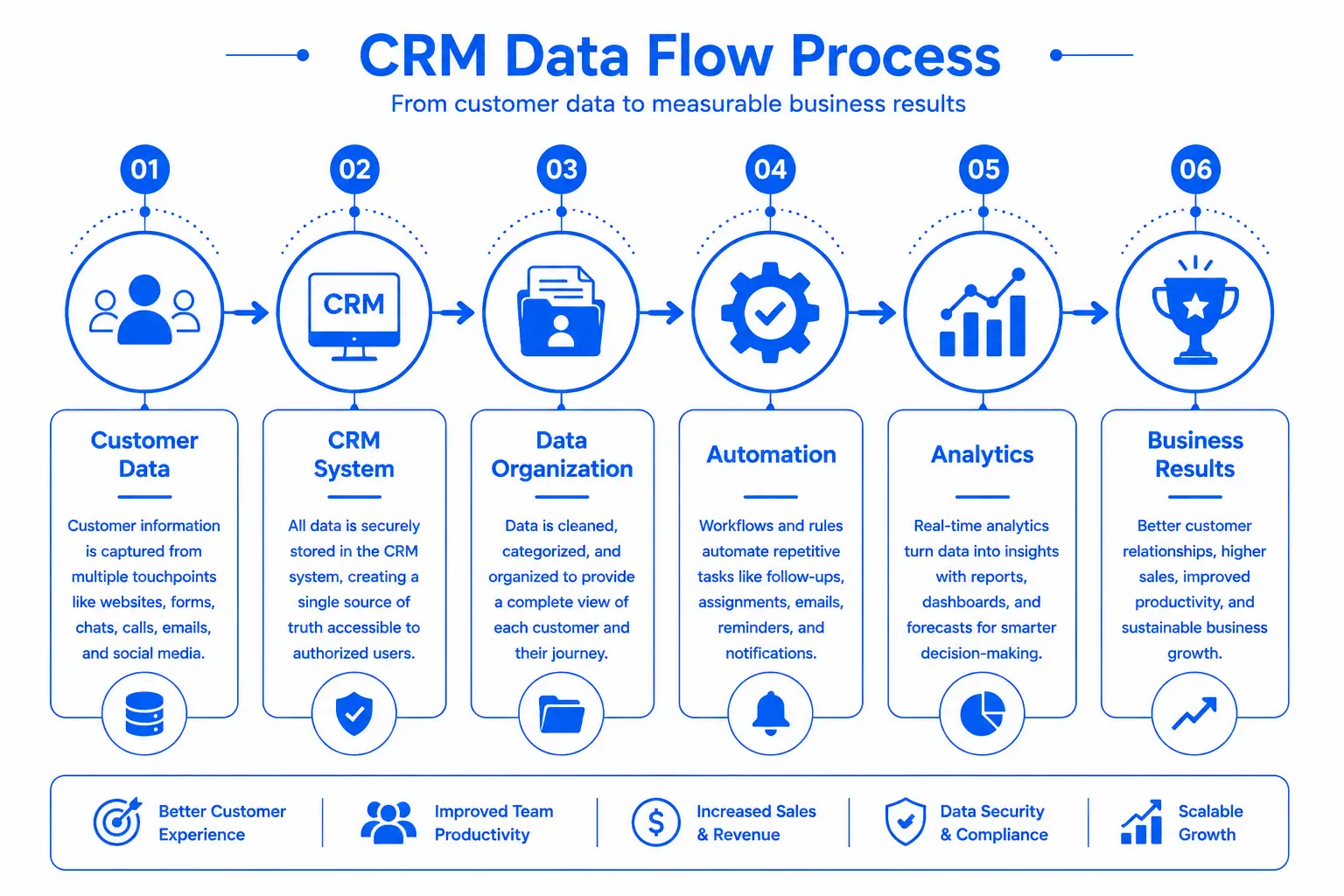
The CRM Workflow: Step-by-Step
Step 1 Customer Data Entry: When a prospect visits your website and fills out a contact form, their information automatically flows into your CRM. No manual typing required.
Step 2 Data Organization: The CRM categorizes leads by stage: interested, qualified, negotiating, or ready to buy. This helps your sales team prioritize outreach.
Step 3 Task Automation: The CRM sends automated reminders for follow-ups, schedules emails, and assigns tasks to team members instantly.
Step 4 Interaction Tracking: Every email, call, meeting, and message is logged automatically. Your team always sees the complete history.
Step 5 Analytics and Reporting: The CRM analyzes trends and generates reports showing conversion rates, sales velocity, and customer lifetime value.
Step 6 Decision Making: Managers use insights to optimize strategies, forecast revenue, and allocate resources effectively.
Why CRM Software Is Important for Modern Businesses
In today’s competitive landscape, customers expect personalized experiences. They want companies to remember their preferences, anticipate their needs, and provide seamless service across all channels. Without CRM software, delivering this level of service is nearly impossible.
Consider these harsh realities facing businesses without proper systems:
- Lost Opportunities: Studies show companies lose 50% of leads because follow-ups are delayed or forgotten
- Wasted Time: Sales reps spend 30% of their day searching for customer information instead of selling
- Poor Collaboration: Team members don’t share information, leading to duplicate efforts and inconsistent customer service
- Missed Insights: Without data analysis, businesses can’t identify trends or predict future revenue
- Low Customer Retention: Lack of personalization makes customers feel undervalued and encourages switching to competitors
This is precisely why benefits of CRM software have become non-negotiable for thriving businesses. A robust CRM platform transforms these challenges into competitive advantages.
Key Benefits of CRM Software for Businesses
Centralized Customer Information
Instead of customer data scattered across emails, spreadsheets, and notebooks, CRM software brings everything into one secure location. Your team can instantly see the complete customer journey from first interaction to last purchase. This eliminates confusion, prevents duplicate work, and ensures everyone has the same information.
Improved Sales Productivity
Sales teams waste countless hours on administrative tasks. CRM software automates data entry, scheduling, and follow-up reminders. This frees up time for what matters most: selling. Research shows CRM implementation increases sales productivity by 25-30%, meaning your team closes more deals in less time.
Data-Driven Decision Making
CRM platforms provide real-time dashboards and reports showing exactly what’s happening in your business. See which sales strategies work, which customer segments are most profitable, and where revenue growth is coming from. This enables managers to make confident decisions based on facts, not hunches.
Enhanced Customer Experience
When your team has complete customer context at their fingertips, they provide better service. Customers feel valued because your company remembers their history, preferences, and unique needs. This personal touch builds loyalty and increases lifetime customer value significantly.
Workflow Automation
Benefits of CRM software include powerful automation capabilities. Set up workflows that send automated emails, assign tasks, create follow-up reminders, and escalate urgent issues. This reduces manual work by up to 90%, saves teams 5-8 hours per week, and ensures nothing falls through the cracks.
Scalability and Growth
As your business grows, so does your data volume. CRM systems scale effortlessly, handling thousands of customers without slowing down. Whether you have 5 employees or 500, a modern CRM grows with your business and supports your expansion goals.
Cross-Team Collaboration
Sales, marketing, and customer support teams work in silos without proper systems. CRM software breaks these silos by providing a unified workspace. Marketing sees which campaigns generate sales, sales knows which customers need support, and support teams can upsell effectively. This alignment drives better results.
CRM Software Benefits for Small Business Growth
Small businesses face unique challenges. Limited budgets, small teams wearing multiple hats, and intense competition from larger enterprises. This makes the benefits of CRM software even more critical for startups and SMEs.
Why Small Businesses Need CRM:
- Cost-Effective Growth: Cloud-based CRM solutions cost a fraction of legacy systems. Small businesses see ROI within 3-6 months
- Level Playing Field: Access to the same customer intelligence tools as Fortune 500 companies
- Quick Implementation: Modern CRM platforms are user-friendly and don’t require extensive IT expertise
- Team Productivity: Even a 3-person sales team can double their output with automation and better data
- Customer Retention: Small businesses live or die by customer loyalty. CRM software enables the personal touch that builds loyalty
Companies like Nadcab Labs specialize in building custom CRM solutions tailored for small businesses and startups. These organizations understand the unique needs of growing companies and deliver affordable, powerful systems that accelerate growth without overwhelming existing processes.
CRM vs Manual Systems: Clear Performance Comparison
See exactly how CRM software outperforms traditional manual systems for managing customer relationships.
| Aspect | Manual System (Spreadsheets, Email) | CRM Software |
|---|---|---|
| Data Organization | Scattered across multiple files and inboxes | Centralized, searchable, always updated |
| Time to Find Information | 10-20 minutes per customer lookup | Instant, less than 5 seconds |
| Data Accuracy | Prone to errors and duplicate entries | Automated validation prevents errors |
| Task Management | Manual reminders and follow-ups missed | Automated reminders and scheduling |
| Team Collaboration | Version conflicts and communication delays | Real-time updates across entire team |
| Analytics and Reporting | Manual compilation, hours of work | Automated reports, instant insights |
| Scalability | Becomes unmanageable with growth | Scales infinitely with business |
| Monthly Cost | Low upfront, high hidden operational costs | Affordable SaaS pricing with rapid ROI |
Essential CRM Features That Drive Business Value
Modern CRM platforms include dozens of features. Here are the most impactful ones that directly translate to business benefits:
Contact Management
Store unlimited customer records with detailed information. Track communication preferences, purchase history, and interaction timelines. Never lose valuable customer context again.
Sales Pipeline Management
Visualize your entire sales process from lead to customer. Track deal progress, identify bottlenecks, and forecast revenue accurately. Sales managers gain complete visibility into team performance.
Email Integration and Tracking
Every email is automatically logged in customer records. Track open rates, clicks, and responses. Know exactly when prospects engage with your messages.
Task and Calendar Management
Stay organized with automated task assignments, calendar syncing, and reminder notifications. Never miss a follow-up deadline.
Advanced Reporting and Analytics
Generate customized reports on sales performance, customer acquisition costs, lifetime value, and more. Dashboards show real-time metrics for immediate insights.
Mobile CRM Access
Access customer data, update records, and manage your pipeline from any device, anywhere. Field sales teams stay productive on the go.
AI-Powered Insights
Next-generation CRM systems use artificial intelligence to predict customer behavior, recommend next best actions, and identify upsell opportunities automatically.
Real-World Examples: How Businesses Use CRM Software
To truly understand benefits of CRM software, let’s examine how different types of businesses leverage these systems:
SaaS Companies
SaaS businesses use CRM to track customer onboarding, usage patterns, and renewal dates. They automate expansion workflows to upsell premium features and predict churn before it happens. This extends customer lifetime value significantly.
E-Commerce Retailers
Retailers use CRM to analyze purchase patterns, send personalized product recommendations, and create targeted loyalty programs. They segment customers by behavior and deliver relevant marketing messages that increase repeat purchases.
B2B Service Providers
Consulting firms and agencies use CRM to manage complex, multi-year client relationships. They track project history, resource allocation, and revenue contributions per account. This ensures consistent service and identifies expansion opportunities.
Real Estate Agencies
Real estate professionals use CRM to manage property leads, track buyer preferences, and maintain client relationships over years. Automated follow-ups ensure no lead is forgotten, and historical data helps match properties to the right buyers.
Customer Support Teams
Support centers use CRM to track customer issues from submission to resolution. They access complete customer history to understand context, prioritize urgent tickets, and provide faster resolutions. This improves satisfaction scores dramatically.
Key Benefits Impact Framework
Future of CRM: AI and Advanced Automation Trends
The CRM landscape is evolving rapidly. Understanding emerging trends helps businesses future-proof their customer management strategy.
Artificial Intelligence and Predictive Analytics
AI is transforming how CRM software works. Modern systems analyze vast amounts of customer data to predict behavior, identify churn risk, and recommend optimal actions. Benefits of CRM software increasingly include AI that learns from your business patterns and becomes smarter over time.
Omnichannel Customer Experience
Customers interact through multiple channels: email, chat, social media, phone, and in-person. Advanced CRM systems unify these interactions, ensuring consistent experiences regardless of channel. Your team sees one integrated customer view.
Voice of Customer Analytics
Next-generation CRM platforms use natural language processing to analyze customer feedback from surveys, reviews, and support conversations. This uncovers insights about satisfaction, pain points, and opportunities.
Integration Ecosystems
Modern CRM systems connect seamlessly with marketing automation, accounting software, e-commerce platforms, and communication tools. This creates a unified business platform rather than disconnected tools.
Privacy and Compliance
With regulations like GDPR and CCPA, CRM systems now include advanced data governance, consent management, and audit trails. Businesses can manage customer data responsibly while maintaining compliance.
Challenges When Implementing CRM Systems
While the benefits of CRM software are tremendous, implementation does come with considerations. Understanding these helps you prepare for success.
Data Migration Complexity
Moving years of customer data from legacy systems requires careful planning. Data cleanup, validation, and migration can be time-intensive. Professional implementation services help streamline this process.
User Adoption and Training
Even the best CRM software fails if users don’t adopt it. Sales teams especially resist change. Success requires comprehensive training, executive sponsorship, and showing teams how CRM reduces their workload.
Customization and Configuration
Every business has unique processes. Configuring CRM software to match your workflows requires technical expertise. This is where custom CRM development services from companies like Nadcab Labs add tremendous value.
Data Quality Maintenance
CRM is only as good as the data inside it. Ensuring continuous data quality requires processes, governance, and team discipline. Garbage in equals garbage out.
Ready to Transform Your Customer Management?
Are you losing leads because customer data is scattered? Frustrated with manual processes wasting your team’s time? Struggling to compete with larger businesses that have sophisticated systems?
Nadcab Labs specializes in designing and developing custom CRM solutions for startups, small businesses, and enterprises. We understand the specific challenges you face and build intelligent systems that drive real business results.
Our CRM solutions deliver:
- ✓ Rapid implementation with minimal disruption
- ✓ Custom workflows matching your unique business processes
- ✓ AI-powered features for competitive advantage
- ✓ Seamless integration with your existing tools
- ✓ Comprehensive training and ongoing support
The Time for CRM Software Is Now
The benefits of CRM software extend far beyond simple contact management. Modern CRM systems are strategic business tools that drive growth, improve customer satisfaction, and enable intelligent decision-making. From centralized customer data to AI-powered insights, CRM software addresses fundamental business challenges that impact revenue and growth.
The question is no longer whether to implement benefits of CRM software, but which solution best fits your business needs. Cloud-based platforms offer affordability and quick deployment. Enterprise systems provide depth and customization. Custom CRM development ensures perfect alignment with your unique processes.
Starting with CRM software doesn’t require massive investment. Many platforms offer free trials and flexible pricing. The key is taking the first step. Begin with basic contact management and gradually add features as your team matures and your business grows.
Your competitors are already using CRM software. The businesses winning in today’s market have superior customer intelligence and faster decision-making. Don’t let manual processes hold your business back. Explore CRM solutions today and unlock the growth potential of organized, intelligent customer management.
Frequently Asked Questions
Q1.How much does CRM software cost?
CRM pricing varies widely based on features and users. Cloud-based solutions range from free plans for small teams to $100+ per user monthly for enterprise platforms. Most businesses find affordable options starting at $20-50 per user monthly. ROI typically occurs within 3-6 months as productivity increases and sales improve.
Q2.How long does CRM implementation take?
Implementation timeframe depends on complexity. Cloud-based CRM systems can be operational within 2-4 weeks for basic setups. Custom CRM development typically requires 2-4 months including design, development, data migration, and training. Quick starts with pre-built workflows accelerate deployment significantly.
Q3.What's the difference between on-premise and cloud CRM?
Cloud CRM is hosted online, offering accessibility, lower costs, automatic updates, and easy scalability. On-premise CRM runs on company servers, providing more control and customization but requiring IT maintenance. Most businesses choose cloud for flexibility and lower total cost of ownership. Custom CRM solutions can combine benefits of both approaches.
Q4.Can CRM software integrate with other business tools?
Yes, modern CRM platforms integrate with email, calendar, accounting software, marketing automation, e-commerce platforms, and communication tools. APIs and middleware enable seamless data flow across systems. This creates unified workflows and eliminates manual data entry. Integration capabilities vary by platform, so verify compatibility with your specific tools.
Q5.How do you ensure data security in CRM systems?
Enterprise CRM systems employ encryption, regular backups, access controls, audit trails, and multi-factor authentication. Cloud providers meet compliance standards including GDPR, HIPAA, and SOC 2. Custom CRM development includes security best practices from the ground up. Regular security audits and employee training further protect sensitive data.
Q6.How do I measure CRM success and ROI?
Track metrics including sales cycle duration, conversion rate improvements, customer retention increase, time spent on administrative tasks, and revenue per customer. Dashboard analytics show real-time progress. Compare pre-CRM and post-CRM metrics to quantify impact. Most businesses measure ROI through increased revenue and reduced operational costs within the first year.
Q7.What industries benefit most from CRM implementation?
All industries benefit from CRM. Sales-focused organizations like technology, real estate, and financial services see immediate impact. Service industries including consulting, support, and healthcare improve customer care. E-commerce and retail increase loyalty and repeat purchases. Manufacturing companies manage complex B2B relationships effectively. No industry is exempt from CRM value.
Q8.Should we choose Salesforce, HubSpot, or a custom solution?
Market leaders like Salesforce CRM and HubSpot CRM offer proven solutions with extensive integrations. They suit businesses wanting rapid deployment and large ecosystems. Custom CRM development better fits organizations with unique workflows, specific integrations, or competitive differentiation needs. Evaluate your specific requirements to choose appropriately.
Q9.How do we ensure team adoption of CRM software?
Adoption requires executive sponsorship, comprehensive training, hands-on support during transition, and clear communication about benefits. Start with power users who champion adoption internally. Celebrate early wins to build momentum. Address resistance with additional training and demonstrating how CRM reduces workload. Regular feedback sessions refine processes and increase engagement.
Q10.What are emerging AI features in modern CRM platforms?
Modern CRM systems include AI-powered lead scoring predicting purchase likelihood, chatbots automating customer interactions, sentiment analysis understanding customer emotions, and predictive analytics forecasting churn risk. Next-generation platforms automatically recommend next best actions and identify upsell opportunities. AI integration transforms CRM from data storage to intelligent business advisors.
Explore Services
Related Services
Reviewed by

Naman Singh
Co-Founder & CEO, Nadcab Labs
Naman Singh is the Co-Founder and CEO of Nadcab Labs, where he drives the company’s vision, global growth, and strategic expansion in blockchain, fintech, and digital transformation. A serial entrepreneur, Naman brings deep hands-on experience in building, scaling, and commercializing technology-driven businesses. At Nadcab Labs, Naman works closely with enterprises, governments, and startups to design and implement secure, scalable, and business-ready Web3 and blockchain solutions. He specializes in transforming complex ideas into high-impact digital products aligned with real business objectives. Naman has led the development of end-to-end blockchain ecosystems, including token creation, smart contracts, DeFi and NFT platforms, payment infrastructures, and decentralized applications. His expertise extends to tokenomics design, regulatory alignment, compliance strategy, and go-to-market planning—helping projects become investor-ready and built for long-term sustainability. With a strong focus on real-world adoption, Naman believes in building blockchain solutions that deliver measurable value, solve practical problems, and unlock new growth opportunities for organizations worldwide.