Ai Overview
The creator economy refers to the broad set of tools, platforms, and business models that allow individuals to build an audience and make money from their creative work. In 2023, the creator economy was valued at around $250 billion globally. Projections suggest it will cross $480 billion by 2027. An artist creates a piece of digital art, mints it as an NFT with a 10 percent royalty setting, and sells it for $1,000.
Key Takeaways
- The global NFT market reached $48.7 billion in 2025, showing a strong recovery from previous volatility, with projections suggesting growth toward $247 billion by 2029, driven by broader adoption and real-world utility use cases.
- NFT marketplace development costs range from $30,000 to $150,000+, depending on features, with basic platforms costing $30,000 to $50,000 and advanced platforms with custom smart contracts and multi-chain support reaching $150,000 or more.[1]
- Gaming NFTs represent a massive market valued at approximately $471.90 billion in 2024, with forecasts projecting growth to $942.58 billion by 2029, with trading volume concentrated heavily in PFP assets at 37 percent and gaming at 25 percent.[2]
- Smart contracts automate NFT transactions by handling cryptocurrency transfers, NFT delivery to buyers, royalty distributions to creators, and permanent blockchain recording without intermediaries.[3]
- Virtual real estate NFTs are predicted to grow at a compound annual growth rate of 27.4 percent, with platforms like Decentraland and The Sandbox enabling users to buy, develop, and monetize digital property.[4]
- Event ticketing NFTs now represent 5.3 percent of ticket sales across major US venues in 2025, demonstrating practical utility beyond speculative collectibles and providing fraud prevention.[5]
- Rarible introduced community governance through RARI tokens, allowing users to vote on platform decisions, including feature updates and fee changes, representing a shift toward decentralized marketplace management.[6]
The way creators earn money has changed completely in the last few years. A musician no longer needs a record label. A digital artist does not need a gallery. A game developer does not need a publisher to reach millions of players. This change is largely because of two things working together: the creator economy and NFT marketplaces.
The creator economy is simply the ecosystem where individuals create content, art, music, games, or experiences and earn money directly from their audience. NFT marketplaces are the digital trading floors where unique digital items are bought and sold using blockchain technology. This is where an NFT marketplace development company plays a key role by building platforms that support secure transactions and creator ownership. When these two things come together, creators get tools they never had before: permanent proof of ownership, automatic royalties on every resale, and direct access to a global buyer pool without any middleman taking a large cut.
This blog explains everything about how the creator economy and NFT marketplaces work, who the key players are, what it costs to build an NFT platform, and where this whole space is heading. Whether you are a creator looking to monetize your work or a business planning to build an NFT marketplace, this blog covers it all from the ground up.
NFT Marketplace Development Guide
What Is the Creator Economy and Why Does It Matter
The creator economy refers to the broad set of tools, platforms, and business models that allow individuals to build an audience and make money from their creative work. This includes YouTubers, Instagram artists, independent musicians, game developers, writers, and anyone else who creates something people want to pay for or support.
A few numbers help show the scale of this. In 2023, the creator economy was valued at around $250 billion globally. Projections suggest it will cross $480 billion by 2027. More than 200 million people around the world now identify as creators in some capacity, and a growing portion of them are using blockchain-based tools, including NFT marketplaces, to build income streams that did not exist five years ago.
What makes the creator economy different from traditional entertainment or media is the direct relationship between creator and audience. A painter selling prints through a gallery gives up a large percentage to that gallery. The same painter selling digital art as NFTs keeps most of the revenue and receives a percentage every time that NFT is resold. The economics are simply better for the person doing the actual creating.
The Core Problems the Creator Economy Solves
Before platforms like Patreon, Substack, and NFT marketplaces existed, creators faced three major problems:
1. Middlemen taking large cuts. Labels, galleries, publishers, and platforms have historically taken anywhere from 30 percent to 70 percent of a creator’s earnings. This left many talented people unable to sustain themselves financially, even when their work was genuinely popular.
2. No control over resale value. When a musician sold an album or an artist sold a painting, they received money once. Every resale after that went to someone else. An NFT changes this because smart contracts can automatically send a percentage of every future sale back to the original creator.
3. No proof of original ownership. Digital files can be copied endlessly. Before blockchain, there was no technical way to say “this is the original and everything else is a copy.” NFTs solve this by creating a unique, unforgeable record on the blockchain.
Understanding NFT Marketplaces: How They Actually Work
An NFT marketplace is an online platform where people can create (mint), buy, sell, and trade non-fungible tokens. Think of it like eBay or Amazon, except everything sold is a unique digital item with verified ownership recorded on a blockchain.
The word “non-fungible” simply means not interchangeable. A dollar bill is fungible because you can swap it for another dollar bill and have the same thing. A specific piece of digital artwork converted into an NFT is non-fungible because there is only one original, and it has a unique identifier that cannot be duplicated.
The Step-by-Step Process Inside an NFT Marketplace
Step 1: Wallet Connection. A user connects a compatible cryptocurrency wallet (like MetaMask or Phantom) to the marketplace. This wallet holds both the user’s cryptocurrency and their NFTs.
Step 2: Minting. A creator uploads a digital file (image, video, music, 3D model, etc.) and fills in details like name, description, royalty percentage, and supply count. The platform then writes this information into a smart contract on the blockchain, creating the NFT. This process is called minting.
Step 3: Listing for Sale. The creator lists the NFT at a fixed price or puts it up for auction. The listing itself is recorded on-chain, so it cannot be faked or altered.
Step 4: Purchase and Smart Contract Execution. When a buyer purchases the NFT, the smart contract automatically handles the entire transaction: it moves the cryptocurrency from the buyer’s wallet to the seller’s wallet, transfers the NFT to the buyer’s wallet, sends the royalty percentage to the original creator (if it is a secondary sale), and records the new ownership on the blockchain permanently.
Step 5: Secondary Market Activity. The buyer can hold the NFT, display it, or resell it. Every time it changes hands, the original creator receives the royalty percentage they set at minting, often between 5 and 10 percent.
Types of NFT Marketplaces Built for Creators
Not all NFT marketplaces serve the same purpose. There are several distinct types, each designed for a specific kind of creator or digital asset.
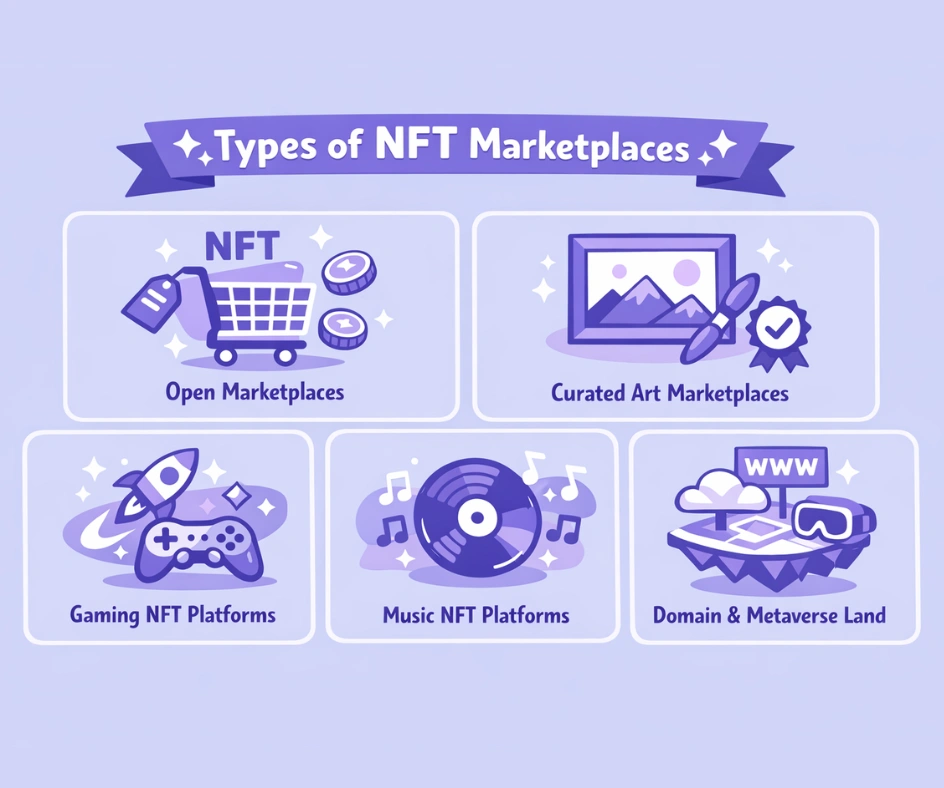
1. Open Marketplaces
These accept NFTs of all types from any creator without a vetting process. OpenSea is the largest example. Anyone can mint and list on these platforms. The advantage is accessibility; the disadvantage is that the sheer volume of listings makes it hard for individual creators to stand out.
2. Curated Art Marketplaces
Platforms like Foundation and SuperRare only accept work from creators who pass an invitation or application process. This keeps quality high and often results in higher sale prices. These are the most appropriate NFT platforms for artists who want their work taken seriously as fine digital art.
3. Gaming NFT Platforms
Marketplaces like Axie Infinity’s internal market, Immutable X, and Gods Unchained focus specifically on in-game items, characters, and land. Players can buy, sell, and trade game assets that have real-world value. Gaming NFTs alone were valued at approximately $471.90 billion in 2024.
4. Music NFT Platforms
Sound.xyz and Royal allow musicians to mint songs and albums as NFTs and sell ownership stakes to fans. A fan might buy a percentage of a song’s streaming royalties, meaning they earn every time that song plays. This creates a whole new relationship between musicians and their supporters.
5. Domain and Metaverse Land Marketplaces
Decentraland and The Sandbox allow users to buy virtual land as NFTs. These parcels of digital real estate can be developed, rented, or sold. Virtual real estate NFTs are projected to grow at a compound annual growth rate of 27.4 percent, making this one of the fastest-growing sub-categories in the NFT space.
Top NFT Marketplace Trends in 2026 & Beyond
Top NFT Marketplaces Creators Are Using Right Now
The NFT marketplace landscape has matured significantly. Here is a look at the platforms that creators actually use and why each one stands out for different needs.
1. OpenSea
OpenSea remains the largest general NFT marketplace by trading volume. It controls approximately 90 percent of Ethereum NFT trading and hosts over 80 million NFTs. In 2024, it recorded around $14.68 billion in total trading volume. It supports multiple blockchains, including Ethereum, Polygon, Solana, and Klaytn. The platform charges a 2.5 percent fee on sales and allows creators to set royalties between 0 and 10 percent.
2. Blur
Blur launched in October 2022 and quickly became the go-to platform for professional NFT traders rather than casual buyers. It offers zero marketplace fees, advanced analytics, real-time floor price data, and batch listing tools. By 2023, it had surpassed OpenSea in raw trading volume, though its user base tends to be more trader-oriented than creator-focused.
3. Foundation
Foundation is a curated platform focused on digital art. Creators need an invitation from an existing Foundation member to list work. The platform takes a 15 percent commission on primary sales and gives creators a 10 percent royalty on all secondary sales. The quality of work on Foundation tends to be significantly higher than open platforms, and sale prices reflect this.
4. SuperRare
SuperRare positions itself as the premium fine art NFT marketplace. It is heavily curated, with an acceptance rate of under 1 percent for artist applications. The platform charges a 15 percent commission on primary sales and a 3 percent fee on secondary sales. SuperRare launched its own governance token (RARE) in 2021 to give the community a say in platform decisions.
5. Rarible
Rarible introduced one of the most interesting features in the NFT space: community governance. Through RARI tokens, platform users can vote on decisions including fee structures, feature launches, and policy changes. This moves the platform closer to a decentralized model where users, not just the founding team, shape how it operates. Rarible supports Ethereum, Tezos, Flow, and Polygon.
6. Sound.xyz
Sound.xyz is built specifically for musicians. Artists can release songs as NFTs with a limited number of editions, so fans who support early get a collectible tied to that song. The platform has become a model for how creator monetization platforms in music could look, giving artists a way to earn from their core audience without relying on streaming platforms that pay fractions of a cent per play.
NFT Marketplace Development Costs
| Development Component | Cost Range | Key Considerations |
|---|---|---|
| Basic Platform Features | $30,000 – $50,000 | User authentication, NFT minting, buying/selling functionality, basic wallet integration |
| Advanced Platform Features | $100,000 – $150,000+ | Custom smart contracts, multi-chain support, advanced analytics, decentralized storage, royalty management |
| UI/UX Design | $5,000 – $20,000 | Simple interface vs. custom-branded design with intricate elements |
| Blockchain Integration | $10,000 – $20,000 | Ethereum most common, alternatives like Solana or BSC may vary |
| Smart Contract Development | Included in platform costs | Token standards (ERC-721, ERC-1155), security audits, testing |
| Security Implementation | $5,000 – $15,000 | Encryption, multi-factor authentication, and regular security audits |
| Ongoing Maintenance | $1,000 – $5,000/month | Server hosting, updates, customer support, security monitoring |
Creator Economy Business Models That Use NFTs
The combination of the creator economy and NFT technology has produced several interesting business models. These are not theoretical. They are live, generating real revenue for real people right now.
1. Royalty-Based Income for Artists
This is the most straightforward model. An artist creates a piece of digital art, mints it as an NFT with a 10 percent royalty setting, and sells it for $1,000. If the buyer resells it for $5,000, the artist automatically receives $500. Every future resale continues paying the original creator. Over time, particularly for artists whose work appreciates in value, this can become a meaningful passive income stream.
2. Limited Edition Drops
A creator releases a limited collection of NFTs, say 100 editions of an artwork or a music track. Scarcity drives demand. Fans who support the creator early get a collectible that may increase in value as the creator becomes more well-known. This mirrors the economics of limited-edition physical merchandise but without manufacturing or shipping costs.
3. Token-Gated Communities and Content
Some creators use NFT ownership as an access pass. Hold a specific NFT, and you unlock exclusive content, private Discord channels, early access to new work, or in-person event tickets. This turns NFTs from pure collectibles into functional membership tokens. Platforms like Collab. Land makes it easy to verify wallet ownership and gate Discord or Telegram groups accordingly.
4. Play-to-Earn Gaming Models
In games like Axie Infinity and Gods Unchained, players earn NFTs through gameplay and can sell them on marketplaces for real money. This flips the traditional gaming model, where players spend money to progress, into one where skilled players can actually earn. During 2021 and 2022, some players in the Philippines were earning more from Axie Infinity than from local employment.
5. NFT Ticketing for Events
Event ticketing is one of the most practical NFT use cases. An NFT ticket cannot be counterfeited, can be tracked on-chain, and can include built-in resale caps to prevent scalping. Event ticketing NFTs now represent 5.3 percent of ticket sales across major US venues in 2025. Artists and event organizers benefit because they can include a royalty on any ticket resale, something that was impossible with paper or traditional digital tickets.
6. Music Royalty NFTs
Platforms like Royal allow musicians to sell fractional ownership of their music royalties as NFTs. A fan buys a 0.5 percent stake in a song’s future streaming income. If that song earns $100,000 per year, that fan earns $500 per year. This gives fans a financial stake in an artist’s success and gives artists upfront capital without needing a label advance.
“What is TMC NFT?”
Which Blockchain to Use for NFT Marketplace Development
One of the first decisions when building an NFT platform for artists or creators is choosing the right blockchain. This choice affects transaction fees, speed, environmental impact, and which wallets and users your platform can serve.
1. Ethereum
Ethereum is the dominant blockchain for NFTs, powering approximately 62 percent of all NFT transactions globally. It has the largest developer community, the most established token standards (ERC-721 and ERC-1155), and the deepest liquidity. The downside historically was high gas fees during peak network congestion, though Ethereum’s move to proof-of-stake in 2022 reduced energy consumption by over 99 percent, and various Layer 2 solutions have significantly reduced transaction costs.
2. Solana
Solana processes thousands of transactions per second at costs that are a fraction of a cent. This makes it attractive for high-volume NFT marketplaces, particularly in gaming, where frequent small transactions are common. Magic Eden is the largest Solana NFT marketplace and has grown substantially. Solana’s main criticism has been network outages, though stability has improved significantly through 2024.
3. Polygon
Polygon is a Layer 2 solution built on Ethereum. It offers Ethereum compatibility with much lower fees and faster transaction speeds. OpenSea, Reddit’s NFT collectibles, and Starbucks’ Odyssey loyalty program all used Polygon-based NFTs. For creators and platforms that want Ethereum’s ecosystem without high fees, Polygon is the most common choice.
4. Tezos
Tezos has gained significant traction in the art world, specifically. Platforms like Objkt.com and Hic et Nunc (now HEN) built large communities of digital artists on Tezos, largely because minting fees (called “gas fees” in other chains) are extremely low. This makes it accessible for artists who want to experiment without spending significant money up front.
5. Flow
Flow is the blockchain built by Dapper Labs specifically for consumer NFT applications. NBA Top Shot, which allows fans to buy officially licensed video highlights as NFTs, runs on Flow. The chain is designed to handle consumer-scale applications without the complexity of wallets and gas fees that put off mainstream users.
Comparing Blockchains for NFT Marketplace Development
| Blockchain | Transaction Speed | Average Fees | NFT Share | Best For |
|---|---|---|---|---|
| Ethereum | ~15 TPS (L1) | Variable ($1-$50+) | ~62% | High-value art, established collections |
| Solana | 65,000+ TPS | Under $0.01 | ~10% | Gaming, high-frequency trading |
| Polygon | 7,000 TPS | Under $0.01 | ~8% | Consumer apps, brands, loyalty programs |
| Tezos | ~52 TPS | Under $0.01 | ~4% | Independent artists, experimental art |
| Flow | ~1,000 TPS | Low | ~3% | Sports collectibles, mainstream consumer NFTs |
Essential Features Every NFT Marketplace Needs
If you are planning to build an NFT marketplace, there is a set of features that every serious platform needs to have from day one. Skipping these is not an option if you want creators to trust your platform with their work.
1. Wallet Integration
The platform must support multiple wallet types, including MetaMask, WalletConnect, Coinbase Wallet, and chain-specific wallets like Phantom (for Solana). Users should be able to connect their wallet in one click without creating a separate account. The simpler this process is, the more creators and buyers your platform will attract.
2. NFT Minting Tool
Creators need a simple interface to upload files, add metadata, set royalty percentages, and choose edition sizes. The best platforms make this a matter of a few steps. Complex minting processes drive away creators who are artists first and technologists second.
3. Smart Contract Management
The marketplace needs well-audited smart contracts that handle minting (ERC-721 for unique items, ERC-1155 for multiple editions), listing and sale transactions, royalty distribution, and auction logic. These contracts should be audited by a professional security firm before launch. A single vulnerability in a smart contract can drain an entire marketplace’s funds, which has happened to several platforms.
4. IPFS or Decentralized Storage
The actual digital files (images, videos, audio) should be stored on a decentralized storage system like IPFS (InterPlanetary File System) or Arweave rather than on a central server. If the marketplace stores files on its own servers and shuts down, all the NFTs become broken links pointing to nothing. Decentralized storage ensures the content persists regardless of what happens to the marketplace company.
5. Auction and Fixed Price Listing
The platform should support both Dutch auctions (price drops over time), English auctions (price rises with bids), and fixed-price listings. Different NFT types suit different formats. High-value, unique artworks often perform better at auction. Gaming items and lower-priced collectibles often move faster at fixed prices.
6. Creator Profiles and Discovery
Creators need public profile pages that showcase their work, history, and collection stats. The marketplace needs strong search and discovery tools so buyers can find new creators. Without good discovery, only already-famous creators get attention, and new talent cannot break through.
7. Royalty Enforcement
Royalty enforcement has become a significant debate in the NFT space. Some marketplaces (like Blur) made royalties optional to attract traders who wanted to avoid the fees. This hurt creators significantly. A serious NFT platform for artists should have a clear policy on royalty enforcement and ideally use on-chain enforcement mechanisms so royalties cannot be bypassed.
What is Treasure NFT? Is it Real or Fake?
Security Risks in NFT Marketplaces and How to Address Them
Security is one of the biggest challenges in the NFT ecosystem. The statistics are sobering: over $100 million worth of NFTs were stolen between July 2021 and July 2022 alone. Scammers averaged approximately $300,000 per incident during this period. This is not a small problem.
1. Phishing Attacks
The most common type of NFT theft involves phishing: fake websites that look like real marketplaces, fake Discord bots offering free NFT mints, and social engineering attacks on creators with large followings. Users are tricked into signing wallet transactions that drain their funds or transfer their NFTs. Marketplaces should invest heavily in user education and display clear warnings about wallet connection requests.
2. Smart Contract Vulnerabilities
Poorly written smart contracts have been exploited to drain marketplace funds or steal NFTs en masse. In 2022, a smart contract bug allowed an attacker to purchase 17 CryptoPunks for far below market value. Regular security audits by firms like CertiK, Trail of Bits, or Consensys Diligence are not optional for any serious platform.
3. Wash Trading
Wash trading is when someone buys and sells the same NFT to themselves repeatedly to inflate the price and trading volume numbers. This creates false demand signals and can mislead other buyers into overpaying. Some research suggests that a significant portion of reported NFT trading volume on certain platforms has involved wash trading, which makes transparency and volume reporting accuracy important marketplace design considerations.
4. Counterfeit NFTs
Open marketplaces occasionally have listings where someone mints an NFT using artwork they did not create, essentially stealing an artist’s work and trying to sell it as their own NFT. Platforms need both technical measures (like reverse image search integration) and human moderation to address this problem quickly when artists report it.
Where the Creator Economy and NFT Ecosystem Are Heading
The NFT market has gone through boom and bust cycles already. The 2021 peak, where individual JPEGs sold for millions, gave way to a sharp correction in 2022 and 2023. But the underlying technology never went away, and by 2025, the market will have recovered to $48.7 billion with projections pointing toward $247 billion by 2029. This recovery is different from the first boom because it is being driven more by actual utility than speculation.
1. Real-World Asset Tokenization
One of the most significant trends is tokenizing real-world assets as NFTs. Property deeds, car titles, luxury watches, and even fine wine are being explored as candidates for on-chain ownership records. When a physical asset has an NFT representing ownership, transferring that asset becomes as simple as sending the NFT. This is a massive potential market that goes far beyond digital art.
2. AI and NFTs Coming Together
Generative AI tools have given creators the ability to produce much more output much faster. This raises interesting questions for the NFT space: how do you establish authenticity and originality when AI can generate thousands of variations? Some platforms are experimenting with on-chain provenance tracking that records the creation process, not just the final output, so buyers can verify how a piece was made.
3. Social Tokens and Creator Coins
Beyond NFTs, the creator economy is also seeing growth in social tokens, which are fungible currencies created by individual creators. A musician might launch their own token that fans buy to access perks, vote on decisions (like setlists or which city to tour next), or simply hold as an investment in that creator’s career. Platforms like Rally and Roll have been building infrastructure for this model.
4. Brands Entering the NFT Creator Space
Major brands have been experimenting with NFT drops and digital creator economy models. Nike’s acquisition of RTFKT (a digital sneaker company), Adidas’s Into the Metaverse NFT drop, and Starbucks Odyssey loyalty NFTs on Polygon are examples of how the corporate world is moving into this space. As brands build digital creator economies around their products, the infrastructure they need overlaps significantly with what independent creators use.
5. Cross-Chain Interoperability
Currently, an NFT minted on Ethereum cannot be natively used in a Solana-based game. Bridges exist, but they are complex and sometimes vulnerable to hacks. The next generation of NFT platforms is working on true cross-chain interoperability so creators can reach audiences on any blockchain and buyers can trade without being locked into one ecosystem.
How AI Is Transforming NFT Marketplaces
How to Choose the Right NFT Marketplace Solution for Your Business
If you are building a business in the NFT space, there are three broad approaches to consider, each with different tradeoffs in cost, time, and flexibility.
1. White-Label NFT Marketplace Solutions
A white-label solution is a pre-built NFT marketplace platform that you can brand and deploy as your own. Companies like OpenSea’s Seaport protocol or white-label providers offer these. The advantage is speed: you can launch in weeks rather than months. The disadvantage is limited customization. If your business model needs specific features, a white-label solution may not support them.
2. Custom NFT Marketplace Development
Building from scratch gives you complete control over every feature, the smart contract logic, the user experience, and the business model. This is the right choice for businesses with unique requirements, like a music platform with royalty-sharing mechanics or a gaming marketplace with in-game item crafting. Development costs for a custom platform range from $30,000 for a basic build to $150,000 or more for a full-featured platform with multi-chain support.
3. API-Based Integration
Some businesses do not need a standalone marketplace but want to add NFT functionality to an existing platform. In this case, using APIs from providers like Alchemy, Moralis, or NFTPort can add minting, transfer, and display functionality to an existing application without building the blockchain infrastructure from scratch. This is the lowest-cost option but gives the least control.
Launch Your NFT Marketplace Platform Today:
We bring deep blockchain expertise to NFT marketplace development. Our specialized team handles everything from smart contract creation to multi-chain integration, ensuring your platform is built for growth, security, and user experience. Whether you need a curated art marketplace or a gaming NFT platform, we deliver solutions that work.
Final Thoughts
The creator economy and NFT marketplaces are two forces that, when combined, give individual creators more economic power than they have ever had. Artists can set their own prices, earn automatically from every future resale of their work, build gated communities for their most loyal supporters, and reach a global audience without any traditional intermediary taking the majority of their earnings.
For businesses, the opportunity is significant. The NFT market is on a long recovery and growth trajectory, gaming NFTs alone represent a multi-hundred-billion-dollar market, and practical applications like event ticketing and real-world asset tokenization are bringing NFT technology into industries far beyond digital art. Building an NFT marketplace now means entering a space that is maturing, which is actually a better time to build than during a speculative frenzy when quality was secondary to speed.
The technology stack required for a serious NFT marketplace includes smart contracts on the right blockchain for your use case, decentralized storage, strong security architecture, and a user experience that does not require deep crypto knowledge to use. The cost ranges from $30,000 for a basic platform to well over $150,000 for a fully-featured, multi-chain marketplace.
Whatever path you choose, understanding the fundamentals covered in this blog, from how smart contracts handle royalties to which blockchain suits which type of creator, gives you a solid foundation for making good decisions in this space.