Ai Overview
Before diving into specific types, let’s establish what an MLM compensation plan is. Think of it as the rulebook or blueprint for the business. The plan’s design directly influences team dynamics, growth speed, and distributor behavior. , 10% on Level 1, 5% on Level 2, 3% on Level 3).
Key Takeaways
- Think of the MLM compensation plan as the company’s rulebook.
It defines your team structure, income flow, and daily focus. Choosing a plan that aligns with your strengths is the foundation of long-term success. - The Uni-Level plan is the simplest to understand.
You can sponsor unlimited members directly without balancing requirements. Earnings grow by building depth, making it ideal for beginners who value simplicity. - Binary plans focus on balance and teamwork.
You build two legs, and commissions depend on matching volume on both sides. This can accelerate growth but requires active management and strategy. - Matrix plans offer predictable structure.
With fixed width and depth (like 3×5), teams fill automatically. Spillover helps growth, but earning potential is capped within each matrix. - No single plan is perfect.
Every model involves trade-offs—speed vs. balance, freedom vs. limits. The best plan is the one that fits how you prefer to build and lead. - Most modern companies use hybrid plans.
Combinations like Binary with Uni-Level bonuses allow companies to reward both recruiters and team builders effectively. - The plan is only the engine.
Real success comes from strong products, consistency, ethical practices, and leadership. A good plan amplifies effort—it doesn’t replace it.
Choosing the right compensation plan is one of the most critical decisions for any Multi-Level Marketing (MLM) business. It defines how your distributors get paid, how teams are structured, and ultimately, what drives the growth of your network. For newcomers and even experienced network marketers, terms like Binary, Matrix, and Uni-Level can be confusing.
This article will cut through the complexity. We’ll explain these three common MLM plans in simple, straightforward language. You’ll learn the core structure of each, how commissions are earned, and their key advantages and challenges. By the end, you’ll have a clear understanding of how each model works.
If you’re curious how MLM plans work in the crypto space, you can also check out our related guide: What Is a Cryptocurrency MLM Plan and How Does It Work?
What is an MLM Compensation Plan?
Before diving into specific types, let’s establish what an MLM compensation plan is. Think of it as the rulebook or blueprint for the business. It determines:
- Structure: How your downline (the team you build) is organized.
- Earning Potential: How you make money—through personal sales, team sales, bonuses, or a combination.
- Requirements: What you need to do to qualify for commissions (e.g., maintain personal sales volume, balance team legs).
The plan’s design directly influences team dynamics, growth speed, and distributor behavior. No single plan is “the best.” The right choice depends on the company’s products, goals, and the experience level of its target distributors.
The Uni-Level MLM Plan: Simple and Wide
The Uni-Level plan is often considered the simplest to understand and explain, making it a popular choice for beginners.
How it Works:
In a Uni-Level structure, you (the distributor) can personally sponsor an unlimited number of people directly into your frontline. There is no restriction on width. Each person you sponsor is placed on your first level. Then, each of their recruits falls onto your second level, and so on, creating many levels of depth.
Imagine it like a family tree starting with you. Your children (frontline) are Level 1. Your grandchildren are Level 2, your great-grandchildren are Level 3, and so on. You have no limit on how many children you can have.
How You Earn Commissions:
You earn commissions based on the sales volume generated by your downline across a specified number of levels (commonly 5-7 levels deep). The commission percentage typically decreases as you go deeper into your downline (e.g., 10% on Level 1, 5% on Level 2, 3% on Level 3).
- Example: If someone on your 3rd level makes a sale, you earn a small, predefined percentage of that sale, even though you didn’t sponsor them directly.
Key Characteristics:
- Pros: Extremely easy to explain. No limits on frontline sponsoring. Encourages wide, horizontal growth. Less pressure as there’s no need to “balance” teams.
- Cons: Commissions get diluted at deeper levels. Can encourage “collecting” recruits without providing adequate support, as depth is more valuable than just width. To earn significant income, you need a very deep and active organization.
Check out this Quora discussion on What MLM companies use a unilevel plan? for insights into businesses using this model.
The Binary MLM Plan: Focused on Balance
The Binary plan is one of the most popular and fastest-growing structures, but it operates on very different rules than Uni-Level.
How it Works:
In a Binary plan, you are restricted to sponsoring only two people directly onto your frontline. These two people form your two “legs”—typically called the Left Leg and the Right Leg (or sometimes Power Leg and Profit Leg). Everyone you or your team recruits after those first two must be placed “under” someone, cascading down to fill the weaker side of the structure. This creates a deep, vertical team very quickly.
How You Earn Commissions:
Earnings in a Binary are primarily based on achieving a balanced sales volume between your two legs. The company sets a commission “cap” or rate based on the volume of the weaker leg.
- Example: If your Left Leg generates $10,000 in sales volume and your Right Leg generates $6,000 in a pay period, you are paid a commission (say 10%) on the weaker leg’s volume ($6,000). The stronger leg’s “excess” volume ($4,000) may be carried forward to the next cycle or not count for commission, depending on the plan rules. This is called “balancing.”
Key Characteristics:
- Pros: Can generate fast cycles and frequent commissions. The structure forces teamwork and support, as leaders help fill the weaker legs of their team members (a concept called “spillover”). It’s easy to visualize with just two legs.
- Cons: It can be complex to manage and explain. The balance requirement can be frustrating if one leg grows much faster than the other. There’s a risk of “commission chasing,” where the focus shifts from selling products to simply recruiting to balance volume.
Launch a Legally Compliant Crypto MLM Platform
We architect and audit enterprise-grade smart contracts that ensure security, regulatory alignment, and sustainable scalability.
The Matrix MLM Plan: Structured and Predictable
The Matrix plan adds a layer of strict width and depth limits, creating a very organized and predictable structure.
How it Works:
A Matrix is defined by two numbers: width and depth. The most common is a 3×5 Matrix. This means:
- Width (3): You can have a maximum of 3 people in your frontline (Level 1).
- Depth (5): Your downline can extend only 5 levels deep.
Once your frontline of 3 is full, the next person you sponsor “spills over” to the next available spot in your downline, usually filling from left to right and top to bottom. This creates a forced, orderly team build.
How You Earn Commissions:
You earn based on the sales volume or the number of people within your defined matrix (e.g., your 3×5 grid). Some matrix plans pay for “cycle completions” within the grid. The income potential is more predictable and capped by the matrix size, which companies market as an advantage for budgeting and sustainability.
Key Characteristics:
- Pros: Very structured and predictable. Promotes strong support and “spillover” from upline to downline, as leaders help fill their team’s matrix. Easy to track progress toward filling your matrix.
- Cons: Income is limited by the matrix size. Once your matrix is full, you cannot earn from new recruits unless you qualify for a new matrix (a process called “re-entry”). The forced spillover can sometimes lead to distributors becoming passive, waiting for their upline to fill their matrix for them.
A Detailed MLM Plan Comparison Table
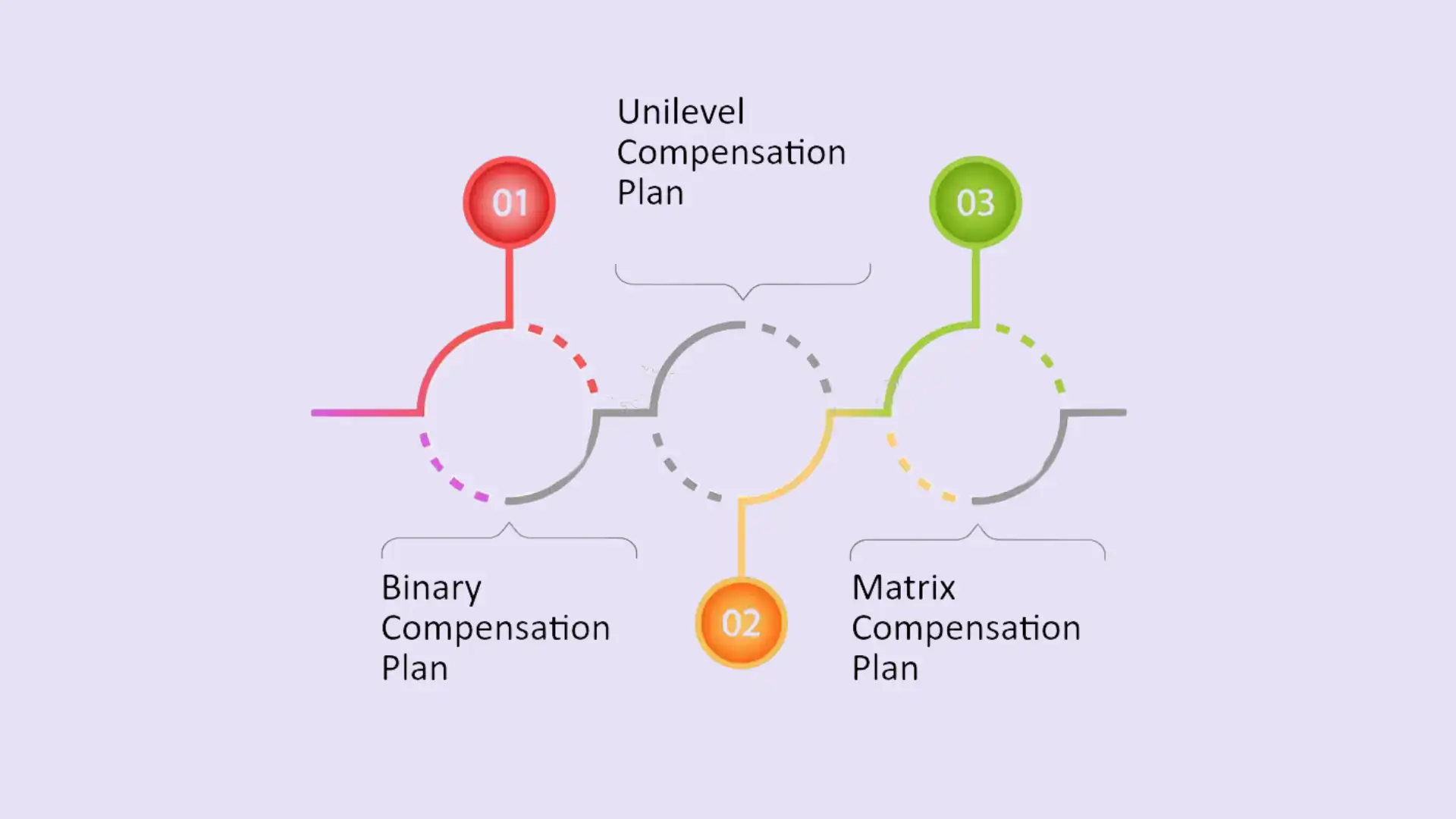
The table below summarizes the core differences between the three plans.
| Feature | Uni-Level Plan | Binary Plan | Matrix Plan |
|---|---|---|---|
| Core Structure | Unlimited width, multiple depth levels. | Exactly two frontline legs (Left & Right). | Fixed width (e.g., 3) and depth (e.g., 5). |
| Frontline Limit | Unlimited. You can sponsor as many as you want. | Strictly Two. No more direct sponsors allowed after two. | Fixed Number (e.g., 3, 4, or 5). |
| Spillover | None. Each new recruit goes directly under their sponsor. | Very Common. Excess recruits spill down to fill the weaker leg, often benefiting new members. | Defining Feature. New recruits spill over to fill the matrix in a set order. |
| Commission Driver | Depth. Earnings from sales across many levels of your downline. | Balance. Earnings based on matching volume between your two legs. | Grid Fill. Earnings based on filling and cycling within your fixed matrix. |
| Ease of Understanding | Very Easy. Simple “level” concept. | Moderate to Complex. Balance rules can be confusing. | Moderate. Spillover and matrix limits are easy to grasp. |
| Primary Focus | “Sponsor widely and build deep.” | “Build two strong, balanced legs.” | “Fill your matrix completely and cycle.” |
| Growth Style | Horizontal & Deep. Grows out and down. | Vertical & Fast. Grows deep down two paths. | Orderly & Predictable. Grows in a pre-set pattern. |
| Key Challenge | Income dilution at deeper levels; needs massive depth. | Frustration from imbalance; pressure to recruit for volume. | Income cap; potential for passivity waiting for spillover. |
Choosing the Right Plan: A Deeper Dive
Understanding these mechanics helps you align a plan with your goals, whether you’re a distributor or a business owner.
For the Distributor:
- Choose Uni-Level if: You are new, want simplicity, have a large personal network, and prefer a plan where you aren’t penalized if one part of your team grows faster than another. Your success depends on building a deep organization, not just a wide one.
- Choose Binary if: You are competitive, understand teamwork dynamics, and thrive in a fast-paced environment. You must be comfortable actively managing balance and teaching your team to do the same. Success requires building two powerhouse legs.
- Choose Matrix if: You value structure and predictability. You appreciate a plan where your upline has a vested interest in helping you (via spillover). You’re comfortable with a defined income ceiling per matrix and understand the “re-entry” process to continue earning.
For the Company Founder:
The plan you choose becomes your company’s culture.
- Uni-Level fosters independent growth and is easy to onboard new distributors. However, it requires robust tracking software for deep levels and can lead to less team cohesion.
- Binary creates explosive growth and intense team interdependence. It requires clear education to prevent frustration and must be carefully managed to avoid appearing like a “recruiting-only” scheme. Software must expertly handle volume calculations and spillover placement.
- Matrix offers excellent control over payouts (predictable liability) and encourages strong mentoring. However, the hard limits can demotivate top earners, and the plan must be designed to allow for re-entry or advancement to keep leaders engaged.
The Reality of Modern MLM:
Very few companies use a “pure” version of these plans today. Most successful companies use hybrid plans. A common example is a Binary with Uni-Level bonuses, where core commissions come from leg balance, but additional bonuses are paid for personally sponsored recruits (like Uni-Level) or for rank achievements. This combines the fast growth of Binary with the personal sponsorship incentives of Uni-Level.
Final Thoughts
Binary, Matrix, and Uni-Level plans are the foundational engines of MLM, each with a distinct philosophy. The Uni-Level plan offers width and simplicity, the Binary plan thrives on balance and speed, and the Matrix plan provides order and predictability. The detailed comparison shows that trade-offs are inherent in each model. Ultimately, success is less about finding a “perfect” plan and more about matching a plan’s strengths to your personal skills and business goals. The most important factors remain consistent across all plans: a quality product, ethical practices, dedicated work, and effective team leadership.
Frequently Asked Questions
Q1.Which MLM plan is easiest for beginners?
For most beginners, the Uni-Level plan is the easiest to understand. There’s no complex balancing act. You can sponsor as many people as you want directly, and you earn commissions from sales made by your team several levels deep. Its simplicity makes it easier to explain to new recruits, allowing you to focus on building your network rather than decoding complicated rules.
Q2.What’s the fastest way to earn in MLM: Binary or Uni-Level?
A Binary plan is often structured for faster, more frequent payouts due to its cycling nature, but it’s not necessarily “easier.” You can earn quickly if your two legs are balanced. A Uni-Level plan offers slower, more steady growth, as building significant depth takes time. So, “fastest” depends on your ability to build two strong, balanced teams quickly. Binary has a higher short-term potential, while Uni-Level is a longer-term build.
Q3.What does "spillover" mean in MLM, and which plans have it?
Spillover is when new members you recruit are placed under your existing team members instead of directly under you, helping to fill their downline. This is a core feature of Matrix plans (where it happens automatically to fill the grid) and is very common in Binary plans (where excess recruits spill into the weaker leg). Uni-Level plans typically do not have spillover; everyone you sponsor stays in your direct line.
Q4.Is a Matrix plan better because it has spillover from my upline?
Spillover can be a great help, as it means your upline leader has a direct incentive to help fill your matrix. However, relying solely on spillover is a passive strategy. The downside is that your income is capped by the matrix size (e.g., a 3×5 grid). Once it’s full, you stop earning from it unless you qualify for a new one. It’s a supportive plan but has built-in limits.
Q5.Why do I have to "balance" my legs in a Binary plan?
Balancing is the core earning mechanism of a Binary. You earn commissions based on the sales volume of your weaker leg. This design is meant to encourage teamwork—you’re incentivized to support your slower-growing leg, and your upline is incentivized to spill over into it. It prevents the entire network from growing down just one path and aims to create a wider, more stable organization.
Q6.Can I make real money with a Uni-Level plan if commissions get smaller each level?
Yes, but the strategy is different. In Uni-Level, you need depth. While the commission percentage decreases per level, the volume of sales from a very deep organization (thousands of people across 7+ levels) can be massive. The key is not just sponsoring many people (width) but helping your frontline build their own deep teams, which in turn builds your depth. It’s a leverage model.
Q7.What happens in a Matrix plan when my front line is full?
When your frontline (e.g., your 3 slots) is full, the next person you personally sponsor “spills over” to the next open position in your downline, following a set order (left to right, top to bottom). This benefits your existing team members. Your focus then shifts from filling your frontline to helping your entire matrix fill and “cycle” (complete) so you can earn commissions and potentially qualify to start a new matrix.
Q8.Are most MLM companies using pure Binary, Matrix, or Uni-Level plans today?
Most modern companies use hybrid plans that combine features. A very common example is a “Binary with Uni-Level features,” where your core commissions come from balancing two legs, but you also earn fast-start bonuses for personal sponsoring (like Uni-Level) and leadership bonuses for hitting ranks. This blends the growth speed of Binary with the personal recruitment incentives of other plans to motivate distributors in multiple ways.
Explore Services
Related Services
Reviewed by

Aman Vaths
Founder of Nadcab Labs
Aman Vaths is the Founder & CTO of Nadcab Labs, a global digital engineering company delivering enterprise-grade solutions across AI, Web3, Blockchain, Big Data, Cloud, Cybersecurity, and Modern Application Development. With deep technical leadership and product innovation experience, Aman has positioned Nadcab Labs as one of the most advanced engineering companies driving the next era of intelligent, secure, and scalable software systems. Under his leadership, Nadcab Labs has built 2,000+ global projects across sectors including fintech, banking, healthcare, real estate, logistics, gaming, manufacturing, and next-generation DePIN networks. Aman’s strength lies in architecting high-performance systems, end-to-end platform engineering, and designing enterprise solutions that operate at global scale.