Ai Overview
The blockchain industry has undergone a remarkable transformation since Ethereum first introduced programmable smart contracts to the world. For builders, investors, and organizations evaluating blockchain strategies, the trajectory of the Ethereum Virtual Machine directly influences technology decisions, cost projections, and competitive positioning. By 2021, the total value locked in DeFi protocols surpassed $100 billion.
Key Takeaways
- The Ethereum Virtual Machine is the foundational execution engine that powers all smart contracts on Ethereum, and its evolution is reshaping the entire blockchain landscape.
- EVM scalability was historically limited by single-threaded execution, high gas fees, and network congestion that made enterprise-grade applications impractical.
- Layer 2 solutions, particularly rollups, emerged as the primary Ethereum scaling solutions to move computation off-chain while inheriting mainnet security.
- ZK EVM (Zero Knowledge EVM) combines the compatibility of the original EVM with cryptographic proof systems to achieve both scalability and privacy.
- There are multiple zkEVM types ranging from fully EVM-equivalent to high-level designs, each balancing trade-offs between compatibility, performance, and proof efficiency.
- The EVM evolution from a basic execution engine to zero knowledge-powered infrastructure is enabling real-world use cases in DeFi, enterprise compliance, and cross-chain interoperability.
- EVM architecture principles remain central to blockchain innovation, with zkEVM preserving the same developer tooling and smart contract standards.
- Zero knowledge proofs address the long-standing privacy gap in public blockchains, allowing data verification without exposing underlying information.
- Despite significant progress, challenges like proving time, hardware costs, and tooling maturity remain obstacles that the industry is actively solving.
- The long-term trajectory of EVM evolution points toward zkEVM becoming the standard execution layer, enabling mass adoption of Ethereum-based applications globally.
Understanding the Evolution of the Ethereum Virtual Machine
The blockchain industry has undergone a remarkable transformation since Ethereum first introduced programmable smart contracts to the world. At the heart of that transformation sits the Ethereum Virtual Machine, the computation layer that makes decentralized applications possible. But the original design, while groundbreaking, was never meant to handle the scale of activity we see today. The EVM evolution from a straightforward execution engine to an ecosystem powered by zero knowledge proofs represents one of the most significant shifts in blockchain infrastructure over the past decade.
Understanding this evolution is not just an academic exercise. For builders, investors, and organizations evaluating blockchain strategies, the trajectory of the Ethereum Virtual Machine directly influences technology decisions, cost projections, and competitive positioning. Let us walk through this journey from the fundamentals to the frontier.
What Is the Ethereum Virtual Machine (EVM)?
The Ethereum Virtual Machine is a Turing-complete, stack-based virtual machine that serves as the runtime environment for all Ethereum smart contracts. Think of it as a global computer that every node on the Ethereum network runs simultaneously. When a developer writes a smart contract in Solidity and deploys it, the code is compiled into EVM bytecode. That bytecode is then executed identically on every participating node, ensuring consensus without a central authority.
This design was revolutionary when it launched in 2015. While EVM scalability was not a primary concern in those early days, the foundation was strong. Before the EVM, blockchains were primarily limited to simple value transfers. The Ethereum Virtual Machine opened the door to programmable money, decentralized governance, and a universe of applications that no single entity controls. For organizations exploring blockchain solutions for enterprises, the EVM remains the most widely supported execution standard in the industry.
Role of EVM in Ethereum Smart Contracts
Smart contracts are self-executing programs stored on the blockchain. The EVM is responsible for interpreting and running these contracts whenever a transaction triggers them. It manages the contract’s state, allocates memory, handles storage operations, and enforces gas limits that prevent infinite loops or resource abuse. Every operation in a smart contract has an associated gas cost, and the EVM tracks these costs meticulously to ensure fair resource allocation across the network.
Without the EVM, there would be no DeFi protocols, no NFT marketplaces, and no decentralized autonomous organizations. It is the layer that transforms static blockchain ledgers into dynamic, programmable platforms.
How EVM Architecture Enables Decentralized Execution
EVM architecture is built on deterministic execution. Given the same input and state, every node will produce exactly the same output. This determinism is achieved through a carefully constrained instruction set (opcodes) and isolated execution sandboxes. The architecture separates storage (persistent), memory (temporary), and stack operations, creating a predictable environment for contract execution.
This architectural design also ensures that malicious or buggy code cannot compromise the underlying system. The sandbox model means a failing contract does not crash the node, and gas limits prevent any single transaction from monopolizing resources. Understanding EVM architecture and its inner mechanics is essential for anyone building on Ethereum or its Layer 2 ecosystem.
Early Limitations of the EVM
While the EVM pioneered smart contract execution, it was designed during a period when the Ethereum network processed a fraction of the volume it handles today. As adoption grew, several fundamental limitations became apparent, each contributing to the urgent need for the EVM evolution we are witnessing now.
Scalability Challenges in the Ethereum Network
The original Ethereum network processes roughly 15 to 30 transactions per second. Compare that with traditional payment networks handling thousands of transactions per second, and the gap becomes clear. EVM scalability was constrained because every node had to execute every transaction sequentially. There was no parallelism, no off-chain processing, and no way to batch operations efficiently. During peak activity periods, the network would grind to a near halt, with pending transactions stacking up in the mempool for hours.
Gas Fees and Performance Bottlenecks
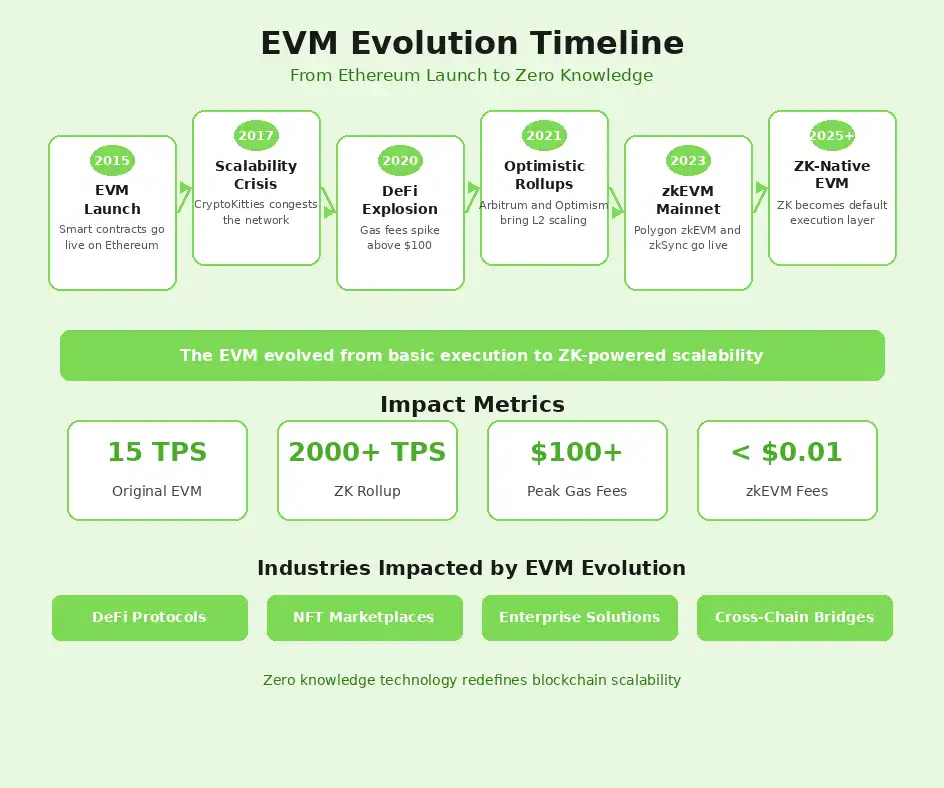
Gas fees on Ethereum are driven by supply and demand. When block space is limited and demand is high, users bid up gas prices to get their transactions included. During the DeFi Summer of 2020 and the NFT boom of 2021, gas fees routinely exceeded $100 for a simple token swap. For everyday users, this made Ethereum practically unusable. For businesses exploring blockchain integration, unpredictable costs were a deal-breaker.
Lack of Native Privacy in Traditional EVM
The EVM was designed for transparency, not privacy. Every transaction, balance, and contract interaction is visible on the public ledger. While this transparency is valuable for auditing and trust, it creates significant challenges for financial institutions, healthcare providers, and any organization handling sensitive data. The lack of native privacy mechanisms meant that achieving confidentiality on Ethereum required complex workarounds that were expensive and difficult to maintain.
Industry Principle: Any blockchain solution that exposes sensitive business data on a public ledger introduces regulatory risk. Privacy should be a design requirement, not an afterthought.
Why Ethereum Needed Scalability Solutions
The explosive growth of Ethereum-based applications created an urgency that the original EVM architecture could not ignore. What started as a platform for experimental smart contracts quickly became the settlement layer for billions of dollars in value. The mismatch between demand and capacity forced the community to rethink how the Ethereum Virtual Machine should operate at scale.
Growing Demand for EVM-Based Applications
DeFi, NFTs, and High Transaction Volume
By 2021, the total value locked in DeFi protocols surpassed $100 billion. NFT trading volumes reached billions monthly. Gaming protocols, prediction markets, and decentralized identity systems all added to the load. Each of these applications required frequent, often complex interactions with smart contracts on the EVM. A single Uniswap swap might involve multiple contract calls, each consuming gas and competing for block space. Understanding the full landscape of enterprise blockchain use cases reveals just how critical scaling became for mainstream adoption.
Impact on Ethereum Network Congestion
Network congestion was not just an inconvenience. It was an existential threat to Ethereum’s position as the leading smart contract platform. Competing chains like Solana, Avalanche, and BNB Chain attracted users and builders with lower fees and faster confirmation times. While these alternatives often made trade-offs on decentralization, they demonstrated that the market demanded better performance. Ethereum scaling solutions became the top priority for the ecosystem’s survival and growth.
Introduction to Layer 2 Scaling on Ethereum
Among the various Ethereum scaling solutions proposed, the community settled on a rollup-centric roadmap rather than overhauling the base layer. Layer 2 networks would handle the bulk of transaction processing while relying on Ethereum mainnet for security and data availability. This approach preserved decentralization while dramatically improving throughput and reducing costs.
Off-Chain Computation and EVM Compatibility
The key insight behind Layer 2 scaling is that not every computation needs to happen on mainnet. These Ethereum scaling solutions move execution off-chain and only post proofs or compressed data back to Ethereum, allowing Layer 2 networks to process thousands of transactions for the cost of a single mainnet transaction. Critically, the best Layer 2 solutions maintain EVM compatibility, meaning developers can deploy the same Solidity code they have already written without starting from scratch.
Security and Trust Assumptions in Scaling Models
Not all Ethereum scaling solutions offer the same security guarantees. Sidechains, for instance, have their own validator sets and do not inherit Ethereum’s security. Rollups, on the other hand, post transaction data to Ethereum, making them verifiable by anyone. The trust model you choose has direct implications for the safety of funds, the integrity of smart contract execution, and the regulatory posture of your application.
From Rollups to Zero Knowledge Technology
Rollups represent the most promising class of Ethereum scaling solutions, and within that category, zero knowledge technology has emerged as the gold standard for both security and efficiency. The transition from basic rollup concepts to fully functional Zero Knowledge EVM implementations marks a pivotal chapter in the EVM evolution story. As Ethereum scaling solutions matured, EVM scalability improvements began to accelerate, with each generation of rollups bringing meaningful performance gains.
Understanding Ethereum Rollups
Optimistic Rollups vs ZK Rollups
The two primary rollup designs take fundamentally different approaches to transaction validation. Optimistic Rollups assume transactions are valid by default and rely on a challenge period (typically 7 days) during which anyone can submit a fraud proof if they detect an invalid state transition. ZK Rollups, by contrast, generate a cryptographic validity proof for every batch of transactions, providing instant mathematical certainty that the state transition is correct.
Optimistic Rollups vs ZK Rollups: Comparison
| Feature | Optimistic Rollups | ZK Rollups |
|---|---|---|
| Validation Method | Fraud proofs (reactive) | Validity proofs (proactive) |
| Withdrawal Time | ~7 days (challenge period) | Minutes (once proof is verified) |
| EVM Compatibility | High (near full EVM equivalence) | Varies by implementation type |
| Security Model | At least one honest validator needed | Mathematical proof guarantees |
| Computation Cost | Lower on-chain cost | Higher proof generation cost |
| Privacy Support | Limited | Native privacy capabilities |
| Maturity Level | Production-ready (Arbitrum, Optimism) | Rapidly maturing (zkSync, Polygon zkEVM) |
For teams evaluating rollup architecture and upgrade strategies, the choice between Optimistic and ZK Rollups has significant long-term implications for cost, user experience, and security posture.
How Rollups Improve Ethereum Scalability
Rollups improve EVM scalability by bundling hundreds or thousands of transactions into a single batch, processing them off-chain, and posting only a compressed summary or proof back to Ethereum. This means the mainnet does not need to re-execute every transaction. It simply verifies that the batch was processed correctly. The result is a dramatic increase in throughput, from Ethereum’s base 15-30 TPS to thousands of TPS per rollup, with proportional reductions in per-transaction costs.
Fundamentals of Zero Knowledge Proofs
Zero knowledge proofs are cryptographic protocols that allow one party (the prover) to convince another party (the verifier) that a statement is true without revealing any information beyond the validity of the statement itself. In the context of blockchain, this means you can prove that a computation was performed correctly without showing the inputs, the intermediate steps, or even the complete output.
zkSNARKs and zkSTARKs Explained
zkSNARKs (Succinct Non-Interactive Arguments of Knowledge) produce compact proofs that are fast to verify, making them ideal for on-chain verification where gas costs matter. However, they require a trusted setup ceremony, which introduces a potential (though manageable) trust assumption. zkSTARKs (Scalable Transparent Arguments of Knowledge) eliminate the need for a trusted setup and offer post-quantum security, but their proofs are larger and more expensive to verify on-chain. Both systems are actively used in the Zero Knowledge EVM ecosystem, with different projects choosing based on their specific performance and security requirements.
Privacy-Preserving Computation on Blockchain
Beyond scalability, zero knowledge proofs unlock genuine privacy for blockchain applications. A financial institution can prove it has sufficient reserves without disclosing exact balances. A user can verify their identity meets compliance requirements without sharing personal data. This capability is transforming how regulated industries view public blockchains, shifting the narrative from “too transparent” to “selectively transparent.”
Introduction to ZK EVM (zkEVM)
The concept of a Zero Knowledge EVM represents the convergence of two powerful ideas: the universal compatibility of the Ethereum Virtual Machine and the mathematical guarantees of zero knowledge proofs. Building a ZK EVM that faithfully replicates the EVM’s execution while generating validity proofs is one of the most ambitious engineering challenges in blockchain history.
What Is a Zero Knowledge EVM?
A Zero Knowledge EVM is an execution environment that runs Ethereum smart contracts inside a zero knowledge proof circuit. It takes the same bytecode, the same opcodes, and the same state transition logic as the original EVM, but wraps every computation in a cryptographic proof that can be verified efficiently on-chain. The goal is to make the transition seamless for developers: write your Solidity contract once, and it runs on both the EVM and the ZK EVM without modification.
How zkEVM Maintains EVM Compatibility
Maintaining EVM compatibility inside a zero knowledge proof system is extraordinarily complex. The EVM was not designed with proof generation in mind. Operations like SHA3 hashing, which are trivial for a CPU, are extremely expensive inside a ZK circuit. implementations must carefully map each EVM opcode to an equivalent constraint system, preserving the exact behavior while minimizing the proving overhead. The degree to which this is achieved defines the “type” of zkEVM.
Execution Environment in zkEVM Architecture
The zkEVM architecture typically includes several components: a sequencer that orders transactions, an executor that processes them (generating an execution trace), a prover that converts the execution trace into a zero knowledge proof, and a verifier contract on Ethereum mainnet that checks the proof. This architecture separates concerns cleanly, allowing each component to be optimized independently. The EVM architecture principles of determinism and sandboxed execution remain intact throughout this pipeline. For a deeper understanding of these mechanics, explore EVM functionality and operational principles.
Types of zkEVM Implementations
Fully EVM-Equivalent zkEVMs
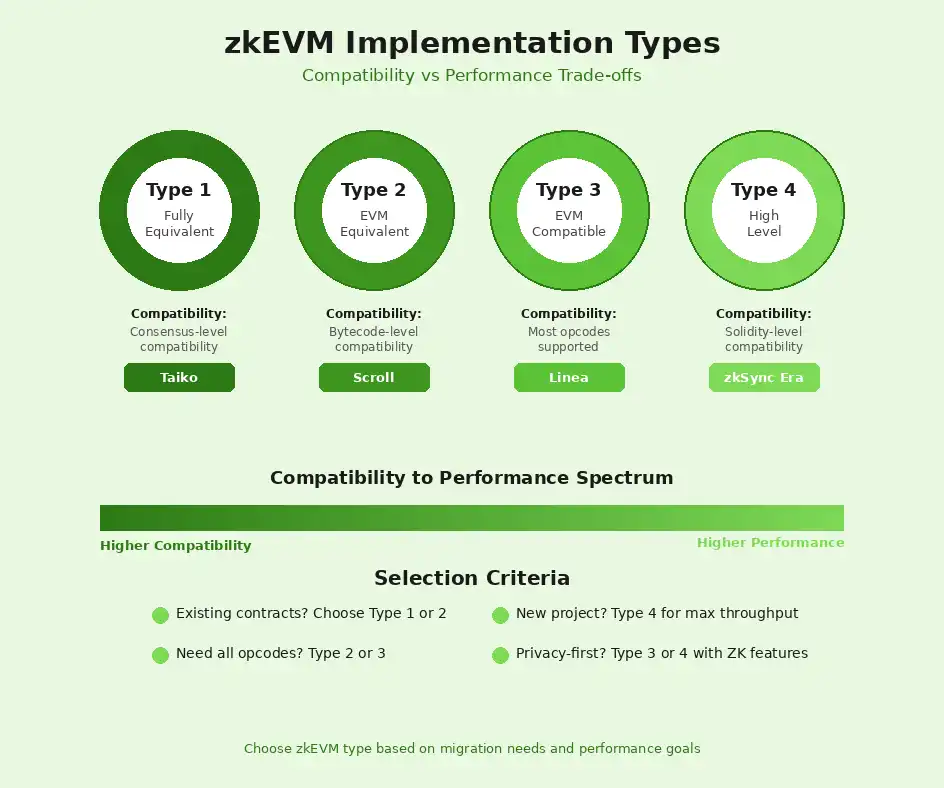
Type 1 and Type 2 zkEVMs aim for full or near-full equivalence with the Ethereum mainnet EVM. A Type 1 zkEVM is indistinguishable from the mainnet execution environment at the consensus level, meaning any tool, debugger, or infrastructure built for Ethereum works without changes. Type 2 achieves equivalence at the EVM bytecode level but may differ in how it handles peripheral features like block hashing. These implementations prioritize developer experience and ecosystem compatibility over raw proving speed.
EVM-Compatible vs High-Level zkEVM Designs
Type 3 zkEVMs sacrifice some EVM compatibility for improved proving performance, while Type 4 designs compile Solidity to a custom intermediate representation optimized for proof generation. The trade-off is clear: higher-level designs generate proofs faster and cheaper, but they may not support every EVM opcode or behavior. For teams migrating existing contracts, full EVM equivalence matters. For new projects building from scratch, higher-level designs can offer significant performance advantages.
zkEVM Type Comparison
| zkEVM Type | Compatibility Level | Proving Speed | Example Projects |
|---|---|---|---|
| Type 1 (Fully Equivalent) | Ethereum-equivalent at consensus level | Slowest proving | Taiko, Scroll (aspiring) |
| Type 2 (EVM-Equivalent) | Bytecode-level equivalence | Slower proving | Scroll, Polygon zkEVM |
| Type 3 (EVM-Compatible) | Most EVM opcodes supported | Moderate proving | Linea (transitional) |
| Type 4 (High-Level) | Solidity-level compatibility | Fastest proving | zkSync Era, StarkNet |
Selecting the Right zkEVM Model for Your Project
Choosing between zkEVM types depends on several factors: if your priority is migrating existing contracts with zero code changes, Type 1 or Type 2 implementations are ideal. If you are building new applications and want maximum throughput, Type 4 designs offer superior proof generation speed. Consider your team’s familiarity with Ethereum tooling, the complexity of your contracts, your throughput requirements, and whether privacy is a core feature. Also assess the maturity of each ecosystem’s developer tooling, documentation, and community support before committing to a specific stack.
How zkEVM Transforms Ethereum Smart Contracts
The impact of ZK EVM on smart contract execution goes well beyond cost savings. It fundamentally changes the security model, the finality guarantees, and the privacy capabilities available to builders and users. This section explores how the combination of zero knowledge proofs and EVM compatibility is transforming what smart contracts can do.
Smart Contract Execution with Zero Knowledge Proofs
Off-Chain Execution and On-Chain Verification
In a zkEVM, transactions are executed off-chain by a sequencer and executor. The executor generates a detailed trace of every computation step. A specialized prover then compresses this entire trace into a succinct zero knowledge proof, typically just a few hundred bytes. This proof is posted to Ethereum mainnet, where a verifier smart contract checks its validity. If the proof is valid, the state transition is accepted. If not, it is rejected. This means Ethereum never needs to re-execute the transactions; it only needs to verify a single proof, dramatically reducing the load on the mainnet.
Reduced Gas Costs and Faster Finality
Because verification is exponentially cheaper than execution, zkEVM transactions typically cost a fraction of their mainnet equivalents. Gas fees that would be $50 or more on Ethereum mainnet can drop to pennies on a ZK EVM Layer 2. Finality is also improved: unlike Optimistic Rollups where you must wait 7 days for the challenge period to expire, ZK Rollups achieve finality as soon as the proof is verified on-chain, which typically takes minutes.
zkEVM Transaction Lifecycle: Step-by-Step Flow
| Step | Stage | Description | Where It Happens |
|---|---|---|---|
| 1 | Transaction Submission | User submits a transaction through a wallet or dApp interface | User-side (off-chain) |
| 2 | Sequencing | Sequencer orders and batches multiple transactions together | Layer 2 (off-chain) |
| 3 | Execution | Executor processes each transaction and generates an execution trace | Layer 2 (off-chain) |
| 4 | Proof Generation | ZK prover converts execution trace into a succinct validity proof | Prover network (off-chain) |
| 5 | Proof Submission | Compressed proof and state root are submitted to Ethereum mainnet | Ethereum L1 (on-chain) |
| 6 | On-Chain Verification | Verifier contract validates the proof and updates the state on Ethereum | Ethereum L1 (on-chain) |
| 7 | Finality | Transaction is finalized with full Ethereum security guarantees | Ethereum L1 (on-chain) |
Privacy and Security Enhancements in zkEVM
Trustless Ethereum Scaling
Unlike sidechains or centralized solutions, zkEVM scaling is trustless. The security does not depend on the honesty of a validator set or the reputation of an operator. It depends on mathematics. If the proof verifies, the computation is correct. Period. This trustless model is what makes ZK EVM the most compelling Ethereum scaling solution for applications handling significant value, whether in DeFi protocols managing billions or institutional platforms processing regulated transactions.
Privacy-Preserving Smart Contracts
Zero knowledge proofs enable a new class of smart contracts that can process private inputs and produce verifiable outputs without exposing the underlying data. Imagine a lending protocol that verifies a borrower’s creditworthiness without seeing their financial history, or a supply chain contract that confirms product authenticity without revealing trade secrets. These are not theoretical possibilities; they are actively being built on ZK EVM platforms today. Teams exploring zero knowledge applications in Web3 are finding new use cases across multiple industries.
Risk Consideration: While ZK proofs offer strong mathematical guarantees, the correctness of the proof system depends on the implementation. Auditing ZK circuits is a specialized discipline, and bugs in proof generation can lead to invalid state transitions being accepted. Always engage experienced cryptographic auditors before mainnet deployment.
Real-World Use Cases of zkEVM
The theoretical advantages of zkEVM are compelling, but its real value is demonstrated in production use cases that solve tangible problems for real users and organizations. From high-frequency DeFi trading to enterprise compliance, the Zero Knowledge EVM is proving its worth across diverse sectors.
Scaling DeFi Protocols on Ethereum
High-Frequency Trading and Liquidity Efficiency
Decentralized exchanges and automated market makers on Ethereum mainnet have always struggled with latency and cost. A single swap on Uniswap V3 can cost tens of dollars during peak periods. On a ZK EVM Layer 2, the same swap costs fractions of a cent and confirms in seconds. This cost reduction unlocks high-frequency trading strategies, tighter spreads, and more efficient capital allocation that were previously impossible on mainnet. Liquidity providers benefit from lower impermanent loss risk due to faster rebalancing, and traders enjoy execution quality that approaches centralized exchange performance.
Building crypto exchanges on ZK EVM infrastructure enables near-instant settlement with the full security of Ethereum.
Enterprise and Institutional Blockchain Adoption
Compliance-Friendly Privacy Using Zero Knowledge
For enterprises operating in regulated markets, the challenge has always been reconciling blockchain transparency with data protection requirements like GDPR and CCPA. Zero knowledge proofs offer an elegant solution: prove compliance without disclosing sensitive data. A financial institution can demonstrate AML/KYC compliance to regulators through a ZK proof, while keeping individual customer data off the public chain. This compliance-friendly approach is accelerating institutional adoption of Ethereum-based infrastructure across financial services, real estate, and healthcare. The Athene Network case study illustrates how blockchain platforms can scale while maintaining robust security and user trust.
Secure Data Verification on Public Chains
Supply chain verification, credential authentication, and insurance claim validation all require proving facts about data without exposing the data itself. Zero Knowledge EVM makes this practical at scale. A pharmaceutical company can verify that a drug batch passed all quality checks throughout the supply chain. An educational institution can issue tamper-proof credentials that employers can verify instantly. All of this happens on a public blockchain with full transparency about the verification process, but complete privacy about the underlying data.
Challenges and Limitations of zkEVM
For all its promise, the ZK EVM ecosystem faces real challenges that must be acknowledged honestly. As the most advanced of all Ethereum scaling solutions, understanding these limitations is essential for making informed decisions about when and how to adopt this technology.
Computational Complexity of Zero Knowledge Proofs
Proving Time and Hardware Requirements
Generating zero knowledge proofs is computationally intensive. Proving a batch of transactions can require high-end GPUs or specialized hardware, and the process can take minutes to hours depending on the complexity and the proof system used. This creates a centralization risk: only well-resourced entities can afford to run provers, which partially undermines the decentralization ethos. However, progress in proof aggregation, recursive proofs, and hardware acceleration is rapidly reducing these barriers. Projects like Cysic, Ingonyama, and others are building dedicated proving hardware that promises to democratize proof generation.
Developer Experience and Tooling Gaps
Debugging and Testing in zkEVM Environments
While zkEVM aims for EVM compatibility, the debugging experience is not yet on par with mainnet. Error messages from proof failures can be cryptic, and tracing the root cause of a failed proof requires understanding both EVM execution semantics and ZK circuit constraints. Testing frameworks are still maturing, and documentation varies significantly across implementations. For teams used to the rich tooling ecosystem of Ethereum (Hardhat, Foundry, Tenderly), the transition to zkEVM requires patience and often specialized knowledge. The good news is that the tooling gap is closing rapidly, with major projects investing heavily in developer experience.
EVM Evolution Timeline: Key Milestones
| Year | Milestone | Impact on EVM Evolution |
|---|---|---|
| 2015 | Ethereum Mainnet Launch | First production EVM deployment, smart contracts go live |
| 2017 | ICO Boom and CryptoKitties | First major EVM scalability crisis exposed throughput limits |
| 2019 | Rollup Concept Formalized | Vitalik publishes rollup-centric roadmap for Ethereum scaling solutions |
| 2020 | DeFi Summer | Gas fees spike to $100+, urgency for Layer 2 scaling intensifies |
| 2021 | Optimistic Rollups Launch | Arbitrum and Optimism bring first production rollup scaling |
| 2022-2023 | zkEVM Mainnet Launches | Polygon zkEVM, zkSync Era, and Scroll go live with ZK EVM solutions |
| 2024-2025 | Proof Optimization Era | Hardware acceleration, recursive proofs, and proving cost reduction |
| 2025+ | zkEVM as Default Execution Layer | EVM architecture evolution reaches zero knowledge-native execution |
The Future of EVM in a Zero Knowledge World
The EVM evolution is far from over. If anything, we are entering the most transformative phase yet. The convergence of zero knowledge proof technology with the Ethereum Virtual Machine is setting the stage for a blockchain infrastructure that is scalable, private, interoperable, and accessible to billions of users worldwide.
zkEVM as the Next Generation Ethereum Execution Layer
The long-term vision for Ethereum involves zkEVM becoming the standard execution layer. Rather than a supplementary scaling solution, zero knowledge proof technology would be integrated directly into Ethereum’s core protocol. This would mean every transaction on Ethereum benefits from the efficiency and privacy of ZK proofs, not just those on Layer 2 networks. Projects across the ecosystem are aligning toward this vision, with significant research and engineering investment flowing into making ZK-native execution practical at the base layer.
Interoperability Across Layer 2 Networks
One of the biggest challenges in today’s Layer 2 landscape is fragmentation. Liquidity, users, and applications are spread across dozens of rollups, each operating as a somewhat isolated environment. Zero knowledge proofs offer a path to seamless interoperability: a proof generated on one Layer 2 can be verified on another without requiring a trusted bridge or centralized intermediary. These advances in EVM scalability through shared proof layers, cross-chain proof aggregation, and unified settlement are all active areas of research that will define the next chapter of EVM scalability and usability.
Power Your Ethereum Apps with zkEVM Innovation
From EVM optimization to zkEVM development, we help businesses scale securely using advanced zero knowledge solutions
Launch Your Exchange Now
Long-Term Impact on Ethereum Scalability and Privacy
Towards Mass Adoption of Ethereum Applications
Mass adoption requires that using blockchain applications feels no different from using any other internet service. Users should not need to think about gas fees, confirmation times, or which Layer 2 they are connected to. The EVM evolution toward zero knowledge technology, building on earlier Ethereum scaling solutions, is making this possible. With sub-cent transaction costs, near-instant finality, and built-in privacy, zkEVM removes the friction points that have kept mainstream users at arm’s length. Combined with account abstraction, improved onboarding flows, and mobile-first interfaces, the stage is set for Ethereum to scale from millions to billions of active users.
The Ethereum Virtual Machine started as a bold experiment in decentralized computation. Through years of iterative improvement, community-driven research, and breakthrough innovations in zero knowledge cryptography, it is evolving into something far more powerful than its creators imagined. The EVM architecture that made smart contracts possible is now being extended by ZK EVM technology to deliver the performance, privacy, and scalability that global adoption demands. Organizations, builders, and investors who understand this evolution and position themselves accordingly will be at the forefront of the next era of decentralized technology.
Frequently Asked Questions
Q1.What is the EVM and why does it matter?
The Ethereum Virtual Machine is the computation engine that runs smart contracts on the Ethereum blockchain. It processes every transaction and ensures that code executes identically across all nodes. Its importance lies in enabling decentralized applications without relying on a central server, making it the backbone of thousands of blockchain projects globally.
Q2.How has the Ethereum Virtual Machine evolved over the years?
The EVM evolution has moved from a single-layer execution model to a multi-layered ecosystem involving Layer 2 solutions, rollups, and zero knowledge technology. Initially designed for basic smart contract execution, the architecture now supports off-chain computation, proof-based verification, and significantly higher throughput while maintaining the same security guarantees.
Q3.What is a ZK EVM?
A ZK EVM (Zero Knowledge EVM) is an execution environment that combines the compatibility of the Ethereum Virtual Machine with zero knowledge proof technology. It allows smart contracts to be executed off-chain and verified on-chain using cryptographic proofs, reducing costs and improving speed without sacrificing security or trust.
Q4.What are the differences between Optimistic Rollups and ZK Rollups?
Optimistic Rollups assume transactions are valid and only run fraud proofs when challenged, leading to a 7-day withdrawal delay. ZK Rollups use cryptographic validity proofs to confirm correctness immediately. While Optimistic Rollups offer broader EVM compatibility today, ZK Rollups deliver faster finality and stronger security guarantees in the long run.
Q5.How does EVM scalability affect transaction costs?
EVM scalability directly impacts gas fees, which represent the cost of computation on Ethereum. When the network is congested, users compete for block space, driving fees to hundreds of dollars per transaction. Layer 2 solutions and zkEVM architectures dramatically reduce these costs by processing transactions off-chain and settling compressed proofs on mainnet.
Q6.Can existing Ethereum smart contracts run on zkEVM?
Yes, depending on the type of zkEVM implementation. Fully EVM-equivalent zkEVMs aim to support existing Solidity contracts with little or no modifications. EVM-compatible variants may require minor code adjustments, while higher-level zkEVM designs might need more significant changes to leverage zero knowledge proof generation efficiently.
Q7.What are zkSNARKs and zkSTARKs?
zkSNARKs (Zero Knowledge Succinct Non-Interactive Arguments of Knowledge) and zkSTARKs (Zero Knowledge Scalable Transparent Arguments of Knowledge) are two types of zero knowledge proof systems. zkSNARKs produce smaller proofs but require a trusted setup, while zkSTARKs are transparent and quantum-resistant but generate larger proofs. Both enable privacy-preserving verification on blockchain.
Explore Services
Related Services
Reviewed by

Aman Vaths
Founder of Nadcab Labs
Aman Vaths is the Founder & CTO of Nadcab Labs, a global digital engineering company delivering enterprise-grade solutions across AI, Web3, Blockchain, Big Data, Cloud, Cybersecurity, and Modern Application Development. With deep technical leadership and product innovation experience, Aman has positioned Nadcab Labs as one of the most advanced engineering companies driving the next era of intelligent, secure, and scalable software systems. Under his leadership, Nadcab Labs has built 2,000+ global projects across sectors including fintech, banking, healthcare, real estate, logistics, gaming, manufacturing, and next-generation DePIN networks. Aman’s strength lies in architecting high-performance systems, end-to-end platform engineering, and designing enterprise solutions that operate at global scale.