Ai Overview
Blockchain domains are human-readable name records stored directly on a public blockchain rather than controlled by a traditional domain registrar. com” is leased from a registrar and managed through ICANN-governed infrastructure, a blockchain domain such as “company. Even in technologically sophisticated markets like the USA and UK, surveys consistently show that fewer than 15% of internet users have interacted with any form of Web3 application.
What Are Blockchain Domains?
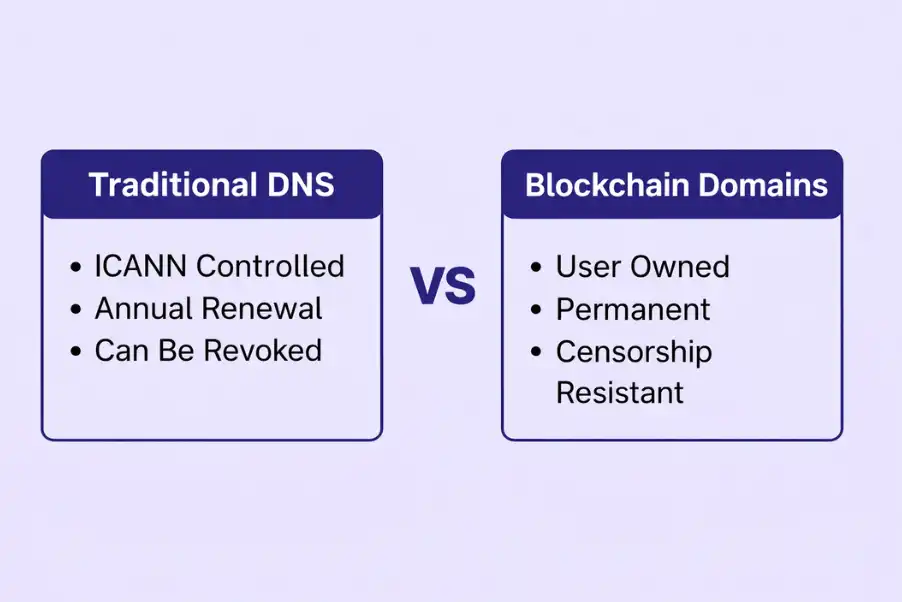
Blockchain domains are human-readable name records stored directly on a public blockchain rather than controlled by a traditional domain registrar. While a standard DNS domain like “company.com” is leased from a registrar and managed through ICANN-governed infrastructure, a blockchain domain such as “company.eth” or “company.crypto” is a non-fungible token (NFT) recorded permanently on the blockchain. This means once you register it, it belongs to you as long as you hold the private key. No annual renewal fees to a registrar. No seizure risk from a centralized authority. No single point of failure.
These domains serve dual purposes. First, they function as readable replacements for complex hexadecimal wallet addresses, making it simple to receive cryptocurrency payments without error-prone copy-paste operations. Second, and more significantly for the future of digital identity ownership, they serve as persistent, portable identifiers that can carry verified credentials, reputation, and access rights across any compatible dApp or platform. Providers such as Ethereum Name Service (ENS) and Unstoppable Domains have pioneered this space, with combined registrations exceeding four million domains as of 2024.
What Is Decentralized Identity?
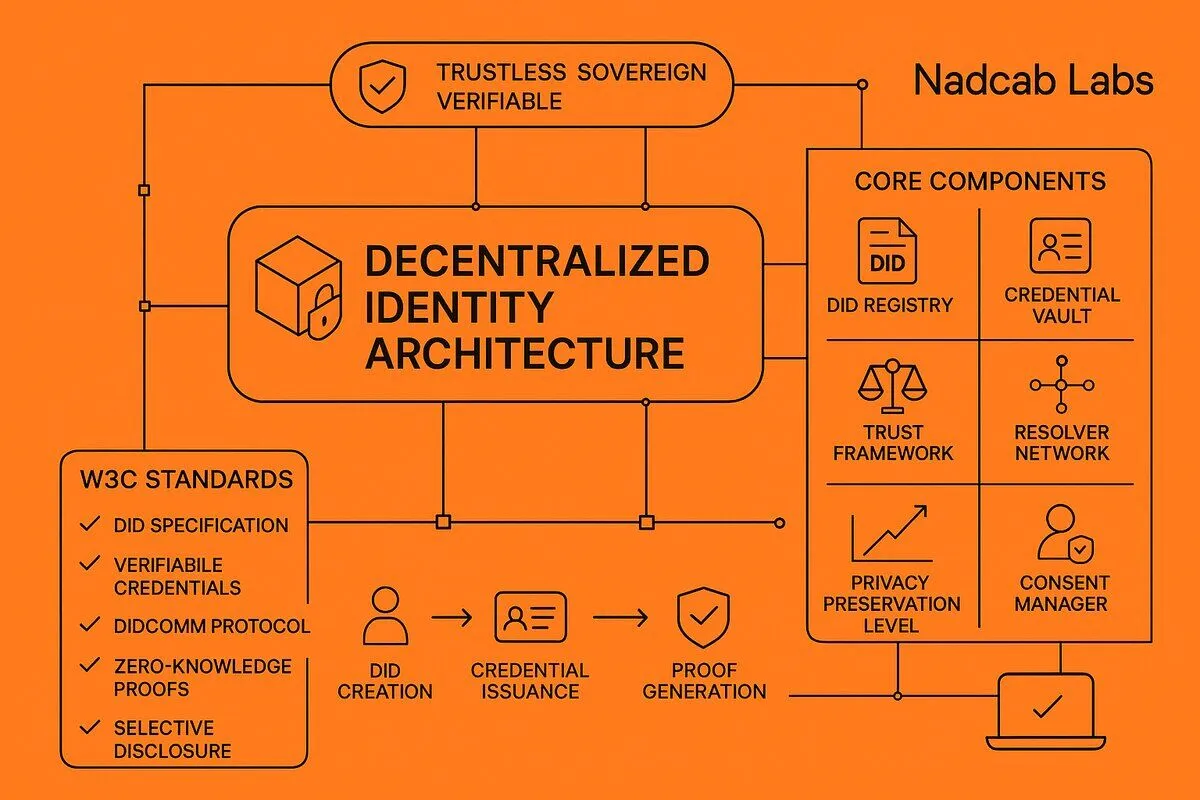
Decentralized identity, often abbreviated as DID, is a digital identity model where individuals control their own credentials without relying on a central issuing authority. The World Wide Web Consortium (W3C) has formalized a Decentralized Identifiers specification that defines a new type of globally unique identifier resolvable without a central registry. In practice, decentralized identity means a person can possess verifiable digital credentials such as proof of age, professional qualifications, or financial standing and present them selectively without exposing unnecessary personal data. The credentials are cryptographically signed, tamper-proof, and user-controlled.
In the context of blockchain identity management, decentralized identity goes beyond theoretical privacy models. It enables practical applications: logging into platforms without a password, proving citizenship to access services, or verifying employment history for a DAO governance vote, all without surrendering raw personal data to any single corporate database. For users in the UK, UAE, and Canada, where data protection regulations are increasingly stringent, decentralized identity offers a compliance-compatible path to digital trust that legacy systems struggle to match.
Why Identity Matters in Web3?
Web3 is fundamentally a trust layer built on cryptography rather than institutional authority. In this environment, identity is not just a convenience feature; it is the bedrock of every interaction. Whether you are voting in a DAO, claiming royalties as an NFT creator, accessing DeFi lending based on credit history, or asserting ownership of a virtual land parcel in the metaverse, your identity must be verifiable, portable, and immune to tampering. Without a robust decentralized identity layer, Web3 risks recreating the same centralized bottlenecks and single points of failure that define Web2.
Blockchain domain names address this need by providing a stable, user-owned anchor for digital identity. They bridge the gap between the cryptographic complexity of public key infrastructure and the usability expectations of mainstream users. For businesses building on Web3, integrating blockchain-based identity is not optional; it is the architectural foundation that determines whether their platform can earn and maintain user trust in a permission-less, global ecosystem.
Understanding How Blockchain Domains Work
To appreciate the identity implications of blockchain domains, it is essential to understand the technical mechanics that make them fundamentally different from legacy DNS infrastructure. At their core, blockchain domains operate through smart contracts that record ownership, resolve names to addresses, and enforce transfer rules without any intermediary authority. The ownership record is public, auditable, and immutable, creating a trustless verification system that works across borders and jurisdictions.
Human-Readable Addresses Explained
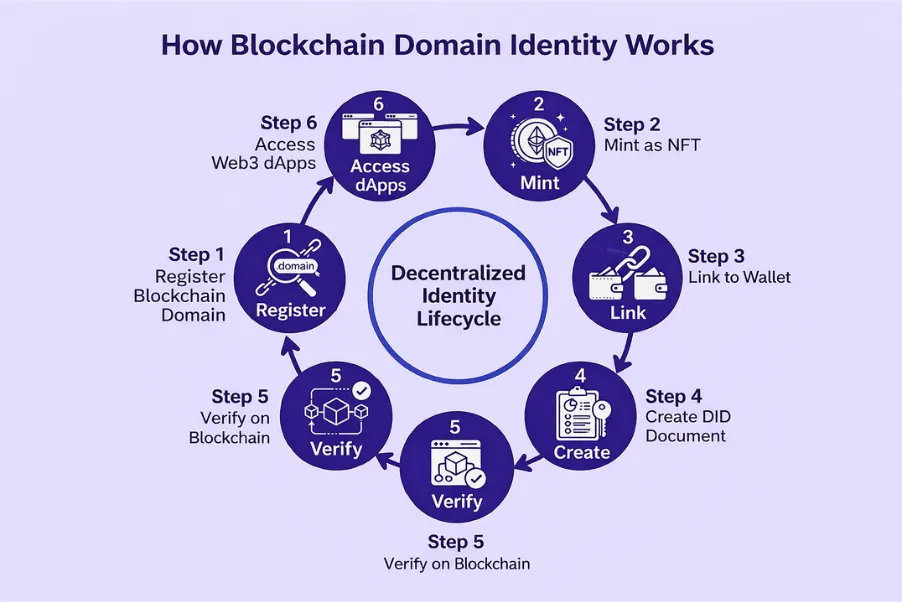
A standard Ethereum wallet address looks like this: 0x4bE6f2bE1e7f3e5c2A6D9F1a3c4D2E7B8F9A0C1. Memorizing or accurately sharing such an address is error-prone and represents a significant usability barrier for crypto adoption. Blockchain domain names solve this elegantly. A user registers a name like “alice.eth” and maps it to their wallet address. Anyone wanting to send funds to Alice simply types “alice.eth” into a compatible wallet, and the smart contract resolver translates it to the correct address automatically.
This human-readable address capability extends beyond payments. The same domain can resolve to decentralized storage content, point to a decentralized website hosted on IPFS, or store metadata about the user’s identity attributes. In markets like the UAE, where government-led blockchain initiatives are actively integrating such technologies into public services, human-readable blockchain addresses are emerging as critical infrastructure for citizen-facing digital services and blockchain identity management at national scale.
Blockchain-Based Ownership and Control
Ownership of a blockchain domain is governed entirely by cryptographic private keys. Unlike a traditional domain where the registrar can theoretically suspend or transfer your domain under legal pressure, a blockchain domain cannot be taken from you without your private key. This is a profound shift in the definition of digital ownership. The domain is represented as an NFT in your wallet, and its transfer, sale, or modification requires your explicit cryptographic authorization.
This ownership model directly enables decentralized identity. When your identity is anchored to a blockchain domain you genuinely own, your digital self cannot be deleted, suspended, or hijacked by a platform decision. For professionals in the USA and Canada who have experienced account bans or identity lockouts on major platforms, this immutable ownership model represents a fundamental upgrade to the guarantees that underpin digital identity ownership.
Integration with Wallets and dApps
Blockchain domains achieve their identity potential through seamless integration with the broader Web3 ecosystem. Major wallets including MetaMask, Trust Wallet, Rainbow, and Coinbase Wallet support ENS and Unstoppable Domains resolution natively, meaning users can send assets and interact with protocols using readable names without any additional setup. On the dApp side, platforms can query a user’s blockchain domain to retrieve not just their wallet address but also associated metadata: a profile picture, a verified social handle, governance voting power, or linked credentials.
This integration layer is what transforms a simple naming system into a full-featured Web3 identity infrastructure. The domain becomes a universal profile that travels with the user across every compatible application, creating a persistent, self-managed digital identity that no single platform controls. As the ecosystem matures, this interoperability is becoming a standard expectation for any credible Web3 platform targeting users in sophisticated markets like the UK and USA.
The Role of Blockchain Domains in Decentralized Identity
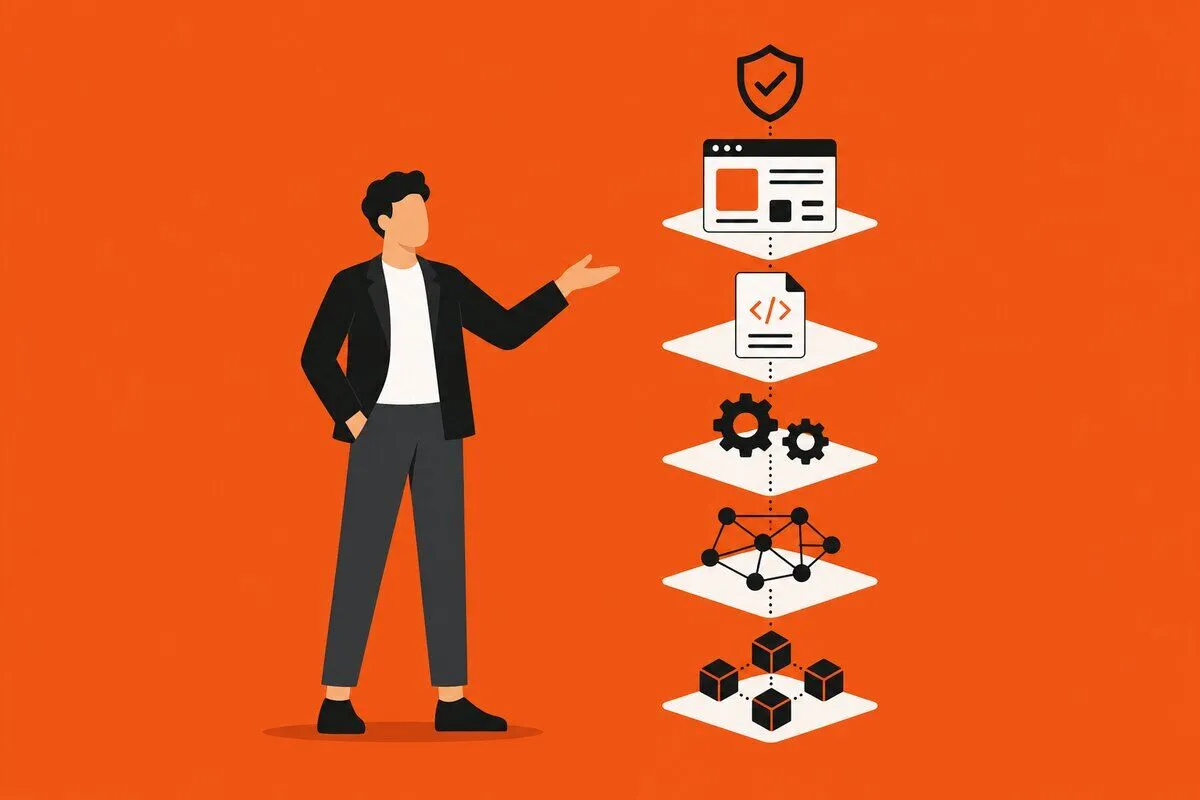
Blockchain domains are not merely a naming convenience. They represent the foundational infrastructure layer upon which the entire architecture of decentralized identity is being constructed. Over the past eight years, we have observed how each layer of the Web3 identity stack depends on reliable, user-owned identifiers, and blockchain domains fulfill that requirement with cryptographic certainty that no legacy system can replicate.
Replacing Traditional Login Systems
The “Sign in with Google” or “Sign in with Facebook” buttons that dominate the modern web are convenient but carry enormous hidden costs. They create dependency on technology corporations, expose browsing habits to advertising ecosystems, and create identity fragility whenever a platform changes its API policies or suspends an account. Blockchain-based authentication using domains like “user.eth” replaces this model with cryptographic proof of identity that no third party can revoke.
When a user signs into a Web3 platform with their blockchain domain, they are essentially saying: “I am the verified holder of this cryptographic key, and my domain is my identity claim.” No username, no password, no OAuth handshake with a corporate server. This model, already implemented by platforms like Mirror.xyz, Snapshot, and OpenSea, is expanding rapidly as more applications recognize that decentralized identity is both a security upgrade and a competitive differentiation in markets where user privacy concerns are at an all-time high.
Enabling Self-Sovereign Identity
Self-sovereign identity (SSI) is the gold standard of digital identity in Web3, and blockchain domains are its primary enabler. SSI means the individual, not an institution, is the root of trust for their own identity. Combined with verifiable credentials (VCs) issued by trusted institutions and stored in the user’s wallet, a blockchain domain becomes a universal, portable identity container. A professional in London could carry a verifiable credential from their university, linked to their blockchain domain, and present it to a DAO in Dubai without any intermediary verification service.
The standards enabling this, particularly the W3C DID specification and Verifiable Credentials Data Model, are specifically designed to work with blockchain-anchored identifiers. Blockchain domain names, because they are persistent and owner-controlled, serve as ideal DID documents. This convergence of standards and infrastructure is creating a genuine, working ecosystem for self-sovereign identity that is already processing real transactions in financial services, healthcare credentialing, and professional certification across North America, Europe, and the Gulf region.
Simplifying Web3 User Experience
One of the most persistent criticisms of blockchain technology is its user experience complexity. Long addresses, confusing key management, and fragmented platform logins create friction that prevents mainstream adoption of digital identity in Web3. Blockchain domains directly address this by providing a single, memorable identifier that serves as a user’s universal Web3 handle. Instead of managing different addresses for Ethereum, Polygon, Solana, and other networks, a user with an Unstoppable Domain can point their single readable name to all their addresses simultaneously.
This simplification is not cosmetic. It fundamentally changes the accessibility calculus for non-technical users in markets like Canada and the UAE who are eager to participate in Web3 but deterred by complexity. When signing into a dApp becomes as simple as typing your name and approving a wallet signature, the barrier to decentralized identity adoption collapses. This UX improvement is why platforms that integrate blockchain domain resolution consistently report higher user retention and lower onboarding drop-off rates.
Key Benefits of Blockchain Domains for Identity
A comprehensive view of why blockchain-based identity is outperforming legacy systems across every critical dimension.
Enhanced Security and Privacy
- Cryptographic ownership eliminates password vulnerabilities
- No centralized database to breach or exploit
- Selective disclosure of identity attributes
- Immutable audit trail of credential issuance
- Resistant to DNS hijacking and spoofing attacks
User-Controlled Identity
- Full ownership through private key cryptography
- No platform can delete or suspend your identity
- Portable across all compatible Web3 applications
- User decides what data to share and with whom
- Transfer or sell identity assets freely on open markets
Interoperability Across Platforms
- One domain resolves across multiple blockchains
- Compatible with wallets, dApps, and DeFi protocols
- Standards-based integration with W3C DID specs
- Cross-chain credential verification without bridges
- Growing support from browsers and mobile apps
Enhanced Security and Privacy
Blockchain domains improve security by removing central databases that hackers often target. Instead of storing data on servers, identity is linked to private cryptographic keys controlled by the user. This reduces risks like data breaches and password leaks. It also supports privacy by allowing users to share only necessary information, keeping their full identity safe and protected.
User-Controlled Identity
With blockchain domains, users fully own and control their digital identity. Unlike traditional platforms where accounts can be restricted or deleted, blockchain identity stays with the user. This means your data, reputation, and credentials remain safe even if a platform shuts down. It gives users true ownership and independence over their online presence and identity.
Interoperability Across Platforms
Blockchain domains work across multiple platforms, making identity management simple and unified. A single domain can connect wallets, apps, and online profiles in one place. Unlike traditional systems that depend on central providers, blockchain ensures open access and compatibility. This allows users to use the same identity across different Web3 applications without needing multiple logins or accounts.
Use Cases of Blockchain Domains in Real World
Theoretical benefits become compelling when translated into concrete applications. Across industries and geographies, blockchain domains are already powering real-world decentralized identity use cases that demonstrate the practical viability of this technology at scale.
Web3 Authentication and Login
The most immediate real-world application of blockchain domains in decentralized identity is Web3 authentication. Platforms like Snapshot (used by hundreds of DAOs for governance voting), Mirror.xyz (a decentralized publishing platform), and Lens Protocol (a decentralized social network) all use blockchain domain-based login as their primary authentication mechanism. Users connect their wallet, sign a message to prove domain ownership, and are authenticated instantly without creating a username or password.
This authentication model is spreading beyond pure Web3 platforms. Traditional enterprise software companies in the USA and UK are piloting blockchain domain login as a complement to existing single sign-on systems, particularly for scenarios involving contractor access, cross-organizational collaboration, and partner network authentication where traditional directory systems create friction and security exposure. The ability to authenticate a party cryptographically, without sharing personal data, is a transformative capability for regulated industries.
Digital Payments and Wallet Addresses
In the UAE and Canada, where cross-border crypto payments are increasingly common for freelancers, expatriate workers, and international businesses, blockchain domains are dramatically improving the payment experience. Receiving a payment to “business.eth” instead of a 42-character hexadecimal string reduces errors, increases confidence, and enables payment tracking through a consistent identifier. This is particularly valuable for businesses managing payroll, vendor payments, or customer refunds in cryptocurrency.
Real-world examples abound. Crypto-native agencies and consultancies in Dubai are listing their .eth or .crypto addresses on invoices and business cards, creating a professional brand identity that extends into Web3. Freelancers in Canada and the UK are using blockchain domain payment addresses to receive international client payments without banking intermediaries, reducing fees and settlement times from days to minutes. Digital identity ownership in the payments context translates directly to business efficiency and competitive advantage.
Identity in DAOs and Metaverse
Decentralized Autonomous Organizations represent one of the most demanding environments for digital identity systems. DAO governance requires verifying that a voter holds the right tokens, has participated in previous proposals, and has not already voted, all without a central administrator managing the process. Blockchain domains serve as the persistent identifier that enables all of these checks through on-chain queries. Projects like Gitcoin Passport link blockchain domains to a suite of identity verification checks, creating a Sybil-resistance score that protects governance integrity.
In metaverse environments like Decentraland and The Sandbox, blockchain domains function as usernames and property deed references simultaneously. A user’s “avatar.eth” name can represent their character, their virtual land parcel, their badge collection, and their governance rights within the virtual world, all anchored to a single, user-owned identifier. As the metaverse grows from a niche concept to a mainstream engagement platform, blockchain-based identity becomes the foundation for economic, social, and governance activity in these emerging digital spaces.
Challenges and Limitations
No technology achieves transformative impact without confronting significant obstacles. Blockchain domains and decentralized identity systems face genuine challenges that must be acknowledged honestly by practitioners and prospects alike. Understanding these barriers is essential for any organization in the USA, UK, UAE, or Canada evaluating blockchain identity management for real-world deployment.
Adoption Barriers
The single largest obstacle to broad decentralized identity adoption is user familiarity and tooling maturity. Mainstream internet users are deeply accustomed to password-based login and centralized account management. Asking them to manage a crypto wallet, understand private key security, and navigate blockchain transaction fees is a significant behavioral ask. Even in technologically sophisticated markets like the USA and UK, surveys consistently show that fewer than 15% of internet users have interacted with any form of Web3 application. Without dramatically improved onboarding experiences and educational infrastructure, decentralized identity risks remaining a specialist tool rather than a mainstream identity layer.
Browser compatibility represents another adoption barrier. While plugins like MetaMask provide blockchain domain resolution for Chrome and Firefox users, native browser support is still limited. Users on mobile devices, corporate networks with restrictive security policies, or older hardware may find blockchain-based identity inaccessible without additional technical configuration. Resolving these friction points requires coordinated effort from browser vendors, wallet providers, and platform builders.
| Challenge | Impact Level | Affected Markets | Mitigation Path |
|---|---|---|---|
| Private key management | High | All | Hardware wallets, social recovery |
| Browser compatibility | Medium | USA, UK, Canada | Browser extensions, native integration |
| Regulatory uncertainty | High | USA, UK | Policy engagement, compliance frameworks |
| Gas fees and cost | Medium | All | Layer 2 solutions, alternative chains |
| Smart contract risk | Medium | All | Audits, formal verification |
| Cross-chain fragmentation | Low-Medium | UAE, Canada | Universal resolver standards |
Regulatory Concerns
The regulatory landscape for blockchain domains and decentralized identity is fragmented and rapidly evolving. In the USA, the SEC, CFTC, and state regulators have taken varied positions on crypto assets, creating legal uncertainty for businesses building identity infrastructure on blockchain. In the UK, the FCA is developing a comprehensive cryptoasset regulation framework, but clarity on how decentralized identity systems fit within existing data protection and financial regulation remains limited. The UAE stands out as the most proactive jurisdiction, with the VARA framework and Abu Dhabi Global Market regulations providing clearer guidance for blockchain businesses.
Anti-money laundering (AML) and know-your-customer (KYC) requirements present a specific tension for decentralized identity systems. Regulators require financial institutions to verify customer identities through approved processes, while decentralized identity is designed to minimize data sharing. Emerging solutions such as zero-knowledge proofs that allow users to prove KYC compliance without revealing underlying data offer a promising path forward, but regulatory acceptance of these cryptographic proofs remains in early stages across all major markets.
Technical Limitations
Beyond usability and regulatory challenges, blockchain domains face inherent technical limitations that must be addressed for enterprise-scale decentralized identity implementation. On-chain storage is expensive and limited; storing rich identity metadata directly on the blockchain is not practical for high-volume use cases. Most implementations use off-chain storage like IPFS, Arweave, or encrypted databases with only the hash or reference stored on-chain, creating dependencies on off-chain infrastructure availability. Blockchain itself faces latency and throughput constraints that limit real-time identity verification at consumer internet scale.
Private key recovery represents perhaps the most critical technical limitation. If a user loses their private key, they permanently lose access to their blockchain domain and all associated identity. Unlike traditional accounts where a password reset email or identity verification call can restore access, blockchain key loss is irreversible without prior recovery mechanisms. Solutions like social recovery wallets, hardware security modules, and multi-party computation key management are maturing but not yet standardized or widely accessible.
Compliance and Governance Checklist
Before deploying blockchain domain-based identity systems in regulated environments, organizations must address these critical governance requirements.
Blockchain Identity Governance Standards
Standard 1: Conduct a formal data protection impact assessment before deploying any blockchain identity system handling personal data in GDPR or similar jurisdictions.
Standard 2: Ensure all smart contracts governing domain ownership and credential issuance have been audited by a recognized third-party security firm before deployment.
Standard 3: Establish a formal key management policy including hardware wallet requirements, backup procedures, and organizational recovery processes for enterprise deployments.
Standard 4: Align credential schemas with W3C Verifiable Credentials Data Model to ensure interoperability with global decentralized identity ecosystems and compliance readiness.
Standard 5: Implement zero-knowledge proof mechanisms where identity verification is required to minimize data exposure while satisfying AML and KYC regulatory obligations.
Standard 6: Monitor regulatory guidance from the FCA (UK), SEC (USA), VARA (UAE), and FINTRAC (Canada) on an ongoing basis and update compliance frameworks accordingly.
Standard 7: Establish a credential revocation mechanism that allows issuers to invalidate compromised or expired credentials without modifying the user’s core blockchain domain identity.
Standard 8: Document and publish a transparency report on identity system governance, including domain registration policies, dispute resolution procedures, and user rights mechanisms.
Future of Blockchain Domains in Identity Systems
The trajectory of blockchain domains in decentralized identity points unmistakably toward mainstream integration. The foundational infrastructure is in place, the standards are converging, and the regulatory conversations are maturing. What comes next is a period of rapid acceleration as Web3 identity moves from early adopter curiosity to institutional infrastructure in market.
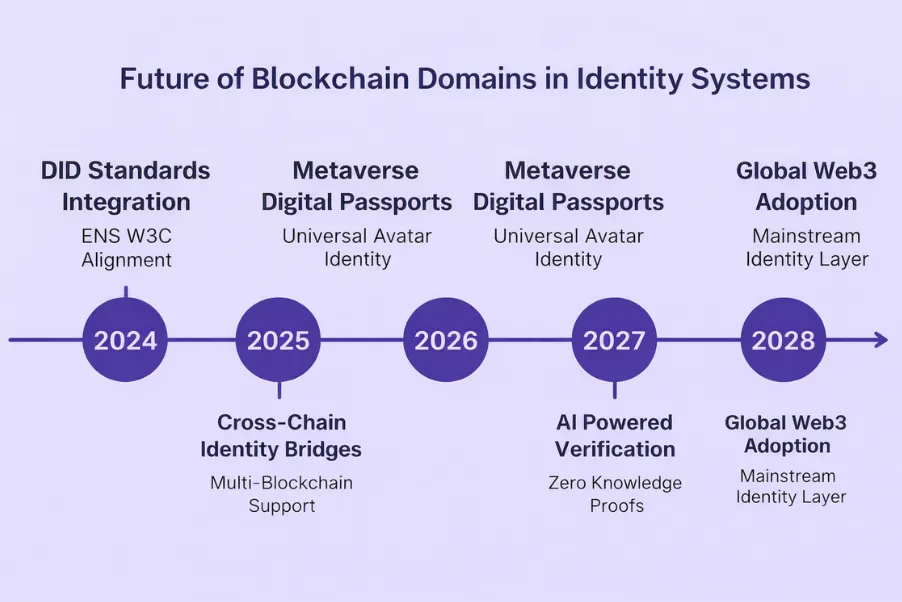
Integration with Decentralized Identity Standards
The alignment between blockchain domain infrastructure and formal W3C DID standards is accelerating rapidly. The W3C DID Core specification defines how a decentralized identifier should resolve to a DID document containing public keys, authentication methods, and service endpoints. ENS and similar blockchain naming systems are being mapped to this specification, enabling seamless interoperability between blockchain domains and the broader decentralized identity ecosystem including verifiable credential issuers, verifiers, and wallets.
Organizations building identity infrastructure are increasingly looking to DID-compliant blockchain domains as their primary identifier layer. This convergence eliminates the historical fragmentation between blockchain domain systems and enterprise identity management, creating a single, standards-compliant identity primitive that can serve both consumer-facing Web3 applications and regulated enterprise environments simultaneously.
Role in Web3 Growth
Decentralized identity is not a standalone feature; it is the enabling layer for virtually every other Web3 capability. DeFi credit scoring, DAO governance, NFT royalty distribution, cross-platform reputation systems, and metaverse commerce all require reliable, portable, user-owned identity. As these Web3 sectors grow, the demand for blockchain domain-based identity infrastructure will grow proportionally. Analysts project the global decentralized identity market to exceed $50 billion by 2030, driven primarily by financial services, healthcare, and government adoption across major economies.
For businesses in the USA, UK, UAE, and Canada that are building Web3 platforms or integrating blockchain capabilities into existing products, the strategic importance of adopting blockchain-based identity infrastructure now cannot be overstated. Early movers who establish robust decentralized identity systems will gain compounding advantages in user trust, regulatory compliance readiness, and platform interoperability as the broader Web3 ecosystem matures around shared identity standards.
Emerging Trends and Innovations
Several emerging innovations are set to dramatically expand the capabilities and adoption of blockchain domains in decentralized identity. Zero-knowledge proofs (ZKPs) are enabling identity verification without data disclosure, allowing users to prove attributes like age, citizenship, or financial standing without revealing the underlying data. Projects like Polygon ID and zkSync are building ZKP-native identity layers that integrate directly with blockchain domains. This will unlock compliant decentralized identity for financial services and healthcare in jurisdictions with strict data protection requirements.
Account abstraction, a technical upgrade to Ethereum’s account model, is poised to transform the user experience of blockchain identity by eliminating the private key management burden. With account abstraction, users can set social recovery mechanisms, use biometric authentication, and delegate account access without compromising the decentralized ownership model. Combined with advances in cross-chain messaging protocols, the next generation of blockchain domain-based identity systems will be more secure, more accessible, and more powerful than anything available today, making digital identity in Web3 a genuine alternative to the centralized systems that currently dominate the internet.
Blockchain Domain Identity Model Selection Criteria
Choosing the right blockchain domain and identity model requires evaluating three critical dimensions that determine long-term viability and compliance fitness.
Three-Step Selection Framework
Step 1: Evaluate Technical Fit
- Assess target blockchain network maturity and security track record
- Confirm wallet ecosystem support for domain resolution
- Evaluate gas cost and Layer 2 availability for cost management
- Verify smart contract audit history and upgrade mechanisms
Step 2: Assess Compliance Readiness
- Map provider’s data handling against GDPR, DIFC, and CCPA requirements
- Confirm W3C DID specification alignment for credential compatibility
- Evaluate KYC/AML integration capabilities with zero-knowledge options
- Review dispute resolution and domain recovery policy documentation
Step 3: Measure Ecosystem Adoption
- Count compatible dApps, wallets, and browsers supporting the domain system
- Assess active user base and registration growth trajectory
- Evaluate cross-chain interoperability roadmap and current multi-chain support
- Review community governance and long-term protocol sustainability plans
Blockchain Domain Providers Comparison
For businesses evaluating the best blockchain domain system for their decentralized identity needs, the following comparison offers a clear and structured overview of leading providers based on key evaluation criteria.
| Provider | Domain Extensions | Blockchain | Wallet Support | W3C DID Compatible | Best For |
|---|---|---|---|---|---|
| ENS | .eth | Ethereum | MetaMask, Rainbow, Coinbase | Yes (did:ens) | DeFi, DAOs, Web3 identity |
| Unstoppable Domains | .crypto, .nft, .wallet | Polygon, Ethereum | Trust Wallet, Brave, 200+ | Yes | Payments, mainstream users |
| Handshake | Custom TLDs | HNS (own chain) | Limited | Partial | Decentralized DNS |
| Space ID | .bnb, .arb | BNB Chain, Arbitrum | MetaMask, Binance | In progress | Multi-chain identity |
| Solana Name Service | .sol | Solana | Phantom, Solflare | Yes (did:sol) | High-speed Web3 apps |
Ready to Build Your Decentralized Identity Infrastructure?
Partner with our team to architect blockchain domain-based identity systems that are secure, compliant, and built for the Web3 era.
Frequently Asked Questions
Q1.What are blockchain domains and how do they relate to decentralized identity?
Blockchain domains are human-readable names registered on a blockchain that replace complex wallet addresses. Unlike traditional domains controlled by registrars, blockchain domains are owned directly by users through cryptographic keys. In the context of decentralized identity, they serve as a portable, self-sovereign identifier that users carry across Web3 platforms. They enable individuals in markets like the USA, UK, UAE, and Canada to control their digital identity without relying on centralized authorities or corporations to authenticate them online.
Q2.How does decentralized identity differ from traditional digital identity?
Traditional digital identity relies on centralized systems where companies like Google or Facebook store and control your personal data. Decentralized identity, powered by blockchain technology, shifts control back to individuals. Users hold cryptographic credentials in digital wallets and share only what is necessary for each transaction or interaction. This model eliminates single points of failure, reduces data breach risks, and empowers users with true ownership of their credentials, a significant advancement for privacy-conscious users across global markets.
Q3.Which blockchain domain providers are most popular in 2025?
The most prominent blockchain domain providers include Unstoppable Domains, Ethereum Name Service (ENS), and Handshake. ENS allows users to register .eth domains on the Ethereum blockchain, while Unstoppable Domains supports extensions like .crypto, .nft, and .wallet. Handshake operates at the DNS root level, offering censorship-resistant alternatives. Adoption is growing rapidly across the USA, UK, UAE, and Canada as awareness of Web3 identity solutions increases among both individual users and enterprise clients seeking blockchain identity management.
Q4.Are blockchain domains legally recognized in countries like the USA, UK, or UAE?
The legal landscape for blockchain domains varies by jurisdiction. In the USA, there is no specific federal law governing blockchain domain ownership, though property rights principles may apply. The UK is actively exploring digital identity frameworks that could include blockchain-based systems. The UAE, through its blockchain strategy and DIFC Digital Economy frameworks, is among the most progressive regulators in recognizing digital assets. Users should consult legal counsel, as the regulatory status of crypto domains continues to evolve across all target markets.
Q5.How secure are blockchain domains compared to traditional DNS?
Blockchain domains are significantly more resistant to common DNS attacks such as DNS hijacking, cache poisoning, and man-in-the-middle attacks. Because ownership records are stored immutably on a distributed ledger, no single entity can alter or seize a domain without the private key. However, users must safeguard their private keys, as losing them means losing domain access permanently. Smart contract vulnerabilities remain a potential risk, so selecting providers with audited smart contracts is essential for robust blockchain identity management.
Q6.Can blockchain domains be used for email and website hosting?
Yes. Blockchain domains can be configured to point to decentralized storage solutions like IPFS (InterPlanetary File System) or Arweave, enabling fully censorship-resistant websites. Some providers also support decentralized email protocols. While traditional browsers require browser extensions or special resolvers to access blockchain domains, growing support from major browsers and resolvers is closing this usability gap. For businesses in the USA, UK, UAE, and Canada exploring Web3 identity infrastructure, this offers a compelling path to decentralized digital presence.
Explore Services
Related Services
Reviewed by

Aman Vaths
Founder of Nadcab Labs
Aman Vaths is the Founder & CTO of Nadcab Labs, a global digital engineering company delivering enterprise-grade solutions across AI, Web3, Blockchain, Big Data, Cloud, Cybersecurity, and Modern Application Development. With deep technical leadership and product innovation experience, Aman has positioned Nadcab Labs as one of the most advanced engineering companies driving the next era of intelligent, secure, and scalable software systems. Under his leadership, Nadcab Labs has built 2,000+ global projects across sectors including fintech, banking, healthcare, real estate, logistics, gaming, manufacturing, and next-generation DePIN networks. Aman’s strength lies in architecting high-performance systems, end-to-end platform engineering, and designing enterprise solutions that operate at global scale.