Ai Overview
Web3 storage represents a paradigm shift from centralized cloud services to distributed networks where files are stored across multiple independent nodes rather than company-owned data centers. Traditional cloud providers can shut down services, change pricing models, or go out of business entirely. 5% annually based on historical trends, making the endowment sustainable for centuries.
Key Takeaways
- Web3 storage distributes files across decentralized networks, eliminating single points of failure and providing censorship resistance for dApps and NFT platforms.
- IPFS uses content addressing with unique CIDs to locate files by their cryptographic hash rather than server location, ensuring data integrity verification.
- Filecoin complements IPFS by adding economic incentives for storage providers, guaranteeing data persistence through proof mechanisms and storage deals.
- Arweave offers permanent storage with a one-time payment model, making it ideal for NFT metadata and content requiring guaranteed long-term availability.
- Enterprise adoption requires hybrid architectures combining Web3 storage with encryption, access controls, and compliance frameworks for regulatory requirements.
- IPFS alone cannot guarantee file permanence since data disappears when no nodes pin it, requiring Filecoin or pinning services for reliability.
- Storage costs vary significantly between solutions, with Arweave charging one-time fees while Filecoin and IPFS pinning use ongoing payment models.
- NFT projects should store metadata on permanent solutions like Arweave while using IPFS gateways for faster content delivery to end users.
- Web3.Storage and similar APIs simplify decentralized file storage integration, providing HTTP endpoints and SDKs for seamless uploads and retrieval.
- The future of Web3 storage involves multi-layered architectures combining hot storage for speed with cold storage for cost-effective long-term preservation.
The way applications store and retrieve data is undergoing a fundamental transformation. Traditional centralized storage creates single points of failure, censorship vulnerabilities, and data ownership concerns that conflict with Web3 principles. For organizations building decentralized applications, NFT marketplaces, and blockchain-based platforms across the USA, UK, UAE, and Canada, understanding Web3 platform solutions for storage has become essential. This comprehensive guide examines the three dominant Web3 storage technologies, IPFS, Filecoin, and Arweave, explaining how each works, when to use them, and how to architect robust decentralized file storage systems for production applications.
What is Web3 Storage?
Web3 storage represents a paradigm shift from centralized cloud services to distributed networks where files are stored across multiple independent nodes rather than company-owned data centers. In Web3 data storage systems, no single entity controls the infrastructure, and files are addressed by their content rather than their location. This architectural difference creates inherent advantages including censorship resistance, improved fault tolerance, and true data ownership for users. When you upload a file to a Web3 storage network, it gets distributed across the globe, making it virtually impossible for any government or corporation to block access or delete content unilaterally.
Why Traditional Cloud Storage Doesn’t Fit Web3?
Traditional cloud providers like Amazon S3, Google Cloud Storage, and Microsoft Azure operate on a fundamentally different model than Web3 applications require. These services store files on proprietary servers controlled by single corporations, creating several critical mismatches with decentralized application requirements. First, they introduce centralization risk where the provider can modify terms, increase prices, or terminate service without user consent. Second, they enable censorship where governments can compel providers to remove content. Third, they create data ownership ambiguity where the provider often claims rights over stored content. For dApps promising users true ownership of their digital assets, relying on centralized storage undermines the entire value proposition.
How Decentralized Storage Works in Simple Terms?
Decentralized file storage operates like a global network of computers each storing small pieces of files and cooperating to serve them when requested. When you upload a file, it gets split into chunks, encrypted, and distributed across many independent storage nodes. Each chunk receives a unique cryptographic identifier based on its contents. To retrieve a file, you request it using this identifier, and the network locates nodes holding the pieces, reassembles them, and delivers the complete file. No single node holds all your data, and many nodes can hold copies of the same chunks, creating redundancy. This approach eliminates single points of failure while enabling anyone to participate in the storage network.
On-Chain Storage vs Off-Chain Storage
| Aspect | On-Chain Storage | Off-Chain Storage (IPFS/Filecoin/Arweave) |
|---|---|---|
| Cost | Extremely expensive ($100,000+ per MB on Ethereum) | Very affordable ($0.001-15 per GB) |
| Data Size | Limited to small data (hashes, references) | Unlimited file sizes supported |
| Immutability | Fully immutable once committed | Immutable by content hash (Arweave permanent) |
| Speed | Slow (block confirmation required) | Fast retrieval via gateways |
| Use Case | Critical state data, token balances | Files, images, metadata, documents |
Why Web3 Apps Need Decentralized Storage?
Building truly decentralized applications requires every component of the stack to embrace decentralization principles. A dApp with decentralized smart contracts but centralized file storage creates a critical vulnerability that undermines the entire system’s integrity. When NFT images or dApp assets live on AWS, the platform can remove them, the company can go bankrupt, or governments can force takedowns. Web3 storage solutions eliminate these risks while providing additional benefits like content verification, global availability, and alignment with the trustless ethos that makes blockchain technology valuable.
Storage Challenges in dApps and NFT Platforms
Decentralized applications face unique storage challenges that traditional solutions cannot adequately address. NFT platforms must store artwork, metadata, and media files in ways that preserve the value proposition of digital ownership. If an NFT points to a centralized URL that goes offline, the token becomes worthless despite the blockchain record. Gaming dApps need to store large asset libraries accessible to players globally without creating geographic bottlenecks. DeFi protocols require reliable storage for governance proposals, audit reports, and protocol documentation. Social dApps must handle user-generated content at scale while preventing any single entity from controlling or censoring that content. Each use case demands storage that matches the decentralization level of the application itself.
Censorship Resistance and Data Ownership
Censorship resistance represents a core value proposition of Web3 storage that centralized alternatives simply cannot provide. In countries with restrictive internet policies, decentralized storage enables access to information that governments might otherwise block. For journalists, activists, and researchers, Web3 storage solutions offer protection against content removal by powerful interests. Additionally, the growing demand for services that help remove negative articles from Google reflects how important digital control, online reputation, and unrestricted access to information have become in today’s internet landscape.
Data Availability and Long-Term Persistence
Long-term data availability poses significant challenges for any storage system. Traditional cloud providers can shut down services, change pricing models, or go out of business entirely. Web3 storage approaches this problem differently through economic incentives and distributed architecture. Filecoin creates financial motivation for storage providers to maintain data over time. Arweave’s endowment model pre-funds storage costs for centuries. IPFS enables content to persist as long as any node in the global network continues hosting it. These mechanisms provide stronger guarantees for data persistence than relying on any single corporate entity’s continued operation and goodwill.
How IPFS Works?
The IPFS protocol forms the foundation of most Web3 storage architectures, providing the addressing and retrieval layer that other solutions build upon. Created by Protocol Labs, IPFS reimagines how content is located and served on the internet by replacing location-based URLs with content-based addressing. This fundamental shift enables a more resilient, efficient, and verifiable approach to file storage and distribution that aligns perfectly with decentralized application requirements.
What IPFS Is and Why It Matters?
IPFS stands for InterPlanetary File System, a peer-to-peer hypermedia protocol designed to make the web faster, safer, and more open. Unlike HTTP where you request files from specific servers, IPFS requests files by their content hash, meaning any node holding the content can serve it. This creates a more resilient network where popular content gets served from many locations simultaneously, reducing bandwidth costs and improving load times. The protocol matters for Web3 because it provides a decentralized alternative to centralized hosting without requiring blockchain transaction fees for every file operation.
How IPFS Handles Your Files
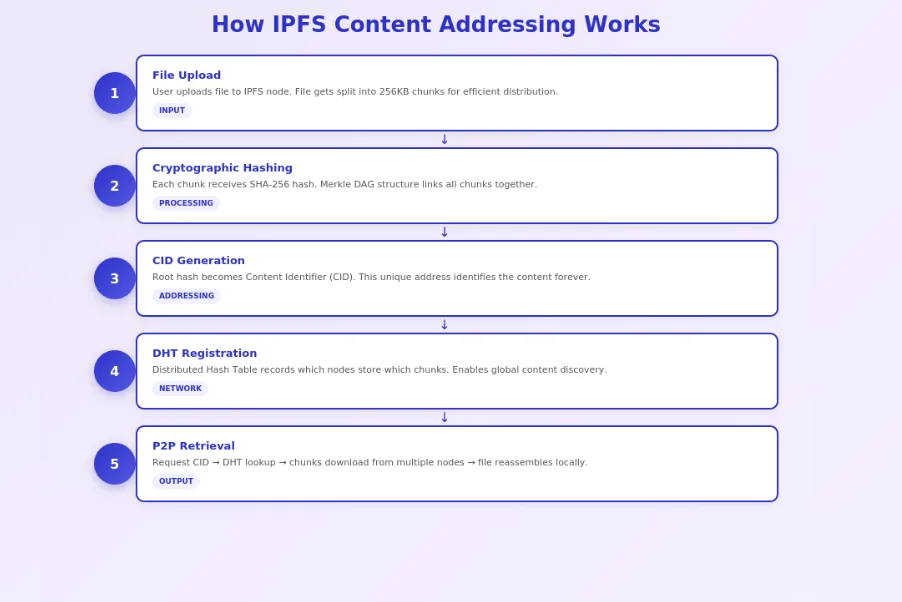
Step 1: Chunking
- File splits into 256KB chunks
- Each chunk hashed individually
- Merkle DAG structure created
Step 2: CID Generation
- Root hash becomes the CID
- Unique identifier for content
- Any change creates new CID
Step 3: Distribution
- Chunks spread across nodes
- DHT tracks chunk locations
- Redundancy through replication
Content Addressing and CIDs Explained
Content Identifiers (CIDs) represent the revolutionary addressing mechanism that makes IPFS work. When you add a file to IPFS, the system generates a cryptographic hash of the content, creating a unique fingerprint that serves as the file’s address. This CID looks something like “bafybeigdyrzt5sfp7udm7hu76uh7y26nf3efuylqabf3oclgtqy55fbzdi” and guarantees that the content you receive matches exactly what was originally stored. If even a single bit changes, the CID changes entirely. This content-based addressing eliminates broken links since the address is inherently tied to the content itself, not to any particular server location.
How IPFS Retrieves Data?
When you request content from IPFS using a CID, the network performs a distributed lookup to find nodes storing that content. The Distributed Hash Table (DHT) maintains records of which nodes hold which content, enabling efficient discovery across the global network. Once located, chunks transfer directly from holding nodes to your device, often from multiple sources simultaneously. This parallel download mechanism improves speed significantly for popular content. Caching further optimizes performance since any node that retrieves content can subsequently serve it to others, creating organic content distribution networks without centralized infrastructure costs.
What IPFS Cannot Do Alone?
IPFS excels at content addressing and peer-to-peer delivery but does not inherently guarantee data persistence. Content only remains available as long as at least one node “pins” it, actively choosing to store and serve that content. Without pinning, files eventually get garbage collected as nodes make room for new content. This creates a critical gap for applications requiring long-term storage guarantees. Running your own IPFS node and pinning content requires ongoing infrastructure maintenance. Pinning services like Pinata or Infura offer managed pinning but reintroduce centralization. This permanence problem led to the creation of Filecoin and explains why many projects combine multiple storage solutions.
What is Filecoin and How It Complements IPFS?
The Filecoin storage network addresses IPFS’s permanence limitations by creating economic incentives for reliable, long-term data storage. Also built by Protocol Labs, Filecoin adds a blockchain layer that rewards storage providers for maintaining data over time while penalizing those who fail to meet their commitments. This incentive structure transforms storage from a voluntary activity into a sustainable business model, ensuring content remains available even when no volunteers choose to host it.
Filecoin Storage Network Overview
Filecoin operates as a decentralized storage marketplace where clients pay storage providers to store their data. The network uses its native FIL token for all transactions, creating a global economy around storage provision. Storage providers compete for deals by offering competitive pricing and reliable service, while clients benefit from market-driven pricing and provider choice. The Filecoin blockchain records all storage deals, proofs, and payments, creating a transparent and verifiable system. As of 2024, the network stores over 15 exabytes of data across thousands of storage providers worldwide, making it one of the largest decentralized storage networks in operation.
Storage Deals, Miners, and Proof Mechanisms
Filecoin uses sophisticated cryptographic proofs to verify that storage providers actually maintain client data. Proof of Replication (PoRep) confirms that a provider has created a unique copy of the data, preventing them from pretending to store multiple copies when they only store one. Proof of Spacetime (PoSt) requires providers to periodically prove they continue storing the data throughout the deal duration. Providers who fail proofs face slashing penalties, losing staked collateral. This proof system creates strong economic incentives for honest behavior, making Filecoin storage more reliable than systems based purely on reputation.
Why Filecoin Is Used for Persistent Storage?
Filecoin solves the persistence problem through economic design rather than technical mechanisms alone. Storage providers commit to storing data for specified periods, typically ranging from six months to several years. They stake collateral that gets slashed if they fail to maintain the data. Clients can renew deals or negotiate new ones as expiration approaches. This creates a self-sustaining ecosystem where storage provision is profitable, ensuring long-term network health. For enterprises in the USA, UK, and Canada requiring compliance-grade storage, Filecoin’s verifiable proofs provide audit trails that centralized solutions cannot match.
IPFS + Filecoin Workflow
The typical IPFS and Filecoin workflow combines both protocols for optimal results. First, content uploads to IPFS and receives a CID for addressing and retrieval. Second, the CID gets registered with Filecoin storage providers through a storage deal. Third, providers seal the data using PoRep and begin submitting PoSt proofs. Fourth, applications retrieve content via IPFS using the CID, while Filecoin ensures the underlying data remains available. This architecture lets applications use fast IPFS retrieval while benefiting from Filecoin’s persistence guarantees. Services like Web3.Storage abstract this complexity, handling both layers automatically.
IPFS + Filecoin Integration Workflow
1. Upload to IPFS
Content gets chunked, hashed, and distributed across IPFS nodes. A unique CID is generated for addressing.
2. Create Filecoin Deal
Storage deal negotiated with miners specifying duration, price, and redundancy requirements.
3. Data Sealing
Provider generates Proof of Replication, cryptographically proving they stored a unique copy.
4. Retrieve via IPFS
Applications fetch content using the CID through IPFS gateways while Filecoin ensures availability.
What is Arweave and Why It’s Different?
Arweave permanent storage takes a fundamentally different approach to the persistence problem, offering a “pay once, store forever” model that eliminates ongoing storage costs entirely. Rather than time-based deals or voluntary pinning, Arweave uses an economic endowment model designed to fund storage for approximately 200 years based on projected storage cost declines. This makes Arweave uniquely suited for content requiring guaranteed permanent availability, including NFT metadata, historical records, and regulatory archives.
Arweave’s Permanent Storage Model
Arweave’s permanence derives from its unique economic design called the Storage Endowment. When you pay to store data on Arweave, a portion of that payment goes to miners immediately, while the remainder enters an endowment pool. This pool earns interest as AR tokens appreciate and gets paid out gradually to miners who continue storing the data over time. The mathematics assume storage costs decline by 0.5% annually based on historical trends, making the endowment sustainable for centuries. Unlike subscription models, once data is on Arweave, it requires no further action or payment to remain available permanently.
“Pay Once, Store Forever” Explained
The pay-once model calculates upfront costs to cover the estimated total cost of storage over an extremely long period. Current Arweave storage costs approximately $5-15 per gigabyte as a one-time fee, varying with AR token prices and network conditions. This fee accounts for current storage costs plus projected future costs adjusted for anticipated technology improvements. While no system can truly guarantee “forever,” Arweave’s model provides the strongest permanence guarantee available in decentralized storage. For organizations in the UAE and UK archiving legal documents or historical records, this model eliminates budget uncertainty and ongoing vendor relationships.
Permaweb and Permanent Content Hosting
The Permaweb represents Arweave’s vision of a permanent internet layer where content, applications, and data persist indefinitely. Unlike the regular web where content disappears when servers go offline, the permaweb ensures everything stored there remains accessible through any Arweave gateway. Entire web applications can be deployed to the permaweb, running forever without hosting costs or maintenance. This capability has attracted significant attention from the NFT community, where ensuring artwork and metadata survive as long as the blockchain itself becomes a critical requirement for maintaining digital asset value.
Best Use Cases for Arweave in Web3
Arweave excels in scenarios requiring guaranteed permanent availability without ongoing management. NFT metadata storage represents the primary use case, ensuring digital art persists as long as the NFT token exists on-chain. Legal and regulatory archives benefit from immutable, permanently accessible records. Academic and scientific data storage preserves research outputs for future generations. Censorship-resistant publishing enables journalists and activists to publish content that cannot be removed. Historical archiving protects cultural heritage and important documents. The common thread is content that must survive indefinitely without requiring anyone to maintain it actively.
IPFS vs Filecoin vs Arweave
Choosing between Web3 storage solutions requires understanding their fundamental differences in cost structure, persistence guarantees, and optimal use cases. The following comparison helps architects and project managers select the right solution for specific requirements.
Cost, Speed, and Storage Permanence
| Feature | IPFS | Filecoin | Arweave |
|---|---|---|---|
| Cost Model | Free (requires pinning) | Pay per GB per month | One-time payment |
| Typical Cost | $0.01-0.15/GB/month (pinning) | $0.0001-0.01/GB/month | $5-15/GB (one time) |
| Retrieval Speed | Fast (gateway dependent) | Slow (unsealing required) | Fast (gateway dependent) |
| Permanence | Not guaranteed | Deal duration (renewable) | Permanent (200+ years) |
| Decentralization | High (P2P network) | High (1000s of miners) | Medium (fewer nodes) |
| Best For | Content delivery, caching | Large data, cold storage | NFTs, permanent records |
Decentralization Level and Redundancy
Decentralization varies significantly across these three solutions. IPFS achieves the highest decentralization with millions of nodes worldwide, though content availability depends on voluntary pinning. Filecoin maintains thousands of professional storage providers with economic incentives for reliability, creating robust redundancy through multiple deal copies. Arweave has fewer nodes due to higher hardware requirements but maintains sufficient decentralization for censorship resistance. When evaluating Web3 storage solutions, consider both the number of nodes and the economic incentives keeping them operational. A highly decentralized but unpaid network may prove less reliable than a smaller but economically sustainable one.
Best for NFTs vs dApps vs Archives
Different Web3 applications have distinct storage requirements that favor different solutions. NFT projects prioritize permanent metadata storage, making Arweave the premium choice despite higher upfront costs. The reasoning is simple: if an NFT exists for 100 years, its metadata must also survive that long. DApp platforms often need a balance of cost efficiency and availability, making IPFS with Filecoin backup an excellent choice. Large-scale archives requiring cost-effective long-term storage may prefer Filecoin’s low per-gigabyte costs. Gaming applications storing frequently accessed assets benefit from IPFS’s fast retrieval through distributed caching. The optimal choice depends on balancing permanence requirements, budget constraints, and access patterns.
When to Use One vs Combine Them
Sophisticated Web3 storage architectures often combine multiple solutions to leverage each system’s strengths. A common pattern stores NFT metadata on Arweave for permanence while using IPFS gateways for fast delivery. Another approach uses Filecoin for large file backup while serving content through IPFS’s distributed cache. Enterprise applications might store compliance documents on Arweave for permanent records while keeping operational data on Filecoin with IPFS access. The key insight is that these systems complement rather than compete with each other. Choosing all three for different purposes often produces better outcomes than trying to use one solution for everything.
Web3.Storage and Storage APIs
While understanding underlying protocols matters, most teams need practical tools for integrating Web3 storage into applications. Web3.Storage and similar services abstract the complexity of IPFS and Filecoin, providing simple APIs that feel familiar to engineers experienced with traditional cloud storage.
What Web3.Storage Is
Web3.Storage is a service built by Protocol Labs that simplifies storing data on IPFS and Filecoin. It provides a simple API where you upload files and receive CIDs, while the service handles pinning, Filecoin deal creation, and redundancy management behind the scenes. The service offers generous free tiers making it accessible for projects just starting out. For production applications, paid plans provide increased quotas and support. Web3.Storage represents the easiest entry point for teams wanting to integrate decentralized file storage without managing infrastructure or understanding protocol intricacies.
Uploading Files and Pinning on IPFS
The upload process with Web3.Storage involves sending files to their API endpoint and receiving a CID in response. The service immediately pins the content to their IPFS nodes, making it retrievable through any IPFS gateway. Additionally, the service automatically creates Filecoin storage deals, ensuring long-term persistence beyond just pinning. Files can be uploaded individually or as directory structures preserving folder hierarchies. For NFT projects, this means uploading metadata JSON files and artwork images with simple HTTP requests, then referencing the resulting CIDs in smart contracts.
Using HTTP Gateways for Retrieval
IPFS gateways bridge the gap between the IPFS network and standard web browsers. Instead of requiring users to run IPFS nodes, gateways translate CID requests into content delivery over HTTP. Public gateways like ipfs.io, cloudflare-ipfs.com, and gateway.pinata.cloud serve content to any browser. Applications can use gateway URLs directly in image tags, metadata links, and API responses. For production applications, dedicated gateways offer better performance and reliability than public options. Gateway selection significantly impacts user experience since retrieval speed varies considerably between providers.
Tools and SDKs for Builders
The Web3 storage ecosystem offers mature tooling for multiple programming languages and frameworks. JavaScript and TypeScript engineers can use the web3.storage client library for seamless integration. Python engineers have options like py-web3-storage and ipfshttpclient. Mobile applications can integrate using REST APIs or native SDKs. Build tools like IPFS-deploy simplify publishing static sites to IPFS. NFT-specific tools handle metadata generation and batch uploads. These tools reduce integration effort from weeks to hours for experienced teams, making Web3 storage accessible even for projects with tight timelines.
Web3 Storage Architecture
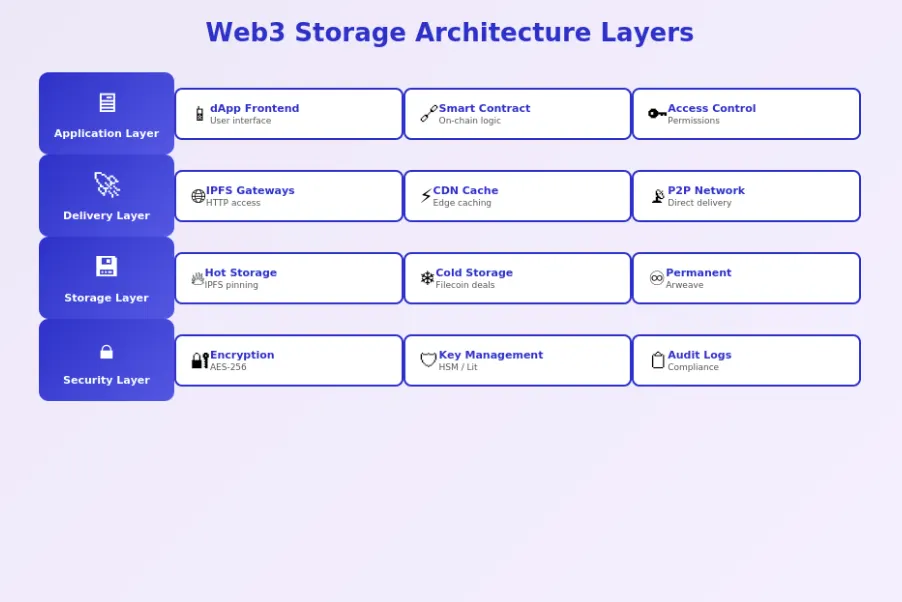
Implementing Web3 storage effectively requires thoughtful architecture decisions beyond simply choosing a storage provider. Our eight years of experience building decentralized applications across markets in the USA, UK, UAE, and Canada has revealed common patterns that separate successful implementations from problematic ones.
Storing Metadata vs Storing Full Files
A critical architectural decision involves separating metadata from full file storage. Metadata, the JSON describing assets, typically requires the strongest permanence guarantees and should often live on Arweave or pinned IPFS. Full media files, which are larger and more expensive to store permanently, might use Filecoin for cost efficiency. This tiered approach optimizes costs while maintaining appropriate permanence levels for each data type. The metadata references the media CIDs, creating a linked structure where the small, critical data ensures the larger files remain findable and verifiable.
Handling NFT Metadata the Right Way
NFT metadata storage represents one of the most consequential architectural decisions in Web3 projects. The token URI stored on-chain must point to permanent, immutable metadata. Best practice stores metadata JSON on Arweave with artwork on IPFS backed by Filecoin. The metadata JSON includes the IPFS CID for the artwork, creating verifiable links between token, metadata, and media. Never use centralized URLs for NFT metadata, as server shutdown renders tokens worthless. Always verify CIDs match content before minting, preventing metadata manipulation attacks that have affected multiple high-profile projects.
Web3 Storage Selection Criteria
Step 1: Assess Requirements
- Define permanence needs
- Estimate storage volume
- Calculate access frequency
- Identify compliance requirements
Step 2: Evaluate Options
- Compare cost models
- Test retrieval performance
- Verify decentralization level
- Check tooling availability
Step 3: Design Architecture
- Layer storage by data type
- Plan redundancy strategy
- Implement monitoring
- Document recovery procedures
Encryption and Privacy for Sensitive Files
While Web3 storage provides decentralization and permanence, it does not inherently provide privacy. Content stored on IPFS, Filecoin, or Arweave is publicly accessible to anyone with the CID. For sensitive data, encrypt files before upload using client-side encryption. The encryption key then becomes the access control mechanism. Lit Protocol and similar solutions provide decentralized access control, enabling conditional decryption based on token ownership or other on-chain conditions. This pattern allows storing encrypted content publicly while controlling who can decrypt and view it, enabling privacy-preserving applications on public storage infrastructure.
Backup Strategy and Redundancy Planning
Even with decentralized storage, redundancy planning remains essential. Use multiple pinning services for critical IPFS content rather than relying on a single provider. Create Filecoin deals with multiple miners in different geographic regions. For absolutely critical data, consider storing on both Arweave and IPFS with Filecoin backup. Maintain local copies of irreplaceable content that could not be recreated if lost. Document CIDs and storage locations in secure, backed-up systems. Test retrieval periodically to verify content remains accessible. This defense-in-depth approach protects against edge cases that might affect any single storage solution.
Enterprise & Compliance Considerations
Enterprise adoption of Web3 storage requires addressing regulatory requirements, data governance policies, and organizational risk management frameworks. Organizations in regulated industries can successfully implement decentralized file storage by architecting solutions that satisfy compliance requirements while preserving Web3 benefits.
Data Governance in Decentralized Storage
Data governance on decentralized networks requires different approaches than centralized systems. Since data cannot be deleted from permanent storage like Arweave, organizations must implement strong pre-upload governance to prevent storing inappropriate content. Classification frameworks should identify which data types are suitable for permanent public storage versus encrypted storage versus traditional systems. Audit trails should track what content was stored, when, by whom, and the associated CIDs. Metadata management systems should maintain relationships between business records and their decentralized storage locations. These governance structures ensure organizational control while leveraging decentralized infrastructure benefits.
Privacy, Access Control, and Encryption
Enterprise privacy requirements demand robust encryption and access control implementations. Encrypt all sensitive data using AES-256 or equivalent before storage. Manage encryption keys through hardware security modules or enterprise key management systems. Implement access control layers that verify authorization before providing decryption keys. Consider token-gated access where NFT ownership controls decryption rights. For GDPR compliance, ensure that encryption keys can be destroyed to effectively “delete” data even from permanent storage. Document these privacy controls thoroughly for regulatory audits and compliance certifications.
Enterprise Compliance Checklist for Web3 Storage
Data Classification: Categorize all data before selecting appropriate storage tier and encryption requirements.
Encryption Standards: Implement AES-256 encryption for all sensitive data before uploading to public networks.
Key Management: Store encryption keys in HSMs with proper access controls and rotation policies.
Audit Trails: Maintain complete logs of storage operations, CIDs, and access patterns for compliance.
Geographic Controls: For data residency requirements, use private IPFS networks or specified Filecoin miners.
Deletion Capability: Document crypto-shredding procedures for GDPR right-to-erasure compliance.
Regulatory and Compliance Challenges
Regulatory frameworks were designed for centralized systems, creating interpretation challenges for decentralized storage. GDPR’s right to erasure conflicts conceptually with permanent storage, requiring encryption-based approaches for compliance. Data residency requirements may conflict with global distribution across storage nodes. Financial regulations may require specific record retention periods with verifiable timestamps. Healthcare regulations demand access controls and audit capabilities. Organizations should engage legal counsel experienced in both blockchain technology and relevant regulatory frameworks. Document the technical and procedural controls that achieve regulatory intent even when traditional mechanisms do not apply.
Hybrid Storage (Web3 + Cloud) Approach
Many enterprises find hybrid architectures combining Web3 storage with traditional cloud services provide the best balance of innovation and compliance. Critical records requiring immutability and censorship resistance go to decentralized storage. Operational data requiring frequent updates stays in traditional databases. Sensitive data requiring geographic controls uses private infrastructure with Web3 backup. This tiered approach lets organizations adopt Web3 storage incrementally, starting with less sensitive use cases and expanding as teams gain experience and confidence. The hybrid model acknowledges that different data types have different requirements, and no single storage solution optimizes for all of them.
Common Web3 Storage Problems and How to Solve Them
Real-world Web3 storage implementations encounter predictable challenges that teams should anticipate and address proactively. Understanding these common problems and their solutions prevents project delays and user experience issues.
Broken IPFS Links and Missing Pins
The most common Web3 storage problem involves IPFS content becoming unavailable because no nodes continue pinning it. This happens when pinning services are discontinued, free tier limits are exceeded, or local nodes go offline. Prevention requires using multiple pinning services simultaneously, backing up critical content to Filecoin, and monitoring content availability proactively. When broken links occur, content might still exist on the network cached by other nodes. Tools like ipfs-search.com can help locate content that may still be retrievable. For truly lost content, restoring from local backups and re-uploading remains the only solution.
Slow Gateway Performance
IPFS gateway performance varies dramatically between providers and depends on content popularity, geographic location, and network conditions. Slow gateways create poor user experiences, particularly for NFT marketplaces displaying images. Solutions include using dedicated gateway services rather than public gateways, implementing gateway fallback logic that tries multiple providers, caching frequently accessed content at the application layer, and pre-warming caches by requesting content before users need it. Some projects run their own IPFS nodes with gateway functionality for complete control over performance, though this increases operational complexity.
Storage Cost Unpredictability
Web3 storage costs fluctuate with token prices, creating budget unpredictability for organizations. Arweave costs in AR tokens, Filecoin uses FIL, and these prices vary significantly over time. Strategies for managing this volatility include purchasing tokens during low price periods, using stablecoin-denominated services where available, building cost buffers into project budgets, and hedging through forward contracts on supported exchanges. Some projects pre-purchase storage credits when prices are favorable. Understanding the relationship between token prices and actual storage costs helps teams plan budgets more accurately despite inherent cryptocurrency volatility.
Ensuring Long-Term Availability
Guaranteeing content remains available for years or decades requires deliberate architectural decisions. For maximum assurance, store critical content on Arweave for permanence while maintaining IPFS copies for performance. Create Filecoin deals with long durations and multiple miners. Use enterprise pinning services with strong uptime guarantees and service level agreements. Monitor content availability through automated checks that alert when retrieval fails. Document the storage architecture so future maintainers understand how to verify and restore content availability. No single mechanism guarantees permanent availability, but layered approaches dramatically improve the probability of long-term success.
How to Choose the Right Web3 Storage Solution?
With clear understanding of each platform’s strengths and limitations, choosing the right Web3 storage solution becomes a matter of matching requirements to capabilities. Different application types have distinct needs that favor different solutions or combinations.
Best Choice for NFTs
NFT projects should prioritize permanence above all other factors since NFTs may exist for decades or longer. Arweave offers the strongest permanence guarantees for metadata, making it the premium choice for valuable collections. For larger collections where Arweave costs become prohibitive, IPFS with Filecoin backup provides a cost-effective alternative with strong availability guarantees. Always store metadata separately from artwork, potentially using different solutions for each. Never use centralized storage for any component of NFT infrastructure.
Best Choice for dApps
Decentralized applications typically require balanced performance, cost efficiency, and availability. IPFS provides the fastest retrieval through distributed caching, making it ideal for frequently accessed application assets. Combine IPFS with Filecoin for backup to ensure content survives even if IPFS pinning lapses. Use dedicated gateways for consistent performance rather than relying on public infrastructure. For critical application configuration or governance data that must never change or disappear, consider Arweave storage even if most assets use IPFS.
Best Choice for Permanent Documents
Documents requiring permanent, unalterable storage, such as legal contracts, regulatory filings, academic publications, and historical records, benefit most from Arweave’s permanence model. The one-time payment eliminates ongoing budget requirements and vendor dependencies. Arweave’s immutability provides strong evidence that documents have not been modified since storage. For organizations in regulated industries across the USA, UK, UAE, and Canada, this immutable audit trail supports compliance requirements.
Best Choice for Enterprise Apps
Enterprise applications often require hybrid approaches balancing Web3 benefits with operational and compliance requirements. Use private IPFS networks for content requiring geographic control. Implement encryption layers for sensitive data stored on public networks. Choose storage providers with enterprise support and service level agreements. Consider Filecoin for large-scale data where cost efficiency matters most. Use Arweave for compliance records requiring provable immutability.
The Future of Web3 Storage
Web3 storage has matured significantly over the past several years, evolving from experimental protocols to production-ready infrastructure supporting billions of dollars in digital assets. As the ecosystem continues developing, several trends shape the future of decentralized file storage.
Storage Will Be Multi-Layered
The future of Web3 storage involves sophisticated multi-layered architectures rather than single-solution approaches. Hot storage layers will provide fast access for frequently needed content, while cold storage layers offer cost-effective long-term preservation. Caching layers will optimize delivery performance globally. Archive layers will ensure permanent preservation of critical records. Middleware will abstract these layers, automatically routing content to appropriate storage based on access patterns and requirements.
Industry Best Practices for Web3 Storage
Standard 1: Always use content-addressed storage (CIDs) rather than mutable URLs for blockchain-referenced content.
Standard 2: Implement redundancy across multiple pinning services or storage providers for critical content.
Standard 3: Encrypt sensitive data before uploading to any public decentralized storage network.
Standard 4: Separate metadata storage from media file storage, optimizing each for appropriate permanence.
Standard 5: Monitor content availability proactively with automated alerts for retrieval failures.
Standard 6: Document all CIDs and storage configurations for operational continuity and disaster recovery.
Standard 7: Use dedicated gateways for production applications rather than shared public infrastructure.
Standard 8: Test content retrieval periodically to verify long-term availability before issues affect users.
What’s Next for IPFS, Filecoin, and Arweave?
Each major Web3 storage platform continues evolving with significant improvements on their roadmaps. IPFS focuses on performance improvements and better tooling for seamless integration. The Filecoin Virtual Machine (FVM) enables smart contracts on Filecoin, creating programmable storage deals and new application possibilities. Arweave’s AO network brings computation to permanent storage, enabling applications that execute on stored data. Improved interoperability between these systems will enable more sophisticated multi-layer architectures. Organizations investing in Web3 storage today build capabilities that become increasingly valuable as these networks grow.
Final Thoughts
Web3 storage represents a fundamental shift in how applications handle data, moving from centralized dependencies to resilient, decentralized infrastructure. IPFS provides the addressing and delivery layer, Filecoin adds economic incentives for persistence, and Arweave offers permanent storage guarantees. Understanding when to use each solution, and how to combine them effectively, enables building truly decentralized applications that match the trustless, censorship-resistant properties of blockchain technology itself. As your agency partner with over eight years of experience implementing Web3 solutions across global markets, we recommend starting with clear requirements, testing thoroughly, and architecting for the multi-layered future of decentralized storage.
Build Your Web3 Storage Architecture
Partner with experienced architects to implement IPFS, Filecoin, and Arweave solutions that match your application requirements.
Frequently Asked Questions
Q1.What is Web3 storage and how does it differ from traditional cloud storage?
Web3 storage refers to decentralized file storage systems that distribute data across multiple nodes rather than centralized servers. Unlike traditional cloud storage providers like AWS or Google Cloud where a single company controls your data, Web3 storage solutions use blockchain technology and peer-to-peer networks to ensure censorship resistance, data ownership, and improved availability. Users maintain control over their files without relying on any single entity.
Q2.How does Filecoin work with IPFS for persistent storage?
Filecoin is a blockchain network that incentivizes storage providers to store data reliably over time. While IPFS handles the addressing and retrieval of content, it does not guarantee files remain available permanently. Filecoin solves this by creating economic incentives through storage deals where miners commit to storing data for specified periods. Users pay FIL tokens, and miners earn rewards for proving they maintain the stored data correctly.
Q3.What makes Arweave different from IPFS and Filecoin?
Arweave offers a unique “pay once, store forever” model through its permaweb architecture. Unlike IPFS which requires ongoing pinning or Filecoin which uses time-based storage deals, Arweave charges a one-time fee calculated to cover approximately 200 years of storage costs. Data stored on Arweave becomes part of a permanent, immutable web, making it ideal for NFT metadata, historical archives, and content that must never disappear.
Q4.Which Web3 storage solution is best for NFT metadata?
For NFT metadata, Arweave is often the preferred choice because it guarantees permanent storage without ongoing maintenance. However, IPFS combined with Filecoin provides a more cost-effective option for larger collections. The best choice depends on budget, permanence requirements, and collection size. Many projects use IPFS for initial minting with Filecoin backup, while high-value NFTs increasingly choose Arweave for guaranteed longevity.
Q5.Can enterprises use Web3 storage while maintaining compliance requirements?
Yes, enterprises across the USA, UK, UAE, and Canada are adopting hybrid storage architectures that combine Web3 and traditional cloud solutions. Encryption before upload ensures data privacy on public networks. Access control layers manage permissions, while compliance-focused providers offer geographic storage guarantees. Organizations maintain regulatory compliance by encrypting sensitive data locally, using private IPFS networks, and implementing proper data governance frameworks.
Explore Services
Related Services
Reviewed by

Aman Vaths
Founder of Nadcab Labs
Aman Vaths is the Founder & CTO of Nadcab Labs, a global digital engineering company delivering enterprise-grade solutions across AI, Web3, Blockchain, Big Data, Cloud, Cybersecurity, and Modern Application Development. With deep technical leadership and product innovation experience, Aman has positioned Nadcab Labs as one of the most advanced engineering companies driving the next era of intelligent, secure, and scalable software systems. Under his leadership, Nadcab Labs has built 2,000+ global projects across sectors including fintech, banking, healthcare, real estate, logistics, gaming, manufacturing, and next-generation DePIN networks. Aman’s strength lies in architecting high-performance systems, end-to-end platform engineering, and designing enterprise solutions that operate at global scale.