Ai Overview
A block explorer is a web-based tool that lets anyone browse blockchain data. You can look up a transaction hash, check a wallet address, or inspect the contents of a specific block. For most projects, using a block explorer API is far more cost-effective than managing this yourself. Each approach carries distinct trade-offs that affect performance, cost, reliability, and alignment with blockchain principles.
Key Takeaways
- Block explorer APIs give developers direct access to real-time blockchain data, including transaction details, address balances, and block confirmations.
- They reduce development time significantly by eliminating the need to run and maintain full blockchain nodes for basic data queries.
- Common use cases range from cryptocurrency wallets and DeFi platforms to auditing tools and analytics dashboards.
- Choosing the right API depends on factors like supported networks, rate limits, pricing, and the specific data endpoints your project requires.
- Future developments in block explorer APIs point toward cross-chain support, AI-driven analytics, and improved privacy features.
- Integration challenges include rate limiting, data consistency across forks, and balancing between centralized API providers and decentralized alternatives.
If you have spent any time building on a blockchain, you know that getting clean, reliable data from the chain is one of the first problems you hit. You need transaction details, wallet balances, contract states, and block confirmations. Without a good way to pull this data, your application is basically flying blind.
That is where block explorer APIs come in. They act as a bridge between your application and the raw blockchain data, packaging it into structured, easy-to-use formats that developers can work with. Think of them as the database query layer for blockchains, except instead of querying a MySQL table, you are pulling data from a distributed ledger that spans thousands of nodes worldwide.
In this article, we are going to break down exactly how block explorer APIs affect blockchain development projects. We will cover what they are, how they work, where they fit into real projects, and what the future looks like. Whether you are building a wallet app, a DeFi protocol, or an enterprise solution, understanding these APIs is not optional. It is essential.
What Are Block Explorer APIs, Exactly?
A block explorer is a web-based tool that lets anyone browse blockchain data. You can look up a transaction hash, check a wallet address, or inspect the contents of a specific block. Block explorers have been around since the early days of Bitcoin, and they remain one of the most used tools in the blockchain space.
A block explorer API takes that same data and makes it available programmatically. Instead of a human browsing a website, your application can send HTTP requests and get back structured JSON responses containing the exact data it needs. This is a big deal for developers because it means you do not have to set up and sync your own blockchain node just to read basic on-chain data.
To put this in perspective, syncing a full Ethereum node can take days and requires hundreds of gigabytes of storage. For many projects, especially early-stage ones or those with limited infrastructure budgets, that is not practical. Block explorer APIs solve this problem by giving you node-level data access through simple API calls.
The relationship between block explorer APIs and RPC nodes in blockchain is worth understanding. While RPC nodes give you raw, low-level access to a blockchain, block explorer APIs typically provide higher-level, indexed data that is easier to work with for common use cases. Many developers use both depending on what their application needs.
How Block Explorer APIs Work: The Request Lifecycle
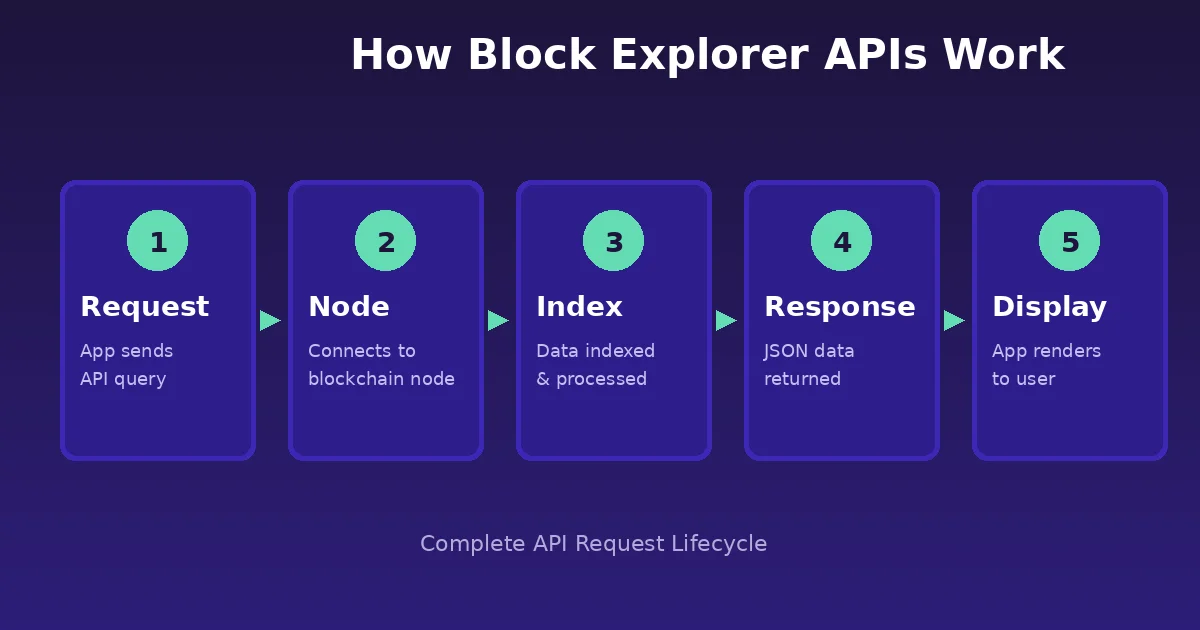
Understanding the lifecycle of an API request helps you make better decisions about when and how to use these tools. Here is how a typical block explorer API request flows from start to finish.
First, your application sends a request to the API endpoint. This could be something as simple as asking for the balance of a specific Ethereum address. The API provider receives your request, authenticates it using your API key, and routes it to their infrastructure.
Behind the scenes, the API provider runs blockchain nodes that are constantly syncing with the network. But here is the key part. They do not just store the raw blockchain data. They index it. This means they process every block and transaction, organizing the data into optimized databases that can respond to queries in milliseconds rather than seconds.
Once the query is processed, the API sends back a structured response, usually in JSON format, containing exactly the data your application requested. Your app then parses this response and presents it to the user or uses it for internal logic.
The entire round trip typically takes between 50 and 500 milliseconds depending on the complexity of the query and the provider’s infrastructure. For applications that need to display data to users in real time, this speed is critical.
Core Components of Block Explorer APIs
Not all block explorer APIs are built the same, but most share a common set of core components. The table below breaks down the essential pieces that make these APIs functional and useful for developers.
| Component | What It Does | Why It Matters |
|---|---|---|
| Transaction Endpoints | Fetch details of individual transactions by hash | Core feature for wallets, payment trackers, and audit tools |
| Address Endpoints | Query balances and transaction history for a wallet address | Essential for portfolio trackers and account management |
| Block Endpoints | Retrieve block data including timestamp, miner, and transactions | Needed for block verification and chain analysis |
| Smart Contract Endpoints | Read contract state, verify source code, and call view functions | Critical for DeFi apps and contract interaction tools |
| Token Endpoints | Track ERC-20, ERC-721, and other token transfers and balances | Necessary for any app dealing with tokens or NFTs |
| Gas and Fee Estimators | Provide current gas prices and fee estimates | Helps users and apps optimize transaction costs |
| WebSocket Subscriptions | Push real-time updates for new blocks, transactions, or events | Powers live dashboards and instant notification systems |
Each of these components serves a specific purpose in blockchain application development. The best APIs provide all of them through a unified interface, which means developers do not need to piece together data from multiple sources. For teams working on blockchain development projects, having access to a reliable API with comprehensive endpoints can cut development time by weeks or even months.
Why Block Explorer APIs Matter for Development Projects
Let us talk about the practical impact these APIs have on real development work. It goes beyond just reading data from a blockchain.
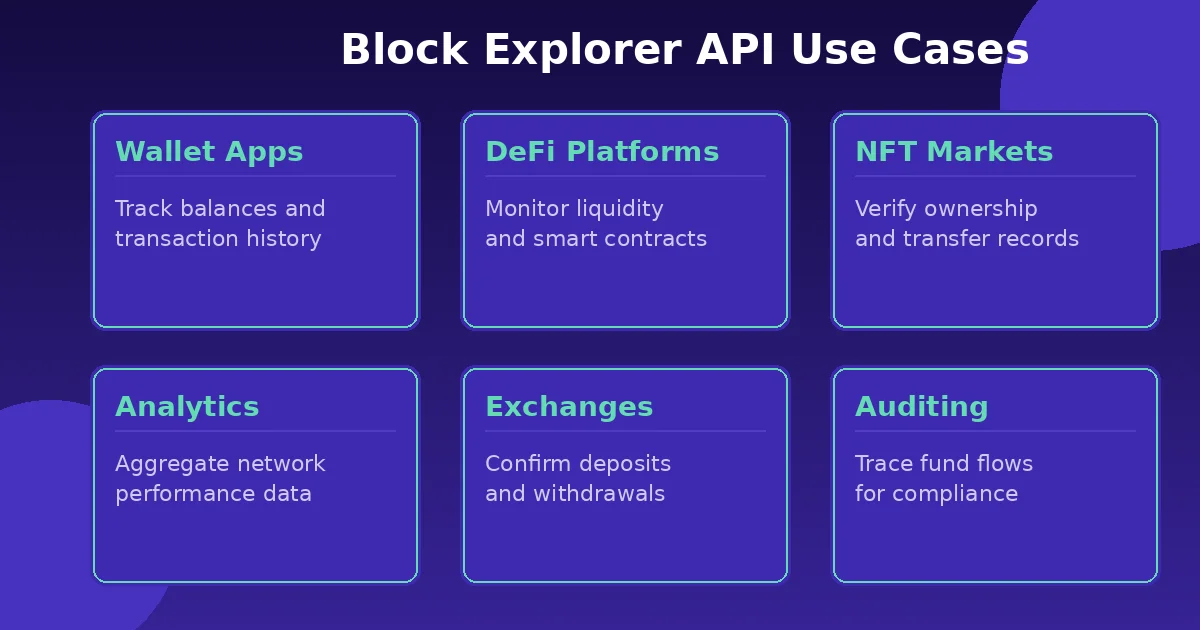
They save infrastructure costs. Running your own blockchain node means paying for servers, storage, bandwidth, and the engineering time to keep everything synced and maintained. A mid-range Ethereum archive node, for example, needs over 12 terabytes of SSD storage as of 2024. For most projects, using a block explorer API is far more cost-effective than managing this yourself.
They speed up development cycles. When you are prototyping or building an MVP, you want to move fast. Block explorer APIs let you start pulling real blockchain data within minutes of signing up. No node setup, no syncing wait times, no database configuration. You write a few API calls and you have working blockchain data integration.
They provide indexed and processed data. Raw blockchain data is not user-friendly. A block on Ethereum contains transaction receipts, state changes, logs, and internal calls, all in a format that requires significant processing to make useful. Block explorer APIs do this heavy lifting for you, delivering clean, structured data that your application can use directly.
They handle scalability. When your application grows from 100 to 100,000 users, the API provider handles the increased load on the blockchain data side. You do not need to scale your node infrastructure proportionally. This is a massive advantage for startups and growing projects.
Understanding these benefits is especially important when dealing with complex blockchain scenarios. For instance, when chain splits impact the blockchain, block explorer APIs help developers track which chain their users’ transactions ended up on, providing clarity in what could otherwise be a confusing situation.
Real-World Use Cases Across the Blockchain Industry
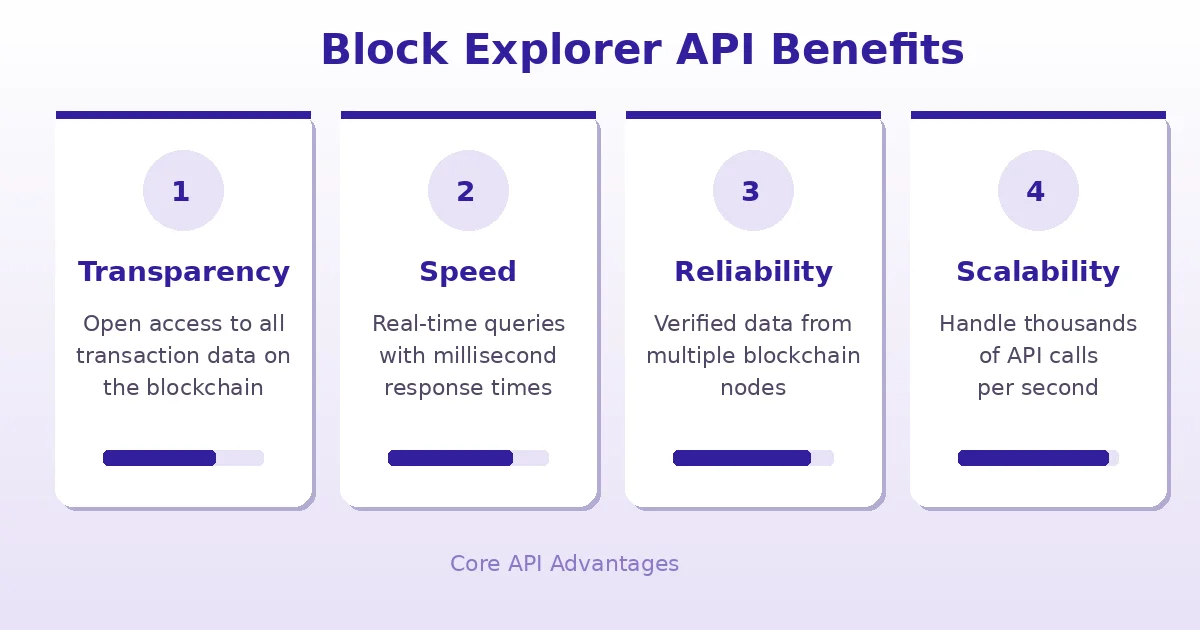
Block explorer APIs show up in almost every corner of the blockchain industry. Here are some of the most common and impactful use cases that developers encounter in production environments.
Cryptocurrency Wallets: This is probably the most widespread use case. Every wallet application needs to display balances, transaction histories, and pending transactions. When you open MetaMask or Trust Wallet and see your token balances update, block explorer APIs are doing the work behind the scenes. The wallet sends your address to the API and gets back a complete picture of your holdings and activity.
DeFi Protocols: Decentralized finance applications rely heavily on real-time blockchain data. Lending protocols need to monitor collateral ratios. DEXes need to track liquidity pool states. Yield aggregators need to watch multiple contracts across different protocols. Block explorer APIs provide the data feeds that keep these applications responsive and accurate.
NFT Marketplaces: Verifying ownership of an NFT, tracking its provenance, and displaying transfer history all require querying the blockchain. Block explorer APIs make it straightforward to pull this data and present it in a way that buyers and sellers can trust. According to Wikipedia’s overview of NFTs, provenance tracking is one of the key value propositions of non-fungible tokens, and it depends entirely on reliable blockchain data access.
Compliance and Auditing: As blockchain adoption grows in regulated industries, the need for compliance tools grows with it. Block explorer APIs enable audit tools that can trace the flow of funds, identify suspicious patterns, and generate reports that satisfy regulatory requirements. These tools are becoming increasingly important for enterprise-level blockchain adoption.
Analytics Platforms: Companies like Dune Analytics and Nansen built their businesses on making blockchain data accessible and understandable. At their core, these platforms use block explorer APIs and custom indexing solutions to aggregate data and provide insights that traders, investors, and developers find valuable. For businesses exploring this space, our guide to enterprise blockchain applications covers how analytics fits into the broader enterprise blockchain picture.
Comparing Popular Block Explorer APIs
Not every block explorer API is the right fit for every project. The choice depends on which blockchain networks you need to support, how many requests your application will make, and what specific data you need access to. Here is a comparison of some of the most widely used options.
| API Provider | Supported Chains | Free Tier Rate Limit | Best For |
|---|---|---|---|
| Etherscan API | Ethereum, Goerli, Sepolia | 5 calls/sec | Ethereum-focused projects, contract verification |
| Blockchair API | 17+ chains including BTC, ETH, BSC | Varies by plan | Multi-chain analytics and data aggregation |
| BscScan API | BNB Smart Chain | 5 calls/sec | BSC-native DeFi and token projects |
| Alchemy Enhanced APIs | Ethereum, Polygon, Arbitrum, Optimism | 300M compute units/mo | Production apps needing high reliability and NFT data |
| The Graph (Subgraphs) | Ethereum, Polygon, Arbitrum, many more | 100K queries/mo | Custom indexed data and decentralized querying |
One thing worth noting is that Etherscan and similar chain-specific explorers often share the same codebase. BscScan, PolygonScan, and Arbiscan are all built on Etherscan’s platform, which means their APIs have nearly identical interfaces. If you have integrated with one, you can integrate with the others with minimal code changes.
How to Integrate Block Explorer APIs Into Your Project
Getting started with a block explorer API is simpler than many developers expect. But doing it well requires some thought beyond just making your first API call. Here is a practical walkthrough of the integration process.
Step 1: Define your data requirements. Before you pick an API provider, list out exactly what data your application needs. Do you need historical transaction data or just the latest blocks? Do you need token transfer events? Smart contract interactions? Gas estimates? Being specific here saves you from picking an API that does not cover your needs.
Step 2: Choose your provider and get API keys. Based on your requirements, select a provider from the comparison above. Sign up for an account and generate your API keys. Most providers offer generous free tiers that are more than enough for development and testing.
Step 3: Build an abstraction layer. This is something many teams skip, and it comes back to bite them. Do not scatter raw API calls throughout your codebase. Instead, create a service layer that wraps the API calls. This gives you a single place to handle authentication, error handling, rate limiting, and caching. If you ever need to switch providers or add a fallback, you only change code in one place.
Step 4: Implement caching. Block explorer APIs have rate limits. Even on paid plans, you do not want to make unnecessary calls. Cache responses that do not change frequently. For instance, once a transaction has enough confirmations, its data is not going to change. Cache it locally and stop hitting the API for it.
Step 5: Handle errors gracefully. APIs go down sometimes. Networks get congested. Requests time out. Your application needs to handle all of these scenarios without crashing or showing broken data to users. Implement retry logic with exponential backoff, and always validate the data you receive before using it.
This integration process works regardless of whether you are building a small tool or a full-scale enterprise application. The principles stay the same. What changes is the scale of your caching, the sophistication of your error handling, and the number of API providers you might need to support. Projects that also rely on real-world data oracles for blockchain often combine oracle data with block explorer API data to get both on-chain and off-chain information in one place.
Impact on Different Blockchain Sectors
The influence of block explorer APIs is not uniform across the blockchain industry. Different sectors use these tools in different ways, and the impact varies based on the specific demands of each area.
In the DeFi sector, block explorer APIs are practically infrastructure. Every DeFi protocol needs to track token movements, contract interactions, and liquidity changes. Without reliable APIs, these protocols would need to maintain their own indexing infrastructure, which would be prohibitively expensive for smaller teams. The APIs also enable the composability that DeFi is known for, where one protocol reads data from another protocol’s contracts to build layered financial products.
In the gaming and metaverse sector, the needs are different. Blockchain games need fast reads for in-game asset ownership verification, but the volume of data they process tends to be more focused on specific token and NFT contracts rather than broad network data. The integration of blockchain with AR, VR, and metaverse platforms is creating new demands for APIs that can handle real-time asset verification with very low latency.
In the enterprise sector, block explorer APIs serve a governance and compliance function. Large organizations using blockchain for supply chain management or document verification need audit trails that can stand up to regulatory scrutiny. Block explorer APIs provide the data access layer that makes this possible, giving auditors and compliance teams the ability to trace any transaction back to its origin.
In the mining and validation sector, these APIs help operators monitor network conditions, track mining difficulty changes, and verify that their blocks are being properly propagated across the network. Pool operators use API data to calculate payout distributions and provide transparency to their miners.
Build Smarter Blockchain Applications
Need expert help integrating block explorer APIs into your blockchain project? Our team delivers reliable, scalable solutions tailored to your development goals.
Challenges and Limitations You Should Know About
Block explorer APIs are incredibly useful, but they are not without their downsides. Being aware of these limitations helps you architect better solutions.
Centralization risk is the elephant in the room. When your decentralized application depends on a centralized API provider for its data, you have introduced a single point of failure. If Etherscan goes down, every application that depends solely on their API is affected. Smart teams mitigate this by using multiple providers or by combining API access with their own lightweight nodes.
Rate limiting can become a bottleneck as your application scales. Free tiers typically allow only a few calls per second, which is fine for development but can be insufficient for production applications with thousands of concurrent users. Upgrading to paid plans helps, but the costs can add up quickly for high-volume applications.
Data consistency during forks is another concern. When a blockchain experiences a fork or a reorganization, the data served by different API providers might temporarily disagree. Your application needs to account for this possibility, especially when handling financial transactions where showing incorrect confirmation data could have real consequences.
Historical data gaps can catch teams off guard. Some API providers only index data from a certain block height forward, or they may charge significantly more for accessing historical data. If your application needs to analyze years of blockchain history, make sure your provider can deliver that data before you commit.
Privacy considerations also come into play. Every API request you make reveals information about what addresses and transactions your application cares about. For applications where privacy matters, this metadata leakage to a third-party API provider could be a concern. Decentralized alternatives like The Graph help address this, but they come with their own trade-offs in terms of query flexibility and speed.
Centralized vs. Decentralized Block Explorer APIs
The choice between centralized and decentralized block explorer APIs is one of the more nuanced decisions blockchain developers face. Each approach carries distinct trade-offs that affect performance, cost, reliability, and alignment with blockchain principles.
| Factor | Centralized APIs (Etherscan, Alchemy) | Decentralized APIs (The Graph) |
|---|---|---|
| Query Speed | Very fast, typically under 100ms | Slightly slower due to network hops |
| Uptime | Depends on single provider | Distributed, more fault tolerant |
| Customization | Limited to provider’s endpoints | Fully customizable via subgraphs |
| Cost Model | Monthly subscription or per-call | Pay-per-query via GRT tokens |
| Censorship Resistance | Provider can restrict access | Permissionless, no gatekeeping |
| Learning Curve | Simple REST APIs, familiar patterns | Requires learning GraphQL and subgraph schema |
Many production applications use a hybrid approach. They rely on centralized APIs for speed-critical operations and use decentralized alternatives as a fallback or for specific queries where customization matters. This is not an either-or decision, and the best strategy depends on your project’s priorities.
Future Trends Shaping Block Explorer APIs
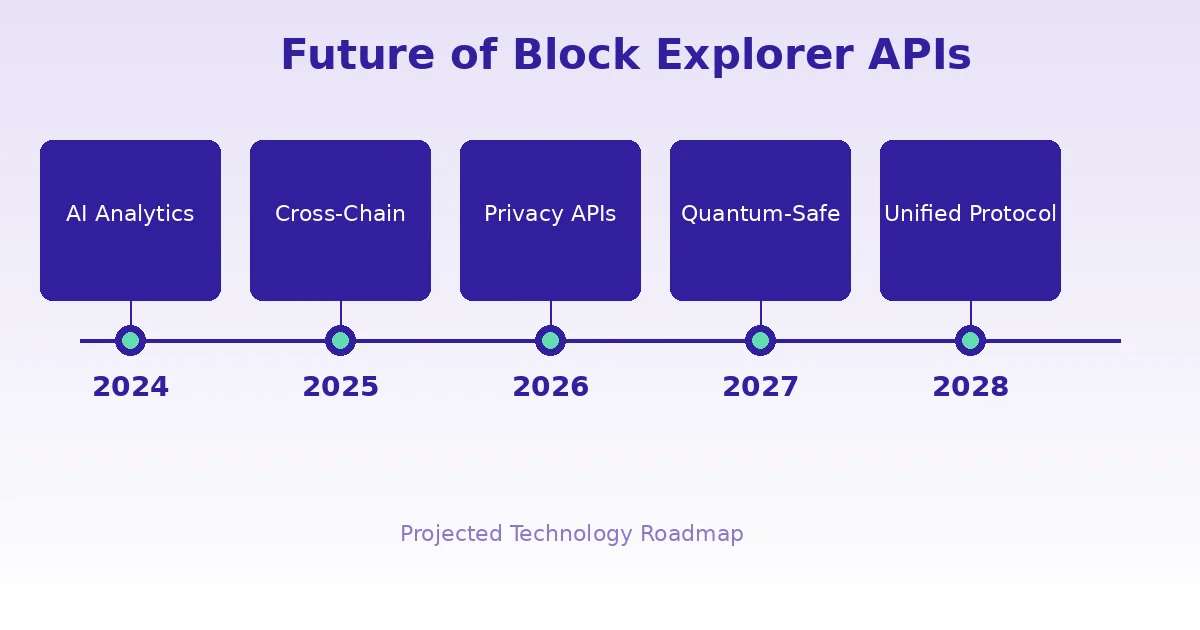
The block explorer API space is changing fast. Several trends are reshaping what developers can expect from these tools in the coming years.
Cross-chain and multi-chain support is becoming a standard expectation rather than a premium feature. As the blockchain ecosystem fragments across layer-1s, layer-2s, and sidechains, developers need APIs that can provide a unified view across multiple networks. Providers that only support a single chain are finding themselves at a disadvantage. The ability to query balances, track tokens, and monitor transactions across Ethereum, Polygon, Arbitrum, and other networks from a single API is quickly becoming table stakes.
AI-powered analytics is the next frontier. Some providers are beginning to add machine learning layers on top of their indexed data. These systems can detect patterns that would be impossible for humans to spot manually, like identifying wash trading in NFT markets, flagging potential rug pulls, or predicting network congestion before it happens. While still early, this trend has significant implications for risk management and compliance tools.
Enhanced privacy features are emerging in response to growing concerns about surveillance and data tracking. New API designs are exploring ways to let applications query blockchain data without revealing which specific addresses or transactions they are interested in. This is particularly relevant as privacy-preserving blockchain protocols like Zcash and Secret Network gain traction.
Real-time streaming improvements are driven by the demand for instant updates. WebSocket connections and server-sent events are replacing traditional polling patterns. Instead of your application asking the API every few seconds if there is new data, the API pushes updates to your application the moment something changes on-chain. This reduces latency, saves API calls, and creates smoother user experiences.
Layer-2 and rollup-specific APIs are another area of rapid development. As more applications move to layer-2 scaling solutions, there is a growing need for APIs that can handle the unique data structures and bridging operations that come with rollups. This includes tracking deposits and withdrawals between L1 and L2, monitoring proof submissions, and querying batch transaction data. These APIs will need to understand both the underlying layer-1 data and the rollup-specific structures that sit on top of it.
Security Best Practices When Using Block Explorer APIs
Security is not just about your smart contracts. How you interact with block explorer APIs also has security implications that developers need to take seriously.
First, never expose your API keys in client-side code. This sounds obvious, but it happens more often than you would think. If your API key is embedded in a frontend JavaScript bundle, anyone can extract it and use your API quota. Always proxy API calls through your backend server where the key stays hidden.
Second, validate all data you receive from APIs before using it in your application logic. Just because the data comes from a reputable provider does not mean it is always correct. Network issues, caching delays, and provider bugs can all result in unexpected data. Validate that addresses are properly formatted, that amounts make sense, and that transaction statuses are consistent with what you expect.
Third, implement request signing and logging. Keep a record of every API call your application makes, including the request parameters and the response received. This audit trail is invaluable when debugging issues and is often required for compliance purposes in regulated industries.
Fourth, have a fallback plan. If your primary API provider goes down, what happens? At minimum, you should have error handling that gracefully degrades the user experience. Ideally, you should have a secondary provider configured as a backup. The cost of maintaining a backup API integration is small compared to the cost of your entire application going dark because of a provider outage.
Measuring the Impact: Before and After API Integration
Numbers tell a clearer story than words. Here is what the integration of block explorer APIs typically looks like in measurable terms for a blockchain development project.
| Metric | Without Block Explorer API | With Block Explorer API |
|---|---|---|
| Time to first data query | Days to weeks (node setup + sync) | Minutes (API key + first call) |
| Infrastructure cost (monthly) | $200 to $2,000+ for node hosting | $0 to $400 for API plans |
| Query response time | 500ms to 5 seconds | 50ms to 300ms |
| Maintenance hours per month | 10 to 40 hours | 1 to 5 hours |
| Data types available | Raw chain data only | Indexed, structured, enriched data |
These numbers are approximate and vary based on the blockchain network and specific use case, but they illustrate the general pattern. Block explorer APIs do not just save time. They fundamentally change the economics of building blockchain applications. For a team working with a dedicated blockchain development company, these efficiency gains translate directly into faster delivery timelines and lower project costs.
A Practical Example: Building a Transaction Tracker
To make this more concrete, let us walk through a simplified example of how a development team would use a block explorer API to build a transaction tracking feature.
Say you are building a payment processing platform that accepts cryptocurrency. When a customer sends a payment, your system needs to detect the incoming transaction, monitor its confirmation status, and update the order once the payment is confirmed. Here is how block explorer APIs make this possible.
Your application generates a unique receiving address for each order. It then registers that address with the block explorer API’s webhook or notification system. When a transaction hits that address, the API notifies your application immediately. Your app then queries the transaction endpoint to get full details, including the amount sent, the gas fee paid, and the current number of confirmations.
As new blocks are mined, your application periodically checks the confirmation count. Most payment platforms require between 3 and 12 confirmations depending on the blockchain and the transaction amount. Once the required confirmations are reached, your system marks the payment as complete and processes the order.
Without a block explorer API, building this feature would require running your own node, writing custom indexing code, and managing the infrastructure to keep it all running reliably. With the API, the core logic can be built in a day and tested against real blockchain data immediately.
Where This All Leads
Block explorer APIs have become a foundational layer in blockchain development. They are not glamorous, and they rarely make headlines, but they quietly power most of the blockchain applications people use daily. From wallets to DeFi protocols to enterprise compliance tools, these APIs provide the data access layer that makes everything else possible.
The impact on development projects is measurable and significant. They reduce costs, accelerate timelines, improve data quality, and let developers focus on building their application logic instead of wrestling with infrastructure. As the blockchain ecosystem grows more complex with layer-2 networks, cross-chain bridges, and new consensus mechanisms, the role of block explorer APIs will only become more important.
For developers and teams working on blockchain projects today, the question is not whether to use block explorer APIs. The question is how to use them effectively, which providers to trust, and how to architect your application so that your API dependencies are secure, performant, and resilient. Get those decisions right, and you have a solid foundation to build on.
Frequently Asked Questions
Q1.What is a block explorer API and how does it differ from a regular block explorer?
A block explorer is a website where users can manually look up blockchain data like transactions and wallet addresses. A block explorer API provides the same data programmatically through HTTP requests, returning structured JSON responses that applications can parse and use. Developers integrate these APIs into their software to automate data retrieval instead of relying on manual lookups. The API approach enables real-time features like balance tracking, payment notifications, and automated reporting that would be impossible through a browser-based explorer.
Q2.Are block explorer APIs free to use for blockchain development projects?
Most block explorer API providers offer free tiers that are sufficient for development and small-scale production use. Etherscan, for example, allows five API calls per second on its free plan. However, as your application grows and needs more throughput, you will likely need to upgrade to paid plans. Paid plans typically range from $50 to $400 per month depending on the provider and usage volume. Some decentralized options like The Graph use a pay-per-query model using GRT tokens, which can be more cost-effective for certain usage patterns.
Q3.Can block explorer APIs be used with any blockchain network or just Ethereum?
Block explorer APIs are available for virtually every major blockchain network, not just Ethereum. Bitcoin has APIs from providers like Blockchair and Blockchain.com. BNB Smart Chain has BscScan. Polygon has PolygonScan. Multi-chain providers like Alchemy and Moralis support dozens of networks through a single API interface. The specific endpoints and data formats may vary between networks since each blockchain has its own data structures, but the general concepts of querying transactions, addresses, and blocks remain consistent across providers.
Q4.How do block explorer APIs handle blockchain forks and chain reorganizations?
When a blockchain fork or reorganization occurs, block explorer APIs need to update their indexed data to reflect the canonical chain. During this process, there can be a brief window where the API returns data that might become invalid once the reorg settles. Reputable providers handle this by flagging blocks as finalized only after sufficient confirmations and by re-indexing affected blocks quickly after a reorg. Developers should build their applications to account for this by waiting for a minimum confirmation count before treating transaction data as final.
Q5.What are the main security risks when using block explorer APIs in production?
The primary security risks include API key exposure in client-side code, which lets attackers abuse your quota or impersonate your application. Man-in-the-middle attacks are possible if you do not enforce HTTPS for all API communications. Relying on a single provider creates availability risk if that provider experiences downtime or data corruption. There is also the metadata privacy concern, where your API requests reveal which addresses your application monitors. Mitigate these risks by proxying calls through your backend, using multiple API providers as fallbacks, and validating all incoming API data.
Q6.Should I use a block explorer API or run my own blockchain node for my project?
The answer depends on your project requirements and stage. For most applications, especially early-stage projects and MVPs, block explorer APIs are the practical choice because they eliminate infrastructure costs and setup time. If your application requires custom data indexing, extremely high query volumes, or complete independence from third-party providers, running your own node makes more sense. Many mature projects use a combination where they run their own node for critical operations and use APIs as a supplementary data source or failover option for less critical queries.
Explore Services
Related Services
Reviewed by

Aman Vaths
Founder of Nadcab Labs
Aman Vaths is the Founder & CTO of Nadcab Labs, a global digital engineering company delivering enterprise-grade solutions across AI, Web3, Blockchain, Big Data, Cloud, Cybersecurity, and Modern Application Development. With deep technical leadership and product innovation experience, Aman has positioned Nadcab Labs as one of the most advanced engineering companies driving the next era of intelligent, secure, and scalable software systems. Under his leadership, Nadcab Labs has built 2,000+ global projects across sectors including fintech, banking, healthcare, real estate, logistics, gaming, manufacturing, and next-generation DePIN networks. Aman’s strength lies in architecting high-performance systems, end-to-end platform engineering, and designing enterprise solutions that operate at global scale.