Ai Overview
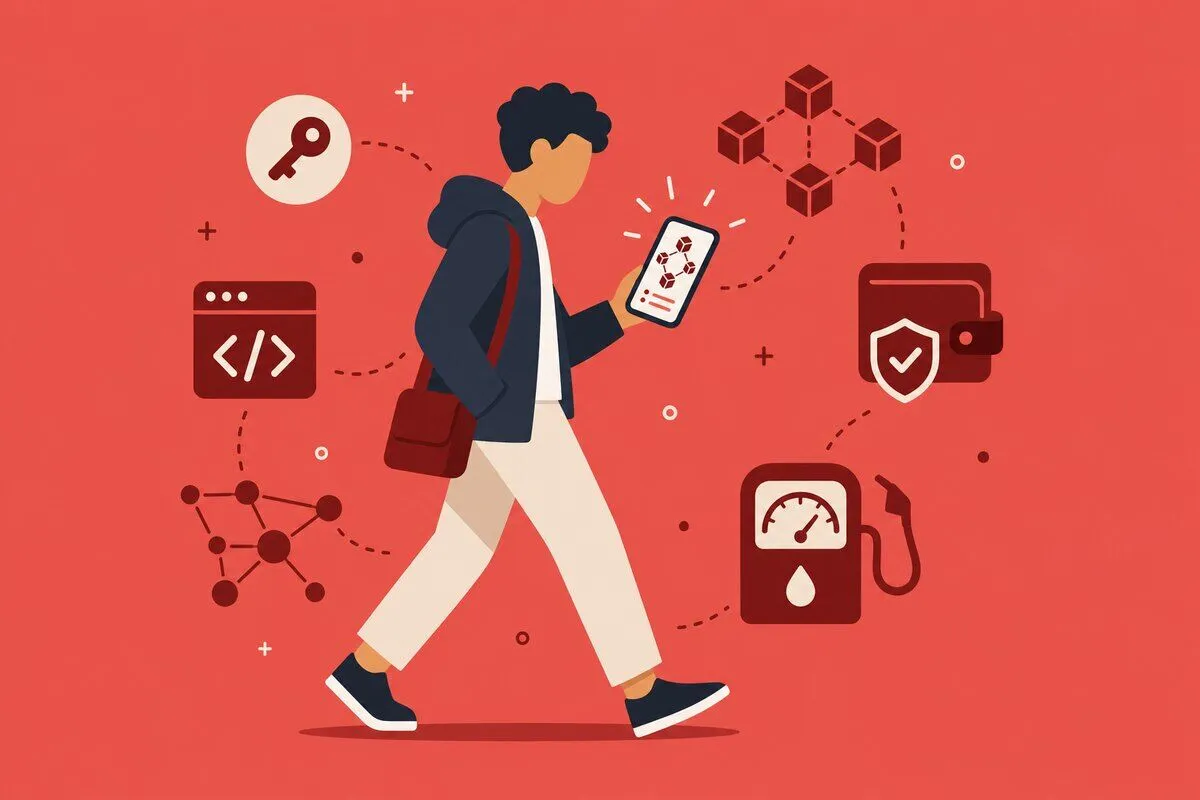
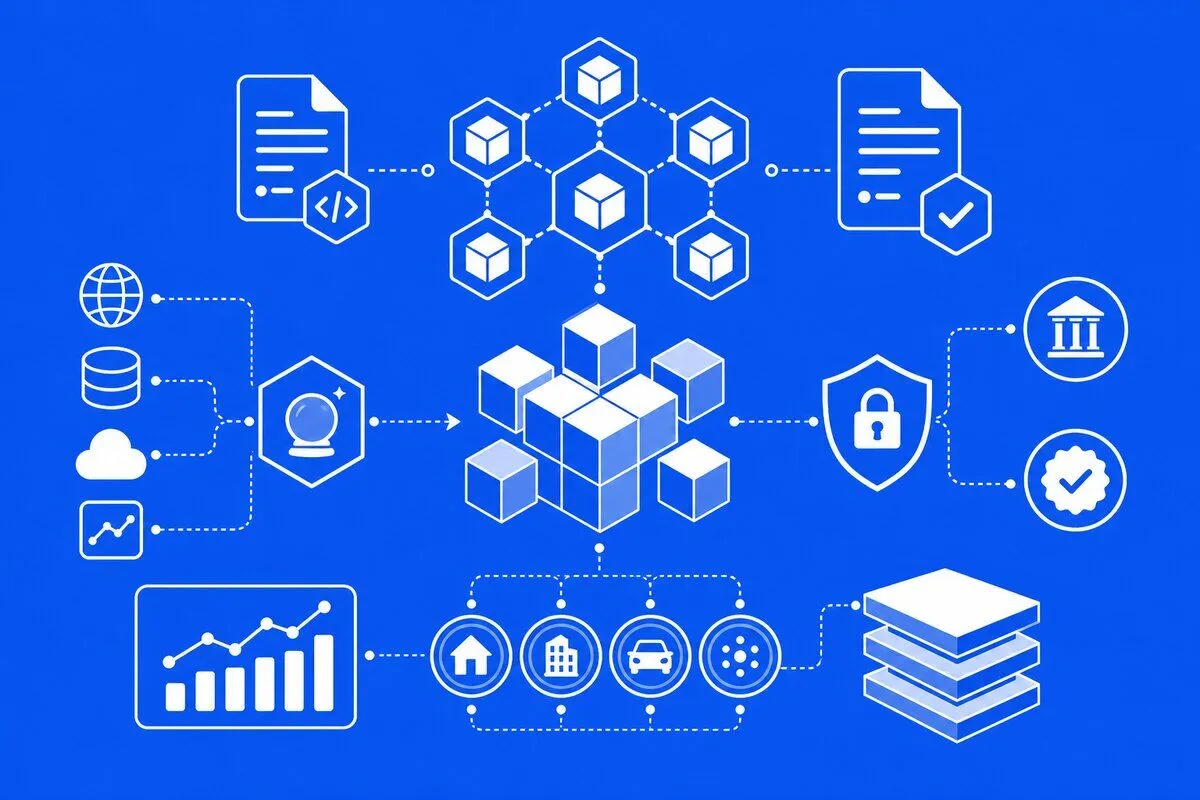
The internet has transformed how humanity communicates, works, and lives, but its current form concentrates power in the hands of a few corporations that control our data, identities, and online experiences. Web3 technology represents a fundamental reimagining of this relationship, shifting control from platforms to users through decentralized networks that no single entity owns or controls.
Key Takeaways
- Web3 represents the third generation of the internet built on blockchain technology, enabling user ownership of data, digital assets, and online identities without centralized intermediaries[1]
- Blockchain provides the foundation for Web3 by creating decentralized, transparent, and immutable records that enable trustless interactions between parties
- Smart contracts automate agreements and application logic, executing predetermined actions when conditions are met without requiring trusted intermediaries
- Web3 wallets serve as universal identity and authentication, replacing platform-specific logins with cryptographic keys users control across all applications
- Core use cases include DeFi for permissionless financial services, NFTs for digital ownership, and DAOs for decentralized governance and community coordination
- Layer 2 solutions including zk-rollups and optimistic rollups address blockchain scalability by processing transactions off-chain while maintaining security
- Current challenges include scalability limitations, user experience complexity, security risks from smart contract vulnerabilities, and regulatory uncertainty
- The future of Web3 points toward mass adoption through improved usability, integration with AI and IoT, and enterprise adoption for supply chain and identity use cases
What Is Web3?
The internet has transformed how humanity communicates, works, and lives, but its current form concentrates power in the hands of a few corporations that control our data, identities, and online experiences. Web3 technology represents a fundamental reimagining of this relationship, shifting control from platforms to users through decentralized networks that no single entity owns or controls.
Understanding what is Web3 requires appreciating both its technical foundations and its philosophical vision of an internet where users are participants and owners rather than products. This blockchain-based internet promises to restore the open, permissionless innovation that characterized the early web while addressing the trust and coordination problems that led to centralization.
Definition of Web3
Web3 is the collective term for the ecosystem of decentralized web technologies, protocols, and applications built on blockchain infrastructure that enable user ownership, transparent governance, and trustless interactions. Unlike Web2 where platforms intermediate all interactions and extract value, Web3 applications operate on open networks where users control their own data, assets, and identity through cryptographic keys. As the industry continues to evolve, emerging Web3 trends are shaping how decentralized platforms approach scalability, interoperability, digital ownership, and user engagement.
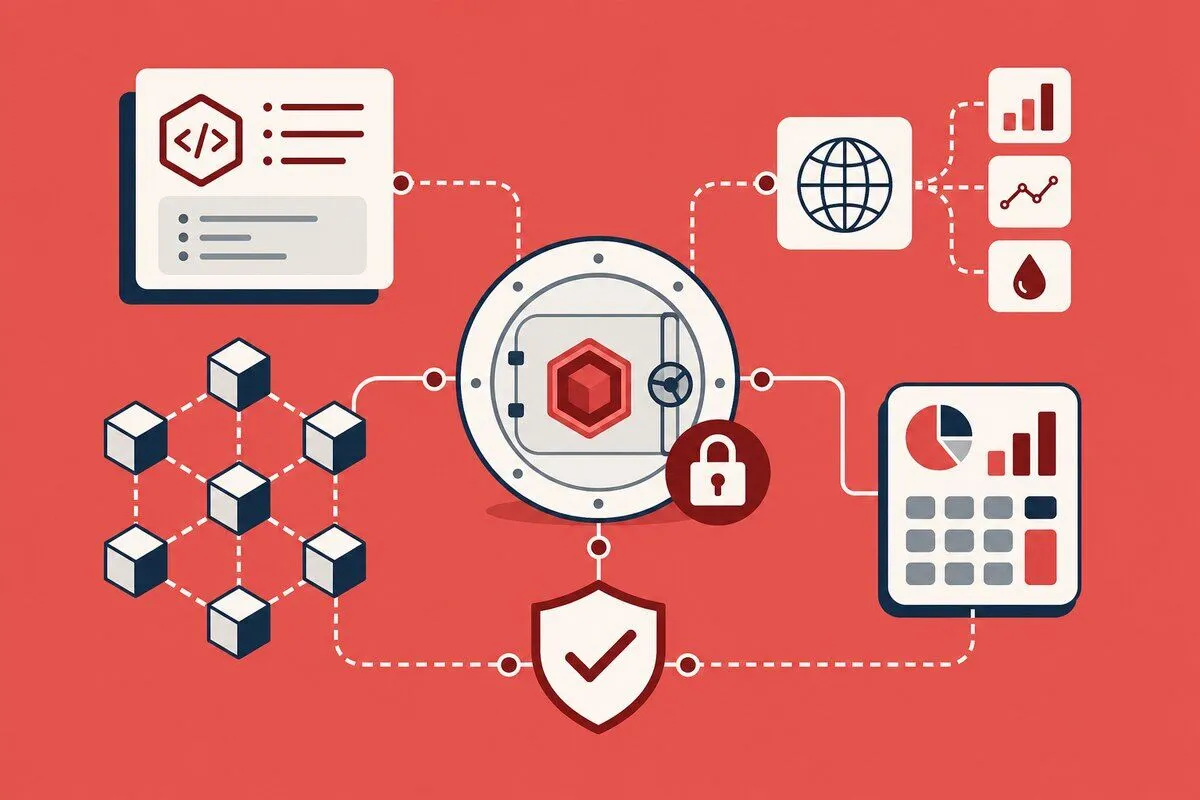
The decentralized web achieves this through several interconnected innovations: blockchains that provide shared, immutable records without central authorities; smart contracts that automate agreements without trusted intermediaries; tokens that enable new economic models for coordination and value exchange; and cryptographic wallets that give users self-sovereign identity across applications.
Evolution from Web1 to Web3
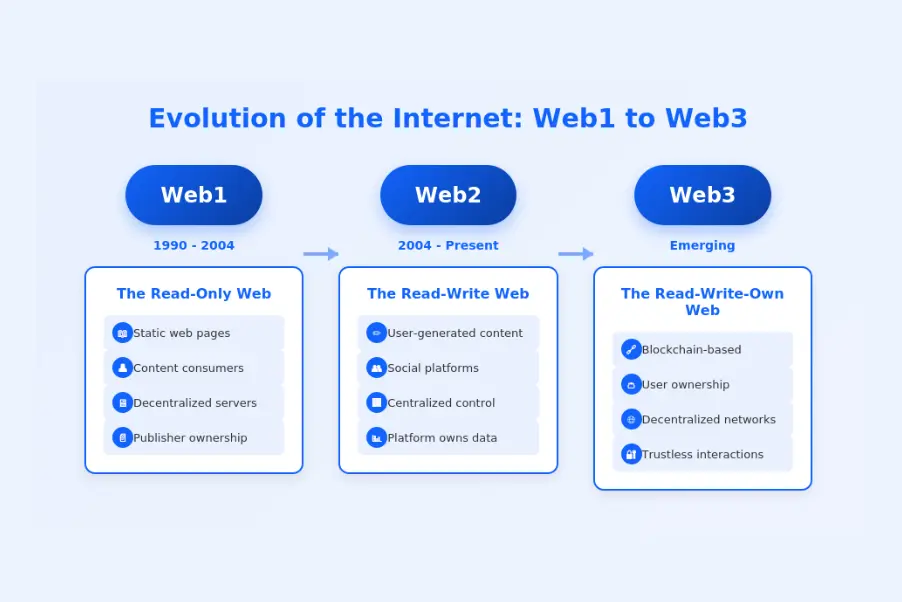
Web1, spanning roughly 1990 to 2004, was the read-only web of static pages where users consumed content created by a small number of publishers. The decentralized architecture meant anyone could host a website, but interactivity was limited and creating content required technical skills.
Web2, from 2004 to present, became the read-write web where platforms enabled anyone to create content through social media, blogs, and user-generated platforms. However, this came at the cost of centralization, where platforms like Facebook, Google, and Amazon became gatekeepers controlling access, monetizing user data, and wielding enormous power over online discourse and commerce.
Web3 aims to be the read-write-own web where users not only create content but own their digital assets, data, and the platforms themselves through token-based governance. This evolution addresses Web2’s concentration of power while preserving its accessibility and interactivity.
| Aspect | Web1 (1990-2004) | Web2 (2004-Present) | Web3 (Emerging) |
|---|---|---|---|
| User Role | Reader | Reader + Creator | Reader + Creator + Owner |
| Architecture | Decentralized servers | Centralized platforms | Decentralized networks |
| Data Ownership | Publisher owned | Platform owned | User owned |
| Trust Model | Trust publishers | Trust platforms | Trust code (trustless) |
| Value Capture | Advertisers | Platforms | Users + Participants |
Why Web3 Is Important
Web3’s importance stems from addressing fundamental problems with how the current internet operates, problems that affect privacy, autonomy, competition, and the distribution of value created online.
Problems with Web2 Internet
The current internet’s centralization creates systemic issues that affect billions of users daily.
Data Control and Privacy Issues
Web2 platforms collect vast amounts of user data including browsing history, location, contacts, communications, and behavioral patterns. This data fuels targeted advertising that generates enormous profits for platforms while users receive no compensation. Privacy violations, data breaches, and unauthorized data sharing have become routine, affecting billions of people and enabling surveillance at unprecedented scale.
Beyond privacy, platforms control user accounts with arbitrary power to suspend, ban, or modify terms of service. Users have no recourse when platforms decide to limit their access, and their content, connections, and reputation remain trapped within each platform’s walled garden. This creates lock-in that limits competition and gives platforms leverage over both users and businesses that depend on them.
How Web3 Works
Understanding how Web3 works requires examining its core technical components and how they interact to create decentralized applications and services.
Role of Blockchain in Web3
Web3 blockchain infrastructure provides the foundation for all decentralized applications by creating shared, transparent, and immutable records that all participants can trust. Rather than relying on central databases controlled by single entities, blockchains distribute data across networks of nodes that collectively maintain consensus about the current state. This eliminates single points of failure and control while enabling trustless interactions between parties who need not know or trust each other.
Blockchains achieve this through cryptographic linking of blocks, where each block contains a hash of the previous block creating a chain that cannot be altered without detection. Consensus mechanisms ensure all nodes agree on which transactions are valid and in what order, preventing double-spending and maintaining network integrity.
Public vs Private Blockchains
Public blockchains like Ethereum and Bitcoin are permissionless networks where anyone can participate in transaction validation, read the full transaction history, and deploy applications. These networks prioritize decentralization and censorship resistance, making them the primary infrastructure for Web3 applications where trust minimization matters most.
Private or permissioned blockchains restrict participation to approved entities, trading decentralization for performance and control. While useful for enterprise applications requiring privacy and compliance, private blockchains do not deliver the open, trustless properties that define Web3’s value proposition for end users.
Smart Contracts in Web3
Smart contracts are self-executing programs stored on blockchains that automatically enforce agreements when predetermined conditions are met. They enable complex application logic to run in a decentralized, trustless manner, forming the building blocks for all Web3 applications.
How Smart Contracts Execute Logic
Smart contracts execute when users send transactions that trigger their functions, with the blockchain network validating execution and recording state changes. Once deployed, smart contracts run exactly as programmed without the possibility of downtime, censorship, or third-party interference. This deterministic execution means anyone can predict how a contract will behave given specific inputs, enabling trust without trusting any particular party.
Smart contracts can hold and transfer value, interact with other contracts, and implement arbitrary business logic from simple token transfers to complex financial instruments. Organizations building decentralized applications and blockchain-based platforms leverage smart contracts to create trustless systems that operate transparently and predictably.
Decentralized Applications (dApps)
Decentralized applications combine smart contracts with user interfaces to create complete applications that operate on blockchain infrastructure rather than traditional servers.
How dApps Differ from Traditional Apps
Traditional applications run on servers controlled by companies that can modify functionality, restrict access, and collect user data. dApps run on decentralized networks where core logic executes through smart contracts that no single party controls. Users interact with dApps through wallets rather than accounts, maintaining control over their identity and assets across applications.
This architectural difference means dApps are censorship resistant, operate 24/7 without downtime risk, and enable users to verify exactly how they function by reading open-source contract code. However, dApps also face limitations including slower performance, higher costs for on-chain operations, and complexity that creates user experience challenges.
Core Components of Web3
The Web3 ecosystem comprises several essential components that work together to enable decentralized applications and services.
Web3 Wallets
Wallets are the fundamental interface between users and Web3, managing cryptographic keys that control blockchain accounts and enable interactions with decentralized applications.
Wallet-Based Authentication
Wallet-based authentication replaces traditional usernames and passwords with cryptographic signatures that prove ownership of blockchain addresses. When connecting to a dApp, users sign messages with their private keys, proving their identity without revealing sensitive information or creating accounts that platforms control. This single identity works across all Web3 applications, eliminating the need for separate credentials while giving users complete control.
Different wallet types serve different needs: browser extensions like MetaMask provide convenience, hardware wallets offer maximum security for significant holdings, and mobile wallets enable on-the-go access. Understanding wallet security is essential as losing access to private keys means permanent loss of associated assets with no recovery option.
Cryptocurrencies and Tokens
Tokens represent programmable value on blockchains, enabling new economic models for coordination, governance, and value exchange.
Utility Tokens vs Governance Tokens
Utility tokens provide access to specific services or functionality within Web3 platforms, similar to prepaid credits that unlock features or pay for usage. Governance tokens grant voting rights over protocol decisions, allowing holders to participate in shaping the platforms they use. Many tokens serve both functions, aligning user incentives with platform success while enabling decentralized decision-making.
Teams building crypto exchanges and trading platforms implement sophisticated token models that balance liquidity incentives with governance participation.
Consensus Mechanisms
Consensus mechanisms enable distributed networks to agree on transaction validity and ordering without central coordination.
Proof of Work vs Proof of Stake
Proof of Work (PoW) requires miners to expend computational energy solving cryptographic puzzles, with successful miners earning the right to add blocks and receive rewards. While highly secure and battle-tested through Bitcoin, PoW consumes significant energy and has limited throughput capacity.
Proof of Stake (PoS) selects validators based on tokens they stake as collateral, with honest behavior rewarded and malicious behavior punished through stake slashing. PoS uses far less energy and enables higher throughput, making it the consensus choice for most modern Web3 platforms including Ethereum after its transition from PoW.
| Aspect | Proof of Work | Proof of Stake |
|---|---|---|
| Security Model | Computational work | Economic stake |
| Energy Usage | Very high | Minimal |
| Throughput | Limited (~7-15 TPS) | Higher (100+ TPS) |
| Entry Barrier | Hardware investment | Token stake |
| Examples | Bitcoin, Litecoin | Ethereum, Solana, Cardano |
Web3 Infrastructure Stack
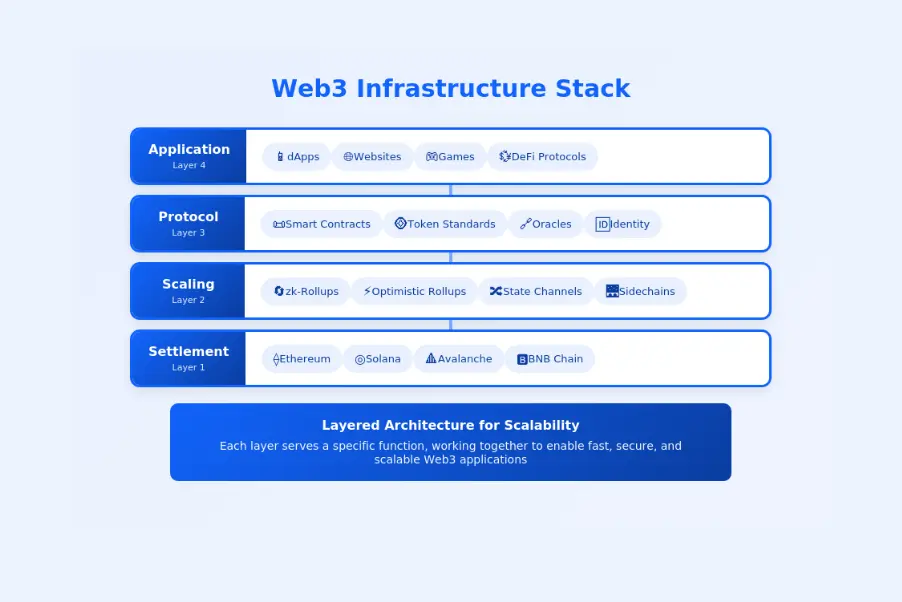
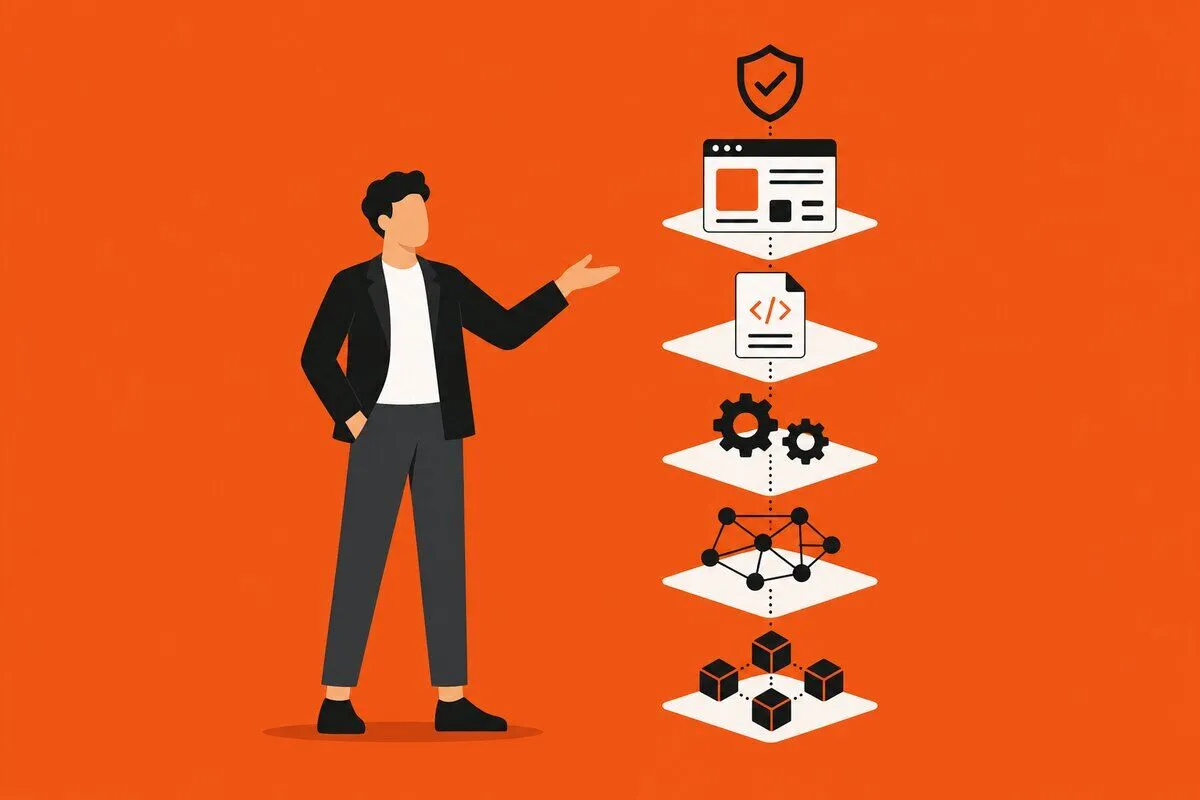
Web3 architecture comprises multiple layers that work together to provide scalable, secure infrastructure for decentralized applications.
Layer 1 Blockchains
Layer 1 blockchains like Ethereum, Solana, and Avalanche provide the foundational infrastructure where smart contracts execute and final transaction settlement occurs. These networks prioritize security and decentralization as the base layer of trust for the entire Web3 ecosystem.
Scalability Challenges
Layer 1 blockchains face fundamental scalability limitations known as the blockchain trilemma: the difficulty of simultaneously achieving decentralization, security, and scalability. Increasing throughput typically requires trade-offs, either reducing the number of validators which hurts decentralization, or weakening consensus which affects security. This limitation drives the need for Layer 2 solutions that scale without compromising Layer 1 properties.
Layer 2 Solutions
Layer 2 solutions process transactions off the main blockchain while inheriting its security guarantees, dramatically increasing throughput and reducing costs.
zk-Rollups and Optimistic Rollups
zk-Rollups bundle many transactions together and generate cryptographic proofs that the bundle executed correctly, posting only the proof and compressed data to Layer 1. This achieves high throughput with immediate finality once proofs verify. Optimistic Rollups assume transactions are valid and only compute proofs if challenged during a dispute window, offering simpler implementation but requiring wait periods for withdrawals.
Both approaches enable Web3 platforms to serve millions of users with low fees while maintaining the security guarantees of underlying Layer 1 networks. The choice between them involves trade-offs around finality speed, computational costs, and implementation complexity.
Selecting Web3 Platforms: Key Criteria
When choosing blockchain platforms for Web3 applications, consider these essential factors:
- Transaction Throughput: Evaluate TPS capacity against expected usage patterns
- Cost Structure: Assess gas fees and their predictability during network congestion
- Security Track Record: Review history of exploits, upgrades, and incident response
- Ecosystem Maturity: Consider available tools, libraries, and community support
- Decentralization Level: Evaluate validator distribution and governance structure
- Interoperability: Assess bridges and cross-chain capabilities for multi-chain strategies
Web3 Use Cases
Web3 applications span diverse categories, each demonstrating unique benefits of decentralized architecture.
DeFi (Decentralized Finance)
DeFi recreates financial services like lending, trading, and insurance on blockchain infrastructure, removing intermediaries and enabling permissionless access.
Lending, Staking, and Yield Farming
DeFi lending protocols allow users to supply assets to liquidity pools and earn interest, while borrowers can access loans using cryptocurrency as collateral without credit checks or bank approval. Staking rewards users for locking tokens to secure proof-of-stake networks. Yield farming involves strategically moving assets across protocols to maximize returns, often combining lending, staking, and liquidity provision.
NFTs and Digital Ownership
Non-fungible tokens enable verifiable digital ownership of unique assets, from artwork to real estate deeds to identity credentials.
NFT Use Beyond Art
While digital art popularized NFTs, the technology enables ownership verification for any unique digital or physical asset. Gaming uses NFTs for player-owned items that persist across games. Music NFTs give fans ownership stakes in songs. Real estate tokenization enables fractional property ownership. Identity credentials as NFTs provide verifiable, portable qualifications. These applications demonstrate NFT utility far beyond collectibles.
DAOs (Decentralized Autonomous Organizations)
DAOs enable collective governance and coordination through token-based voting without traditional corporate structures.
Community-Led Decision Making
DAOs allow communities to collectively manage treasuries, make strategic decisions, and coordinate activities through transparent on-chain governance. Token holders propose and vote on changes, with smart contracts automatically executing approved proposals. This enables organizations to operate globally without legal entities, hierarchies, or geographic limitations, though challenges around voter participation and governance capture remain active areas of experimentation.
| Phase | Stage | User Actions | Result |
|---|---|---|---|
| 1 | Wallet Setup | Install wallet, secure seed phrase | Self-sovereign identity |
| 2 | Acquire Assets | Purchase crypto from exchange | Tokens for gas and usage |
| 3 | Connect to dApp | Approve wallet connection | Authenticated access |
| 4 | Transaction | Sign and submit transaction | Action executed on-chain |
| 5 | Confirmation | Wait for block finality | Permanent, immutable record |
| 6 | Ownership | Assets in wallet custody | Full user control |
Benefits of Web3
Web3 delivers fundamental improvements over Web2 in ownership, transparency, and resistance to censorship.
User Data Ownership
Web3 gives users actual ownership of their data and digital assets through cryptographic keys they control. Unlike Web2 where platforms hold user data in proprietary databases, Web3 data lives on public blockchains or decentralized storage where only key holders can modify or transfer it. This ownership extends to identity, social graphs, financial assets, and creative works, enabling portability across applications and platforms.
Transparency and Trust
Blockchain transparency means all transactions and smart contract code are publicly verifiable, enabling trust through verification rather than faith in institutions. Users can audit exactly how applications work, track all fund flows, and verify that systems operate as claimed. This transparency enables new forms of accountability while reducing information asymmetries that platforms exploit in Web2.
Censorship Resistance
Decentralized networks resist censorship because no single party can block transactions, remove content, or ban users. Applications run on infrastructure distributed across thousands of nodes globally, requiring coordinated action across jurisdictions to shut down. This property matters for financial access, free expression, and ensuring critical applications remain available regardless of political or commercial pressures.
Challenges and Limitations of Web3
Despite its promise, Web3 faces significant challenges that currently limit mainstream adoption.
Scalability Issues
Blockchain networks process far fewer transactions than centralized systems, with major networks handling dozens to hundreds of transactions per second compared to thousands for traditional payment networks. This limitation causes congestion during high demand, with transaction fees spiking and confirmation times increasing. Layer 2 solutions address this but add complexity and introduce their own trade-offs.
Security Risks
Web3 introduces new attack vectors that users must understand and protect against.
Hacks and Exploits
Smart contract vulnerabilities have enabled billions of dollars in losses through exploits that drain funds from protocols. Phishing attacks targeting wallet approvals trick users into signing malicious transactions. Bridge hacks compromising cross-chain infrastructure have caused some of the largest losses. The irreversibility of blockchain transactions means stolen funds typically cannot be recovered, making security paramount.
User Experience Barriers
Web3 applications remain difficult for mainstream users to navigate. Managing seed phrases, understanding gas fees, evaluating transaction approvals, and avoiding scams require knowledge most users lack. The complexity of wallet setup, the anxiety of irreversible transactions, and unfamiliar concepts create friction that deters adoption. Significant UX improvement is needed for Web3 to reach mainstream audiences.
Web3 vs Web2
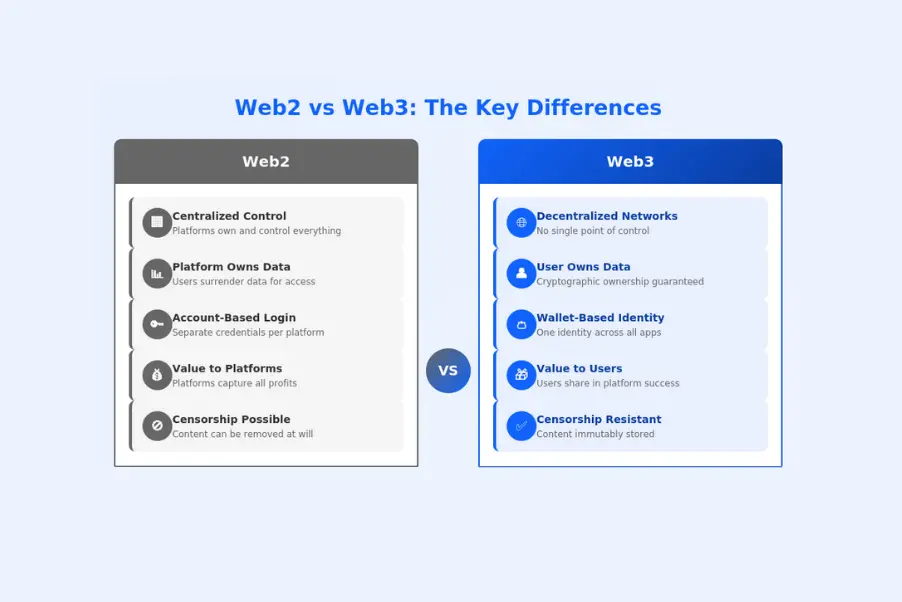
Direct comparison between Web3 vs Web2 highlights the fundamental architectural and philosophical differences.
Centralization vs Decentralization
Web2 centralizes control in platforms that own user relationships, data, and monetization. Web3 decentralizes these functions across networks where protocols rather than companies set rules, users rather than platforms own data, and value distributes to participants rather than shareholders. This shift enables permissionless innovation and reduces platform risk but introduces coordination complexity and performance trade-offs.
Ownership and Monetization
Web2 monetization extracts value from users through advertising and data sales, with platforms capturing most value created on their networks. Web3 enables users to own their contributions through tokens, NFTs, and protocol rewards, aligning incentives between users and networks. Creators can monetize directly without platform intermediation, though discoverability and payment infrastructure challenges remain.
Future of Web3
The Web3 ecosystem continues evolving toward greater usability, integration, and real-world application.
Mass Adoption of Web3
Mass adoption requires solving current usability challenges through better wallets, account abstraction that hides blockchain complexity, and applications that deliver clear value beyond speculation. Improved onboarding, lower fees through scaling solutions, and familiar user experiences will drive adoption. The path likely involves gradual integration where users benefit from Web3 infrastructure without necessarily understanding it directly.
Integration with AI and IoT
Web3 integration with AI could enable decentralized AI training and inference, ensuring AI systems remain open and user-controlled rather than concentrated in few corporations. IoT integration enables machine-to-machine payments and autonomous device coordination through smart contracts. These combinations create possibilities for decentralized infrastructure that operates without human intermediation while maintaining user sovereignty.
Enterprise and Government Use Cases
Enterprises are exploring Web3 for supply chain transparency, credential verification, and cross-organizational coordination where shared infrastructure reduces friction. Government applications include identity systems, voting, and transparent public finance. These institutional use cases may drive significant adoption as organizations recognize blockchain benefits for specific problems, even without embracing full decentralization.
Ready to move beyond Web2?
Learn how Web3 works and start your journey toward decentralized innovation today.
Final Thoughts
Web3 explained in full reveals both the transformative potential and current limitations of this emerging paradigm. The vision of an internet where users own their data, identities, and digital assets represents a fundamental reimagining of online power structures that have concentrated in platform monopolies. Blockchain technology, smart contracts, and token economics provide the technical foundation for this vision, enabling trustless interactions and decentralized coordination at global scale.
Current Web3 applications demonstrate real value in DeFi, digital ownership, and decentralized governance, though challenges around scalability, security, and user experience limit mainstream adoption. The Web3 internet continues maturing through technical improvements in scaling, usability, and security, with Layer 2 solutions and improved tooling addressing core limitations.
Understanding what is Web3 and how Web3 works provides essential context for navigating the ongoing evolution of digital infrastructure. Whether Web3 fully realizes its ambitious vision or integrates more modestly with existing systems, the technologies and ideas it has pioneered will shape the future of the internet. For individuals, organizations, and societies, engaging thoughtfully with these developments enables informed participation in shaping that future.
Frequently Asked Questions
Q1.What exactly does Web3 mean in the crypto space?
Web3 is the idea of a user-controlled internet built on blockchain and crypto technologies, w.here data, identity, and digital assets are managed through decentralized systems instead of central platforms, offering greater transparency, security, and ownership to everyone online.
Q2.Are Web3 and the metaverse the same thing or different?
Web3 and the metaverse are different. Web3 focuses on a decentralized internet using blockchain and crypto, while the metaverse is a virtual world where people interact through digital spaces. They can work together, but they are not the same thing.
Q3.Can Web3 make the internet fully decentralized?
Web3 aims to make the internet more decentralized, but full decentralization is unlikely. Some parts will still need regulation, infrastructure, and trusted services. However, Web3 can greatly reduce central control and give users more ownership, transparency, and independence than today’s internet.
Q4.In what ways does Web3 support innovation?
Web3 supports innovation by enabling decentralized apps, open-source development, token-based rewards, and secure digital ownership. It encourages new business models, removes intermediaries, and allows creators, developers, and users to collaborate directly, leading to faster, more transparent, and community-driven technological progress.
Q5.How does Web3 affect the creative economy?
Web3 affects the creative economy by giving creators more control and direct ownership of their work through blockchain and NFTs. It reduces reliance on middlemen, enables fairer earnings, builds stronger communities, and opens new ways to monetize art, music, content, and digital experiences.
Q6.Can Web3 replace traditional apps?
Web3 cannot fully replace traditional apps, but it can enhance them by adding decentralization, transparency, and user ownership. Many apps will use a mix of Web2 and Web3 features, creating hybrid models that balance convenience, security, and decentralization based on user needs.
Explore Services
Related Services
Reviewed by

Aman Vaths
Founder of Nadcab Labs
Aman Vaths is the Founder & CTO of Nadcab Labs, a global digital engineering company delivering enterprise-grade solutions across AI, Web3, Blockchain, Big Data, Cloud, Cybersecurity, and Modern Application Development. With deep technical leadership and product innovation experience, Aman has positioned Nadcab Labs as one of the most advanced engineering companies driving the next era of intelligent, secure, and scalable software systems. Under his leadership, Nadcab Labs has built 2,000+ global projects across sectors including fintech, banking, healthcare, real estate, logistics, gaming, manufacturing, and next-generation DePIN networks. Aman’s strength lies in architecting high-performance systems, end-to-end platform engineering, and designing enterprise solutions that operate at global scale.