Ai Overview
The transformation of real estate investment through blockchain technology represents one of the most significant shifts in property markets across the USA, UK, UAE, and Canada. On-chain ownership representation forms the foundation of tokenized real estate platforms, enabling fractional investment in properties across the USA, UK, UAE, and Canada with unprecedented efficiency.
Key Takeaways
- On-chain asset management provides immutable ownership records and automated compliance enforcement for tokenized real estate across global markets including USA, UK, UAE, and Canada.
- Off-chain systems handle legal documentation, property management operations, and sensitive tenant data that cannot reside on public blockchain networks.
- Smart contracts automate dividend distributions, transfer restrictions, and corporate actions while maintaining complete audit trails for regulatory reporting requirements.
- Oracle networks serve as critical bridges synchronizing property valuations, rental income, and legal status updates between blockchain and traditional systems.
- Hybrid architectures balance transparency benefits of blockchain with privacy requirements mandated by data protection regulations like GDPR and CCPA.
- Custody models range from self-custody solutions for sophisticated investors to platform-managed options providing enhanced security and recovery mechanisms.
- Gas fee optimization and layer-2 scaling solutions address transaction cost challenges inherent in large-scale property tokenization deployments.
- Compliance modules must adapt dynamically to jurisdiction-specific securities regulations, foreign ownership restrictions, and anti-money laundering requirements.
- Secondary market functionality enables fractional ownership liquidity while maintaining regulatory compliance across multiple trading jurisdictions simultaneously.
- Future system designs increasingly incorporate zero-knowledge proofs, cross-chain interoperability, and AI-driven property management automation capabilities.
1. Introduction to Real Estate Tokenization Architecture
The transformation of real estate investment through blockchain technology represents one of the most significant shifts in property markets across the USA, UK, UAE, and Canada. As an agency with over eight years of experience designing and implementing real estate tokenization platforms, we have witnessed firsthand how the distinction between on-chain and off-chain asset management fundamentally shapes platform capabilities, regulatory compliance postures, and investor experiences.
Understanding on-chain vs off-chain asset management is not merely a technical exercise but rather a strategic imperative that influences every aspect of tokenized real estate operations. On-chain components leverage blockchain’s inherent properties of immutability, transparency, and programmability to create trustless ownership records and automated business logic execution. Meanwhile, off-chain components handle the complex realities of physical property ownership, legal documentation, and regulatory compliance that cannot exist purely in digital form.
This comprehensive guide examines the system design considerations, architectural patterns, and practical trade-offs that platform builders and investors must understand when navigating the tokenized real estate landscape. Whether you are evaluating investment opportunities in Dubai’s emerging tokenization market or building platforms for institutional investors in London or New York, these principles provide the foundation for informed decision-making.
2. Why Asset Management Design Is Critical in Tokenized Real Estate
The architectural decisions made during platform design have lasting implications for operational efficiency, regulatory compliance, and investor trust. Poorly designed asset management systems create friction that undermines the core value proposition of tokenization, which promises increased liquidity, reduced transaction costs, and broader market access. Our experience working with institutional clients in Toronto, London, and Dubai consistently demonstrates that early architectural choices determine long-term platform success.[1]
On-chain vs off-chain asset management decisions directly impact transaction settlement times, compliance automation capabilities, and the feasibility of secondary market trading. Platforms that attempt to place excessive data on-chain face prohibitive gas costs and privacy concerns, while those that rely too heavily on off-chain systems sacrifice the transparency and automation benefits that blockchain enables. Finding the optimal balance requires deep understanding of both technical constraints and business requirements specific to each market jurisdiction.
The regulatory landscape further complicates these decisions. Securities regulators in the United States, Financial Conduct Authority in the United Kingdom, Dubai Financial Services Authority in the UAE, and provincial securities commissions in Canada each impose distinct requirements that influence where data must reside and how ownership transfers must be recorded. System designs must accommodate these variations while maintaining coherent platform operations across borders.
3. What Assets Are On-Chain in Real Estate Tokenization Platforms
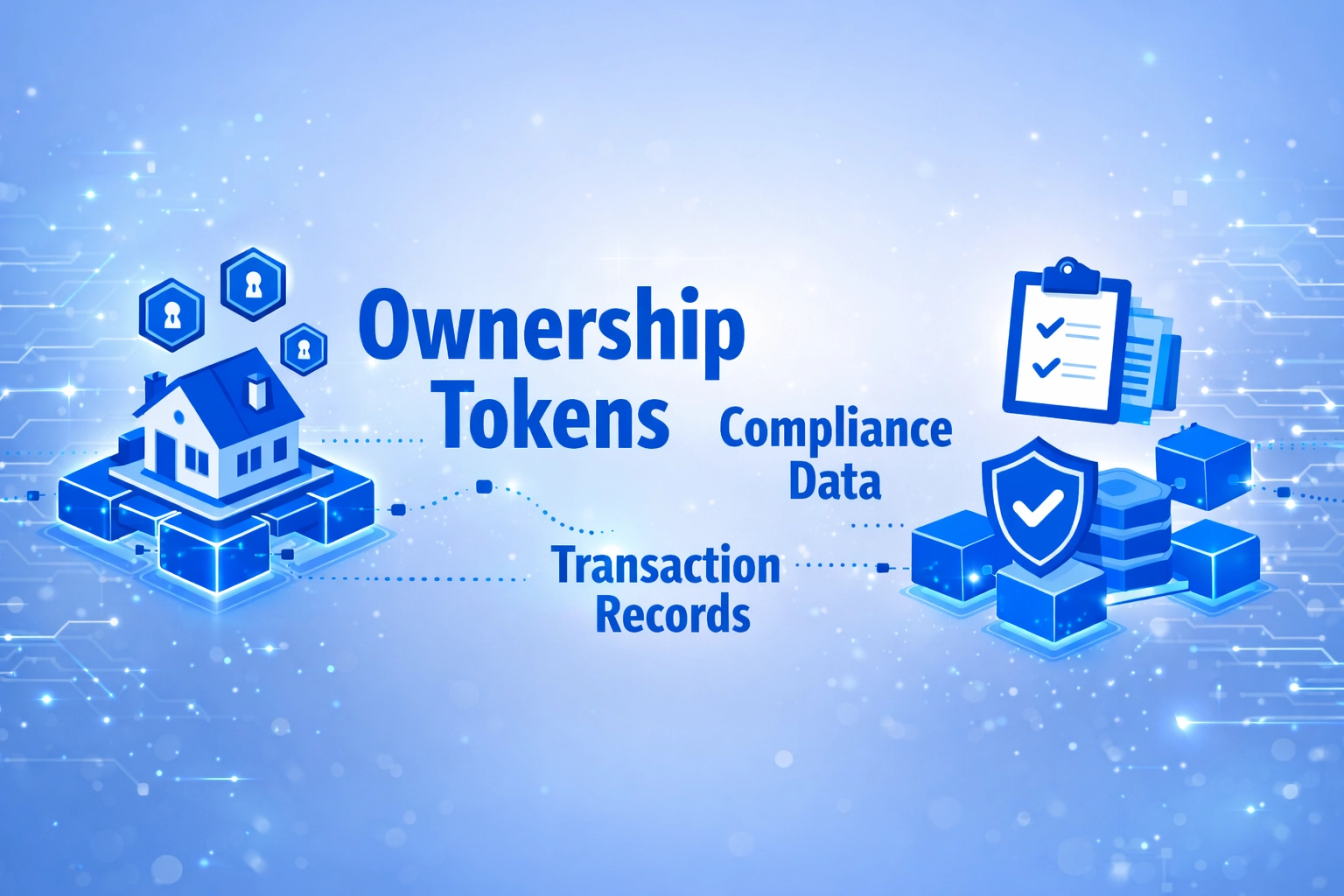
Ownership Tokens
- ERC-20 or ERC-1400 security tokens representing fractional property ownership
- Immutable ownership records with complete transaction history
- Programmable transfer restrictions based on investor accreditation status
Compliance Data
- Investor whitelist addresses verified through KYC/AML processes
- Jurisdictional compliance flags for cross-border trading restrictions
- Accreditation status records for securities regulation compliance
Transaction Records
- Complete audit trail of all token transfers and ownership changes
- Dividend distribution records with cryptographic verification
- Corporate action execution logs for regulatory reporting
On-chain asset management in tokenized real estate focuses on data that benefits most from blockchain’s unique properties. Token ownership records gain immutability and transparency that builds investor confidence across markets in the USA, UK, UAE, and Canada. Compliance data stored on-chain enables automated enforcement of transfer restrictions without manual intervention. Transaction histories provide auditable records that satisfy regulatory reporting requirements while enabling real-time portfolio tracking for investors.
4. What Data and Processes Remain Off-Chain (Legal and Operational Layer)
Off-chain systems in tokenized real estate platforms handle the substantial operational complexity that accompanies physical property ownership. Legal documentation including property deeds, title insurance policies, tenant lease agreements, and regulatory filings must remain in traditional document management systems for several compelling reasons. First, these documents often contain sensitive personal information protected by privacy regulations. Second, legal enforceability in courts across the USA, UK, UAE, and Canada still requires traditional documentation formats. Third, the storage costs of placing large documents on blockchain networks would be prohibitively expensive.
Property management operations including tenant communications, maintenance coordination, rent collection, and property inspections generate continuous data flows that are impractical to record on-chain. These operational processes require flexibility, frequent updates, and integration with traditional business systems that blockchain architectures do not efficiently support. Off-chain systems handle these requirements while maintaining cryptographic links to on-chain records through hash references and digital signatures.
Financial operations including bank account management, fiat currency processing, and tax withholding calculations also remain off-chain due to integration requirements with traditional financial infrastructure. Platforms must interface with banking systems, payment processors, and tax authorities that operate outside blockchain networks. Sophisticated middleware solutions bridge these systems, ensuring financial data flows accurately between on-chain token records and off-chain banking operations.
On-chain ownership representation forms the foundation of tokenized real estate platforms, enabling fractional investment in properties across the USA, UK, UAE, and Canada with unprecedented efficiency. Security token standards like ERC-1400 provide built-in compliance features including transfer restrictions, forced transfers for regulatory requirements, and document management capabilities. These tokens represent beneficial ownership interests in underlying property-holding structures, typically special purpose vehicles or real estate investment trusts structured specifically for tokenization.
6. Off-Chain Property Records, Legal Documents, and Custody Systems
| Document Type | Storage Location | On-Chain Reference | Update Frequency |
|---|---|---|---|
| Property Deeds | Secure Document Vault | IPFS Hash | Upon Transfer |
| Title Insurance | Legal Custodian | Document Hash | Annual Renewal |
| Tenant Leases | Property Management System | Aggregate Hash | Lease Events |
| Property Appraisals | Valuation Database | Value Oracle Feed | Quarterly |
| Regulatory Filings | Compliance System | Filing Reference | As Required |
| Insurance Policies | Insurance Custodian | Policy Hash | Annual |
Off-chain property records management requires sophisticated custody arrangements that maintain legal validity while enabling blockchain integration. Professional custodians in major financial centers including New York, London, Dubai, and Toronto provide secure document storage with strict access controls and audit capabilities. These systems maintain the authoritative legal records while providing cryptographic proofs that link on-chain tokens to underlying documentation.
7. Smart Contract Design for Tokenized Real Estate Assets
Smart contract architecture for tokenized real estate must balance security, flexibility, and gas efficiency while accommodating complex business logic. The core token contract typically implements security token standards with extensions for transfer restrictions, forced transfers, and document management. Complementary contracts handle dividend distributions, voting mechanisms, and corporate actions, creating a modular system that can evolve as platform requirements change.
Transfer restriction logic represents one of the most critical smart contract components, enforcing compliance rules that vary by jurisdiction. Investors in the USA face different accreditation requirements than those in the UK, while UAE regulations impose distinct foreign ownership limitations. Smart contracts must evaluate multiple compliance conditions before approving transfers, checking investor whitelist status, jurisdictional restrictions, holding period requirements, and aggregate ownership limits.
Upgradability patterns enable platforms to adapt smart contracts as regulations evolve or business requirements change. Proxy contract patterns allow logic upgrades while preserving token ownership records and accumulated transaction history. However, upgradability introduces trust assumptions that must be carefully managed through time-locked upgrades, multi-signature requirements, and transparent governance processes that maintain investor confidence.
8. Linking Physical Property Rights to On-Chain Tokens
The legal framework connecting on-chain tokens to physical property rights constitutes the foundation upon which tokenized real estate platforms operate. This connection typically involves special purpose vehicles that hold property title while issuing tokens representing beneficial ownership interests. Legal documentation including operating agreements, subscription documents, and token holder agreements establish the rights and obligations of all parties, creating enforceable claims in courts across the USA, UK, UAE, and Canada.
Token holder rights typically include proportional claims to rental income, capital appreciation upon property sale, and voting rights on major decisions affecting the property. These rights must be precisely defined in legal documentation and accurately reflected in smart contract logic. Discrepancies between legal agreements and smart contract behavior create enforcement risks that sophisticated investors and regulators increasingly scrutinize.
Enforcement mechanisms ensure token holders can exercise their rights even if platform operators become unresponsive or insolvent. Legal structures typically include provisions for successor administrators, direct claim rights against property-holding entities, and emergency governance mechanisms. These protections prove essential for building institutional investor confidence in tokenized real estate offerings across global markets.
9. System Design Trade-Offs: Transparency vs Privacy in Real Estate Data
| Data Category | Transparency Benefit | Privacy Concern | Recommended Approach |
|---|---|---|---|
| Token Ownership | Verifiable ownership proof | Investor identity exposure | Pseudonymous on-chain |
| Transaction History | Complete audit trail | Trading pattern analysis | On-chain with encryption |
| Property Financials | Investor due diligence | Competitive sensitivity | Permissioned access |
| Tenant Information | Occupancy verification | Personal data protection | Off-chain only |
| Valuation Data | Price discovery support | Market manipulation risk | Periodic oracle feeds |
| Compliance Status | Automated enforcement | Regulatory exposure | On-chain flags only |
Balancing transparency and privacy in on-chain vs off-chain asset management requires careful consideration of stakeholder needs and regulatory requirements. Institutional investors in London, New York, and Dubai demand sufficient transparency to conduct due diligence while protecting their portfolio strategies from competitors. Retail investors benefit from transparent ownership records but may prefer privacy regarding their investment positions. Regulators require audit capabilities while privacy laws mandate protection of personal information.
10. Transaction Cost, Gas Fees, and Settlement Efficiency
Gas Optimization: Layer-2 solutions reduce transaction costs by 90% or more compared to Ethereum mainnet while maintaining security guarantees.
Batch Processing: Aggregating multiple transfers into single transactions significantly reduces per-transaction costs for high-volume platforms.
Settlement Speed: On-chain settlement completes in minutes rather than days required for traditional real estate transactions.
Off-Chain Costs: Legal documentation and compliance processes contribute significant costs that blockchain cannot eliminate.
Cross-Border Efficiency: Tokenized transfers across USA, UK, UAE, and Canada avoid correspondent banking delays and fees.
Total Cost Analysis: Comprehensive analysis must include on-chain, off-chain, and hybrid system costs for accurate comparison.
11. Security Models for Real Estate Token Management
Security architecture for tokenized real estate platforms must address threats across both on-chain and off-chain components. Smart contract security requires rigorous auditing, formal verification where possible, and ongoing monitoring for emerging vulnerabilities. Our experience auditing platforms serving investors in the USA, UK, UAE, and Canada reveals that the most common vulnerabilities involve access control errors, reentrancy risks, and oracle manipulation rather than novel cryptographic attacks.
Off-chain security encompasses traditional cybersecurity concerns including database protection, network security, and employee access controls. Platforms must protect sensitive investor information, property documents, and administrative credentials from unauthorized access. Integration points between on-chain and off-chain systems present particular risks, as compromised oracles or middleware can corrupt blockchain data or enable unauthorized transactions.
Key management represents a critical security domain that spans both on-chain and off-chain considerations. Private keys controlling smart contract administration, treasury funds, and emergency functions require robust protection through hardware security modules, multi-signature requirements, and geographically distributed key holders. Recovery mechanisms must balance security against the risk of permanent asset loss if keys are irretrievably lost.
12. Compliance and Regulatory Constraints in Tokenized Property Systems
USA Requirements
- SEC registration or exemption compliance
- Accredited investor verification
- State blue sky law compliance
- FinCEN AML requirements
UK Requirements
- FCA authorization or exemption
- Prospectus requirements
- GDPR data protection compliance
- Money laundering regulations
UAE Requirements
- DFSA or SCA authorization
- Foreign ownership restrictions
- Designated zone compliance
- Central bank regulations
Canada Requirements
- Provincial securities registration
- Offering memorandum requirements
- FINTRAC AML compliance
- PIPEDA privacy compliance
Regulatory compliance in tokenized real estate requires continuous monitoring and adaptation as frameworks evolve. Platforms operating across multiple jurisdictions must implement compliance layers that can accommodate varying requirements without sacrificing operational efficiency. Smart contract compliance modules enforce on-chain restrictions while off-chain systems maintain documentation required by each regulatory authority.
13. Oracle and Middleware Design for On-Chain to Off-Chain Synchronization
Oracle networks provide the critical infrastructure connecting blockchain smart contracts with external data sources in tokenized real estate platforms. These systems feed property valuations, rental income figures, occupancy rates, and compliance status updates to on-chain contracts, enabling automated decision-making based on real-world conditions. Designing robust oracle systems requires addressing reliability, accuracy, and manipulation resistance concerns.
Multi-source oracle designs aggregate data from multiple independent providers, reducing single point of failure risks and manipulation opportunities. For property valuations, platforms might combine automated valuation models, professional appraisals, and comparable sales data through consensus mechanisms that filter outliers and ensure accuracy. These approaches prove particularly valuable for high-value commercial properties in markets like London, Dubai, and New York where accurate valuations significantly impact investor returns.
Middleware solutions handle more complex integration requirements including document management, identity verification, and financial system connections. These components must maintain high availability and security while processing sensitive data flows between blockchain networks and traditional enterprise systems. API gateway designs, message queue architectures, and event-driven patterns enable scalable middleware that can grow with platform transaction volumes.
14. Handling Corporate Actions: Rent Distribution, Maintenance, and Taxes
Rent Collection
Off-chain property management collects rent from tenants through traditional banking channels and reconciles payments.
Expense Deduction
Operating expenses, maintenance costs, property taxes, and management fees are deducted from gross rental income.
Tax Withholding
Applicable tax withholdings are calculated based on investor jurisdictions in USA, UK, UAE, and Canada.
Net Income Calculation
Final distributable income is calculated and prepared for on-chain distribution to token holders.
Distribution Trigger
Oracle submits verified distribution amount to smart contract, triggering automated dividend calculation.
Pro-Rata Allocation
Smart contract calculates each token holder’s proportional share based on ownership percentage at snapshot.
On-Chain Distribution
Dividends are distributed automatically to token holder wallets in stablecoin or native cryptocurrency.
Reporting and Records
Complete audit trail generated for regulatory reporting, tax documentation, and investor statements.
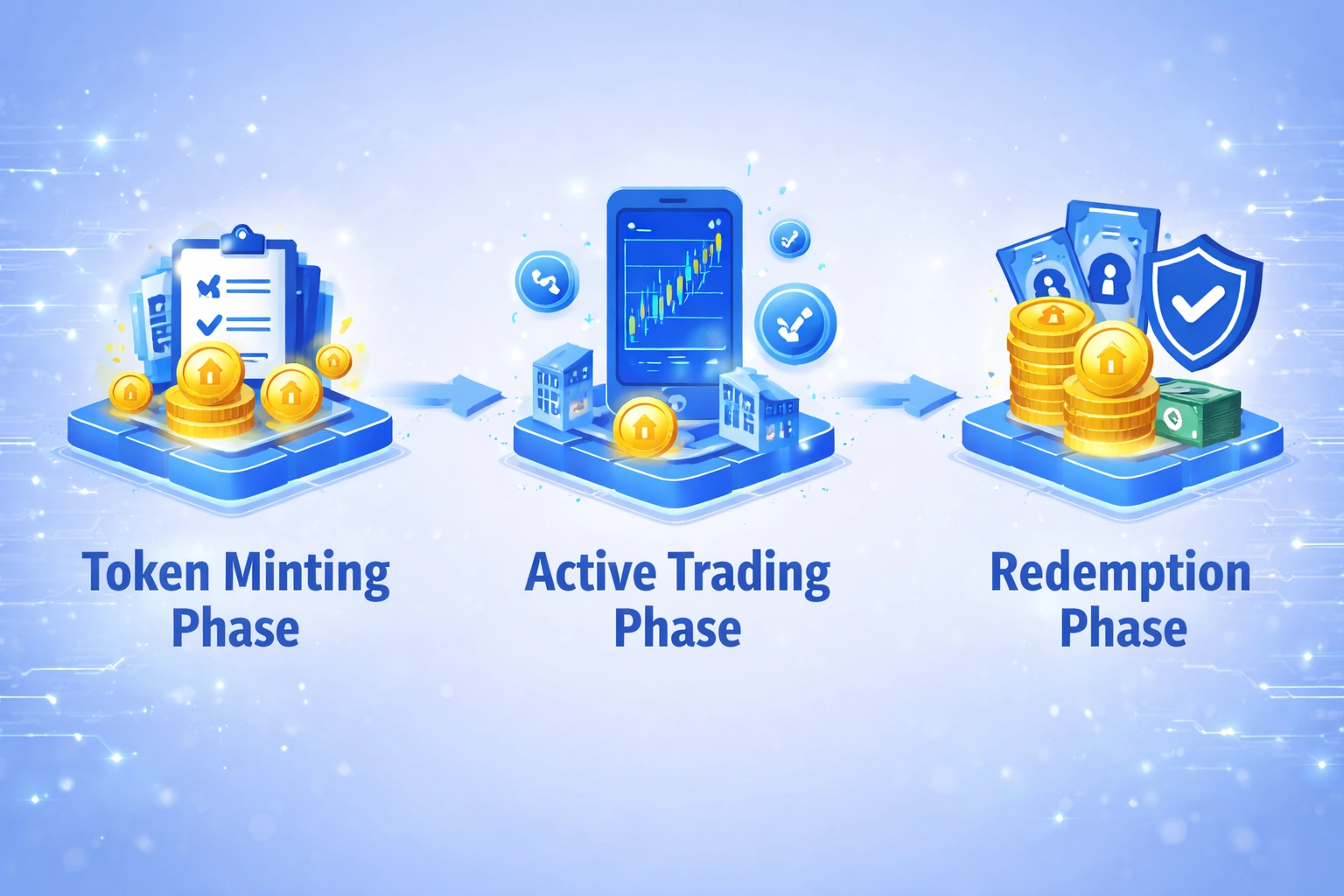
15. Asset Lifecycle Management: Minting, Transfers, and Redemption
Token Minting Phase
Initial token creation following property acquisition, legal structuring completion, and regulatory approval. Smart contracts mint tokens representing fractional ownership based on total property valuation and minimum investment thresholds.
Active Trading Phase
Secondary market trading enables token transfers between verified investors. Smart contracts enforce compliance rules, holding periods, and jurisdictional restrictions while recording all ownership changes immutably.
Redemption Phase
Property sale or refinancing triggers token redemption process. Smart contracts calculate pro-rata distributions, burn redeemed tokens, and distribute proceeds to token holders based on final ownership records.
16. Custody Models: Self-Custody vs Platform-Managed Real Estate Tokens
| Factor | Self-Custody | Platform-Managed | Institutional Custody |
|---|---|---|---|
| Control Level | Complete investor control | Platform-controlled | Third-party custodian |
| Recovery Options | Seed phrase only | Account recovery available | Multi-party recovery |
| Regulatory Status | User responsibility | Platform regulated | Licensed custodian |
| Insurance Coverage | Self-insured | Platform policy | Full institutional coverage |
| Target Investor | Crypto-native users | Retail investors | Institutional capital |
| Best Markets | Global DeFi users | USA, UK retail | UAE, Canada institutions |
Custody model selection significantly impacts platform architecture, regulatory compliance requirements, and target investor demographics. Sophisticated platforms often offer multiple custody options, enabling investors to choose based on their technical capabilities, security preferences, and regulatory requirements. This flexibility proves particularly valuable when serving diverse investor bases across the USA, UK, UAE, and Canada.
17. Scalability Challenges in Large-Scale Property Tokenization
Scaling tokenized real estate platforms to handle thousands of properties and millions of investors introduces architectural challenges across both on-chain and off-chain components. Transaction throughput limitations on public blockchains constrain the frequency of token transfers and dividend distributions, particularly during high-demand periods. Layer-2 scaling solutions, rollup technologies, and alternative blockchain networks offer varying trade-offs between throughput, cost, and security guarantees.
Off-chain systems face different scalability challenges including database performance, API throughput, and document storage capacity. Property management operations generate continuous data flows that must be processed, validated, and reconciled with on-chain records. Integration middleware must handle increasing transaction volumes without introducing bottlenecks that degrade user experience or delay critical operations like dividend distributions.
Our experience scaling platforms for institutional clients in London, Dubai, and Toronto demonstrates that scalability planning must begin during initial architecture design. Retrofitting scalability into systems designed for smaller scale often requires expensive re-engineering efforts that could have been avoided with proper upfront planning. Modular architectures that can scale individual components independently provide the flexibility needed to address bottlenecks as they emerge.
18. Hybrid Architecture Patterns for Real Estate Token Platforms
Effective tokenized real estate platforms employ hybrid architecture patterns that leverage the strengths of both on-chain and off-chain components while mitigating their respective limitations. The most successful platforms we have designed implement clear separation of concerns, placing ownership records and compliance enforcement on-chain while maintaining operational flexibility through off-chain systems. This division enables rapid iteration on user interfaces and business processes without requiring smart contract modifications.
Event-driven architectures facilitate seamless coordination between on-chain and off-chain components. Smart contract events trigger off-chain workflows for document generation, notification delivery, and external system updates. Conversely, off-chain processes submit transactions to smart contracts when compliance verifications complete or corporate actions require on-chain execution. Message queues and event buses ensure reliable delivery even during temporary system outages.
Caching and indexing layers improve performance by reducing direct blockchain queries for frequently accessed data. Subgraph protocols and custom indexing solutions maintain queryable representations of on-chain data that support the complex filtering and aggregation operations required for investor dashboards and reporting systems. These layers must balance freshness requirements against query performance, implementing appropriate update frequencies for different data types.
19. Real-World Use Cases: Fractional Ownership and Secondary Markets
Fractional ownership use cases demonstrate the transformative potential of on-chain vs off-chain asset management in real estate. A premium commercial property in Dubai valued at $50 million becomes accessible to investors through tokens representing $1,000 minimum investments. On-chain systems manage token ownership, enforce accreditation requirements for UAE and international investors, and automate quarterly rental distributions. Off-chain systems handle property management, tenant relations, and regulatory filings with Dubai Land Department.
Secondary market functionality enables token liquidity that traditional real estate investments lack. Investors in Toronto can sell their tokens to buyers in London through compliant trading venues that verify both parties meet regulatory requirements. Smart contracts enforce transfer restrictions automatically, checking jurisdictional rules, holding periods, and ownership concentration limits before approving transactions. Settlement completes in minutes rather than the weeks required for traditional real estate transfers.
Institutional adoption continues accelerating as major real estate firms in New York, London, and Dubai explore tokenization for portfolio diversification and capital efficiency. These sophisticated investors demand enterprise-grade security, regulatory compliance, and integration with existing portfolio management systems. Platforms serving institutional capital must provide comprehensive reporting, tax documentation, and audit capabilities that meet the stringent requirements of institutional investment committees and regulators.
20. Future System Design Trends in Real Estate Tokenization Platforms
Trend 1: Zero-knowledge proofs enable privacy-preserving compliance verification without exposing sensitive investor information on public blockchains.
Trend 2: Cross-chain interoperability protocols facilitate seamless token transfers between different blockchain networks serving various jurisdictions.
Trend 3: AI-powered property management automation reduces operational costs while improving tenant satisfaction and maintenance efficiency.
Trend 4: Decentralized identity solutions streamline investor onboarding while maintaining compliance with KYC and AML requirements.
Trend 5: Central bank digital currencies provide native fiat settlement rails that eliminate stablecoin counterparty risks in dividend distributions.
Trend 6: Regulatory sandbox programs in UAE, UK, and Canada accelerate innovation by providing safe environments for platform experimentation.
Trend 7: Modular compliance frameworks enable rapid adaptation to evolving regulatory requirements across multiple jurisdictions simultaneously.
Trend 8: Institutional-grade custody solutions with insurance coverage unlock pension fund and sovereign wealth fund participation in tokenized real estate.
The future of on-chain vs off-chain asset management in real estate tokenization points toward increasingly sophisticated hybrid architectures that optimize for specific use cases and regulatory environments. Platforms serving institutional investors in established financial centers like London and New York will emphasize regulatory compliance, enterprise integration, and risk management. Those targeting emerging markets may prioritize accessibility, mobile-first experiences, and innovative features that attract new investor demographics.
Our eight years of experience designing and implementing tokenized real estate platforms across the USA, UK, UAE, and Canada has demonstrated that successful system design requires deep understanding of both technical possibilities and business realities. The distinction between on-chain and off-chain components is not merely architectural but fundamentally shapes platform capabilities, regulatory posture, and competitive positioning. As the market matures, platforms that master this balance will capture the significant opportunities that tokenized real estate presents for transforming how property investment works globally.
Building for the Future of Tokenized Real Estate
Understanding on-chain vs off-chain asset management is essential for anyone building, investing in, or evaluating tokenized real estate platforms. The architectural decisions made today will determine which platforms successfully scale to serve the massive global real estate market opportunity. By carefully balancing transparency with privacy, automation with flexibility, and innovation with regulatory compliance, forward-thinking platforms can create lasting value for investors, property owners, and the broader real estate ecosystem across the USA, UK, UAE, Canada, and beyond.
People Also Ask
Q1.1. What is the difference between on-chain and off-chain asset management in real estate tokenization?
On-chain asset management refers to recording ownership data, transaction history, and token transfers directly on a blockchain, ensuring transparency and immutability. Off-chain asset management handles legal documentation, property records, tenant agreements, and regulatory compliance outside the blockchain. Both layers work together in tokenized real estate platforms, with on-chain systems managing digital ownership tokens while off-chain systems maintain physical property rights and legal enforceability across jurisdictions like the USA, UK, UAE, and Canada.
Q2.2. Why do real estate tokenization platforms need both on-chain and off-chain components?
Real estate tokenization platforms require hybrid architectures because physical properties cannot exist entirely on blockchain networks. On-chain components provide transparent ownership tracking, automated dividend distributions, and secondary market trading capabilities. Off-chain components handle property management, legal title transfers, regulatory filings, and tenant relations. This dual-layer approach ensures digital tokens maintain legal connection to underlying physical assets while benefiting from blockchain efficiency and programmability.
Q3.3. What types of data should remain off-chain in tokenized real estate systems?
Sensitive data including tenant personal information, detailed property appraisals, legal contracts, insurance documents, and maintenance records typically remain off-chain for privacy and compliance reasons. Regulatory requirements in markets like Dubai, Toronto, London, and New York mandate certain documentation stays within controlled systems. Off-chain storage also handles large files that would be prohibitively expensive to store on blockchain networks, with cryptographic hashes linking this data to on-chain records.
Q4.4. How do smart contracts manage on-chain real estate tokens?
Smart contracts automate token minting, ownership transfers, dividend distributions, and compliance enforcement for real estate tokens. These programmable contracts execute predefined rules without intermediaries, ensuring consistent treatment of all token holders. They manage investor whitelisting, transfer restrictions based on jurisdictional requirements, and automatic rent distribution calculations. Smart contracts also handle corporate actions like property sales, refinancing events, and capital calls while maintaining complete audit trails.
Q5.5. What are the security considerations for on-chain vs off-chain asset management?
On-chain security focuses on smart contract auditing, private key management, and protection against blockchain-specific attacks like reentrancy or flash loan exploits. Off-chain security addresses traditional cybersecurity concerns including database protection, access control, encryption standards, and compliance with data protection regulations like GDPR and CCPA. Hybrid platforms must secure integration points where on-chain and off-chain systems communicate, typically through oracle networks and middleware solutions.
Q6.6. How do oracle systems synchronize on-chain tokens with off-chain property data?
Oracle networks serve as trusted bridges between blockchain smart contracts and external data sources. In real estate tokenization, oracles feed property valuations, rental income figures, occupancy rates, and legal status updates to on-chain systems. These middleware solutions aggregate data from multiple sources, apply consensus mechanisms to ensure accuracy, and push verified information to smart contracts. Proper oracle design is critical for maintaining accurate on-chain representations of off-chain property performance.
Q7.7. What compliance challenges exist when managing tokenized real estate across multiple jurisdictions?
Tokenized real estate platforms operating across the USA, UK, UAE, and Canada face varying securities regulations, property ownership laws, and investor accreditation requirements. On-chain compliance modules must enforce jurisdiction-specific transfer restrictions while off-chain systems maintain documentation for each regulatory framework. Platforms must navigate different tax treatments, anti-money laundering requirements, and foreign ownership restrictions, requiring sophisticated compliance architectures that adapt to each market’s unique legal landscape.
Explore Services
Related Services
Reviewed by

Aman Vaths
Founder of Nadcab Labs
Aman Vaths is the Founder & CTO of Nadcab Labs, a global digital engineering company delivering enterprise-grade solutions across AI, Web3, Blockchain, Big Data, Cloud, Cybersecurity, and Modern Application Development. With deep technical leadership and product innovation experience, Aman has positioned Nadcab Labs as one of the most advanced engineering companies driving the next era of intelligent, secure, and scalable software systems. Under his leadership, Nadcab Labs has built 2,000+ global projects across sectors including fintech, banking, healthcare, real estate, logistics, gaming, manufacturing, and next-generation DePIN networks. Aman’s strength lies in architecting high-performance systems, end-to-end platform engineering, and designing enterprise solutions that operate at global scale.