Ai Overview
The landscape of medical education stands at a turning point where traditional teaching methods meet transformative digital innovation. 17% market share in 2024, driven by proactive regulatory frameworks and substantial investment from integrated healthcare delivery networks. A study comparing VR learning to mannequin-based learning revealed that virtual simulation activities achieved a cost-utility ratio of $1.
Key Takeaways
- The global VR in healthcare market reached USD 5.62 billion in 2024 and is projected to grow at a 30.3% CAGR through 2030, with medical training and education holding the largest share at 29.50% in 2024, indicating widespread institutional recognition of the technology’s value.
[1] - Surgeons trained using VR make 40% fewer mistakes than conventionally trained peers, demonstrating significant improvements in procedural accuracy and patient safety outcomes.[2]
- In randomized controlled trials, participants trained with VR platforms demonstrated 42% improvement in procedural accuracy, 38% reduction in training time, 45% decrease in error rates, and 48% increase in trainee confidence compared to traditional methods.[3]
- VR proves 83% more cost-effective than high-fidelity mannequin-based simulation, with costs after three years reaching $115.43 per participant for VR training compared to $327.78 for traditional live exercises.[4]
- More than 60% of medical schools worldwide had integrated VR technology into their teaching modules by 2023, reflecting rapid adoption across educational institutions globally.[5]
- Analysis of 21 studies showed 74% reported improved learning ability and 87% reported greater accuracy in actual medical practice by VR trainees, along with VR training improving overall performance by 250% according to Research Gate surveys.[6]
- With 3,000 learners, VR becomes 52% less expensive than classroom sessions, demonstrating significant cost advantages at scale while maintaining consistent training quality across locations.[7]
- The VR Medical Training Market was valued at USD 609.05 million in 2025 and is expected to reach USD 2,899.99 million by 2035, growing at a 16.6% CAGR, reflecting strong investment confidence in the technology.[8]
- North America leads global adoption with 43.17% market share in 2024, driven by proactive FDA regulatory frameworks and Medicare transitional coverage programs that facilitate reimbursement for VR-based training.[9]
- Using VR in education makes it possible to reach a four times better retention rate than traditional educational methods, while students using VR stated it enables faster work, enhances performance, and boosts motivation.[10]
Reimagining Healthcare Education in the Digital Age
The landscape of medical education stands at a turning point where traditional teaching methods meet transformative digital innovation. Augmented Reality (AR) and Virtual Reality (VR) technologies have emerged as powerful tools that are fundamentally changing how healthcare professionals learn, practice, and perfect their skills. These immersive technologies offer solutions to longstanding challenges in medical training while opening new possibilities for hands-on experience in risk-free environments.
The Growing Market for Immersive Medical Training
Market Size and Growth Projections
The numbers tell a compelling story about the rapid adoption of AR and VR in healthcare education. According to market research data, the global VR in healthcare market reached USD 5.62 billion in 2024 and projects growth at a compound annual growth rate of 30.3% through 2030. The medical training segment specifically shows remarkable expansion, with the VR Medical Training Market valued at USD 609.05 million in 2025 and expected to reach USD 2,899.99 million by 2035, growing at a 16.6% CAGR during this forecast period.
U.S. Market Leadership and Training Dominance
The U.S. augmented reality and virtual reality in healthcare market demonstrates particularly strong momentum, with market size reaching USD 1.03 billion in 2024. Analysts project this will grow at a 15.4% CAGR from 2025 to 2030. Medical training and education currently hold the largest share at 29.50% in 2024, reflecting the sector’s recognition of immersive technology’s value in preparing healthcare professionals.
Regional Adoption and Regulatory Support
North America leads global adoption with 43.17% market share in 2024, driven by proactive regulatory frameworks and substantial investment from integrated healthcare delivery networks. The region benefits from FDA initiatives that have established dedicated codes for VR behavioral therapy devices and implemented transitional coverage programs for emerging technologies. These policy supports create clearer pathways for Medicare reimbursement and encourage wider institutional adoption.
Understanding the Technology Behind Medical Training Simulations
How Virtual Reality Creates Immersive Learning Environments
Virtual reality creates fully immersive digital environments that transport users into computer-generated worlds. Through head-mounted displays and motion tracking systems, VR allows medical trainees to step into simulated operating rooms, emergency departments, or patient consultation spaces. The technology provides 360-degree visual experiences combined with spatial audio and haptic feedback, creating scenarios that closely mirror real clinical situations.
Augmented Reality’s Role in Enhanced Physical Training
Augmented reality takes a different approach by overlaying digital information onto the physical world. Rather than replacing reality entirely, AR enhances what users see in their actual environment. Medical students wearing AR glasses or using AR-enabled tablets can view 3D anatomical models superimposed on physical objects, see step-by-step procedural guidance during practice sessions, or visualize internal body structures on training mannequins. This blending of digital and physical elements maintains connection to the real world while adding valuable instructional layers.
Hardware Evolution and Modern Device Capabilities
The hardware ecosystem supporting these technologies has evolved significantly. Modern VR headsets like the HTC VIVE XR Elite and Meta Quest series offer standalone capabilities without requiring connection to powerful computers. These devices include built-in processors, high-resolution displays, and sophisticated tracking systems that monitor head and hand movements with precision. AR applications leverage smartphones, tablets, and specialized glasses like Microsoft HoloLens to deliver their enhanced reality experiences.
Software Platforms and Advanced Features
Software development platforms have matured alongside hardware advances. Medical VR applications typically incorporate realistic 3D anatomical models created from actual patient imaging data, physics engines that simulate tissue behavior and instrument interactions, AI-driven virtual patients that respond dynamically to trainee actions, and comprehensive analytics modules that track performance metrics. Many systems now integrate haptic feedback technology, allowing trainees to feel resistance when making incisions or palpating virtual tissues, adding crucial tactile dimensions to the learning experience.
You may also like:
HIPAA Cloud Security for Healthcare: Protecting Data with Compliant Cloud Infrastructure
Surgical Training Excellence Through Virtual Simulation
Moving Beyond “See One, Do One, Teach One”
Surgical education represents one of the most impactful applications of VR in medical training. The traditional model of surgical training followed the “see one, do one, teach one” approach, where novice surgeons observed procedures, then performed them under supervision before teaching others. This method posed inherent risks and limited practice opportunities. VR surgical simulators transform this paradigm by offering unlimited practice repetitions in consequence-free environments.
Evidence-Based Performance Improvements
Research demonstrates the substantial benefits of VR surgical training. Studies show that surgeons trained using VR make 40% fewer mistakes than peers trained through conventional methods alone. In a randomized controlled trial, participants trained with VR platforms showed a 42% improvement in procedural accuracy, a 38% reduction in training time, and better skill retention compared to traditional training groups. The technology also led to a 45% decrease in error rates and a 48% increase in trainee confidence levels.
Leading Platforms and Comprehensive Training Modules
Surgical simulation platforms like Osso VR and FundamentalVR have gained recognition for their comprehensive procedure libraries. These systems offer training modules covering everything from basic suturing techniques to complex minimally invasive surgeries. Trainees can practice laparoscopic procedures, robotic-assisted surgeries, and orthopedic interventions repeatedly until achieving mastery. The simulations adapt difficulty based on performance, ensuring appropriate challenge levels throughout the learning curve.
Parallels with Aviation and Safety Outcomes
The aviation industry provides a useful parallel for understanding VR’s potential impact. Since the 1970s, flight simulation training has contributed to nearly a 50% reduction in human error-related airline crashes. Medical education appears positioned for similar safety improvements as VR training becomes more widespread. Several leading medical schools already report improved surgical outcomes among graduates who completed extensive VR training programs before entering operating rooms.
Anatomy Education Reimagined
Overcoming Traditional Anatomy Teaching Limitations
Human anatomy forms the foundation of medical knowledge, yet traditional anatomy education faces significant challenges. Cadaver availability remains limited at many institutions, ethical considerations surround their use, and two-dimensional textbook illustrations struggle to convey three-dimensional spatial relationships. AR and VR technologies address these limitations while adding capabilities impossible with conventional teaching methods.
Interactive 3D Models and Holographic Learning
Applications like HoloHuman allow students to interact with immersive holographic anatomical models displaying labeled structures of male and female bodies. Students can rotate, zoom, and dissect these digital models from any angle, examining muscle attachments, vascular pathways, and nerve distributions with clarity that exceeds what cadaver dissection typically provides. The technology enables viewing multiple pathological variations that would require numerous cadavers to demonstrate in traditional settings.
Award-Winning Mixed Reality Applications
The HoloAnatomy application, developed in 2016 for Microsoft HoloLens, won recognition at the Jackson Hole Wildlife Film Festival Science Media Awards. This mixed reality application allows entire classes to simultaneously view the same life-sized 3D anatomical image, facilitating collaborative learning and instructor-led exploration. Students can uncover blood vessels, muscles, and skeletal structures layer by layer, seeing how anatomical systems work together to produce physiological functions.
Real-World Implementation and Learning Outcomes
Case Western Reserve University implemented Microsoft HoloLens devices for anatomy education, allowing students to examine detailed 3D models without traditional study materials or cadaver dissections. The approach has demonstrated improved learning outcomes, with students reporting better spatial understanding and enhanced ability to visualize complex anatomical relationships. Research indicates that medical students show significantly higher knowledge gain when using immersive environments compared to screen-based learning methods.
Exploring Anatomy at Multiple Scales
VR platforms enable students to explore anatomical structures at scales impossible in physical reality. Trainees can shrink down to travel through blood vessels, examining vascular walls at microscopic levels, or expand their perspective to understand whole-body systems. This flexibility helps students develop an intuitive understanding of anatomy that translates into better clinical decision-making and diagnostic abilities.
Emergency Response and Critical Care Training
Simulating High-Pressure Medical Scenarios
Emergency medical situations demand quick thinking, precise execution, and coordinated team responses under intense pressure. Traditional emergency training using mannequins provides valuable experience but cannot fully replicate the stress, chaos, and unpredictability of actual emergency scenarios. VR creates immersive emergency simulations that expose trainees to realistic crisis situations while capturing performance data for detailed analysis.
Comprehensive Emergency Training Platforms
Applications like PerSim, developed by MedCognition, allow emergency response training for medical and non-medical personnel. The system creates virtual patients experiencing various emergencies, complete with simulated vital signs, appropriate physical symptoms, and realistic responses to interventions. Trainees practice triaging multiple casualties, managing mass casualty incidents, and responding to natural disasters or terrorist attacks without endangering real patients.
Advanced Virtual Medical Tools and Scenarios
SimX offers what developers describe as the most comprehensive VR healthcare curriculum available, with nearly 600 virtual medical tools and props plus 100 simulations of real-world patient encounters. Medical students learn to insert IVs and place catheters, take patient vitals, interpret diagnostic imaging, and perform emergency procedures like defibrillation and intubation. The platform’s branching logic creates interactive scenarios where patient conditions evolve based on trainee actions, teaching the consequences of decisions in real-time.
Safety Training Success Stories from Other Industries
The mining industry provides evidence for VR safety training effectiveness. Introduction of VR safety training in mining operations resulted in a 43% reduction in lost time due to injuries. Healthcare emergency training shows similar promise, with VR-trained responders demonstrating faster response times and more appropriate intervention selection in simulated emergencies. Studies report that students practicing in VR for 25 minutes or more showed 85% greater confidence in their abilities.
Cost Analysis of Immersive Training Solutions
Financial Considerations for Technology Adoption
Financial considerations significantly influence technology adoption decisions in educational institutions. While VR and AR systems require upfront investment in hardware, software, and implementation, evidence increasingly demonstrates favorable long-term cost profiles compared to traditional training methods.
Comparing VR to Mannequin-Based Training Costs
A study comparing VR learning to mannequin-based learning revealed that virtual simulation activities achieved a cost-utility ratio of $1.08 USD versus $3.62 USD for mannequin-based simulation activities. When examining multiple years of use, research found VR training costs in a hospital reached $115.43 per participant after three years, while live exercise costs remained fixed at $327.78 per participant. These figures demonstrate VR’s improving cost-effectiveness as institutions scale usage across more learners.
Long-Term Cost Advantages and Scalability
According to research published in the Journal of Medical Internet Research, VR proves 83% more cost-effective than high-fidelity mannequin-based simulation. The technology eliminates recurring expenses for disposable supplies, reduces wear on physical equipment, and minimizes facility scheduling constraints. Once developed, VR simulations can serve unlimited trainees without degradation, while physical simulators require maintenance, replacement parts, and eventual retirement.
Enterprise Scale Economic Benefits
PwC analysis highlights cost-efficiency at scale. With 375 learners, VR training demonstrated cost parity with classroom learning. However, with 3,000 learners, VR becomes 52% less expensive than classroom sessions. This scalability advantage proves particularly valuable for large healthcare systems training hundreds or thousands of employees annually. The technology’s standardization also ensures consistent training quality regardless of location or instructor availability.
Real-World Hospital Implementation Results
Boston Children’s Hospital reported VR as an efficient training method because mannequin simulations are expensive. Their XR simulation lab manager noted that VR provides more training time per dollar invested, allowing nurses to gain experience with rare but critical scenarios like sepsis assessment and management. The hospital deployed VR across multiple departments, achieving positive return on investment through improved nurse preparedness and reduced orientation time.
Budget Options and Democratizing Access
Infrastructure costs continue declining as technology matures. Budget VR systems now provide effective training at accessible price points. Studies indicate that budget VR medical training serves as an effective tool for training novice surgeons, reducing the time required to learn complex procedures. This democratization of access enables smaller institutions and resource-limited settings to implement immersive training programs previously available only at well-funded academic centers.
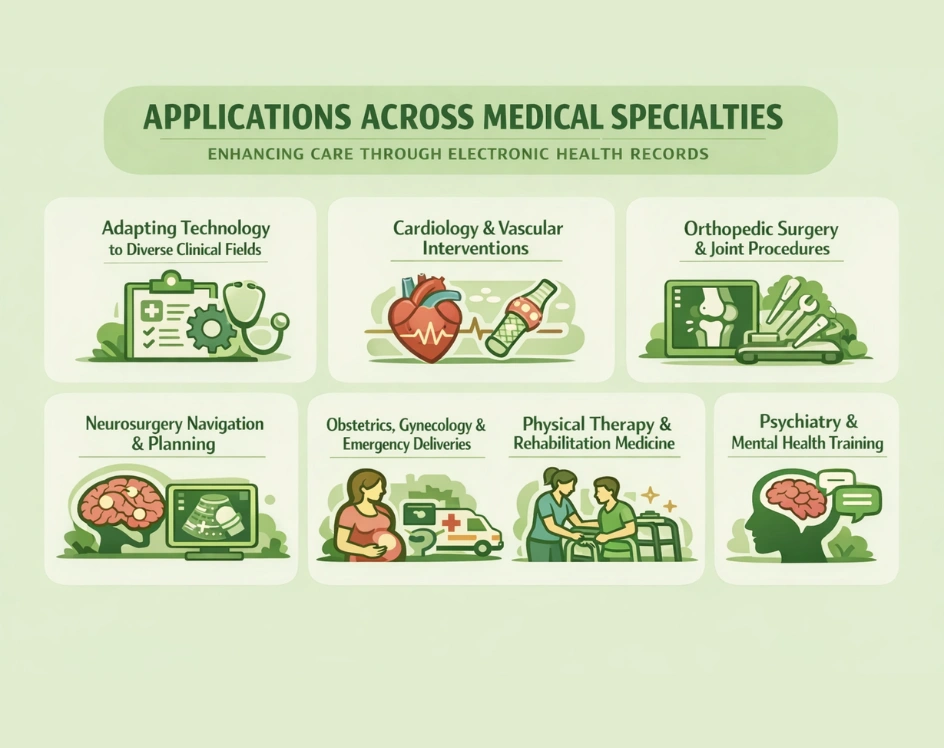
Applications Across Medical Specialties
Adapting Technology to Diverse Clinical Fields
The versatility of AR and VR technologies enables applications across virtually all medical specialties. Each field benefits from simulation capabilities tailored to its specific educational needs and clinical scenarios.
Cardiology and Vascular Interventions
Cardiology training utilizes VR to simulate routine and complex procedures, including angioplasty, cardiac catheterization, and valve repair. Trainees practice navigating guidewires through vascular systems, positioning stents, and managing complications like vessel perforation or contrast reactions. The technology allows repeated practice of rare but high-stakes situations that trainees might encounter infrequently during traditional rotations.
Orthopedic Surgery and Joint Procedures
Orthopedic surgery training benefits from VR systems focused on joint replacement procedures. 3D Systems introduced a VR system offering a detailed simulation of joint replacement surgeries, allowing trainees to practice precise bone cuts, component positioning, and soft tissue balancing. The haptic feedback in these systems helps develop the feel for bone density and tissue resistance that proves crucial in actual procedures.
Neurosurgery Navigation and Planning
Neurosurgery applications provide trainees with 3D views of patient skulls and brains to visualize tumor locations and practice surgical approaches. AR enhances actual neurosurgical procedures by overlaying patient CT scans in real-time during operations, helping surgeons navigate complex anatomy without shifting attention to separate screens. This heads-up display approach improves situational awareness and reduces cognitive load during demanding procedures.
Obstetrics, Gynecology, and Emergency Deliveries
Obstetrics and gynecology training incorporates VR simulations for procedures ranging from routine deliveries to emergency cesarean sections. Trainees practice managing shoulder dystocia, postpartum hemorrhage, and other obstetric emergencies that require rapid intervention. The technology also simulates gynecologic procedures like laparoscopic hysterectomy and minimally invasive techniques.
Physical Therapy and Rehabilitation Medicine
Physical therapy and rehabilitation settings employ VR for both training and patient treatment. Healthcare students learn assessment techniques and therapeutic interventions through virtual patient interactions. Research shows VR-based rehabilitation can achieve 20% faster gait speed recovery for stroke survivors engaged in immersive balance tasks compared to traditional therapy approaches. Practitioners at MidSouth Orthopaedic Rehab, a physical therapy clinic in Memphis known for orthopaedic and sports rehab work, observe that “Immersive environments give clinicians a controlled way to challenge balance, proprioception, and load tolerance well before a patient is ready for those demands in real life, which often translates into more durable returns to activity.
Psychiatry and Mental Health Training
Psychiatry and mental health training leverages VR to create therapeutic scenarios and teach communication skills. Trainees practice crisis intervention, suicide assessment, and trauma-informed interviewing with virtual patients programmed to display realistic emotional responses. The technology also supports training in exposure therapy techniques for treating phobias, PTSD, and anxiety disorders, competencies that clinicians increasingly manage alongside therapy practice management software in modern mental health practices.
Performance Measurement and Learning Analytics
Comprehensive Data Collection Capabilities
Modern VR medical training platforms incorporate sophisticated analytics capabilities that track learner performance with precision impossible in traditional education settings. These systems record every action, decision, and movement during simulations, generating comprehensive data for assessment and improvement.
Key Performance Metrics and AI Analysis
Performance metrics typically captured include procedure completion time, adherence to established protocols, number and severity of errors, economy of motion and efficiency, use of correct techniques and tools, and response patterns to complications. Advanced systems employ AI to analyze these metrics, identifying patterns that distinguish expert from novice performance and providing personalized feedback targeting specific skill gaps.
Multi-Perspective Replay and Review Functions
The replay functionality in VR systems allows trainees to review their performance from multiple perspectives. Students can watch simulations from their own viewpoint to understand their decision-making process, observe from overhead angles to see overall workflow and organization, or focus on specific technical elements like hand positioning or instrument handling. This multi-perspective review enhances learning by making implicit knowledge explicit and revealing habits that might otherwise go unnoticed.
Instructor Dashboards and Aggregated Insights
Instructors benefit from dashboards displaying aggregated performance data across multiple trainees. These analytics reveal common learning challenges, inform curriculum adjustments, and identify students requiring additional support. The objective nature of VR-generated data supplements subjective instructor assessments, providing a more comprehensive evaluation of trainee capabilities.
Adaptive Learning and Progressive Difficulty
Progressive difficulty adjustment represents another powerful application of performance analytics. Systems monitor trainee success rates and automatically adjust scenario complexity, introducing new challenges as skills develop while providing additional practice for struggling areas. This adaptive learning approach optimizes the training experience for each individual’s current ability level and learning pace.
Partnering with a blockchain development company to secure and timestamp these performance records adds an additional layer of integrity and portability to trainee credentials.
Comparative Analysis of Training Modalities
Healthcare education traditionally relies on multiple teaching methods, each with distinct strengths and limitations. The table below compares various training modalities to illustrate how AR/VR fits within the educational ecosystem.
| Training Method | Advantages | Limitations | Ideal Use Cases |
|---|---|---|---|
| Didactic Lectures | Efficient information delivery to large groups; consistent content presentation; low cost per student | Limited hands-on experience; passive learning; difficulty assessing practical skills | Foundational knowledge; theoretical concepts; overview of clinical conditions |
| Textbook Study | Self-paced learning; comprehensive reference material; accessible anywhere | Lacks interactivity; two-dimensional representations; no feedback on application | Independent study; review of detailed information; exam preparation |
| Cadaver Dissection | Real human anatomy; tactile experience; understanding of anatomical variation | Limited availability; ethical considerations; inability to show living physiology; single-use | Detailed anatomical education; surgical exposure; understanding of tissue relationships |
| Mannequin Simulation | Hands-on practice; physical skill development; team training opportunities | High costs; limited scenario variety; requires instructor presence; wear and degradation | Basic procedural skills; team communication practice; standardized assessments |
| Clinical Rotations | Real patient interactions; authentic clinical environment; mentorship opportunities | Variable case exposure; patient risk; limited practice repetition; scheduling constraints | Clinical reasoning; patient communication; professional development |
| VR Simulation | Unlimited practice repetitions; safe error environment; diverse scenarios; objective performance data | Initial equipment costs; requires technology comfort; lacks some tactile feedback | Rare procedures; high-risk scenarios; individual skill development; remote training |
| AR Training | Maintains real-world connection; enhances physical practice; portable implementation | Requires compatible devices; overlay accuracy challenges; processing demands | Anatomy visualization; procedural guidance; surgical planning; remote expert assistance |
This comparison demonstrates that no single modality optimally addresses all educational needs. Effective medical training programs integrate multiple approaches, leveraging each method’s strengths while compensating for limitations. VR and AR increasingly serve as valuable additions to this educational mix rather than complete replacements for existing methods.
Implementation Challenges and Practical Considerations
Technical Infrastructure Requirements
Despite compelling benefits, integrating AR and VR technologies into medical education faces several substantial challenges that institutions must address for successful adoption. Technical infrastructure requirements present immediate barriers. Healthcare institutions need reliable high-speed internet connectivity, adequate electrical capacity for charging multiple devices, secure data storage meeting HIPAA compliance standards, and IT support staff familiar with immersive technologies. Many facilities, particularly in resource-limited settings, struggle to meet these prerequisites without significant capital investment.
Device Compatibility and Integration Issues
Device compatibility and integration pose ongoing challenges. VR headsets must work smoothly with existing learning management systems, electronic health records, and educational databases. Incompatibilities between platforms create workflow disruptions and limit the technology’s utility. Ensuring minimal latency while maintaining visual fidelity proves crucial to prevent motion sickness, particularly for users prone to simulator sickness symptoms.
Content Development Costs and Expertise Gaps
Content development costs and expertise gaps slow adoption rates. Creating high-quality medical VR simulations requires collaboration between clinical experts, instructional designers, 3D modelers, programmers, and quality assurance specialists. This multidisciplinary approach proves expensive and time-consuming. Institutions often lack internal expertise for content creation, forcing reliance on commercial vendors whose products may not perfectly align with specific curricular needs.
User Adaptation and Training Needs
User adaptation challenges affect both learners and instructors. Some individuals experience motion sickness, disorientation, or eye strain when using immersive technologies. These symptoms typically diminish with exposure but can initially impair learning effectiveness. Instructors require training to effectively integrate VR/AR into curricula, assess student performance in virtual environments, and troubleshoot technical issues. Insufficient instructor preparation leads to underutilization of available capabilities.
Privacy, Security, and Cultural Barriers
Privacy and data security concerns emerge as systems collect detailed performance information. The sensitive nature of educational data requires robust protection mechanisms and clear policies regarding data access, retention, and use. Institutions must ensure compliance with educational privacy regulations while leveraging analytics to improve training outcomes.
Cultural resistance and skepticism sometimes slow adoption. Some medical educators question whether virtual training truly translates to real-world competence, preferring traditional methods despite evidence supporting VR effectiveness. Overcoming this skepticism requires demonstrating measurable improvements in learner outcomes and providing hands-on experiences that showcase the technology’s capabilities.
Standardization and Accreditation Uncertainty
Standardization and accreditation issues create uncertainty. Medical education governing bodies continue developing guidelines for incorporating simulation into curricula and determining how virtual training hours count toward certification requirements. The lack of universal standards makes institutions hesitant to invest heavily in programs that might not receive full accreditation recognition.
Breaking Down Barriers to Widespread Adoption
Collaborative Purchasing and Resource Sharing
Addressing implementation challenges requires coordinated efforts from multiple stakeholders, including technology developers, educational institutions, healthcare systems, and regulatory bodies. Collaborative purchasing models can reduce financial barriers. Consortia of institutions sharing VR content libraries and development costs achieve economies of scale unattainable by individual organizations. Device sharing programs allow multiple schools or departments to utilize the same equipment through coordinated scheduling. Cloud-based platforms reduce local infrastructure requirements by handling processing and storage remotely.
Localized Content Development Strategies
Localized content development addresses the need for culturally appropriate and specialty-specific training materials. Open-source simulation frameworks enable institutions to create custom scenarios without starting from scratch. Modular content designs allow mixing and matching components to build scenarios meeting particular educational objectives. Template-based development tools empower clinical educators to create basic simulations without extensive programming knowledge.
Faculty Training and Support Programs
Comprehensive training programs for faculty and staff prove essential for effective implementation. Professional development should cover basic device operation and troubleshooting, instructional design principles for immersive learning, assessment strategies for virtual performance, and best practices for blending virtual with traditional training. Ongoing technical support and educational consulting help instructors maximize technology utilization.
Evidence Generation Through Research
Evidence generation through rigorous research strengthens the case for VR adoption. Well-designed studies comparing learning outcomes between training modalities provide data-driven justification for investment. Publishing implementation experiences, lessons learned, and best practices accelerates knowledge dissemination across the medical education community. Documenting return on investment through metrics like reduced training time, improved patient outcomes, and decreased error rates helps secure institutional support.
Regulatory Clarity and Accreditation Standards
Regulatory clarity from accrediting bodies creates confidence for investing in immersive technologies. Clear guidelines specifying how virtual training hours contribute to certification requirements enable curriculum planning. Recognition of VR simulation as equivalent to specific traditional training experiences legitimizes the technology in professional development pathways.
Future Developments and Emerging Trends
Artificial Intelligence Integration
The trajectory of AR and VR in medical training points toward increasingly sophisticated, accessible, and effective learning experiences. Several technological advances promise to enhance immersive medical education in the coming years. Artificial intelligence integration will enable more realistic and responsive virtual patients. AI-powered characters can display natural language conversation abilities, exhibit appropriate emotional responses, show culturally diverse behaviors and health beliefs, and adapt presentations based on trainee actions in ways current scripted simulations cannot match. Machine learning algorithms will analyze trainee performance patterns to provide personalized learning recommendations and predict areas requiring additional practice.
Advanced Haptic Technology Improvements
Haptic technology improvements will add increasingly realistic tactile feedback. Advanced haptic devices can simulate the resistance of cutting different tissue types, convey the texture and firmness of organs during palpation, reproduce the sensation of suturing various materials, and provide force feedback during instrument manipulation. These developments address current limitations where virtual training lacks the physical sensations crucial to many medical skills.
5G Connectivity and Edge Computing
5G connectivity and edge computing will reduce latency issues while enabling high-fidelity graphics. Faster network speeds support remote collaborative training where geographically distributed learners share the same virtual environment in real-time. Edge computing brings processing power closer to users, minimizing lag that can trigger motion sickness or disrupt immersion.
Mixed Reality Platform Evolution
Mixed reality platforms will blur boundaries between physical and virtual elements. These systems overlay detailed holograms onto actual patients or mannequins, combining the benefits of hands-on practice with digital enhancements. Surgical trainees might practice procedures on physical models while seeing holographic guidance, simulated anatomy beneath surfaces, or real-time performance metrics in their field of view.
Biometric Integration and Stress Response Monitoring
Biometric integration will provide deeper insights into trainee readiness and stress responses. Sensors monitoring heart rate, eye tracking, galvanic skin response, and brain activity patterns reveal cognitive load, attention allocation, and emotional states during simulations. This physiological data helps instructors understand how trainees handle pressure and identify optimal training intensities for skill development.
Digital Twins and Patient-Specific Training Models
The integration of digital twins and patient-specific models will personalize education and clinical preparation. Before complex procedures, surgeons can practice on virtual replicas created from actual patient imaging data, rehearsing the specific case they will perform. This approach moves beyond generic simulation toward individualized preparation that accounts for unique anatomical variations and pathology.
Blockchain for Credential Verification
A trusted blockchain development solution may verify training credentials and track competency development across institutions. Immutable records of completed simulations, achieved skill levels, and earned certifications could follow professionals throughout their careers, providing verifiable evidence of capabilities to licensing boards and employers.
Recommended Reading:
Global Impact and Accessibility Considerations
Democratizing Medical Education Worldwide
The democratizing potential of VR and AR in medical education extends beyond wealthy nations and well-funded institutions. These technologies offer opportunities to address global healthcare workforce shortages and improve training quality in resource-limited settings.
Large-Scale Implementation Examples
The VA Immersive initiative deployed more than 1,200 VR healthcare headsets across 160 VA medical centers and clinics spanning all 50 U.S. states and Puerto Rico in June 2024, demonstrating the technology’s reach. This large-scale implementation shows how VR can standardize training quality across geographically dispersed locations, ensuring rural healthcare workers receive education comparable to urban academic centers.
Addressing Challenges in Resource-Limited Settings
Low- and middle-income countries face particular challenges, including limited medical school faculty, insufficient clinical training sites, and restricted access to expensive equipment. VR addresses these gaps by reducing dependence on physical resources and enabling self-directed learning when instructors are unavailable. A study examining VR and AR in Low- and Middle-Income Countries found that 60% of medical schools worldwide had integrated VR technology into their teaching modules by 2023.
Declining Costs and Expanded Access
Device cost reductions continue to expand access. Budget VR headsets now provide effective training at price points accessible to institutions in developing regions. Smartphone-based AR applications leverage devices already widely available, requiring minimal additional investment. As hardware costs decline and cloud-based platforms reduce local infrastructure requirements, immersive medical training becomes feasible for increasingly diverse educational settings.
Remote Learning Benefits for Underserved Areas
Remote learning capabilities prove particularly valuable for underserved areas. Trainees in rural or isolated locations can access expert instruction and sophisticated simulations without relocating to urban centers. This flexibility helps retain healthcare workers in communities most needing their services by enabling local professional development. Telemedicine and remote collaboration features in VR platforms connect learners with international experts, breaking down geographical barriers to quality education.
Accessibility Features for Diverse Learners
Accessibility for people with disabilities represents another important consideration. AR and VR can accommodate various learning styles and physical abilities in ways traditional education cannot. Visual learners benefit from 3D anatomical models and color-coded guidance systems. Individuals with mobility limitations can participate in virtual clinical rounds and procedural practice that physical restrictions might otherwise limit. Voice-controlled interfaces and gesture recognition systems support users with different motor abilities.
Industry Application Performance Metrics
Understanding real-world implementation outcomes helps institutions make informed decisions about adopting immersive technologies. The table below summarizes key performance indicators from various studies and implementations.
Industry Application Performance Metrics
| Performance Metric | Traditional Training | VR/AR Training | Improvement Percentage | Source/Study |
|---|---|---|---|---|
| Surgical Error Rate | Baseline | 40% fewer errors | 40% reduction | Finance Online study |
| Procedural Accuracy | Baseline | Significantly higher | 42% improvement | Randomized controlled trial |
| Training Time Required | Baseline | Substantially reduced | 38% reduction | Randomized controlled trial |
| Error Rates | Baseline | Markedly decreased | 45% decrease | VR platform implementation |
| Trainee Confidence | Baseline | Notably increased | 48% increase | VR platform implementation |
| Skills Knowledge | Baseline | Dramatically improved | 230% increase | Virti platform data |
| Workplace Injury Reduction | Baseline | Mining industry VR training | 43% reduction | Minesafe International |
| Learning Ability Improvement | Baseline | VR learning environments | 74% of studies show improvement | Analysis of 21 studies |
| Practical Accuracy | Baseline | VR trainees vs conventional | 87% of studies show improvement | Analysis of 21 studies |
| Cost-Effectiveness Ratio | $3.62 USD | VR vs mannequin simulation | 66% lower cost | Journal of Medical Internet Research |
| Overall Cost Comparison | Traditional methods | VR implementation | 83% more cost-effective | Journal of Medical Internet Research |
| Performance Improvement | Traditional methods | VR training scalability | 250% performance boost | Research Gate survey |
| Information Retention | Traditional methods | VR in education | 4x better retention rate | Virtual and Augmented Reality in Education |
| Welding Test Performance | Traditional training | VR-trained students | 100% performed better | Iowa State University |
| Confidence for Interviews | Pre-VR practice | 25+ minutes VR practice | 85% more confident | VirtualSpeech study |
These metrics demonstrate consistent patterns of improved learning outcomes, enhanced skill development, reduced error rates, and favorable cost profiles compared to traditional training methods. The data supporting VR and AR effectiveness continues to accumulate as more institutions implement these technologies and conduct rigorous evaluations.
The Path Forward for Medical Education
More Than Incremental Improvement
The integration of AR and VR technologies into medical training represents more than an incremental improvement to existing educational methods. These immersive tools fundamentally expand what becomes possible in healthcare education, enabling practice scenarios previously unimaginable and learning experiences that accelerate skill development while improving safety.
Consistent Evidence of Effectiveness
Evidence from multiple sources consistently demonstrates that properly implemented VR medical training improves procedural accuracy, reduces errors, shortens learning curves, and enhances trainee confidence. The technology proves particularly valuable for rare but critical procedures where real-world practice opportunities remain limited, high-risk scenarios where mistakes carry serious consequences, and standardized skill assessments where objective performance measurement proves essential.
Economic Arguments for Adoption
Cost considerations, once a primary barrier to adoption, increasingly favor immersive technologies as institutions scale implementations and hardware prices continue declining. The 83% cost advantage over high-fidelity mannequin simulation, combined with unlimited practice repetitions and consistent training quality, creates compelling economic arguments for investment. Institutions that implement VR and AR strategically report positive returns through reduced training time, improved clinical outcomes, and enhanced workforce readiness.
Ongoing Challenges and Solutions
Challenges remain, particularly around content development, technical infrastructure, instructor preparation, and standardization across institutions. However, ongoing technological advances, growing evidence bases, and collaborative approaches to implementation steadily address these barriers. The regulatory environment continues evolving toward greater recognition of simulation-based training in certification and licensioning pathways.
Thoughtful Integration of Multiple Modalities
The future of medical education will likely involve thoughtful integration of multiple modalities, with immersive technologies complementing rather than replacing traditional approaches. Cadaver dissection, clinical rotations, mentorship relationships, and direct patient care retain irreplaceable value. VR and AR augment these foundational experiences by filling gaps, providing additional practice opportunities, and enabling learning experiences impossible through other means.
Priorities for the Medical Education Community
As the technology matures and adoption accelerates, the medical education community must prioritize evidence generation, implementation research, and knowledge sharing. Rigorous studies comparing outcomes across training modalities, documentation of best practices, and transparent reporting of challenges will help institutions navigate implementation decisions and optimize educational effectiveness.
The Ultimate Goal
The transformation of medical training through immersive technologies ultimately serves a single goal: better preparing healthcare professionals to deliver safe, effective, compassionate care to patients. By this measure, AR and VR have already demonstrated substantial value, with promising potential for even greater impact as the technologies continue advancing. The question facing medical education institutions is no longer whether to adopt immersive training technologies, but how to implement them most effectively within their specific educational contexts and resource constraints.
Frequently asked questions
Q1.What is the difference between AR and VR in medical training?
Virtual Reality (VR) creates fully immersive digital environments that completely replace the real world, allowing medical trainees to step into simulated operating rooms or emergency departments through head-mounted displays. Augmented Reality (AR) overlays digital information onto the physical world, enhancing what users see in their actual environment. AR maintains a connection to the real world while adding instructional layers, such as 3D anatomical models superimposed on training mannequins or step-by-step procedural guidance during practice sessions.
Q2.How much does VR medical training cost compared to traditional methods?
VR proves 83% more cost-effective than high-fidelity mannequin-based simulation, according to research published in the Journal of Medical Internet Research. After three years of use, VR training costs reach $115.43 per participant compared to $327.78 for traditional live exercises. With 3,000 learners, VR becomes 52% less expensive than classroom sessions while maintaining consistent training quality across locations. Initial equipment costs are offset by eliminating recurring expenses for disposable supplies and reducing wear on physical equipment.
Q3.Do surgeons trained with VR perform better than those trained traditionally?
Yes, research demonstrates substantial performance improvements. Surgeons trained using VR make 40% fewer mistakes than peers trained through conventional methods alone. In randomized controlled trials, VR-trained participants showed 42% improvement in procedural accuracy, 38% reduction in training time, 45% decrease in error rates, and 48% increase in confidence levels compared to traditional training groups. These improvements translate into better patient safety outcomes and reduced complications.
Q4.What medical specialties benefit most from AR/VR training?
Virtually all medical specialties benefit from immersive training technologies. Surgery shows particularly strong applications, with platforms offering training for laparoscopic procedures, robotic-assisted surgeries, and orthopedic interventions. Emergency medicine uses VR for crisis scenarios and mass casualty training. Anatomy education across all specialties benefits from 3D visualization capabilities. Other specialties, including cardiology, neurosurgery, obstetrics, physical therapy, and psychiatry, have developed specialty-specific VR training modules tailored to their unique educational needs.
Q5.Can VR training replace hands-on clinical experience?
No, VR training complements rather than replaces traditional clinical experience. The future of medical education involves thoughtful integration of multiple modalities. Cadaver dissection, clinical rotations, mentorship relationships, and direct patient care retain irreplaceable value. VR augments these foundational experiences by filling gaps, providing additional practice opportunities for rare procedures, enabling unlimited repetition in safe environments, and offering learning experiences impossible through other means. The technology proves particularly valuable for high-risk scenarios and procedures with limited real-world practice opportunities.
Q6.How long does it take to learn to use VR medical training systems?
Most medical trainees adapt to VR systems quickly, typically within one or two practice sessions. Modern VR headsets feature intuitive controls and user-friendly interfaces designed for ease of use. Some individuals may initially experience minor motion sickness or disorientation, but these symptoms typically diminish with exposure. The learning curve for basic VR operation is minimal compared to the substantial time savings the technology provides in actual medical skill development. Studies show VR training reduces overall training time by 38% compared to traditional methods.
Q7.What are the main challenges in implementing VR medical training?
Key implementation challenges include initial infrastructure requirements such as high-speed internet connectivity, adequate electrical capacity, and HIPAA-compliant data storage. Content development costs remain high, requiring collaboration between clinical experts, instructional designers, and programmers. Device compatibility and integration with existing learning management systems pose ongoing technical challenges. Some educators show cultural resistance, questioning whether virtual training translates to real-world competence. Standardization and accreditation uncertainty create hesitation among institutions regarding how virtual training hours count toward certification requirements.
Q8.How many medical schools worldwide have adopted VR technology?
More than 60% of medical schools worldwide had integrated VR technology into their teaching modules by 2023, reflecting rapid global adoption. North America leads with 43.17% market share in 2024, driven by proactive FDA regulatory frameworks and Medicare transitional coverage programs. The VA Immersive initiative deployed over 1,200 VR healthcare headsets across 160 VA medical centers spanning all 50 U.S. states and Puerto Rico in June 2024. Adoption continues accelerating as hardware costs decline and evidence supporting effectiveness accumulates.
Q9.Does VR training improve knowledge retention compared to traditional methods?
Yes, VR demonstrates significantly better retention rates. Using VR in education achieves four times better retention compared to traditional educational methods. Analysis of 21 studies showed 74% reported improved learning ability among VR trainees. The immersive nature of VR engages multiple senses simultaneously, creating stronger memory formation. Students can practice procedures repeatedly until achieving mastery, reinforcing learning through active participation rather than passive observation. The technology’s ability to simulate realistic scenarios helps learners develop an intuitive understanding that translates better into clinical practice.
Q10.What is the future outlook for AR/VR in medical training?
The VR Medical Training Market was valued at USD 609.05 million in 2025 and projects growth to USD 2,899.99 million by 2035 at a 16.6% CAGR, reflecting strong investment confidence. Future developments include artificial intelligence integration for more realistic virtual patients, advanced haptic technology providing better tactile feedback, 5G connectivity enabling real-time collaborative training, mixed reality platforms blending physical and virtual elements, biometric integration revealing cognitive load and stress responses, patient-specific digital twins for personalized surgical rehearsal, and blockchain technology for credential verification. As technology matures and costs decline, immersive medical training will become increasingly accessible worldwide.
Reviewed by

Aman Vaths
Founder of Nadcab Labs
Aman Vaths is the Founder & CTO of Nadcab Labs, a global digital engineering company delivering enterprise-grade solutions across AI, Web3, Blockchain, Big Data, Cloud, Cybersecurity, and Modern Application Development. With deep technical leadership and product innovation experience, Aman has positioned Nadcab Labs as one of the most advanced engineering companies driving the next era of intelligent, secure, and scalable software systems. Under his leadership, Nadcab Labs has built 2,000+ global projects across sectors including fintech, banking, healthcare, real estate, logistics, gaming, manufacturing, and next-generation DePIN networks. Aman’s strength lies in architecting high-performance systems, end-to-end platform engineering, and designing enterprise solutions that operate at global scale.