Ai Overview
Cloud platforms for logistics operations are internet-based software systems that help businesses manage the full range of supply chain activities without needing to maintain physical servers or install software on local machines. The Transportation Management segment holds the largest functional share in the cloud logistics market at around 30% of total revenue.
Key Takeaways
- The global cloud logistics market was valued at USD 33.82 billion in 2024 and is projected to reach approximately USD 115.99 billion by 2034, growing at a CAGR of 13.12%.[1]
- North America held the largest share of 30% in the global cloud logistics market in 2024, driven by mature cloud computing infrastructure and strong supply chain optimization priorities.[2]
- The Asia-Pacific region is estimated to expand at the fastest CAGR of 14.25% between 2025 and 2034 in the cloud logistics market, driven by rapid e-commerce growth and expanding manufacturing bases.[3]
- Large enterprises held over 66.4% of the cloud logistics market share in 2024, as they increasingly use cloud solutions to manage complex, global supply chains.[4]
- The Transportation Management segment leads the cloud logistics market with around 30% revenue share, as companies shift from on-premise systems to cloud-native freight and transport tools.[5]
- The public cloud segment dominated the cloud logistics market with a revenue share of 29.9% in 2024, while the private cloud is growing fastest due to demand for tighter data control and compliance.[6]
- The web-based OS segment held over 54% of the cloud logistics market share in 2024, allowing logistics teams to access management platforms from any device, anywhere.[7]
- A study by Zebra Technologies in June 2024 revealed that organizations in America with real-time supply chain visibility have the potential to reduce product recalls by up to 70%.[8]
- In February 2024, Oracle announced plans to enhance its Supply Chain and Manufacturing (SCM) Fusion Cloud to improve logistics decision-making, cut costs, and automate regulatory compliance for enterprises.[9]
- Data centers currently account for up to 1.5% of global energy use and 1% of energy-related greenhouse gas emissions, which is why choosing cloud providers committed to renewable energy has become a major sustainability consideration for logistics companies.[10]
Think about how a package moves from a warehouse in one country to your doorstep in another. Behind that simple delivery is a long chain of events involving suppliers, freight companies, warehouses, customs, last-mile drivers, and dozens of digital systems. For years, managing all of this meant relying on slow, disconnected software that sat on physical servers and could not talk to one another properly.
Today, that picture is changing fast. Cloud platforms for logistics operations have stepped in to pull all those moving parts together into one connected system. Whether you run a small fleet of trucks or manage a global supply chain, cloud-based logistics management gives you the tools to track shipments live, automate paperwork, manage inventory in real time, and make smarter decisions based on actual data.
In this blog, we will walk you through everything you need to know about cloud logistics platforms, including what they are, how they work, what they offer, which industries use them most, and what challenges to watch out for. All of this is backed by real market data and industry insights.
Recommended Reading:
Logistics & Transportation Digital Solutions: Automation & Cost Reduction
What Are Cloud Platforms for Logistics Operations?
Cloud platforms for logistics operations are internet-based software systems that help businesses manage the full range of supply chain activities without needing to maintain physical servers or install software on local machines. Instead of running a transportation management system on a company’s own computer hardware, everything runs on remote servers managed by cloud providers and is accessed through a browser or mobile app.
These platforms bring together functions like order management, warehouse control, route planning, freight auditing, customs compliance, and real-time shipment tracking under one digital roof. All the data flows into a single place, so every department and every partner in the supply chain can see the same information at the same time.
There are three main types of cloud deployments used in logistics:
1. Public Cloud
In this setup, the logistics software is hosted on shared infrastructure managed by a third-party provider like Amazon Web Services, Microsoft Azure, or Google Cloud. It is the most cost-friendly option and easy to get started with. According to Grand View Research, the public cloud segment held the largest share of 29.9% in the cloud logistics market in 2024.
2. Private Cloud
Here, the cloud infrastructure is used exclusively by one organization. It offers greater control over data and is preferred by companies with strict regulatory requirements. According to Grand View Research, the private cloud segment is growing the fastest during the forecast period due to rising demand for tighter data security and compliance management.
3. Hybrid Cloud
This approach mixes public and private cloud elements. A company might store sensitive customer data on a private cloud while using a public cloud to run less sensitive logistics applications. This model gives businesses flexibility without fully giving up control.
All three models run on the same core idea: logistics software delivered over the internet, accessible from any device, and managed without the burden of maintaining physical IT infrastructure.
The Size and Growth of the Cloud Logistics Market
The numbers speak for themselves. The global cloud logistics market was valued at USD 33.82 billion in 2024 and is projected to reach approximately USD 115.99 billion by 2034, expanding at a compound annual growth rate of 13.12%, according to Precedence Research. That kind of growth does not happen by accident. It reflects a deep, structural shift in how logistics companies think about technology.
Looking at where this growth is concentrated:
1. North America Leads the Market
North America held the largest share of 30% in the global cloud logistics market in 2024. The region benefits from mature cloud computing infrastructure, heavy investment in supply chain technology, and a strong culture of digital transformation among logistics providers.
2. Asia-Pacific is growing the Fastest
Asia-Pacific is estimated to expand at the fastest CAGR of 14.25% between 2025 and 2034. Countries like India, Australia, Singapore, and emerging ASEAN economies are deploying cloud-based transport and warehouse management systems to handle growing cross-border trade volumes and complex last-mile delivery networks.
3. Large Enterprises Dominate Adoption
Large enterprises account for 66.4% of the cloud logistics market share in 2024. These companies typically manage multi-region operations, large fleets, and complex supply chains that benefit most from the visibility, automation, and analytics that cloud platforms provide.
4. E-Commerce as a Key Growth Driver
The growth in online shopping worldwide has pushed logistics companies to adopt solutions that can handle high order volumes, fast inventory changes, and delivery speed expectations. According to Global Market Insights, the cloud logistics market size was valued at USD 21.2 billion in 2023 and is expected to grow at over 12% CAGR between 2024 and 2032, owing largely to the rapid growth of e-commerce.
These numbers confirm what logistics companies on the ground are already experiencing: cloud-based logistics management, powered by Ozcoast Logistics, is no longer optional. It is the backbone of a competitive supply chain.
Cloud Logistics Market Overview by Segment (2024)
| Segment | Market Detail | Key Insight |
|---|---|---|
| Global Market Size (2024) | USD 33.82 Billion | Expected to reach USD 115.99 billion by 2034 at 13.12% CAGR |
| Leading Region | North America (30% share) | Driven by advanced cloud infrastructure and tech investment |
| Fastest Growing Region | Asia-Pacific (14.25% CAGR) | E-commerce boom and cross-border trade expansion |
| Deployment Type Leader | Public Cloud (29.9% share) | Pay-per-use pricing and low setup costs drive adoption |
| Enterprise Size Leader | Large Enterprises (66.4% share) | Complex global operations require advanced cloud capabilities |
| OS Type Leader | Web-Based OS (54% share) | Enables access from any device without software installation |
| Top Functional Segment | Transportation Management (~30%) | Route optimization and freight management are top priorities |
Sources: Precedence Research, Grand View Research, Exactitude Consultancy
Core Functions of a Cloud-Based Logistics Management Platform
A cloud logistics platform is not one single tool. It is a combination of several systems that work together to manage the end-to-end flow of goods. Here is what most mature cloud-based logistics platforms include:
1. Transportation Management System (TMS)
A TMS running on the cloud helps logistics companies plan shipments, select carriers, book freight, and track deliveries in real time. It also handles freight billing, audit functions, and carrier performance tracking. The Transportation Management segment holds the largest functional share in the cloud logistics market at around 30% of total revenue. Oracle’s 2024 update to its Transportation Management cloud application specifically improved decision-making tools and logistics network modelling for enterprises managing complex freight operations.
2. Warehouse Management System (WMS)
Cloud-based warehouse management systems, often referred to as Cloud-Based WMS, handle receiving, put-away, picking, packing, and shipping of goods inside a warehouse. They integrate with barcode scanners, RFID tags, and automated equipment to reduce manual errors and speed up order processing. According to market projections from Exactitude Consultancy, the Warehouse Management segment is expected to surpass USD 13 billion by 2034, making it one of the fastest-growing application categories in cloud logistics.
3. Inventory Management
Cloud inventory tools let businesses track stock levels across multiple locations in real time. They can set automatic reorder points, monitor fast-moving items, and flag discrepancies between what the system shows and what is physically on the shelf. This becomes especially valuable for companies with multiple warehouses or retail locations that need a single view of their stock. Using free inventory management software can help small businesses track stock without added costs, but it’s important to carefully evaluate their features and limitations to ensure they meet your specific needs.
4. Order Management
Order management modules handle the full lifecycle of a customer order from the moment it is placed to the point of delivery. They connect with e-commerce platforms, ERP systems, and customer portals to make sure every order is fulfilled correctly and on time.
5. Real-Time Shipment Visibility
This is one of the features businesses value most. Cloud logistics platforms connect with GPS systems, carrier tracking networks, and IoT sensors to show exactly where a shipment is at any moment. A Zebra Technologies study from June 2024 found that organizations in America with real-time supply chain visibility have the potential to reduce product recalls by as much as 70%.Supported by effective Zebra device management that keeps visibility tools running without disruption.
6. Supply Chain Analytics and Reporting
Analytics tools built into cloud logistics platforms turn raw operational data into useful reports. Managers can see delivery performance, carrier costs, warehouse productivity, and inventory turnover all in one place. This allows data-driven decisions rather than decisions based on guesswork.
7. Global Trade and Customs Compliance
For companies that move goods across borders, cloud logistics platforms include modules for managing customs documentation, import/export regulations, and trade compliance. Oracle’s 2024 enhancement to its Global Trade Management application added improved trade incentive tools and automated compliance features to help businesses navigate complex international shipping rules.
Recommended Reading:
Key Benefits of Cloud Platforms for Logistics Operations
Businesses do not switch to cloud-based logistics management just because it sounds modern. They switch because the advantages are very practical and directly affect their bottom line. Here is a look at what cloud logistics platforms actually deliver:
1. Lower Costs Without Expensive Hardware
Traditional logistics software required businesses to buy and maintain their own servers, hire IT teams to manage them, and pay for software licenses. Cloud logistics moves all of that to a subscription or pay-per-use model. Companies only pay for the resources they actually use. By hosting logistics systems on the cloud, businesses eliminate the need for costly servers, hardware maintenance, and dedicated IT staff. This freed-up capital can be redirected into operations, fleet expansion, or customer experience improvements.
2. Real-Time Tracking That Builds Customer Trust
Cloud-based logistics platforms give businesses and their customers live updates on where shipments are at any given moment. GPS tracking, carrier integrations, and IoT sensor data all feed into a central dashboard. This means logistics managers can spot a delay before it becomes a customer complaint, and customers themselves can track their deliveries without needing to call anyone. This level of transparency directly builds brand trust and reduces customer service costs.
3. Easy Scaling During Peak Seasons
One of the biggest operational headaches in logistics is managing peak demand periods like holiday seasons or large promotional events. With traditional on-premise systems, you either over-invest in infrastructure that sits idle most of the year or you under-invest and struggle during busy periods. Cloud logistics platforms solve this by letting businesses scale their computing resources up or down based on demand. No hardware upgrades, no long procurement cycles, just instant capacity when you need it.
4. Better Teamwork Across the Supply Chain
Cloud platforms bring all supply chain participants onto the same digital workspace. Suppliers, carriers, warehouse teams, customs brokers, and customers can all access the same data and communicate through the same system. This removes the information gaps that cause delays, errors, and misunderstandings. When everyone works from the same data, coordination improves, and the whole supply chain runs more smoothly.
5. Smarter Decision-Making Through Data
Cloud logistics platforms collect large amounts of operational data every day. Advanced analytics tools then process that data to give logistics managers insights they could not get from manual reports. They can forecast demand, identify which delivery routes cost the most, find out which suppliers are consistently late, and predict equipment maintenance needs. According to supply chain research cited by Acropolium, supply chain organizations today prioritize efficiency and cost optimization (58%), resilience (53%), and agility to support new business models (49%) as their top business concerns. Cloud analytics directly addresses all three.
6. Stronger Disaster Recovery and Business Continuity
When on-premise servers fail, logistics operations can grind to a halt. Cloud platforms provide built-in disaster recovery features, including data backup, replication, and failover solutions that keep systems running even during hardware failures, cyberattacks, or natural disasters. This is critical for logistics companies where even a few hours of downtime can result in missed deliveries and significant revenue loss.
7. Environmental Benefits Through Smarter Resource Use
Cloud computing tends to be more energy-efficient than running equivalent workloads on individual on-premise servers. Beyond energy efficiency, cloud logistics platforms help companies optimize delivery routes, reduce fuel waste, and minimize unnecessary transportation runs. According to the International Energy Agency (IEA), data centers currently account for up to 1.5% of global energy use and 1% of energy-related greenhouse gas emissions. This is why leading cloud providers are actively committing to renewable energy targets, and logistics companies choosing cloud providers with strong sustainability policies can meaningfully reduce their carbon footprint.
How Cloud Computing Works Inside a Logistics Operation
It helps to understand what actually happens under the hood when a logistics company runs its operations on a cloud platform. There are four main technology layers that make cloud computing work in logistics:
1. Infrastructure as a Service (IaaS)
This is the foundation. IaaS gives logistics companies access to virtual servers, storage, and networking over the internet. Instead of owning physical machines, they rent computing power from providers like AWS, Azure, or Google Cloud. This layer handles the raw computing needs of the logistics platform.
2. Platform as a Service (PaaS)
PaaS provides a development environment in the cloud. Logistics technology companies use this layer to build, test, and deploy their own logistics applications without managing the underlying infrastructure. This speeds up the development of custom logistics tools tailored to specific industry needs.
3. Software as a Service (SaaS)
This is what most logistics businesses interact with daily. SaaS logistics platforms like transportation management systems, warehouse management tools, and supply chain planning software are delivered entirely through a web browser or mobile app. The software vendor manages everything in the background while the logistics company simply uses it. Payment is typically monthly or annual, based on usage.
4. IoT Integration and Edge Computing
Modern cloud logistics platforms connect with IoT devices in the field. Sensors on trucks can send temperature readings for cold chain shipments. GPS devices on packages update their location every few minutes. RFID tags in warehouses update inventory counts automatically. All of this data flows into the cloud platform in near-real time, giving managers a live picture of everything happening across their logistics network.
The combination of these layers is what makes cloud-based logistics management so powerful. It is not just software sitting on a remote server. It is a connected, intelligent system that processes live data from the physical world and turns it into actionable information for logistics teams.
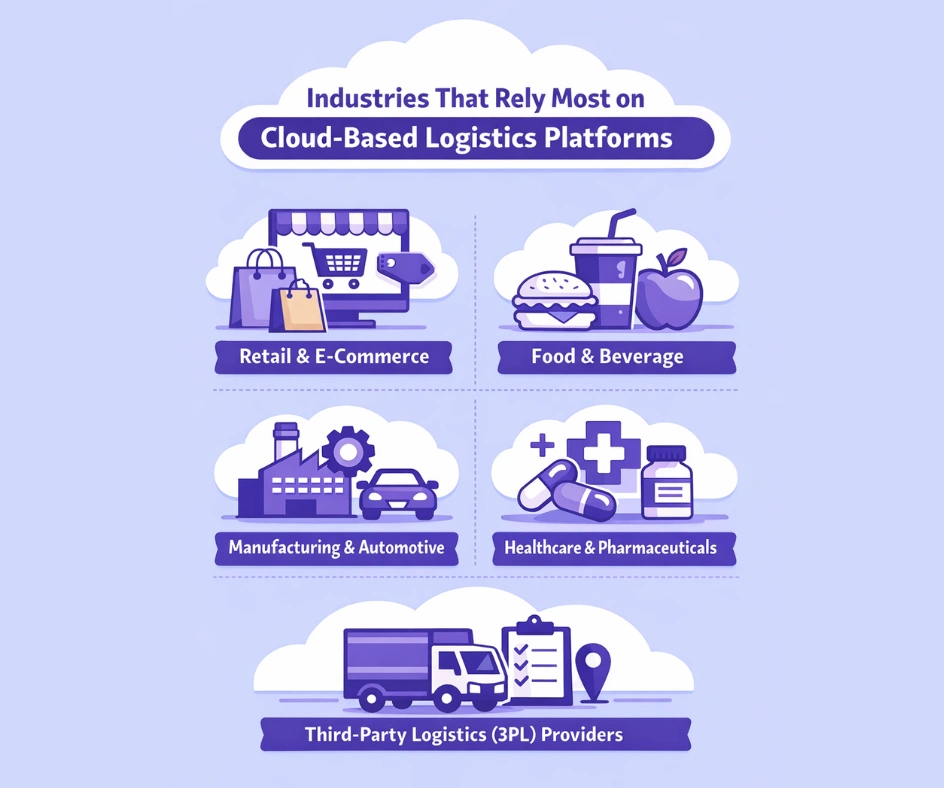
Industries That Rely Most on Cloud-Based Logistics Platforms
Cloud logistics is not limited to one type of business. Many industries have found that cloud-based supply chain management improves their operations in very specific ways. Here are some of the biggest adopters:
1. Retail and E-Commerce
Retail is the single largest end-user segment in the cloud logistics market, holding a revenue share of 23% in 2024, according to Grand View Research. Online retailers depend on cloud logistics for managing high order volumes, tracking inventory across multiple warehouses, and delivering fast and accurate shipping to customers. Cloud platforms give retailers the visibility and flexibility to meet changing consumer expectations without constantly scaling up physical infrastructure.
2. Food and Beverage (Cold Chain)
Managing perishable goods requires tight temperature control at every step of the journey. Cloud platforms integrated with IoT sensors allow food logistics companies to monitor temperature and humidity inside trucks and containers in real time. Automated alerts are sent when readings go outside the required range, allowing corrective action before goods are spoiled. This helps companies stay within food safety regulations and reduces waste significantly.
3. Manufacturing and Automotive
Manufacturing companies use cloud logistics platforms to manage just-in-time supply chains where the timing of parts deliveries is critical. A delay in one component can stop an entire production line. Cloud-based supply chain visibility tools give manufacturers early warnings when supplier shipments are delayed, so they can source from alternate suppliers before the production impact hits.
4. Healthcare and Pharmaceuticals
The healthcare sector has strict requirements around the handling and tracking of medical products, vaccines, and controlled substances. Cloud logistics platforms help pharmaceutical companies manage cold chain compliance, lot tracking, expiry date monitoring, and regulatory documentation. Any failure in this chain can have serious consequences, which is why the visibility and control that cloud platforms offer are so highly valued.
5. Third-Party Logistics (3PL) Providers
3PL companies manage logistics on behalf of other businesses. They handle warehousing, transportation, and distribution for multiple clients at the same time. Cloud logistics platforms are especially valuable for 3PLs because they can serve different clients on the same platform while keeping their data separate. The ability to quickly onboard new clients, scale operations, and offer real-time reporting makes cloud platforms the default choice for modern 3PL operations. Providers like Simple Distribution put this into practice, handling warehousing and order fulfillment for brands that would rather not run the systems themselves
Leading Cloud Logistics Platform Vendors and Their Key Strengths
| Vendor | Platform | Key Strength in Logistics |
|---|---|---|
| Oracle | Oracle SCM Cloud | Transportation management, global trade compliance, freight optimization for enterprises |
| SAP | SAP Logistics Business Network | End-to-end supply chain integration with ERP, multi-region deployments, and process standardization |
| Manhattan Associates | Manhattan Active Supply Chain | Warehouse management, order management, and carrier collaboration for retailers and 3PLs |
| Blue Yonder (JDA) | Blue Yonder Luminate Platform | AI-powered demand forecasting, inventory optimization, supply chain planning |
| Descartes Systems | Descartes Cloud | Route optimization, customs compliance, and carrier network management for freight companies |
| Kinaxis | RapidResponse | Supply chain planning, concurrent planning for fast-moving industries like electronics and automotive |
| Flexport | Flexport Platform | End-to-end freight forwarding visibility, port tracking, and customs documentation for importers/exporters |
Sources: Mordor Intelligence, Report Mines, Mark et Trends Analysis
The Role of AI and IoT in Cloud Logistics Platforms
Cloud platforms for logistics operations do not work in isolation. They are increasingly powered by artificial intelligence and connected to the physical world through the Internet of Things. Together, these technologies are changing what cloud logistics can do.
1. AI-Driven Demand Forecasting
AI models built into cloud logistics platforms can analyze historical sales data, seasonal patterns, market trends, and even external signals like weather forecasts to predict how much stock will be needed and when. This reduces the problem of overstocking (which ties up cash) and understocking (which leads to missed sales). Logistics companies that use AI-driven demand forecasting can keep inventory levels much tighter without running out of key products.
2. Route Optimization
AI-powered route planning tools inside cloud logistics platforms take multiple factors into account simultaneously, including traffic conditions, delivery windows, vehicle capacity, driver schedules, and fuel costs. They then calculate the most efficient route for each delivery. The result is fewer kilometers driven, lower fuel costs, and more deliveries completed per shift. This is particularly valuable for last-mile logistics, where delivery costs are highest.
3. Predictive Maintenance for Fleets
Cloud logistics platforms connected to vehicle telematics can monitor engine performance, mileage, and component wear in real time. AI models can predict when a vehicle is likely to need maintenance before it breaks down, allowing fleet managers to schedule repairs during off-peak hours. This reduces unplanned downtime and extends the life of fleet assets.
4. IoT Sensors for Cold Chain and Asset Tracking
IoT devices send live data to cloud logistics platforms from wherever they are. Temperature sensors inside refrigerated trucks update cold chain platforms every few minutes. GPS trackers on high-value shipments update their position continuously. RFID scanners in warehouses record every movement of goods automatically. All of this data comes together in the cloud to give logistics managers a complete, real-time picture of their entire operation.
5. Automated Alerts and Exception Management
Rather than having logistics managers constantly monitor dashboards, AI systems in cloud platforms watch for exceptions and send automated alerts when something goes wrong. A shipment delayed beyond its scheduled departure time, a temperature reading outside the permitted range, a carrier who has not confirmed a pickup: all of these trigger instant notifications so the right person can act quickly without needing to watch the screen all day.
In June 2024, CMA CGM, a major logistics solution provider, announced a partnership with Google to integrate AI across CMA CGM’s global operations. The collaboration focuses on improving employee decision-making, enhancing shipping efficiency, and making operations more responsive to market disruptions. This is a clear example of how major logistics players are embedding AI into their cloud operations at a strategic level.
Challenges of Moving to a Cloud Logistics Platform
Cloud-based logistics management is not without its difficulties. Companies that are serious about making the switch should go in with a clear understanding of the obstacles they might face:
1. Data Security and Privacy Concerns
Logistics companies handle a lot of sensitive information, including customer details, shipment contents, pricing agreements with carriers, and trade documentation. Storing all of this on cloud servers that are shared or managed by a third party raises legitimate questions about who can access the data and how it is protected. Companies need to choose cloud providers with strong encryption, access controls, and compliance certifications relevant to their industry and geography.
2. Integration with Older Systems
Many established logistics companies still run parts of their operations on legacy software that was built decades ago. Connecting these older systems to a modern cloud platform can be complex and time-consuming. Data formats may not match, APIs may not exist for older software, and some systems may need to be replaced entirely before a cloud platform can work properly across the whole operation.
3. Network Reliability
Cloud platforms depend entirely on internet connectivity. If a warehouse is in an area with poor or unstable internet service, real-time cloud applications may not work properly. Logistics companies need to assess their network infrastructure at every location before deploying cloud-based tools, and consider offline modes or backup connectivity options for critical operations.
4. Change Management and Staff Training
Switching from familiar on-premise systems to cloud platforms involves change, and people generally resist change. Warehouse staff, dispatchers, and logistics coordinators need to learn new tools, and some will find the transition difficult. Without proper training programmes and ongoing support, adoption rates suffer, and the expected benefits of the new platform may not be fully realized.
5. Managing Cloud Costs Over Time
Cloud logistics platforms start on a pay-per-use model, which sounds affordable. But as usage grows, as more users are added, and as more data is stored and processed, monthly cloud costs can increase significantly. Companies need to monitor their usage carefully, set budgets, and negotiate contracts with cloud vendors to avoid bill shock.
6. Vendor Lock-In Risk
Once a logistics company has built its entire operation around one cloud vendor’s platform, switching to a different vendor becomes very difficult. Data needs to be migrated, integrations need to be rebuilt, and staff need to be retrained. Many logistics companies are now adopting multi-cloud strategies to avoid this situation, spreading their workloads across more than one platform to maintain flexibility.
Companies need to choose cloud providers with strong encryption, access controls, and compliance certifications. In some cases, businesses also explore cloud storage alternatives to gain better control over sensitive data and avoid vendor lock-in.
Recommended Reading:
How to Choose the Right Cloud Logistics Platform for Your Business
With so many options in the market, choosing the right cloud-based logistics platform can feel overwhelming. Here are the most important factors to evaluate:
1. Define Your Core Operational Needs First
Before looking at any platform, document what your logistics operation actually needs. Do you need a transportation management system, a warehouse management system, both, or something more specialized like cold chain tracking or customs compliance? Starting with a clear list of requirements helps you avoid paying for features you do not need and ensures the platform you choose actually solves your problems.
2. Check Integration Capabilities
A cloud logistics platform that cannot connect to your existing ERP, e-commerce system, or carrier network is not useful. Look for platforms with open APIs, pre-built connectors for common business systems, and a history of successful integrations with software similar to what you already use.
3. Evaluate Data Security and Compliance Features
Ask potential vendors about their data encryption standards, access control features, audit logging capabilities, and any compliance certifications they hold such as ISO 27001, SOC 2, or GDPR compliance. For businesses in regulated industries like food, pharma, or cross-border trade, compliance features are non-negotiable.
4. Look at Total Cost of Ownership
Compare not just the subscription price but the full cost of running the platform, including implementation fees, integration costs, training, ongoing support, and potential usage-based charges as your volumes grow. A platform that looks cheap upfront can become expensive quickly if the pricing model scales steeply with data volume or number of users.
5. Assess the Vendor’s Industry Experience
A cloud logistics vendor that has served companies similar to yours in terms of size, geography, and industry brings a lot of value beyond just software. They understand your specific challenges, can configure the platform appropriately, and can offer guidance based on what has worked for others in your situation.
6. Request a Live Demo and a Pilot Period
Reading vendor brochures only goes so far. Ask for a live demonstration of the platform running real logistics scenarios similar to your own. Better still, negotiate a pilot period where you can run the platform on part of your operation before committing to a full rollout. Real-world testing is the best way to find out if a platform truly fits your workflow.
Build Your Cloud Logistics Platform Today:
We bring 8+ years of software development expertise to cloud-based logistics management. Our team handles everything from cloud architecture design to ERP integration, real-time tracking modules, and custom supply chain analytics. Whether you need a transportation management system, a warehouse platform, or a full cloud logistics suite, we build solutions that are built for how your operation actually works.
Final Thoughts
Cloud platforms for logistics operations have moved from being a technology trend to a fundamental part of how modern supply chains function. The data confirms this clearly. The global cloud logistics market, valued at USD 33.82 billion in 2024, is on its way to USD 115.99 billion by 2034, with companies across retail, manufacturing, healthcare, and freight driving adoption at a steady pace.
What makes cloud-based logistics management so compelling is not any single feature but the combination of things it enables. You get real-time visibility across your entire supply chain. You get the ability to scale your operations quickly without buying hardware. You get data and analytics tools that turn daily operational noise into clear business intelligence. And you get a platform where every partner in your supply chain, from suppliers to carriers to customers, can work from the same information.
The challenges are real, too. Data security needs careful attention. Legacy system integration takes time and planning. Staff need training and support through the transition. Cloud costs need to be monitored as usage grows. But none of these challenges outweigh the long-term advantages for businesses that are serious about staying competitive in a market that is only getting faster and more demanding.
The question for most logistics companies today is no longer whether to move to a cloud logistics platform. It is how to do it well. That means starting with a clear understanding of your own operational needs, choosing a platform with strong integration capabilities and a proven industry track record, and planning the rollout carefully so adoption is smooth and the benefits come quickly.
Businesses that move thoughtfully and decisively on cloud logistics will find themselves better placed to handle demand fluctuations, serve customers better, and build the kind of supply chain resilience that protects them from disruptions they cannot predict.
Frequently Asked Questions
Q1.What is cloud computing in logistics?
Cloud computing in logistics means running your supply chain software, such as shipment tracking, warehouse management, and route planning, over the internet instead of on physical servers at your location. It gives logistics teams access to live data, automation tools, and reporting from any device, anywhere, without needing to manage IT infrastructure themselves.
Q2.What are the top 3 cloud platforms?
The top 3 cloud platforms used in logistics are Amazon Web Services (AWS), Microsoft Azure, and Google Cloud. AWS leads in market share globally, Azure is widely preferred by enterprises already using Microsoft tools, and Google Cloud is known for its strong data analytics and AI capabilities.
Q3.What are the 7 Ps of logistics?
The 7 Ps of logistics are Product, Price, Place, Promotion, People, Process, and Physical Evidence. These are the key elements that logistics and supply chain managers focus on to make sure the right goods reach the right customer, at the right time, in the right condition, and at the right cost.
Q4.What are the 4 types of cloud services?
The 4 types of cloud services are Infrastructure as a Service (IaaS), Platform as a Service (PaaS), Software as a Service (SaaS), and Function as a Service (FaaS). In logistics, SaaS is the most commonly used type as it covers ready-to-use platforms like transportation management systems and warehouse tools that teams can access directly through a browser.
Q5.What is the difference between a cloud logistics platform and traditional logistics software?
Traditional logistics software is installed on physical servers owned and maintained by the company. Cloud logistics platforms run on remote servers managed by a cloud provider and are accessed through a browser or app. Cloud platforms eliminate the need for hardware investment, offer faster updates, and allow access from anywhere. Traditional on-premise software typically requires dedicated IT staff for maintenance and cannot scale as easily during peak periods.
Q6.How does cloud-based logistics management improve supply chain visibility?
Cloud logistics platforms integrate with GPS tracking systems, carrier networks, IoT sensors, and warehouse management tools to pull live data from across the supply chain into one central dashboard. This means logistics managers can see where every shipment is at any moment, monitor warehouse operations in real time, and receive automated alerts when something goes off track without needing to call different teams or check separate systems manually.
Q7.Is cloud-based logistics suitable for small and medium businesses?
Yes. Cloud logistics platforms are available on subscription and pay-per-use pricing models, which means small and medium businesses do not need to make large upfront investments to get started. Many vendors offer entry-level packages with core features that can be expanded as the business grows. The ability to scale without purchasing new hardware makes cloud logistics particularly useful for growing companies whose volumes fluctuate.
Q8.How do cloud logistics platforms handle data security?
Leading cloud logistics platforms use multiple layers of security, including data encryption in transit and at rest, multi-factor authentication for user access, role-based permissions that limit who can see which data, regular security audits, and compliance with industry standards such as ISO 27001 and SOC 2. Companies with specific regulatory requirements, such as GDPR in Europe or HIPAA in healthcare, should verify that their chosen vendor holds the relevant certifications.
Q9.What is the role of AI in cloud logistics platforms?
Artificial intelligence enhances cloud logistics platforms in several important ways. AI models improve demand forecasting accuracy by analyzing historical data and market signals. Route optimization algorithms calculate the most fuel-efficient delivery paths in real time. Predictive maintenance tools monitor fleet health and flag maintenance needs before breakdowns occur. Anomaly detection systems identify unusual patterns in logistics data that may indicate fraud, error, or supply chain disruption. AI also powers the automated alert systems that notify managers when key thresholds are crossed.
Q10.How long does it take to implement a cloud logistics platform?
Implementation timelines vary significantly depending on the size of the operation, the complexity of existing systems, and how much customization is required. A small business deploying a standard SaaS logistics platform with limited integrations might be up and running in a few weeks. A large enterprise rolling out a fully integrated cloud logistics suite across multiple countries and connecting to numerous legacy systems could take six months to a year or more. The most important factors that affect timeline are the readiness of your existing data, the quality of your integration plan, and how well the change management process is handled.
Explore Services
Related Services
Reviewed by

Aman Vaths
Founder of Nadcab Labs
Aman Vaths is the Founder & CTO of Nadcab Labs, a global digital engineering company delivering enterprise-grade solutions across AI, Web3, Blockchain, Big Data, Cloud, Cybersecurity, and Modern Application Development. With deep technical leadership and product innovation experience, Aman has positioned Nadcab Labs as one of the most advanced engineering companies driving the next era of intelligent, secure, and scalable software systems. Under his leadership, Nadcab Labs has built 2,000+ global projects across sectors including fintech, banking, healthcare, real estate, logistics, gaming, manufacturing, and next-generation DePIN networks. Aman’s strength lies in architecting high-performance systems, end-to-end platform engineering, and designing enterprise solutions that operate at global scale.