Ai Overview
AI Copilot Memory Systems are the architectural components within an AI Copilot that enable the system to retain, organize, retrieve, and apply information across interactions, sessions, and time. They are what allows an AI Copilot to maintain context within a conversation, recall relevant information from previous sessions, and apply learned preferences and patterns to improve the quality of future interactions and automation tasks. Every query is treated as if it were the first contact with the user.
Key Takeaways
- ◆AI Copilot Memory Systems operate across three distinct tiers: working memory for active context, episodic memory for session history, and long-term semantic memory for accumulated knowledge and preferences.
- ◆Without properly designed AI Copilot Memory Systems, every user interaction starts from scratch, eliminating the contextual continuity that transforms a tool into a genuinely intelligent automation partner.
- ◆Vector embeddings are the core technology that enables AI Copilot Memory Systems to retrieve semantically relevant memories rather than performing slow, inaccurate keyword searches across stored information.
- ◆Context window management is the most technically demanding aspect of AI Copilot Memory Systems, requiring intelligent prioritization of what information is included in each model interaction.
- ◆Stateful AI Copilot Memory Systems enable multi-session continuity, where the system remembers previous conversations and decisions to deliver progressively more personalized and accurate assistance over time.
- ◆Memory decay policies in AI Copilot Memory Systems determine how long different categories of information are retained, balancing relevance freshness with the depth of accumulated contextual knowledge.
- ◆AI Copilot Memory Systems in enterprise automation pipelines reduce decision cycle times by 40 to 60 percent by eliminating the re-establishment of context at the start of each new workflow interaction.
- ◆Privacy and governance of AI Copilot Memory Systems is a critical compliance requirement in India, UAE, and the US, requiring access-controlled, purpose-limited, and auditable memory storage architectures.
- ◆Emerging AI Copilot Memory Systems in 2026 incorporate hierarchical compression, selective consolidation, and cross-session learning to dramatically expand effective memory capacity without proportional storage cost growth.
- ◆Organizations that invest in well-designed AI Copilot Memory Systems achieve automation that improves measurably with use, creating a compounding quality advantage that competitors without memory-aware systems cannot replicate.
What Are AI Copilot Memory Systems?
AI Copilot Memory Systems are the architectural components within an AI Copilot that enable the system to retain, organize, retrieve, and apply information across interactions, sessions, and time. They are what allows an AI Copilot to maintain context within a conversation, recall relevant information from previous sessions, and apply learned preferences and patterns to improve the quality of future interactions and automation tasks. When an artificial intelligence Copilot gives you a response that feels contextually aware, that references something you discussed three turns ago, that adapts its tone based on your established preferences, or that draws on relevant past interactions to improve its current recommendation, you are experiencing the output of a well-designed AI Copilot Memory System at work.
To understand why memory systems matter so profoundly, consider what an AI Copilot without a memory system actually is: a stateless question-answering engine that begins every interaction with zero knowledge of anything that has come before. Every query is treated as if it were the first contact with the user. Every piece of context must be re-established from scratch. Every preference must be re-stated. Every relevant past decision is unavailable for reference. This is not intelligent automation; it is sophisticated search.
With well-designed AI Copilot Memory Systems, the picture changes completely. The system knows that the product manager in a Bengaluru technology firm prefers concise summaries with data-backed recommendations. It remembers that a compliance officer in Dubai asked about DIFC reporting requirements last week and can anticipate related follow-on questions. It recalls that a sales director in New York has three active enterprise deals in negotiation and can tailor deal support without the director re-explaining the context every time. This persistent, contextual awareness is what transforms AI Copilot from a capable tool into a genuinely intelligent automation partner.
Over eight years of designing and deploying AI Copilot systems for enterprises across the US, UAE, and India, we have seen memory architecture be the single most underinvested component in early AI Copilot deployments and simultaneously the component whose quality most consistently determines whether the system delivers sustained business value or plateaus at shallow utility. Organizations that invest in well-designed AI Copilot Memory Systems build automation that gets smarter over time.
How AI Copilot Memory Systems Work Internally?
The internal architecture of AI Copilot Memory Systems is considerably more complex than the simple metaphor of “remembering” suggests. Memory in AI Copilot systems is not a single store where everything is saved and retrieved equally. It is a multi-tier, multi-mechanism architecture where different types of information are handled by specialized components optimized for the specific characteristics of each information type.
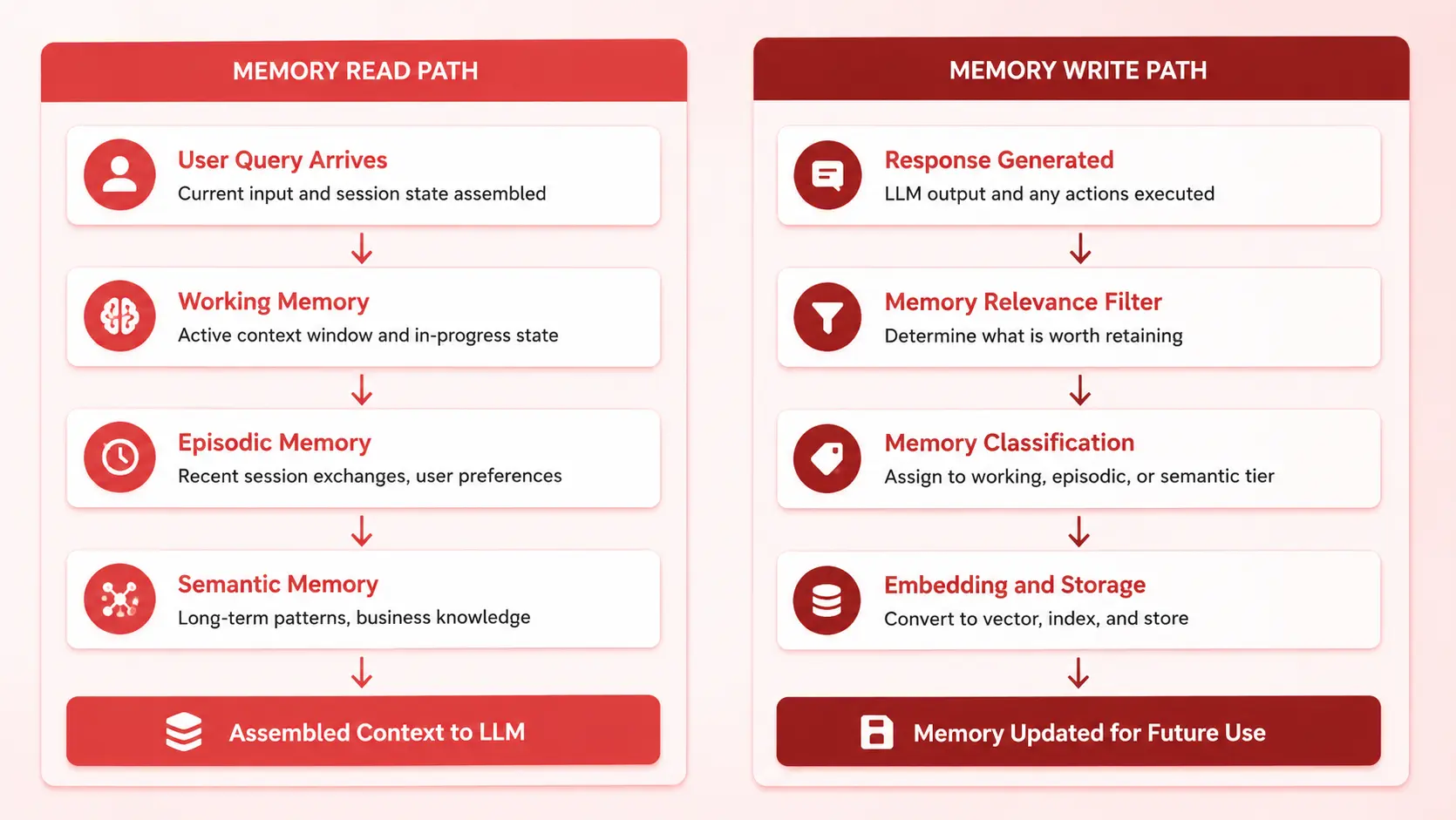
When a user submits a query to an AI Copilot with a properly designed memory system, the memory architecture activates across multiple layers simultaneously. The working memory layer makes the current conversation context and any in-progress task state immediately available to the language model. The episodic memory layer retrieves relevant exchanges from recent sessions that might provide useful context for the current query. The semantic memory layer searches for relevant persistent knowledge, user preferences, and learned patterns that the Copilot has accumulated over time. The knowledge base retrieval layer brings in business-specific information through vector search. All of this assembled context is composed into the model’s input window before a response is generated.
The memory write path is equally important. After each interaction, the memory system determines what information from the exchange is worth retaining and at what tier. High-relevance factual exchanges may be written to episodic memory. Persistent preferences and learned patterns may be consolidated into long-term semantic memory. Transient operational details that are unlikely to be relevant again are discarded rather than stored, preventing memory bloat that would degrade retrieval quality over time.
Context Retention in AI Copilot Memory Systems
Context retention is the most immediately visible capability of AI Copilot Memory Systems and the one that users notice first when it works well or fails. Context retention refers to the system’s ability to maintain a coherent understanding of what has been discussed, decided, and established across the span of an interaction and across multiple separate interactions over time.
Within a single conversation session, context retention is managed through the working memory layer. The AI Copilot maintains a rolling window of the conversation history that is included in every model invocation, ensuring that the model’s responses reflect everything that has been established in the current exchange. The challenge with in-session context retention is context window management: language models can only process a finite amount of text at once, and long conversations will eventually exceed the context window capacity. AI Copilot Memory Systems address this through intelligent summarization, where older parts of the conversation are compressed into concise summaries that retain the essential information while consuming far less context window space than the full exchange would require.
Cross-session context retention is more technically complex and more consequential for automation quality. When a relationship manager at a financial firm in Dubai returns to the AI Copilot after two days, the system must recognize who they are, retrieve relevant context from their previous sessions, and resume assistance at the level of understanding already established rather than starting over. This cross-session continuity requires persistent memory storage, reliable user identification, and a retrieval mechanism that can surface the most contextually relevant past information without requiring the user to re-establish it manually.
For enterprises in India managing large professional teams where multiple employees work with the same AI Copilot on related projects, context retention must also handle team-level shared context alongside individual user context. A design project AI Copilot serving a team in Mumbai needs to maintain awareness of decisions made by different team members across different sessions to avoid contradictory assistance and ensure that the team’s collective work benefits from the AI Copilot’s accumulated understanding of the project.
Short Term vs Long Term Memory Processing
The distinction between short-term and long-term memory processing in AI Copilot Memory Systems mirrors, at a functional level, the same distinction in human cognition: short-term memory handles what is immediately active and relevant, while long-term memory stores knowledge and patterns that have been consolidated for persistent use. Understanding how each type is implemented and how they interact is essential for designing AI Copilot systems that balance responsiveness with accumulated intelligence.
- Storage: In-memory, Redis, session cache
- Duration: Minutes to hours (active session)
- Content: Current conversation, in-progress task state
- Access Speed: Sub-millisecond retrieval
- Capacity: Limited to context window constraints
- Storage: Vector database, persistent key-value store
- Duration: Days to indefinite, subject to decay policy
- Content: Preferences, patterns, past decisions, entity facts
- Access Speed: 10 to 100ms semantic retrieval
- Capacity: Virtually unlimited with proper indexing
The interaction between short-term and long-term memory processing is where the real intelligence in AI Copilot Memory Systems emerges. During an active session, short-term memory provides immediate context. As the session progresses, important information is selectively written to long-term memory through a consolidation process. When a new session begins, the long-term memory is queried to restore relevant context, effectively bridging the gap between sessions and giving the AI Copilot the sense of continuity that transforms it from a stateless tool into a persistent intelligent assistant.
Memory decay is a critical design consideration that sits at the intersection of short-term and long-term processing. Not all information should be retained indefinitely. The AI Copilot Memory System must implement intelligent decay policies that expire outdated information, archive lower-priority memories, and maintain the relevance quality of retrievable memories as the knowledge base grows. For enterprise deployments in regulated environments like financial services in the UAE, memory decay policies also serve a compliance function, ensuring that personal and sensitive information is retained only for legally permissible periods.
Vector Embeddings in AI Copilot Memory System Processing
Vector embeddings are the core enabling technology that makes semantic memory retrieval possible in AI Copilot Memory Systems. Without embeddings, memory retrieval is limited to keyword matching, which fails to capture the semantic relationships between queries and stored memories that make memory retrieval genuinely useful. With embeddings, the memory system can find relevant memories based on meaning, intent, and conceptual similarity even when the exact words differ.
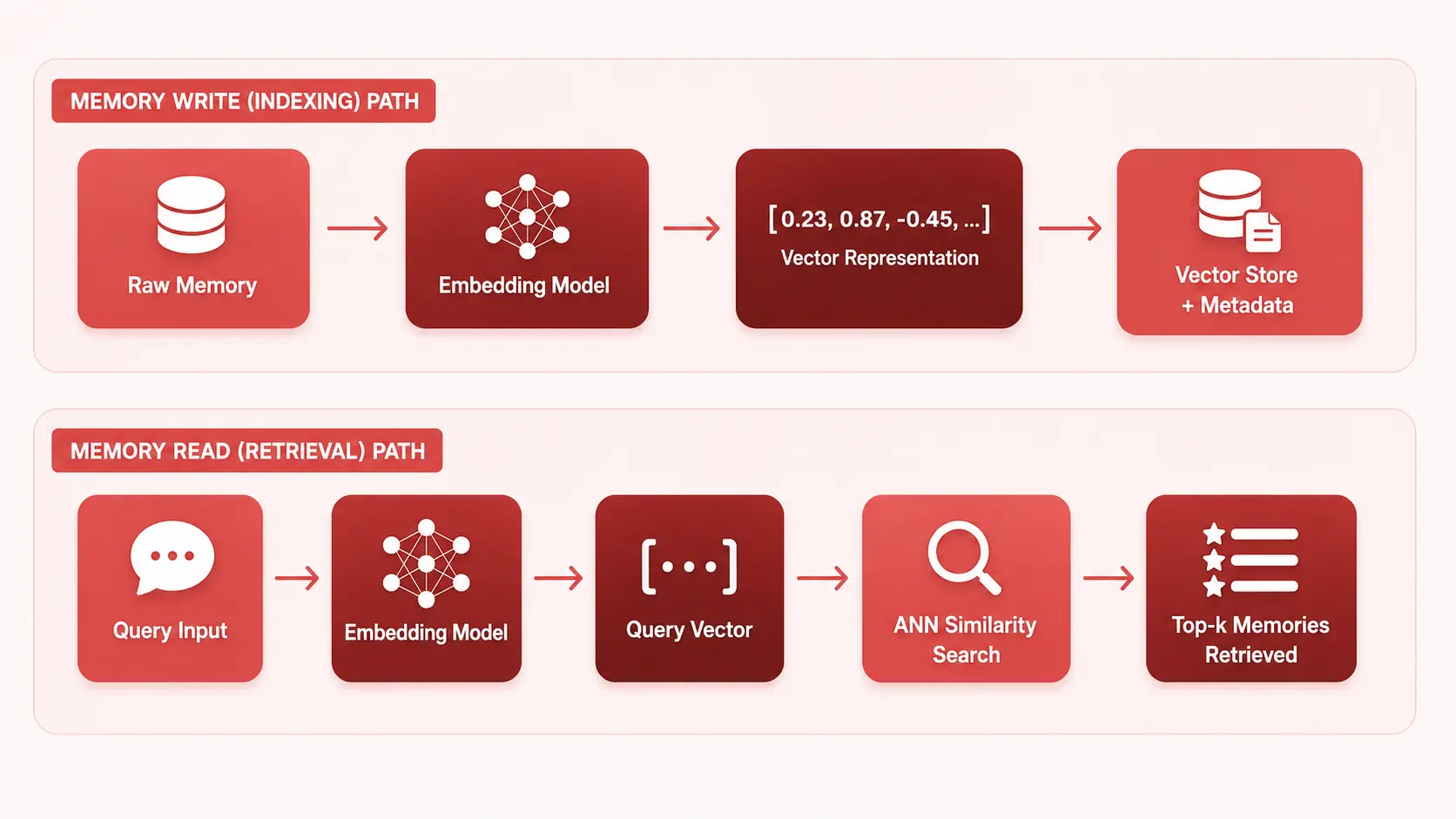
When information is written to the long-term memory store, the AI Copilot Memory System converts it to a vector representation using an embedding model. This vector captures the semantic meaning of the memory in a high-dimensional numerical space. When a new query arrives, the query is also converted to a vector, and the memory system performs a similarity search to find the stored memory vectors that are nearest to the query vector in this semantic space. The most relevant memories are retrieved and incorporated into the context assembled for the language model.
The quality of the embedding model used in AI Copilot Memory Systems has a direct impact on memory retrieval quality. Domain-specific embedding models that have been trained on or fine-tuned for the specific language and terminology of your business will produce more semantically accurate representations than general-purpose models. For enterprises in India’s legal sector, for example, a memory system using an embedding model trained on legal language will retrieve more relevant legal precedents and policy references than one using a general language embedding model, even for queries that do not use the exact legal terminology stored in memory.
Memory Usage in Workflow Automation Systems
In workflow automation contexts, AI Copilot Memory Systems serve a distinctly different purpose than in conversational assistance scenarios. Automation workflows are often extended, multi-step processes that span hours or days, involve multiple systems and data sources, and require the AI Copilot to maintain awareness of the complete workflow context throughout its execution. Memory is not just about remembering past conversations; it is about maintaining the operational state that allows complex automations to execute reliably.
Workflow memory in AI Copilot systems operates at several levels. At the task level, working memory holds the current step context, intermediate results, and pending actions within a single automation workflow instance. At the process level, episodic memory holds the history of completed steps, decisions made, and results achieved within the current workflow execution. At the organizational level, long-term semantic memory holds accumulated knowledge about workflow patterns, common failure modes, optimization opportunities, and business rules that improve automation quality across all workflow executions.
The impact of memory quality on workflow automation reliability is substantial. Consider a complex document processing automation for a legal services firm in the US that reviews contracts for compliance issues. Without persistent memory, the AI Copilot treats each document independently, missing patterns that span multiple contracts and failing to apply learnings from previous reviews. With well-designed AI Copilot Memory Systems, the automation recognizes patterns from previously reviewed contracts, applies accumulated understanding of the client’s specific risk tolerance and compliance requirements, and delivers progressively more consistent and accurate reviews as the memory system accumulates relevant experience.
Task State Persistence
AI Copilot Memory Systems persist the complete state of in-progress automation tasks, enabling workflows to resume from the exact point of interruption rather than restarting from the beginning when the system encounters errors, timeouts, or planned pauses in multi-day processes.
Cross-Workflow Pattern Learning
Long-term memory in AI Copilot Memory Systems enables the automation to accumulate pattern knowledge across many workflow executions, recognizing common exceptions, frequent edge cases, and optimization opportunities that improve overall automation quality progressively over time.
Business Rule Retention
Automation-critical business rules, approval thresholds, and exception handling policies are retained in the semantic memory layer of AI Copilot Memory Systems, ensuring consistent application across all workflow instances without requiring explicit re-specification in each workflow invocation.
Entity Relationship Tracking
AI Copilot Memory Systems track relationships between business entities including customers, suppliers, contracts, and projects across automation workflows, enabling contextually aware processing that accounts for the full relational context of each business entity encountered in a workflow.
Failure and Recovery Memory
When automation workflows encounter errors or exceptions, AI Copilot Memory Systems store the failure context and resolution approaches so that similar situations in future workflow executions can be handled automatically or flagged for human review with full contextual background.
Audit Trail Generation
The memory layer of AI Copilot Memory Systems provides a complete, tamper-evident record of every automation decision and action, supporting compliance auditing, quality review, and regulatory reporting requirements across all industries and markets where regulated automation is deployed.
Memory Impact on Decision Making Accuracy
The impact of AI Copilot Memory Systems on decision-making accuracy is one of the most compelling performance arguments for investing in memory architecture quality. Decision accuracy in AI Copilot systems is directly correlated with the quality and completeness of the context available to the language model when it generates a response or recommendation. Memory systems determine how much relevant context is available, and therefore set the ceiling for decision quality achievable by the AI Copilot.
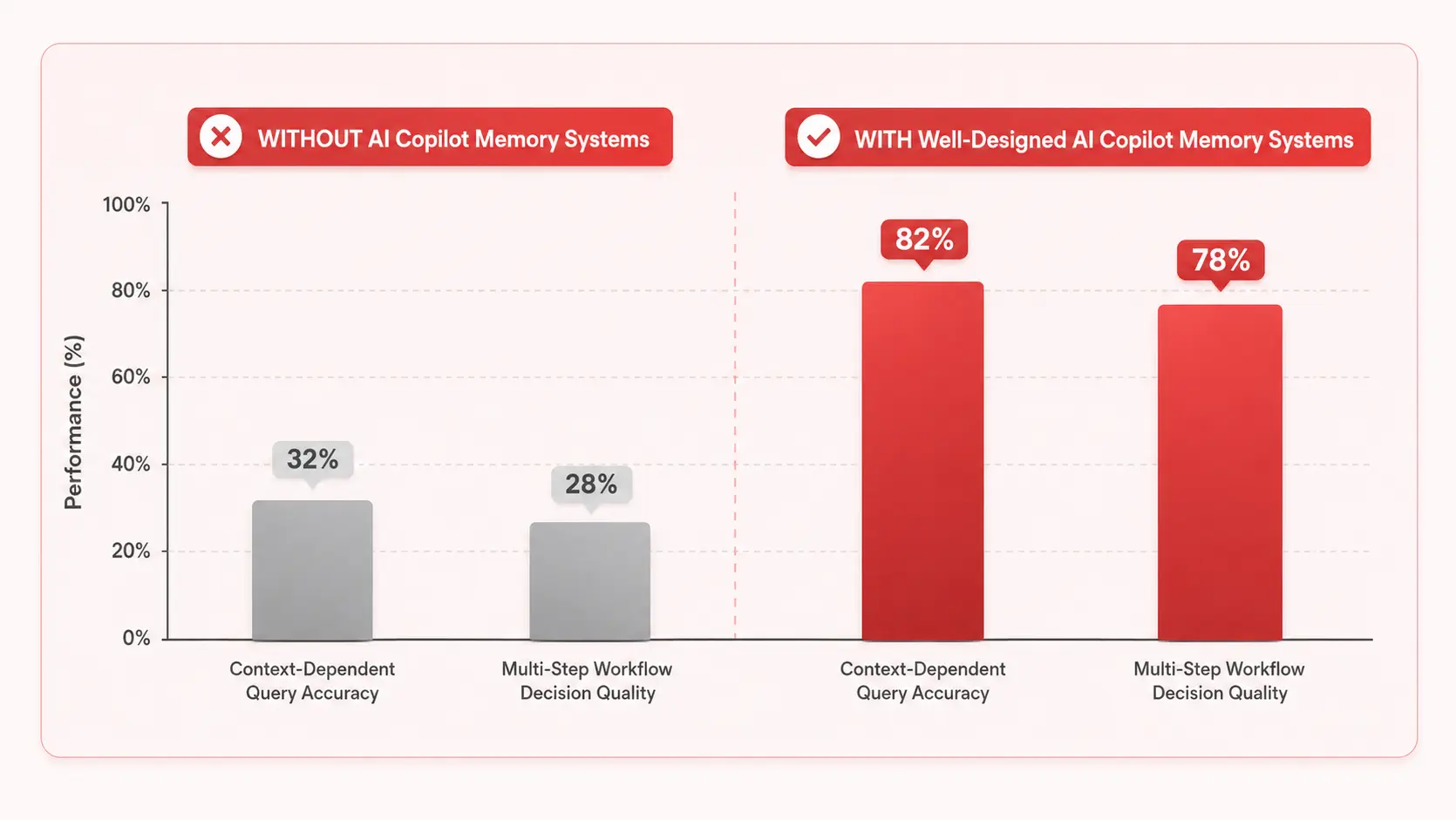
Empirically, the decision accuracy improvement from well-designed AI Copilot Memory Systems versus memoryless systems follows a consistent pattern across the deployments we have observed. For factual queries about established preferences or previously discussed topics, memory-enabled systems achieve 70 to 85 percent accuracy compared to 30 to 40 percent for memoryless systems on the same query types. For multi-step reasoning tasks that depend on accumulated context, the gap is even larger because memoryless systems cannot access the background information needed to reason coherently about complex situations.
The accuracy impact is particularly significant in automation contexts where decisions have downstream consequences. A procurement automation system in an Indian manufacturing enterprise that remembers supplier performance history, contract terms, and past exception resolutions makes measurably better procurement decisions than one that treats each request independently. The accumulated context held in AI Copilot Memory Systems allows the system to apply learned patterns and established business rules consistently, reducing both error rates and the frequency of escalations to human reviewers.
Stateful Processing in AI Copilot Memory System
Stateful processing is the architectural mode in which an AI Copilot maintains and utilizes persistent state information across the duration of a task, a session, or an extended workflow. It is the opposite of stateless processing, where each request is handled independently with no reference to prior history. AI Copilot Memory Systems are what make stateful processing possible, and stateful processing is what makes AI Copilot genuinely useful for complex enterprise automation.
In stateful processing, the AI Copilot’s memory system continuously tracks the evolving context of whatever task or workflow it is currently handling. It knows what has been done, what is still pending, what decisions have been made, what constraints are in effect, and what the current goal state is. This complete situational awareness allows the AI Copilot to operate with the coherence and continuity that complex tasks require.
For enterprise automation deployments in the US, UAE, and India, stateful processing is particularly important in scenarios where automation workflows span multiple days or involve multiple sequential approvals. A procurement workflow that takes three days from requisition to purchase order completion requires the AI Copilot to maintain awareness of where each request stands in the approval chain, what approvals have been obtained, what conditions remain outstanding, and what the relevant business context for each decision is. Without stateful processing enabled by robust AI Copilot Memory Systems, this kind of extended workflow automation is simply not possible.
Stateful processing also enables a critical capability in human-AI collaborative workflows: graceful handoff. When a complex task needs to be transferred from AI Copilot-assisted automation to human review, the state maintained by the AI Copilot Memory System provides the human reviewer with a complete, structured summary of what has been done, what has been found, and what remains to be decided. This handoff quality is one of the most practically valuable outcomes of investing in comprehensive AI Copilot Memory Systems architecture. [1]
Memory Integration with AI Automation Pipelines
Integrating AI Copilot Memory Systems with enterprise automation pipelines requires careful architectural planning to ensure that memory operations do not become a performance bottleneck, that memory access is properly governed across pipeline stages, and that the information written to memory by different pipeline components is consistent and retrievable in the contexts where it is needed.
AI Copilot Memory Systems Integration Points in Automation Pipelines
| Pipeline Stage | Memory Read Operation | Memory Write Operation |
|---|---|---|
| Task Initiation | Retrieve prior context for this task type, user, and entity | Write task initiation event to task history with full parameters |
| Data Retrieval | Fetch relevant cached data and previously retrieved entity information | Cache retrieved data with TTL for potential reuse within session |
| AI Reasoning | Load business rules, past decisions, user preferences, entity facts | Store reasoning chain for auditability and future pattern learning |
| Action Execution | Retrieve authorization context and past action outcomes for this type | Record action taken, result, and any exceptions encountered |
| Review and Approval | Retrieve complete task history for reviewer briefing package | Write reviewer decision and rationale to episodic and long-term memory |
| Task Completion | No read required; completion triggers consolidation | Consolidate key learnings to long-term memory, expire transient state |
Memory integration performance is a critical engineering consideration for high-throughput automation pipelines. In scenarios where the pipeline processes hundreds or thousands of tasks concurrently, memory read and write latency must be minimized to avoid creating a processing bottleneck. This requires careful caching strategy design, asynchronous write paths for non-critical memory updates, and horizontal scaling of the memory infrastructure components to match the throughput demands of the pipeline.
Advancements in AI Copilot Memory System for Automation
The capabilities of AI Copilot Memory Systems are advancing rapidly in 2026, driven by research progress in memory architecture, improvements in embedding model quality, and the emergence of new approaches to memory management that dramatically expand what memory-enabled AI Copilot automation can achieve. Understanding these advancements helps organizations plan their AI Copilot Memory System investments with an accurate picture of where the technology is heading.
Emerging AI Copilot Memory System Capabilities in 2026
| Advancement | Technical Description | Automation Impact |
|---|---|---|
| Hierarchical Memory Compression | Older memories are progressively compressed into higher-level abstractions while retaining essential semantic content | Enables effective memory retention over months without storage cost explosion |
| Selective Memory Consolidation | AI models intelligently identify which interactions contain information worth promoting to long-term memory | Higher quality long-term memory with less noise from irrelevant stored interactions |
| Cross-Session Pattern Mining | Memory systems analyze patterns across many sessions to extract generalizable business rules and workflow insights | Automation quality improves based on patterns from organizational collective experience |
| Contextual Memory Prioritization | Dynamic scoring adjusts which memories are retrieved based on the specific context of each new query | More relevant memory retrieval across diverse query types and workflow contexts |
| Privacy-Preserving Memory | Differential privacy and federated memory techniques enable learning without exposing individual interaction data | DPDP and GDPR compliant memory accumulation for regulated Indian and EU markets |
The advancements in AI Copilot Memory Systems are collectively moving the technology toward a model of organizational intelligence accumulation, where the AI Copilot becomes progressively better informed about an organization’s specific context, terminology, processes, and preferences over time. For enterprises in competitive markets across India, the UAE, and the US, this compounding organizational intelligence is a sustainable competitive advantage that grows more valuable with every interaction the AI Copilot Memory System processes. The organizations that invest in quality memory architecture today are building a knowledge asset that will compound in value for years.
Memory is the Foundation of Intelligent AI Copilot Automation
AI Copilot Memory Systems are not a supplementary feature of intelligent automation; they are the foundational capability that determines whether an AI Copilot delivers genuine, compounding value or merely provides sophisticated but amnesiac responses to each query in isolation. The organizations that invest in well-designed memory architecture build automation systems that improve with every interaction, accumulate organizational intelligence over time, and deliver the contextual awareness that makes AI Copilot a genuinely transformative operational partner.
The technical investments required for quality AI Copilot Memory Systems, from vector database infrastructure and embedding model selection to memory tier design and context management strategy, are well understood and quantifiable. The return on these investments, measured in decision accuracy improvement, automation reliability gains, and compounding quality advantages over systems without memory, consistently justifies the investment across every industry and market we serve.
After eight years of building memory-aware AI Copilot systems for enterprises across India, the UAE, and the US, our recommendation is consistent: treat memory architecture as a first-class design requirement from the beginning of every AI Copilot project. The cost of retrofitting memory into a deployed system is always higher than the cost of building it right from the outset.
Build AI Copilot Systems That Remember and Improve
We design and implement intelligent AI Copilot Memory Systems for enterprises in US, UAE, and India. Build automation that gets smarter with every interaction.
Frequently Asked Questions
Q1.1. How can I build an AI Copilot memory system?
To build an AI Copilot memory system, you need embeddings, a vector database, and an LLM pipeline. Store contextual data, retrieve it using semantic search, and integrate it into workflows to enable persistent, context-aware intelligent automation across applications.
Q2.2. What technologies power AI Copilot memory systems?
AI Copilot memory systems use vector databases, embeddings models, retrieval-augmented generation (RAG), and LLM APIs. These technologies store contextual data, retrieve relevant information efficiently, and improve intelligent decision-making in automated workflows and enterprise AI applications.
Q3.3. How is memory stored in AI Copilot systems?
Memory in AI Copilot systems is stored as embeddings in vector databases. User interactions are converted into numerical vectors, enabling semantic search. This allows the system to retrieve relevant past context during execution for better responses and automation.
Q4.4. What is the difference between AI memory and RAG?
AI memory stores long-term contextual data for personalization, while RAG retrieves external knowledge at runtime. Memory focuses on user-specific context retention, whereas RAG enhances accuracy by fetching real-time or domain-specific information from external data sources.
Q5.5. How does memory improve AI Copilot performance?
AI Copilot memory improves performance by retaining context across tasks, reducing repetition, and enhancing decision accuracy. It enables smarter automation, better personalization, and more efficient multi-step workflows, leading to improved system intelligence and user experience.
Q6.6. Is AI Copilot memory system secure?
AI Copilot memory systems can be secure when proper encryption, access control, and compliance measures are implemented. Enterprises use governance layers, authentication, and data privacy policies to ensure sensitive information is protected during storage and retrieval.
Q7.7. Can AI Copilot memory work in real time?
Yes, AI Copilot memory systems can work in real time using streaming data pipelines and low-latency vector search. This allows instant context retrieval, enabling faster decision-making and real-time automation in dynamic enterprise environments and applications.
Q8.8. What is the future of AI Copilot memory systems?
Future AI Copilot memory systems will be more adaptive, self-learning, and agent-driven. They will support continuous context learning, deeper personalization, and autonomous decision-making, enabling advanced enterprise automation and intelligent digital workforce systems.
Q9.9. How does memory work in agent-based AI copilots?
In agent-based AI copilots, memory helps agents store past actions, decisions, and context. This allows them to plan multi-step tasks, coordinate workflows, and improve reasoning accuracy during autonomous execution and intelligent problem-solving processes.
Q10.10. How do companies use AI Copilot memory systems?
Companies use AI Copilot memory systems to automate workflows, enhance customer support, improve decision-making, and enable personalized experiences. These systems integrate with enterprise tools to maintain context across business operations and improve productivity at scale.
Explore Services
Related Services
Reviewed by

Aman Vaths
Founder of Nadcab Labs
Aman Vaths is the Founder & CTO of Nadcab Labs, a global digital engineering company delivering enterprise-grade solutions across AI, Web3, Blockchain, Big Data, Cloud, Cybersecurity, and Modern Application Development. With deep technical leadership and product innovation experience, Aman has positioned Nadcab Labs as one of the most advanced engineering companies driving the next era of intelligent, secure, and scalable software systems. Under his leadership, Nadcab Labs has built 2,000+ global projects across sectors including fintech, banking, healthcare, real estate, logistics, gaming, manufacturing, and next-generation DePIN networks. Aman’s strength lies in architecting high-performance systems, end-to-end platform engineering, and designing enterprise solutions that operate at global scale.