Ai Overview
Traders using centralized exchanges (CEX) get speed, liquidity, and familiar interfaces, but they hand over custody of their funds to a third party. Gox hack in 2014 resulted in a loss of approximately $460 million in Bitcoin. The FTX collapse in 2022 saw over $10 billion in customer funds disappear due to misuse by platform insiders. By December 2024, DEX monthly trading volume reached approximately $140 billion, up 160% from the start of that year.
Traders using centralized exchanges (CEX) get speed, liquidity, and familiar interfaces, but they hand over custody of their funds to a third party. Traders using decentralized exchanges (DEX) retain full asset control and privacy, but face slower execution, thin liquidity, and limited compliance support for institutional use. Neither model fully solves what traders and regulators need in 2026. Hybrid crypto exchanges address this gap directly by combining the performance of centralized systems with the asset custody and transparency of decentralized ones. This blog explains what they are, why they are replacing older models, and what makes them the foundation of next-generation crypto trading infrastructure.
Key Takeaways
- Dual Architecture: Hybrid exchanges use a centralized engine for order matching and speed, while settlements and custody operate on-chain — combining the strengths of both models.
- No Custodial Risk: Users retain control of their private keys and funds, eliminating the single-point-of-failure risk that caused the FTX collapse and multiple exchange hacks between 2022 and 2025.
- CEX-Level Speed: High-frequency order matching runs at centralized speeds, not constrained by block confirmation times — maintaining the trading performance institutional and retail users expect.
- DEX-Level Transparency: All settlements are recorded on-chain, giving traders verifiable proof of every transaction without needing to trust the exchange’s internal records.
- Regulatory Readiness: Built-in KYC/AML modules allow hybrid platforms to meet the compliance requirements of MiCA (EU), FinCEN (US), and equivalent frameworks globally.
- Multi-Chain Support: Modern hybrid exchanges operate across Ethereum, Solana, BNB Chain, Polygon, and other networks simultaneously, eliminating the need for external bridges.
- Aggregated Liquidity: Hybrid platforms pull liquidity from both CEX and DEX order books, reducing slippage and supporting large trade execution more effectively than either model alone.
- AI Integration: Real-time fraud detection, smart order routing, and automated risk monitoring are standard features in future-ready hybrid exchange infrastructure.
- Institutional Adoption Driven: Institutional capital requires both regulatory compliance and self-custody — a combination only hybrid exchanges can currently deliver at scale.
What Is a Hybrid Crypto Exchange?
A hybrid crypto exchange is a trading platform that uses a centralized system for order matching and execution, while handling asset custody and trade settlement through smart contracts on a blockchain. The user experience on the front end resembles a standard centralized exchange — fast, familiar, with deep order books. On the back end, users retain ownership of their funds through non-custodial wallet integration, and final settlements are recorded on-chain.
This architecture was designed to answer a specific problem: CEXs are fast and liquid but dangerous to trust with your funds; DEXs are trustless and transparent but slow and hard to use. A hybrid exchange uses the right layer for each function. Speed and matching happen centrally. Security and settlement happen on-chain. The result is a platform that neither pure CEX nor pure DEX users have to compromise on.[1]
The hybrid model also supports both custodial and non-custodial wallet options depending on user preference. Retail users can use a simpler custodial experience. Institutional users or privacy-focused traders can connect non-custodial wallets and retain full key control. Both types of users can trade on the same platform simultaneously without infrastructure changes.
Why Pure CEX and DEX Models Have Limitations
The Problems with Centralized Exchanges
Centralized exchanges hold user funds in platform-controlled wallets. This makes them efficient to operate but creates a concentrated target for attackers and a trust dependency for users. The Mt. Gox hack in 2014 resulted in a loss of approximately $460 million in Bitcoin. The FTX collapse in 2022 saw over $10 billion in customer funds disappear due to misuse by platform insiders. Between 2024 and 2025, hacks affecting DMM Bitcoin, WazirX, and Bybit reinforced that custodial models remain the most consistently targeted infrastructure in the crypto ecosystem.[2]
Beyond security, centralized exchanges are subject to regulatory pressure that can restrict user access. They implement KYC and AML processes that reduce privacy and can block users in certain jurisdictions. Institutional investors increasingly demand proof-of-reserves and self-custody options — requirements that pure CEX infrastructure cannot meet without significant architectural changes.
The Problems with Decentralized Exchanges
DEX platforms give users full control over their assets and operate without a central authority. By December 2024, DEX monthly trading volume reached approximately $140 billion, up 160% from the start of that year. Despite this growth, DEXs face persistent limitations. Order execution depends on block confirmation times, making them slower than centralized matching engines. Liquidity is fragmented across multiple pools and chains. The interface complexity is a barrier for mainstream retail users and makes institutional onboarding practically impossible without custom integration work.[3]
Regulatory compliance is also difficult on pure DEX platforms. There is no straightforward mechanism for implementing KYC or AML without fundamentally changing the permissionless nature of the protocol. As regulators in the EU, US, and Asia tighten requirements for crypto trading platforms, DEXs operating without compliance infrastructure face growing legal exposure. Understanding the full technical architecture involved is covered in the guide on how to build a hybrid exchange, which explains how CEX and DEX components integrate at the infrastructure level.
How Hybrid Exchanges Solve Both Problems
Hybrid crypto exchanges allocate each function to the layer best suited for it. Order matching, user interface, and liquidity aggregation run on centralized infrastructure for speed and efficiency. Asset custody, settlement finality, and trade verification run on-chain for security and transparency. Users get both without choosing between them.
Self-Custody Without Sacrificing Speed
On a hybrid platform, users connect a non-custodial wallet — similar to how you connect MetaMask to a DEX. The exchange matching engine executes trades at CEX speeds, but the actual movement of funds happens through smart contracts directly between wallets. The platform never holds your assets in a centralized pool. This eliminates the custodial risk that makes CEX hacks so damaging while maintaining the trading performance users expect from centralized platforms.[4]
On-Chain Settlement and Verifiable Transparency
Every completed trade on a hybrid exchange is recorded on a public blockchain. This means any user can independently verify their transaction history, confirm that settlements matched the agreed price, and audit the platform’s activity without relying on the exchange’s internal reporting. This on-chain verifiability is what regulators and institutional clients increasingly require, and it is something centralized exchanges can only partially simulate through proof-of-reserves audits.
Aggregated Liquidity Across CEX and DEX Sources
Hybrid platforms pull liquidity from both centralized order books and decentralized liquidity pools simultaneously. This creates deeper order books than either source alone can provide and reduces slippage on large trades. For institutional traders placing orders above $1 million, liquidity depth is a non-negotiable requirement. Hybrid exchanges are the only current infrastructure that aggregates both CEX and DEX liquidity sources into a single trading interface. Businesses building this type of infrastructure from scratch typically work with a cryptocurrency exchange development company that has experience integrating both centralized matching engines and on-chain settlement protocols.
CEX vs DEX vs Hybrid Exchange: Direct Comparison
| Feature | Centralized Exchange (CEX) | Decentralized Exchange (DEX) | Hybrid Exchange |
|---|---|---|---|
| Asset Custody | Exchange holds your funds | You hold your funds | You hold your funds |
| Order Matching Speed | High-speed centralized engine | Slow (block confirmation dependent) | High-speed centralized engine |
| Settlement | Internal (off-chain) | On-chain | On-chain |
| Transparency | Internal records only | Fully on-chain verifiable | Fully on-chain verifiable |
| Liquidity | Deep (centralized pools) | Fragmented across chains/pools | Aggregated from both sources |
| KYC/AML Compliance | Yes | Difficult to implement | Yes (built-in modules) |
| Privacy | Low (full KYC required) | High (permissionless) | Configurable by user type |
| Hack Risk | High (central fund pool) | Lower (smart contract risk) | Low (no central fund custody) |
| Institutional Suitability | Partial | Limited | Full |
| Multi-Chain Support | Limited | Chain-specific | Cross-chain native |
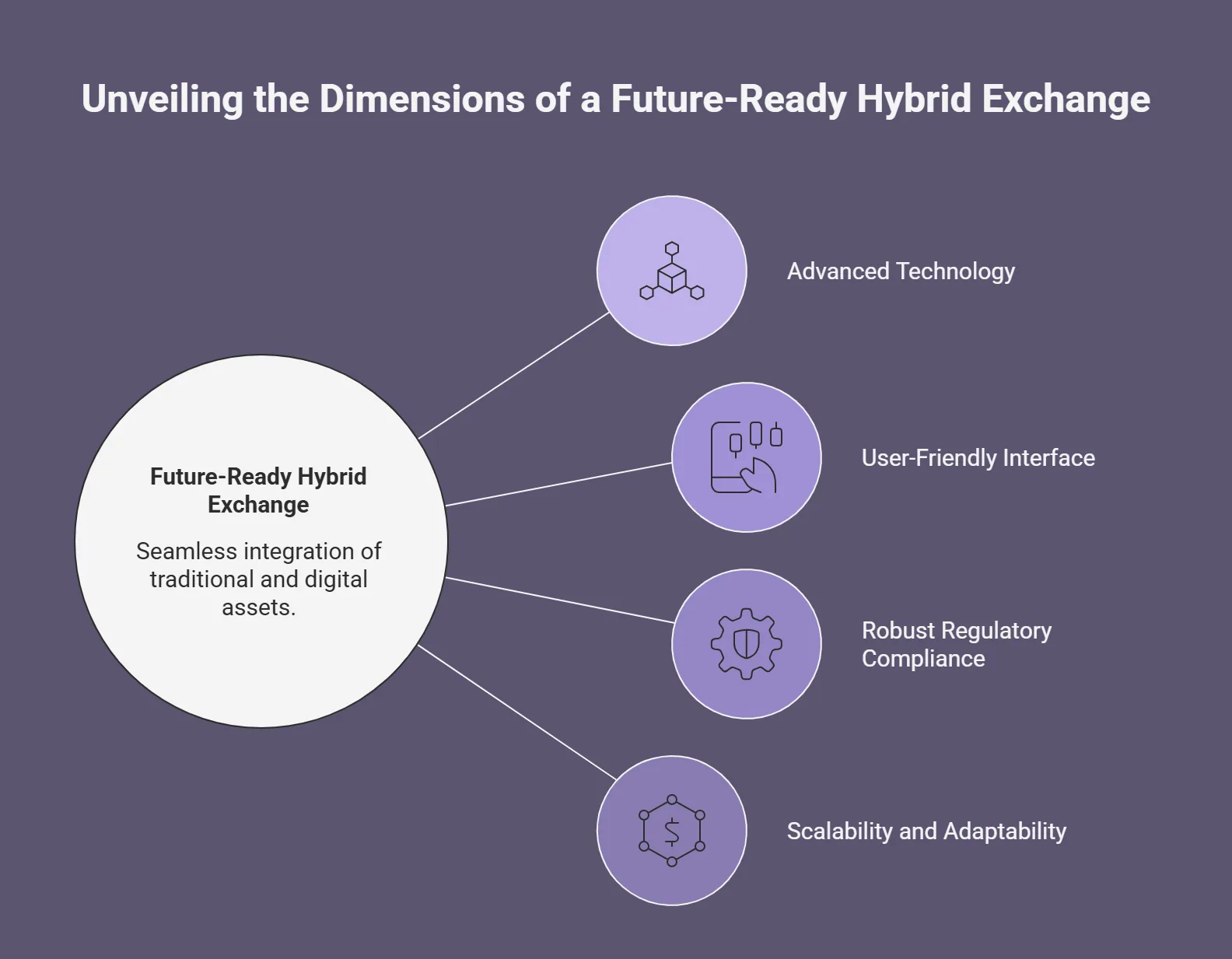
Key Features of a Future-Ready Hybrid Exchange
Cross-Chain Interoperability
Assets exist across Ethereum, Solana, BNB Chain, Polygon, and Cardano. A hybrid exchange with cross-chain support lets users trade tokens from different networks within a single interface, without needing external bridges or separate wallets for each chain. This removes friction and consolidates liquidity that would otherwise be scattered.
AI-Driven Risk Management
Modern hybrid exchange infrastructure integrates AI for real-time fraud detection, suspicious activity flagging, smart order routing, and automated risk monitoring. These systems reduce the human oversight required to manage a high-volume platform and improve both security and execution quality simultaneously.[5]
Configurable Compliance Modules
Regulatory requirements vary by country. A hybrid platform with modular KYC/AML tools can be configured to meet different legal frameworks — EU MiCA, US FinCEN requirements, Singapore MAS, or UAE VARA — without rebuilding the core platform. This makes the exchange legally deployable across multiple jurisdictions from a single codebase.
OTC Desk Integration
Institutional traders frequently use over-the-counter (OTC) desks for large transactions that would move market prices if placed on a standard order book. Hybrid exchanges integrate OTC functionality alongside spot and derivatives trading, giving institutional clients a complete trading solution within one platform rather than requiring them to use separate services.
Smart Contract Automation
Trade execution, escrow, settlement, and fund movement are all handled by audited smart contracts rather than manual platform operations. This reduces counterparty risk, speeds up settlement, and creates an auditable trail for every transaction that external parties can verify independently.
Why the Future of Crypto Trading Is Hybrid
The market is already moving in this direction. Binance launched Alpha 2.0 to blend centralized exchange performance with on-chain trading through its own DEX layer. BitMart has been building a hybrid model combining CEX speed with on-chain trading infrastructure. Coinbase and other major platforms are integrating decentralized features to satisfy both regulators and privacy-focused users simultaneously.[6]
Three forces are accelerating this shift. First, regulatory pressure: the EU’s MiCA regulation, the US GENIUS Act, and equivalent frameworks in Asia require compliance infrastructure that pure DEXs cannot provide without compromising their architecture. Hybrid exchanges integrate this compliance natively. Second, institutional adoption: corporate entities holding crypto as treasury assets and investment firms allocating to digital assets require both self-custody and regulated access. Only hybrid exchanges deliver both. Third, user expectations: retail traders who have experienced DEX hacks and CEX collapses now demand platforms where they control their keys without sacrificing trading performance.
📌 Trend to Watch (2025–2026)
The number of active DEX platforms reached 959 in 2025, compared to 217 centralized exchanges tracked by CoinGecko. Yet monthly DEX volume at $140 billion still represents a fraction of total crypto trading. The gap between DEX usage and CEX volume shows that decentralization is growing but cannot yet replace centralized performance. Hybrid exchanges close this gap by combining both layers. As MiCA enforcement expands across the EU in 2026 and US crypto regulation takes shape, exchanges that cannot demonstrate on-chain settlement and built-in compliance will face increasing legal and institutional barriers — making the hybrid model not just a preference but a structural requirement.
Challenges Hybrid Exchanges Still Face
The hybrid model is not without complications. Building and maintaining a platform that integrates both centralized and decentralized components requires expertise in two distinct technical disciplines simultaneously. The matching engine, order management system, and front-end must work seamlessly with smart contract systems, multi-chain wallets, and on-chain settlement protocols. Teams that specialize in only CEX or only DEX development are not equipped to build a full hybrid system without collaboration.[7]
Regulatory clarity is still developing in many jurisdictions. While the hybrid model is architecturally well-positioned for compliance, the specific licensing requirements for a platform that combines custodial and non-custodial services remain inconsistent across regions. Exchange operators must engage legal counsel familiar with both crypto-specific and traditional financial services regulation in each market they intend to serve.
Smart contract risk is another layer. Unlike a pure CEX where settlement is managed internally, on-chain settlement depends on the correctness of the smart contracts used. An unaudited or exploitable contract creates a direct attack vector. Regular third-party audits from firms with verified blockchain security expertise are a non-negotiable part of operating secure and scalable crypto trading infrastructure on a hybrid model.
Build a Future-Ready Hybrid Crypto Exchange
Nadcab Labs develops hybrid crypto exchange platforms with centralized order matching, on-chain settlement, multi-chain support, KYC/AML modules, and smart contract infrastructure built for regulatory compliance and institutional-grade performance.
Frequently Asked Questions
Q1.What is a hybrid crypto exchange exactly?
A hybrid crypto exchange uses a centralized matching engine for fast order execution while handling asset custody and trade settlement through smart contracts on a blockchain. Users trade at CEX speeds but retain control of their funds through non-custodial wallets. Settlements are recorded on-chain, making every transaction independently verifiable without relying on the exchange’s internal records.
Q2.Why are hybrid exchanges better than CEX?
Hybrid exchanges solve the main risk of centralized exchanges, custodial control over user funds. On a hybrid platform, the exchange never holds your assets in a centralized pool, eliminating the risk of losses from hacks or mismanagement (as seen with FTX and multiple exchange breaches between 2022 and 2025). Users still get CEX-level trading speed and liquidity alongside this security improvement.
Q3.How do hybrid exchanges differ from DEX platforms?
DEX platforms are fully on-chain, including order matching. This makes them slower and harder to use. Hybrid exchanges run order matching on centralized infrastructure for speed, while keeping settlement and custody on-chain. The result is faster execution, deeper liquidity, and a more accessible interface than DEXs, while maintaining the on-chain transparency and self-custody benefits that DEXs provide.
Q4.Are hybrid exchanges compliant with crypto regulations?
Yes, hybrid exchanges are architecturally well-suited for regulatory compliance. They integrate KYC and AML modules on the centralized layer while maintaining on-chain settlement transparency. This allows them to meet requirements under EU MiCA, US FinCEN rules, Singapore MAS, and UAE VARA frameworks. Pure DEX platforms struggle with this because implementing compliance infrastructure conflicts with their permissionless design.
Q5.What blockchains do hybrid exchanges typically support?
Modern hybrid exchange platforms support multiple blockchains simultaneously, including Ethereum, BNB Chain, Solana, Polygon, and Cardano. Cross-chain interoperability allows users to trade assets from different networks within a single interface without needing external bridges or separate wallets. This multi-chain capability aggregates liquidity across ecosystems and is a standard feature in future-ready hybrid exchange infrastructure.
Explore Services
Related Services
Reviewed by

Aman Vaths
Founder of Nadcab Labs
Aman Vaths is the Founder & CTO of Nadcab Labs, a global digital engineering company delivering enterprise-grade solutions across AI, Web3, Blockchain, Big Data, Cloud, Cybersecurity, and Modern Application Development. With deep technical leadership and product innovation experience, Aman has positioned Nadcab Labs as one of the most advanced engineering companies driving the next era of intelligent, secure, and scalable software systems. Under his leadership, Nadcab Labs has built 2,000+ global projects across sectors including fintech, banking, healthcare, real estate, logistics, gaming, manufacturing, and next-generation DePIN networks. Aman’s strength lies in architecting high-performance systems, end-to-end platform engineering, and designing enterprise solutions that operate at global scale.