Ai Overview
Imagine having a personal financial assistant who never sleeps, never gets emotional, and can process information faster than any human mind. Think of them like the autopilot system in modern aircraft: they can handle routine flying tasks autonomously, but a pilot remains essential for complex decisions and emergencies. Imagine you discover that Uniswap is selling ETH at $1900 while SushiSwap is paying $1920 for ETH.
Key Takeaways
- AI agents in DeFi trading execute transactions 24/7 without human emotion, making decisions based on pre-programmed algorithms and real-time market data.
- AI powered DeFi traders excel at repetitive tasks like arbitrage, yield farming, and liquidity optimization but lack human intuition in unprecedented market conditions.
- Complete replacement of human traders by AI agents is unlikely; the future involves hybrid models combining autonomous systems with human oversight.
- Smart contracts enable autonomous DeFi trading by allowing AI agents to execute complex financial operations without intermediaries.
- AI DeFi trading bots can analyze thousands of tokens and market conditions simultaneously, identifying opportunities invisible to human analysis.
- Security risks including smart contract vulnerabilities, flash loan attacks, and market manipulation pose significant limitations to fully autonomous AI trading systems.
- AI agents for yield farming can automatically rebalance portfolios and compound returns, but regulatory uncertainty creates operational risks.
- Human traders retain advantages in strategic decision-making, risk management, and adapting to black swan events that break historical patterns.
- The future of AI agents in crypto will likely feature advanced integration with blockchain infrastructure, allowing more sophisticated autonomous strategies.
- Startups and enterprises building AI powered DeFi platforms should focus on transparency, security audits, and human accountability mechanisms.
The decentralized finance (DeFi) landscape is undergoing a dramatic transformation. Where human traders once dominated, a new generation of AI agents in DeFi trading now operates around the clock, analyzing market data, executing trades, and optimizing yields at speeds no human can match. But does this mean the end of human traders? The answer is more nuanced than a simple yes or no. In this guide, we’ll explore how AI agents in DeFi are reshaping the trading landscape, what they can and cannot do, and whether they represent replacement or partnership for human traders.
What Are AI Agents in DeFi Trading?
Imagine having a personal financial assistant who never sleeps, never gets emotional, and can process information faster than any human mind. That’s essentially what AI agents in DeFi trading are. Think of them like the autopilot system in modern aircraft: they can handle routine flying tasks autonomously, but a pilot remains essential for complex decisions and emergencies.
AI agents in DeFi are software programs built with machine learning and algorithmic decision-making capabilities. They interact directly with decentralized finance protocols through smart contracts, analyzing market conditions, identifying trading opportunities, and executing transactions without human intervention.
Unlike simple trading bots that follow rigid rules, AI powered DeFi agents learn from market patterns, adapt their strategies, and make increasingly sophisticated decisions. They’re like the difference between a calculator (which only does what you tell it) and a smart financial advisor (which learns your preferences and suggests new approaches).
How AI Agents Work in Decentralized Finance
Understanding how autonomous DeFi trading functions requires breaking down the process into digestible steps. Here’s how AI agents operate within the DeFi ecosystem:
Step by Step: How AI Agents Execute DeFi Trades
Step 1: Data Collection and Analysis
The AI agent continuously monitors blockchain data, price feeds from multiple exchanges, liquidity pools, and market volatility indicators. It’s like a stock market ticker on steroids, processing millions of data points per second.
Step 2: Pattern Recognition and Prediction
Using machine learning models trained on historical data, the agent identifies patterns that signal profitable opportunities. For example, it might detect when price discrepancies exist between different DeFi platforms (arbitrage opportunities).
Step 3: Strategy Evaluation
The agent evaluates risk-reward ratios, calculates potential gas fees, assesses slippage, and determines whether an opportunity meets the pre-defined success criteria.
Step 4: Smart Contract Execution
If conditions are met, the agent triggers smart contracts that automatically execute the trade. This happens on the blockchain, creating an immutable record of the transaction.
Step 5: Performance Monitoring and Adjustment
The agent continuously monitors the outcome, learns from results, and adjusts its parameters for future trades. This creates a feedback loop of continuous improvement.
The key difference between AI crypto trading agents and traditional algorithms is their ability to adapt. Traditional trading bots follow fixed rules: “If price goes above X, sell.” AI agents learn which conditions actually matter and adjust their decision-making over time.
AI Agent Decision Flow in DeFi Trading
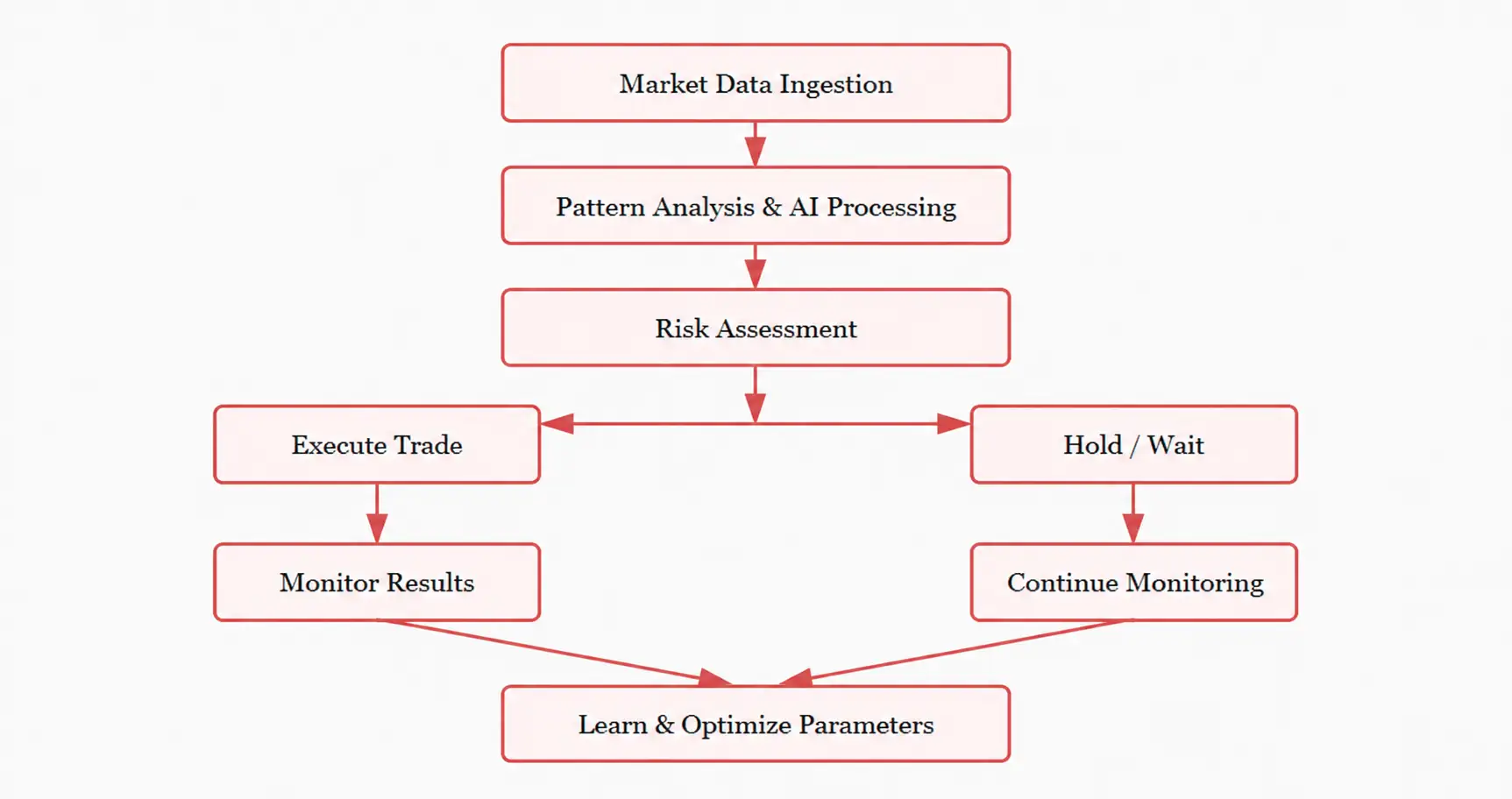
This continuous loop is what makes intelligent DeFi trading systems powerful. They don’t just execute trades; they learn from every transaction and refine their approach.
AI Agents vs Traditional Trading Bots: What’s the Difference?
Not all automated trading systems are equal. Understanding the difference between AI DeFi trading bots and simpler trading bots is crucial for evaluating their potential.
Comparison Table: AI Agents vs Traditional Bots
| Feature | Traditional Trading Bots | AI Powered Agents |
|---|---|---|
| Decision Making | Rule based (If X, then Y) | Machine learning based (learns from patterns) |
| Adaptability | Fixed parameters, requires manual updates | Adapts automatically to market changes |
| Data Processing | Limited to pre-defined variables | Analyzes complex multi-dimensional data |
| Learning Capability | No learning, performs same tasks | Improves performance over time |
| Complexity Handling | Works well for simple strategies | Handles multi-factor, complex strategies |
| Market Volatility Response | May fail in unprecedented conditions | Adapts strategy based on market regime |
| Resource Efficiency | Light computational requirements | Requires significant computing power |
| Cost | Generally lower cost | Higher development and operational cost |
Think of it this way: traditional bots are like cruise control on a highway. You set a speed, and it maintains that speed. AI agents are like adaptive cruise control in modern cars: they adjust automatically based on traffic conditions, distance to other vehicles, and changing road situations.
The growing impact of AI agents in DeFi and the evolution of autonomous financial technology
Can AI Agents Actually Replace Human DeFi Traders?
This is the question everyone asks. The honest answer: not completely, but in specific domains, they’re already better than humans.
Where AI Agents Win Against Human Traders
- Speed: AI agents execute trades in milliseconds. Humans take seconds or minutes. In arbitrage, this means the difference between profit and loss.
- Emotionless Execution: Humans panic sell during crashes or get greedy during rallies. AI agents follow logic consistently, regardless of market sentiment.
- 24/7 Operations: Cryptocurrency markets never sleep. AI agents can trade around the clock while human traders need rest.
- Data Processing: AI agents for yield farming can monitor thousands of pools simultaneously and rebalance positions instantly. No human can do this.
- Consistency: AI agents don’t have bad days. They execute their strategy with mechanical precision every single time.
Where Human Traders Still Hold the Advantage
- Black Swan Events: When something unprecedented happens (like regulatory crackdowns or technology breakthroughs), human traders adjust faster because they understand context and implications.
- Strategic Innovation: Humans invent new trading strategies. AI agents optimize existing ones. Creativity remains a human domain.
- Risk Management: Experienced traders understand when to break their rules. They recognize situations where the normal playbook doesn’t apply and pivot accordingly.
- Accountability: When something goes wrong, there’s a human to hold responsible. With autonomous crypto trading, the responsibility chain is murky.
- Multi-Protocol Complexity: Human traders can reason across different blockchain ecosystems and understand complex interactions between protocols that AI might miss.
Reality Check: The most successful trading operations today combine both. They use AI powered DeFi systems for routine, high-frequency operations while keeping human traders for strategic decision-making, risk management, and crisis response.
Advantages of AI Powered DeFi Trading
AI powered DeFi offers tangible benefits that are transforming how people interact with decentralized finance:
Increased Profitability Opportunities
AI agents identify micro-opportunities that humans would miss. For instance, they spot arbitrage across 10 different DEXs and capture profits in seconds. Over time, these tiny wins compound into significant returns.
Risk Reduction Through Diversification
DeFi AI agents can spread capital across numerous pools, tokens, and strategies simultaneously, reducing concentration risk. A human might hold 5 positions; an AI agent might manage 100.
Optimized Yield Farming
Yield farming requires constant monitoring: depositing into pools, claiming rewards, reinvesting, and rebalancing. AI agents for yield farming automate all of this, ensuring optimal returns without human effort.
Elimination of Human Bias
Cognitive biases like recency bias (overweighting recent events) or confirmation bias (seeking information that confirms existing beliefs) don’t affect AI agents. They trade based on data, not emotion.
Scalability Without Additional Labor
Managing a $1 million portfolio and a $100 million portfolio requires almost identical effort for an AI agent. Scaling a human trading team is expensive and complicated.
Risks and Limitations of Autonomous DeFi Trading
While autonomous DeFi trading offers exciting possibilities, it comes with significant risks that cannot be ignored.
Technical and Security Risks
- Smart Contract Vulnerabilities: If the smart contract code has bugs, the AI agent can lose all funds in seconds. Unlike a human who might catch a suspicious transaction, automated systems execute before thinking.
- Flash Loan Attacks: Malicious actors can manipulate prices instantly using flash loans. If the AI agent relies on price feeds without proper protection, it’s vulnerable to being exploited.
- Oracle Manipulation: Many smart contracts rely on price oracles (data sources). If these are manipulated, the AI agent makes decisions based on false information.
- Network Failures: If the blockchain network experiences congestion or failures, trades might execute at unexpected prices or fail entirely.
Market and Strategic Risks
- Overfitting to Historical Data: AI DeFi trading bots trained on past market conditions might fail spectacularly when markets behave differently. A strategy that worked in a bull market might destroy capital in a bear market.
- Liquidity Challenges: The AI agent might identify a profitable trade but struggle to execute it due to insufficient liquidity in a small pool, resulting in severe slippage.
- Unexpected Market Regime Changes: When market conditions shift fundamentally (like the 2022 crypto winter), historical AI models become unreliable.
- Correlated Risk: If many AI agents use similar strategies and data sources, they all react the same way during stress events, amplifying market volatility.
Regulatory and Legal Risks
- Unclear Regulations: Government agencies are still figuring out how to regulate AI agents in crypto. New laws could retroactively affect the legality of your trading operations.
- Market Manipulation Concerns: Regulators view automated trading with suspicion. What you consider optimization might be classified as market manipulation by authorities.
- Tax Compliance: Managing tax reporting for thousands of autonomous trades is complex and error-prone.
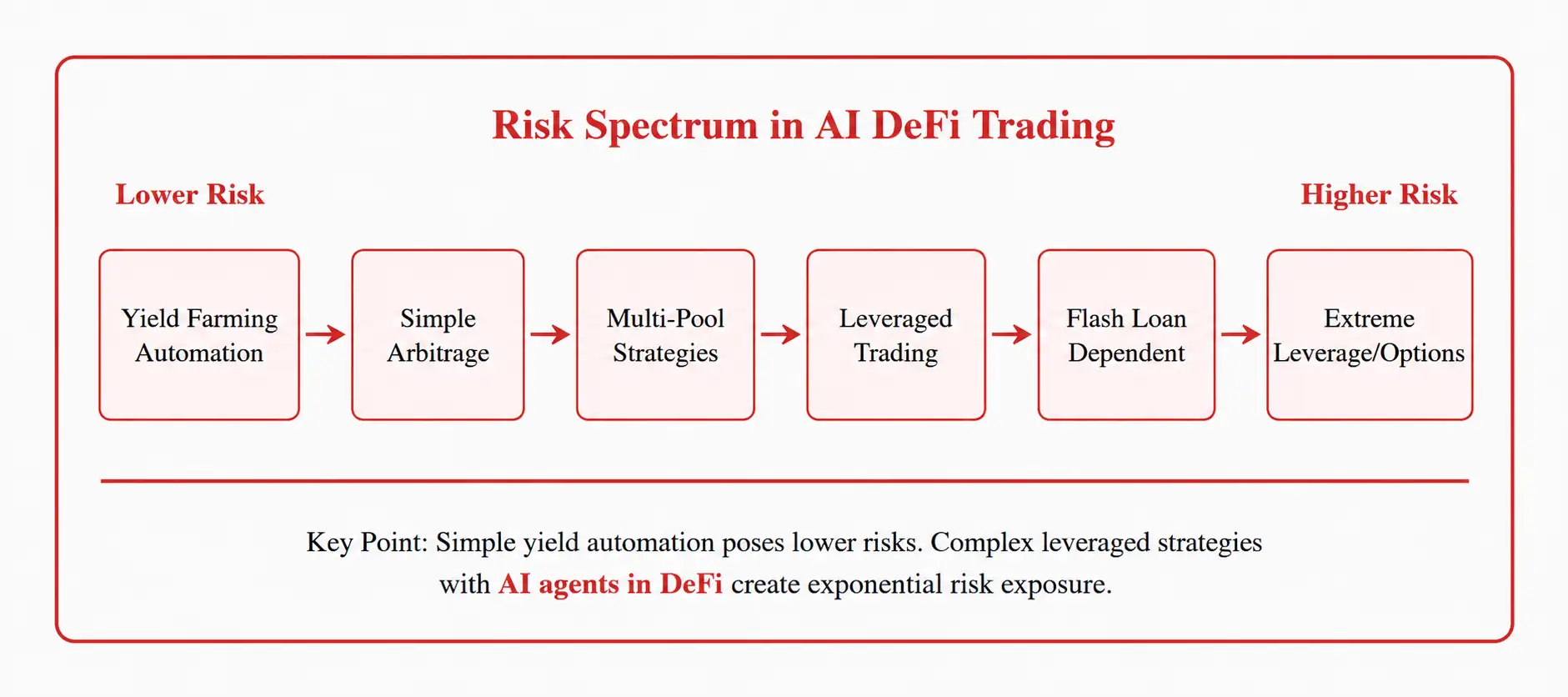
Real World Use Cases of AI Agents in DeFi
AI agents in DeFi trading aren’t theoretical. They’re operating right now, managing millions of dollars and generating tangible results.
Arbitrage Bots Capturing Cross Exchange Opportunities
Imagine you discover that Uniswap is selling ETH at $1900 while SushiSwap is paying $1920 for ETH. A human couldn’t execute fast enough to profit. An AI agent spots this, swaps on Uniswap, transfers the ETH, and sells on SushiSwap in seconds, capturing the spread before market prices align.
These aren’t theoretical gains. Real DeFi platforms report thousands of successful arbitrage executions daily. The profits are tiny per trade (often 0.5% to 2%), but multiplied across thousands of trades, they become significant.
Automated Yield Farming and Liquidity Mining
AI agents for yield farming transform how liquidity providers (LPs) operate. Instead of manually moving liquidity, monitoring APY changes, and managing impermanent loss, the AI agent does everything automatically.
For example, a user deposits $10,000 into an AI enabled yield farming protocol. The agent automatically:
- Identifies the best performing liquidity pools daily
- Rebalances the portfolio to concentrate on high-yield opportunities
- Harvests and automatically reinvests rewards (compounding)
- Adjusts positions when risks increase in specific pools
The user earns 15% to 25% annualized returns without lifting a finger. That’s the power of DeFi AI agents at work.
Dynamic Portfolio Rebalancing
A human trader might rebalance a 30-token portfolio monthly. An AI powered DeFi system rebalances daily or even hourly based on volatility and correlation changes. This maintains the desired risk profile automatically, without the time investment.
Flash Loan Optimization (For Informed Traders)
Advanced AI agents use flash loans (uncollateralized loans that must be repaid in the same transaction) to execute complex strategies like liquidation hunting or multi-step arbitrage. These sophisticated operations would be impossible for humans to execute in the required microseconds.
The Future of AI in DeFi Trading: Trends and Evolution
Where is AI agents in DeFi trading heading? Several clear trends are emerging.
Advanced Machine Learning Models
Current AI DeFi trading bots rely primarily on supervised learning and reinforcement learning. Future systems will integrate transformer models and advanced deep learning architectures, enabling them to understand complex market narratives and social sentiment from on-chain and off-chain data.
Multi-Chain and Cross-Protocol Intelligence
Current systems optimize within a single blockchain. The next generation of intelligent DeFi trading systems will understand opportunities across Ethereum, Solana, Polygon, and other chains simultaneously, bridging assets and executing atomic transactions across multiple protocols.
Decentralized AI Agents
Imagine AI agents that run completely on-chain, governed by DAOs (decentralized autonomous organizations) instead of centralized companies. This represents the ultimate form of autonomous DeFi trading where the algorithm itself is decentralized and transparent.
Explainable AI for Trading
A critical gap today: traders don’t understand why AI makes certain decisions. Future AI agents in crypto will provide clear explanations for each trade, increasing trust and enabling human oversight of autonomous systems.
Regulatory Compliant Agents
As regulations crystallize, AI systems will embed compliance directly into their logic. They’ll know which strategies are legal in which jurisdictions, automatically avoiding regulatory pitfalls.
Building Secure AI Powered DeFi Platforms: Insights for Enterprises
For startups and enterprises considering building AI powered DeFi platforms, several principles are non-negotiable.
Security Audits and Code Review
Before deploying any AI agents in DeFi system with real user funds, engage top security firms to audit both the smart contracts and the AI decision-making logic. The cost of audits (often $50,000 to $200,000) is negligible compared to the risk of a $10 million hack.
Transparent Parameter Management
Users should understand exactly what the AI agent is doing with their funds. Document all parameters, constraints, and decision-making thresholds clearly. Transparency builds trust.
Human Oversight and Kill Switches
No matter how sophisticated the AI, include emergency mechanisms that allow humans to pause trading if something goes wrong. An AI agent operating without safeguards is a liability, not an asset.
Gradual Rollout and Testing
Launch autonomous DeFi trading systems with small amounts of capital first. Monitor performance, gather user feedback, identify edge cases, and scale gradually. A 12-month testing period with $1 million is better than a 1-month launch with $100 million.
Documentation and Explainability
Document the AI model architecture, training data, assumptions, and limitations. When the AI makes an unexpected trade, can you explain why? If not, you’re not ready for production.
Ready to Build the Future of AI DeFi?
The convergence of artificial intelligence and decentralized finance represents one of the most compelling opportunities in blockchain technology. Whether you’re developing AI agents for yield farming, building autonomous DeFi trading platforms, or exploring how AI powered DeFi can transform your operations, success requires expertise, security, and trustworthy architecture.
Nadcab Labs specializes in designing, developing, and deploying enterprise-grade AI powered blockchain and DeFi solutions. Our team combines deep blockchain engineering, machine learning expertise, and Web3 security practices to help you build systems that are intelligent, secure, and compliant.
The Realistic Future of AI Agents in DeFi Trading
Will AI agents in DeFi trading completely replace human traders? The evidence suggests a nuanced reality: certain functions will be entirely automated, while others will remain deeply human-dependent.
What will disappear: Routine, repetitive trading tasks like yield farming optimization, simple arbitrage, and portfolio rebalancing will be entirely handled by AI agents in DeFi. Humans doing these tasks manually will become obsolete.
What will persist: Strategic decision-making, risk management during crises, regulatory navigation, and innovation will remain fundamentally human activities. An AI agent might execute 10,000 trades, but a human decides whether the trading algorithm should exist at all.
The future belongs to traders and platforms that combine the best of both worlds: AI powered DeFi systems handling the mechanical aspects while humans focus on strategy, security, and innovation. This hybrid model is already emerging in leading DeFi protocols and will become the industry standard.
Rather than asking “Can AI replace human traders?” ask instead: “How can we use AI agents to augment human capabilities and create better outcomes for users and businesses?” That mindset shift transforms the conversation from replacement anxiety to collaborative opportunity.
The age of AI agents in DeFi trading is already here. The question isn’t whether to adapt, but how quickly you can harness this technology responsibly to stay competitive in an increasingly automated financial landscape.
Frequently Asked Questions
Q1.How much does it cost to implement an AI powered DeFi trading system?
Development costs range significantly based on complexity. A basic AI agent costs $50,000 to $150,000 to build. Enterprise-grade systems with multiple protocols, security audits, and compliance integration range from $300,000 to $2,000,000. Additionally, you’ll incur operational costs for infrastructure, compute power, and security monitoring (roughly $5,000 to $50,000 monthly depending on scale).
Q2.What programming languages are best for building AI agents in crypto?
Python dominates AI and machine learning development due to its rich ecosystem (PyTorch, TensorFlow, scikit-learn). For blockchain interaction, you’ll also need Solidity (for Ethereum smart contracts), JavaScript/TypeScript (for Web3 libraries), and Rust (increasingly popular for performance-critical DeFi systems). Most enterprise projects combine Python for AI logic with TypeScript for Web3 connectivity.
Q3.How do AI agents handle low liquidity and slippage in small token pairs?
Advanced AI agents predict slippage using liquidity depth analysis and order book data. They employ several strategies: breaking large orders into smaller chunks to reduce market impact, using liquidity aggregators to find the best execution venue, setting maximum slippage thresholds, and in some cases, choosing not to execute if slippage would exceed profitability. Some sophisticated agents even use flash loans to add temporary liquidity for complex operations.
Q4.Are AI trading agents profitable in bear markets or only during bull runs?
Well designed AI agents generate profits in all market conditions, though the magnitude differs. In bull markets, they capture upside momentum. In sideways markets, they excel at arbitrage and yield farming (which don’t depend on price direction). In bear markets, defensive AI strategies (holding stablecoins, shorting through lending protocols, or simply reducing exposure) protect capital. The key is that the AI system includes strategies optimized for multiple market regimes, not just bull markets.
Q5.What's the difference between backtesting and live trading with AI agents?
Backtesting uses historical data to simulate how a strategy would have performed. Live trading uses real capital in real markets. The critical difference: backtesting assumes perfect execution and ignores slippage, gas fees, and market impact. A strategy that shows 50% returns in backtesting might generate 10% in live trading after accounting for real-world costs. This is why gradual rollout and continuous monitoring are essential.
Q6.Can AI agents be hacked or manipulated to trade against user interests?
Yes, multiple attack vectors exist: compromised private keys give attackers control; malicious oracle data feeds can trick agents into bad trades; smart contract bugs can be exploited; and API vulnerabilities can be weaponized. Mitigation requires multi-signature wallets, oracle redundancy, regular security audits, rate limiting on trades, and human oversight controls. No system is unhackable, but security best practices dramatically reduce risk.
Q7.How do regulatory bodies view AI powered DeFi trading systems?
Regulatory treatment is evolving. The SEC views some AI trading strategies as potential market manipulation if they create artificial pricing or deceive other traders. The CFTC regulates derivatives trading with AI. Most jurisdictions lack clear rules specific to DeFi AI, creating legal ambiguity. Best practice: operate with clear documentation, avoid strategies that could be classified as market manipulation, maintain transaction records for tax reporting, and stay updated on regulatory developments in your jurisdiction.
Q8.What happens if an AI agent makes a catastrophic loss due to a smart contract bug?
This is a critical liability question. In decentralized systems, there’s often no insurance or recourse. Your options are limited to: pursuing legal action against developers (difficult and expensive), seeking coverage from insurance protocols (emerging but limited), or accepting the loss. This is why security audits, gradual rollouts, and capital limits during testing phases are essential. Users should also understand that AI agents operate with their private keys and are bound by smart contract logic they can’t override mid-transaction.
Q9.How do AI agents learn from past trades and improve their strategies over time?
Machine learning models use historical trade data to identify patterns and refine decision-making. Reinforcement learning trains agents by rewarding profitable trades and penalizing losses, gradually improving strategy selection. However, there’s a critical caveat: if you train on bull market data, the agent becomes optimized for bull markets. This is called overfitting. Robust systems train on diverse market conditions (bull, bear, sideways, volatile) so the agent learns multiple strategies and selects appropriately based on current conditions.
Q10.What's the minimum capital required to make AI powered DeFi trading profitable?
This depends on the strategy. Yield farming can be profitable with $5,000 if gas fees are reasonable (on Polygon or Arbitrum). Arbitrage requires larger capital ($50,000 to $500,000) because opportunities are small per trade and transaction costs are high. Leverage and complex strategies require $1,000,000+ to generate meaningful returns after fees and slippage. A general rule: start with 10x your target monthly income in capital. If you want $5,000 monthly profits, start with at least $50,000 capital and reasonable expectations for net returns (25% to 50% annually is realistic; 100%+ should raise red flags).
Explore Services
Related Services
Reviewed by

Aman Vaths
Founder of Nadcab Labs
Aman Vaths is the Founder & CTO of Nadcab Labs, a global digital engineering company delivering enterprise-grade solutions across AI, Web3, Blockchain, Big Data, Cloud, Cybersecurity, and Modern Application Development. With deep technical leadership and product innovation experience, Aman has positioned Nadcab Labs as one of the most advanced engineering companies driving the next era of intelligent, secure, and scalable software systems. Under his leadership, Nadcab Labs has built 2,000+ global projects across sectors including fintech, banking, healthcare, real estate, logistics, gaming, manufacturing, and next-generation DePIN networks. Aman’s strength lies in architecting high-performance systems, end-to-end platform engineering, and designing enterprise solutions that operate at global scale.