Ai Overview
Think of DeFi staking like a savings account at a traditional bank, but instead of earning interest, you earn cryptocurrency rewards. A typical Ethereum validator requires 32 ETH (over 100,000 USD at current prices) and consistent technical maintenance. Meet Sarah, a beginner crypto investor with 1,000 USDC (stablecoin) she wants to put to work. A retail investor with 5 ETH earning 5 percent annual rewards generates over 11,000 USD in passive income per year at current prices, without selling their assets.
Key Takeaways
- DeFi staking options allow you to earn passive rewards by locking or providing your cryptocurrency to blockchain networks and protocols.
- There are four main types of staking available: flexible staking, locked staking, liquid staking, and validator staking, each with different risk and reward profiles.
- Flexible staking offers lower returns but high liquidity, making it ideal for investors who value accessibility and control over their assets.
- Locked staking typically provides higher returns due to longer commitment periods, but your funds remain inaccessible until the lock period ends.
- Liquid staking solves the liquidity problem by giving you tradable tokens representing your staked assets, allowing you to earn rewards while maintaining flexibility.
- Validator staking requires running a node and significant technical knowledge, but offers the highest rewards for those willing to take on operational responsibility.
- Retail investors benefit most from flexible or liquid staking options, while enterprises often prefer locked staking for predictable long-term returns.
- DeFi staking platforms enable individuals and businesses to participate in decentralized finance without operating their own infrastructure.
- Major risks include smart contract vulnerabilities, market volatility, platform insolvency, and potential slashing penalties for validators.
- The future of DeFi staking options will include improved yield optimization, cross-chain staking, and enterprise-grade security solutions from blockchain solution providers.
DeFi staking options have transformed how people earn passive income in the cryptocurrency world. Instead of letting your digital assets sit idle in a wallet, staking allows you to participate in blockchain networks and earn rewards for your contribution. Whether you are a beginner investor, a business looking to optimize treasury management, or a developer building the next generation of blockchain solutions, understanding DeFi staking options is essential in today’s Web3 landscape.
In this guide, we will explore the different DeFi staking options available, how they work, their benefits and risks, and most importantly, which option suits your specific needs and goals. Let’s dive into the world of staking and discover how you can make your crypto work harder for you.
What Is DeFi Staking? Understanding the Basics
Think of DeFi staking like a savings account at a traditional bank, but instead of earning interest, you earn cryptocurrency rewards. When you stake your crypto, you are essentially committing your digital assets to support a blockchain network’s operations. In return, the network rewards you with additional tokens. This process is fundamental to how many modern blockchains maintain security and validate transactions.
The term “staking” comes from the idea that you are putting your money “at stake” to support the network. This creates a financial incentive for participants to act honestly. If someone tries to cheat or validate fraudulent transactions, they lose part or all of their staked assets, a process called slashing. This elegant system has made staking one of the most important mechanisms in decentralized finance.
Unlike traditional mining, which requires expensive hardware and significant electricity consumption, staking is environmentally friendly and more accessible to everyday investors. This is why DeFi staking options have become so popular, attracting billions of dollars in capital and creating new opportunities for passive income generation.
How DeFi Staking Works
Types of DeFi Staking Options: Finding Your Perfect Fit
Not all staking options are created equal. Different DeFi staking options serve different purposes and suit different investor profiles. Let’s break down the four main categories that dominate the decentralized finance landscape.
Flexible Staking: Maximum Accessibility
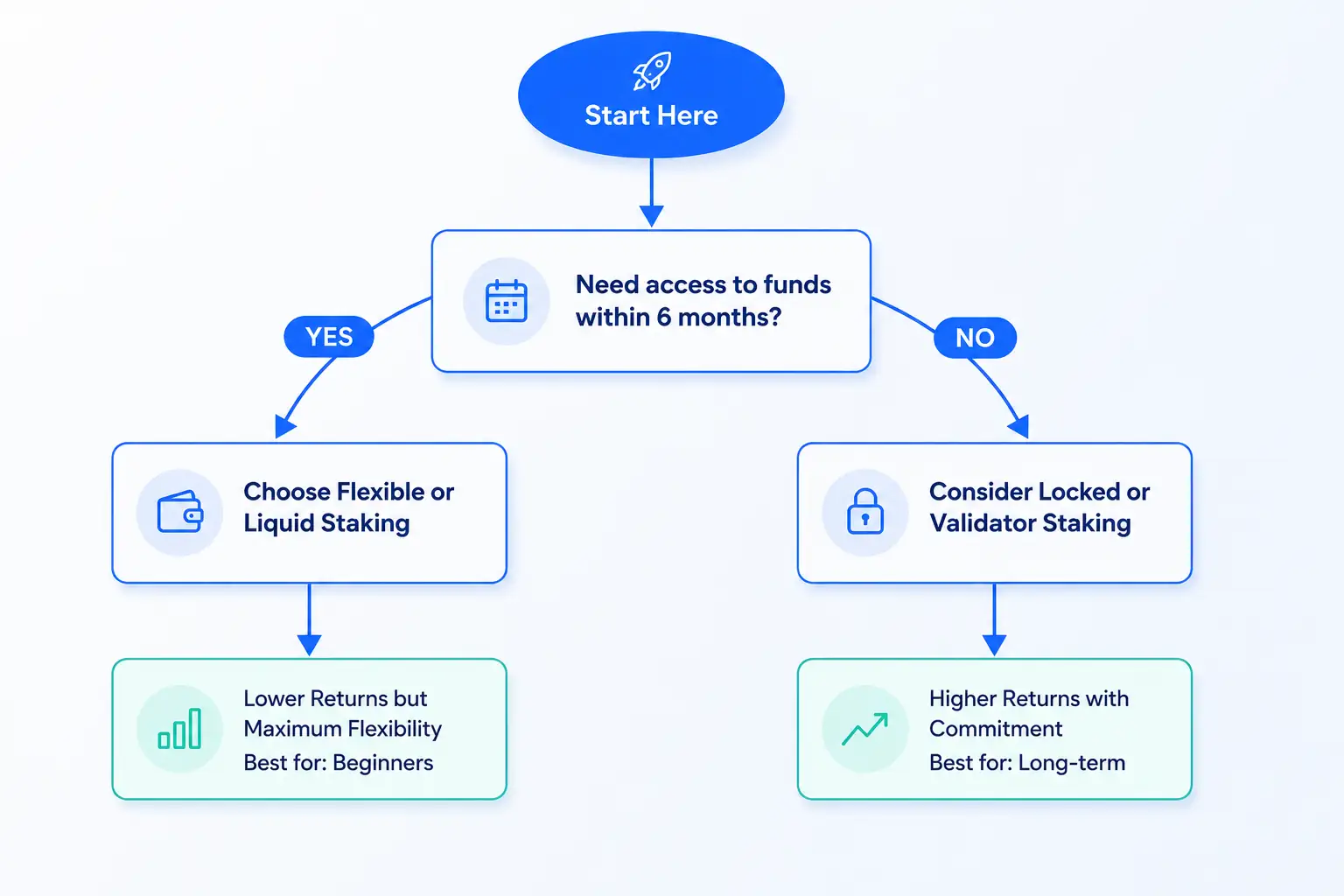
Flexible staking is perfect for investors who want exposure to staking rewards without locking up their capital. You can stake your crypto and withdraw it at any time without penalties. The tradeoff is lower returns, typically ranging from 3 to 8 percent annually depending on the platform and cryptocurrency.
Think of flexible staking like a regular savings account. Your money is always accessible, but you earn less interest compared to a fixed deposit. This makes it ideal for:
- Beginners testing the waters with small amounts
- Investors who need liquidity for emergencies
- Traders who want to participate in staking while maintaining flexibility
- Businesses maintaining cryptocurrency reserves with passive income
Locked Staking: High Returns, Patient Players
Locked staking requires you to commit your assets for a fixed period, typically ranging from 30 days to several years. In exchange for this commitment, platforms offer significantly higher rewards, often between 15 to 40 percent annually or even more depending on the asset and lock period.
This is similar to a fixed deposit at a bank. You agree to leave your money untouched for a specific timeframe, and in return, you receive a premium interest rate. Locked staking benefits:
- Long-term investors with a clear 6 month to 2 year horizon
- Enterprises planning predictable treasury allocation
- Startups raising capital and wanting to put it to work
- Individuals comfortable with volatility over long periods
Liquid Staking: The Best of Both Worlds
Liquid staking explained simply: you stake your crypto and receive a tokenized representation of your staked assets. These liquid staking tokens can be traded, sold, or used in other DeFi protocols while your original assets continue earning rewards. It’s like having your cake and eating it too.
When you participate in liquid staking through platforms like Lido, you deposit your Ethereum and receive stETH in return. This stETH token:
- Represents your stake and accumulating rewards
- Can be traded on exchanges anytime
- Can be used as collateral in lending protocols
- Maintains its value relative to the underlying asset
Liquid staking explained through real use cases: A business using liquid staking can earn staking rewards on their Ethereum holdings while using the liquid tokens to generate additional yield through lending protocols. This dual income approach has made liquid staking increasingly popular among sophisticated investors and institutions.
Validator Staking: For the Technical Elite
Validator staking crypto involves running your own blockchain node and actively validating transactions. This requires substantial capital, technical expertise, and operational responsibility. A typical Ethereum validator requires 32 ETH (over 100,000 USD at current prices) and consistent technical maintenance.
Validators earn the highest rewards because they assume the most risk and responsibility. However, they also face:
- Technical complexity of running infrastructure
- Slashing risks if your node validates incorrectly
- Uptime requirements to maintain network participation
- Significant capital requirements
Comparing DeFi Staking Options: Returns, Liquidity, and Risk
| Staking Type | Annual Returns | Liquidity | Min Capital | Risk Level |
|---|---|---|---|---|
| Flexible Staking | 3 to 8 percent | Instant Withdrawal | Low (1 USD+) | Medium |
| Locked Staking | 15 to 40 percent | After Lock Period | Low to Medium | High |
| Liquid Staking | 5 to 15 percent | Full (Trade Anytime) | Low | Medium to High |
| Validator Staking | 10 to 20 percent | Locked (Full Period) | Very High (32 ETH+) | Very High |
Step by Step: How DeFi Staking Works in Practice
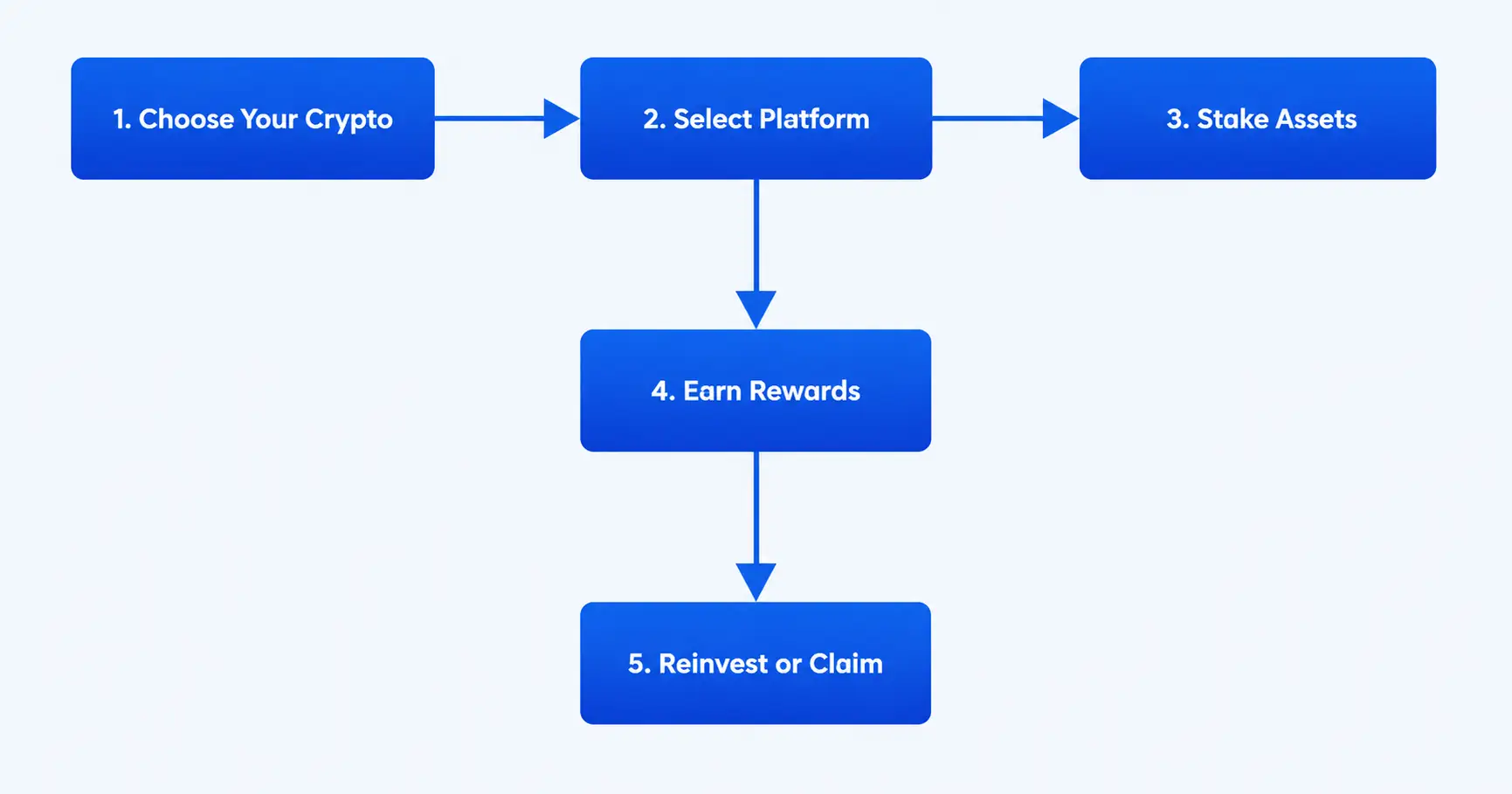
Let’s walk through a real world example of how DeFi staking works. Meet Sarah, a beginner crypto investor with 1,000 USDC (stablecoin) she wants to put to work.
Step 1: Research and Select a Platform
Sarah researches DeFi staking platforms like Aave, Compound, or Lido. She checks their security audits, user reviews, and available staking options. She chooses a platform offering flexible staking with 6 percent annual returns and a strong security track record.
Step 2: Connect Her Wallet
Sarah connects her cryptocurrency wallet (MetaMask, Coinbase Wallet, or similar) to the platform. This allows the platform to access her assets without holding her private keys.
Step 3: Deposit Crypto
She deposits her 1,000 USDC into the staking pool. The platform now holds her assets in a smart contract and begins earning rewards for her.
Step 4: Rewards Accumulate
Daily, her staking balance increases. At 6 percent annual return, she earns roughly 0.016 USDC per day. Rewards compound either automatically or when she chooses to reinvest.
Step 5: Manage or Withdraw
After a month, Sarah has earned 5 USDC in rewards. She can claim these rewards, reinvest them for compound growth, or withdraw her entire stake anytime without penalties.
Real World Use Cases: How Different Users Benefit from DeFi Staking
DeFi staking options have created opportunities across different user segments. Let’s explore how various stakeholders leverage these opportunities.
Retail Investors: Building Passive Income
Individual investors use flexible and liquid staking to earn passive income from their crypto holdings. A retail investor with 5 ETH earning 5 percent annual rewards generates over 11,000 USD in passive income per year at current prices, without selling their assets. This passive income crypto staking approach has democratized yield generation, previously available only to institutional players.
Retail investors benefit from crypto staking rewards in multiple ways. Some reinvest earnings for compound growth, while others use staking income to cover living expenses or fund other investments. The key advantage is maintaining exposure to potential price appreciation while earning steady yields.
Businesses and Enterprises: Optimizing Treasury Management
Corporations and startups holding cryptocurrency reserves increasingly use locked staking to maximize returns. A fintech company with 1,000 ETH earning 8 percent annual returns generates 800 ETH (approximately 2.4 million USD) in additional revenue per year. This approach turns otherwise idle assets into revenue generators.
Enterprises choose DeFi staking options because they:
- Generate predictable cash flow from balance sheet cryptocurrency
- Maintain full ownership and control of underlying assets
- Diversify revenue streams beyond their core business
- Strengthen financial metrics and investor confidence
Developers and Blockchain Platforms: Building DeFi Infrastructure
Developers and blockchain platforms use staking to build sustainable business models. A DeFi platform might create its own staking pool, attracting users and generating fees. Validator staking crypto requires infrastructure investment, but platforms earn proportional rewards for maintaining network security.
Blockchain solution providers like Nadcab Labs help businesses and platforms build secure, scalable staking infrastructure. These providers design custom staking solutions, implement robust security measures, and ensure compliance with regulatory requirements. Their expertise enables businesses to enter the staking market confidently.
Benefits of DeFi Staking: Why Millions Are Getting Involved
✓ Passive Income Generation
Earn consistent rewards without active trading or market speculation. Your crypto works for you while you sleep.
✓ Reduced Environmental Impact
Staking uses minimal electricity compared to mining, making it environmentally sustainable and appealing to eco-conscious investors.
✓ Lower Barriers to Entry
Unlike mining, staking requires no expensive hardware. You can start with small amounts on flexible staking platforms.
✓ Variety of Options
Choose from flexible, locked, liquid, or validator staking based on your risk tolerance, capital, and investment timeline.
✓ Network Security Participation
Contribute to blockchain security and earn rewards for helping maintain network integrity and decentralization.
✓ Long-term Value Alignment
Stakers benefit from network growth and success. Your incentives align with the platform’s long-term health and adoption.
Risks and Limitations: Important Considerations
While DeFi staking offers attractive rewards, it’s essential to understand the risks involved. Responsible investing means acknowledging these limitations alongside the benefits.
Smart Contract Risk
DeFi staking platforms depend on smart contracts, lines of code that execute automatically. If a contract contains bugs or vulnerabilities, funds could be at risk. Even audited contracts carry some residual risk. Always research a platform’s security audits and track record before depositing substantial amounts.
Market Volatility and Slashing Risk
While staking generates rewards, your underlying asset’s value can fluctuate dramatically. If ETH drops 50 percent, your staking rewards might not offset the loss. Additionally, validators face slashing penalties if they validate incorrectly or behave maliciously. Even small mistakes can result in partial capital loss.
Liquidity Constraints
Locked staking can trap your capital for extended periods. If you need emergency access to funds, you cannot withdraw without penalties. Liquid staking solves this but introduces additional risks through derivative tokens.
Platform Insolvency
Centralized staking platforms can fail or disappear. Unlike traditional banks with deposit insurance, crypto deposits have no protection. Always use platforms with strong governance, transparent reserves, and insurance mechanisms where available.
Choosing the Right DeFi Staking Option for You
Industry Applications: Staking Across Sectors
DeFi Staking in Fintech
Fintech companies integrate staking into their platforms, offering customers yield opportunities on crypto holdings. Traditional finance bridges use staking to provide competitive returns, attracting users away from traditional savings accounts. This innovation is reshaping how financial services companies compete.
Gaming and NFT Ecosystems
Gaming platforms introduce staking mechanics to their tokens, allowing players to earn passive income from their digital assets. NFT marketplaces offer staking pools for governance tokens, creating additional value beyond trading. These mechanisms increase user engagement and token utility.
Enterprise Blockchain Solutions
Enterprises building private and hybrid blockchains use validator staking to secure their networks. Consortium blockchains implement staking to align incentives among participating organizations. This approach ensures network integrity while distributing governance.
Popular DeFi Staking Platforms and Their Offerings
Several DeFi staking platforms dominate the market, each offering unique features and security profiles. Here are the leading options:
Lido (Liquid Staking)
The largest liquid staking protocol, allowing users to stake Ethereum and receive stETH tokens. Lido controls over 30 percent of staked Ethereum, demonstrating widespread adoption and trust. Users enjoy full liquidity while earning approximately 3.5 to 4.5 percent annual returns.
Aave (Multi-Asset Lending and Staking)
A comprehensive DeFi platform offering flexible staking on multiple cryptocurrencies. Users deposit assets and earn variable rewards based on protocol activity. Aave’s governance token also offers staking opportunities with additional incentives.
Compound (Flexible Yield)
A pioneer in DeFi lending, Compound allows users to deposit crypto and earn interest. The platform recently introduced staking for governance token holders, adding another income stream for participants.
Kraken and Coinbase (Centralized Staking)
Major exchanges offer staking services with lower barriers to entry. Users stake directly through their exchange accounts, simplifying the process for beginners. Returns are lower than decentralized platforms but security is enhanced through exchange insurance.
DeFi Staking Platforms and Enterprise Solutions
For enterprises requiring custom solutions, blockchain solution providers like Nadcab Labs design and implement tailored staking infrastructure. These solutions include:
- Custom smart contract development for proprietary staking mechanisms
- Security audits and compliance frameworks
- Integration with existing enterprise systems
- Governance and parameter optimization
- User interface and experience design
The Future of DeFi Staking: Emerging Trends and Innovations
The DeFi staking landscape continues evolving rapidly. Several trends are shaping the future of this sector and creating new opportunities for investors and developers.
Cross-Chain Staking
Future DeFi staking options will enable staking across multiple blockchains simultaneously. Users will be able to stake on Ethereum, Polkadot, and other networks from a single interface, diversifying risk and maximizing returns. Bridge protocols and cross-chain communication are making this increasingly feasible.
Yield Optimization and Aggregators
Yield aggregators will automatically move funds between staking opportunities to capture the best returns. These protocols analyze market conditions in real-time and reallocate capital without user intervention, simplifying the staking experience for non-technical investors.
Institutional Grade Infrastructure
As institutional adoption increases, we will see enterprise-grade staking infrastructure with insurance, custody solutions, and regulatory compliance features. This evolution will unlock trillions in potential institutional capital entering the staking market.
Regulatory Clarity and Compliance
Governments worldwide are developing regulatory frameworks for staking rewards and DeFi platforms. Clear regulations will reduce uncertainty, increase institutional participation, and protect retail investors through standardized disclosures and safeguards.
Ready to Build Your DeFi Staking Solution?
Whether you are a startup launching a blockchain platform, an enterprise optimizing treasury management, or a fintech company expanding into crypto yield products, Nadcab Labs provides expert guidance and custom solutions for building secure, scalable DeFi staking infrastructure.
Our team of blockchain experts brings years of experience in smart contract development, security auditing, and regulatory compliance. We help you navigate the complexities of DeFi staking and bring your vision to life.
Choosing Your DeFi Staking Path
DeFi staking options have democratized passive income generation in cryptocurrency. Whether you are interested in flexible staking’s accessibility, locked staking’s higher returns, liquid staking’s best-of-both-worlds approach, or validator staking’s premium rewards, there is an option suited to your circumstances and risk tolerance.
The key to successful staking is understanding your needs, researching platform security, and starting small while you learn. Begin with flexible staking on reputable platforms, develop your knowledge, and gradually explore more advanced options as you gain confidence.
The future of DeFi staking is bright, with emerging innovations making participation easier, safer, and more rewarding. Whether you are an individual investor seeking passive income, a business optimizing treasury management, or a developer building Web3 solutions, DeFi staking options offer compelling opportunities for growth and value creation.
Remember, crypto staking rewards are not guaranteed, and all investments carry risk. Always conduct thorough research, understand the risks involved, and invest only what you can afford to lose. With proper due diligence and a strategic approach, DeFi staking can become a valuable part of your cryptocurrency and investment strategy.
Frequently Asked Questions
Q1.What is the minimum amount required to start staking?
The minimum amount varies by platform and staking type. Flexible and liquid staking on platforms like Lido, Aave, and Compound often require as little as 1 USD or even smaller amounts. Validator staking on Ethereum requires a minimum of 32 ETH (approximately 100,000 USD). Always check specific platform requirements before committing funds.
Q2.How are staking rewards taxed?
Tax treatment of staking rewards depends on your jurisdiction. In most countries, staking rewards are treated as ordinary income and taxed at your marginal tax rate when received. Some jurisdictions may apply capital gains tax when you sell or transfer staked assets. Consult with a tax professional in your country for accurate guidance on your specific situation.
Q3.Can I unstake my crypto anytime?
Unstaking depends on your staking type. Flexible staking allows instant withdrawal without penalties. Locked staking requires waiting until the lock period ends, typically 30 days to several years. Liquid staking lets you trade your staking tokens anytime, though converting back to original assets may involve small fees. Validator staking requires formal withdrawal which can take weeks due to network consensus.
Q4.What happens to my staking rewards if the platform goes down?
If a centralized staking platform fails, your rewards may be lost if not previously withdrawn. This is why using decentralized protocols with transparent smart contracts is important. Choose platforms with security insurance, audit history, and transparent governance. Some platforms offer insurance through protocols like Nexus Mutual to protect against smart contract failures.
Q5.How do I choose between different staking platforms?
Evaluate platforms based on security (audits, insurance), returns offered, asset variety, user interface, withdrawal flexibility, fees, and community reputation. Research the team behind the platform, check their GitHub repositories, and read independent reviews. Start with small amounts to test the platform before committing significant capital.
Q6.What is slashing and how does it affect validators?
Slashing is a penalty mechanism that reduces a validator’s stake if they validate fraudulently or behave maliciously. Ethereum validators can lose 1 to 100 percent of their stake depending on violation severity. Running reliable, well-maintained validator infrastructure minimizes slashing risk. Slashing only applies to active validators, not users of flexible or liquid staking platforms.
Q7.Are staking rewards guaranteed?
Staking rewards are not guaranteed. Rewards depend on network activity, total staked amount, inflation rates, and protocol parameters. If network activity decreases, rewards may drop. Additionally, market volatility can reduce the real value of your rewards. Always view staking as an investment with variable returns, not a guaranteed income source.
Q8.Can I stake multiple cryptocurrencies simultaneously?
Yes, most DeFi staking platforms support staking multiple cryptocurrencies. You can stake Ethereum on Lido, USDC on Compound, and other assets on different platforms simultaneously. Many yield aggregators and portfolio management tools help manage multiple staking positions from a single interface, simplifying the process.
Q9.What is the difference between APY and APR in staking?
APR (Annual Percentage Rate) is simple interest without compounding. APY (Annual Percentage Yield) includes compounding effects. If a platform offers 10 percent APY with daily compounding, your effective return exceeds 10 percent due to earning interest on interest. Always compare APY when evaluating staking returns to understand true earning potential.
Q10.How do I start staking if I'm a complete beginner?
Start by purchasing crypto on a major exchange like Coinbase or Kraken. Begin with flexible staking on the same platform for simplicity. Once comfortable, explore other platforms and staking types. Always use a hardware wallet for security if staking significant amounts. Join DeFi communities, read whitepapers, and educate yourself before expanding to advanced staking strategies.
Explore Services
Related Services
Reviewed by

Naman Singh
Co-Founder & CEO, Nadcab Labs
Naman Singh is the Co-Founder and CEO of Nadcab Labs, where he drives the company’s vision, global growth, and strategic expansion in blockchain, fintech, and digital transformation. A serial entrepreneur, Naman brings deep hands-on experience in building, scaling, and commercializing technology-driven businesses. At Nadcab Labs, Naman works closely with enterprises, governments, and startups to design and implement secure, scalable, and business-ready Web3 and blockchain solutions. He specializes in transforming complex ideas into high-impact digital products aligned with real business objectives. Naman has led the development of end-to-end blockchain ecosystems, including token creation, smart contracts, DeFi and NFT platforms, payment infrastructures, and decentralized applications. His expertise extends to tokenomics design, regulatory alignment, compliance strategy, and go-to-market planning—helping projects become investor-ready and built for long-term sustainability. With a strong focus on real-world adoption, Naman believes in building blockchain solutions that deliver measurable value, solve practical problems, and unlock new growth opportunities for organizations worldwide.