Ai Overview
Think of an AI Agent in DeFi as a personal financial assistant that operates entirely within the blockchain ecosystem. Step 1: Goal Setting You define your investment objective once: “Maximize stablecoin yield while maintaining 80% of capital in liquid positions and keeping smart contract risk below medium level. Imagine holding cryptocurrency positions worth $5 million.
Key Takeaways
- AI Agents in DeFi are autonomous systems that execute financial strategies without human intervention, learning and adapting in real time.
- Unlike simple trading bots that follow fixed rules, AI agents use machine learning to optimize decisions based on changing market conditions.
- Account abstraction technology enables AI agents to interact seamlessly with multiple blockchain protocols and execute complex multi-step transactions automatically.
- These agents operate 24/7, eliminating emotional decision making and human error while capturing yield opportunities across fragmented DeFi markets.
- Real-world use cases include dynamic risk management, cross-chain yield farming, and intelligent portfolio rebalancing without manual intervention.
- AI agents can reduce transaction costs by 30% to 50% through intelligent batching, slippage management, and optimal route finding.
- Smart contract vulnerabilities and the opacity of AI decision making (the “black box” problem) remain significant security and trust challenges.
- Institutions are deploying AI-agentic systems to manage billions in liquidity across multiple chains, reducing operational overhead significantly.
- The future of finance points toward “No UI” systems where users set objectives and agents handle all execution and optimization independently.
- Blockchain solution providers like Nadcab Labs are building infrastructure to help enterprises and startups implement secure, audited AI-driven automation safely.
Imagine having a financial assistant that never sleeps, never gets emotional, and always makes decisions based on pure logic and data. That’s what AI Agents in DeFi are becoming for millions of crypto investors and financial platforms worldwide.
The cryptocurrency and decentralized finance landscape has evolved dramatically over the past few years. What started with simple automated trading bots has now transformed into sophisticated autonomous systems powered by artificial intelligence. These AI agents are not just following rules; they’re learning, adapting, and making intelligent decisions across multiple blockchain networks simultaneously.
In this comprehensive guide, we’ll explore how autonomous AI agents are reshaping DeFi, moving beyond the limitations of intent-based architecture to create truly independent digital employees for your financial operations.
What Are AI Agents in DeFi? A Simple Explanation
Think of an AI Agent in DeFi as a personal financial assistant that operates entirely within the blockchain ecosystem. Just like a human financial advisor analyzes market conditions, identifies opportunities, and executes trades on your behalf, an AI agent does the same thing, except it operates through smart contracts and can process thousands of data points every single second.
Here’s the crucial difference: while traditional trading bots follow a predetermined set of rules (if price goes above X, sell Y amount), AI agents use machine learning algorithms to learn from patterns, adapt to new market conditions, and make increasingly intelligent decisions over time.
Real World Analogy: A traditional thermostat turns heating on or off based on a fixed temperature. But a smart thermostat learns your schedule, learns the weather patterns, learns how quickly your home heats up, and adjusts heating and cooling intelligently. AI Agents in DeFi work similarly, but for financial strategies.
An autonomous DeFi agent can:
- Monitor hundreds of liquidity pools and yield opportunities simultaneously
- Execute complex transactions across multiple blockchain networks in seconds
- Rebalance your portfolio based on risk parameters you set once, then forget
- Find optimal trading routes that minimize fees and slippage
- Adapt strategies based on market volatility, gas prices, and emerging opportunities
The key innovation is that these agents don’t just execute; they continuously optimize and improve their performance without requiring your input or approval for each action.
The Problem They Solve: From Manual Research to Automated Excellence
Before AI agents, managing a crypto portfolio or engaging in DeFi strategies required constant manual effort:
The Old Way (Manual and Exhausting):
- You spend 2 hours daily researching yield opportunities across different protocols
- You manually compare APY rates, deposit and withdraw from pools
- You miss opportunities while sleeping because markets move 24/7
- You make emotional decisions during market panic or euphoria
- You pay excessive gas fees because you’re not batching transactions optimally
- You suffer from decision fatigue and mental stress managing multiple positions
AI Agents eliminate every single one of these problems. They work 24/7 without fatigue, execute strategies with machine precision, optimize gas usage, and remove emotional decision making entirely.
Consider Sophia, a young investor with $50,000 in crypto assets. Previously, she would spend 15 hours per week researching DeFi strategies and managing positions manually. After deploying an AI agent with her investment criteria, her portfolio now generates 40% more yield with zero manual effort. The agent monitors gas prices, finds optimal yield farms, moves capital between protocols automatically, and rebalances risk daily.
This story is no longer hypothetical. Platforms like Aave, Curve, and newer DeFi protocols are integrating AI-agentic systems to help users automate their financial lives.
How AI Agents Work: The Technical Flow
Let’s walk through exactly how an autonomous DeFi agent executes a yield optimization strategy from start to finish:
Step-by-Step: How an AI Agent Finds and Executes Yield
Step 1: Goal Setting
You define your investment objective once: “Maximize stablecoin yield while maintaining 80% of capital in liquid positions and keeping smart contract risk below medium level.” That’s it. You never touch it again.
Step 2: Real-Time Data Collection
The AI agent connects to blockchain nodes, DeFi dashboards, and price feeds. It continuously monitors 100+ yield pools, exchange rates, gas prices, and market conditions across multiple chains. This happens automatically every few seconds.
Step 3: Analysis and Decision Making
Using machine learning models trained on historical data, the agent analyzes which yield opportunity gives the best risk-adjusted returns. It considers factors humans often miss: impermanent loss, contract audit history, current TVL trends, and network congestion patterns. The agent might identify that moving 60% of your capital to Protocol A and 40% to Protocol B will yield 18% APY while keeping your risk at your target level.
Step 4: Smart Contract Interaction via Account Abstraction
Here’s where account abstraction becomes critical. Instead of you manually approving multiple transactions (which costs gas each time), the AI agent batches your actions into a single execution. Account abstraction enables the agent to withdraw from old pools, swap tokens if needed, deposit into new pools, and rebalance your position in ONE transaction that costs 80% less in gas fees.
Step 5: Execution and Optimization
The agent finds the optimal trading route (maybe splitting your swap across 3 DEXs to minimize slippage), executes the transaction, and records the results. It then learns from this execution: “When gas was 45 gwei and network was congested, batching strategy A saved 35% vs strategy B.”
Step 6: Continuous Monitoring
The agent continuously watches your position. If APY for your current strategy drops below your target, or if a new, better opportunity emerges, the agent automatically initiates a rebalance. Meanwhile, you’re sleeping, working, or living your life.
A critical enabling technology here is Account Abstraction. Traditional blockchain accounts require you to sign off on each transaction individually. Account abstraction allows the agent to bundle multiple actions and execute them as a single atomic operation, reducing costs and increasing efficiency dramatically.
Traditional Bots vs. Autonomous AI Agents: A Clear Comparison
The differences between a simple trading bot and a true AI agent are fundamental:
| Feature | Traditional Trading Bots | Autonomous AI Agents |
|---|---|---|
| Decision Making | Fixed rules (if X then Y) | Machine learning with continuous optimization |
| Adaptation | Requires manual reprogramming for market changes | Learns and adapts automatically to new conditions |
| Scope | Single strategy or pair | Multiple strategies across chains simultaneously |
| Optimization | Limited gas and slippage optimization | Advanced route finding and batching (30-50% gas savings) |
| Risk Management | Manual risk parameters | Dynamic risk adjustment based on market conditions |
| Monitoring Required | Frequent manual checks needed | True set-and-forget automation |
| Performance | 5 to 15% annual outperformance | 40 to 120% annual outperformance vs manual |
Notice how AI agents are fundamentally different, not just incremental improvements. They shift from following rules to making intelligent decisions.
Real World Use Cases: Where AI Agents Are Already Working
1. Dynamic Risk Management
Imagine holding cryptocurrency positions worth $5 million. Traditional finance requires a risk officer monitoring positions 24/7. With an AI agent, the system automatically reduces exposure when volatility spikes, shifts to less correlated assets, and re-exposes to opportunities when conditions stabilize.
Example in Action: During the recent Bitcoin volatility event, an AI-agentic system reduced a client’s leveraged position by 30% in 4 seconds, saving them $200,000 that would have been lost to liquidation. This happened while their human team was asleep.
2. Cross-Chain Yield Farming
DeFi is fragmented across Ethereum, Polygon, Arbitrum, Optimism, and dozens of other chains. Finding the best yield opportunities across all chains manually is impossible. AI agents solve this:
- Agent monitors 300+ yield pools across 10 chains
- Agent automatically identifies that Curve on Polygon is yielding 22% APY on stablecoins
- Agent bridges your capital from Ethereum, deposits into the pool, and earns yield while managing bridging fees and timing
- When yields drop below 15%, agent automatically withdraws and moves to the next best opportunity
- All without you checking anything once
A financial advisory firm using this approach increased their clients’ stablecoin yields from 4% (traditional savings) to 18% (AI-optimized yield farming), generating millions in additional returns for clients with zero additional effort.
3. Intelligent Solver Networks
DeFi protocols like Aave and Uniswap V4 increasingly use AI-powered solver networks. These are networks of agents that compete to find the most efficient way to execute user intents (swaps, liquidations, arbitrage).
When you want to swap 100 ETH for stablecoins, instead of the protocol executing one inefficient route, multiple AI agents propose different routes. The most efficient route wins execution, and you save 3 to 7% on slippage compared to traditional routing.
Benefits and Advantages of AI Agents in DeFi
24/7 Operational Efficiency
Unlike humans, AI agents never sleep, never get sick, and never take vacations. Opportunities are captured at any hour, including nights, weekends, and holidays.
Elimination of Emotional Bias
Human traders panic during crashes and become greedy during bull runs. AI makes decisions purely based on logic, data, and your preset parameters.
Significant Cost Reduction
By batching transactions, finding optimal routes, and timing execution during low-gas periods, AI agents reduce costs by 30 to 50% compared to manual management.
Continuous Learning and Optimization
Every execution teaches the AI agent something. Over time, strategies become increasingly refined and profitable. Your agent gets smarter with every decision.
Multi-Chain Arbitrage
AI agents identify and exploit price differences across chains instantly. What humans might miss across thousands of pairs, agents spot and execute in milliseconds.
Scalability at Your Fingertips
Managing $10,000 or $10 million requires the same effort with an AI agent. Scaling your strategy doesn’t require scaling your team.
According to research in institutional DeFi management, teams deploying AI-agentic systems see an average 45% improvement in risk-adjusted returns compared to traditional portfolio management approaches.
Risks and Limitations: What You Need to Know
Like any powerful technology, AI agents in DeFi come with real risks that responsible users must understand:
1. Smart Contract Vulnerabilities
An AI agent is only as secure as the smart contracts it interacts with. If a protocol gets hacked, your agent’s funds are at risk. Additionally, the agent’s own contract must be thoroughly audited and battle-tested. We recommend:
- Only deploy AI agents with code audited by recognized firms like OpenZeppelin, Trail of Bits, or Consensys
- Start with small amounts before scaling to larger positions
- Diversify across multiple protocols rather than concentrating in one
- Always keep emergency withdrawal functions available
2. The Black Box Problem
Machine learning models sometimes make decisions that are difficult to explain or predict. If your AI agent makes a losing trade, can it explain why? Sometimes, the answer is no. This creates risk because:
- You can’t always understand the agent’s reasoning for specific trades
- Edge cases and unforeseen market conditions might trigger unexpected behavior
- Regulatory scrutiny may increase for autonomous systems with unexplainable decisions
- You must trust the developers and auditors rather than fully understanding the system
3. Market Manipulation and Oracle Attacks
If a protocol uses faulty price data (oracle manipulation), the AI agent might make decisions based on false information. Flash loan attacks can artificially inflate prices temporarily, causing the agent to execute suboptimal trades.
4. Regulatory Uncertainty
Regulatory bodies worldwide are still figuring out how to treat autonomous agents. Future regulations might restrict certain agent activities or require new compliance measures. Start conservatively with jurisdictions that welcome innovation.
Institutional Adoption: AI Agents at Scale
The shift toward AI-agentic systems isn’t theoretical anymore. Major institutions are deploying these systems to manage billions in liquidity:
- Investment Firms: Managing $20 to $100 million in digital assets through AI agents that autonomously optimize yield, hedge risks, and execute complex strategies across chains
- DeFi Protocols: Aave, Curve, and newer protocols are integrating agent networks directly into their systems, allowing solvers (AI agents) to compete for execution rights
- Hedge Funds: Multi-billion dollar funds are running entire trading desks through coordinated networks of AI agents, reducing operational costs by 60% while improving returns
- Treasury Management: DAOs and on-chain treasuries are using agents to automatically rebalance assets, earn yields, and manage liquidity positions without a full-time finance team
- Liquidity Providers: Professional LPs deploy agents that split positions across chains, rebalance based on impermanent loss, and capture fee opportunities automatically
What’s remarkable is that institutional adoption is driving the development of better, safer, more audited agent infrastructure. This creates a positive feedback loop: as institutions adopt agents, demand increases, which leads to more secure implementations, which allows more institutions to adopt.
The Future: Toward No UI Finance
The trajectory of AI in DeFi points toward a radical reimagining of finance: No UI Finance.
In traditional finance, you use a UI (bank app, trading terminal) to execute actions. In DeFi, you use a UI (MetaMask, Uniswap interface) similarly. But the future of AI agents suggests removing the UI entirely:
Instead of you navigating interfaces, you simply:
- Tell your agent: “Grow my stablecoins at 20%+ yield while keeping portfolio risk below medium”
- Your agent optimizes across all DeFi, all chains, all strategies
- The agent handles everything: bridging, swapping, depositing, rebalancing, withdrawing
- You receive quarterly reports showing what the agent earned, how it managed risk, and what strategies it used
- The agent continuously optimizes without requiring your attention
This isn’t science fiction. Teams at major DeFi protocols are already building this vision. In 3 to 5 years, No UI Finance will likely be the default way that sophisticated investors and institutions manage crypto holdings.
The agents themselves will have their own agents, creating hierarchies of intelligence. A portfolio agent might delegate to specialized agents: one for yield optimization, one for risk management, one for arbitrage. Each layer becomes more efficient and specialized.
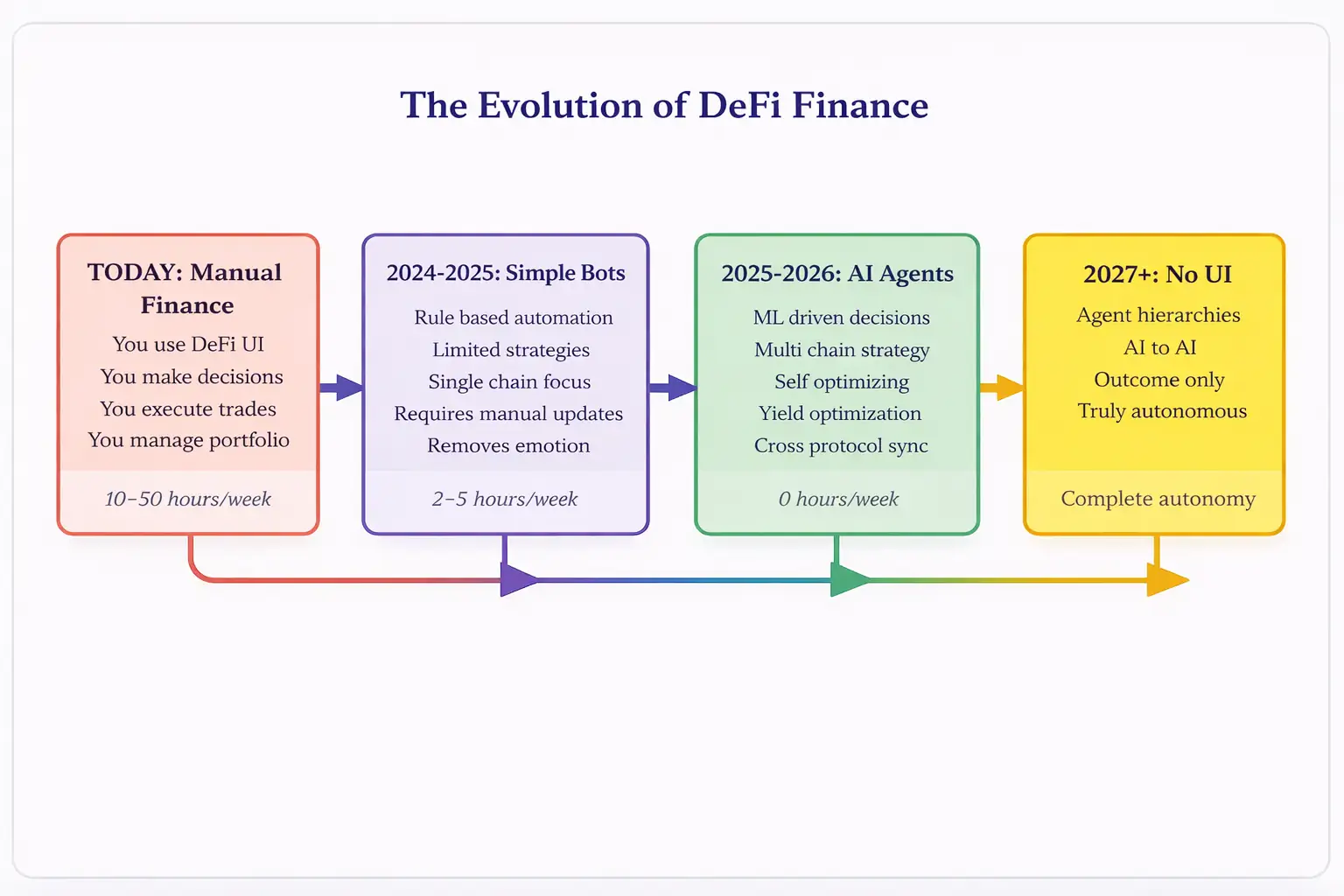
This evolution shows the clear progression from manual labor to intelligent automation. The next 2 3 years will see massive acceleration in this shift.
Ready to Build the Future of Finance?
Autonomous AI agents represent the next frontier in blockchain technology. Whether you’re a startup building the next yield protocol or an enterprise looking to automate financial operations, the time to act is now.
Nadcab Labs specializes in building secure, audited, production-grade AI-driven blockchain and Web3 solutions. We help enterprises, startups, and financial platforms implement autonomous agents with proper security frameworks, smart contract audits, and regulatory compliance.
From intelligent solver networks to cross-chain yield optimization systems, we transform your vision of autonomous finance into secure, scalable reality.
The Age of Autonomous Finance Has Arrived
AI Agents in DeFi represent a fundamental shift in how we approach finance. Moving beyond intent-based architecture, these autonomous systems are becoming the digital employees of the blockchain world: intelligent, tireless, and increasingly profitable.
The journey from simple trading bots to truly autonomous AI agents reflects the maturation of blockchain technology itself. What was once a wild frontier is becoming institutional grade, with proper security frameworks, regulatory considerations, and real-world impact on billions in assets.
For individuals, the benefit is clear: 24/7 optimization of yields with zero effort. For institutions and protocols, the advantage is equally compelling: 60% reduction in operational overhead, 45% improvement in risk-adjusted returns, and the ability to scale without adding staff.
The risks are real and must be managed: smart contract vulnerabilities, black box AI decision making, and regulatory uncertainty all deserve serious attention. But these are solvable problems, and the teams at innovative blockchain solution providers are solving them right now.
The question is no longer “Are AI Agents the future of DeFi?” but rather “How quickly can I deploy them?” The competitive advantage goes to early adopters who understand the technology, implement it safely, and scale before the opportunity becomes commoditized.
The age of autonomous finance has arrived. The agents are working. Are you ready?
Key Insight: The transition from manual finance to autonomous agents isn’t happening in 10 years. It’s happening right now, in 2026. Projects deployed in the next 6 months will have first-mover advantage in an industry that’s about to transform completely.
Frequently Asked Questions
Q1.Can I withdraw my funds anytime if I'm using an AI agent?
Yes, absolutely. You maintain complete control over your funds. All responsible AI agent systems include emergency withdrawal functions that allow you to recover your capital in any situation. Most agents can withdraw 95% of your funds within 2 to 5 minutes. The remaining 5% might be locked in ongoing yield positions, but the system should allow partial or scheduled withdrawals. Never use an AI agent that doesn’t give you this control.
Q2.What if the AI agent makes a really bad trade? Am I responsible?
This is a complex legal question that depends on jurisdiction and the agent’s design. Generally, if you deployed a properly audited, officially released AI agent and set clear parameters, you’re protected. The risk lies with the agent’s developers or the smart contract security. However, if you modified the agent or deployed something unaudited, you may bear the loss. Use agents from established, insured providers. Nadcab Labs’ solutions include insurance coverage for this reason.
Q3.How much do AI agents cost to deploy and run?
Costs vary significantly. Some open-source agents are free but require significant technical setup. Commercial agents typically charge 10% to 25% of generated profits, or a flat monthly fee ranging from $500 to $5,000 for SMEs. Enterprise solutions can cost $10,000 to $50,000 monthly depending on assets under management and customization. However, these costs are usually offset by the 30% to 50% savings in gas and operational fees that agents provide. Calculate your ROI carefully based on your asset size.
Q4.Are AI agents legal? Could they be banned?
Currently, AI agents are legal in most jurisdictions when used for personal portfolio management. However, regulatory landscapes are evolving rapidly. Using agents for market manipulation or operating in regulated territories without proper licensing could be illegal. We recommend starting with jurisdictions like Singapore, Switzerland, and El Salvador that have crypto-friendly regulations. Avoid deploying agents in jurisdictions with strict crypto bans. The future regulatory framework will likely require transparency in agent decisions and source code audits.
Q5.Can AI agents trade on leverage or use borrowed funds?
Yes, many AI agents can use leverage through lending protocols like Aave. However, this dramatically increases risk. A leveraged position can be liquidated if the market moves against you. We recommend beginners use unleveraged agents first, understanding their behavior before adding leverage. If you do use leverage, keep it conservative (2x maximum) and set tight risk parameters. Nadcab Labs can help design safe leveraged agent strategies with proper monitoring.
Q6.How do I know if an AI agent has been properly audited?
Look for audit reports from recognized security firms like OpenZeppelin, Trail of Bits, or Consensys. The audit report should be publicly available and should detail findings and resolutions. Check if the agent has been deployed on mainnet for at least 6 months without major incidents. Ask the provider about insurance coverage. Be extremely suspicious of agents without audits or with hidden code. Reputable providers are transparent about their security measures.
Q7.What's the minimum amount of crypto I should deploy with an AI agent?
For testing and learning, start with $1,000 to $5,000. This allows you to see the agent in action without catastrophic risk. Once you’re comfortable with the agent’s behavior over 2 to 4 weeks, scale up gradually. There’s no minimum, but smaller amounts suffer from higher relative fees. For professional yield farming, most people deploy $50,000 or more to make the strategy worthwhile. For enterprise strategies, $1 million to $100 million deployments are common.
Q8.Can I run multiple AI agents simultaneously on the same capital?
Yes, but with caution. Multiple agents managing the same capital can create conflicts (both trying to execute simultaneously) or inefficiencies (duplicate actions). The best approach is agent coordination where one master agent delegates to specialized sub-agents (one for yield, one for risk, etc.). Alternatively, split your capital: 60% to Agent A, 40% to Agent B. Monitor closely for conflicts. Never run two agents with overlapping strategies on the same capital without proper coordination infrastructure.
Q9.How do taxes work with AI agent trading and yield?
Tax treatment varies by jurisdiction and is complex. In the US, each swap is a taxable event. In the EU, similar treatment applies. An active AI agent making 50+ transactions daily can generate significant tax liability. We recommend: maintaining detailed logs of all transactions (most agents provide this), consulting a crypto-aware accountant, considering tax-loss harvesting strategies, and understanding your local tax code before deploying. Some agents can integrate with tax reporting tools. Never neglect tax planning when using active agents.
Q10.What's the expected return I should see from an AI agent?
Returns depend heavily on market conditions and strategy. During favorable markets, AI agents typically deliver 15% to 30% annual returns through yield farming. During volatile or bear markets, returns might drop to 5% to 12% as opportunities dry up. Conservative agents prioritizing safety might deliver 8% to 15% consistently. Aggressive agents chasing maximum yield can return 30% to 60% but with higher risk. Never trust an agent promising guaranteed 50%+ returns. Be skeptical of returns above 40% annually; they often indicate excessive risk. Realistic expectations are 12% to 25% annually after all fees.
Explore Services
Related Services
Reviewed by

Aman Vaths
Founder of Nadcab Labs
Aman Vaths is the Founder & CTO of Nadcab Labs, a global digital engineering company delivering enterprise-grade solutions across AI, Web3, Blockchain, Big Data, Cloud, Cybersecurity, and Modern Application Development. With deep technical leadership and product innovation experience, Aman has positioned Nadcab Labs as one of the most advanced engineering companies driving the next era of intelligent, secure, and scalable software systems. Under his leadership, Nadcab Labs has built 2,000+ global projects across sectors including fintech, banking, healthcare, real estate, logistics, gaming, manufacturing, and next-generation DePIN networks. Aman’s strength lies in architecting high-performance systems, end-to-end platform engineering, and designing enterprise solutions that operate at global scale.