Ai Overview
Decentralized applications represent a paradigm shift in software development. This balance significantly impacts your application’s performance, cost, and capabilities. We typically aim for 100% test coverage on smart contracts because bugs can cost millions. Simple optimization like using appropriate data types, minimizing storage writes, and batching operations can reduce gas costs by 50% or more.
Key Takeaways
- Decentralized apps combine smart contracts, Web3 frontends, and blockchain networks to create transparent, trustless applications without central control.
- Professional audits, comprehensive testing, and following established security patterns are non-negotiable for protecting user funds and data.
- Layer 2 rollups, sidechains, and hybrid architectures solve blockchain’s scalability challenges while maintaining security and decentralization.
- Excellent UX design abstracts blockchain complexity, provides clear feedback, and makes decentralized apps accessible to mainstream users.
- DeFi, NFTs, gaming, supply chain, and DAOs demonstrate how decentralized apps solve real problems across multiple industries.
- Account abstraction, cross-chain interoperability, and AI integration represent the next evolution of decentralized applications.
Introduction to Decentralized Applications (dApps)
Decentralized applications represent a paradigm shift in software development. Think of them as regular applications, but instead of running on a single company’s servers, they operate across a network of computers spread around the world. This fundamental difference changes everything about how data is stored, how trust is established, and how power is distributed.
At their core, decentralized apps use blockchain technology to ensure transparency and immutability. When you interact with a traditional app like Instagram or Gmail, your data sits on company servers, and you trust those companies to handle it responsibly. With decentralized apps, the code runs on a public blockchain where everyone can see exactly how it works. No single entity controls the application, which means no single point of failure or censorship.
The beauty of these applications lies in their open nature. Anyone can verify the code, participate in the network, or build upon existing applications. This openness has sparked innovation we’ve rarely seen before, with developers worldwide contributing to a shared ecosystem. From our experience building these systems, the collaborative nature of decentralized app development accelerates innovation while maintaining security.
Key Characteristics of Decentralized Apps
Understanding what makes decentralized apps unique helps explain why they’re gaining traction across industries. These characteristics aren’t just technical features; they represent fundamental advantages that traditional applications simply cannot match.
Open Source Foundation: Every line of code in a quality decentralized app is publicly available. This transparency builds trust because anyone can audit the code for security vulnerabilities or hidden functions. We’ve seen this openness catch potential issues before they become problems, with community members worldwide acting as vigilant guardians of code quality.
Decentralized Storage: Rather than storing data in centralized databases, decentralized apps distribute information across numerous nodes. This approach eliminates single points of failure. If one node goes down, the network continues functioning seamlessly. Your data remains accessible even if dozens of nodes fail simultaneously.
Cryptographic Security: Every transaction and interaction gets cryptographically secured. Users maintain control through private keys, making unauthorized access extremely difficult. This security model has proven remarkably resilient, protecting billions of dollars in digital assets across various blockchain networks.
| Characteristic | Description | Business Impact |
|---|---|---|
| Transparency | All transactions visible on blockchain | Builds user trust and accountability |
| Immutability | Once recorded, data cannot be altered | Prevents fraud and data tampering |
| Censorship Resistance | No single authority can shut down app | Ensures continuous availability |
| User Ownership | Users control their own data and assets | Empowers users, reduces liability |
| Interoperability | Can interact with other blockchain apps | Creates ecosystem opportunities |
Tokenization and Incentives: Many decentralized apps incorporate native tokens that align incentives between developers and users. These tokens can represent ownership, voting rights, or access to features. This economic model creates sustainable ecosystems where everyone benefits from the network’s growth.
Core Components of a dApp Architecture
Building decentralized apps requires understanding how different components work together. The architecture might seem complex at first, but breaking it down reveals a logical structure that makes sense once you grasp the fundamentals.
Smart Contracts Layer: This forms the backbone of any decentralized app. Smart contracts are self-executing programs stored on the blockchain that automatically enforce agreements. They handle everything from token transfers to complex business logic. When you interact with a decentralized app, you’re essentially calling functions in these smart contracts.
Frontend Interface: Users need a familiar way to interact with blockchain technology. The frontend looks similar to traditional web applications, using standard technologies like React or Vue. However, instead of connecting to a central server, it communicates directly with blockchain nodes through Web3 libraries. This layer translates complex blockchain operations into simple, user-friendly actions.
Wallet Integration: Digital wallets serve as the authentication mechanism for decentralized apps. Rather than creating usernames and passwords, users connect their crypto wallets. These wallets manage private keys and sign transactions, providing both identity verification and payment processing in one solution.
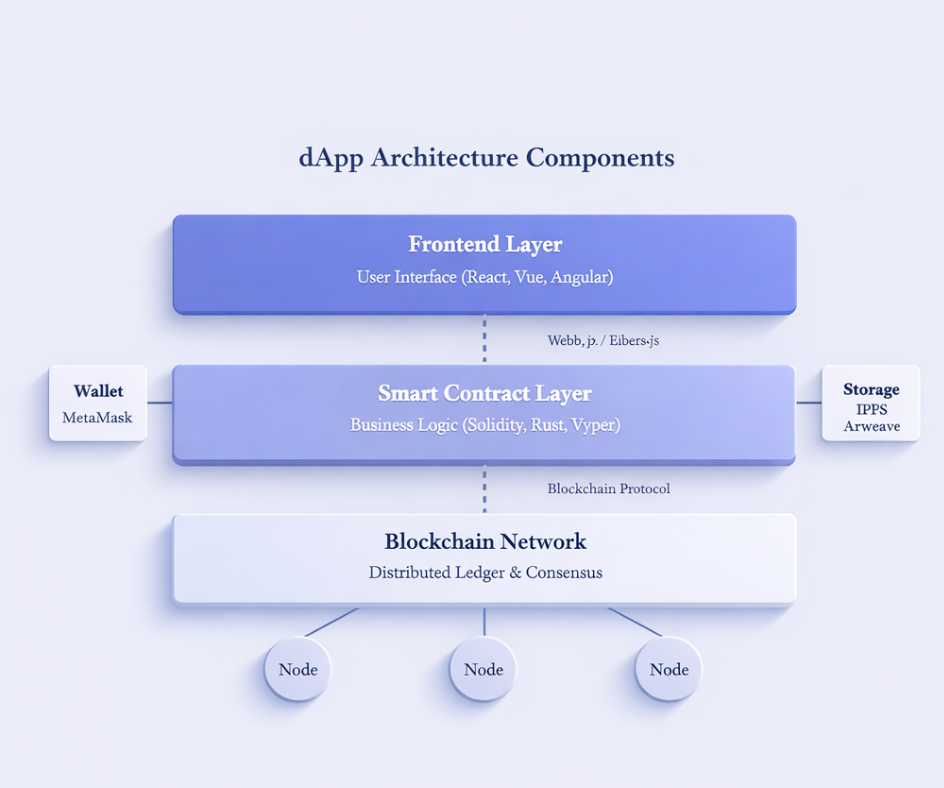
Blockchain Network: The underlying blockchain (Ethereum, Polygon, Solana, etc.) provides the infrastructure. It maintains the distributed ledger, processes transactions, and ensures consensus across all nodes. Different blockchains offer varying tradeoffs between speed, security, and decentralization.
Off-Chain Storage: Not everything belongs on the blockchain. Large files like images or videos are too expensive to store on-chain. Solutions like IPFS (InterPlanetary File System) or Arweave provide decentralized storage for these assets, while keeping critical data on the blockchain itself.
Understanding Smart Contract Architecture
Smart contracts deserve deeper exploration because they’re what make decentralized apps truly decentralized. These programs live permanently on the blockchain, executing exactly as coded without any possibility of downtime, censorship, or third-party interference.
Think of smart contracts as digital agreements that enforce themselves. When conditions are met, they automatically execute. For example, in a decentralized lending app, a smart contract might hold collateral and automatically release it when a loan is repaid. No bank officer needed, no paperwork, no delays. The code handles everything based on predetermined rules.
Writing effective smart contracts requires careful planning. Unlike traditional software where you can push updates easily, smart contracts are immutable once deployed. This permanence is both a strength and a challenge. On one hand, users know the rules won’t change arbitrarily. On the other hand, bugs can’t be easily fixed. This is why we spend weeks auditing contracts before deployment, running countless tests to catch potential issues.
Modern smart contract architectures follow modular patterns. Rather than one massive contract, developers create smaller, focused contracts that interact with each other. This approach improves security, makes code easier to audit, and allows for upgradeable components through proxy patterns. Our projects typically involve multiple interconnected contracts, each handling specific functions like token management, governance, or core business logic.
Backend Logic in dApps – On-Chain vs Off-Chain
One of the most important architectural decisions involves determining what logic belongs on-chain versus off-chain. This balance significantly impacts your application’s performance, cost, and capabilities.
On-Chain Logic: This includes anything requiring trustless verification or immutable records. Financial transactions, ownership transfers, voting mechanisms, and state changes all benefit from being on-chain. The blockchain guarantees these operations happened exactly as recorded, providing cryptographic proof that’s publicly verifiable. However, on-chain operations cost gas fees and have throughput limitations.
Off-Chain Logic: Many operations don’t need blockchain’s security guarantees. User interface calculations, data formatting, complex computations, and temporary state can all happen off-chain. This approach dramatically reduces costs and improves performance. Off-chain components might use traditional databases, serverless functions, or decentralized computation networks.
| Aspect | On-Chain | Off-Chain |
|---|---|---|
| Cost | High (gas fees required) | Low (standard hosting costs) |
| Speed | Slower (block confirmation time) | Fast (instant processing) |
| Trust | Trustless, verifiable | Requires trust in operators |
| Storage | Very expensive, limited | Cheap, unlimited |
| Best For | Critical state, transactions, proof | UI logic, computations, metadata |
Hybrid architectures combine both approaches effectively. For instance, a decentralized social network might store post ownership and important interactions on-chain, while hosting actual post content and images off-chain. This gives you blockchain’s security benefits without paying astronomical fees for every piece of data.
The rise of Layer 2 solutions has blurred these lines. Technologies like rollups allow more computation to happen off-chain while still inheriting the security of the main blockchain. This architectural evolution is making decentralized apps more practical for everyday use, reducing costs dramatically while maintaining security guarantees.
Frontend Architecture for dApps
The frontend of decentralized apps bridges the gap between complex blockchain technology and everyday users. While the backend operates on blockchain, the frontend must feel as intuitive as any modern web application.
Most decentralized apps use familiar frameworks like React, Vue, or Angular for their interfaces. These frameworks handle the user interface just like traditional apps. The key difference lies in how they communicate with the backend. Instead of HTTP requests to a server, they use Web3 libraries to interact with smart contracts. Libraries like Web3.js, Ethers.js, or web3.py translate JavaScript function calls into blockchain transactions.
State management becomes more complex in decentralized apps. You’re managing not just application state, but also blockchain state, wallet connections, pending transactions, and network status. Tools like Redux or Zustand help organize this complexity, while specialized hooks manage wallet connections and contract interactions. From our development experience, proper state management prevents common issues like stale data or transaction errors.
Progressive enhancement is crucial. Not every user has a Web3 wallet installed, and not everyone understands cryptocurrency. Your frontend should gracefully handle these scenarios, offering read-only modes or educational onboarding. The best decentralized apps feel accessible to blockchain newcomers while providing power features for experienced users.
Wallet Connectivity and User Authentication
Wallet connectivity fundamentally changes how authentication works in decentralized apps. Instead of usernames and passwords stored in databases, users authenticate through cryptographic signatures from their wallets. This approach eliminates password breaches, reduces friction, and gives users complete control over their identity.
MetaMask dominates as the most popular wallet, but supporting multiple wallets improves accessibility. WalletConnect allows mobile wallet connections, while built-in browser wallets like Coinbase Wallet or Brave Wallet serve growing user bases. Libraries like RainbowKit or Web3Modal simplify multi-wallet support, handling the complexity of different connection methods.
The authentication flow typically involves requesting a wallet connection, asking users to sign a message proving ownership, and then maintaining that session. Unlike traditional sessions that expire, wallet connections persist until explicitly disconnected. This creates a seamless experience where users don’t constantly re-authenticate, though it requires careful security considerations to prevent unauthorized actions.
Transaction signing provides granular permission control. Every action that modifies blockchain state requires explicit user approval. Users see exactly what they’re signing, including which contract, what function, and what parameters. This transparency builds trust but requires clear UX design to avoid approval fatigue where users blindly click through warnings.
Popular Blockchain Platforms for dApps
Choosing the right blockchain platform shapes your entire decentralized app. Each platform offers different tradeoffs, and understanding these distinctions helps you make informed decisions for your specific use case.
Ethereum: The original smart contract platform remains the most widely used for decentralized apps. Its mature ecosystem, extensive tooling, and largest developer community make it the default choice for many projects. However, high gas fees during network congestion can price out smaller transactions. Ethereum’s transition to proof-of-stake improved energy efficiency while maintaining security.
Polygon: This Layer 2 scaling solution for Ethereum offers dramatically lower fees while maintaining compatibility with Ethereum tools and standards. Many decentralized apps deploy on both Ethereum mainnet and Polygon, letting users choose based on their needs. Polygon’s fast block times and low costs make it ideal for applications with frequent transactions.
Solana: Known for high throughput and low latency, Solana can handle thousands of transactions per second. This performance makes it attractive for applications requiring speed, like decentralized exchanges or gaming. The tradeoff comes in higher hardware requirements for validators, which some argue reduces decentralization.
Binance Smart Chain: Offers EVM compatibility with lower fees than Ethereum, though with more centralized validators. Its growing ecosystem and cross-chain bridges make it accessible for projects targeting Asian markets specifically.
Avalanche: Provides subnet functionality allowing custom blockchain creation with their own rules and validators. This flexibility appeals to enterprises wanting control over their blockchain environment while benefiting from the broader Avalanche ecosystem.
Most Common Use Cases of Decentralized Apps
Decentralized apps have found product-market fit in several domains where their unique characteristics solve real problems. These use cases demonstrate blockchain technology moving beyond speculation into practical utility.
Decentralized Finance (DeFi): This remains the killer application for blockchain technology. DeFi apps enable lending, borrowing, trading, and earning yield without traditional financial intermediaries. Platforms like Aave and Compound let anyone become a lender, while Uniswap revolutionized trading through automated market makers. The transparency of smart contracts means users can verify exactly how their funds are being used, something impossible with traditional banks.
NFT Marketplaces: Non-fungible tokens proved blockchain’s value for digital ownership. Marketplaces like OpenSea and Rarible let creators sell digital art, music, and collectibles directly to buyers. Smart contracts automate royalty payments, ensuring creators earn from secondary sales automatically. This use case has expanded beyond art into gaming items, event tickets, and digital identity.
Gaming and Metaverse: Blockchain gaming lets players truly own their in-game assets. Unlike traditional games where the company controls everything, decentralized games give players property rights to their items, characters, and achievements. Games like Axie Infinity and Decentraland have demonstrated this model can work, creating real economies where players earn while playing.
Supply Chain Tracking: Transparency makes blockchain ideal for supply chains. Companies use decentralized apps to track products from manufacture to delivery, recording each handoff immutably. This combats counterfeiting, verifies authenticity, and provides consumers with complete product histories. Food safety, pharmaceutical verification, and luxury goods authentication all benefit from this transparency.
Decentralized Autonomous Organizations (DAOs): These represent a new form of organizational structure where decisions happen through token-based voting. DAOs manage everything from investment funds to protocol governance without traditional corporate hierarchies. Members propose changes, vote on decisions, and see actions executed automatically through smart contracts.
Identity and Credentials: Blockchain-based identity systems let individuals control their personal data. Rather than multiple companies holding fragments of your identity, decentralized identity apps let you own your credentials and selectively share them. This has applications in education (verifiable degrees), employment (work history), and KYC (know your customer) processes.
dApp Development Lifecycle – Step-by-Step
Building decentralized apps follows a structured process that ensures security, functionality, and user adoption. Our experience across dozens of projects has refined this methodology into a repeatable framework.
Phase 1: Planning and Research (2-3 weeks)
Start by clearly defining your use case and target users. Research existing solutions to understand what works and where gaps exist. This phase includes choosing your blockchain platform, defining tokenomics if applicable, and mapping out smart contract architecture. Document requirements thoroughly because changing smart contracts after deployment is difficult and expensive.
Phase 2: Smart Contract Development (4-6 weeks)
Write your smart contracts using Solidity, Rust, or your platform’s language. Follow established patterns and security best practices from the start. Write comprehensive tests covering every function and edge case. We typically aim for 100% test coverage on smart contracts because bugs can cost millions. Deploy to testnets early and often to catch issues before mainnet launch.
Phase 3: Frontend Development (3-5 weeks)
Build your user interface while smart contracts are being audited. Integrate Web3 libraries and implement wallet connectivity. Create clear user flows that explain what’s happening on the blockchain. Good decentralized app interfaces abstract away blockchain complexity while maintaining transparency when users need it. Include proper loading states for transaction confirmation and comprehensive error handling.
Phase 4: Security Audits (2-4 weeks)
Never skip professional audits for contracts handling significant value. Third-party security firms examine your code for vulnerabilities, logic errors, and attack vectors. Address all findings before mainnet deployment. Budget adequately for audits as they are expensive but far cheaper than fixing exploits post-launch. Consider multiple auditors for high-value projects.
Phase 5: Testing and Deployment (2-3 weeks)
Deploy to testnets first and conduct thorough integration testing. Run beta programs with real users to identify usability issues. Once confident, deploy to mainnet during low-traffic periods. Prepare monitoring systems to track contract interactions and catch issues early. Have emergency procedures ready including pause mechanisms if your contract design includes them.
Phase 6: Launch and Monitoring (Ongoing)
Launch doesn’t end development. Monitor blockchain activity closely, engage with your community, and iterate on the frontend based on feedback. Track gas usage patterns and optimize where possible. Build governance mechanisms for future upgrades if your architecture supports them. Maintain active communication channels for users to report issues or ask questions.
Tools & Frameworks Used in dApps
The decentralized app ecosystem provides mature tooling that accelerates development while maintaining security. Choosing the right tools makes the difference between smooth development and constant friction.
Development Frameworks: Hardhat has become the standard for Ethereum development, offering comprehensive testing, debugging, and deployment capabilities. Truffle remains popular, particularly for teams familiar with its ecosystem. Foundry appeals to developers wanting Solidity-based tests and faster compilation. Each framework handles the grunt work of compiling contracts, managing networks, and running tests.
Web3 Libraries: Ethers.js offers a lightweight, complete library for blockchain interaction with excellent documentation. Web3.js, while older, has extensive usage examples and remains widely deployed. These libraries handle the complexity of encoding transactions, managing wallet connections, and parsing blockchain events into JavaScript objects your application can use.
Testing Tools: Ganache provides local blockchain instances for development, letting you test without spending real crypto. Tenderly offers advanced debugging and simulation capabilities for complex transaction flows. Hardhat’s console.log functionality lets you debug smart contracts similarly to JavaScript, dramatically improving development speed.
Smart Contract Libraries: OpenZeppelin provides battle-tested, audited contract implementations for common functionality like tokens, access control, and upgradeable patterns. Rather than reinventing the wheel, developers import these proven contracts as building blocks. This approach dramatically reduces security risks while speeding development.
Storage Solutions: IPFS (InterPlanetary File System) offers decentralized file storage with content addressing, ensuring files never disappear as long as someone hosts them. Arweave provides permanent storage with upfront payment. Filecoin creates a marketplace for storage, letting users choose providers based on price and reliability.
Testing and Debugging in Decentralized Apps
Testing decentralized apps requires more rigor than traditional applications because mistakes can’t be easily fixed. The immutability that makes blockchain valuable also makes bugs potentially catastrophic. Our testing methodology has evolved through hard-learned lessons about what can go wrong.
Unit testing forms the foundation. Every smart contract function needs tests covering expected behavior, edge cases, and failure modes. Test what happens when users provide invalid inputs, when contracts run out of gas, and when external calls fail. We write tests before implementing features, following test-driven development principles that catch issues early.
Integration testing verifies how contracts interact with each other. Many exploits happen at contract boundaries where assumptions about state or behavior don’t hold. Test entire user flows from frontend to blockchain and back. Simulate various network conditions including slow confirmation times and transaction failures.
Fuzzing automatically generates random inputs to find edge cases humans miss. Tools like Echidna test assertions under thousands of scenarios, discovering vulnerabilities through systematic exploration. This technique has uncovered critical bugs that manual testing never found.
Testnet deployment catches real-world issues before mainnet. Deploy to networks like Goerli, Mumbai, or Sepolia that mirror mainnet conditions without using real money. Invite beta users to try your application, offering incentives for finding bugs. Real user behavior often reveals problems that tests never anticipated.
Performance Optimization in dApps
Decentralized apps face unique performance challenges. Every blockchain interaction costs money and takes time. Optimizing these applications requires understanding both blockchain mechanics and user experience principles.
Gas Optimization: Writing efficient smart contracts saves users money and makes your application more accessible. Simple optimization like using appropriate data types, minimizing storage writes, and batching operations can reduce gas costs by 50% or more. Every bit of storage and computation directly impacts user costs, so efficiency matters.
Caching Strategies: Don’t query the blockchain for every piece of data. Cache frequently accessed information locally or use indexing services like The Graph. Users won’t notice if their balance is a few seconds stale, but they will notice if every page load takes 10 seconds waiting for blockchain queries.
Batch Operations: When possible, combine multiple transactions into single calls. Rather than approving tokens and then swapping in separate transactions, use contracts that handle both atomically. Users appreciate fewer wallet prompts and lower total gas costs.
| Optimization Technique | Implementation | Impact |
|---|---|---|
| Use uint256 | Prefer uint256 over smaller uints | Saves gas on operations |
| Pack variables | Group variables to fit storage slots | Reduces storage costs 30-50% |
| Minimize loops | Avoid unbounded loops in contracts | Prevents gas limit issues |
| Use events | Store data in events instead of state | Cheaper than storage variables |
| Batch reads | Use multicall for multiple queries | Faster user experience |
Progressive Loading: Show users something immediately while blockchain data loads in the background. Display cached data first, then update when fresh information arrives. Users tolerate delays better when they see the application responding.
Security Risks & Best Practices for dApps
Security isn’t optional in blockchain development; it’s foundational. The permanent, financial nature of smart contracts makes them high-value targets. Understanding common vulnerabilities and mitigation strategies separates professional projects from disasters waiting to happen.
Reentrancy Attacks: These occur when external calls allow malicious contracts to call back into your contract before the first execution completes. The infamous DAO hack exploited this vulnerability. Prevent reentrancy by following checks-effects-interactions pattern and using OpenZeppelin’s ReentrancyGuard. Always update state before making external calls.
Integer Overflow/Underflow: While Solidity 0.8+ has built-in overflow checking, understanding these issues remains important. Verify arithmetic operations, especially when dealing with user inputs or calculations involving tokens. SafeMath libraries provide additional protection for older Solidity versions.
Access Control: Implement robust permission systems. Never rely on transaction.origin for authentication; use msg.sender. Clearly define admin functions and consider multi-signature requirements for critical operations. OpenZeppelin’s AccessControl provides battle-tested role management.
Front-Running: Public mempools let anyone see pending transactions before they’re mined. Attackers can copy your transaction with higher gas to execute first. Mitigate this through commit-reveal schemes, private transaction services, or designing mechanisms that minimize front-running profitability.
Oracle Security: External data feeds represent centralization points. Use decentralized oracle networks like Chainlink with multiple data sources. Implement circuit breakers that pause functionality if oracle data seems incorrect. Never blindly trust external price feeds without validation.
Critical Security Checklist
- Get professional security audits before mainnet deployment
- Implement pausable functionality for emergency situations
- Use established libraries instead of custom cryptographic code
- Test all edge cases including failure scenarios
- Set up monitoring and alerting for suspicious activity
- Maintain bug bounty programs to incentivize responsible disclosure
Scalability Solutions for dApps
Scalability remains blockchain’s biggest challenge. As decentralized apps gain users, transaction volumes can overwhelm base layer blockchains. Multiple approaches address this limitation, each with distinct tradeoffs.
Layer 2 Rollups: These solutions process transactions off-chain while posting compressed data to mainnet. Optimistic rollups assume transactions are valid unless challenged, while zero-knowledge rollups use cryptographic proofs. Both dramatically increase throughput while inheriting Ethereum’s security. Arbitrum and Optimism lead optimistic rollups, while zkSync and StarkNet pioneer zk-rollups.
Sidechains: Independent blockchains run parallel to mainnet with their own consensus mechanisms. Polygon’s PoS chain exemplifies this approach, offering fast, cheap transactions with bridges to Ethereum. The tradeoff involves accepting different security assumptions than mainnet.
State Channels: Parties can conduct unlimited transactions off-chain, only settling final states on-chain. Lightning Network uses this for Bitcoin payments. State channels work perfectly for repetitive interactions between fixed participants but don’t suit every use case.
Sharding: This divides the blockchain into parallel chains called shards, each processing different transactions. Ethereum’s upcoming sharding implementation will dramatically increase capacity. Near Protocol and Harmony already implement sharding with promising results.
Choosing the right scaling solution depends on your application’s needs. High-frequency trading benefits from Layer 2 rollups’ speed. Gaming applications might prefer sidechains for predictable, low costs. Payment applications could use state channels for instant, free transfers between users.
UX/UI Best Practices for dApps
User experience makes or breaks decentralized apps. Blockchain technology introduces friction that traditional apps don’t face. Excellent UX design bridges this gap, making decentralized apps accessible to mainstream users.
Wallet Onboarding: First-time users need clear guidance connecting wallets. Provide simple instructions with screenshots for popular wallets. Detect when users lack a wallet and guide them to install MetaMask or alternatives. Consider social login options like Web3Auth that abstract away wallet complexity for beginners.
Transaction Feedback: Users need constant awareness of transaction status. Show pending states clearly, celebrate confirmations, and explain errors in plain language. Display gas costs before users commit transactions. Nothing frustrates users more than unclear transaction states or unexpected fees.
Error Handling: Blockchain errors are cryptic. Transform technical error messages into actionable guidance. If a transaction fails due to slippage, explain what slippage means and how to adjust it. When gas estimation fails, suggest increasing gas limits rather than showing raw error codes.
Network Switching: Detect incorrect networks and prompt users to switch. Most wallets now support automatic network switching, so use these features to reduce friction. Display clear warnings when users connect to unsupported networks.
Essential UX Elements
Loading States
Show progress indicators for blockchain operations with estimated completion times
Gas Indicators
Display transaction costs in both crypto and fiat currencies before confirmation
Transaction History
Provide in-app transaction tracking with links to blockchain explorers
Mobile Optimization: Many users access decentralized apps through mobile wallets. Ensure your interface works smoothly on smaller screens. Test wallet connection flows on both iOS and Android. Mobile users represent growing portions of blockchain adoption.
Educational Content: Integrate contextual help throughout your application. Use tooltips to explain blockchain concepts when users encounter them. Create a comprehensive FAQ addressing common questions. Video tutorials showing wallet setup and first transactions help tremendously.
Ready to Build Your Decentralized App?
With 8+ years in blockchain, we build secure and reliable decentralized apps from start to finish, helping your ideas become real, scalable solutions.
Real-World Examples of Successful dApps
Examining successful decentralized apps reveals patterns worth emulating. These projects demonstrate how blockchain technology solves real problems for real users.
Uniswap: This decentralized exchange revolutionized cryptocurrency trading through automated market makers. Instead of traditional order books, Uniswap uses liquidity pools where users trade against smart contracts. Anyone can become a liquidity provider, earning fees from trades. The protocol has facilitated trillions in trading volume, proving decentralized finance can compete with centralized alternatives.
Aave: This lending protocol lets users deposit crypto assets to earn interest or borrow against collateral. Everything happens through smart contracts without intermediaries. Aave introduced flash loans, enabling uncollateralized borrowing within single transactions; a financial primitive only possible on blockchain. The protocol manages billions in deposits across multiple blockchain networks.
OpenSea: The largest NFT marketplace demonstrates blockchain’s application for digital ownership. Artists mint NFTs representing their work, collectors purchase them, and creators earn royalties on secondary sales automatically. OpenSea provides discovery, verification, and transaction infrastructure while smart contracts handle the actual ownership transfers.
Axie Infinity: This play-to-earn game showed blockchain gaming’s potential. Players collect, breed, and battle creatures called Axies, each represented as NFTs. The game created economic opportunities in developing countries where players earned meaningful income. While it faced challenges, Axie pioneered models other games now follow.
MakerDAO: One of DeFi’s oldest protocols, Maker created DAI, a decentralized stablecoin backed by crypto collateral. Users lock assets in Maker’s smart contracts to mint DAI, creating a stable currency without relying on traditional banking. The DAO governs protocol parameters through token holder voting, demonstrating decentralized governance at scale.
ENS (Ethereum Name Service): This protocol replaces complicated blockchain addresses with human-readable names like “alice.eth”. ENS domains work across the entire Ethereum ecosystem, functioning as universal usernames. The service has registered millions of domains, becoming critical infrastructure for web3 identity.
Future Trends in Decentralized Applications
The decentralized app ecosystem continues evolving rapidly. Understanding emerging trends helps position projects for future success and guides strategic technology choices.
Account Abstraction: This technology fundamentally improves user experience by enabling smart contract wallets with features impossible in traditional externally owned accounts. Users can pay gas fees with any token, enable social recovery, and batch transactions. Account abstraction bridges the gap between blockchain complexity and mainstream usability.
Cross-Chain Interoperability: The future involves multiple blockchains working together seamlessly. Protocols like LayerZero and bridge technologies enable assets and data to move between chains. Users won’t need to understand which blockchain they’re using; applications will abstract away these details.
AI Integration: Combining artificial intelligence with decentralized apps creates powerful possibilities. AI agents can interact with smart contracts autonomously, while blockchain provides verifiable training data and model provenance. This convergence opens new application categories we’re only beginning to explore.
Real-World Asset Tokenization: Bringing traditional assets onto blockchain unlocks liquidity and accessibility. Real estate, bonds, commodities, and other assets becoming tokenized creates massive markets for decentralized apps. Regulatory frameworks are slowly enabling this transition, particularly in jurisdictions embracing blockchain innovation.
Zero-Knowledge Proofs: Privacy remains blockchain’s challenge; every transaction is public. Zero-knowledge technology lets users prove statements without revealing underlying data. This enables private transactions, confidential smart contracts, and identity verification without exposing personal information. Privacy-preserving decentralized apps will unlock use cases currently impossible.
Modular Blockchain Architecture: Rather than monolithic blockchains handling everything, modular designs separate consensus, execution, and data availability. This specialization improves performance while maintaining security. Projects like Celestia pioneer this approach, likely influencing future decentralized app infrastructure.
Mainstream Adoption: Perhaps most importantly, decentralized apps are moving toward mainstream users. Better UX, lower costs through scaling solutions, and clearer value propositions are bringing blockchain to everyday consumers. The next generation of successful decentralized apps will abstract away complexity, making blockchain invisible to users who simply want better applications.
Conclusion – Building the Decentralized Future
Decentralized apps represent more than technological innovation; they embody a vision of the internet where users control their data, applications run transparently, and intermediaries become optional. Over eight years working in this space, we’ve seen blockchain technology mature from experimental projects to production systems serving millions of users.
Building successful decentralized apps requires balancing multiple concerns: security, performance, user experience, and decentralization itself. The tools and practices outlined in this guide provide a foundation, but the ecosystem evolves constantly. Stay curious, keep learning, and engage with the community. The developers, users, and entrepreneurs building decentralized apps today are creating tomorrow’s digital infrastructure.
Whether you’re developing your first smart contract or architecting complex DeFi protocols, remember that this technology’s true power lies in giving users control. Every decentralized app you build contributes to a more open, transparent, and equitable digital world. The future is decentralized, and it’s being built right now by developers willing to embrace this paradigm shift.