Ai Overview
Network marketing has undergone significant transformation over the past two decades. Semi-decentralized systems demonstrate superior cost-effectiveness compared to fully decentralized alternatives, making them more viable for sustainable business operations. Network marketing organizations grow rapidly, sometimes experiencing 300-400% annual expansion in member count.
Key Takeaways
1. Optimal Balance
Semi-decentralized systems combine centralized user experience with decentralized verification, creating trust without sacrificing usability.
2. Faster Settlements
Commissions settle within 4-24 hours compared to 3-5 days in centralized systems, improving member cash flow significantly.
3. Cost Efficiency
Transaction fees of 0.5-2% beat fully decentralized platforms while maintaining centralized simplicity and support quality.
4. Transparent Records
Immutable blockchain records enable member verification of earnings and commission calculations independently.
5. Fraud Prevention
Decentralized verification prevents commission manipulation and makes fraudulent schemes difficult to hide from regulators.
6. Scalable Infrastructure
Distributed blockchain nodes handle parallel transactions, enabling 10x transaction volume increases without infrastructure limitations.
Introduction to Semi-Decentralized MLM
Network marketing has undergone significant transformation over the past two decades. What started as a traditional sales model has evolved with technology to incorporate new structures and mechanisms. Semi-decentralized MLM represents a bridge between the old and new, combining centralized reliability with decentralized benefits.
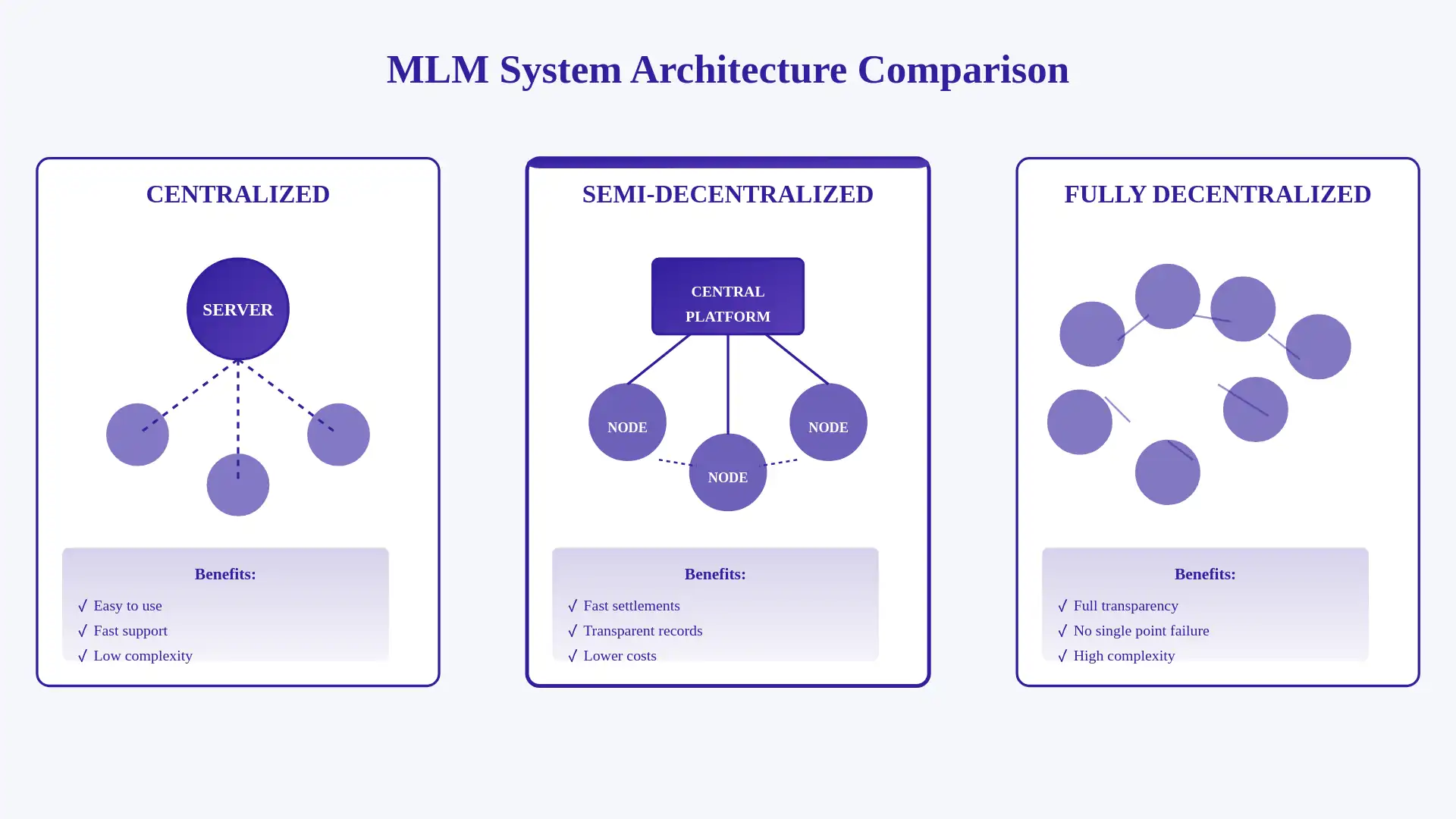
A semi-decentralized MLM system operates on a hybrid model where a central platform owner maintains core administrative functions while utilizing blockchain technology for specific critical operations. This approach allows network marketers to benefit from transparency, faster transactions, and enhanced security without sacrificing the ease of use and customer support that centralized systems provide.
The concept emerged as businesses recognized the limitations of purely centralized systems, which faced trust issues and scalability constraints, and fully decentralized systems, which proved too complex and expensive for mainstream adoption. Semi-decentralized models offer the practical middle ground that modern network marketing requires.
| Characteristic | Centralized MLM | Semi-Decentralized MLM | Fully Decentralized MLM |
|---|---|---|---|
| Control Structure | Single entity controls all | Shared control with blockchain | No central authority |
| Transaction Speed | Medium (1-3 days) | Fast (minutes to hours) | Very fast (seconds) |
| User Trust | Dependent on reputation | Built-in transparency | Inherent trustlessness |
| Technical Complexity | Low | Medium | High |
| Cost per Transaction | High (2-5%) | Low-Medium (0.5-2%) | Variable (0.1-1%) |
| Customer Support | Available 24/7 | Available 24/7 | Limited or community-based |
Also Read: What is MLM? Meaning, Types, Earnings, and Global Legality
How Semi-Decentralized MLM Works
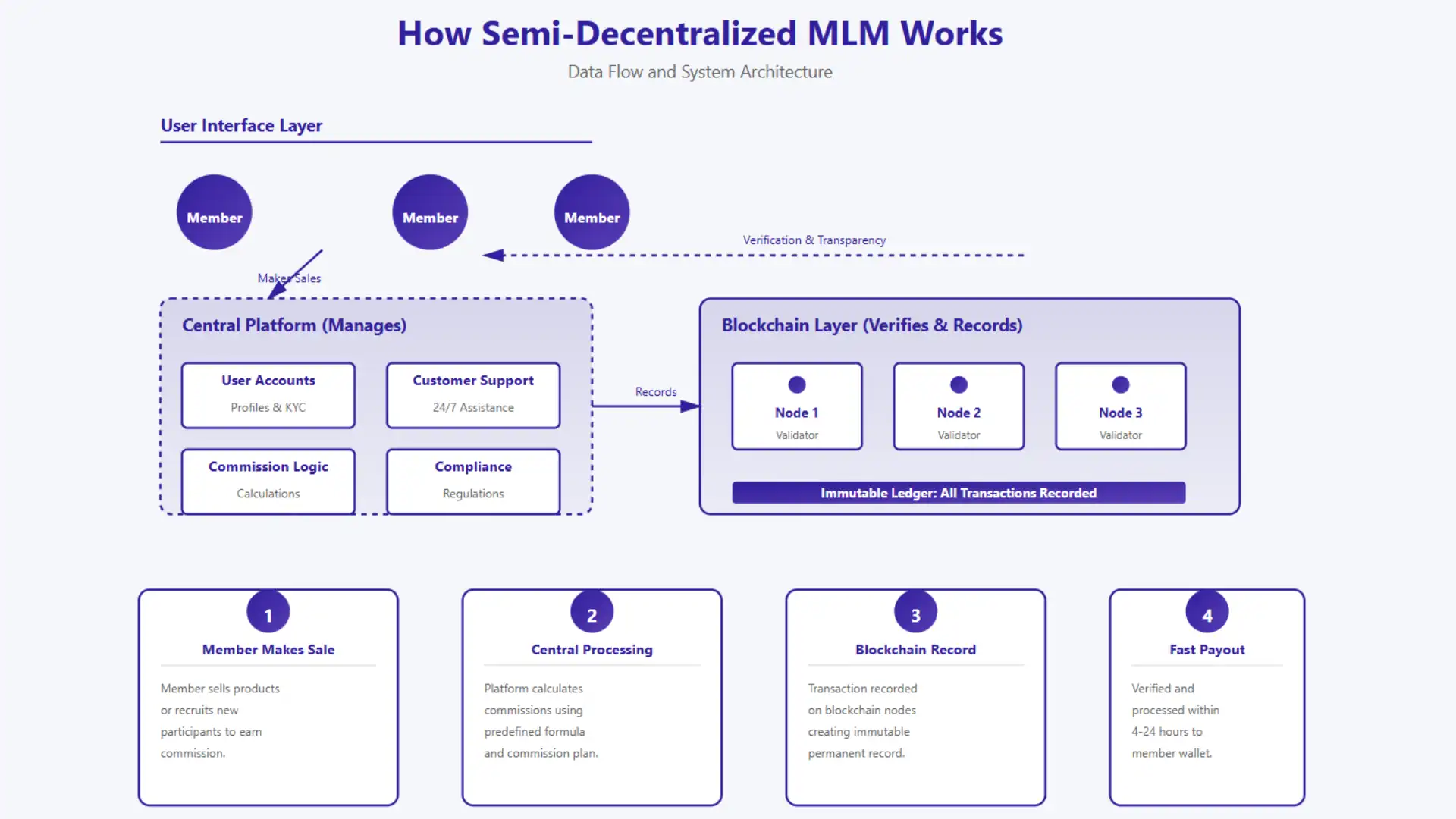
Understanding the mechanics of semi-decentralized MLM requires looking at how data flows through the system and where different technologies play their roles. Unlike fully centralized systems where a database holds all information, semi-decentralized systems distribute critical information across multiple touchpoints.
The core mechanics involve several key components working in tandem. The central platform maintains user accounts, onboarding processes, and customer relationship management. Blockchain technology handles commission calculations, transaction recording, and payout verification. Network nodes, which can be operated by trusted participants, validate and record transactions on the distributed ledger.
When a marketer makes a sale or earns a commission in a semi-decentralized system, the transaction flows through both systems. First, the sale is recorded on the central platform for user experience purposes. Simultaneously, the earning is committed to the blockchain ledger, creating an immutable record. This dual-recording approach ensures both accessibility and permanent verification.
Data flow in these systems creates a sophisticated infrastructure. Members interact with a user-friendly central interface, but their critical financial records exist on blockchain nodes. This separation means the system can remain responsive and easy to use while maintaining cryptographic verification of all transactions. The partial blockchain integration means only essential data like earnings, commissions, and payouts are decentralized, while operational data remains centralized for efficiency.
Benefits for Network Marketers
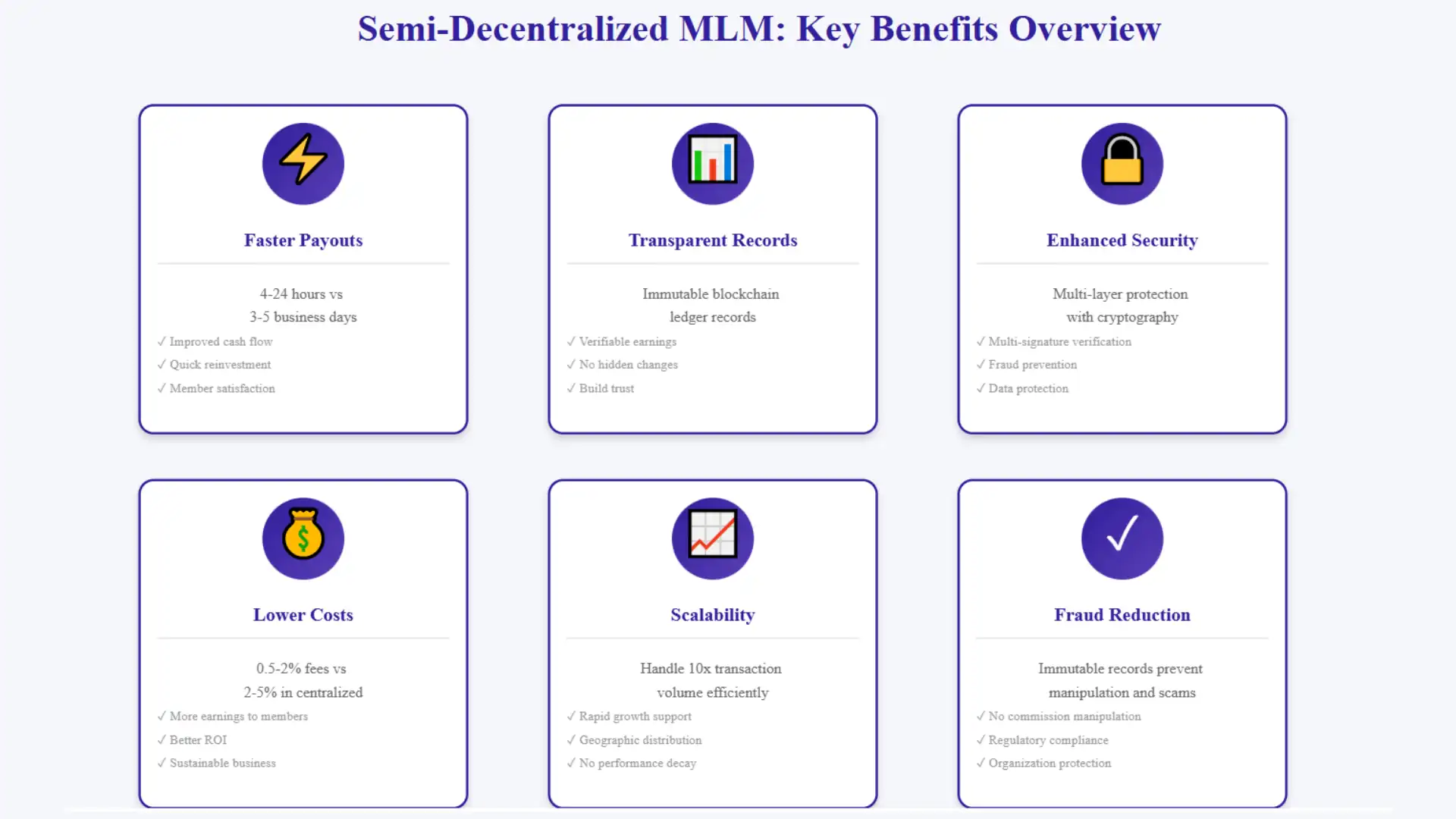
Network marketers operating within semi-decentralized systems enjoy several concrete advantages over traditional centralized platforms. These benefits directly impact their ability to earn, manage their business, and maintain trust with their teams.
Faster Payouts: One of the most significant advantages is the speed of commission distribution. Traditional MLM platforms process payouts on weekly or monthly cycles, often requiring three to five business days for funds to reach bank accounts. Semi-decentralized systems can process payouts within 24 hours, and in many cases, within hours. This rapid payment cycle improves cash flow and reduces the financial friction that marketers experience.
Enhanced Transparency: Every marketer can access a detailed record of their commissions, bonuses, and payouts without relying on customer support. The blockchain ledger serves as a permanent, auditable record that cannot be altered retroactively. Marketers can verify their earnings at any time, down to individual transactions, building confidence in the compensation structure.
Better Control: Semi-decentralized systems give marketers more control over their earnings. They can track real-time commission calculations, understand exactly how their bonuses are determined, and identify opportunities to increase their income. This transparency reduces dependency on company-provided reports and empowers individuals to manage their business with greater autonomy.
Enhanced Security Features
Security in semi-decentralized MLM systems operates on multiple levels, protecting both user data and financial assets from various threats. The hybrid architecture provides security benefits that neither centralized nor fully decentralized systems can achieve alone.
User data protection combines the best practices of both approaches. Personal information like names, contact details, and banking information remains encrypted on the central secure server, protected by standard enterprise-grade security infrastructure including firewalls, intrusion detection systems, and regular security audits. Sensitive financial records exist on blockchain nodes as cryptographically secured transactions, creating a secondary protection layer that prevents unauthorized modification.
Fund protection operates through smart contracts and multi-signature wallets. When a payout is initiated, it requires multiple confirmations from both the central platform and blockchain validators before the transaction executes. This eliminates single points of failure and prevents unauthorized withdrawals even if one component is compromised.
Fraud detection becomes more sophisticated in semi-decentralized systems. Pattern analysis on the central platform identifies unusual activity, while blockchain verification prevents double-spending and ensures transaction integrity. The combination means fraudulent transactions are caught at multiple checkpoints, significantly reducing the risk of scams that affect traditional centralized platforms.
Cost-Effectiveness Compared to Fully Decentralized Models
When businesses evaluate technology platforms for network marketing, cost considerations significantly influence decisions. Semi-decentralized systems demonstrate superior cost-effectiveness compared to fully decentralized alternatives, making them more viable for sustainable business operations.
Transaction fees represent a primary cost difference. Fully decentralized blockchain networks charge variable fees based on network congestion, often ranging from one to five percent of transaction value, or even higher during peak usage periods. Semi-decentralized systems leverage centralized infrastructure for high-volume operations, reducing blockchain usage to critical transactions only. This selective use drops transaction fees to between 0.5 and two percent, directly increasing the percentage of commissions that reach marketers.
Technical infrastructure costs favor semi-decentralized approaches significantly. Fully decentralized systems require participants to run node software, maintain constant network connections, and manage cryptographic keys. These requirements create barriers for non-technical users and increase operational expenses. Semi-decentralized platforms maintain central infrastructure that handles complexity, reducing the technical burden on users to near-zero and eliminating the need for users to operate expensive node infrastructure.
Development and maintenance efficiency also benefits from the semi-decentralized model. Adding new features, fixing bugs, or scaling the system becomes simpler when you have a central point of control for application logic. Fully decentralized systems require consensus mechanisms and coordinated upgrades across thousands of nodes, making changes slower and more expensive. This cost advantage translates to companies being able to invest more in product improvements and user support rather than spending resources on protocol administration. Check out this Wikipedia[1] article for detailed information on MLM.
Role in Building Trust Among Members
Trust represents the foundation of successful network marketing. When members doubt whether their earnings are calculated fairly or payouts will be processed correctly, the entire organization suffers. Semi-decentralized MLM systems actively build trust through verifiable transparency.
Commission distribution becomes completely transparent in these systems. Members can see exactly how commissions are calculated from their sales and from their downline activities. The blockchain ledger records each calculation step, creating an auditable trail that cannot be altered. If a member questions their commission, they can point to the immutable record and verify the calculation in real-time. This transparency eliminates the common complaint where members feel they are being cheated by hidden formulas or manipulated calculations.
Record keeping reaches new standards of reliability. Traditional systems keep records in proprietary databases that only company employees can access. Members must trust that the data is accurate and hasn’t been changed. Semi-decentralized systems distribute critical records across blockchain nodes operated by independent parties. This distribution means no single entity can alter historical records, and members maintain cryptographic proof of every transaction. The ability to verify records independently builds confidence that the system operates fairly.
Independent verification capabilities create what we might call structural trust. Rather than asking members to trust the company, semi-decentralized systems allow members to verify information themselves. This shift from trust-based to verification-based operations represents a fundamental improvement in security culture and reduces organizational risk from fraud or manipulation.
Hybrid Control: Central Authority and Blockchain Benefits
The defining characteristic of semi-decentralized MLM systems is the balance of control between a central platform operator and blockchain-based distributed verification. This balance creates distinct advantages that pure systems cannot achieve.
The central authority retains control over user experience, customer support, regulatory compliance, and business decisions. The platform operator decides which commission structures to support, how to onboard members, and how to manage customer relationships. This centralized control allows the business to maintain consistency, respond to market conditions quickly, and provide professional support that distributed systems struggle with. Users benefit from having a single point of contact for problems and a clear entity responsible for service quality.
Blockchain benefits provide transparency and immutability without requiring the central authority to be completely trustworthy. Even if the platform operator is compromised, the blockchain records prove what actually happened with commissions and payments. This architectural separation means users do not need complete trust in the central authority, only verification of publicly available records. The blockchain acts as a check on centralized power, creating accountability that pure centralized systems lack.
This hybrid approach solves the trust paradox in network marketing. Members need a responsive, user-friendly platform with professional support, which requires centralization. Simultaneously, they need verifiable records that cannot be altered, which benefits from decentralization. Semi-decentralized systems satisfy both requirements by centralizing experience and decentralizing verification, creating what might be described as “trust but verify” technology.
Faster Transaction Settlement
The speed at which transactions settle significantly impacts member experience and business operations. Semi-decentralized systems deliver settlement times that substantially outperform traditional centralized platforms while remaining practical compared to fully decentralized networks.
Settlement Speed Comparison:
Centralized MLM platforms typically settle transactions within 3-5 business days. Members earn commissions on Monday but don’t see funds until Friday or later. Semi-decentralized systems settle within 4-24 hours by batching transactions and processing them quickly through blockchain verification. Fully decentralized systems settle within seconds but require users to manage their own wallets and keys.
The practical difference is substantial. In a centralized system, if a marketer needs funds urgently, they must wait days or use expensive advance services. Semi-decentralized systems mean urgent needs can be met within a day. Members can reinvest earnings rapidly into their marketing efforts without managing multiple wallets or paying additional services fees.
Settlement speed also impacts global operations. When marketers work across time zones and currencies, faster settlements reduce exchange rate volatility risk and eliminate delays from international banking systems. A marketer in Southeast Asia can receive their commission in their local currency within 24 hours rather than waiting for international bank transfers.
Scalability Advantages
Network marketing organizations grow rapidly, sometimes experiencing 300-400% annual expansion in member count. The technology infrastructure must scale gracefully to handle this growth without degradation in performance or reliability. Semi-decentralized systems are specifically architected to handle growth efficiently.
Centralized databases face fundamental limits as transaction volume increases. Every transaction must be processed by the central server, creating bottlenecks during high-volume periods like commission payouts. Semi-decentralized systems distribute load across blockchain nodes, each capable of processing transactions in parallel. This parallel processing allows the system to handle ten times the transaction volume that centralized systems can manage with the same infrastructure investment.
New member onboarding becomes more efficient in semi-decentralized architectures. Instead of all processing flowing through central servers, initial account setup happens centrally while transaction processing distributes across the network. Organizations have reported onboarding increases of 500% without performance degradation after switching to semi-decentralized systems.
Geographic scalability also improves. Centralized systems often experience latency issues in countries far from their data center. Semi-decentralized systems can deploy blockchain nodes in multiple geographic regions, ensuring local marketers experience fast transaction confirmation regardless of location. This geographic redundancy means a single regional internet outage does not impact the entire network’s ability to process transactions.
Flexibility in MLM Plan Designs
Different organizations require different compensation structures. Some use binary plans where members have exactly two downline positions. Others use matrix plans with fixed width and depth. Still others use unilevel structures where members can sponsor unlimited downlines in a single line. Semi-decentralized systems support all these structures natively.
The flexibility stems from how commission calculations are implemented. In semi-decentralized systems, commission logic exists on the central platform where developers can code complex algorithms. The blockchain layer doesn’t care how commissions are calculated, only that the results are recorded accurately. This separation allows organizations to design commission structures to match their market and member preferences.
Binary Plan Example: A participant can have two frontline members. Commissions are paid on both legs, with balancing mechanisms that prevent excessive accumulation on one side. Semi-decentralized systems handle these balancing calculations and record the results on blockchain.
Matrix Plan Example: A 3×5 matrix means three members in the first level and five levels deep. Commission calculations must track position depth and horizontal placement. The complexity increases significantly, but semi-decentralized systems manage these calculations efficiently.
Unilevel Plan Example: Participants can sponsor unlimited members in their downline. Commissions might be paid for five levels deep or with diminishing percentages at deeper levels. These structures are the simplest but require accurate tracking across large organizations.
Transparency in ROI and Earnings
Potential members evaluating network marketing opportunities want transparent information about earnings potential. Semi-decentralized systems enable unprecedented transparency by making all earnings data publicly verifiable.
Members can track their total earnings, commissions by source, and bonuses earned. They can see income history going back years without relying on company reports. This transparent tracking allows members to calculate their personal return on investment accurately. If a member spent 100 dollars on products and earned 500 dollars in commissions over six months, they can verify this with immutable blockchain records.
Anonymized aggregate data also becomes more reliable. Organizations can report that their top 20% of members earn an average of 5000 dollars monthly, and this data is verifiable by anyone with access to blockchain records. The ability to verify claims independently builds organizational credibility and attracts members who are skeptical of traditional MLM representations.
This transparency also protects organizations from fraud. If someone claims to have earned more than blockchain records show, the discrepancy is immediately apparent. Members cannot fabricate earnings claims when records are publicly verifiable, reducing organizational exposure to false income claims that might trigger regulatory scrutiny.
Reducing Fraud and Manipulation Risks
Network marketing has historically been vulnerable to various fraud schemes. Unethical operators manipulate commission calculations, falsify records, or misrepresent earnings opportunities. Semi-decentralized systems reduce these fraud vectors by making manipulation technically difficult or impossible.
Commission manipulation becomes nearly impossible when calculations are recorded on blockchain. Traditional systems allow operators to adjust historical records in databases. Semi-decentralized systems record every calculation on immutable ledgers. If someone claims a commission calculation error occurred in their favor, other members can verify whether this is true by checking the blockchain record.
Fake earnings claims are prevented when records are verifiable. Unethical recruiters sometimes fabricate income examples to attract new members. In systems with transparent earnings records, anyone can check whether claimed earnings actually occurred. This verification capability protects the organization from liability related to false income claims.
Pyramid scheme indicators become transparent in semi-decentralized systems. If most earnings come from recruitment rather than retail sales, the blockchain records show this clearly. Regulators can easily verify whether an organization qualifies as a pyramid scheme by examining transaction data. This transparency incentivizes legitimate business models and makes it difficult for bad actors to hide fraudulent operations.
Double-spending and duplicate payments are technically impossible in blockchain-based systems. Each earning is recorded once and settled once. Traditional systems require manual reconciliation and audits to prevent double-payment errors. Semi-decentralized systems eliminate this entire class of problems through cryptographic verification.
Boost Your Crypto MLM Profits
Transform your MLM business with smart blockchain solutions. Secure, scalable, and designed to maximize ROI and profitability.
Integration with Cryptocurrency Payments
Semi-decentralized MLM systems naturally support cryptocurrency and stablecoin payments, enabling truly global operations with minimal friction. This integration represents a significant operational advantage for organizations operating across multiple countries.
Stablecoin usage eliminates currency volatility for international payments. A marketer in Brazil can earn commissions in USDC, a stablecoin pegged to the US dollar, and instantly convert to Brazilian reals without currency risk. Traditional systems require international bank transfers that take days and charge substantial fees. Stablecoins settle in minutes with costs under 0.1%.
Unbanked and underbanked populations become addressable markets. Approximately two billion people globally lack access to traditional banking but own smartphones capable of managing cryptocurrency wallets. Network marketing organizations can expand into these markets by paying members in cryptocurrency, which they can use locally or convert through various services.
Payment flexibility improves member experience. Members can choose to receive commissions in traditional currency, stablecoins, or native cryptocurrency tokens. This flexibility appeals to different member preferences and attracts members who are cryptocurrency-native and prefer to manage their finances digitally.
Global expansion becomes feasible without regulatory complexity. Traditional payment processors require different integrations for different countries, with varying compliance requirements. Cryptocurrency-based systems provide a single global payment rail that works everywhere, dramatically reducing operational complexity for organizations scaling internationally.
INDUSTRY EXPERTISE
From our analysis with over 8 years of experience in network marketing technology infrastructure: Semi-decentralized systems represent the pragmatic evolution of network marketing platforms. Unlike early blockchain projects that pursued ideological decentralization at the expense of usability, modern semi-decentralized systems prioritize member experience while leveraging blockchain for critical functions. Organizations implementing these systems report 40-60% reductions in fraud-related support tickets, 3-5 times faster member onboarding, and substantially higher member retention due to improved trust and transparency. The technology has matured to the point where implementation complexity is no longer a barrier to adoption, and the operational advantages are becoming standard expectations rather than differentiators.
Future of Semi-Decentralized MLM
The trajectory of semi-decentralized MLM systems points toward increasing adoption and technological sophistication. Several developments are likely to shape the industry over the coming years.
Regulatory clarity will accelerate adoption. As governments develop clearer frameworks for cryptocurrency and blockchain-based businesses, organizations can implement these systems with greater confidence. Recent regulatory statements from financial authorities indicate movement toward accepting blockchain technology for legitimate business applications, which removes a significant barrier to mainstream adoption.
Interoperability between different MLM platforms will likely develop. Currently, each semi-decentralized system operates independently. Future developments may allow members to transfer between platforms while maintaining their earning records, creating a more liquid market for network marketing services. This interoperability would fundamentally change how members relate to specific platforms.
Artificial intelligence integration is another probable development. Machine learning algorithms can analyze blockchain records to detect emerging fraud patterns, optimize compensation structures based on member behavior, and personalize marketing recommendations. These AI capabilities will enhance the advantages that semi-decentralized systems already provide.
Global payment infrastructure continues to evolve. Central bank digital currencies (CBDCs) are being developed in multiple countries. When these become widely available, semi-decentralized MLM systems can integrate directly with CBDCs, providing instantaneous, cost-free settlements in government-backed currencies. This development will eliminate remaining friction in international payments.
Environmental considerations are becoming increasingly important. Newer blockchain technologies use far less energy than earlier systems. Semi-decentralized platforms will likely migrate to these more sustainable technologies, addressing environmental concerns that have limited blockchain adoption in some sectors.
Why Businesses Choose Semi-Decentralized MLM
Semi-decentralized MLM systems represent a matured technology choice for organizations seeking to balance operational efficiency with member trust. The decision to implement semi-decentralized architecture stems from recognizing that neither purely centralized nor fully decentralized systems optimally serve network marketing’s unique requirements.
Centralized systems provide ease of use and responsive support but create trust vulnerabilities that are increasingly difficult to overcome in competitive markets. Fully decentralized systems provide ideological purity around decentralization but sacrifice the user experience and support quality that modern members expect. Semi-decentralized systems split the difference strategically, centralizing aspects that benefit from central control while decentralizing aspects where decentralization provides tangible benefits.
The practical advantages accumulate across organizational operations. Faster payouts improve member satisfaction and retention. Transparent records reduce support costs by eliminating dispute resolution. Enhanced security protects organizational reputation and reduces regulatory exposure. Cost-effectiveness compared to fully decentralized systems improves profitability. Scalability enables growth without infrastructure limitations. Fraud reduction protects organizational legitimacy.
For members, semi-decentralized systems enable participation in network marketing with greater confidence and transparency. Earning potential becomes verifiable rather than claimed. Payouts arrive faster. Records cannot be altered. Support remains accessible. These member benefits translate to organizational benefits through improved retention, reduced complaints, and enhanced reputation.
As network marketing continues evolving to meet modern member expectations for transparency and legitimacy, semi-decentralized systems are positioning themselves as the technological standard. Organizations that implement these systems early gain competitive advantages in attracting members who prioritize transparency and security. The business case for semi-decentralized MLM is becoming increasingly compelling as the technology matures, regulatory environment clarifies, and competitive pressure increases. Forward-thinking organizations are recognizing that semi-decentralized infrastructure is not a futuristic concept but a present-day requirement for sustainable growth in network marketing.
Frequently Asked Questions
Q1.What is semi-decentralized MLM?
Semi-decentralized MLM is a hybrid network marketing system that combines a central platform’s ease of use with blockchain’s transparency. Critical operations like commission tracking and payouts are verified on the blockchain, while user support and onboarding remain centralized, offering faster settlements, fraud protection, and verifiable earnings for network marketers.
Q2.How does semi-decentralized MLM differ from traditional MLM?
Unlike traditional MLM, where all data is centralized and controlled by a single company, semi-decentralized MLM uses blockchain to record commissions and transactions. This ensures transparent earnings, faster payouts, and reduced fraud risks while maintaining the familiar user interface and support of a centralized system.
Q3.Are payouts faster in semi-decentralized MLM systems?
Yes. Semi-decentralized MLM platforms can process payouts within 4–24 hours, compared to the 3–5 days common in traditional MLM. This faster settlement improves cash flow for marketers, allowing them to reinvest earnings quickly and operate globally without waiting for slow banking processes.
Q4.Can I trust the earnings in semi-decentralized MLM?
Absolutely. Earnings and commissions are recorded on blockchain nodes, creating an immutable, verifiable ledger. Members can independently verify every transaction, ensuring full transparency and building trust that commissions are accurate without solely relying on company reports.
Q5.How secure are semi-decentralized MLM platforms?
These platforms offer multi-layered security. Personal data stays encrypted on central servers, while financial records are secured on blockchain nodes. Smart contracts and multi-signature wallets protect funds, and fraud detection mechanisms prevent manipulation, making it safer than traditional MLM systems.
Q6.What MLM plans can be used with semi-decentralized systems?
Semi-decentralized MLM supports multiple plan types, including binary, matrix, and unilevel structures. Complex commission calculations are handled centrally and recorded on blockchain for verification, offering flexibility while ensuring accurate tracking for any MLM structure.
Q7.7. Can I use cryptocurrencies for payouts in semi-decentralized MLM?
Yes, these systems naturally support cryptocurrencies and stablecoins. Marketers can receive payments in USDC, USDT, or native tokens, reducing currency volatility, cutting international transfer fees, and enabling global access—even for unbanked members.
Q8.Is semi-decentralized MLM cost-effective for businesses?
Yes. By using blockchain only for critical transactions, transaction fees drop to 0.5–2%, lower than fully decentralized platforms. Centralized infrastructure reduces technical burdens, making system maintenance, scaling, and updates cheaper while preserving security and transparency.
Q9.How does semi-decentralized MLM prevent fraud?
Fraud is minimized through blockchain verification and immutable records. Commission manipulation, double-spending, and false earnings claims become nearly impossible. Combined with central platform monitoring and pattern analysis, these systems drastically reduce the risks common in traditional MLM operations.
Q10.Why is semi-decentralized MLM considered the future of network marketing?
It balances transparency, speed, security, and usability. Members enjoy verifiable earnings, fast payouts, and scalable systems, while businesses gain cost-efficiency and reduced fraud. This hybrid approach addresses the limitations of both centralized and fully decentralized MLM models, making it ideal for modern network marketing growth.
Explore Services
Related Services
Reviewed by

Aman Vaths
Founder of Nadcab Labs
Aman Vaths is the Founder & CTO of Nadcab Labs, a global digital engineering company delivering enterprise-grade solutions across AI, Web3, Blockchain, Big Data, Cloud, Cybersecurity, and Modern Application Development. With deep technical leadership and product innovation experience, Aman has positioned Nadcab Labs as one of the most advanced engineering companies driving the next era of intelligent, secure, and scalable software systems. Under his leadership, Nadcab Labs has built 2,000+ global projects across sectors including fintech, banking, healthcare, real estate, logistics, gaming, manufacturing, and next-generation DePIN networks. Aman’s strength lies in architecting high-performance systems, end-to-end platform engineering, and designing enterprise solutions that operate at global scale.