Ai Overview
Before diving into the token revolution, it’s essential to understand why conventional loyalty programs are failing to meet modern consumer expectations. According to a report by Bond Brand Loyalty, nearly 30% of loyalty points go unredeemed each year. 7% of businesses have made plans to boost investment into loyalty programs to retain customers in the face of inflation.
Key Takeaways
- The global loyalty market is projected to reach $214.7 billion by 2028, representing a massive opportunity for brands that innovate their loyalty strategies.
[1] - 96% of millennials believe loyalty programs need a refresh, indicating strong consumer demand for modernized engagement approaches.[2]
- Nearly 30% of traditional loyalty points go unredeemed each year, representing both lost customer value and brand liability.
- Singapore Airlines’ KrisPay has expanded to over 150 partners covering 650+ outlets, demonstrating successful blockchain loyalty implementation at scale.[3]
- Cleveland Cavaliers’ token-based program delivered 21% lift in enrolled member spending and 51% boost in Team Shop sales, proving concrete ROI from blockchain loyalty.[4]
- Smart contracts eliminate intermediaries and reduce operational costs, allowing brands to offer more generous rewards while improving profit margins.[5]
- Brands using tokenized perks see up to 25% lift in repeat purchase rates, driven by the tradability and perceived value of on-chain rewards.[6]
- 22% of millennials and 20% of Gen Z already own cryptocurrency, making these demographics primed to embrace token-based loyalty programs.[7]
- The average U.S. consumer holds 18 loyalty memberships but actively uses only half, highlighting the fragmentation problem that blockchain interoperability can solve.[8]
- Ponta Points serves over 100 million users across 300,000 retailers in Japan, and has begun piloting blockchain-based rewards to enhance its massive program.[9]
The loyalty landscape is undergoing a fundamental transformation. Traditional punch cards and basic points systems that dominated retail for decades are giving way to something far more powerful: token-based loyalty programs built on blockchain technology. This shift represents one of the most significant changes in customer engagement strategy since the introduction of frequent flyer miles in the 1980s.
The global loyalty market is expected to grow by 11.1% on an annual basis to reach US$150.9 billion in 2024. Meanwhile, the loyalty market is projected to exceed $24 billion in revenue within the next five years, creating massive opportunities for brands willing to embrace new technologies.
But why are so many companies making this switch? The answer lies in a perfect storm of consumer dissatisfaction, technological advancement, and changing demographics. 96% of millennials believe loyalty programs need a refresh with new ways to reward users, while 41% of Gen Z consumers are not satisfied with current rewards programs, preferring nontraditional rewards.
This comprehensive guide explores why blockchain-based tokens are becoming the backbone of modern loyalty strategies, how leading brands are implementing them, and what this means for the future of customer relationships.
Understanding the Current State of Traditional Loyalty Programs
Before diving into the token revolution, it’s essential to understand why conventional loyalty programs are failing to meet modern consumer expectations.
1. The Fragmentation Problem
American consumers face overwhelming complexity in managing their loyalty relationships. In 2023, an average consumer in the United States held roughly 18 loyalty program memberships but actively used only half of them. This disparity between enrollment and engagement reveals a fundamental flaw in how traditional programs operate.
The proliferation of separate, siloed loyalty accounts creates friction for consumers who must track multiple programs, remember various login credentials, and navigate different redemption rules. The average U.S. household has 29 separate loyalty accounts, leading to confusion and disengagement.
2. The Breakage Challenge
Traditional loyalty programs suffer from a phenomenon known as “breakage,” where customers earn points but never redeem them. According to a report by Bond Brand Loyalty, nearly 30% of loyalty points go unredeemed each year. While this might seem beneficial to businesses from a short-term financial perspective, high breakage rates actually signal declining member engagement and reduced program effectiveness.
Loyalty programs with a breakage rate in the 25 to 35 percent range are considered to have a healthy rate. The breakage rates loyalty programs experience differ widely by vertical. For example, in the travel industry, the breakage rate averages 85 percent, while retailers often see a 30 percent breakage rate. These unredeemed points create hidden liabilities on company balance sheets while simultaneously frustrating customers who feel their loyalty goes unrewarded.
3. Consumer Dissatisfaction with Current Programs
According to Antavo’s 2023 Global Customer Loyalty Report, 67.7% of businesses have made plans to boost investment into loyalty programs to retain customers in the face of inflation. Yet despite this increased investment, traditional programs continue to underwhelm.
The fundamental issue is structural. Conventional loyalty programs operate within “walled gardens” where customer data is siloed, and rewards are limited to specific use cases. These models have long depended on third-party cookies and opaque data practices to thrive. However, as privacy regulations tighten and cookies phase out, these models are rapidly losing their viability.
What Are Token Based Loyalty Programs?
Token-based loyalty programs represent a paradigm shift in how brands reward customer behavior. Instead of accumulating points in a centralized database controlled entirely by the issuing company, customers earn digital tokens recorded on a blockchain.
1. The Technical Foundation
Token-based loyalty programs use blockchain to give customers digital tokens for engaging with brands. These tokens function similarly to cryptocurrencies in that they exist as digital assets on a distributed ledger, but they’re specifically designed for brand engagement purposes.
The key difference from traditional points lies in ownership and flexibility. When you earn tokens in a blockchain-based system, you genuinely own them. They exist in your digital wallet, and you can often trade, transfer, or redeem them according to your preferences rather than being locked into a single brand’s ecosystem.
2. Smart Contracts: The Engine Behind Automation
One of blockchain’s more compelling features for brands is its smart contracts, which are automated, self-executing agreements that eliminate the need for intermediaries. This built-in perk streamlines rewards program processes, cutting operational costs and boosting a program’s bottom line.
Smart contracts automatically execute when predetermined conditions are met. If a customer makes their tenth purchase, the smart contract can instantly issue bonus tokens without any manual processing. This automation reduces administrative overhead while ensuring customers receive their rewards immediately.
The automation provided by smart contracts drastically reduces the administrative burden and operating costs associated with running loyalty programs. Businesses no longer need to manually track, validate, and process loyalty transactions.
3. Tokenization Creates New Value
Tokenization, converting assets into digital tokens, is elevating customer engagement. It creates secondary markets where customers can trade, sell, or rent their rewards, incentivizing participation and opening new revenue streams.
This is perhaps the most revolutionary aspect of token-based loyalty programs. Unlike traditional points that remain trapped within a single program, tokens can flow freely. A customer who has no immediate use for their airline tokens could trade them with someone else or convert them into tokens for a different brand entirely.
Recommended Reading:
Why Brands Are Making the Switch to Blockchain-Based Tokens
1. Meeting Younger Consumer Expectations
- The Generational Shift
Younger consumers are driving demand for modernized loyalty experiences. More than three-quarters of millennials and 71% of Gen Z consumers consider loyalty programs vital for brand allegiance. However, their expectations differ dramatically from those of previous generations.
Gen Z and millennials value unique experiences and exclusive access over traditional rewards, finding backstage passes, VIP access, or limited edition products more appealing than cash back and discounts.
- Digital Asset Familiarity
With 22% of millennials and 20% of Gen Z already owning cryptocurrency, these consumer groups are primed to embrace blockchain-based loyalty. This existing familiarity with digital assets makes the transition to token-based programs natural for younger demographics.
By late 2023, 9% of Gen Z and 8% of millennials in the United States owned NFTs, demonstrating a willingness to engage with digital collectibles that can be leveraged for brand loyalty purposes.
2. Enhanced Transparency and Trust
- The Immutable Record
By leveraging blockchain and strategic token development, brands can build trust with customers through immutable and verifiable transactions. Every token earned, transferred, or redeemed is permanently recorded on the blockchain, creating a transparent audit trail that neither the brand nor the customer can manipulate.
This transparency addresses a common complaint about traditional programs, where customers often feel uncertain about their point balances or suspect that rules change without notice.
- Real Time Tracking
Loyalty programs leveraging blockchain offer unparalleled security compared to traditional, centralized models, fostering greater brand trust with customers. The technology’s real-time tracking and personalization capabilities mitigate fraud risks.
3. Interoperability Opens New Possibilities
- Cross-Brand Redemption
Blockchain’s interoperability allows loyalty points to be seamlessly transferred across an ecosystem of merchants. This capability transforms loyalty from a single brand relationship into a network effect.
With blockchain loyalty programs, retailers can create cross-brand loyalty networks where customers earn points that can be redeemed at multiple stores within a network. Several retail brands can join forces to establish a shared loyalty ecosystem where customers earn tokens for purchases made across different brands.
- The Airline Example
Singapore Airlines’ KrisPay program, where air miles can be converted into digital tokens spendable at partner merchants, exemplifies this enhanced convenience.
Flyers can convert their KrisFlyer miles to KrisPay miles and instantly use them for purchases made at partner merchants. The project was co-developed by KPMG Digital Village and Microsoft.
4. Operational Cost Reduction
- Eliminating Intermediaries
Traditional loyalty programs require substantial infrastructure to manage point tracking, fraud prevention, and redemption processing. Blockchain-based systems dramatically reduce these costs.
By eliminating intermediaries, businesses can reduce operational costs associated with managing loyalty programs. This can lead to higher profit margins and potentially more generous rewards for customers.
- Automated Reconciliation
Smart contracts stored on a blockchain help automate settling coalition program accounts, joint campaigns, accountability, reporting, and audits. This automation eliminates the manual reconciliation processes that traditionally consume significant resources.
5. New Revenue Streams Through Secondary Markets
- Tokenized Loyalty Creates Tradable Assets
Yuga Labs, an early adopter, has already earned an estimated $150 million in royalties through tokenized loyalty. While Yuga Labs operates in the NFT space rather than traditional loyalty, their success demonstrates how tokenization can create ongoing revenue through secondary market activity.
Brands using tokenized perks see up to 25% lift in repeat purchase rates, driven by the tradability of on-chain rewards.
Real World Case Studies: Brands Leading the Token Revolution
1. Singapore Airlines: The Pioneer in Aviation
- KrisPay: World’s First Blockchain Airline Loyalty Wallet
Singapore Airlines launched what was touted as the world’s first blockchain-based airline loyalty digital wallet app in 2018, setting the standard for aviation industry adoption.
Overall, the project took six months for Singapore Airlines to create the KrisPay blockchain environment on Azure, a mobile application for iOS and Android devices, and web portals for both customers and partners.
- Results and Expansion
The program has evolved into Kris+, already claiming to have over 150 partners covering more than 650 outlets to provide exclusive deals for the Airline’s customers. The success of KrisPay demonstrated that blockchain loyalty could work at scale while providing genuine value to customers.
Kris+ has since opened up new customer segments for SIA, including non-frequent flyers, while enabling KrisFlyer members to use their miles to pay for purchases at partner merchants and to accumulate loyalty miles for the next flight.
2. Cleveland Cavaliers: Sports Enter the Blockchain Era
- Cavs Rewards: First of Its Kind in Professional Sports
In October 2024, the Cleveland Cavaliers NBA team launched Cavs Rewards. This program gave Cleveland Cavaliers fans a chance to connect with the team by turning everyday purchases into experiences, memorabilia, and collectibles.
The program represents a groundbreaking approach to sports loyalty. Starting on October 25, 2024, every Cavs Rewards member gets a blockchain-powered wallet, automatically storing their engagement history.
- Measurable Business Impact
In the Cavaliers program, sponsors have seen a 21% lift in spend from enrolled members and a 51% boost in Team Shop sales since launch. These results demonstrate that token-based loyalty programs can deliver concrete business outcomes, not just technological innovation.
Cavs Rewards participants will earn on-chain achievement badges via Avalanche, which will recognize various tiers of fandom. These badges are exclusively attainable by accumulating points through Uptop’s rewards program.
3. Ponta Points: Scaling to 100 Million Users in Asia
- Massive Scale Implementation
Ponta Points, operated by Loyalty Marketing, is one of Asia’s largest rewards programs. The app serves 100+ million users across 300,000 retailers in Japan.
- Blockchain Integration
In December 2024, Loyalty Marketing launched a pilot program for Ponta Points, onboarding an initial 30,000 customers to a blockchain-based version of the app. This pilot demonstrates how established loyalty programs with massive user bases can transition to blockchain infrastructure.
4. Starbucks Odyssey: Lessons from a High Profile Experiment
- The Ambitious Vision
Starbucks is officially introducing Starbucks Odyssey today, which combines the company’s successful Starbucks Rewards loyalty program with an NFT platform, allowing its customers to both earn and purchase digital assets that unlock exclusive experiences and rewards.
More than $200,000 in sales have been completed, with NFTs that cost customers little more than a few cups of coffee being sold on the secondary market for as much as $1,900.
- Why It Ended
On 15th March 2024, a little over 18 months after its launch in closed beta, the brand announced that it would be shuttering Odyssey by the end of the month.
The program’s complexity proved to be its downfall. Odyssey was a complex proposition. Participants in Odyssey’s closed beta could earn both Journey Stamps, i.e., Starbucks’ collectible NFTs, and Odyssey Points in exchange for engaging with the brand via purchases, watching videos, or taking quizzes.
The Shift Toward Tokenized Loyalty
-
Enhanced Customer Engagement
Tokenized loyalty programs offer customers a more interactive and engaging experience. The possibility of using, trading, or saving loyalty tokens gives customers a reason to pay attention and interact regularly with the brand. QR-based touchpoints can further enhance this engagement, and tools like The QR Code Generator (TQRCG) make it easy to connect customers to token rewards through simple scans. Customers are more likely to engage with:
- Dynamic token-based offers.
- Gamified rewards systems.
- Collectible tokens or NFTs.
- Community-driven reward pools.
-
True Ownership and Transparency
Blockchain ensures that customers fully own their loyalty tokens. Unlike traditional points that exist only in a centralized brand database, blockchain tokens are stored in secure digital wallets controlled by the customer.
Transparency is another major benefit. All transactions are recorded on the blockchain, making them tamper-proof and fully auditable. Customers can clearly see how many tokens they’ve earned, what they can do with them, and when they used them.
-
Borderless and Interoperable Loyalty
One of the most powerful innovations offered by crypto token platforms is interoperability. With advanced token development solutions, brands can collaborate to create ecosystems where tokens are accepted across multiple businesses. For example, a customer could earn tokens from a clothing store and redeem them at a coffee shop, hotel, or even a streaming service. This kind of flexibility unlocks new partnership opportunities and drives strong network effects across industries.
-
Cost Savings and Automation
Smart contracts reduce administrative overhead by automating:
- Token issuance.
- Redemption processes.
- Loyalty tiers and upgrades.
- Fraud detection.
This means brands can scale loyalty programs more easily while saving on operational costs.
-
Improved Data and Personalization
Blockchain provides access to accurate, real-time customer data (while preserving privacy). This helps brands:
- Understand purchase behavior.
- Personalize rewards and campaigns.
- Predict customer churn.
- Optimize marketing strategies.
Comparative Analysis: Traditional vs. Token-Based Loyalty Programs
| Feature | Traditional Loyalty Programs | Token Based Loyalty Programs |
|---|---|---|
| Ownership | Points owned by the issuing company | Tokens owned by the customer in the digital wallet |
| Transferability | Generally non-transferable | Can be traded, sold, or gifted |
| Expiration | Often expire after a set period | Typically do not expire |
| Cross-Brand Usage | Limited to a single brand ecosystem | Can be used across multiple partner brands |
| Transparency | Rules can change; balances are controlled by the company | Immutable blockchain record |
| Redemption Speed | May require manual processing | Instant via smart contracts |
| Fraud Prevention | Relies on centralized security | Cryptographic protection |
| Administrative Cost | High due to manual processes | Lower through automation |
| Secondary Market | Not possible | Tokens can be traded on marketplaces |
| Customer Data | Siloed within company systems | Customer controls their data |
Benefits for Different Stakeholders
1. Benefits for Customers
- True Ownership of Rewards
Unlike traditional points that exist only in a company database, blockchain-based tokens represent genuine digital assets. Unlike traditional points, these tokens belong entirely to the consumer and are securely stored in a digital wallet.
- Flexibility and Choice
Token holders can decide how to use their rewards rather than being forced into limited redemption options. They might hold tokens for future value appreciation, trade them with other users, or redeem them immediately.
- Protection Against Devaluation
Traditional loyalty programs frequently devalue points by changing redemption rates. Blockchain-based systems make such changes transparent and can be designed to protect token holders from unexpected devaluation.
- Mobile Accessibility
A study found that 69% of people are more likely to use a loyalty program if they can access it on their mobile phone. Token-based programs typically offer robust mobile wallet integration.
2. Benefits for Brands
- Reduced Liability
Traditional unredeemed points create accounting liabilities. Token-based systems can be structured to reduce this burden while actually increasing customer engagement.
- Enhanced Data Insights
Blockchain provides unprecedented visibility into customer behavior patterns, enabling more targeted marketing and personalized experiences.
- Competitive Differentiation
Early adopters of token-based loyalty gain significant competitive advantages in attracting younger, tech-savvy consumers who expect modern engagement experiences.
- Partner Network Expansion
Traditional Loyalty Systems are slow with costly integrations between brands. Delta and Starbucks have to build custom bilateral integrations just to exchange rewards. Blockchain eliminates that friction, allowing partners to plug in instantly, no middlemen required.
3. Benefits for the Broader Ecosystem
- Coalition Programs Become Easier
Next-generation coalition programs can be automatically formed for occasional events such as Black Friday, Christmas, or other designated campaigns. It’s a totally novel and more flexible approach to establishing coalition loyalty programs.
- New Business Models Emerge
The ability to trade and exchange loyalty tokens creates entirely new categories of businesses and services that can operate within and alongside existing loyalty ecosystems.
You may also like:
Crypto Coin and Token Explained: Architecture, Standards, Tokenomics & Cost
Implementation Challenges and How to Overcome Them
1. Technical Complexity
- The Challenge
Blockchain technology remains unfamiliar to many consumers and businesses alike. Implementation requires specialized expertise that may not exist within traditional marketing or customer experience teams.
- Solutions
Many platforms now offer white-label solutions that abstract away blockchain complexity. Uptop’s white-labeled solution delivers a sports industry first: an open-loop rewards system that allows a team or league’s sponsors to participate directly in the fan loyalty program.
Brands should focus on making the user experience feel familiar while the blockchain infrastructure operates invisibly in the background.
- The Challenge
Many people find blockchain hard to understand. This knowledge gap can create barriers to adoption, particularly among older demographics less familiar with digital assets.
- Solutions
Successful programs like Starbucks Odyssey deliberately avoided crypto terminology. It’s intentionally obscuring the nature of the technology underpinning the experience in order to bring in more consumers, including non-technical people, to the web3 platform.
The key is focusing on benefits rather than technology in consumer communications.
3. Regulatory Uncertainty
- The Challenge
Token-based programs may face regulatory scrutiny, particularly regarding securities laws and consumer protection regulations.
- Solutions
Working with legal experts familiar with blockchain regulations is essential. Programs should be designed with compliance in mind from the outset, and brands should monitor evolving regulatory frameworks.
4. Token Value Volatility
- The Challenge
Unlike traditional points with fixed values, token values can fluctuate, creating uncertainty for both brands and customers.
- Solutions
Many successful programs use “stablecoins” or pegged token values to provide consistency. Others embrace value fluctuation as a feature that can increase engagement by creating collector interest.
Industry Applications Across Sectors
1. Retail and Consumer Goods
- The Opportunity
Retail faces intense competition for customer loyalty. The retail and consumer goods segment accounted for the largest revenue share of over 22.0% in 2024 within the loyalty management market, indicating massive potential for innovation.
- Implementation Approach
Retailers can issue tokens for purchases, reviews, referrals, and social media engagement. Cross-retailer partnerships enable customers to use tokens across multiple brands, increasing perceived value.
2. Travel and Hospitality
- Natural Fit
Travel has historically led loyalty program innovation, from airline miles to hotel points. The hospitality and travel industries are ideal candidates for blockchain reward programs, especially given the global nature of their operations and the high value of repeat customers.
- Use Cases
Tokenized rewards allow customers to earn digital tokens for activities such as booking hotel stays, flights, or car rentals. These tokens can be stored in a digital wallet and redeemed across various partners within the travel ecosystem, such as airlines, hotels, and restaurants.
3. Gaming and Entertainment
- Engagement Driver
For example, a player might earn blockchain-based tokens for completing certain tasks in one game, which they can then use to purchase in-game items or rewards in another title.
- Industry Movement
Ubisoft, a major game publisher, has experimented with blockchain technology by launching loyalty programs that allow players to earn rewards in the form of NFTs and digital assets, which can be transferred or sold on blockchain marketplaces.
4. Financial Services
- Building Trust Through Transparency
In the financial services industry, trust and transparency are paramount. Traditional loyalty programs tied to credit cards or banking services are often complex, with customers facing challenges in tracking and redeeming their rewards.
Blockchain-based programs can address these pain points while providing banks with better customer engagement data.
5. Telecommunications
- Reducing Churn
Telecommunication companies have vast customer bases and frequently use loyalty programs to reduce churn and encourage brand loyalty. Blockchain technology enables telecom companies to tokenize their loyalty rewards and allows customers to use their tokens across various services or even exchange them for other cryptocurrencies.
Comparison of Major Blockchain Loyalty Platform Features
| Platform/Program | Blockchain Used | Key Features | Target Industry |
|---|---|---|---|
| KrisPay (Singapore Airlines) | Private blockchain on Azure | Mile conversion, 150+ retail partners, mobile wallet | Aviation/Travel |
| Cavs Rewards | Avalanche | Achievement badges, merchandise redemption, and partner network | Sports |
| Ponta Points Pilot | Avalanche (MUGEN Chain) | Geo-based rewards, NFTs, 300,000 retailer network | Retail |
| Uptop Platform | Avalanche | White label solution, open loop system, brand partnerships | Multi industry |
| Rakuten | Proprietary | Crypto conversion, ecosystem integration | E commerce |
The Future of Token-Based Loyalty Programs
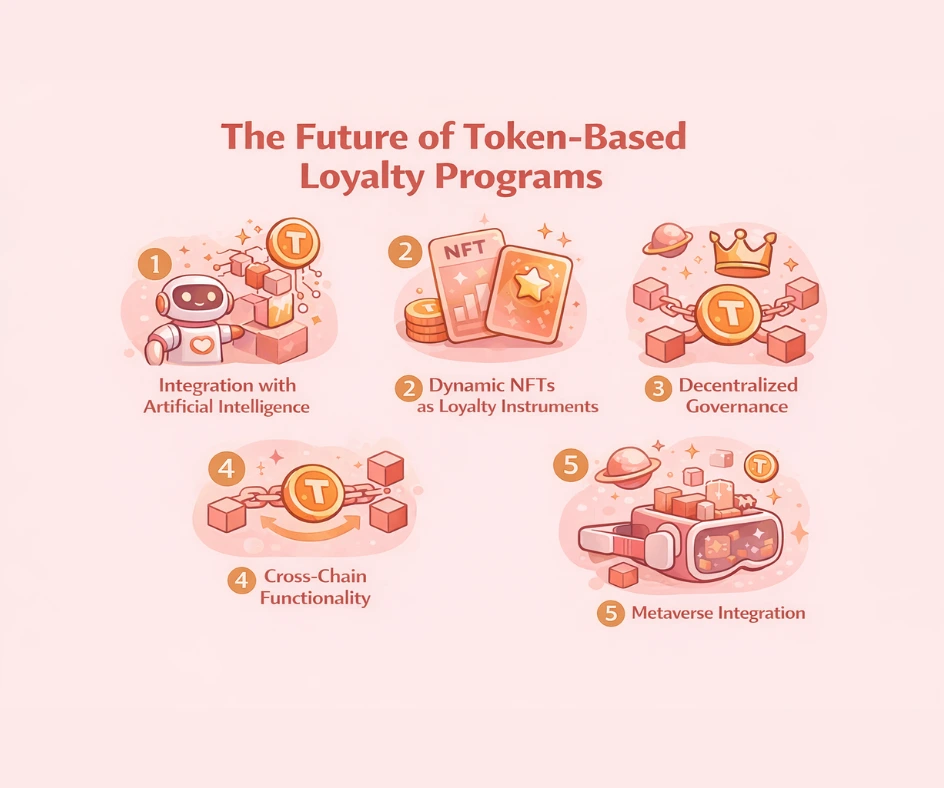
1. Integration with Artificial Intelligence
By leveraging AI, brands can add security measures like verifiable credentials into the mix to help create personalized experiences. The combination of blockchain transparency and AI personalization creates powerful possibilities for hyper-targeted engagement.
2. Dynamic NFTs as Loyalty Instruments
Dynamic NFTs offer a glimpse into the future of on-chain loyalty. These customizable, tokenized assets evolve with user engagement. Think NFT badges that unlock exclusive products or perks, like Lululemon rewards, earning you a free month of personal training at your gym.
3. Decentralized Governance
Future loyalty programs may give token holders voting rights on program decisions, creating true community ownership of brand relationships.
4. Cross-Chain Functionality
As blockchain ecosystems mature, tokens will flow freely across different blockchain networks, further reducing friction and increasing utility.
5. Metaverse Integration
Virtual worlds will create new opportunities for token-based engagement, with loyalty rewards extending into immersive digital experiences.
How to Get Started with Token-Based Loyalty
Step 1: Assess Current Program Performance
Before implementing blockchain, understand your existing program’s strengths and weaknesses. Analyze redemption rates, customer satisfaction, and cost structures.
Step 2: Define Clear Objectives
Determine what you want to achieve. Are you looking to reduce costs, increase engagement, attract younger customers, or enable new partnership models?
Step 3: Choose the Right Technology Partner
Select a platform that matches your technical capabilities and business needs. Consider whether you need a custom solution or can leverage existing white-label options.
Step 4: Start with a Pilot
In December 2024, Loyalty Marketing launched a pilot program for Ponta Points, onboarding an initial 30,000 customers to a blockchain-based version of the app. Starting small allows you to learn and iterate before full-scale deployment.
Step 5: Focus on User Experience
The Starbucks Odyssey experience demonstrates that complexity kills adoption. Make earning and redeeming tokens as simple as possible for customers.
Step 6: Communicate Value, Not Technology
Customers care about what they can do with tokens, not how blockchain works. Focus marketing on benefits rather than technical features.
Final Thoughts
The transformation from traditional points systems to token-based loyalty programs represents a defining moment in how brands build lasting relationships with their customers. As we have explored throughout this guide, blockchain-based tokens address the fundamental shortcomings that have plagued conventional loyalty programs for decades, including fragmented accounts, unredeemed points, limited flexibility, and a lack of transparency.
The evidence speaks for itself. From Singapore Airlines pioneering blockchain loyalty in aviation to the Cleveland Cavaliers achieving remarkable sales lifts through their Cavs Rewards program, early adopters are already reaping substantial benefits. These success stories prove that token rewards for customers are not merely theoretical concepts but practical solutions delivering measurable business outcomes.
For brands still relying on outdated loyalty structures, the writing is on the wall. With 96% of millennials demanding loyalty program innovation and younger generations already comfortable with digital assets, the window for differentiation through brand loyalty tokens is narrowing. Companies that hesitate risk watching their competitors capture the attention and wallets of the most valuable consumer demographics.
The path forward is clear. Token-based loyalty programs offer genuine ownership, cross-brand flexibility, automated rewards through smart contracts, and the transparency that modern consumers demand. Whether you operate in retail, travel, sports, or any industry where customer retention matters, embracing blockchain-based tokens positions your brand at the forefront of loyalty innovation.
The question is no longer whether token-based loyalty will become mainstream. The question is whether your brand will lead this transformation or scramble to catch up. The brands that act now will forge deeper connections with their customers, reduce operational costs, and unlock new revenue streams through secondary markets. Those who wait may find themselves offering yesterday’s rewards in a world that has already moved on to something better.
Frequently Asked Questions
Q1.What exactly are blockchain based tokens in loyalty programs?
Blockchain-based tokens are digital rewards recorded on a distributed ledger rather than in a company’s centralized database. Unlike traditional loyalty points, these tokens represent genuine digital assets that customers own in their digital wallets. They can often be traded, transferred, or redeemed across multiple partner brands, providing flexibility that traditional points cannot match.
Q2.How do token based loyalty programs differ from traditional points systems?
The fundamental difference lies in ownership and flexibility. Traditional points exist only within a company’s database and typically cannot be transferred or traded. Token-based programs give customers actual ownership of their rewards as digital assets. Additionally, blockchain programs offer enhanced transparency through immutable transaction records, automatic reward distribution via smart contracts, and the potential for cross-brand redemption through interoperable ecosystems.
Q3.Are token based loyalty programs safe and secure?
Yes, properly implemented blockchain-based programs offer enhanced security compared to traditional centralized systems. The decentralized nature of blockchain makes it extremely difficult for hackers to manipulate data, as they would need to compromise multiple nodes simultaneously. Cryptographic protections secure individual customer wallets, and the transparent nature of blockchain allows both brands and customers to verify all transactions.
Q4.What happened to Starbucks Odyssey and what can we learn from it?
Starbucks launched Odyssey in late 2022 as an NFT-based extension of its rewards program, but shut it down in March 2024. The primary lesson is that complexity undermines adoption. Odyssey required customers to navigate multiple reward currencies, complete various digital activities, and understand NFT concepts. Successful token programs should prioritize simplicity and clear value propositions over technological sophistication.
Q5.How can smaller businesses implement token based loyalty programs?
Smaller businesses don’t need to build blockchain infrastructure from scratch. White-label platforms now offer ready-to-deploy solutions that handle all technical complexity. These platforms allow small businesses to launch token-based loyalty programs with minimal technical expertise, paying subscription fees rather than making large upfront infrastructure investments.
Q6.Will token based loyalty programs replace traditional points systems entirely?
While token-based programs offer significant advantages, traditional points systems will likely coexist with blockchain alternatives for many years. The transition will be gradual, with many brands starting with hybrid approaches that incorporate blockchain elements into existing programs. The key is matching the loyalty approach to customer demographics and business objectives rather than adopting technology for its own sake.
Explore Services
Related Services
Reviewed by

Aman Vaths
Founder of Nadcab Labs
Aman Vaths is the Founder & CTO of Nadcab Labs, a global digital engineering company delivering enterprise-grade solutions across AI, Web3, Blockchain, Big Data, Cloud, Cybersecurity, and Modern Application Development. With deep technical leadership and product innovation experience, Aman has positioned Nadcab Labs as one of the most advanced engineering companies driving the next era of intelligent, secure, and scalable software systems. Under his leadership, Nadcab Labs has built 2,000+ global projects across sectors including fintech, banking, healthcare, real estate, logistics, gaming, manufacturing, and next-generation DePIN networks. Aman’s strength lies in architecting high-performance systems, end-to-end platform engineering, and designing enterprise solutions that operate at global scale.