Ai Overview
The token ecosystem represents the foundational architecture powering blockchain innovation and Web3 development. Understanding this complex network of technologies, standards, and economic models has become essential for anyone participating in decentralized finance, digital asset creation, or blockchain application development. This comprehensive guide explores every dimension of the token ecosystem from fundamental concepts through advanced implementation strategies.
The token ecosystem represents the foundational architecture powering blockchain innovation and Web3 development. Understanding this complex network of technologies, standards, and economic models has become essential for anyone participating in decentralized finance, digital asset creation, or blockchain application development. This comprehensive guide explores every dimension of the token ecosystem from fundamental concepts through advanced implementation strategies.
Key Takeaways
- Comprehensive Infrastructure: Token ecosystems integrate technical standards, economic models, security frameworks, and governance mechanisms creating resilient decentralized systems.
- Interoperability Standards: ERC-20, ERC-721, and ERC-1155 standards enable seamless integration across wallets, exchanges, and applications within blockchain networks.
- Economic Design Matters: Tokenomics determines value distribution, supply dynamics, and incentive structures critical for long-term project sustainability and adoption.
- Multi-Chain Future: Cross-chain bridges and wrapped tokens enable asset portability between ecosystems, though security considerations remain paramount.
- Security First Approach: Smart contract audits, multi-signature controls, and emergency mechanisms protect against vulnerabilities that have cost billions in exploits.
- Governance Innovation: Token-weighted voting enables decentralized protocol control, distributing decision-making power across stakeholders rather than central authorities.
- Institutional Adoption Growing: Real-world asset tokenization and regulatory frameworks signal mainstream finance integration accelerating throughout 2026.
- AI Integration Emerging: Autonomous AI agents holding and trading tokens create machine-to-machine economies expanding beyond human-only systems.
- Launch Strategy Critical: Successful token launches require comprehensive planning across technical deployment, liquidity provision, community building, and professional execution.
Token Fundamentals and Core Concepts
Tokens serve as programmable digital assets representing value, ownership, or utility within blockchain networks. Unlike traditional financial instruments, tokens operate through smart contracts that enforce transparent rules without intermediaries, fundamentally shifting control from centralized authorities to programmatic execution.
What Tokens Are and Why They Matter
Digital assets known as tokens in web3 serve as building blocks for decentralized applications, enabling seamless interactions between users, protocols, and autonomous systems. These programmable assets operate through smart contracts deployed on blockchain networks, with each token following specific standards determining its behavior, compatibility, and functionality within the broader ecosystem.
The technical implementation involves deploying smart contracts that define token properties, including total supply, transfer mechanisms, and access controls. Developers can create tokens for diverse purposes from simple currencies to complex governance instruments. This programmability enables innovation impossible in traditional financial systems constrained by centralized intermediaries and rigid infrastructure.
Economic Principles Governing Token Systems
Understanding tokenomics in blockchain proves critical as these economic principles determine how value flows through ecosystems. Supply mechanisms control token creation and destruction, distribution schedules determine allocation timing, while utility functions define practical uses driving demand. These economic parameters collectively influence adoption rates, price stability, and long-term sustainability.
Projects must design tokenomics balancing multiple stakeholder interests including developers requiring funding, users seeking utility, investors expecting returns, and validators maintaining network security. Well-structured token economics align these often competing priorities through carefully calibrated incentive mechanisms. Poor tokenomics design frequently leads to project failure regardless of technical merit.
Token Economy Functions Across Web3
The way token economy functions extends beyond individual projects to create interconnected value networks. Tokens facilitate transactions across decentralized exchanges, govern protocol parameters through voting mechanisms, represent ownership in digital and physical assets, and incentivize desired behaviors from network participants.
This economic layer enables coordination mechanisms impossible in traditional centralized systems. Tokens align incentives across globally distributed participants without requiring trust or central authorities. The resulting network effects create value that grows exponentially as adoption increases, mirroring internet protocols that became more valuable as more users connected.
Unique Digital Assets Through NFTs
Digital uniqueness finds expression through non-fungible tokens, which represent individual assets with distinct characteristics and metadata. NFTs revolutionized digital ownership by providing verifiable scarcity and provenance for items ranging from artwork to real-world asset representations.
Their integration spans gaming items retaining value across platforms, collectibles with proven authenticity, digital identity credentials, and tokenized real estate. The versatility of NFT architectures demonstrates how token standards can accommodate radically different use cases while maintaining interoperability within broader ecosystems.
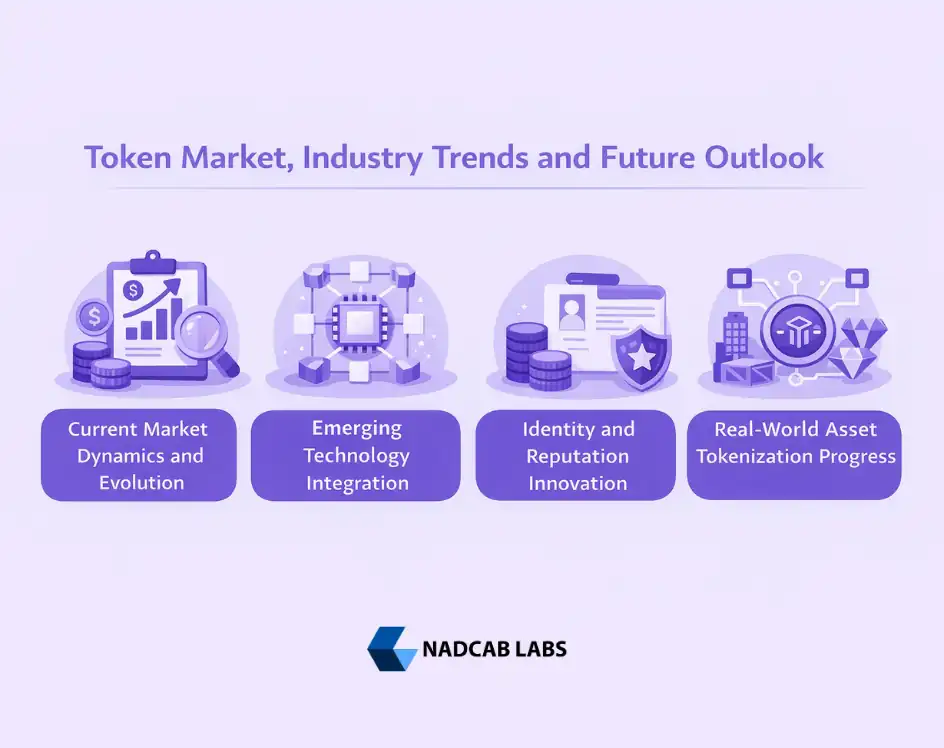
Token Market, Industry Trends and Future Outlook
The token market continues evolving as institutional adoption increases and regulatory frameworks mature across jurisdictions. Investment in blockchain infrastructure has grown substantially, with developers creating increasingly sophisticated applications leveraging token-based coordination mechanisms.
Current Market Dynamics and Evolution
Market dynamics reflect both technological innovation and shifting investor sentiment as the industry transitions toward sustainable growth models. Ethereum maintains dominance as a smart contract platform, with the best ethereum tokens showcasing diverse use cases from decentralized finance to gaming applications.
The network’s extensive developer ecosystem and established infrastructure continue attracting projects requiring robust security and broad compatibility. Layer-2 solutions have addressed scalability limitations while preserving Ethereum’s security guarantees, enabling throughput increases without compromising decentralization. This technological maturation supports growing transaction volumes and expanding use cases.
Emerging Technology Integration
Artificial intelligence integration represents a significant trend reshaping token ecosystems, with ai-based cryptocurrencies emerging to coordinate machine learning resources and autonomous agent interactions. These tokens enable decentralized compute marketplaces, data sharing networks, and AI model governance through blockchain-based coordination.
The convergence of blockchain and artificial intelligence creates new paradigms for distributed computation and value exchange. AI agents can hold tokens, execute trades, and participate in protocol governance autonomously. This machine-to-machine economy represents the next evolution beyond human-only financial systems.
Identity and Reputation Innovation
Identity and reputation systems leverage soulbound tokens to create non-transferable credentials representing achievements, memberships, or qualifications. These innovations address challenges in decentralized identity while enabling new social and professional coordination mechanisms impossible with traditional transferable assets.
Soulbound tokens complement traditional tokens by providing persistent identity layers tied to individuals rather than wallets. This enables reputation systems, educational credentials, work histories, and community memberships that cannot be bought or sold. The combination of transferable and non-transferable tokens creates richer ecosystem possibilities.
Real-World Asset Tokenization Progress
Real-world asset tokenization accelerates through frameworks addressing regulatory compliance, with standards like erc-3643 enabling compliant securities on blockchain networks. This standard addresses regulatory requirements including investor accreditation, transfer restrictions, and disclosure obligations while maintaining blockchain efficiency benefits.
Institutional interest in tokenized securities, real estate, commodities, and other traditional assets signals mainstream recognition of blockchain’s potential for finance modernization. The ability to enable fractional ownership, facilitate 24/7 trading, and automate compliance through smart contracts creates compelling advantages over legacy systems.
2026 Token Ecosystem Trends
| Trend Category | Key Development | Market Impact |
|---|---|---|
| AI Integration | On-chain AI agents holding and trading tokens autonomously | Machine-to-machine economies expanding beyond human participants |
| Account Abstraction | Smart wallets with social logins and automatic gas payments | Improved UX driving mainstream Web2 user adoption |
| Multi-Chain Ecosystems | Cross-chain liquidity and unified token standards | Interoperability becoming core design requirement |
| RWA Tokenization | Securities and physical assets moving on-chain with compliance | Traditional finance integration accelerating institutional adoption |
Token Architecture and Standards
Technical standards provide the foundation for token interoperability and functionality across blockchain ecosystems. These specifications define how tokens behave, interact with smart contracts, and integrate with wallets and exchanges through standardized interfaces.
ERC-20 Fungible Token Standard
The most widely adopted fungible token specification establishes standardized interfaces enabling seamless integration across thousands of projects. Understanding how erc-20 works in web applications proves essential as this standard defines functions for transferring tokens, checking balances, and approving delegated transactions that wallets and exchanges require.[1]
Widespread adoption fueled the initial coin offering boom and continues supporting DeFi infrastructure today. The standard’s simplicity enables developers to create tokens quickly while ensuring compatibility with existing ecosystem infrastructure. Key functions include totalSupply() returning circulation data, balanceOf() checking holdings, transfer() moving tokens directly, approve() authorizing third parties, and transferFrom() enabling approved transfers.
ERC-721 Non-Fungible Token Standard
Non-fungible assets utilize specifications that enable unique digital ownership, with each erc-721 token possessing distinct metadata and identification numbers. This makes them ideal for representing collectibles, gaming items, digital art, and real-world asset ownership rights.
The NFT market’s explosive growth demonstrates how technical standards enable entirely new digital economies and creative expressions. These tokens track individual asset ownership rather than aggregate balances, providing the foundation for provable scarcity and authenticity verification that collectors and creators demand.
ERC-1155 Multi-Token Standard
Multi-token functionality emerges through the erc-1155 standard, supporting both fungible and non-fungible assets within single smart contracts. This hybrid approach reduces gas costs through batch operations and simplifies management for applications requiring diverse token types simultaneously.
Gaming platforms particularly benefit from this efficiency when handling currencies, consumable items, and unique collectibles within unified systems. A single contract can manage thousands of different token types, dramatically reducing deployment complexity and operational costs compared to maintaining separate contracts for each asset class.
Wallet Compatibility and Integration
Infrastructure compatibility depends on how wallets and token standards work cohesively to provide user-friendly experiences. Wallet software implements standard interfaces to display balances, execute transfers, and interact with smart contracts properly without requiring users to understand underlying technical complexity.
Standardization enables users to manage diverse token portfolios through unified interfaces across different wallets and platforms. This interoperability proves essential for mainstream adoption as users expect seamless experiences similar to traditional financial applications.
Platform Selection Considerations
Different blockchain platforms offer varying trade-offs when creating tokens. Ethereum provides the most established infrastructure and largest developer ecosystem, while alternative platforms like Solana offer higher throughput with over 11.9 million tokens created since 2024[2] and significantly lower transaction costs.
Multi-chain strategies increasingly allow projects to leverage multiple networks’ strengths simultaneously. Cross-chain bridges enable tokens to move between ecosystems, though these introduce additional complexity and security considerations requiring careful evaluation.
Blockchain Infrastructure and Token Technology Stack
The underlying infrastructure supporting token operations encompasses transaction processing, state management, and network coordination mechanisms that determine performance characteristics affecting user experiences.
Transaction Fee Mechanisms
Transaction fees operate through mechanisms where gas tokens prioritize network resource allocation based on market demand. Users pay computational costs in native network tokens, with prices fluctuating based on congestion levels and block space scarcity.
These economics create market-based prioritization ensuring efficient resource allocation while funding validator operations and network security. Understanding fee dynamics helps users optimize transaction timing and avoid overpaying during high-demand periods.
DEX Gas Optimization
Decentralized exchange operations face challenges where gas costs significantly impact trading profitability. High fees can make small trades economically unviable, driving demand for layer-2 solutions and alternative blockchains offering lower costs.
Protocols continuously optimize smart contract efficiency to minimize user costs through techniques including batch processing that combines multiple operations, storage optimization reducing expensive on-chain data, computation efficiency through algorithmic improvements, and layer-2 integration moving operations off main chains.
Cross-Chain Asset Bridging
Cross-chain interoperability utilizes bridge technology where wrapped tokens in defi represent assets from one blockchain on another network. This enables liquidity to flow between ecosystems while maintaining exposure to original asset price movements, expanding DeFi possibilities significantly.
Bridge implementations introduce trust assumptions and technical risks requiring careful evaluation. Security remains critical as vulnerabilities have resulted in billions of dollars in exploits. Users must understand custodial models and security architectures before trusting bridges with significant assets.
Asset Portability Architecture
Asset portability across networks employs architectures where wrapped tokens lock assets on source chains while minting equivalent representations on destination networks. These mechanisms enable Bitcoin to participate in Ethereum DeFi and facilitate other cross-chain interactions expanding utility.
Different bridge designs offer varying security models including trusted custodians, validator sets, and cryptographic proofs. Each approach presents distinct trade-offs between security, speed, and cost that users must evaluate based on their specific needs and risk tolerance.
Transaction Processing and Ordering
Transaction ordering and inclusion occur through systems where understanding what mempool is helps users optimize timing and pricing. Pending transactions await processing by validators, with mempool visibility enabling sophisticated users to execute complex trading strategies including arbitrage opportunities.
Miners and validators prioritize transactions based on fees offered, creating competitive markets for block space during high-demand periods. This economic model ensures network resources flow to highest-value use cases while maintaining fair access through transparent pricing.
Token Security, Risks and Failure Scenarios
Security considerations encompass smart contract vulnerabilities, economic attack vectors, and operational risks that threaten token ecosystems. Rigorous security practices prove essential as exploits have resulted in billions of dollars in losses across the industry.
Smart Contract Security Requirements
Smart contract robustness requires implementing essential security features including access controls, upgrade mechanisms, and emergency pause functions. Professional audits identify vulnerabilities before deployment, though audits alone cannot guarantee security against all potential attack vectors.
Ongoing monitoring and incident response planning provide additional protection layers beyond initial audits. Best practices include access controls restricting critical functions, upgrade patterns enabling bug fixes, emergency mechanisms implementing circuit breakers, comprehensive testing covering edge cases, and formal verification providing mathematical proofs of correctness.
Multi-Signature Protection
Enhanced security mechanisms employ protocols where adding multi-signature capabilities requires multiple parties to authorize critical operations. This distributed control reduces single points of failure and insider attack risks that plague centrally controlled systems.
Multi-sig wallets protect treasury funds while governance multi-sigs secure protocol upgrades and parameter changes. Common configurations include 2-of-3, 3-of-5, or 5-of-9 signature requirements balancing security with operational efficiency.
Quantum Computing Preparations
Future-proofing against quantum computing threats involves understanding how post-quantum cryptography works as computational capabilities advance. Current cryptographic assumptions including ECDSA signatures may become vulnerable to quantum attacks within decades.
The blockchain industry actively researches quantum-resistant algorithms to ensure long-term asset security. Migration strategies must balance urgency against disruption risks, requiring careful coordination across entire ecosystems to maintain compatibility during transitions.
Distribution Strategy Impacts
Distribution strategies raise questions about whether airdrops impact token price as projects allocate tokens to communities and stakeholders. These distributions can drive adoption and decentralization but may create selling pressure if recipients lack long-term conviction or project understanding.
Strategic airdrop design balances growth objectives with price stability considerations through vesting schedules, eligibility requirements, and distribution sizing. Well-executed airdrops reward genuine community members while avoiding mercenary participants seeking quick profits.
Legal Compliance and Regulated Tokens
Regulatory frameworks increasingly shape token design and distribution as jurisdictions worldwide establish oversight for digital assets. Compliance requirements vary globally, creating complex challenges for projects seeking international operations.
Security Token Offerings
Regulated fundraising through security token offerings provides compliant alternatives to traditional token sales. These offerings implement investor accreditation verification, transfer restrictions enforcing holding periods, and disclosure requirements satisfying securities regulations.
This approach trades some decentralization for legal clarity and institutional accessibility. Security tokens enable fractional ownership of real-world assets including real estate, commodities, and private equity while maintaining regulatory compliance through programmatic enforcement.
Evolving Regulatory Landscape
Compliance infrastructure continues evolving as regulatory clarity improves across major jurisdictions. Projects must balance innovation with legal requirements, often engaging specialized counsel for token structure guidance and regulatory navigation.
The regulatory landscape’s maturation signals mainstream finance’s growing acceptance of blockchain technology. Clear frameworks reduce uncertainty enabling institutional participation while protecting retail investors from fraudulent schemes.
Token Development and Execution Process
Launching successful token ecosystems requires careful planning across technical implementation, economic design, and community building dimensions. The token lifecycle encompasses ideation, development, testing, deployment, and ongoing maintenance phases.
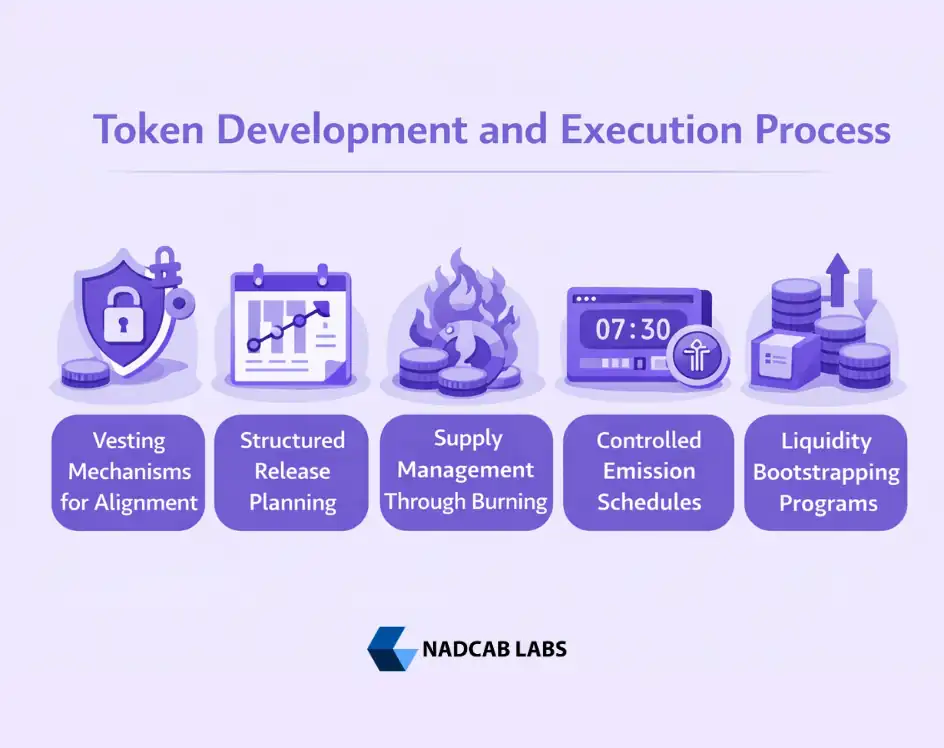
Vesting Mechanisms for Alignment
Distribution mechanisms utilize structures where token vesting gradually releases tokens to team members, investors, and contributors over time. This prevents immediate selling pressure while aligning stakeholder incentives with long-term project success rather than short-term speculation.
Transparent vesting schedules build community trust by demonstrating team commitment to sustainable development. Locked tokens cannot flood markets immediately after launch, providing price stability during critical early growth periods.
Structured Release Planning
Strategic release planning through developing vesting schedules balances stakeholder needs with market dynamics. Cliff periods prevent immediate unlocks creating initial selling pressure, while linear vesting provides predictable release schedules markets can anticipate.
Well-designed vesting protects against market manipulation and supports healthy price discovery by preventing concentrated selling from insiders. Different stakeholder groups typically receive varied vesting terms reflecting their roles and risk profiles.
Supply Management Through Burning
Supply management employs mechanisms where token burning permanently removes tokens from circulation. This creates deflationary pressure offsetting inflation from ongoing emissions, potentially supporting price appreciation as supply decreases.
Strategic burns tied to revenue or usage metrics align token economics with protocol growth. Projects implement burning through transaction fee destruction, buyback-and-burn programs, or stake-to-burn governance mechanisms.
Controlled Emission Schedules
Controlled distribution through managing token emission ensures sustainable liquidity provision rewards. Emission schedules must balance incentivizing participation with preventing excessive dilution that destroys long-term value.
Decreasing emission rates over time help transition from growth subsidies to self-sustaining fee revenue models. Successful projects gradually reduce inflation as network effects strengthen and utility-driven demand replaces speculative interest.
Liquidity Bootstrapping Programs
Liquidity bootstrapping via programs involving token seeding and farming attracts early users and capital to new protocols. These incentives jumpstart network effects while distributing tokens to engaged communities rather than passive speculators.
Successful farming programs transition users from mercenary capital to long-term participants through community building and utility demonstration. Temporary incentives should complement rather than substitute for genuine product-market fit.
Token Economics, Cost and ROI Considerations
Economic sustainability determines whether token ecosystems achieve long-term viability beyond initial hype cycles. Value accrual mechanisms, supply dynamics, and utility creation collectively influence token holder returns and project success.
Deflationary Economic Models
Supply reduction strategies implement approaches where tokens incorporate deflationary mechanisms that decrease circulating supply over time. These mechanisms counter inflationary pressures from ongoing emissions, potentially supporting price appreciation through artificial scarcity creation.
Deflationary models work best when paired with growing demand from expanding utility and adoption. Supply reduction without corresponding demand increases merely redistributes value among remaining holders without creating fundamental growth.
Flexible Supply Management
Flexible supply management through understanding advantages of burnable tokens enables dynamic adjustment to changing market conditions. This capability allows holders or protocols to permanently remove supply, creating scarcity that may support valuations.
The feature supports various economic models from buyback-and-burn programs funded by protocol revenue to stake-to-burn governance mechanisms where participation requires permanent token destruction. Burning provides tangible supply reduction observable on-chain, building confidence in deflationary promises.
Token Use Cases and Governance Models
Practical applications demonstrate token utility beyond speculative trading. Governance mechanisms, access control systems, incentive alignment structures, and value capture models represent core use cases driving sustainable adoption.
Decentralized Governance Systems
Protocol decision-making leverages systems where understanding what governance tokens are enables decentralized control over protocol parameters and upgrades. Token-weighted voting allows stakeholders to propose and approve changes without centralized authority intermediation.
These tokens align protocol evolution with community preferences while distributing control across stakeholders rather than concentrating power. Successful governance balances efficiency with decentralization, avoiding both plutocracy and paralysis through thoughtful mechanism design.
DAO Coordination Mechanisms
Decentralized coordination through how governance tokens work in web3 creates new organizational structures and decision-making processes. DAOs utilize these tokens to coordinate resources, fund development initiatives, and manage treasuries collectively without traditional corporate hierarchies.
These mechanisms enable internet-native organizations operating globally without registration requirements or jurisdictional constraints. Token holders collectively determine strategic direction, resource allocation, and operational policies through on-chain voting.
Exchange Governance Models
Exchange governance implements models where dex governance tokens give users control over fee structures, token listings, and protocol upgrades. This community ownership model distributes value capture to active participants rather than extracting rents through centralized entities.
These systems demonstrate how tokens can align stakeholder interests across decentralized platforms. Users, liquidity providers, and developers collectively steer protocol development through transparent on-chain processes replacing corporate board decisions.
Airdrop Participation Strategies
Post-distribution management requires understanding what to do after receiving airdrops to maximize value and ecosystem participation. Recipients must evaluate project fundamentals, understand token utility beyond speculation, and make informed decisions about holding versus selling.
Active engagement in governance and protocol usage often proves more valuable than immediate liquidation. Airdrop recipients who become active community members typically capture more long-term value than those treating distributions as free money for immediate selling.
Token Launch, Listing and Service Selection
Successful launches require comprehensive planning across technical deployment, liquidity provision, exchange listings, and community building dimensions. Professional execution differentiates projects achieving sustainable traction from those failing to gain adoption despite technical merit.
Decentralized Exchange Launch Strategies
Decentralized exchange launches benefit from resources providing guidance on raydium token listing technical and strategic aspects. Proper liquidity pool setup, tokenomics configuration, and market making establish healthy trading environments supporting price discovery.
DEX listings democratize access while avoiding centralized exchange gatekeeping and listing fees. Projects can launch immediately on decentralized platforms, though they must provide initial liquidity and market making themselves rather than relying on exchange infrastructure.
Solana Ecosystem Integration
Solana ecosystem integration through services helping projects list tokens on raydium connects them with high-throughput infrastructure and growing user bases. The platform’s automated market maker provides efficient trading while supporting liquidity mining programs that attract early liquidity providers.
Strategic deployment captures benefits from the network’s speed and low transaction costs. The ecosystem’s rapid growth creates opportunities for projects seeking exposure to active user communities and developer innovation.
Professional Service Providers
Professional support via services helping projects choose raydium listing services streamlines technical processes and reduces launch risks. Experienced providers handle smart contract deployment, liquidity provisioning, and market infrastructure setup avoiding common pitfalls.
Quality service selection prevents catastrophic failures during critical launch periods. Professional teams bring experience from multiple launches, understanding nuances that first-time projects frequently overlook until costly mistakes occur.
Development Team Selection
Development expertise accessed through services helping get tokens ready with developers ensures robust technical foundations. Professional developers implement security best practices, optimize gas efficiency, and handle complex tokenomics logic correctly from initial deployment.
Technical excellence during development prevents costly vulnerabilities and operational failures that can destroy projects regardless of business model strength. Experienced developers anticipate edge cases, implement proper testing, and design upgradeable systems supporting long-term evolution.
Comprehensive Launch Support
Platform support understanding what token launches nadcab labs supports helps projects select appropriate service providers for their specific needs and target ecosystems. Comprehensive launch support encompasses smart contract development, security auditing, liquidity management, and post-launch optimization.
Choosing providers with relevant expertise and proven track records improves success probabilities. The right partners accelerate time-to-market while reducing risks through battle-tested processes and industry connections.
Token Standard Comparison Framework
| Standard | Token Type | Primary Use Cases | Key Advantage |
|---|---|---|---|
| ERC-20 | Fungible | Currencies, DeFi, Governance | Universal compatibility and adoption |
| ERC-721 | Non-Fungible | NFTs, Collectibles, Unique Assets | Provable uniqueness and ownership |
| ERC-1155 | Multi-Token | Gaming, Mixed Asset Systems | Gas efficiency through batch operations |
| ERC-3643 | Security | Regulated Assets, Real-World Assets | Built-in compliance and restrictions |
| SPL (Solana) | Universal | All Token Types on Solana | High speed and minimal transaction costs |
Final Thoughts
The token ecosystem represents one of blockchain technology’s most transformative innovations, enabling programmable value transfer and decentralized coordination at unprecedented scales. From fundamental concepts through advanced implementation strategies, this comprehensive framework demonstrates how tokens power the Web3 revolution across diverse applications and use cases.
Understanding token architecture, economics, security considerations, and governance mechanisms proves essential for anyone building or participating in blockchain ecosystems. Market trends point toward continued maturation as institutional adoption increases[4] and regulatory frameworks provide clearer guidelines for compliant operations.
Technical innovations in cross-chain interoperability, account abstraction, and AI integration expand possibilities while improving user experiences. The crypto token ecosystem evolution from speculative instruments to fundamental infrastructure supporting diverse applications signals sustained growth potential. Success in token ecosystem participation requires continuous learning as technology and markets evolve rapidly, with those understanding interconnected systems explored throughout this guide positioned to capitalize on emerging opportunities in this dynamic space.
Frequently Asked Questions
Q1.what defines a token ecosystem?
a token ecosystem encompasses technical standards, economic models, infrastructure, security frameworks, and governance mechanisms enabling digital asset creation and operation. these interconnected components support diverse applications from defi to nfts across blockchain networks.
Q2.how do token standards work?
token standards define interfaces and behaviors ensuring interoperability across wallets, exchanges, and applications. standards like erc-20, erc-721, and erc-1155 specify functions for transfers, approvals, and balance tracking that enable seamless integration.
Q3.why does tokenomics matter for success?
tokenomics determines value distribution, incentive alignment, and supply dynamics affecting long-term sustainability. well-designed token economics balance stakeholder interests while supporting network growth, adoption, and security through sustainable incentive structures.
Q4.what security risks affect tokens?
token security risks include smart contract vulnerabilities, economic attacks, bridge exploits, and operational failures. comprehensive audits, multi-signature controls, emergency mechanisms, and ongoing monitoring help mitigate these threats to ecosystem integrity.
Q5.how do governance tokens work?
governance tokens enable decentralized decision-making through token-weighted voting on protocol parameters, upgrades, and treasury management. holders propose and vote on changes, distributing control across stakeholders rather than centralizing authority.
Q6.what makes token launches successful?
successful launches combine robust technical implementation, sustainable tokenomics, adequate liquidity provision, strategic exchange listings, and engaged community building. professional execution across these dimensions differentiates projects achieving traction from failures.
Q7.how do wrapped tokens enable interoperability?
wrapped tokens represent assets from one blockchain on another through locking original assets and minting equivalent representations. this bridging mechanism enables cross-chain liquidity and expanded utility but introduces trust assumptions requiring careful evaluation.
Explore Services
Related Services
Reviewed by

Aman Vaths
Founder of Nadcab Labs
Aman Vaths is the Founder & CTO of Nadcab Labs, a global digital engineering company delivering enterprise-grade solutions across AI, Web3, Blockchain, Big Data, Cloud, Cybersecurity, and Modern Application Development. With deep technical leadership and product innovation experience, Aman has positioned Nadcab Labs as one of the most advanced engineering companies driving the next era of intelligent, secure, and scalable software systems. Under his leadership, Nadcab Labs has built 2,000+ global projects across sectors including fintech, banking, healthcare, real estate, logistics, gaming, manufacturing, and next-generation DePIN networks. Aman’s strength lies in architecting high-performance systems, end-to-end platform engineering, and designing enterprise solutions that operate at global scale.