Ai Overview
The crypto MLM industry has grown rapidly over the past decade. While this growth has created legitimate opportunities, it has also attracted bad actors looking to exploit inexperienced investors and entrepreneurs. Learning to identify warning signs early can save you from financial loss and legal trouble. Phrases that should trigger immediate skepticism include statements like “guaranteed 10% monthly returns” or “double your investment in 90 days” or “risk-free crypto investment.
The crypto MLM industry has grown rapidly over the past decade. While this growth has created legitimate opportunities, it has also attracted bad actors looking to exploit inexperienced investors and entrepreneurs. Learning to identify warning signs early can save you from financial loss and legal trouble.
Key Takeaways
- Always verify company registration, legal identity, and physical address before engaging with any crypto MLM vendor
- Guaranteed or fixed returns are a major red flag since no legitimate investment can promise specific profits
- A real crypto MLM platform must have an actual product or service with genuine utility beyond recruitment
- Check for public smart contract audits and transparent blockchain infrastructure before investing
- Proper KYC/AML compliance and adherence to regional regulations indicate vendor legitimacy
- Excessive focus on recruitment over product usage is characteristic of Ponzi schemes
- Research vendor reputation through independent forums, reviews, and past project history
- Always request third-party audits and legal review before signing any contracts
Introduction: Why Choosing the Right Crypto MLM Vendor Matters
The intersection of cryptocurrency and multi-level marketing has created a unique business model that continues to attract millions of participants worldwide. According to data from various industry reports, the global MLM market has grown significantly, with crypto-based platforms taking an increasing share of this growth.
However, this rapid expansion has come with serious problems. Scams, Ponzi models disguised as legitimate businesses, and outright fraudulent projects have cost investors billions of dollars. The decentralized nature of cryptocurrency makes it easier for bad actors to disappear with funds, leaving participants with empty wallets and broken promises.
This makes vendor due diligence absolutely critical. Whether you are an investor looking to join a crypto MLM platform or a business owner seeking to develop one, understanding the red flags can protect you from becoming another victim. At Nadcab Labs, with over 8 years of experience in blockchain development and cryptocurrency MLM software solutions, we have seen firsthand how choosing the wrong vendor can destroy businesses and reputations.
What Is a Crypto MLM Vendor?
A crypto MLM vendor is a company or individual that provides the technology, platform, or services needed to run a cryptocurrency-based multi-level marketing business. These vendors can range from legitimate software development firms to outright scammers selling repackaged solutions.
The difference between legitimate software providers and fraudulent operators often comes down to transparency, technical capability, and business ethics. Genuine vendors offer clearly defined services, have verifiable track records, and operate within legal frameworks. Fraudulent operators, on the other hand, make vague promises, hide behind anonymity, and often disappear once they have collected payments.
Common services offered by genuine vendors include smart contract development, wallet integration, compensation plan configuration, admin dashboards, member portals, and ongoing technical support. If you want to understand more about the MLM business model and its different types, you can read this comprehensive guide on MLM meaning, types, and global regulations.
Lack of Transparency in Business Operations
One of the most obvious red flags is a lack of transparency in how a vendor operates. Legitimate businesses have nothing to hide, while fraudulent ones rely on secrecy to avoid accountability.
| Transparency Indicator | Legitimate Vendor | Risky Vendor |
|---|---|---|
| Company Registration | Publicly verifiable registration documents | No registration or offshore shell companies |
| Ownership Information | Named founders with LinkedIn profiles | Anonymous or hidden ownership |
| Physical Address | Verifiable office location | No address or virtual office only |
| Contact Information | Multiple verified contact channels | Only email or Telegram support |
If a vendor cannot provide clear company registration or legal identity documents, this should immediately raise concerns. Hidden ownership or anonymous founders make it impossible to hold anyone accountable if things go wrong. Similarly, the absence of a physical address or verifiable office details suggests the vendor may not be operating a legitimate business.
Unrealistic Profit Guarantees
Perhaps no red flag is more common or more dangerous than promises of guaranteed returns. As noted by Wikipedia’s article on multi-level marketing, legitimate MLM businesses depend on actual product sales, not guaranteed investment returns.
Phrases that should trigger immediate skepticism include statements like “guaranteed 10% monthly returns” or “double your investment in 90 days” or “risk-free crypto investment.” No legitimate investment can guarantee specific returns because market conditions are inherently unpredictable. When vendors promise fixed profits regardless of market performance, they are almost certainly running an unsustainable model.
Another warning sign is marketing that focuses more on income potential than product value. If a vendor spends 90% of their presentation talking about earnings and only 10% discussing what the platform actually does, their priorities are in the wrong place. Sustainable MLM businesses succeed by selling real products, not by recruiting participants into income schemes.
No Real Product or Utility
A legitimate crypto MLM platform needs an actual product or service that provides genuine value to users. When the only “product” is the opportunity to recruit others, the business model collapses into what regulators classify as a pyramid scheme.
Warning signs in this category include tokens or coins with no real use case beyond speculation. The token should solve a problem or provide utility within an ecosystem. If you cannot clearly explain what the token does besides being bought and sold, that is a problem.
Over-dependence on recruitment commissions is another major concern. While referral bonuses are standard in MLM, they should be supplementary to product-based income. When recruitment is the primary source of earnings, the model becomes unsustainable once new participant growth slows.
The absence of a clear ecosystem, roadmap, or technical documentation also indicates a lack of serious development. Legitimate projects have detailed whitepapers explaining their technology, use cases, and development timeline. Vague promises without technical backing suggest the vendor is selling hype rather than substance.
Build Your Crypto MLM Platform the Right Way
Partner with experienced developers who understand compliance, security, and sustainable business models. Get a platform built on transparency and technical excellence.
Weak or Non-Existent Blockchain Infrastructure
Since crypto MLM platforms are built on blockchain technology, the quality and transparency of that infrastructure matters enormously. Weak technical foundations create both security risks and opportunities for manipulation.
The absence of public smart contract audits is a serious red flag. Reputable projects have their smart contracts audited by recognized security firms, and they publish these audit reports publicly. Without audits, there is no way to verify that the contracts do what vendors claim they do or that they are secure against exploits.
Closed-source or unverifiable blockchain code presents similar problems. Open-source code allows independent developers to review the technology and confirm it works as advertised. When vendors refuse to share their code or deploy on private blockchains that cannot be verified, participants have no way to confirm the technology is legitimate.
Centralized control over funds and wallets is perhaps the biggest technical red flag. If the vendor can unilaterally access or move participant funds, the entire system depends on trusting unknown parties. True decentralization removes this single point of failure and fraud risk.
Poor Compliance and Legal Awareness
Legitimate crypto MLM vendors understand and respect regulatory requirements. Those that ignore compliance expose themselves and their participants to significant legal risks.
| Compliance Area | What to Look For | Red Flags |
|---|---|---|
| KYC/AML | Identity verification processes | No identity verification required |
| Regional Regulations | Awareness of jurisdiction-specific rules | Claims that regulations do not apply |
| Securities Law | Legal opinion on token classification | No legal review of token status |
| Tax Compliance | Guidance on reporting obligations | Suggests avoiding tax reporting |
No implementation of Know Your Customer and Anti-Money Laundering procedures is a major concern. These requirements exist to prevent fraud and money laundering. Platforms that skip them are either ignorant of regulations or deliberately avoiding compliance.
Vendors who claim that “regulation doesn’t apply to crypto” are either misinformed or lying. While cryptocurrency regulation varies by jurisdiction, most countries have established rules that apply to crypto businesses, especially those involving investment or MLM structures. Ignoring these rules can result in serious legal consequences for all involved.
Aggressive Referral-First Marketing
The way a crypto MLM platform markets itself reveals a lot about its true nature. Aggressive recruitment-focused marketing often indicates an unsustainable business model that depends on constant new participant inflows.
Heavy pressure to recruit new members quickly is a classic warning sign. Legitimate businesses grow through providing value, not through high-pressure recruitment tactics. When vendors emphasize urgency or create artificial deadlines for joining, they are using manipulation tactics rather than demonstrating genuine value.
Incentive structures that favor recruitment over usage are equally concerning. If the compensation plan pays significantly more for bringing in new members than for actual product sales or platform usage, the priorities are backwards. This structure inevitably leads to a collapse when recruitment slows.
Binary, matrix, or forced spillover structures with no balance create additional risks. While these compensation models can work legitimately, poorly designed versions concentrate benefits at the top while leaving newer participants unable to earn. If you want to learn more about the different types of MLM business structures and how they work, check out this detailed explanation of MLM business types.
Lack of Post-Launch Support and Maintenance
What happens after a platform launches is just as important as the initial development. Vendors who disappear after deployment leave their clients vulnerable to technical problems, security issues, and market changes.
No upgrade or security patch roadmap is a significant concern. Blockchain technology evolves rapidly, and platforms need regular updates to remain secure and competitive. Vendors who do not plan for ongoing development are selling a product with a limited lifespan.
Slow or non-responsive technical support creates immediate operational problems. When issues arise, which they inevitably do, you need quick access to developers who can diagnose and fix problems. Vendors who take days to respond to support requests will leave your platform vulnerable during critical periods.
Disappearing vendor teams after deployment is perhaps the worst scenario. Some fraudulent vendors collect their payment and then become impossible to contact. This leaves clients with a platform they cannot maintain or update, and no recourse for recovering their investment.
Negative Market Reputation
A vendor’s history and reputation provide valuable insight into what you can expect from working with them. Taking time to research public perception can reveal patterns that individual interactions might miss.
Fake testimonials and paid reviews are unfortunately common in the crypto space. Look for reviews on independent platforms rather than just on the vendor’s own website. Check if testimonials come from verifiable individuals with real social media presence and professional backgrounds.
| Research Source | What to Check | Warning Signs |
|---|---|---|
| Discussions in crypto subreddits | Multiple complaints or scam accusations | |
| Trustpilot | Verified user reviews | Many negative reviews or fake positive ones |
| BitcoinTalk | Forum discussions and project threads | Scam tags or abandoned projects |
| Team profiles and employment history | Fake profiles or short tenure patterns |
A history of rebranding after failed projects is another serious concern. Some fraudulent vendors simply rename themselves after each collapse, hoping to escape their reputation. Research whether the team members have been involved in other projects and what happened to those ventures.
How to Verify a Legitimate Crypto MLM Vendor
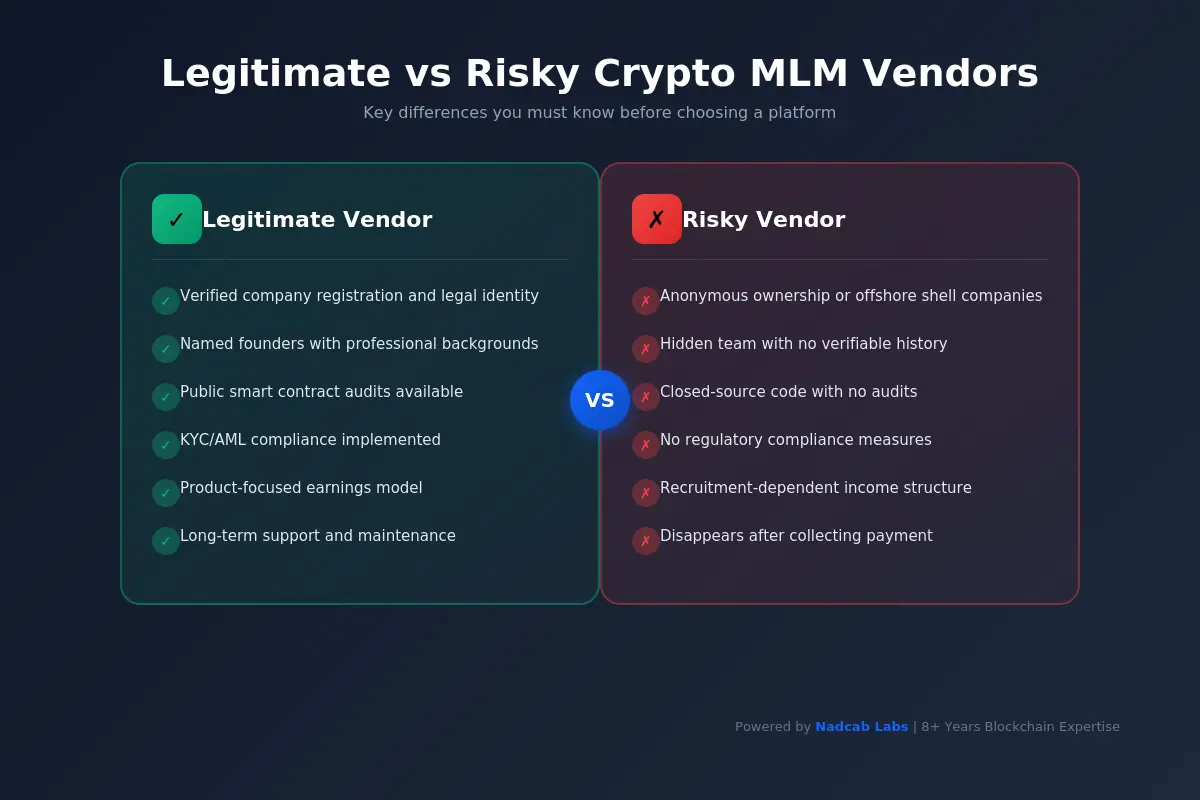
Now that we have covered the red flags, let us look at how to actively verify vendor legitimacy. This due diligence process takes time but can save you from costly mistakes.
Due Diligence Checklist:
First, verify legal standing. Request company registration documents and check them against official government registries. Confirm that the company exists and is in good standing.
Second, research the team. Look up founders and key team members on LinkedIn and other professional networks. Verify their claimed experience and check their involvement in previous projects.
Third, examine the technology. Request documentation on the technical architecture. Ask for smart contract addresses so you can verify them on blockchain explorers. Look for published security audits from reputable firms.
Fourth, review compliance measures. Ask about KYC/AML procedures and regulatory strategy. Request copies of any legal opinions regarding token classification and securities law compliance.
Fifth, check references. Ask for contacts at companies the vendor has worked with previously. Actually reach out to these references and ask about their experience.
Questions to Ask Before Signing Contracts:
What specific services are included in the contract? What is the timeline for each deliverable? What happens if deadlines are missed? What ongoing support is included after launch? Who owns the source code and intellectual property? What are the payment terms and are there any hidden fees? What is the process for handling disputes?
The importance of third-party audits and legal review cannot be overstated. Have an independent lawyer review any contracts before signing. Consider hiring a separate security firm to audit smart contracts. These upfront costs are minimal compared to the potential losses from working with a fraudulent vendor.
The Lifecycle of a Crypto MLM Scam
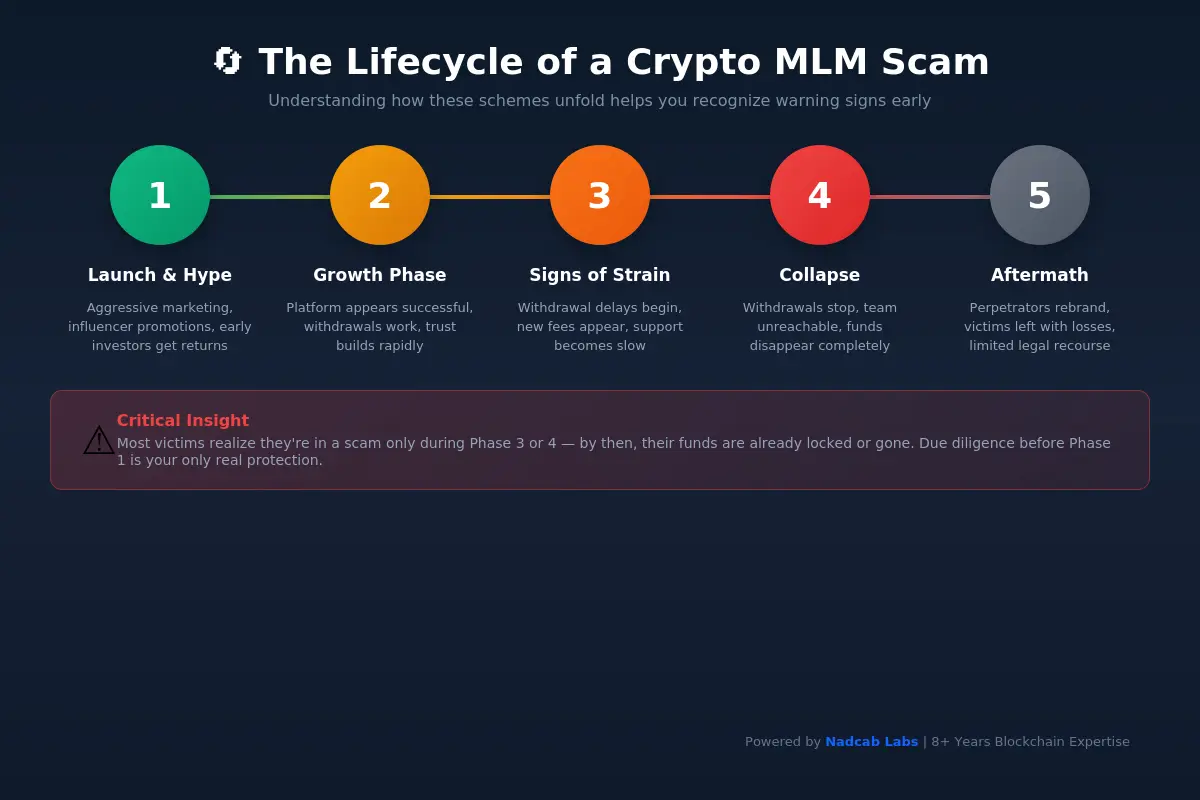
Understanding how these scams typically unfold can help you recognize when you might be caught in one. Most follow a predictable pattern.
Phase 1 – Launch and Hype: The project launches with aggressive marketing, often featuring celebrity endorsements or influencer promotions. Early participants receive promised returns, which encourages them to recruit others and invest more.
Phase 2 – Growth and Confidence Building: As more participants join, the platform appears successful. Withdrawals are processed quickly to build trust. This phase can last months or even years depending on how well the scheme manages its cash flow.
Phase 3 – Signs of Strain: Withdrawal delays begin. The platform introduces new requirements or fees for accessing funds. Technical issues become more frequent. Communication from the team becomes less responsive.
Phase 4 – Collapse: Withdrawals stop entirely. The platform may claim technical problems, regulatory issues, or hacking. The team becomes unreachable. Funds disappear.
Phase 5 – Aftermath: Participants attempt legal action with limited success. The perpetrators may resurface with a new project under different names. Victims are left with significant losses.
Choosing Safety Over Speed
The cryptocurrency MLM space will continue to grow, and with it, both legitimate opportunities and sophisticated scams. The difference between success and failure often comes down to the quality of due diligence performed before committing resources.
Ignoring red flags may allow you to get started faster, but it dramatically increases your risk of becoming a victim. The excitement of potential profits should never override common sense and careful evaluation. Taking extra time to verify vendors, review contracts, and consult with legal and technical experts is always worthwhile.
Compliance, transparency, and technical quality are not just nice-to-have features. They are essential foundations for any sustainable crypto MLM business. Platforms built on these principles have the best chance of long-term success, while those that cut corners inevitably face problems.
At Nadcab Labs, our 8+ years of experience in blockchain development has taught us that there are no shortcuts to building legitimate crypto MLM platforms. We have helped numerous clients navigate this complex landscape by providing transparent, compliant, and technically excellent solutions. Whether you are evaluating vendors or looking to build your own platform, proper due diligence and partnership with experienced developers are your best protections against the risks outlined in this article.
The crypto MLM industry offers real opportunities for those who approach it responsibly. By learning to recognize red flags and insisting on high standards from vendors, you can participate in this growing market while protecting yourself from its pitfalls.
Frequently Asked Questions
Q1.What are the biggest red flags when choosing a crypto MLM vendor?
The biggest warning signs include anonymous ownership with no verifiable company registration, guaranteed profit promises regardless of market conditions, and platforms with no real product beyond recruitment. Also watch for missing smart contract audits, no KYC/AML compliance, and vendors who disappear after receiving payment. Legitimate vendors always have transparent operations and verifiable credentials.
Q2.How can I verify if a crypto MLM platform is legitimate or a scam?
Start by checking the company registration against official government records. Research founders on LinkedIn and verify their professional history. Look for published smart contract audits from reputable security firms. Search Reddit, Trustpilot, and crypto forums for user complaints. Ask for references from past clients and actually contact them. If any information cannot be independently verified, treat it as a major warning sign.
Q3.Why do crypto MLM scams promise guaranteed returns and fixed profits?
Scammers use guaranteed return promises because they attract inexperienced investors looking for easy money. These claims create urgency and override rational decision making. No legitimate investment can guarantee specific returns since markets are unpredictable. When vendors promise fixed monthly profits or risk free earnings, they are running unsustainable models that will eventually collapse when new participant money stops flowing in.
Q4.What happens when a crypto MLM vendor has no smart contract audit?
Without smart contract audits, there is no independent verification that the code works as claimed or is secure against hacks. Unaudited contracts may contain hidden functions allowing developers to drain funds, manipulate balances, or lock withdrawals. Participants have no way to confirm their investments are protected. Reputable projects always publish audit reports from recognized security firms to build trust and demonstrate technical integrity.
Q5.How do I know if a crypto MLM focuses too much on recruitment over products?
Check the compensation plan structure carefully. If most earnings come from recruiting new members rather than selling actual products or services, the model is recruitment dependent. Warning signs include high pressure to build downlines quickly, bonuses tied primarily to signup numbers, and marketing that emphasizes income potential over product benefits. Sustainable MLM businesses generate most revenue from genuine product sales to end users.
Q6.What should I ask a crypto MLM vendor before signing any contract?
Ask for company registration documents and verify them independently. Request smart contract addresses to check on blockchain explorers. Inquire about KYC/AML procedures and regulatory compliance strategy. Ask what happens if deadlines are missed and who owns the source code. Request contact information for previous clients as references. Clarify all payment terms and hidden fees. Have an independent lawyer review contracts before signing anything.
Explore Services
Related Services
Reviewed by

Aman Vaths
Founder of Nadcab Labs
Aman Vaths is the Founder & CTO of Nadcab Labs, a global digital engineering company delivering enterprise-grade solutions across AI, Web3, Blockchain, Big Data, Cloud, Cybersecurity, and Modern Application Development. With deep technical leadership and product innovation experience, Aman has positioned Nadcab Labs as one of the most advanced engineering companies driving the next era of intelligent, secure, and scalable software systems. Under his leadership, Nadcab Labs has built 2,000+ global projects across sectors including fintech, banking, healthcare, real estate, logistics, gaming, manufacturing, and next-generation DePIN networks. Aman’s strength lies in architecting high-performance systems, end-to-end platform engineering, and designing enterprise solutions that operate at global scale.