Ai Overview
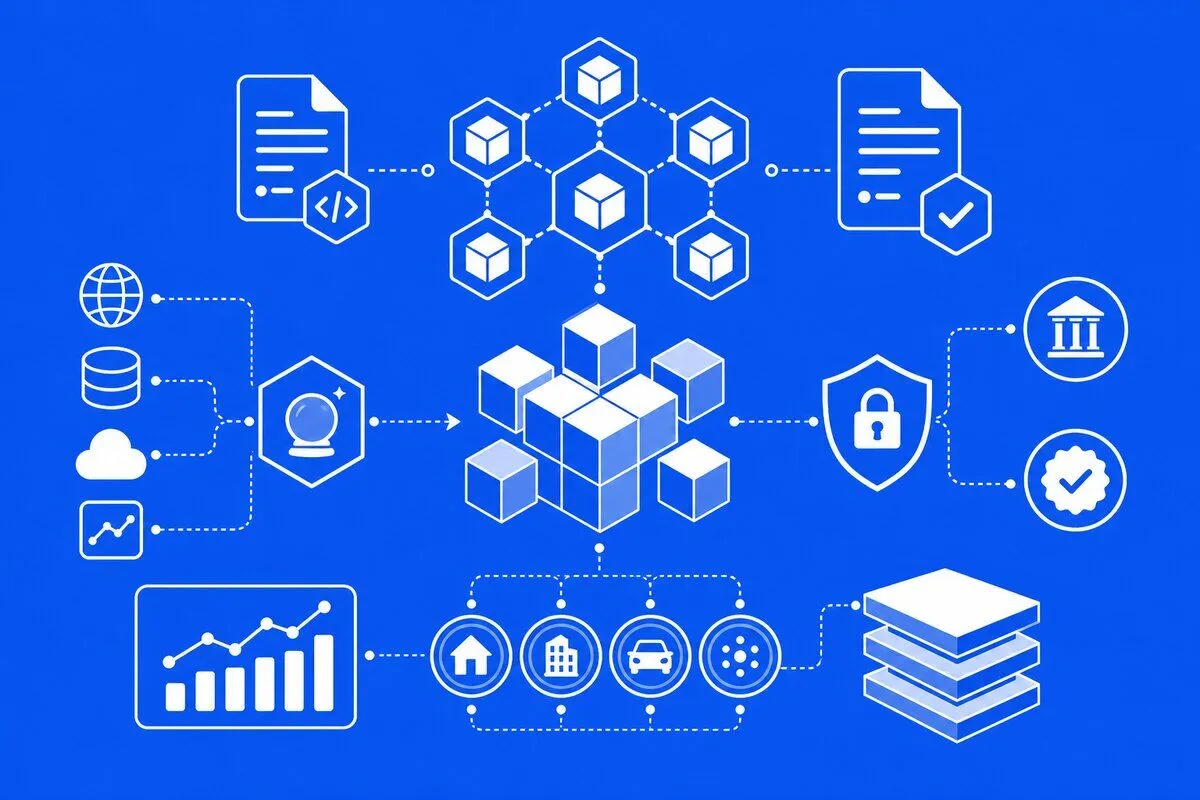
Every standard blockchain wallet address is generated through a cryptographic process that produces a completely random string of alphanumeric characters. This randomness is intentional and is the cornerstone of blockchain security. A standard Bitcoin address might look like 1A1zP1eP5QGefi2DMPTfTL5SLmv7Divf, which carries no inherent meaning whatsoever to a human reader observing it. A vanity address breaks from this randomness at the presentational layer while maintaining the same cryptographic depth underneath.
Key Takeaways
- ✓A vanity address is a custom blockchain wallet address containing a specific user-chosen word, brand name, or recognizable character pattern for easy identification.
- ✓Vanity addresses are cryptographically identical in security to standard addresses when generated using trusted, offline, open-source tools and proper private key storage practices.
- ✓Generation uses brute-force key-pair iteration, testing millions of cryptographic combinations until a public address matches the desired pattern chosen by the user or business.
- ✓Popular tools for generating a vanity address include Vanitygen for Bitcoin, Vanity-ETH for Ethereum, and GPU-accelerated multi-chain tools like HexHunter for faster output.
- ✓Generation time scales exponentially with pattern length; a 4-character prefix takes seconds while an 8-character pattern can require days even with powerful GPU computing resources.
- ✓Bitcoin and Ethereum vanity addresses differ in format: Bitcoin starts with 1 or 3, Ethereum with 0x, each using different underlying cryptographic algorithms and address structures.
- ✓Key risks include address poisoning attacks where fraudsters generate near-identical vanity addresses to trick users into sending funds to the wrong wallet address intentionally.
- ✓Indian crypto businesses, token projects, and fundraising campaigns use vanity addresses to strengthen brand recognition and make public wallet addresses immediately identifiable to users.
- ✓A vanity address does not change the underlying cryptographic security or functionality of a blockchain wallet in any way; it is purely a presentational customization layer.
- ✓Always generate a vanity address offline using open-source tools, store the private key securely offline, and never share it with any third-party vanity pool service you do not fully trust.
What Makes a Blockchain Address a Vanity Address
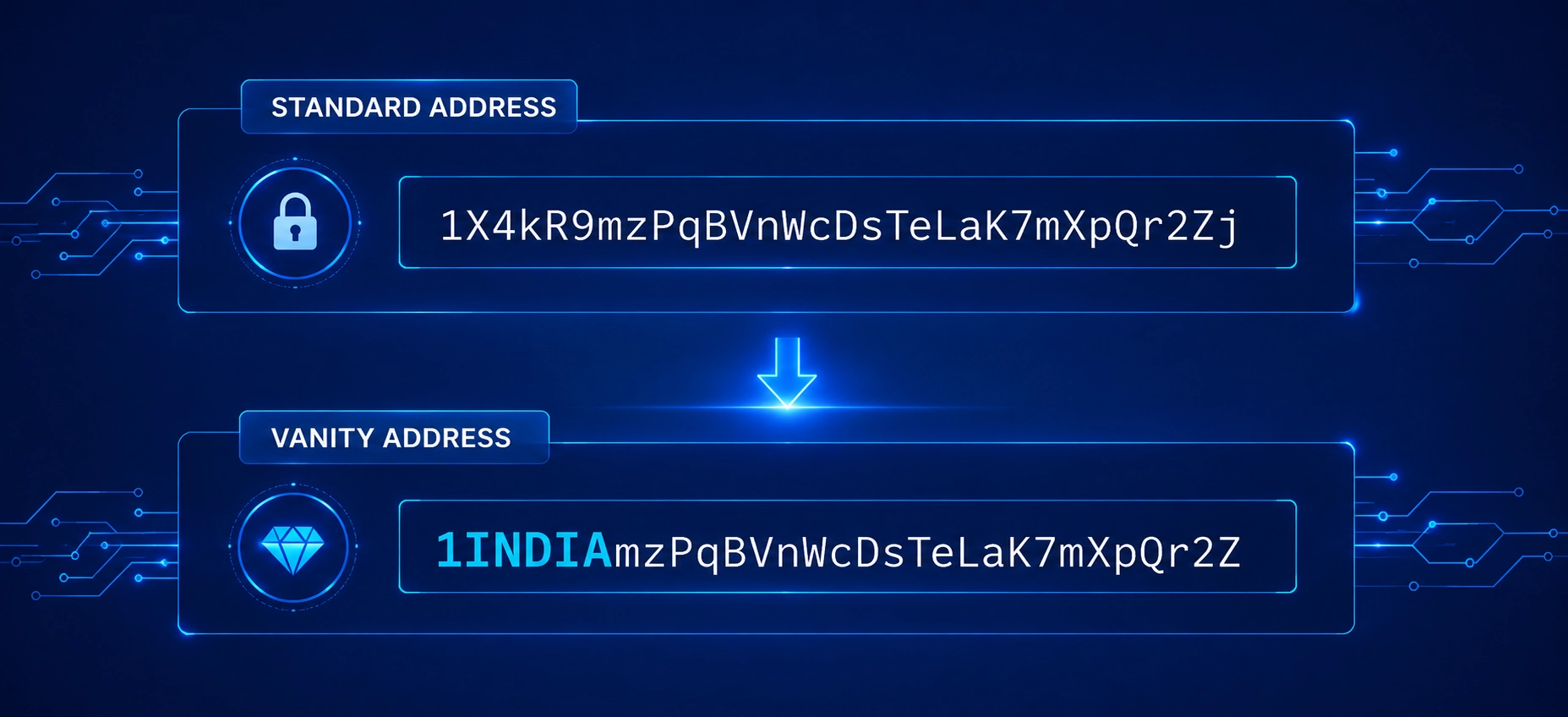
Every standard blockchain wallet address is generated through a cryptographic process that produces a completely random string of alphanumeric characters. This randomness is intentional and is the cornerstone of blockchain security. A standard Bitcoin address might look like 1A1zP1eP5QGefi2DMPTfTL5SLmv7Divf, which carries no inherent meaning whatsoever to a human reader observing it.
A vanity address breaks from this randomness at the presentational layer while maintaining the same cryptographic depth underneath. What distinguishes it is the deliberate inclusion of a user-defined pattern, word, or phrase within the address string. This could be a personal name, a business brand, a project name, or any meaningful sequence of characters. For example, a popular DeFi protocol’s vanity address might begin with 0x1111111254fb6c44… as seen with the 1inch exchange, where seven consecutive ones make the address instantly identifiable across blockchain explorers globally.
For blockchain businesses operating in India’s growing Web3 ecosystem, the appeal of a vanity address is intuitive. In a marketplace crowded with projects and tokens, any mechanism that improves wallet recognition and user confidence has real commercial value. The vanity address achieves this without compromising the underlying cryptographic integrity of the wallet, making it a powerful branding tool for Indian crypto startups, exchanges, and token issuers who interact with large public communities on a daily basis.
How a Vanity Address is Different From a Regular Blockchain Address
The distinction between a vanity address and a regular blockchain address comes down to the process of their creation rather than their underlying cryptographic structure. A regular address is generated in a single operation: the wallet software creates a private key, derives a public key from it, and then converts that public key into an address using a hash function. The entire process takes milliseconds and produces a result that is effectively random from a human perspective.
A vanity address requires an entirely different workflow. Instead of accepting whatever address comes out of a single key generation cycle, specialized software runs this generation cycle millions or even billions of times until the resulting address contains the desired pattern. The private key, public key, and address are all still cryptographically valid and properly derived. The only difference is that the generation process was run repeatedly until a matching output was found. This is computationally expensive but produces an address that is functionally identical to a standard address in every way except its appearance.
For Indian blockchain businesses, this distinction matters practically. A vanity address does not receive any special treatment on the blockchain network itself. It receives transactions the same way, pays the same fees, and interacts with smart contracts identically. The differentiation is entirely at the human recognition layer, which is precisely why it has value for branding, community trust building, and public-facing donation or payment campaigns in the Indian Web3 market.
| Property | Standard Address | Vanity Address |
|---|---|---|
| Generation Method | Single key-pair cycle | Millions of iterations |
| Human Readability | None | High (custom pattern) |
| Cryptographic Security | Full | Full (if done offline) |
| Time to Generate | Milliseconds | Seconds to weeks |
| Branding Value | None | High |
| Blockchain Functionality | Identical | Identical |
How Vanity Addresses Are Generated in Blockchain
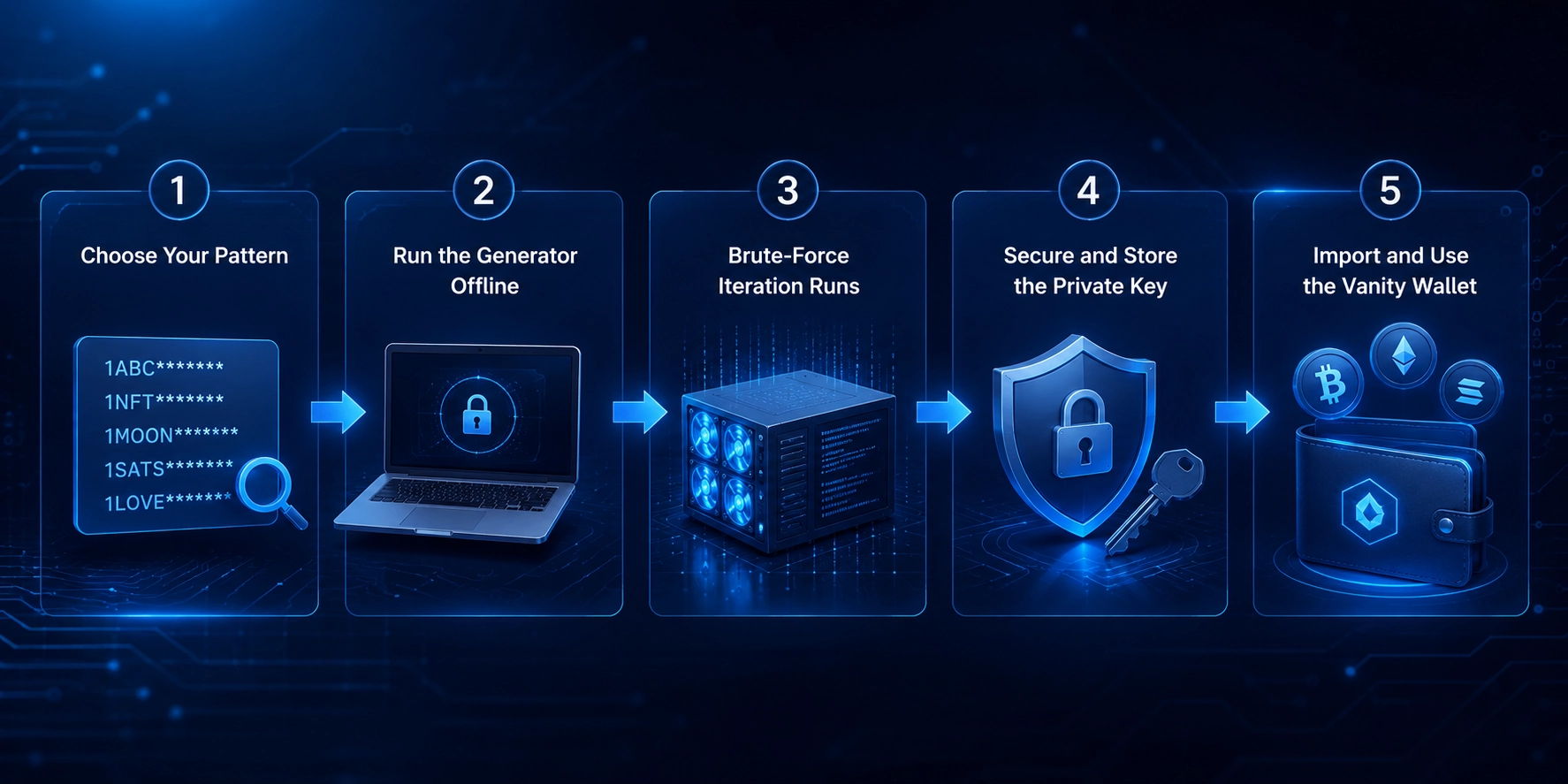
The generation of a vanity address relies on a computational technique known as brute-force searching. At its core, blockchain address generation involves creating a private key, deriving a public key from it using elliptic curve cryptography, and then applying a cryptographic hash function to produce the final address. Every single time this process runs, it produces a different and unique address. Vanity address generation exploits this variability by running the process at extreme speed until a result matches the pattern the user has selected.
The user starts by selecting a desired prefix or pattern, for example the word “BTCSHOP” for a Bitcoin merchant. Specialized software then generates key pairs continuously, converting each public key to an address and immediately checking whether it begins with the desired characters. If the check fails, which it will the overwhelming majority of the time, the software discards that key pair and generates another. This loop runs until a match is found. Modern GPU-accelerated tools can check tens of millions of key pairs per second, dramatically reducing the time needed for shorter patterns.
The resulting private key is the single most important output of this process. It must be stored securely and privately, just as with any other blockchain wallet. The vanity address itself, derived from this private key, can then be shared publicly for receiving funds. For Indian developers and businesses new to vanity address generation, understanding that the private key security is paramount and unchanged by the vanity nature of the address is the most critical technical concept to internalize before proceeding.
What Are the Most Common Uses of Vanity Addresses in Blockchain
Vanity addresses serve a practical purpose beyond personal expression. They have emerged as a genuine utility layer in blockchain interactions where trust, recognition, and usability intersect in meaningful ways. Across India’s Web3 ecosystem, we have observed four primary contexts where vanity addresses deliver clear and measurable value to the businesses and individuals that use them.
Business branding is the most dominant use case. When a crypto exchange, DeFi protocol, or NFT marketplace publishes a vanity address that contains their brand name or a recognizable word, it instantly builds credibility with users. A donor or investor who sees a wallet address beginning with the project’s name rather than a random string immediately has a visual confirmation signal before completing a transaction. This psychological layer of trust has commercial significance in a market where phishing attacks and impersonation are legitimate daily threats to Indian crypto users.
Public fundraising and charitable campaigns also benefit enormously. Indian blockchain-based NGOs and social impact organizations that run transparent on-chain fundraising find that a vanity address improves donation rates because it appears more professional and trustworthy. Marketing campaigns that run print or digital advertisements can feature a short, memorable vanity address that donors can type manually with confidence, reducing transcription errors and increasing successful transaction completions.
Are Vanity Addresses in Blockchain Safe and Secure to Use
The security of a vanity address is entirely conditional on how it is generated and how the resulting private key is stored. The underlying cryptographic mechanism is identical to any standard blockchain address, meaning a properly generated vanity address is exactly as secure as a randomly generated one. The key phrase here is “properly generated.” When the generation process is conducted using verified open-source software on an offline machine with no network connectivity, the private key never leaves your control, and the vanity address is completely safe to use for receiving and holding funds.
The risk profile changes dramatically when users resort to online vanity address generation services or unverified third-party tools. These services may log or transmit the private key to their servers during or after the generation process. Since the private key is the sole access credential to all funds in the wallet, any exposure of it represents a complete and irrecoverable loss of security. For Indian crypto users who are relatively new to blockchain wallets, this risk is particularly relevant because the convenience of web-based generators is appealing but fundamentally dangerous when significant funds are involved.
There is also the specific threat of address poisoning attacks that exploit vanity address techniques maliciously. In these attacks, fraudsters generate addresses that closely resemble a target’s known wallet address, typically matching the first several and last several characters. They then send tiny transactions from these fake addresses to the target’s wallet, hoping the target will copy the fake address from their transaction history the next time they make a payment, accidentally sending funds to the attacker. This risk is not a flaw in vanity addresses themselves but rather a misuse of the same generation technique against unsuspecting users.
How Long Does It Take to Generate a Vanity Address in Blockchain
The time required to generate a vanity address scales exponentially with the complexity and length of the desired pattern. This exponential relationship is a fundamental mathematical property of brute-force search processes and is worth understanding clearly before committing to a target pattern. The number of possible blockchain addresses is astronomically large, meaning longer patterns require testing an exponentially greater number of key pairs before a statistical match occurs.
For Bitcoin, the address space uses Base58 encoding, meaning each character position has 58 possible values. For each additional character you add to your desired prefix, the average search time multiplies by 58. A 4-character prefix might take seconds on a modern CPU. A 6-character prefix might take minutes to hours. An 8-character prefix could take days to weeks even with a powerful GPU. A 10-character prefix becomes practically infeasible without a distributed computing cluster running for months. This exponential growth is why most practical vanity addresses aim for 4 to 6 character patterns rather than attempting longer phrases.
For Indian businesses with time-sensitive project launches or token sale deadlines, understanding this timeline before committing to a specific pattern is essential planning information. Our experience advising blockchain projects across India has shown that teams frequently underestimate generation time and end up either compromising on pattern length or delaying their launch because the generation is still running closer to their deadline.
What Tools and Software Are Used to Create a Vanity Address
Several well-established open-source tools exist for generating vanity addresses across different blockchains, each with its own strengths in terms of speed, supported networks, and ease of use. Selecting the right tool depends on which blockchain you are targeting, what computational resources you have available, and your level of technical comfort with command-line interfaces. Our team has evaluated all major tools across multiple client projects spanning Bitcoin, Ethereum, and Solana vanity address requirements for Indian blockchain businesses.
Vanitygen is the original and most widely referenced open-source tool for Bitcoin vanity address generation. It was created for the Bitcoin community and leverages CPU processing power to iterate through key pairs at high speed. It supports standard Bitcoin addresses as well as compressed and SegWit formats. Vanitygen Plus extends the original tool to support over 100 cryptocurrencies including Litecoin, Dogecoin, and others. Vanity-ETH is the equivalent for Ethereum, running entirely within a web browser in a fully client-side environment where the private key never leaves the user’s machine, with full source code available on GitHub for verification.
For faster generation using GPU acceleration, newer tools like HexHunter use OpenCL to leverage graphics card processing power, achieving speeds up to 100 times faster than equivalent CPU tools. HexHunter supports multiple chains including ETH, SOL, TRX, BTC, APT, and SUI. For Indian developers who already have machines with capable GPUs from ML or gaming use cases, GPU-accelerated tools represent a practical path to generating even 7 or 8 character vanity addresses within a reasonable timeframe for business use.
| Tool | Blockchain Support | Speed Type | Offline Safe |
|---|---|---|---|
| Vanitygen | Bitcoin | CPU | Yes |
| Vanitygen Plus | 100+ Coins | CPU / GPU | Yes |
| Vanity-ETH | Ethereum | Browser / CPU | Yes |
| HexHunter | ETH, SOL, BTC, TRX, SUI | GPU (OpenCL) | Yes |
| Profanity (Deprecated) | Ethereum | GPU | Avoid (Hacked) |
Vanity Addresses in Bitcoin vs Ethereum How They Differ
While the concept of a vanity address is the same across Bitcoin and Ethereum, the technical implementation differs significantly between the two networks due to their different address formats, encoding schemes, and underlying cryptographic constructions. Understanding these differences is practically important for Indian developers and businesses deciding which chain to deploy their branded wallet on, as it directly affects how recognizable the vanity pattern can be and how long generation will take.
Bitcoin addresses are encoded in Base58Check format and typically start with the number 1 for standard Legacy addresses, 3 for P2SH addresses, or bc1 for native SegWit Bech32 addresses. Because Base58 excludes confusing characters like 0, O, I, and l, the character set for vanity patterns is limited to 58 characters per position. This means each additional character in a Bitcoin vanity address prefix multiplies search time by 58. A Bitcoin vanity address like 1BITCOINxyz… is achievable but requires progressively more compute as you extend the prefix beyond 5 characters.
Ethereum addresses use hexadecimal encoding with a 0x prefix, meaning only the characters 0-9 and a-f are part of the address itself after the prefix. This 16-character set means each additional hexadecimal character position multiplies search time by only 16, making Ethereum vanity address generation faster per character than Bitcoin when targeting hex-compatible patterns. However, since hex severely limits which words can be spelled using only 0-9 and a-f characters, many Ethereum vanity addresses rely on EIP-55 checksum casing to create readable patterns using mixed-case letters rather than relying on a limited hex character subset alone.
What Are the Risks and Limitations of Using a Vanity Address
Every technology choice in blockchain comes with trade-offs, and vanity addresses are no exception. While their branding and usability benefits are real, there are specific risks and practical limitations that every individual and business must evaluate honestly before adopting a vanity address for production use. Understanding these risks is part of responsible blockchain deployment, which is a standard recommendation we make to every Indian client considering a vanity address strategy.
The most severe and well-documented real-world risk is the Profanity tool vulnerability. In 2022, the Profanity GPU vanity address generator for Ethereum was found to have a critical flaw in its random number generation algorithm. This flaw allowed attackers to reverse-engineer private keys from vanity addresses generated with the tool, leading to the theft of tens of millions of dollars from wallets whose owners had no idea their addresses were vulnerable. This event, widely covered in the blockchain security community, demonstrates that the generation tool itself is a critical security variable that must be evaluated with extreme care, not assumed to be safe simply because it is popular or widely discussed online.
The Vanity Address Attack, or VAA, is another documented threat where bad actors use the same generation techniques to create look-alike addresses that mimic a target’s wallet. By matching the first 5 and last 7 characters of a real address, an attacker can create an address that appears identical at a casual glance when a user only checks the beginning and end of an address string. This attack is particularly dangerous in the Indian crypto market where users frequently copy addresses from transaction history rather than verifying the complete address character by character before every transaction.
Operationally, vanity addresses also carry the risk of reduced anonymity. Because the address contains a recognizable pattern associated with a specific person or business, it makes blockchain analysis significantly easier for anyone monitoring the public ledger. For businesses where transaction privacy is commercially sensitive, publishing a branded wallet that links all transactions to a known entity requires careful privacy planning as part of the overall blockchain strategy.
- ⚠ Never use online vanity generators for wallets holding real funds
- ⚠ Profanity (Ethereum) had a critical vulnerability; never use it
- ⚠ Address poisoning attacks mimic your address; always verify the full string
- ⚠ Reduced transaction anonymity due to identifiable branding pattern
- ⚠ Losing the private key means permanent and total loss of all wallet funds
Should Your Business Use a Vanity Address in Blockchain
The decision to use a vanity address for your business should be grounded in a clear evaluation of your operational context, security capabilities, and branding objectives. Not every blockchain project needs a vanity address, and for some use cases, particularly those requiring maximum privacy or those without the technical capacity to generate addresses safely offline, a standard randomly generated address is the more appropriate choice. The key is matching the tool to the actual business need rather than adopting it for cosmetic reasons alone.
Indian businesses that benefit most from vanity addresses include those running public-facing campaigns where wallet addresses are communicated through marketing materials, social media, or community channels. Token projects conducting Initial Coin Offerings or public token sales benefit from a branded address because it reduces the risk of donors sending funds to a fraudulent address impersonating the project. Exchanges and DeFi protocols that interact publicly with thousands of users daily also benefit from the instant recognition that a well-chosen vanity address provides to their community members across blockchain explorers.
Businesses that should avoid or approach vanity addresses with extreme caution include those without the technical infrastructure to generate addresses safely offline, those relying on third-party wallet providers that do not support importing custom private keys, and those operating treasury wallets where the highest possible security standards are required above all other considerations. For these use cases, the operational overhead and security risk of the generation process outweighs the branding benefit that a vanity address provides.
- ✓ Public token sale or ICO projects
- ✓ On-chain fundraising and charity drives
- ✓ DeFi protocol public treasury addresses
- ✓ Crypto influencer or personal brand wallets
- ✓ Marketing campaigns with printed wallet QR
- ✗ Private personal cold storage wallets
- ✗ High-security corporate treasury management
- ✗ Users without offline generation capability
- ✗ Privacy-focused anonymous transaction wallets
- ✗ Non-technical teams relying on online generators
With the right operational framework, a vanity address is a legitimate and valuable branding tool that adds measurable trust and recognition to any public-facing blockchain initiative in India’s growing Web3 market. The key success factors are always the same: generate offline, verify the tool’s source code, store the private key securely, and choose a pattern length that balances recognizability with practical generation time. When these conditions are met, a vanity address is a professional-grade asset that strengthens your blockchain presence and builds community confidence from the very first transaction.
Frequently Asked Questions
Q1.1. What is a vanity address in simple words?
A vanity address is a custom cryptocurrency wallet address that contains a specific word, name, or pattern chosen by the user. Instead of a completely random string, it includes recognizable characters making it easier to identify and remember during transactions.
Q2.2. How is a vanity address different from a regular crypto address?
A regular blockchain address is generated randomly by wallet software and has no readable meaning. A vanity address is deliberately crafted through repeated computational attempts to include a specific prefix, suffix, or readable pattern meaningful to the user or business holding it.
Q3.3. Is it safe to use a vanity address for my crypto wallet?
Vanity addresses are cryptographically as secure as regular addresses when generated using trusted, open-source, offline tools. The main safety risk arises when third-party online generators are used, as they may expose your private key to the service provider or malicious actors.
Q4.4. How long does it take to generate a vanity address?
Generation time depends entirely on the complexity and length of the desired pattern. A 4-character prefix may take seconds to minutes on a modern computer, while an 8-character or longer prefix can take days or even weeks without GPU acceleration or distributed computing resources.
Q5.5. What tools are used to generate a vanity address?
The most widely used tools include Vanitygen for Bitcoin, Vanity-ETH for Ethereum wallets, and newer multi-chain tools like HexHunter which supports ETH, SOL, BTC, and more using GPU acceleration. All reputable tools are open-source and designed for offline use to protect your private key security.
Q6.6. Can I create a vanity address for Ethereum and Bitcoin both?
Yes, vanity addresses can be created for both Bitcoin and Ethereum as well as many other blockchains. Bitcoin vanity addresses typically use prefixes starting with 1 or 3, while Ethereum vanity addresses begin with 0x followed by the customized character sequence you select.
Q7.7. Do businesses in India use vanity addresses?
Yes, crypto businesses, exchanges, and blockchain projects in India increasingly use vanity addresses for wallet branding and public donation campaigns. A recognizable address builds donor or customer confidence by making the wallet instantly identifiable rather than an indistinguishable random character string.
Q8.8. Can a vanity address be hacked or exploited?
Vanity addresses themselves are not more hackable than standard addresses when generated properly. However, attackers do use vanity address techniques to create look-alike addresses in address poisoning attacks, tricking users into sending funds to nearly identical fraudulent wallet addresses on any blockchain network.
Q9.9. What is the cost of generating a vanity address?
Generating a vanity address using open-source software on your own hardware is free, though it consumes electricity and computational resources. Paid vanity pool services can generate complex addresses faster by distributing the workload across many computers, typically charging a fee proportional to pattern complexity.
Q10.10. Should small crypto startups in India bother with a vanity address?
For Indian crypto startups running public fundraising campaigns, token sales, or community donation drives, a vanity address adds strong branding value and builds user trust. However, for private wallets or internal treasury addresses, a standard randomly generated address is simpler and carries lower operational risk overall.
Explore Services
Related Services
Reviewed by

Naman Singh
Co-Founder & CEO, Nadcab Labs
Naman Singh is the Co-Founder and CEO of Nadcab Labs, where he drives the company’s vision, global growth, and strategic expansion in blockchain, fintech, and digital transformation. A serial entrepreneur, Naman brings deep hands-on experience in building, scaling, and commercializing technology-driven businesses. At Nadcab Labs, Naman works closely with enterprises, governments, and startups to design and implement secure, scalable, and business-ready Web3 and blockchain solutions. He specializes in transforming complex ideas into high-impact digital products aligned with real business objectives. Naman has led the development of end-to-end blockchain ecosystems, including token creation, smart contracts, DeFi and NFT platforms, payment infrastructures, and decentralized applications. His expertise extends to tokenomics design, regulatory alignment, compliance strategy, and go-to-market planning—helping projects become investor-ready and built for long-term sustainability. With a strong focus on real-world adoption, Naman believes in building blockchain solutions that deliver measurable value, solve practical problems, and unlock new growth opportunities for organizations worldwide.