Ai Overview
Ethereum Mainnet represents the production blockchain network where real-value transactions, smart contract executions, and decentralized applications operate with actual economic consequences. Base fees increase when blocks exceed 50% capacity and decrease when underutilized. During high activity periods, Ethereum Mainnet can burn over 10,000 ETH daily worth tens of millions of dollars.
Ethereum Mainnet represents the production blockchain network where real-value transactions, smart contract executions, and decentralized applications operate with actual economic consequences. As the world’s leading programmable blockchain platform, Ethereum Mainnet processes billions of dollars in daily transaction volume across decentralized finance protocols, NFT marketplaces, and enterprise applications. Understanding what is Ethereum Mainnet and how it functions proves essential for developers deploying smart contracts, users interacting with decentralized applications, and enterprises building Web3 infrastructure.
Key Takeaways
- Production Blockchain Network: Ethereum Mainnet is the live production environment where real ETH transactions occur with actual economic value, distinct from testnets used for development and experimentation with worthless test tokens.
- Proof of Stake Consensus: Since September 2022’s Merge upgrade, Ethereum Mainnet operates on Proof of Stake with 900,000+ validators staking 32 ETH each, reducing energy consumption by 99.95% while maintaining robust security through economic incentives.
- Two-Layer Architecture: Ethereum combines an execution layer handling transactions and smart contracts with a consensus layer managing validator operations and network security, enabling specialized optimization of each component.
- Gas Fee Dynamics: Transaction costs fluctuate based on network congestion, with EIP-1559 introducing base fees (burned) and priority fees (paid to validators), creating deflationary pressure during high activity periods.
- Immutable Smart Contracts: Deployed contracts cannot be modified or deleted, making comprehensive testing, security audits, and testnet validation absolutely critical before Mainnet deployment where real funds are at stake.
- DeFi Foundation: Ethereum Mainnet hosts the world’s largest decentralized finance ecosystem including Uniswap, Aave, MakerDAO, and thousands of protocols collectively securing over $50 billion in total value locked.
- Layer 2 Scaling Strategy: The roadmap embraces rollups (Arbitrum, Optimism, Base) as primary scaling solution, providing 10-100x throughput improvements while Mainnet serves as security and settlement layer.
- Continuous Evolution: From Frontier launch in 2015 through The Merge, Shanghai withdrawals, and Dencun’s proto-danksharding, Ethereum maintains forward momentum with sharding and account abstraction on the roadmap.
- RPC Accessibility: Developers and users access Ethereum Mainnet through RPC endpoints provided by infrastructure services (Infura, Alchemy, QuickNode) or self-hosted nodes, eliminating the need for everyone to run full nodes.
- Global Settlement Layer: Ethereum Mainnet positions itself as Web3 infrastructure foundation—the internet’s value settlement layer providing security, composability, and network effects for the decentralized economy.
Launched on July 30, 2015, by Vitalik Buterin and the Ethereum Foundation, Ethereum Mainnet introduced the revolutionary concept of a Turing-complete blockchain enabling arbitrary programmable logic through smart contracts. Unlike Bitcoin’s limited scripting capabilities, Ethereum blockchain established itself as a global computation platform supporting complex decentralized applications spanning financial services, gaming, identity management, and supply chain coordination.
The network underwent its most significant transformation on September 15, 2022, when “The Merge” transitioned Ethereum Mainnet from energy-intensive Proof of Work to sustainable Proof of Stake consensus. This historic upgrade reduced Ethereum’s energy consumption by 99.95% while maintaining security and decentralization, positioning the network for future scalability improvements through sharding and rollup-centric architecture.
What is Ethereum Mainnet?
Ethereum Mainnet is the primary production blockchain network where real ETH transactions occur, smart contracts execute with actual economic value, and decentralized applications operate with real-world consequences. Unlike testnets used for development and experimentation with worthless test tokens, Ethereum Mainnet processes genuine transactions involving real cryptocurrency, making it the foundation of the global decentralized economy.
As a Layer 1 blockchain, Ethereum Mainnet provides the base security and consensus layer upon which thousands of decentralized applications, protocols, and secondary scaling solutions (Layer 2s) are built. The network maintains its own consensus mechanism, validator set, and economic security model independent of any other blockchain.
Core Characteristics of Ethereum Mainnet
Permissionless Participation: Anyone can interact with Ethereum Mainnet without requiring approval from centralized authorities. Users send transactions, developers deploy smart contracts, and validators secure the network through open participation restoring financial access globally.
Decentralized Consensus: Over 1 million validators distributed across continents collectively agree on the canonical state of Ethereum Mainnet through Proof of Stake consensus[1]. No single entity controls the network, with validator diversity preventing centralization and censorship.
Immutable Transaction History: Once finalized, transactions on Ethereum Mainnet cannot be reversed or altered. This immutability provides settlement guarantees essential for financial applications, with only a 51% attack potentially compromising finality—an economically impractical scenario given validator stake requirements.
Native Currency ETH: Ether (ETH) serves as Ethereum Mainnet’s native gas token paying for computation, transaction processing, and smart contract execution. ETH also functions as collateral for validators, a medium of exchange, and a store of value with market capitalization exceeding $200 billion.
When was Ethereum Mainnet Launched?
Ethereum Mainnet officially launched on July 30, 2015, following extensive development by Vitalik Buterin and the core Ethereum team. The genesis block (Block 0) was mined at 15:26:13 UTC, marking the beginning of the world’s first programmable blockchain capable of executing arbitrary smart contracts.
Initially operating on Proof of Work consensus similar to Bitcoin, Ethereum Mainnet underwent its most significant transformation on September 15, 2022, when The Merge successfully transitioned the network to Proof of Stake. This historic upgrade fundamentally changed how the network achieves consensus while maintaining complete continuity of transaction history and state.
How Does Ethereum Mainnet Work?
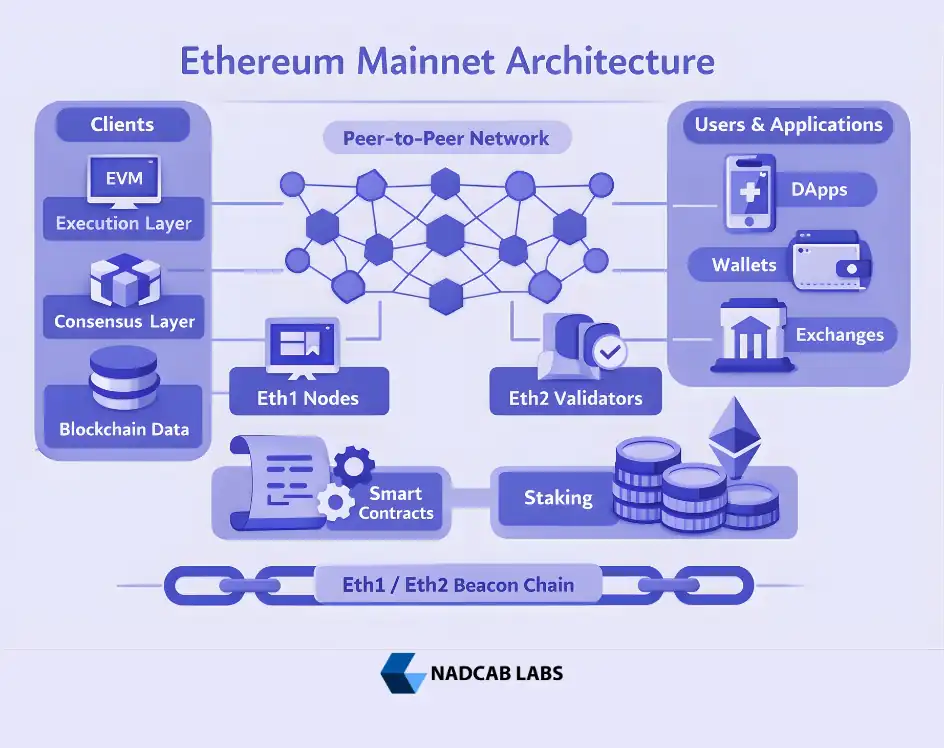
Ethereum Mainnet operates through a sophisticated two-layer architecture combining the execution layer (formerly “Eth1”) handling transactions and smart contract execution with the consensus layer (formerly “Eth2”) managing Proof of Stake consensus and validator operations. This separation of concerns enables specialized optimization of each layer while maintaining seamless integration.
The Execution Layer
The execution layer processes all transactions, maintains account balances, executes smart contracts through the Ethereum Virtual Machine (EVM), and manages the state of the entire network. When users send transactions or interact with decentralized applications, these operations execute on this layer using gas tokens to compensate validators for computational resources.
Key execution layer clients include Geth, Nethermind, Besu, and Erigon, software implementations that nodes run to participate in the network. These clients maintain identical copies of the blockchain state, validate incoming transactions, execute smart contract code, and propagate valid blocks to peers.
The Consensus Layer
The consensus layer coordinates the validator network using Proof of Stake to determine which blocks become part of the canonical chain. Validators stake 32 ETH to participate, running consensus clients (Prysm, Lighthouse, Teku, Nimbus, Lodestar) that propose and attest to blocks every 12 seconds organized into 32-slot epochs.
This consensus mechanism achieves Byzantine Fault Tolerance through a process where randomly selected validators propose blocks while the remaining validators attest to validity. The chain finalizes blocks through a mechanism requiring two-thirds of validators to agree, making reversing finalized transactions economically and cryptographically infeasible.
Transaction Lifecycle on Ethereum Mainnet
- Initiation: User signs transaction with private key specifying recipient, value, and gas parameters
- Mempool: Transaction broadcasts to network entering mempool where validators see pending transactions
- Selection: Validators select transactions for inclusion based on gas price and priority fees
- Execution: EVM executes transaction updating account balances and contract states
- Block Proposal: Validator packages transaction into block and proposes to network
- Attestation: Other validators verify block validity and broadcast attestations
- Finalization: After two epochs (approximately 13 minutes), block achieves finality
Ethereum Mainnet vs Testnet: Understanding the Differences
Developers building on Ethereum utilize testnets—parallel blockchain networks that mirror Mainnet functionality but operate with worthless test ETH obtained freely from faucets. This critical distinction enables risk-free development, testing, and experimentation before deploying smart contracts to Ethereum Mainnet where mistakes have real financial consequences.
| Aspect | Ethereum Mainnet | Ethereum Testnets |
|---|---|---|
| ETH Value | Real economic value, market-traded | No value, free from faucets |
| Purpose | Production environment for live applications | Development, testing, experimentation |
| Network Security | 900,000+ validators, $40B+ staked | Fewer validators, lower security |
| Gas Fees | Variable, can be expensive during congestion | Free or negligible test ETH |
| Permanence | Permanent, immutable blockchain history | May be reset, deprecated over time |
| Common Networks | Ethereum Mainnet (Chain ID: 1) | Sepolia, Goerli, Holesky |
| Risk Level | High – real funds at stake | Zero – no real value at risk |
Best practice for developers involves comprehensive testing on multiple testnets before Mainnet deployment. Major testnets like Sepolia (for application testing) and Holesky (for validator testing) provide production-like environments where teams can identify bugs, optimize gas consumption, and validate security assumptions without financial risk.
Ethereum Mainnet gas fees represent the computational cost required to execute transactions and smart contract operations on the network. Denominated in Gwei (1 Gwei = 0.000000001 ETH), gas fees serve critical functions: compensating validators for processing transactions, preventing spam attacks, and creating economic incentives aligning network participants.
Gas Fee Components Post-EIP-1559
Since the London hard fork implementing EIP-1559 in August 2021, Ethereum Mainnet gas fees comprise two components creating more predictable pricing while introducing deflationary tokenomics:
Base Fee: The minimum price per gas unit determined algorithmically based on network congestion. Base fees increase when blocks exceed 50% capacity and decrease when underutilized. Crucially, base fees are burned—permanently removed from circulation—creating deflationary pressure on ETH supply. During high activity periods, Ethereum Mainnet can burn over 10,000 ETH daily worth tens of millions of dollars.
Priority Fee (Tip): An optional additional payment users offer validators to prioritize their transactions. During congestion, higher tips ensure faster inclusion, while low-priority transactions can specify minimal tips accepting slower confirmation times. Validators receive priority fees directly as compensation for block production.
💡 Gas Fee Calculation Formula:
Total Fee = Gas Units Used × (Base Fee + Priority Fee)
Example: A standard ETH transfer uses 21,000 gas units. With base fee of 30 gwei and priority fee of 2 gwei:
Total Fee = 21,000 × (30 + 2) = 672,000 gwei = 0.000672 ETH ≈ $1.50
Gas fees fluctuate dramatically based on network congestion. During peak usage periods, base fees can exceed 100 Gwei making simple transfers cost $20-50 and complex DeFi interactions hundreds of dollars. Conversely, during low activity periods, fees may drop below 5 Gwei making transactions cost under $1.
Strategies for Managing Gas Costs
- Timing: Execute transactions during low-congestion periods (weekends, non-US hours)
- Gas Price Tools: Use Etherscan Gas Tracker, ETH Gas Station to monitor optimal fees
- Layer 2 Solutions: Utilize rollups like Arbitrum, Optimism, or Base for 90%+ fee reduction
- Batch Transactions: Combine multiple operations into single transaction when possible
- Gas Optimization: Developers should optimize smart contract code minimizing computational complexity
For crypto token development and applications requiring frequent on-chain interactions, understanding gas dynamics proves crucial for user experience and economic viability. Many projects now deploy on Layer 2 networks while maintaining Ethereum Mainnet presence for security and liquidity.
Ethereum Mainnet Validators and Proof of Stake
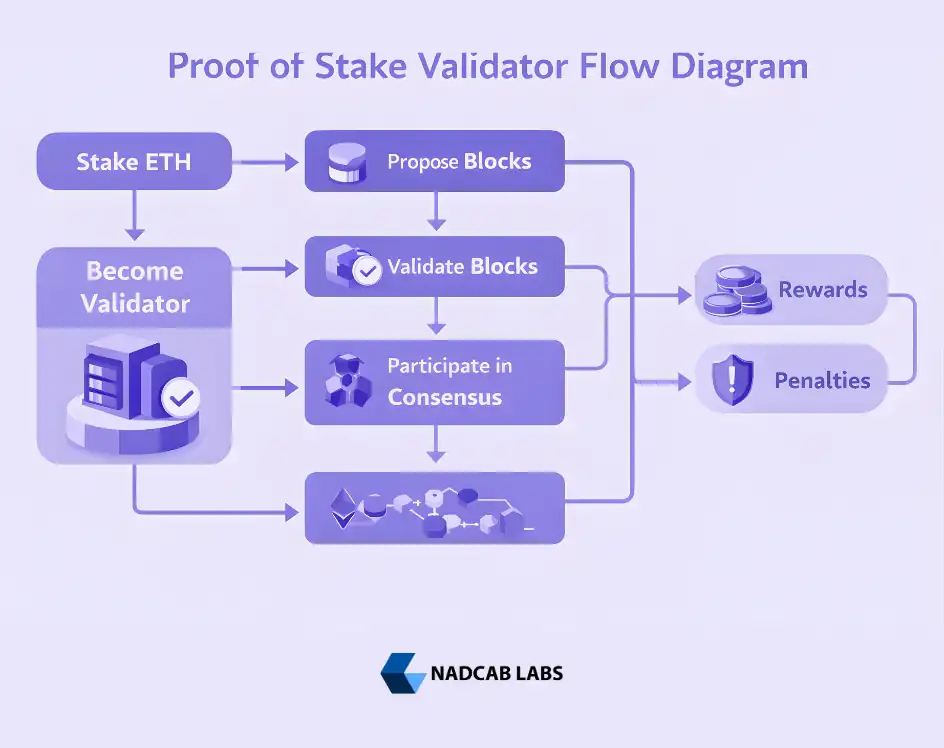
Ethereum Mainnet validators form the backbone of network security following The Merge’s transition to Proof of Stake consensus. Unlike Proof of Work mining requiring specialized hardware and massive energy consumption, Proof of Stake enables anyone with 32 ETH to become a validator securing the network through economic stake rather than computational work.
Becoming an Ethereum Mainnet Validator
Running a validator requires technical competence, reliable infrastructure, and ongoing maintenance. Validators must operate both execution and consensus layer clients, maintain near-perfect uptime (>99%), and stay synchronized with the latest network upgrades. The barrier to entry deliberately balances accessibility with security, ensuring validators have sufficient stake to make malicious behavior economically irrational.
Validator Requirements & Responsibilities
- Stake: Exactly 32 ETH per validator instance
- Hardware: Dedicated machine with 16GB+ RAM, 1TB+ SSD, reliable internet
- Software: Execution client (Geth, Nethermind) + Consensus client (Prysm, Lighthouse)
- Uptime: 24/7 operation with <1% downtime to avoid penalties
- Security: Secure key management, firewall configuration, DDoS protection
- Monitoring: Active alerting for missed attestations, sync issues, hardware failures
As of February 2026, Ethereum Mainnet has over 900,000 active validators representing more than 28.8 million ETH staked—approximately 24% of total ETH supply. This massive stake creates economic security exceeding $75 billion, making attacking the network prohibitively expensive.
Validator Rewards and Penalties
Validators earn rewards from three sources: attestation rewards for correctly validating blocks, block proposal rewards when selected to create blocks, and priority fees paid by users. Annual percentage rates fluctuate based on total validators active, ranging from 3-7% APR on staked ETH. Additionally, validators receive MEV (Maximal Extractable Value) opportunities through transaction ordering.
Penalties include minor inactivity leaks for offline validators and severe slashing (partial stake destruction) for provably malicious behavior like double-signing blocks. The threat of slashing, combined with the requirement to lock substantial capital, creates strong cryptoeconomic incentives for honest validator behavior.
For those unable to meet the 32 ETH requirement or unwilling to manage validator infrastructure, liquid staking services like Lido, Rocket Pool, and Coinbase allow fractional participation. Users deposit any amount of ETH receiving liquid staking tokens (stETH, rETH) representing their stake while delegating validator operations to the protocol.
Deploying Smart Contracts on Ethereum Mainnet
Ethereum Mainnet smart contracts are self-executing programs stored immutably on the blockchain, enabling trustless automation of complex financial logic, governance systems, and decentralized applications. Once deployed, contracts cannot be modified or deleted, making pre-deployment testing and security auditing absolutely critical.
The Smart Contract Deployment Process
Deploying contracts to Ethereum Mainnet follows a rigorous workflow beginning with development in Solidity or Vyper, extensive testing on local networks and testnets, professional security audits, and finally Mainnet deployment through wallet interfaces or deployment scripts. The one-time deployment transaction consumes gas proportional to contract bytecode size and initialization complexity.
- Development: Write contract code using Hardhat, Foundry, or Truffle development frameworks
- Local Testing: Test thoroughly on local Ethereum networks catching obvious bugs
- Testnet Deployment: Deploy to Sepolia/Goerli validating real network behavior
- Security Audit: Engage professional auditors identifying vulnerabilities
- Public Review: Open-source code allowing community security research
- Mainnet Deployment: Deploy to Ethereum Mainnet after addressing all critical issues
- Verification: Publish source code on Etherscan enabling transparency
Popular standards for Ethereum tokens include ERC-20 for fungible tokens (used by USDC, USDT, and thousands of projects), ERC-721 for non-fungible tokens (NFTs), and ERC-1155 for multi-token standards combining both. These standardized interfaces enable interoperability across wallets, exchanges, and applications forming the token ecosystem.
Major DeFi Protocols on Ethereum Mainnet
Ethereum Mainnet hosts the largest and most mature decentralized finance ecosystem globally. Uniswap facilitates billions in weekly decentralized exchange volume through automated market makers. Aave and Compound enable permissionless lending and borrowing securing billions in deposited assets. MakerDAO’s DAI stablecoin maintains its peg through overcollateralized debt positions, representing one of blockchain’s most successful decentralized financial instruments.
The composability of Ethereum smart contracts—the ability for protocols to seamlessly integrate with each other—creates powerful network effects. A single transaction might swap tokens on Uniswap, deposit the output into Aave for yield, and use the aToken as collateral in MakerDAO—all atomically executed in one transaction. This “money lego” composability remains Ethereum’s most defensible moat.
For teams looking to create crypto tokens, Ethereum Mainnet offers unparalleled liquidity, established infrastructure, and the largest developer community. However, gas fees and network congestion increasingly push new projects toward Layer 2 solutions or alternative Layer 1 blockchains for initial deployment.
Ethereum Mainnet Security Model
Ethereum Mainnet security derives from multiple layers of protection including cryptographic primitives, economic incentives, decentralization, and ongoing protocol improvements. The network has processed over 1.8 billion transactions securing hundreds of billions in value without consensus failure since launch, demonstrating robust security despite facing continuous adversarial pressure.
Is Ethereum Mainnet Safe?
Ethereum Mainnet represents one of the most secure decentralized networks globally, though “safe” requires context-dependent evaluation. The base protocol has proven exceptionally resilient with no successful consensus attacks. However, smart contract vulnerabilities have led to hundreds of millions in losses, highlighting that application-layer security depends entirely on contract code quality.
Security Considerations for Users
- Protocol Security: Ethereum Mainnet consensus is highly secure with no successful attacks
- Smart Contract Risk: Individual contracts may contain bugs or vulnerabilities
- Bridge Risk: Cross-chain bridges represent significant attack surface with multiple exploits
- Private Key Security: Users responsible for securing their own wallet private keys
- Phishing Attacks: Social engineering and fake websites remain common threats
- Front-Running: MEV extraction can result in transaction reordering affecting outcomes
Cryptographic and Consensus Security
Ethereum Mainnet employs industry-standard cryptographic primitives including SHA-256 hashing, ECDSA signatures on the secp256k1 curve, and Merkle tree structures for efficient state verification. The Proof of Stake consensus mechanism achieves Byzantine Fault Tolerance under the assumption that at least two-thirds of validators by stake act honestly—an assumption secured through economic incentives where attacking would require destroying billions in staked ETH.
The network employs client diversity as a security feature, with multiple independent implementations (Geth, Nethermind, Besu, Erigon) preventing single bugs from affecting the entire network. If a vulnerability exists in one client, nodes running alternative implementations continue operating normally, preventing consensus failure.
Social layer security provides ultimate backstop—in extreme scenarios like the DAO hack in 2016, the community can coordinate hard forks reversing state changes. However, this nuclear option undermines immutability and has been used only once in Ethereum’s history, with general consensus that such interventions should be exceptionally rare.
Ethereum Mainnet Upgrade Timeline
Ethereum Mainnet has undergone continuous evolution through planned hard forks implementing protocol improvements, scalability enhancements, and security upgrades. These backwards-incompatible changes require all nodes upgrading to remain synchronized with the network, making coordination and testing critical.
| Date | Upgrade Name | Key Improvements |
|---|---|---|
| July 30, 2015 | Frontier | Genesis launch, initial network deployment |
| March 14, 2016 | Homestead | First production-ready release, protocol improvements |
| October 18, 2017 | Byzantium | Privacy features, difficulty adjustment, reduced block rewards |
| February 28, 2019 | Constantinople | Efficiency improvements, further block reward reduction |
| December 8, 2019 | Istanbul | Gas cost optimizations, cryptographic improvements |
| August 5, 2021 | London | EIP-1559 fee market reform, base fee burning |
| September 15, 2022 | The Merge | Transition to Proof of Stake, 99.95% energy reduction |
| April 12, 2023 | Shanghai/Capella | Validator withdrawals enabled |
| March 13, 2024 | Dencun | Proto-Danksharding (EIP-4844), blob transactions for L2 scaling |
Ethereum Mainnet After The Merge
The Merge represents Ethereum’s most significant upgrade, transitioning from energy-intensive Proof of Work mining to environmentally sustainable Proof of Stake validation. This change reduced Ethereum’s energy consumption from approximately 94 TWh/year to under 0.1 TWh/year—equivalent to a 99.95% reduction making Ethereum one of the most energy-efficient blockchain networks globally.
Beyond environmental benefits, The Merge eliminated miner selling pressure (previously 13,000+ ETH sold daily to cover electricity costs), reduced new ETH issuance by 90%, and established foundation for future scalability improvements through sharding. The combination of reduced issuance and EIP-1559 burning often makes Ethereum deflationary during high network activity periods.
Future Ethereum Mainnet Upgrades
The Ethereum roadmap focuses on scalability, security, and sustainability through several planned upgrade categories. Sharding will eventually distribute network load across 64 chains enabling parallel transaction processing. Further consensus improvements will reduce finality time and enhance single-slot finality. Account abstraction will improve user experience through smart contract wallets enabling gasless transactions and social recovery.
Proto-Danksharding introduced in the Dencun upgrade represents the first step toward full data availability sharding. By enabling blob transactions carrying additional data not executed by the EVM, Layer 2 rollups can post data commitments to Ethereum Mainnet at 10-100x lower cost than traditional calldata, dramatically reducing transaction fees on networks like Arbitrum, Optimism, and Base.
Connecting to Ethereum Mainnet RPC
Ethereum Mainnet RPC (Remote Procedure Call) endpoints enable applications to interact with the blockchain without running full nodes. These JSON-RPC interfaces allow reading blockchain state, sending transactions, deploying smart contracts, and monitoring events through standardized API calls served by node infrastructure providers.
Public vs Private RPC Endpoints
Developers can access Ethereum Mainnet through public RPC endpoints provided by infrastructure companies or run private nodes for maximum reliability and control. Public endpoints offer convenience and immediate access but may impose rate limits, experience occasional downtime, or have delayed block propagation. Private nodes provide dedicated resources, guaranteed uptime, and enhanced privacy but require technical expertise and infrastructure costs.
Major Ethereum Mainnet RPC Providers
- Infura: Industry-standard with generous free tier, used by MetaMask
- Alchemy: Developer-friendly with enhanced APIs and built-in analytics
- QuickNode: High-performance infrastructure with global endpoints
- Ankr: Decentralized RPC network with free public endpoints
- Cloudflare: Free public gateway with DDoS protection
- Self-Hosted: Run Geth, Nethermind, or Besu for maximum control
When building production applications, redundancy proves critical. Leading protocols configure multiple RPC providers with automatic failover, ensuring continuous operation even if individual providers experience outages. This redundant architecture mirrors the decentralization philosophy of Ethereum itself.
Common RPC Methods
The Ethereum RPC API exposes dozens of methods for blockchain interaction. Common operations include eth_blockNumber (latest block), eth_getBalance (account balance), eth_sendRawTransaction (submit signed transaction), eth_call (simulate contract execution), and eth_getLogs (query event logs). These standardized methods ensure compatibility across different node implementations and tooling.
The Future of Ethereum Mainnet
Ethereum Mainnet’s roadmap focuses on achieving massive scalability while preserving decentralization and security—the “scalability trilemma” that has constrained blockchain development since Bitcoin’s inception. Through a multi-pronged approach combining Layer 2 rollups, data availability improvements, and eventual sharding, Ethereum aims to support global-scale adoption processing millions of transactions per second.
The Rollup-Centric Roadmap
Rather than scaling Ethereum Mainnet directly through increased block size or decreased block time—approaches that would sacrifice decentralization by raising node requirements—the ecosystem embraces Layer 2 rollups as the primary scaling solution. Rollups execute transactions off-chain but inherit Ethereum Mainnet security through fraud proofs (Optimistic Rollups) or validity proofs (ZK Rollups).
Networks like Arbitrum, Optimism, Base (built by Coinbase), Polygon zkEVM, and zkSync provide 10-100x throughput improvements and proportional fee reductions while maintaining Ethereum security guarantees. Users can move assets between Mainnet and rollups through bridges, though withdrawal delays (7 days for Optimistic Rollups) represent current user experience friction being addressed through fast finality improvements.
Sharding and Data Availability
Full data availability sharding will eventually enable Ethereum Mainnet serving as data availability layer for hundreds of rollups, each processing thousands of transactions per second. Proto-Danksharding (EIP-4844) implemented in March 2024 represents the first step, introducing blob transactions that dramatically reduce Layer 2 data posting costs.
Full Danksharding planned for future upgrades will further expand data capacity enabling even lower rollup fees and higher throughput. Combined with zkEVM rollups achieving full EVM equivalence, this architecture positions Ethereum to serve as global settlement layer for the decentralized internet while maintaining node requirements accessible to ordinary users.
Ethereum Mainnet as Web3 Infrastructure
As Web3 infrastructure matures, Ethereum Mainnet increasingly functions as the security and settlement layer while specialized networks handle specific use cases. DeFi applications might execute on high-throughput rollups, NFT marketplaces on networks optimized for digital collectibles, and gaming on chains prioritizing speed over immediate finality.
This modular architecture preserves Ethereum Mainnet’s role as credibly neutral base layer while enabling ecosystem specialization. The token ecosystem built on Ethereum—from DeFi protocols to NFT collections—benefits from unified liquidity and composability while tailoring execution environments to specific application requirements.
For developers and projects planning long-term infrastructure, understanding Ethereum Mainnet’s roadmap proves essential. While current gas fees may push certain use cases toward alternative platforms, Ethereum’s network effects, security model, and credible neutrality position it as the internet’s value settlement layer for decades to come.
Final Thoughts
Ethereum Mainnet represents the most significant innovation in blockchain technology since Bitcoin, transforming the vision of decentralized digital currency into a global platform for programmable money and trustless applications. From its launch in 2015 through The Merge’s historic transition to Proof of Stake and ongoing scalability improvements, Ethereum has consistently evolved while maintaining network security and continuity.
The network’s success derives from careful balance between decentralization, security, and scalability, the blockchain trilemma that constrains all distributed systems. By prioritizing decentralization and security at the base layer while embracing Layer 2 rollups for scalability, Ethereum charts a path toward global adoption without compromising its core values of credible neutrality and permissionless access.
For developers, investors, and users navigating the Web3 ecosystem, understanding Ethereum Mainnet proves essential. Whether deploying smart contracts, providing liquidity to DeFi protocols, collecting NFTs, or building the next generation of decentralized applications, Ethereum Mainnet provides the security, infrastructure, and network effects enabling blockchain’s most ambitious visions to become reality.
As the roadmap progresses toward full data availability sharding, continued validator improvements, and ever-expanding Layer 2 ecosystems, Ethereum Mainnet solidifies its position as the internet’s value settlement layer, the foundation upon which the decentralized future will be built.
Frequently Asked Questions
Q1.What is the difference between Ethereum and Ethereum Mainnet?
Ethereum refers to the entire ecosystem including the protocol, community, development tools, and all networks (Mainnet and testnets). Ethereum Mainnet specifically denotes the production blockchain network where real-value transactions occur. When people say “I sent ETH” without qualification, they mean Ethereum Mainnet.
Q2.How much does it cost to deploy a smart contract on Ethereum Mainnet?
Deployment costs vary based on contract complexity and network congestion. Simple ERC-20 token contracts typically cost $50-$500, while complex DeFi protocols can exceed $5,000-$20,000. Gas fees fluctuate significantly—deploying during low-congestion periods (weekends, overnight UTC hours) substantially reduces costs. Many projects now deploy on Layer 2 networks where costs are 90-99% lower.
Q3.Can I reverse a transaction on Ethereum Mainnet?
No. Once a transaction is confirmed and included in a finalized block (approximately 13 minutes after submission), it becomes part of the immutable blockchain history and cannot be reversed. This permanence is a feature, not a bug—it enables trustless operations without requiring intermediaries. However, unconfirmed transactions in the mempool can potentially be replaced using higher gas fees through RBF (Replace-By-Fee) mechanisms.
Q4.What is the maximum transaction speed on Ethereum Mainnet?
Ethereum Mainnet produces new blocks every 12 seconds with each block capable of containing approximately 15-30 million gas worth of transactions. This translates to roughly 15-30 transactions per second for simple transfers, or fewer for complex smart contract interactions. Layer 2 rollups increase this to thousands of transactions per second while inheriting Mainnet security.
Q5.Do I need to run a node to use Ethereum Mainnet?
No. Most users interact with Ethereum Mainnet through wallets (MetaMask, Coinbase Wallet) and applications that connect to nodes operated by others via RPC endpoints. Running your own node provides maximum security, privacy, and censorship resistance but requires technical expertise and dedicated hardware. For development and production applications, most teams use managed node services like Infura or Alchemy.
Q6.How is Ethereum Mainnet different from Bitcoin?
While Bitcoin focuses primarily on peer-to-peer value transfer with limited scripting, Ethereum Mainnet provides a Turing-complete programming environment enabling complex smart contracts and decentralized applications. Ethereum uses Proof of Stake (versus Bitcoin’s Proof of Work), produces blocks every 12 seconds (versus Bitcoin’s 10 minutes), and supports thousands of tokens and protocols built on its platform. Bitcoin prioritizes security and decentralization as digital gold; Ethereum emphasizes programmability and developer flexibility as a world computer.
Q7.What happens if Ethereum Mainnet goes down?
Ethereum Mainnet cannot “go down” in the traditional sense due to its distributed architecture. Even if 50% of validators went offline simultaneously, the remaining validators would continue producing blocks, though finality might be delayed. The network has maintained continuous operation since July 2015 without consensus failure. Individual RPC endpoints or dApps may experience downtime, but the base blockchain layer continues operating as long as sufficient validators remain online.
Q8.What is the environmental impact of Ethereum Mainnet?
After The Merge in September 2022, Ethereum Mainnet reduced energy consumption by 99.95%, from approximately 94 TWh/year (comparable to countries like Belgium) to under 0.1 TWh/year (equivalent to a small town). Proof of Stake requires validators only running consumer-grade hardware rather than specialized mining equipment, making Ethereum one of the most energy-efficient blockchains globally while maintaining security through economic rather than computational expense.
Explore Services
Related Services
Reviewed by

Aman Vaths
Founder of Nadcab Labs
Aman Vaths is the Founder & CTO of Nadcab Labs, a global digital engineering company delivering enterprise-grade solutions across AI, Web3, Blockchain, Big Data, Cloud, Cybersecurity, and Modern Application Development. With deep technical leadership and product innovation experience, Aman has positioned Nadcab Labs as one of the most advanced engineering companies driving the next era of intelligent, secure, and scalable software systems. Under his leadership, Nadcab Labs has built 2,000+ global projects across sectors including fintech, banking, healthcare, real estate, logistics, gaming, manufacturing, and next-generation DePIN networks. Aman’s strength lies in architecting high-performance systems, end-to-end platform engineering, and designing enterprise solutions that operate at global scale.