Ai Overview
DeFi tokens serve as native assets powering decentralized financial applications enabling lending, borrowing, trading, and wealth generation without traditional intermediaries like banks or brokers. Decentralized finance (DeFi) has emerged as one of cryptocurrency’s most impactful innovations, with total value locked in DeFi protocols exceeding $100 billion, demonstrating massive capital allocation to these novel financial instruments.
What are DeFi tokens represents fundamental question for anyone exploring decentralized finance revolution transforming traditional financial services through blockchain technology. DeFi tokens serve as native assets powering decentralized financial applications enabling lending, borrowing, trading, and wealth generation without traditional intermediaries like banks or brokers. These programmable digital assets leverage smart contracts executing financial agreements automatically, creating transparent, accessible, and efficient financial systems operating 24/7 globally without geographic restrictions or discriminatory access barriers.
Decentralized finance (DeFi) has emerged as one of cryptocurrency’s most impactful innovations, with total value locked in DeFi protocols exceeding $100 billion, demonstrating massive capital allocation to these novel financial instruments. Understanding how DeFi tokens work, their various types, benefits, risks, and investment strategies proves essential for participants seeking to leverage decentralized finance opportunities while managing inherent risks. Professional crypto token development providers help projects design robust DeFi token economics that support sustainable protocol growth and community value creation.
Key Takeaways
- DeFi Tokens Defined: DeFi tokens are cryptocurrency assets powering decentralized financial protocols, enabling services like lending, borrowing, trading, and yield generation without traditional intermediaries through smart contract automation.
- Multiple Token Types: DeFi ecosystem includes governance tokens granting voting rights, utility tokens accessing services, stablecoins maintaining price stability, and liquidity tokens representing pool shares with distinct functions.
- Smart Contract Foundation: DeFi tokens operate through self-executing smart contracts on blockchains like Ethereum, Binance Smart Chain, and Solana automating financial agreements without requiring trusted third parties.
- Accessibility and Inclusion: Anyone with internet connection can access DeFi services regardless of geography, credit history, or minimum balance requirements democratizing financial services globally.
- High Yield Opportunities: DeFi protocols offer substantially higher returns through yield farming, liquidity provision, and staking compared to traditional banking products, though with corresponding higher risks.
- Transparency and Auditability: All transactions occur on public blockchains enabling complete transparency, independent verification, and reduced fraud compared to opaque traditional finance systems.
- Significant Risk Factors: DeFi investments carry smart contract vulnerabilities, regulatory uncertainty, impermanent loss for liquidity providers, and potential total loss requiring careful risk assessment.
- Rapid Innovation Pace: DeFi ecosystem evolves constantly with new protocols, features, and use cases emerging regularly creating opportunities alongside complexity requiring continuous learning.
Understanding DeFi Tokens Fundamentals
DeFi tokens serve as programmable digital assets enabling decentralized financial services operating without banks, brokers, or centralized institutions. These tokens leverage blockchain technology and smart contracts creating open, permissionless financial systems accessible to anyone with internet connectivity.
What are DeFi Tokens
Decentralized Finance (DeFi) tokens represent cryptocurrency assets powering protocols providing financial services including lending, borrowing, trading, insurance, and derivatives through automated smart contracts. Unlike traditional finance requiring intermediaries verifying transactions and enforcing agreements, DeFi tokens enable peer-to-peer financial interactions settled automatically by code.
These tokens exist on blockchain networks with Ethereum hosting majority of DeFi applications, though Binance Smart Chain, Solana, Avalanche, and other platforms increasingly support DeFi ecosystems. The programmable nature of smart contracts enables DeFi tokens facilitating complex financial arrangements impossible or impractical in traditional systems.
DeFi tokens serve multiple simultaneous purposes within protocols. A single token might enable governance voting, provide fee discounts, generate staking rewards, and represent liquidity pool ownership simultaneously. This multi-functionality distinguishes DeFi tokens from simple payment cryptocurrencies focusing primarily on value transfer.
How DeFi Tokens Work
DeFi tokens operate through smart contracts—self-executing programs running on blockchains automatically enforcing predefined rules without requiring human oversight. When users interact with DeFi protocols, they utilize these tokens to access services, provide collateral, earn yields, or participate in governance.
For example, lending protocols like Aave or Compound enable users depositing tokens into smart contracts earning interest from borrowers. The smart contracts automatically calculate interest rates based on supply and demand, enforce collateralization requirements preventing undercollateralized loans, and distribute yields to lenders without requiring manual administration.
Decentralized exchanges like Uniswap use DeFi tokens enabling automated market making through liquidity pools. Users deposit token pairs into pools receiving liquidity provider tokens representing their share. When traders swap tokens, they pay fees distributed proportionally to liquidity providers automatically without centralized order book management.
Understanding token burning mechanisms helps evaluate how DeFi protocols manage token economics and value accrual through supply reduction strategies.
DeFi vs Traditional Finance
DeFi fundamentally differs from traditional finance across multiple dimensions creating both advantages and challenges. Traditional finance relies on trusted institutions acting as intermediaries verifying identities, enforcing contracts, and maintaining ledgers. This centralization creates single points of failure, geographic restrictions, and barriers excluding billions globally from financial services.
DeFi eliminates intermediaries through trustless smart contracts enforcing agreements automatically. This disintermediation reduces costs, increases accessibility, and enables 24/7 operation without banking hours or holidays. Users maintain custody of assets rather than depositing into institutional accounts reducing counterparty risk though increasing personal security responsibility.
Transparency represents another key distinction. Traditional finance operates through opaque systems where institutions guard proprietary information. DeFi protocols execute on public blockchains where anyone can verify reserves, audit code, and track all transactions creating unprecedented transparency though sacrificing privacy[1].
| Aspect | Traditional Finance | DeFi |
|---|---|---|
| Intermediaries | Banks, brokers, clearing houses required | Smart contracts eliminate intermediaries |
| Access | Requires identity verification, credit checks, geography | Open to anyone with internet connection |
| Operating Hours | Limited to business hours, holidays | 24/7/365 operation |
| Transparency | Opaque, proprietary systems | Fully transparent, auditable on-chain |
| Custody | Institution holds assets | User maintains self-custody |
| Speed | Days for settlement | Minutes to seconds |
Types of DeFi Tokens
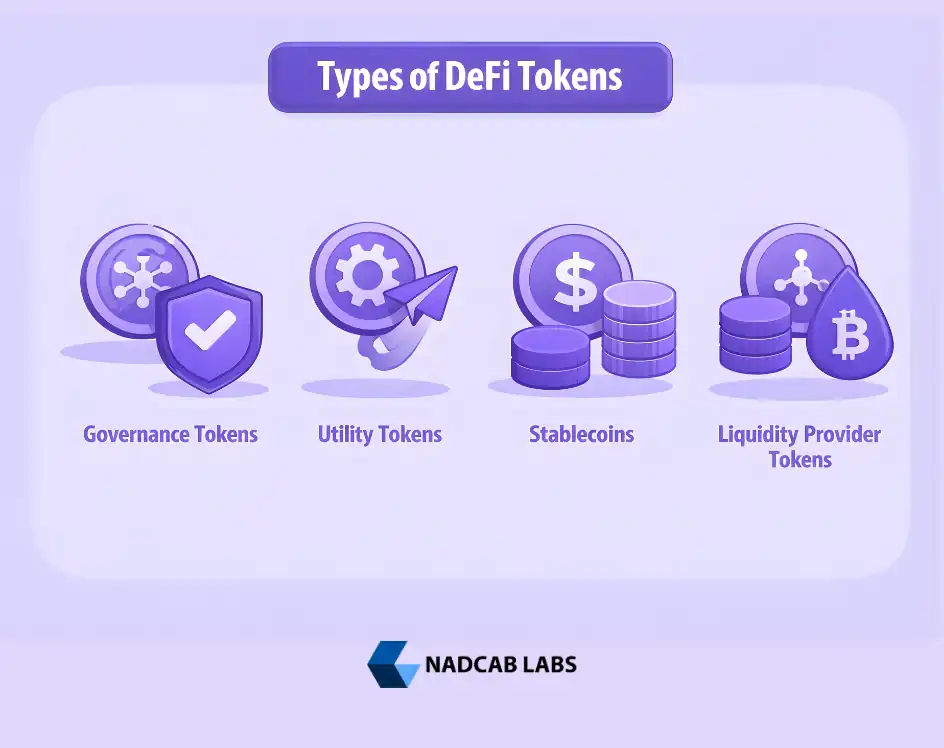
DeFi ecosystem encompasses diverse token types each serving distinct functions within decentralized financial protocols. Understanding these categories helps investors and developers navigate the complex landscape and make informed decisions.
Governance Tokens
Governance tokens grant holders voting rights determining protocol parameters, upgrades, treasury allocations, and strategic direction. This decentralized governance replaces traditional corporate boards with token-weighted voting enabling community-driven development.
Prominent governance tokens include Maker (MKR) controlling MakerDAO and DAI stablecoin parameters, Compound (COMP) governing Compound lending protocol, and Uniswap (UNI) directing Uniswap decentralized exchange development. Holders vote on proposals including interest rate models, collateral types, fee structures, and development priorities.
Governance tokens often accrue value through fee sharing, buyback mechanisms, or perceived influence over valuable protocols. However, voter apathy remains challenge with many holders never participating in governance, concentrating effective control among active participants. When to launch crypto token with governance features requires careful mechanism design preventing governance attacks.
Utility Tokens
Utility tokens provide access to protocol services, enable fee discounts, or unlock specific features within DeFi platforms. These tokens serve functional purposes beyond simple value transfer or governance rights.
Binance Coin (BNB) exemplifies utility tokens offering reduced trading fees on Binance exchange while powering Binance Smart Chain transactions. The token’s utility creates natural demand as users need BNB for platform services, supporting value independent of speculation.
Utility tokens often integrate with protocol tokenomics through fee burning, staking rewards, or preferential access creating value accrual mechanisms. Effective utility design ensures genuine demand for tokens based on platform usage rather than purely speculative interest.
Stablecoins
Stablecoins maintain price stability relative to fiat currencies or other assets, providing volatility shelter within DeFi ecosystems. These tokens enable traders preserving value without exiting to traditional banking while serving as accounting units and medium of exchange for DeFi transactions.
Centralized stablecoins like USDT (Tether) and USDC (USD Coin) maintain reserves of fiat currency backing token issuance. Decentralized algorithmic stablecoins like DAI maintain pegs through overcollateralized cryptocurrency deposits and automatic liquidation mechanisms. Algorithmic stablecoins attempt maintaining pegs through supply expansion and contraction though with mixed success historically.
Stablecoins represent critical DeFi infrastructure enabling lending, liquidity pools, and derivatives markets. However, regulatory scrutiny intensifies as authorities examine reserves, redemption mechanisms, and systemic risks posed by rapidly growing stablecoin supply.
Liquidity Provider Tokens
Liquidity provider (LP) tokens represent shares in decentralized exchange liquidity pools. When users deposit token pairs into pools, they receive LP tokens tracking their ownership percentage and entitling them to proportional fee earnings.
These tokens themselves become tradable assets and collateral for other DeFi applications. Users can stake LP tokens earning additional rewards, use them as collateral for loans, or sell them transferring liquidity pool positions. This composability enables sophisticated strategies layering multiple yield sources.
DeFi Applications and Use Cases
DeFi protocols enable diverse financial services previously requiring traditional institutions. Understanding these applications reveals opportunities and innovations reshaping finance through decentralization.
DeFi Lending and Borrowing
Decentralized lending platforms enable users depositing cryptocurrency earning interest from borrowers. Protocols like Aave, Compound, and MakerDAO automatically match lenders with borrowers, calculate interest rates based on supply-demand dynamics, and enforce collateralization requirements through smart contracts.
Borrowers typically must overcollateralize loans depositing assets worth 125-200% of borrowed amounts. This overcollateralization protects lenders from default risk, though limits capital efficiency. Flash loans represent innovation enabling uncollateralized borrowing repaid within single transaction enabling arbitrage and liquidation strategies impossible in traditional finance.
Interest rates in DeFi lending often substantially exceed traditional banking both for depositors and borrowers. Lenders might earn 5-15% APY on stablecoin deposits compared to near-zero savings account rates. Borrowers pay higher rates but gain instant access without credit checks or application delays.
Decentralized Exchanges
Decentralized exchanges (DEXs) enable peer-to-peer cryptocurrency trading without centralized order books or custodial control. Automated market makers like Uniswap, SushiSwap, and PancakeSwap use liquidity pools and mathematical formulas determining prices algorithmically.
Users trade directly from wallets maintaining asset custody throughout transactions. This eliminates counterparty risk from exchange hacks or fraud affecting centralized platforms. However, DEXs face challenges including lower liquidity for smaller tokens, front-running attacks, and complex user interfaces deterring mainstream adoption.
Yield Farming and Liquidity Mining
Yield farming involves strategically deploying capital across DeFi protocols maximizing returns through staking, liquidity provision, and reward token accumulation. Users might deposit stablecoins into lending platforms earning interest, provide liquidity to DEXs earning fees, stake LP tokens earning governance tokens, and compound returns optimizing across multiple protocols.
This capital-intensive optimization can generate substantial returns during bull markets but carries significant risks including smart contract vulnerabilities, impermanent loss, and reward token price volatility. Understanding crypto gaming tokens provides context for how token rewards programs function across different sectors.
DeFi Insurance and Risk Management
DeFi insurance protocols like Nexus Mutual provide coverage against smart contract failures, exchange hacks, and protocol risks. Users purchase coverage paying premiums protecting against specified losses, with claims assessed by token holder votes or automated oracles.
This decentralized insurance fills critical gap given FDIC insurance doesn’t extend to cryptocurrency and traditional insurance rarely covers digital assets. However, coverage remains limited, claims processes experimental, and premium costs sometimes exceed risk-adjusted value for smaller positions.
Advantages and Disadvantages of DeFi
DeFi offers revolutionary benefits alongside significant drawbacks investors must carefully weigh when allocating capital to decentralized financial protocols.
Key Advantages
Financial Inclusion: DeFi eliminates geographic and socioeconomic barriers enabling anyone with internet access and cryptocurrency to access financial services. This proves especially impactful in developing regions with limited banking infrastructure or where populations are excluded from traditional finance.
Transparency and Auditability: All transactions occur on public blockchains enabling complete transparency. Anyone can verify protocol reserves, audit smart contract code, track fund flows, and independently confirm system operations. This transparency reduces fraud and increases accountability compared to opaque traditional systems.
Programmability and Innovation: Smart contracts enable creating novel financial instruments impossible in traditional systems. Flash loans, automated market makers, algorithmic stablecoins, and composable protocols demonstrate innovation unleashed by programmable money and permissionless development.
Reduced Costs: Eliminating intermediaries substantially reduces fees for many financial services. International transfers occurring in minutes for dollars in fees compete favorably against traditional remittances costing 5-10% and taking days for settlement.
User Custody and Control: DeFi enables maintaining self-custody of assets rather than trusting institutions. Users control private keys and maintain direct asset ownership throughout transactions reducing counterparty risk from institutional failures or fraud.
Significant Disadvantages
Smart Contract Risks: Code vulnerabilities enable exploits draining protocol funds. Even audited contracts face risks from complex interactions and edge cases. Major hacks have stolen billions from DeFi protocols including the $600 million Poly Network exploit and numerous smaller incidents[3].
Regulatory Uncertainty: DeFi operates in regulatory gray zones with authorities globally grappling how to classify and oversee these protocols. Future regulations could substantially restrict DeFi operations, force geographic blocking, or impose compliance requirements conflicting with decentralization principles.
User Experience Complexity: DeFi demands technical knowledge managing private keys, understanding gas fees, evaluating smart contract risks, and navigating complex protocols. This complexity creates barriers preventing mainstream adoption and enables user errors resulting in permanent fund loss.
Scalability Limitations: Network congestion during high activity causes transaction delays and elevated fees. Ethereum gas fees sometimes exceed transaction values for smaller operations, pricing out retail users and limiting accessibility despite philosophical commitment to inclusion.
Impermanent Loss: Liquidity providers face impermanent loss when token price ratios change compared to simply holding assets. This hidden cost affects returns and creates scenarios where providing liquidity underperforms passive holding despite earning fees.
Is DeFi Safe and Risk Management
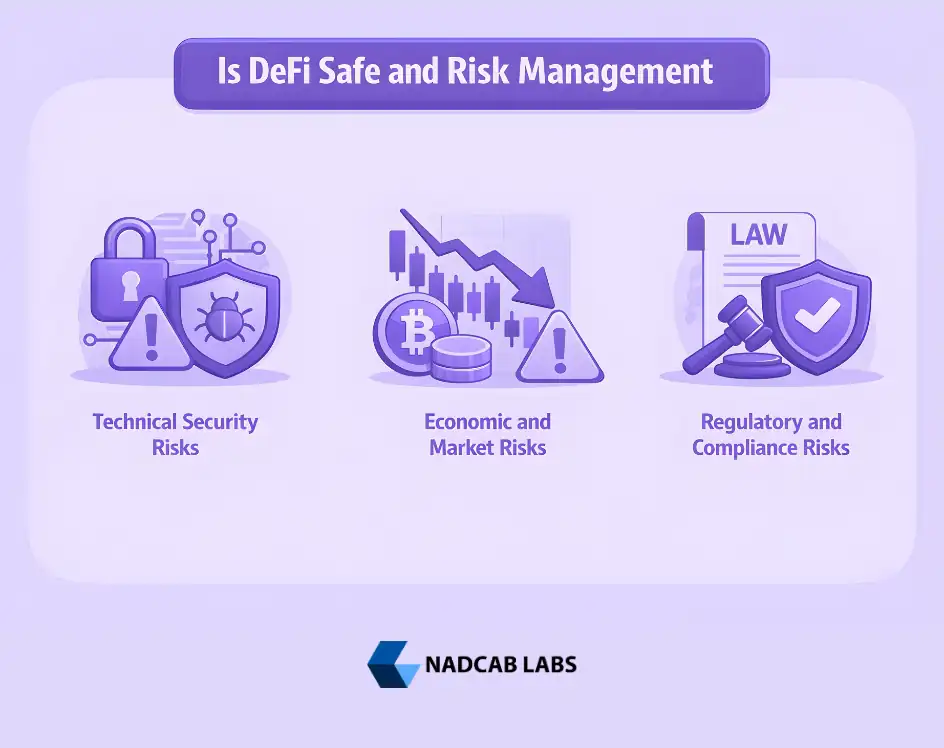
Risks of investing in DeFi extend beyond typical cryptocurrency volatility encompassing technical, economic, and regulatory dimensions requiring comprehensive risk assessment and management strategies.
Technical Security Risks
DeFi smart contracts explained reveals complexity creating vulnerability surfaces for exploits. Despite rigorous auditing, bugs enabling fund theft persist. Flash loan attacks, reentrancy exploits, oracle manipulation, and other technical vulnerabilities have enabled sophisticated thefts.
Risk mitigation includes using battle-tested protocols with strong track records, reading audit reports, starting with small positions testing functionality, and diversifying across multiple platforms reducing single-protocol exposure. However, even major protocols face ongoing risks from undiscovered vulnerabilities.
Economic and Market Risks
Token price volatility affects both collateral positions and rewards valuations. Governance token prices can collapse when protocols lose traction or competitors emerge. Yield farming returns often depend on unsustainable token emissions creating temporary high APYs that decline dramatically over time.
Impermanent loss represents hidden cost for liquidity providers where large price movements between paired tokens result in lower values than simply holding assets. This loss becomes permanent upon withdrawal, though fees and rewards might compensate depending on duration and activity levels.
Regulatory and Compliance Risks
Evolving regulations create uncertainty around DeFi’s legal status. Securities law application to governance tokens, Know Your Customer requirements for DeFi protocols, tax treatment of yield farming, and other issues remain unsettled with potential for retroactive enforcement.
Geographic restrictions may block users from certain jurisdictions accessing protocols as regulatory pressure increases. DeFi projects increasingly implement compliance measures conflicting with decentralization ethos while trying to satisfy regulatory demands.
DeFi Investment Strategy
Successful DeFi investment requires research, diversification, and risk management balancing high-return opportunities against substantial risks inherent to nascent technology and experimental financial systems.
Research and Due Diligence
Thorough investigation precedes investment. Read whitepapers understanding protocol mechanics, tokenomics, and value accrual. Review smart contract audits from reputable firms. Examine team credentials, development activity, and community engagement. Track protocol metrics including total value locked, revenue generation, and user growth.
Understanding protocol differentiation helps identify sustainable advantages versus commoditized services vulnerable to competition. Protocols with strong network effects, technical moats, or regulatory positioning often demonstrate better long-term viability than undifferentiated alternatives.
Portfolio Construction and Diversification
Diversify across multiple protocols, token types, and blockchain ecosystems reducing single-point failure risks. Allocate majority to established protocols with proven track records while dedicating smaller portions to higher-risk, higher-potential emerging projects.
Balance governance tokens, utility tokens, and stablecoins matching risk tolerance and investment timeframes. Consider correlations between positions avoiding concentration in related protocols sharing infrastructure dependencies.
Active Management and Monitoring
DeFi requires active portfolio management given rapid ecosystem evolution. Monitor positions regularly for changes in yields, protocol updates, or emerging risks. Rebalance periodically maintaining target allocations and harvesting gains from outperformers.
Stay informed through community channels, governance forums, and security alerts. Rapid response to discovered vulnerabilities or protocol changes can prevent losses or enable capitalizing on emerging opportunities.
Build Innovative DeFi Solutions
Ready to build your DeFi protocol? Nadcab Labs offers custom blockchain development services tailored for DeFi — from token smart contracts and liquidity pool architecture to governance systems and multi-chain deployment.
Future of DeFi
DeFi’s future trajectory depends on overcoming current limitations while maintaining decentralization principles that differentiate these protocols from traditional finance attempting blockchain integration.
Scaling Solutions and Layer 2
Layer-2 scaling solutions including rollups, sidechains, and state channels address congestion and fees plaguing Ethereum mainnet. These technologies enable higher transaction throughput and lower costs potentially achieving mainstream usability while inheriting security from underlying base layers.
Cross-chain interoperability enables DeFi applications operating seamlessly across multiple blockchains. Bridges connecting ecosystems, multi-chain protocols, and standardized messaging layers facilitate capital flows and composability across previously isolated networks.
Institutional Adoption
Institutional interest in DeFi grows as infrastructure matures and regulatory frameworks clarify. Custody solutions, insurance products, and compliance tools enable traditional finance institutions accessing DeFi opportunities while satisfying fiduciary obligations.
Hybrid models combining DeFi efficiency with traditional finance guardrails may emerge bridging gaps between systems. Permissioned DeFi protocols offering institutional-grade compliance while maintaining blockchain benefits represent potential evolution path.
Regulatory Evolution
Regulatory clarity would unlock broader participation while potentially restricting certain DeFi aspects. Frameworks distinguishing between truly decentralized protocols and centralized services marketed as DeFi would provide guidance for compliant development.
Balance between innovation protection and consumer safeguards determines DeFi’s long-term trajectory. Overly restrictive regulations might push development to friendly jurisdictions while excessive permissiveness enables fraud harming mainstream adoption.
Final Thoughts
What are DeFi tokens encompasses understanding these programmable digital assets enabling decentralized financial services through smart contract automation. DeFi tokens power lending, borrowing, trading, and yield generation platforms creating open, transparent, and accessible financial systems operating without traditional intermediaries.
How DeFi tokens work through self-executing smart contracts on blockchain networks enables novel financial instruments and services impossible in conventional systems. Governance tokens provide protocol control, utility tokens access services, stablecoins offer volatility shelter, and liquidity provider tokens represent pool ownership demonstrating diverse functionality within DeFi ecosystems.
Advantages and disadvantages of DeFi reveal revolutionary potential alongside significant risks. Financial inclusion, transparency, programmability, and reduced costs contrast against smart contract vulnerabilities, regulatory uncertainty, complexity, and scalability limitations requiring careful evaluation before investment.
The future of DeFi depends on addressing current challenges through scaling solutions, improved user experience, regulatory clarity, and institutional infrastructure while maintaining decentralization principles distinguishing these protocols from traditional finance. Success requires balancing innovation with security, accessibility with complexity, and openness with compliance creating sustainable financial systems serving global populations beyond conventional banking reach.
Frequently Asked Questions
Q1.What are defi tokens?
Defi tokens are cryptocurrency assets powering decentralized financial protocols enabling lending, borrowing, trading, and yield generation through smart contracts without traditional intermediaries. they serve governance, utility, stability, and liquidity provision functions across defi ecosystems.
Q2.How do defi tokens work?
Defi tokens operate through self-executing smart contracts on blockchains automatically enforcing financial agreements. users interact with protocols using tokens to access services, provide collateral, earn yields, vote on governance, or supply liquidity.
Q3.Is defi safe for investing?
Defi carries significant risks including smart contract vulnerabilities, regulatory uncertainty, impermanent loss, and market volatility. thorough research, diversification, position sizing, and active monitoring help manage risks, though total loss remains possible from exploits or failures.
Q4.What types of defi tokens exist?
Main defi token types include governance tokens granting voting rights, utility tokens accessing services, stablecoins maintaining price stability, liquidity provider tokens representing pool shares, and wrapped tokens enabling cross-chain functionality with distinct purposes.
Q5.How earn yield with defi?
Earn defi yields through lending deposits earning interest, providing liquidity to exchanges collecting fees, staking tokens for rewards, yield farming across protocols, or participating in liquidity mining programs distributing governance tokens as incentives.
Q6.What is defi vs traditional finance?
Defi eliminates intermediaries through smart contracts enabling peer-to-peer transactions, offers twenty-four seven access without geographic restrictions, provides complete transparency on public blockchains, and enables self-custody compared to traditional institution-based centralized systems.
Explore Services
Related Services
Reviewed by

Aman Vaths
Founder of Nadcab Labs
Aman Vaths is the Founder & CTO of Nadcab Labs, a global digital engineering company delivering enterprise-grade solutions across AI, Web3, Blockchain, Big Data, Cloud, Cybersecurity, and Modern Application Development. With deep technical leadership and product innovation experience, Aman has positioned Nadcab Labs as one of the most advanced engineering companies driving the next era of intelligent, secure, and scalable software systems. Under his leadership, Nadcab Labs has built 2,000+ global projects across sectors including fintech, banking, healthcare, real estate, logistics, gaming, manufacturing, and next-generation DePIN networks. Aman’s strength lies in architecting high-performance systems, end-to-end platform engineering, and designing enterprise solutions that operate at global scale.