Ai Overview
Before getting into the integration flow itself, it helps to understand what a crypto wallet actually is. WalletConnect is a decentralized protocol that creates encrypted communication between blockchain wallets and decentralized applications, supporting over 700 wallets and 70,000 apps. During the NFT boom in March 2023, Ethereum gas fees surged over 1,700 dollars, discouraging smaller transactions.
Key Takeaways
- The NFT market reached USD 61.01 billion in 2025 and is projected to grow to USD 247.41 billion by 2029, making wallet integration a critical infrastructure component for any platform entering this space.[1]
- MetaMask has surpassed 30 million active monthly users and remains the most used wallet for Ethereum-based NFT trading, integrating directly with marketplaces like OpenSea and Rarible through its browser extension and mobile app.[2]
- WalletConnect is a decentralized protocol enabling encrypted communication between wallets and decentralized applications, supporting over 700 wallets and 70,000 applications while moving billions in value monthly.[3]
- Around 62 percent of NFT contracts and primary trading activity take place on Ethereum.[4]
- Over 80 percent of NFT smart contracts now include automated royalty enforcement, and Ethereum-based platforms generated over 920 million dollars in royalties for creators in 2025 alone.[5]
- Multi-chain platforms have seen up to a 40 percent increase in active transactions, showing that supporting multiple blockchains through unified wallet connections directly grows user activity and revenue.[6]
- NFT marketplace development costs range from 30,000 to over 150,000 dollars, with blockchain integration alone costing between 10,000 and 20,000 dollars and security implementation adding another 5,000 to 15,000 dollars.[7]
When someone buys an NFT on OpenSea, Rarible, or any other platform, they are not filling out a form or entering a card number. They are connecting a crypto wallet, clicking approve, and watching a smart contract do the rest. That entire process, from the moment a user lands on a marketplace to the moment they own a new digital asset, is what is called the wallet integration flow.
This is not a small part of how NFT marketplaces work. It is the backbone. Without a working wallet integration, there is no way to identify users, process payments, verify ownership, or record transactions on the blockchain. The wallet is both the user’s identity and their payment tool.
The NFT market has grown significantly over the years. The NFT market size in 2024 was USD 43.08 billion, and by 2025, it had climbed to USD 61.01 billion. Projections suggest it could reach USD 247.41 billion by 2029. With such growth, the way people access and interact with NFT platforms matters more than ever, which is why businesses are focusing on strong nft marketplace development solutions. The wallet integration process is what makes or breaks that experience.
In this blog, we are going to walk through the complete wallet integration flow in NFT marketplaces. We will look at what wallets are, how the connection process works technically, what happens during a transaction, which tools developers use, and what common problems arise during integration. Whether you are a developer building a platform or a business owner planning one, this guide covers everything you need to understand.
What Is a Crypto Wallet and Why Does It Matter for NFT Marketplaces?
Before getting into the integration flow itself, it helps to understand what a crypto wallet actually is. A lot of people assume it is like a bank account where funds are stored. That is not quite right. A crypto wallet stores your private keys, which are the codes that prove you own certain assets on the blockchain. The actual assets, whether they are ETH or NFTs, live on the blockchain itself. Your wallet just holds the key that lets you access and move them.
In an NFT marketplace, the wallet serves two main roles. First, it acts as your identity. When you connect a wallet, the marketplace reads your public address, which works like a username that is unique to you. Second, it acts as your payment tool. When you buy an NFT, the payment goes out from your wallet, and the NFT gets transferred to your wallet address.
There are different types of wallets used in NFT marketplaces today:
1. Software Wallets (Hot Wallets)
These are apps or browser extensions that stay connected to the internet. MetaMask is the most widely used example. It has surpassed 30 million active monthly users and is often the first point of contact many people have with the NFT ecosystem. It works as a browser extension and a mobile app, allowing users to connect directly with platforms like OpenSea and Rarible. Trust Wallet, another popular option developed by Binance, supports multiple blockchains and is widely used across different platforms.
2. Hardware Wallets (Cold Wallets)
Hardware wallets like Ledger and Trezor store private keys offline. This keeps them away from internet-based attacks. They are used by serious collectors who hold high-value NFTs. These wallets can connect to browser-based platforms through companion apps, giving users the security of offline storage while still being able to trade on marketplaces.
3. Custodial Wallets
With custodial wallets, a third party holds the private keys on behalf of the user. This simplifies the onboarding process because users do not need to manage seed phrases. Platforms targeting new users often use custodial solutions. The trade-off is that users must trust the platform provider with their assets.
4. Non-Custodial Wallets
With non-custodial wallets, the user holds full control of their private keys. MetaMask, Trust Wallet, and Phantom are all non-custodial. This gives users maximum ownership but also means that if they lose their seed phrase, they lose access permanently. Most serious NFT traders prefer non-custodial options.
Recommended Reading:
The NFT Marketplace Wallet Connection Process: Step by Step
Now, let us walk through what actually happens during the wallet integration flow in an NFT marketplace. This is the process that users experience every time they visit a platform and hit that “Connect Wallet” button.
Step 1: The User Clicks Connect Wallet
The first thing that happens is the user visits the marketplace and clicks the Connect Wallet button, usually found in the top right corner of the platform. The marketplace then presents a list of supported wallets. Common options include MetaMask, WalletConnect, Coinbase Wallet, Trust Wallet, and Phantom (for Solana-based platforms). The user picks the wallet they use.
Step 2: The Wallet Detects the Request
If the user picks MetaMask and the extension is installed in their browser, the marketplace sends a request to the wallet using the Ethereum provider API. The marketplace calls a method called eth_requestAccounts, which tells MetaMask that the dApp wants permission to read the user’s wallet address. MetaMask then shows a pop-up asking the user to approve this connection.
If the user picks WalletConnect, the process is slightly different. WalletConnect is a decentralized protocol that creates encrypted communication between blockchain wallets and decentralized applications, supporting over 700 wallets and 70,000 apps. The marketplace generates a QR code. The user scans this QR code using their mobile wallet app. Once scanned, an encrypted session is created between the marketplace and the wallet. The user confirms the connection on their phone, and the marketplace gains read access to the wallet address. In more advanced implementations, businesses can enhance this flow by using Uniqode’s QR code tracking to monitor scan activity, analyze connection success rates, and optimize the onboarding experience.
Step 3: The Marketplace Reads the Public Address
Once the user approves the connection, the marketplace receives the user’s public wallet address. This address is a long string of letters and numbers that is unique to that wallet. The marketplace uses this address to look up the user’s NFT holdings, past transactions, and any existing listings. This is how the platform knows what to show you when you open your profile page.
Step 4: Session Establishment and Network Verification
The marketplace also checks which blockchain network the user’s wallet is connected to. If a user is on MetaMask but connected to a test network instead of the Ethereum Mainnet, the marketplace will ask them to switch. The platform needs the user to be on the correct network to make sure any transactions happen on the right blockchain. If the user is on the wrong network, the marketplace will prompt them to switch and guide them through the process.
Step 5: The User Is Now Logged In
Once all of this is confirmed, the user is effectively logged in. There is no password involved. The wallet address is the identity. The marketplace displays the user’s NFTs, their balance if the platform shows crypto amounts, and any active listings or bids. From this point, the user can browse, buy, sell, or mint.
What Happens During a Transaction: The Blockchain Wallet Integration for NFTs
Connecting a wallet is just the starting point. The more complex part of the wallet integration flow happens when a user actually makes a transaction. Here is what takes place when someone buys an NFT.
1. The Buyer Clicks Purchase
The user finds an NFT they want and clicks the buy button. The marketplace prepares a transaction. This transaction includes the amount to be paid in cryptocurrency, the smart contract address of the NFT, and the token ID that identifies the specific NFT being sold.
2. The Wallet Pops Up for Signing
The marketplace sends this prepared transaction to the user’s connected wallet. The wallet shows a pop-up with the transaction details: how much they are spending, what the estimated gas fee is, and which smart contract they are interacting with. The user reviews this and clicks Confirm or Approve.
This step is critical. The user is not just clicking buy. They are cryptographically signing a transaction with their private key. This signature proves to the blockchain that the transaction is legitimate and was authorized by the real owner of the wallet. The private key never leaves the wallet. Only the signed transaction gets sent out.
3. The Smart Contract Executes
Once the signed transaction is broadcast to the blockchain, the smart contract takes over. When a buyer purchases an NFT, the smart contract transfers the NFT to the buyer’s wallet and sends payment to the seller. Many marketplaces allow creators to earn royalties, meaning the creator receives a percentage every time the NFT is resold. All of this happens automatically, without any human middleman involved.
4. Blockchain Confirmation
The transaction is sent to the blockchain network and needs to be confirmed by validators or miners, depending on the blockchain being used. On Ethereum, this can take seconds to a few minutes. On Solana, it is typically much faster. Once confirmed, the ownership of the NFT is updated on the blockchain. The buyer’s wallet address is now recorded as the owner of that specific token.
5. The Marketplace Updates
After the blockchain confirms the transaction, the marketplace reads the new ownership data from the blockchain and updates what it shows on the platform. The NFT now appears in the buyer’s profile. The seller’s listing is removed. If royalties were included in the smart contract, they have already been distributed to the creator’s wallet automatically.
Recommended Reading:
Which Blockchains Are Used in NFT Wallet Integration?
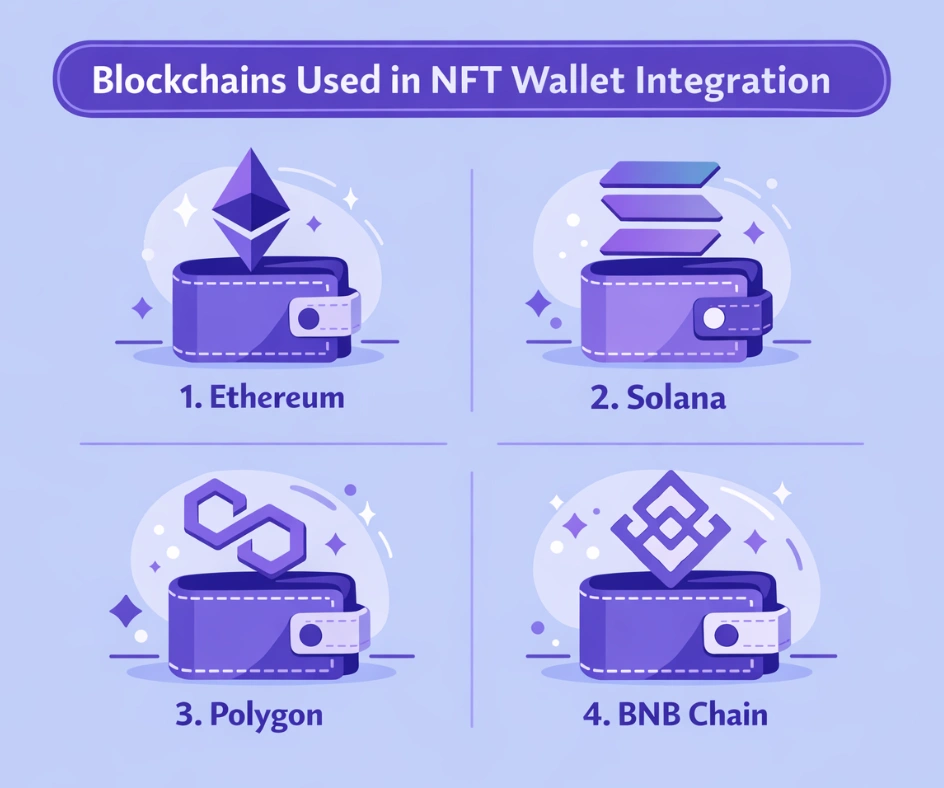
The blockchain a marketplace runs on determines which wallets can be integrated and what the user experience will look like. Different blockchains have different speeds, costs, and levels of adoption.
Ethereum still leads with around 62 percent of NFT contracts and primary trading volume across major collections. Solana processes roughly 18 percent of NFT transactions, driven by high-throughput, low-fee mints and trades. Polygon powers about 11 percent of total NFT minting, including enterprise and brand drops from companies like Starbucks and Nike. BNB Chain accounts for approximately 6 percent of NFT market share, particularly in DeFi-NFT hybrid applications.
Here is how wallet integration differs across these blockchains:
1. Ethereum
Ethereum is the most common choice for NFT marketplace development. MetaMask connects to Ethereum natively. The token standards used are ERC-721 for one-of-a-kind NFTs and ERC-1155 for NFTs that can exist in multiple copies. Gas fees on Ethereum can be high during busy periods. During the NFT boom in March 2023, Ethereum gas fees surged over 1,700 dollars, discouraging smaller transactions. This is why many developers also offer Layer 2 options alongside the Ethereum mainnet.
2. Solana
Solana is known for its fast transaction speeds and very low fees. It uses Phantom Wallet as its primary integration. Phantom has now expanded to also support Ethereum via WalletConnect, making it a cross-chain option. Solana uses different token standards than Ethereum, so marketplaces built on Solana need Solana-specific smart contract logic.
3. Polygon
Polygon is an Ethereum Layer 2 network that offers much lower fees while still being compatible with Ethereum tools and wallets. MetaMask can be configured to connect to Polygon, making the wallet integration process similar to Ethereum but with cheaper transactions. Brands like Starbucks and Nike have used Polygon for their NFT programs.
4. BNB Chain
Binance Smart Chain (now called BNB Chain) is widely used for NFTs in DeFi-adjacent applications. Trust Wallet, developed by Binance, works well with BNB Chain. MetaMask can also be configured to connect to BNB Chain with a custom network setting.
Tools and Protocols Used in Crypto Wallet Integration for NFT Marketplaces
Developers do not build wallet integration from scratch. There are well-established tools and protocols that handle the heavy lifting. Here is what is commonly used:
1. WalletConnect Protocol
WalletConnect is the most widely used open protocol for connecting mobile wallets to web-based dApps. Developers can integrate WalletConnect’s SDK to enable wallet connections with minimal technical overhead, gaining access to a large ecosystem of users and applications. The protocol uses encrypted communication and does not expose private keys. It works by creating a session between the wallet and the dApp via a QR code scan or deep link.
2. Wagmi (React Hooks Library)
Wagmi is a popular library for React developers building NFT marketplaces. It provides pre-built hooks for connecting wallets, reading blockchain data, and sending transactions. It supports multiple connectors, including MetaMask, WalletConnect, and Coinbase Wallet. Developers using Wagmi can set up wallet connection functionality with far less code than building it manually.
3. Ethers.js and Viem
Ethers.js is a JavaScript library that helps developers interact with the Ethereum blockchain. It handles things like sending transactions, reading contract data, and signing messages. Viem is a newer, more type-safe alternative that is gaining popularity among modern developers. Both are used to handle the backend logic of wallet integration in marketplace frontends.
4. Wallet-as-a-Service (WaaS)
Wallet-as-a-Service is a feature that is becoming standard in successful NFT marketplace platforms. WaaS provides efficient digital asset management and improves user experience by bridging the gap between complex blockchain technology and user-friendly interfaces. WaaS solutions can offer invisible wallet experiences, where users interact with Web3 features using just their email or social media login, without ever seeing complicated blockchain terminology.
5. EIP Standards (Ethereum Improvement Proposals)
EIP-721 defines the standard for unique NFT tokens on Ethereum. EIP-1155 supports semi-fungible tokens and allows batch minting, which is useful for gaming platforms. EIP-6963 is a newer standard that helps marketplaces detect multiple installed wallets at once without conflicts. Following these standards ensures that the wallet integration works correctly across different wallets and platforms.
6. IPFS for Metadata Storage
When an NFT is minted, its metadata (the description, image link, traits, and properties) needs to be stored somewhere. IPFS (InterPlanetary File System) is a decentralized storage solution that distributes this data across a network of nodes rather than a single server. IPFS provides accessibility and permanence without the need for a centralized server, ensuring that NFT metadata remains available and cannot be tampered with.
NFT Marketplace Wallet Integration: Key Wallets and Their Features
| Wallet Name | Supported Chains | Best For | Custody Type |
|---|---|---|---|
| MetaMask | Ethereum, Polygon, BNB Chain, Arbitrum | Ethereum NFTs, DeFi, dApps | Non-Custodial |
| Phantom | Solana, Ethereum (via WalletConnect), Polygon | Solana NFTs, Gaming, Fast Trades | Non-Custodial |
| Trust Wallet | Ethereum, BNB Chain, Solana, Polygon | Multi-chain NFT holders, Beginners | Non-Custodial |
| Coinbase Wallet | Ethereum, Base, BNB Chain | Coinbase ecosystem users, NFT collectors | Non-Custodial |
| Ledger | Ethereum, Polygon, Bitcoin, and many others | High-value NFT collectors, Cold Storage | Non-Custodial (Hardware) |
| WalletConnect (Protocol) | 300+ blockchains supported | Mobile wallet users, Cross-platform dApps | Protocol (not a wallet itself) |
Multi-Chain Wallet Integration: Connecting Users Across Different Blockchains
One of the biggest challenges in modern NFT marketplace development is supporting multiple blockchains at the same time. A user on Solana should not have to create a completely new wallet just to buy an NFT listed on an Ethereum-based platform. Multi-chain architecture solves this, and wallet integration is at the heart of it.
Research from the blockchain analytics space shows that multi-chain platforms have seen up to a 40 percent increase in active transactions. This is a strong reason for marketplace developers to invest in multi-wallet support.
In a multi-chain marketplace, the wallet integration layer needs to:
1. Detect the User’s Wallet Type and Network
The marketplace frontend must detect which wallet the user is connecting with and which blockchain that wallet is currently configured to. If a MetaMask user is on Polygon but tries to buy an Ethereum NFT, the platform needs to prompt them to switch networks. This requires the marketplace to handle network-switching logic in its integration layer.
2. Use a Unified Wallet Connection Interface
Modern multi-chain marketplaces use tools like WalletConnect to provide a single connection interface that works across hundreds of different wallets. This means users connecting with MetaMask, Phantom, Trust Wallet, or any other WalletConnect-compatible wallet all go through the same connection flow, making the experience consistent regardless of which wallet they use.
3. Deploy Separate Smart Contracts Per Chain
Each blockchain requires separate smart contract implementations, wallet integrations, and indexing infrastructure. This means the development work for a multi-chain marketplace is significantly larger than a single-chain platform, but the user reach is also much greater. Teams building multi-chain platforms often start with one chain and then add others in planned phases.
4. Display NFTs from All Chains in One Place
The frontend must pull NFT data from multiple blockchains and display it in a single, unified interface. A user browsing a Polygon NFT and a user looking at an Ethereum NFT should feel like they are on the same platform. This requires blockchain indexing services that continuously read data from multiple networks and store it in a database that the marketplace frontend can query quickly.
Recommended Reading:
Security Considerations in NFT Wallet Integration
Security is where many NFT platforms fall short, and the consequences can be severe. Over 100 million dollars worth of NFTs were stolen from July 2021 to July 2022, with scammers averaging around 300,000 dollars per incident. July 2022 alone saw more than 4,600 NFTs stolen in a single month. These numbers highlight why security must be built into the wallet integration from the very beginning.
Here are the main security areas that wallet integration in NFT marketplaces must address:
1. Never Requesting Private Keys
A legitimate NFT marketplace will never ask users for their private key or seed phrase. The wallet handles all signing internally. The marketplace only ever receives the signed transaction output, never the key itself. Any platform or pop-up that asks for a private key or seed phrase is almost certainly a phishing attempt.
2. Smart Contract Auditing
Every smart contract that handles transactions in an NFT marketplace should go through a formal security audit before going live. Studies from the blockchain security space have found that 70 percent of Solidity contracts have vulnerabilities due to poor testing practices. Frameworks like Truffle and Hardhat support automated testing and help developers catch bugs before deployment.
3. Encrypted Communication Channels
The WalletConnect protocol uses end-to-end encryption and Transport Layer Security (TLS) to protect all communication between the wallet and the marketplace. This means even if someone intercepts the data being sent, they cannot read it. Marketplaces should ensure their own HTTPS implementation is also up to standard.
4. Transaction Transparency
Before a user signs a transaction, they should be able to clearly see what the transaction does. Good wallet integration means the marketplace sends a clearly formatted transaction request that explains in plain language what the user is approving. Confusing or misleading transaction requests are a common trick used in phishing attacks.
5. Multi-Factor Authentication for Custodial Wallets
For platforms using custodial wallet solutions, adding multi-factor authentication is important. This means even if someone gains access to a user’s email, they would still need a second verification step to access the wallet. Security experts recommend that multi-factor authentication and encryption protocols be implemented to add extra layers of defense against unauthorized access.
6. Wallet Compatibility Testing
Statistics show that 2024 experienced a 20 percent rise in crypto scams targeting wallet users. Marketplaces should focus on supporting popular wallets such as MetaMask, Trust Wallet, and Coinbase Wallet, and conduct thorough testing with various wallets to ensure a smooth user experience. The transaction signing process should be checked carefully, as some wallets require additional steps or confirmations that can confuse users if not designed properly.
NFT Marketplace Development Costs Including Wallet Integration
| Development Component | Cost Range | Key Considerations |
|---|---|---|
| Basic Platform Features | $30,000 – $50,000 | User authentication, NFT minting, buying/selling functionality, basic wallet integration |
| Advanced Platform Features | $100,000 – $150,000+ | Custom smart contracts, multi-chain support, advanced analytics, decentralized storage, royalty management |
| UI/UX Design | $5,000 – $20,000 | Simple interface vs. custom-branded design with intricate elements |
| Blockchain Integration | $10,000 – $20,000 | Ethereum is the most common; alternatives like Solana or BSC may vary |
| Smart Contract Development | Included in platform costs | Token standards (ERC-721, ERC-1155), security audits, testing |
| Security Implementation | $5,000 – $15,000 | Encryption, multi-factor authentication, and regular security audits |
| Ongoing Maintenance | $1,000 – $5,000/month | Server hosting, updates, customer support, security monitoring |
Common Challenges in NFT Marketplace Wallet Connection Process
Even experienced development teams run into problems when building wallet integration for NFT platforms. Knowing these challenges in advance makes it easier to plan for them.
1. Wallet Compatibility Issues
Not every wallet works the same way. Different wallets use different methods to sign transactions, handle approvals, and communicate with dApps. A marketplace that works perfectly with MetaMask might have display problems or signing errors with Trust Wallet or Phantom. The recommendation is to conduct thorough testing with various wallets to ensure a smooth user experience and to regularly update the wallet integration to incorporate the latest features and security improvements.
2. High Gas Fees Discourage Users
On Ethereum, gas fees can become very high when the network is busy. When the cost of a transaction fee is higher than the value of the NFT being bought, users simply stop transacting. Solutions include using Layer 2 networks like Polygon or Arbitrum, which offer much lower fees while still connecting to Ethereum security. Marketplaces can also implement lazy minting, where the NFT is only minted on the blockchain when someone buys it, shifting the minting cost to the buyer and removing upfront costs for creators.
3. Users Losing Access to Wallets
Non-custodial wallets require users to keep their seed phrases safe. Many users are not experienced with this responsibility. If a user loses their seed phrase, they lose access to all their NFTs permanently. Marketplaces targeting mainstream audiences often address this by offering custodial wallet options or wallet recovery tools, which remove the seed phrase burden from the user but require the platform to manage keys responsibly.
4. Mobile vs. Desktop Connection Differences
The wallet connection process works differently on mobile compared to desktop. On desktop, MetaMask works as a browser extension. On mobile, the marketplace needs to open inside the MetaMask browser, or the user needs to connect through WalletConnect. Marketplaces that are designed only for desktop often have broken experiences on mobile. Given that a large portion of users are on mobile devices, this is a critical thing to test and optimize.
5. Phishing and Fake Websites
Scammers often create fake versions of popular NFT marketplace websites that look identical to the real ones. When a user connects their wallet to a fake site and signs a transaction, they can lose all their NFTs. Platforms need to make their official URLs clear, use SSL certificates, and educate users to always verify the website address before connecting their wallet.
6. Regulatory Compliance
Different countries have different rules around digital assets. KYC (Know Your Customer) and AML (Anti-Money Laundering) regulations apply to certain types of NFT transactions, especially when fiat currency is involved. Custodial wallet providers are required to comply with these regulations in most jurisdictions. Compliance with KYC and AML policies is not just a legal obligation but also a practice that adds credibility to the marketplace in the eyes of users and regulators.
Recommended Reading:
How the Wallet Integration Flow Differs Between Major NFT Marketplaces
Not all NFT marketplaces handle wallet integration the same way. Looking at how real platforms implement it gives useful insight into different approaches.
1. OpenSea
OpenSea supports multiple wallet options, including MetaMask, WalletConnect, Coinbase Wallet, and others. It handles around 90 percent of all NFT trading volume with a total trading volume of roughly 14.68 billion dollars. OpenSea uses lazy minting, which means creators do not pay gas fees upfront. The NFT is only minted when someone actually buys it. This has been a major factor in growing its creator base by removing the financial barrier of minting costs.
2. Blur
Blur is a marketplace aimed at professional traders. It focuses heavily on speed and gas efficiency. Blur recorded roughly 135 million dollars in 30-day trading volume in August 2025, targeting professional traders with advanced analytics and portfolio tools. Its wallet integration is optimized for high-frequency traders who make many transactions quickly and need gas costs to be minimal.
3. Magic Eden
Magic Eden started as a Solana-focused marketplace and uses Phantom Wallet as its primary connection. It later expanded to Ethereum and Polygon, requiring it to support MetaMask and WalletConnect as well. Magic Eden amassed 6.39 billion dollars in cumulative trading volume and held a 37 percent market share at its 2024 peak. Its cross-chain expansion shows how important it is to support multiple wallets as a marketplace grows.
4. Rarible
Rarible supports multiple blockchains, including Ethereum, Polygon, Tezos, and Immutable. It supports a wide range of wallets through WalletConnect integration. Rarible also introduced community governance through RARI tokens, allowing users to vote on platform decisions, including fee changes. The wallet integration on Rarible is therefore not just for transactions but also for governance participation.
Real-World NFT Marketplace and Wallet Integration Projects
The following projects reflect how NFT marketplace development and blockchain wallet integration are being applied in practice. Each showcases different aspects of the wallet connection and smart contract flow discussed throughout this article, from multi-chain support and NFT-based tokenomics to decentralized trading architecture and community-driven platforms.
💎
BendDAO: NFT Liquidity and Decentralized Marketplace
Nadcab Labs developed the BendDAO platform, a decentralized NFT marketplace that combined digital asset trading with NFT lending features. The project required a robust crypto wallet integration flow that supported ownership verification, collateral management, and automated lending transactions through smart contracts, all without any central intermediary involved in the process.
Launch Your NFT Marketplace Platform Today:
We bring deep blockchain expertise to NFT marketplace development. Our specialized team handles everything from smart contract creation to multi-chain integration, ensuring your platform is built for growth, security, and a good user experience. Whether you need a curated art marketplace or a gaming NFT platform, we deliver solutions that work.
Final Thoughts
The wallet integration flow in NFT marketplaces is far more than a technical feature. It is the gateway through which every single user enters, interacts with, and transacts on the platform. Without a working and well-built wallet connection process, nothing else on an NFT marketplace can function as intended.
From the moment a user clicks Connect Wallet to the moment a smart contract confirms an ownership transfer on the blockchain, a lot is happening underneath. The marketplace detects the wallet type, the user approves a connection, the platform reads their public address, transactions are cryptographically signed without the private key ever leaving the wallet, and smart contracts handle the rest automatically. This entire chain of events needs to work correctly every single time.
The market has made its direction clear. With NFT sales reaching 2.82 billion dollars in just the first half of 2025, and the overall market projected to grow to 247 billion dollars by 2029, the platforms that survive and grow will be the ones that get the fundamentals right. Wallet integration is the most fundamental of those fundamentals.
Supporting multiple wallets and multiple blockchains, handling security at every step, designing a clean and easy connection experience for users, and keeping smart contracts audited and reliable are all part of what separates a marketplace that users trust from one they abandon after the first transaction fails.
If you are building an NFT marketplace today, investing proper time and resources into the wallet integration layer is not optional. It is the thing that determines whether users can even get started on your platform in the first place.
Frequently Asked Questions
Q1.What is wallet integration in an NFT marketplace?
Wallet integration in an NFT marketplace is the process of connecting a user’s crypto wallet to the marketplace platform so they can authenticate their identity, view their NFT holdings, and make transactions. The wallet acts as both the user’s login and their payment tool. Without it, the marketplace cannot verify ownership or process any buying, selling, or minting activity on the blockchain.
Q2.Which wallets are most commonly used in NFT marketplaces?
MetaMask is the most widely used wallet for Ethereum-based NFT marketplaces, with over 30 million active monthly users. Phantom is the leading wallet for Solana-based platforms. Trust Wallet and Coinbase Wallet are popular across multiple chains. WalletConnect is a protocol (not a wallet itself) that allows over 700 different mobile wallets to connect to NFT marketplace dApps via QR code scanning or deep links.
Q3.How does WalletConnect work in an NFT marketplace?
WalletConnect creates an encrypted communication channel between a user’s mobile wallet and the NFT marketplace. The marketplace displays a QR code. The user scans it with their mobile wallet app. An encrypted session is then established between the two, and the marketplace gains read access to the user’s public wallet address. When a transaction needs to be approved, the user receives a prompt on their phone to confirm it. The private key never leaves the wallet at any point.
Q4.What is the difference between custodial and non-custodial wallets for NFTs?
With a non-custodial wallet like MetaMask or Phantom, the user holds their own private key and seed phrase. They have full control of their assets, but if they lose the seed phrase, they lose access permanently. With a custodial wallet, a platform or service provider holds the private key on behalf of the user. This makes onboarding easier and reduces the risk of users losing access, but it requires trusting the platform with your assets.
Q5.Why does the blockchain choice affect wallet integration in an NFT marketplace?
Different blockchains use different token standards, transaction formats, and wallet protocols. A marketplace built on Ethereum will use ERC-721 or ERC-1155 token standards and work natively with MetaMask. A Solana-based marketplace will use Solana Program Library (SPL) token standards and connect with Phantom Wallet. If you want to support multiple blockchains, you need separate smart contract implementations and wallet integrations for each chain, which adds development complexity but greatly expands the number of users who can access your platform.
Q6.What are the biggest security risks in NFT marketplace wallet integration?
The main security risks include phishing attacks where users are tricked into connecting their wallet to fake marketplace websites, smart contract vulnerabilities that allow hackers to drain funds or steal NFTs, and poorly implemented transaction signing flows that hide what a user is actually approving. Over 100 million dollars worth of NFTs were stolen between July 2021 and July 2022, largely through phishing and smart contract exploits. Marketplaces must conduct smart contract audits, use encrypted communication protocols, and educate users to verify website URLs before connecting their wallets.
Explore Services
Related Services
Reviewed by

Aman Vaths
Founder of Nadcab Labs
Aman Vaths is the Founder & CTO of Nadcab Labs, a global digital engineering company delivering enterprise-grade solutions across AI, Web3, Blockchain, Big Data, Cloud, Cybersecurity, and Modern Application Development. With deep technical leadership and product innovation experience, Aman has positioned Nadcab Labs as one of the most advanced engineering companies driving the next era of intelligent, secure, and scalable software systems. Under his leadership, Nadcab Labs has built 2,000+ global projects across sectors including fintech, banking, healthcare, real estate, logistics, gaming, manufacturing, and next-generation DePIN networks. Aman’s strength lies in architecting high-performance systems, end-to-end platform engineering, and designing enterprise solutions that operate at global scale.