Ai Overview
Digital transformation in transportation and logistics means using digital tools and technologies to improve how goods are moved, stored, tracked, and delivered. By 2027, e-commerce is expected to make up 41% of all retail sales worldwide. FedEx expanded its autonomous truck fleet significantly, with Aurora-powered trucks achieving cost savings exceeding $200 million annually.
Key Takeaways
- The global digital logistics market was valued at $32.44 billion in 2024 and is expected to grow to $120.33 billion by 2032, at a CAGR of 18.1%, with North America holding 35.82% of the market share.
[1] - McKinsey research shows that embedding AI in supply chain operations can reduce logistics costs by 5 to 20 percent, inventory levels by 20 to 30 percent, and procurement spend by 5 to 15 percent.
[2] - Amazon deployed 750,000 robots across its warehouses in 2023, marking a 40% increase from 520,000 robots in 2022, while automated warehouses now achieve 99% inventory accuracy.
[3] - The United States launched its first fully autonomous freight corridor in 2024, connecting Texas and California, which resulted in a 25% reduction in transit times and a 30% drop in operational costs.
[4] - Cloud-based platforms commanded a 58% share of the digital logistics market in 2024, and cloud-led spending is forecast to rise at a 23.5% CAGR between 2025 and 2030.
[5] - DHL built a blockchain solution to share shipment data with customs officials earlier in the process, which cut customs processing time by up to 90% on air freight between China and Germany.
[6] - UPS’s ORION route optimization system uses AI to calculate the best delivery paths, processing 30,000 route optimizations per minute and saving 38 million liters of fuel every single year.
[7] - FedEx achieved cost savings exceeding $200 million per year by deploying Aurora-powered autonomous trucks in long-haul logistics operations across the United States.
[8] - Connected telematics devices now enable predictive maintenance that cuts equipment downtime by 30% and fuel use by 15 to 20%, while also raising service levels through guaranteed delivery windows.
[9] - Walmart implemented blockchain for tracking food products and reduced traceability time from 7 days to just 2.2 seconds, along with a 50% decrease in food waste through improved inventory management.
[10]
The way goods move from one place to another is changing fast. From trucks on highways to packages in warehouses, the transportation and logistics industry is going through a major shift. This shift is called digital transformation in transportation and logistics, and it is touching every part of how businesses manage their supply chains, deliver products, and serve customers.
For decades, the logistics world ran on paper documents, phone calls, and manual labor. But today, technologies like artificial intelligence (AI), the Internet of Things (IoT), blockchain, and robotics are changing all of that. Companies that once relied on guesswork for delivery schedules now use data to plan every step. Warehouses that needed hundreds of workers now operate with robots picking and packing orders around the clock.
This blog will walk you through every important part of this transformation. We will look at the technologies involved, the real-world examples from companies like Amazon, DHL, FedEx, and Walmart, the costs and savings, the challenges, and what the future holds. Whether you are a business owner, a logistics professional, or someone curious about where this industry is headed, or simply exploring modern logistics solutions, this guide will help you understand the full picture.
What Is Digital Transformation in Transportation and Logistics?
Digital transformation in transportation and logistics means using digital tools and technologies to improve how goods are moved, stored, tracked, and delivered. It is not just about buying new software or hardware. It is about rethinking the entire way a logistics business operates, from the warehouse floor to the customer’s doorstep.
Think of it this way. A traditional trucking company might plan its routes using maps and driver experience. A digitally transformed trucking company uses AI to analyze traffic patterns, weather data, fuel prices, and delivery deadlines all at once to find the fastest and cheapest route. The difference is not just speed; it is the ability to make better decisions with better information.
The global digital logistics market was valued at $32.44 billion in 2024 and is projected to grow to $120.33 billion by 2032, at a CAGR of 18.1%. North America held the largest share at 35.82% in 2024, while the Asia Pacific is expanding at the fastest rate. These numbers show that logistics digital transformation is not a small trend. It is a global movement that businesses cannot afford to ignore.
The five main types of this transformation include business process transformation (digitizing workflows), business model transformation (creating new digital channels), domain transformation (expanding into new markets), cultural transformation (changing how teams think about technology), and cloud transformation (moving operations to the cloud for flexibility).
Why Digital Transformation Matters Now More Than Ever
Several forces are pushing the transportation industry toward digital transformation faster than ever before. Understanding these forces helps explain why companies that delay this shift risk falling behind.
1. The Explosion of E-Commerce
Global e-commerce sales reached $5.82 trillion in 2023, up 10% from the previous year. By 2027, e-commerce is expected to make up 41% of all retail sales worldwide. This massive growth puts enormous pressure on logistics companies to deliver faster, more accurately, and at lower costs. Digital tools are the only way to keep up with this kind of volume.
2. Customer Expectations Have Changed
Customers today expect to know exactly where their package is at any given moment. They want same-day or next-day delivery. They want easy returns. Meeting these expectations without digital systems is nearly impossible. Real-time tracking, automated notifications, and AI-driven delivery scheduling are now basic requirements.
3. Labor Shortages in the Industry
Truck driver shortages exceeded 3.6 million unfilled positions globally in 2024, with 3.4 million retirements expected by 2029. Warehouses face similar problems. Automation and digital tools help fill these gaps by allowing fewer workers to do more, and by handling repetitive tasks that are hard to staff.
4. Rising Operational Costs
Fuel prices, wages, insurance, and compliance costs keep going up. Digital transformation in the transport industry offers ways to cut these costs through better route planning, predictive maintenance, and automated processes. McKinsey research shows that AI alone can reduce logistics costs by 5 to 20 percent.
Recommended Reading:
Blockchain Use Cases: 17 Applications, Examples and Real Companies
Key Technologies Driving Logistics Automation
The backbone of digital transformation in the transportation industry is built on a set of powerful technologies. Each one plays a different role, but together they create a system that is smarter, faster, and more efficient than anything we have seen before.
1. Artificial Intelligence and Machine Learning
AI is perhaps the single most important technology in logistics automation. It powers everything from demand forecasting to route optimization to warehouse management. AI systems analyze massive amounts of data, including historical sales, weather patterns, traffic conditions, and market trends, to make predictions and recommendations that humans simply cannot match in speed or accuracy.
For example, DHL’s AI-powered forecasting platform has reduced delivery times by 25% across 220 countries while improving prediction accuracy to 95%. Their Smart Trucks use machine learning to dynamically reroute deliveries based on real-time traffic, weather, and new pickup requests, saving 10 million delivery miles every year.
Walmart has deployed AI inventory management systems across 4,700 stores, reducing inventory costs by $1.5 billion annually while maintaining 99.2% in stock rates. Their demand forecasting algorithms analyze over 200 variables per product to optimize when and how much to restock.
2. Internet of Things (IoT)
IoT refers to physical devices, like sensors, GPS trackers, and smart labels, that connect to the internet and share data. In logistics, IoT sensors are everywhere. They track the temperature of food shipments, monitor the fuel levels of trucks, detect when warehouse equipment needs maintenance, and provide real-time location updates for packages.
A survey found that 55% of logistics companies now use between 1,000 and 10,000 IoT devices, while 38% operate smaller networks of 500 to 1,000 sensors. These connected devices stream engine health, driver behavior, and cargo data in real time, enabling predictive maintenance that cuts equipment downtime by 30% and fuel use by 15 to 20%.
3. Blockchain Technology
Blockchain creates a tamper-proof digital record of every transaction in a supply chain. Every time a product changes hands, from manufacturer to warehouse to truck to customer, that event is recorded permanently and transparently. This makes it extremely difficult for fraud, theft, or errors to go unnoticed.
Walmart implemented blockchain for tracking produce and meat products and reduced traceability time from 7 days to just 2.2 seconds. They also saw a 50% decrease in food waste through improved inventory management. DHL used blockchain on air freight between China and Germany and cut customs processing time by up to 90%.
4. Cloud Computing
Cloud platforms allow logistics companies to store, process, and share data without investing in expensive on-site servers. Cloud-based platforms commanded a 58% share of the digital logistics market in 2024. The shift to the cloud is driven by its ability to scale up or down based on demand, making advanced logistics tools accessible even to smaller businesses.
5. Robotics and Automation
Robots are transforming warehouse operations. Amazon deployed 750,000 robots across its facilities in 2023, a 40% increase from 520,000 in 2022. Automated warehouses achieve 99% inventory accuracy, reduce labor costs by 3% annually, and consistently ship within one day of order placement. The global robotics market reached nearly $50 billion in 2025 and is expected to reach $111 billion by 2030.
AI and Predictive Analytics in Transportation
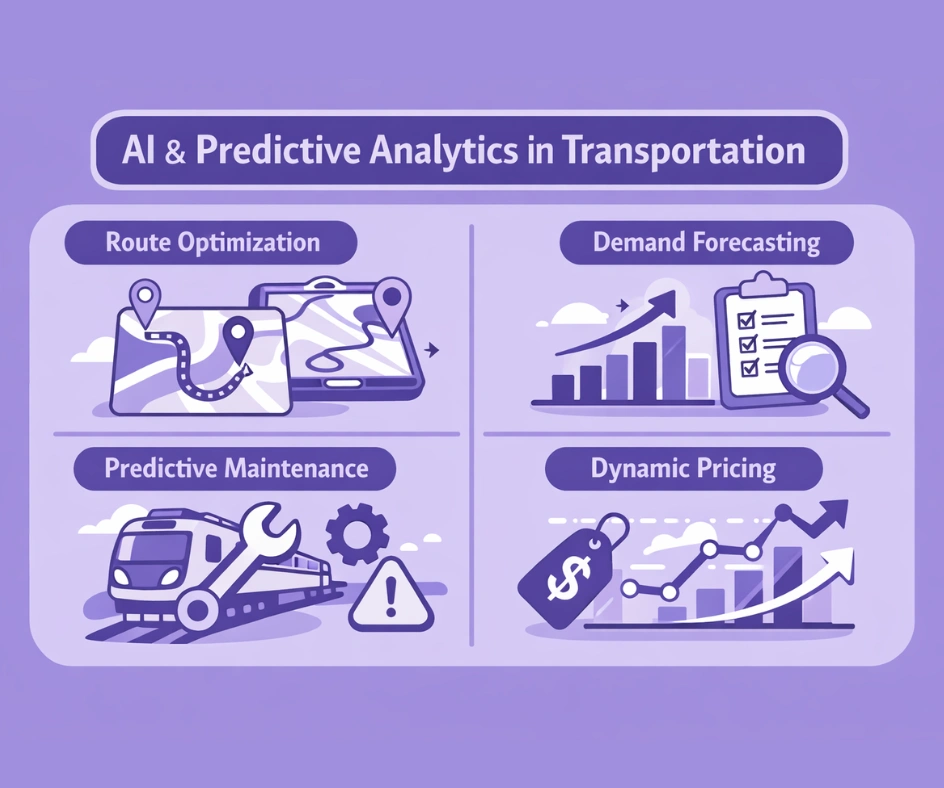
AI and predictive analytics are not just fancy words. They are practical tools that logistics companies use every day to save money, deliver on time, and keep their operations running smoothly. Let us look at how they work in practice.
1. Route Optimization
UPS’s ORION (On Road Integrated Optimization and Navigation) system is one of the best examples. It uses AI to calculate the best delivery paths, processing 30,000 route optimizations per minute. The result? UPS saves 38 million liters of fuel annually and prevents approximately 100,000 metric tons of carbon dioxide emissions each year. That is the power of AI-driven transportation digital transformation.
2. Demand Forecasting
Traditional demand forecasting relied on spreadsheets and past experience. AI takes this to a completely different level. By analyzing hundreds of variables, including seasonal patterns, promotional events, economic indicators, and even social media trends, AI can predict what products will be needed, where, and when, with much greater accuracy. This helps companies avoid two costly problems: having too much inventory (which ties up money) and having too little (which loses sales).
3. Predictive Maintenance
Every time a truck breaks down unexpectedly, it costs time, money, and customer trust. AI-driven predictive maintenance uses sensor data from vehicles to detect signs of wear and tear before they turn into breakdowns. This approach reduces maintenance costs by up to 10% and extends vehicle lifespan. A major logistics provider used a digital twin powered by AI to increase warehouse capacity by nearly 10% without adding any new real estate.
4. Dynamic Pricing
AI enables logistics companies to adjust their pricing in real time based on demand, available capacity, fuel costs, and competitor rates. This helps maximize revenue during peak periods and attract more business during slow periods, all without manual intervention.
Key Technologies and Their Impact on Logistics
| Technology | Primary Use in Logistics | Real World Impact |
|---|---|---|
| Artificial Intelligence | Route optimization, demand forecasting, predictive maintenance | UPS saves 38 million liters of fuel annually with AI route planning |
| Internet of Things (IoT) | Real-time tracking, condition monitoring, fleet management | Cuts equipment downtime by 30% and fuel use by 15 to 20% |
| Blockchain | Supply chain transparency, smart contracts, and fraud prevention | Walmart reduced food traceability time from 7 days to 2.2 seconds |
| Cloud Computing | Data storage, SaaS based logistics platforms, and collaboration | 58% of the digital logistics market runs on cloud-based platforms |
| Robotics | Warehouse picking, sorting, packing, and autonomous delivery | Amazon operates 750,000 warehouse robots, achieving 99% accuracy |
| Autonomous Vehicles | Long-haul freight, hub-to-hub transport, last-mile delivery | FedEx saves over $200 million per year with autonomous trucks |
| Digital Twins | Simulation, facility planning, scenario testing | A logistics provider increased warehouse capacity by 10% without new space |
Autonomous Vehicles and the Future of Freight
Self-driving trucks are no longer science fiction. They are on the road right now, hauling real freight between real cities. The autonomous trucking market reached $1.74 billion in 2025 and is expected to grow to $6.32 billion by 2033 at a CAGR of 17.49%.
In 2024, several major milestones were reached in autonomous freight. The United States launched its first fully autonomous freight corridor connecting distribution hubs in Texas and California. This initiative resulted in a 25% reduction in transit times and a 30% reduction in operational costs. FedEx expanded its autonomous truck fleet significantly, with Aurora-powered trucks achieving cost savings exceeding $200 million annually. Amazon’s Rivian-designed autonomous trucks for regional delivery routes reduced delivery times by 20% and decreased carbon emissions by 35%.
In China, Inceptio Technology delivered 400 autonomous trucks to logistics company ZTO Express in late 2024, one of the world’s largest deployments to date. Over 2,000 trucks equipped with Inceptio’s autonomous driving system are already operating in commercial fleets across China.
In Aurora, Innovation began regular driverless customer hauls between Dallas and Houston, becoming the first company to operate a commercial heavy-duty, self-driving trucking service on public roads. The U.S. Department of Transportation also launched a $120 million initiative to advance smart freight corridors for autonomous vehicles.
Despite this progress, challenges remain. Regulations differ from country to country, making cross-border autonomous operations difficult. Public trust is still building. And cybersecurity is a concern, as autonomous trucks rely on connected systems that could be targeted by hackers.
Recommended Reading:
Warehouse Automation and Smart Facilities
Warehouses are where much of logistics automation happens in practice. The shift from manual operations to automated systems is happening at a remarkable pace.
1. Robotic Picking and Packing
Modern warehouses use Autonomous Mobile Robots (AMRs) and Automated Guided Vehicles (AGVs) to move products around. These robots use AI, sensors, and computer vision to navigate independently, adapt to changing layouts, and work alongside human workers. The results are dramatic: automated warehouses achieve 99% inventory accuracy (a 76% improvement over manual operations), reduce labor costs by 3% annually, and consistently ship within one day of order placement.
2. Smart Warehouses with IoT
Over 11,000 smart warehouses are already operating in North America. These facilities use IoT sensors to monitor everything in real time, from temperature and humidity to inventory levels and equipment health. When a sensor detects that a conveyor belt is starting to vibrate abnormally, the system alerts maintenance staff before the belt breaks down. This kind of predictive approach keeps operations running smoothly and prevents costly disruptions.
3. Automated Storage and Retrieval Systems (AS/RS)
These systems use robotic arms and computerized controls to store and retrieve products automatically. They maximize storage density, meaning companies can fit more products in the same space. AI-driven warehouse technologies optimize warehouse space by up to 30% and reduce fulfillment times by as much as 25%.
4. Voice Directed Technology
About 22% of warehouses now use voice-directed technology, where workers receive instructions through headsets and confirm actions by speaking. This frees up their hands for picking and packing, improving both speed and accuracy.
Blockchain in Supply Chain Management
Blockchain is not just about cryptocurrency. In the world of digital transformation in transportation and logistics, blockchain is solving some of the industry’s oldest and most stubborn problems: fraud, lack of transparency, and slow paperwork.
1. How Blockchain Works in Logistics
Every time a product moves from one party to another, from a factory to a warehouse, from a warehouse to a truck, from a truck to a store, that movement is recorded as a “block” on the blockchain. Each block is linked to the one before it, creating an unbreakable chain of records. No one can alter these records without everyone else knowing. This creates a single source of truth that all parties in the supply chain can trust.
2. Smart Contracts for Automated Payments
Smart contracts are programs on the blockchain that automatically execute when certain conditions are met. For example, when a shipment arrives at its destination and is confirmed by IoT sensors, the smart contract can automatically release payment to the carrier. This eliminates paperwork delays and disputes. DHL uses blockchain-based smart contracts to release payments when shipments meet specific delivery milestones.
3. Real World Results
Walmart’s blockchain implementation for food tracking reduced traceability time from 7 days to 2.2 seconds and cut food waste by 50%. DHL and Accenture developed a blockchain-based system for tracking pharmaceutical products across six geographies, ensuring that every step from manufacturer to end consumer is monitored. FedEx uses blockchain to collect data from shippers, recipients, and carriers to eliminate fraud and resolve freight claims.
The blockchain supply chain market was valued at $3.25 billion in 2025 and is expected to grow at a 59.8% CAGR, reaching $21.29 billion by 2029. Deutsche Post DHL Group has allocated a budget of 100 million euros for blockchain implementation. These numbers show that the industry is betting big on this technology.
Cost Savings from Digital Transformation: Before vs After
| Business Area | Before Digital Transformation | After Digital Transformation |
|---|---|---|
| Route Planning | Manual planning, driver experience-based | AI-driven optimization saving 38 million liters of fuel (UPS) |
| Inventory Tracking | Manual counts, periodic audits | 99% accuracy with automated systems and IoT sensors |
| Food Traceability | 7 days to trace product origin | 2.2 seconds with blockchain (Walmart) |
| Customs Processing | Up to 36 hours using traditional methods | 90% faster with blockchain (DHL China to Germany) |
| Warehouse Operations | Heavy reliance on manual labor | 750,000 robots handling picking and sorting (Amazon) |
| Freight Transport | Human-driven, fixed schedules | Autonomous trucks cutting costs by 30% (US freight corridor) |
| Equipment Maintenance | Scheduled or reactive repairs | Predictive maintenance cuts downtime by 30% |
How Cloud Computing Powers Logistics
Cloud computing is the foundation that makes many other digital tools possible. Without the cloud, running AI algorithms, storing IoT data, or managing blockchain networks would be extremely expensive and complicated for most companies.
In 2024, 72.3% of the digital logistics market preferred cloud-based deployment. Transportation management systems (TMS) and warehouse management systems (WMS) are increasingly offered as cloud-based software as a service (SaaS) products. In fact, 65% of mid to large-sized logistics providers already use SaaS based TMS and WMS for centralized control.
Cloud platforms offer several advantages for logistics companies. They allow businesses to scale up during busy seasons (like holiday shopping) and scale down when demand drops, without buying or selling physical servers. They enable real-time collaboration between different parts of the supply chain, whether that is a warehouse in Chicago, a trucking company in Texas, or a customs office in Shanghai. They also reduce the need for large upfront technology investments, making advanced logistics tools available to smaller companies that could not afford them before.
Major cloud providers like Amazon Web Services, Microsoft Azure, and Google Cloud all offer specialized logistics and supply chain tools. These platforms integrate with IoT devices, run AI models, and support blockchain applications, all in one place.
Real World Success Stories of Digital Transformation
The best way to understand digital transformation in transportation and logistics is to look at companies that have already done it successfully.
1. DHL: AI, Blockchain, and IoT Combined
DHL has invested heavily in digital transformation across its global network. Its AI-powered forecasting platform improves delivery prediction accuracy to 95%. Its blockchain system cut customs processing time by up to 90% on China to Germany air freight. Its IoT network tracks pharmaceutical shipments across six geographies to ensure temperature compliance. Deutsche Post DHL Group has committed 100 million euros to blockchain applications alone.
2. Amazon: The Gold Standard for Warehouse Automation
Amazon operates 750,000 robots in its warehouses and continues to expand. Its automated systems work alongside human workers to pick, pack, and ship orders at speeds that would be impossible with manual labor alone. The company has also invested in autonomous delivery vehicles and drones for last-mile delivery.
3. UPS: Data Driven Route Optimization
UPS’s ORION system processes 30,000 route optimizations per minute, saving 38 million liters of fuel and preventing 100,000 metric tons of CO2 emissions annually. This is one of the most successful examples of AI-driven logistics automation in the world.
4. FedEx: Autonomous Trucking Pioneer
FedEx has expanded its autonomous truck fleet with Aurora-powered vehicles, achieving annual cost savings exceeding $200 million. The company also uses blockchain to collect data from all parties involved in a shipment, helping to prevent fraud and speed up dispute resolution.
5. Walmart: Blockchain for Food Safety
Walmart’s blockchain-based food tracking system is one of the most cited examples of supply chain transparency. By reducing traceability time from 7 days to 2.2 seconds, Walmart can quickly identify and remove unsafe products from shelves, protecting both consumers and the company’s reputation.
Recommended Reading:
Challenges and Barriers to Digital Transformation
While the benefits are clear, digital transformation in the transportation industry is not without its challenges. Companies need to understand these barriers before they begin their transformation journey.
1. High Initial Investment Costs
Implementing AI, IoT, robotics, and blockchain requires significant upfront spending. Most AI use cases require initial investments of €500,000 to €1 million per application, and most logistics firms currently allocate less than 15% of their IT budget to AI. Smaller companies may find it difficult to justify these costs, even though the long-term savings are substantial.
2. Integration with Legacy Systems
Many logistics companies still run on outdated software that was installed years or even decades ago. Connecting modern digital tools to these legacy systems can be complex, time-consuming, and expensive. Poor system compatibility slows down adoption and creates inefficiencies.
3. Data Quality and Privacy Concerns
AI and analytics are only as good as the data they receive. If the data is incomplete, inconsistent, or inaccurate, the predictions and decisions that come out of these systems will be flawed. Additionally, handling customer data across borders raises privacy concerns, especially with regulations like GDPR in Europe.
4. Workforce Resistance and Skill Gaps
Workers who have done things a certain way for many years may resist new digital tools. There is also a shortage of people with the skills needed to operate and maintain advanced systems like AI platforms, blockchain networks, and robotic equipment. Companies need to invest in training and change management to overcome this barrier.
5. Regulatory Uncertainty
Regulations around autonomous vehicles, blockchain contracts, and data sharing differ from country to country and sometimes even from state to state. This fragmented regulatory landscape makes it harder for companies to roll out digital solutions across their global operations.
How to Start Your Digital Transformation Journey
If you are a logistics company looking to begin your digital transformation in transportation and logistics, here is a practical approach.
1. Assess Your Current State
Before investing in any technology, understand where you stand today. Map out your current processes, identify bottlenecks, and figure out where the biggest opportunities for improvement lie. Are you losing money on fuel? Is your warehouse accuracy too low? Are customer complaints about late deliveries increasing?
2. Start with Quick Wins
You do not need to transform everything at once. Start with areas where technology can deliver fast, visible results. Route optimization software, for example, can show fuel savings within weeks. Cloud-based TMS platforms can improve visibility almost immediately.
3. Build a Data Foundation
Make sure your data is clean, organized, and accessible. Invest in data management tools and processes before you invest in AI or analytics. Good data is the fuel that powers every digital tool.
4. Invest in Your People
Technology is only useful if people know how to use it. Train your staff on new tools, hire specialists where needed, and create a culture that embraces change rather than resisting it. Crowley, a multinational logistics company, improved its organizational change maturity score from 1.8 to 3.0 (on a 5-point scale) in a single year by adopting structured change management.
5. Scale Gradually
Once your pilot projects show results, expand them across your operations. Use what you learn from early implementations to improve your approach as you grow. The companies that succeed are the ones that treat digital transformation as an ongoing process, not a one-time project.
Transform Your Logistics Operations with Blockchain Technology:
We bring 8+ years of blockchain development expertise to transportation and logistics. Our specialized team handles everything from smart contract automation and supply chain tracking to IoT integration and decentralized logistics platforms, ensuring your operations are built for transparency, efficiency, and growth. Whether you need freight tracking, automated payments, or end-to-end supply chain visibility, we deliver solutions that work.
Final Thoughts
Digital transformation in transportation and logistics is not a future possibility. It is happening right now, in warehouses, on highways, at ports, and in offices around the world. The companies that are leading this change, like Amazon, DHL, UPS, FedEx, and Walmart, are not just saving money. They are building entirely new ways of operating that are faster, smarter, and more responsive to what customers actually need.
The numbers tell a clear story. The digital logistics market is growing from $32.44 billion in 2024 to $120.33 billion by 2032. AI is cutting logistics costs by up to 20%. Blockchain is turning week-long tracking processes into seconds. Autonomous trucks are saving hundreds of millions of dollars in operating costs. And robots are achieving levels of accuracy and speed that manual operations simply cannot match.
But this transformation is not just about technology. It is about people, processes, and mindset. Companies that succeed will be the ones that invest in training their teams, cleaning up their data, starting with manageable pilot projects, and gradually scaling what works. They will also be the ones who choose the right technology partners, ones who understand both the technology and the unique challenges of the logistics industry.
Whether you are running a small trucking fleet or managing a global supply chain, the message is the same: the tools are available, the benefits are proven, and the time to act is now. Logistics digital transformation is not just about keeping up with competitors. It is about building a business that is ready for whatever comes next.
Frequently Asked Questions
Q1.What is digital transformation in logistics?
Digital transformation in logistics means using modern technologies like AI, IoT, blockchain, cloud computing, and robotics to improve how goods are stored, tracked, transported, and delivered. It covers everything from warehouse automation and route optimization to real-time shipment tracking and automated payment systems.
Q2.How does AI help in transportation and logistics?
AI helps logistics companies plan better routes, forecast demand more accurately, predict equipment failures before they happen, and automate repetitive tasks. For example, UPS uses AI to optimize 30,000 delivery routes per minute, saving millions of liters of fuel every year.
Q3.What role does blockchain play in supply chain management?
Blockchain creates a transparent, tamper-proof record of every transaction in a supply chain. It helps companies track products from origin to destination, automate payments through smart contracts, prevent fraud, and speed up customs processing. Walmart used blockchain to reduce food traceability time from 7 days to 2.2 seconds.
Q4.How much does logistics digital transformation cost?
Costs vary widely depending on the size of the company and the technologies being adopted. Individual AI use cases typically require initial investments of €500,000 to €1 million, while full-scale transformation programs can cost significantly more. However, the savings often outweigh the costs within a few years.
Q5.Are autonomous trucks already being used?
Yes. Several companies are already operating autonomous trucks on public roads. Aurora Innovation runs driverless freight hauls between Dallas and Houston. FedEx and Amazon have expanded their autonomous fleets significantly. The US launched its first fully autonomous freight corridor between Texas and California in 2024.
Q6.What are the biggest challenges in logistics transformation?
The biggest challenges include high initial investment costs, difficulty integrating new tools with old legacy systems, data quality issues, workforce resistance to change, skill shortages, and regulatory uncertainty across different regions and countries.
Explore Services
Related Services
Reviewed by

Aman Vaths
Founder of Nadcab Labs
Aman Vaths is the Founder & CTO of Nadcab Labs, a global digital engineering company delivering enterprise-grade solutions across AI, Web3, Blockchain, Big Data, Cloud, Cybersecurity, and Modern Application Development. With deep technical leadership and product innovation experience, Aman has positioned Nadcab Labs as one of the most advanced engineering companies driving the next era of intelligent, secure, and scalable software systems. Under his leadership, Nadcab Labs has built 2,000+ global projects across sectors including fintech, banking, healthcare, real estate, logistics, gaming, manufacturing, and next-generation DePIN networks. Aman’s strength lies in architecting high-performance systems, end-to-end platform engineering, and designing enterprise solutions that operate at global scale.