Ai Overview
A cloud-based supply chain management platform is a software solution that runs on cloud servers rather than on a company’s own computers or data centers. One of the most attractive benefits of cloud SCM software is the subscription-based pricing model. This makes cloud supply chain management accessible even to small and medium-sized businesses that might not have the budget for traditional enterprise software.
Key Takeaways
- The global cloud supply chain management market was valued at USD 20.56 billion in 2024 and is expected to reach USD 51.15 billion by 2029, growing at a compound annual growth rate of 20 percent during this period.[1]
- According to Gartner, by 2027, 80 percent of manufacturing operations management solutions will be cloud native and edge-driven, closing the gap between IT and operational technology systems.[2]
- Cloud-based SCM platforms like Oracle, SAP, Blue Yonder, and Kinaxis offer features including demand forecasting, warehouse management, transportation planning, procurement, and real-time analytics, all accessible through cloud infrastructure.
- McKinsey research shows that the value created through cloud-enabled innovation is worth more than five times what companies can save by simply cutting IT costs, with an average company achieving 180 percent ROI from cloud adoption.[3]
- The MHI Annual Industry Report forecasts that 86 percent of supply chain-based companies will adopt cloud computing within the next five years, indicating a strong shift away from traditional on-premises models.[4]
- According to a survey by Accenture, around 21 percent of supply chain executives have deployed cloud-enabled capabilities across their entire supply chains, with more companies expected to follow in the coming years.[5]
- North America holds the largest share of the global supply chain management market, with a 38.5 percent share in 2024, driven by the growing adoption of cloud-based tools and strong logistics infrastructure.[6]
Supply chains today are not what they were ten or fifteen years ago. The days when businesses could rely on manual spreadsheets, on-premises software, and disconnected systems to manage their goods, warehouses, and deliveries are quickly fading. The world has become faster, more connected, and more unpredictable. From the pandemic disruptions to global shipping delays, businesses have realized that old systems cannot keep up with the pace of modern commerce.
This is where cloud-based SCM platforms come into the picture. The development of these platforms has moved the entire supply chain management process to the cloud, meaning everything from procurement and manufacturing to warehousing, transportation, and delivery tracking happens online through a central platform. There is no need for expensive servers sitting in a company’s office, no need for large IT teams to manage updates, and no need to worry about losing data during a system crash.
Cloud-based supply chain management platforms have become a top priority for businesses of all sizes. Whether it is a small manufacturer looking for better inventory control or a global enterprise managing thousands of suppliers across different continents, the development of cloud SCM software provides the tools needed to stay competitive. In this blog, we will go through everything you need to know about these platforms, including what they are, how they work, who the major providers are, what benefits they bring, and what challenges companies may face while adopting them.
What Are Cloud-Based SCM Platforms?
A cloud-based supply chain management platform is a software solution that runs on cloud servers rather than on a company’s own computers or data centers. It allows businesses to plan, execute, and monitor their supply chain operations using internet-based tools. All the data is stored on remote servers maintained by the cloud provider, and users can access the platform from anywhere using a computer, tablet, or smartphone.
Cloud supply chain management platforms typically cover several core functions. These include demand planning, inventory management, procurement, warehouse operations, transportation management, order fulfillment, and supply chain analytics. Some platforms also offer advanced tools like AI-driven demand forecasting, real-time shipment tracking, and supplier collaboration portals.
The main difference between cloud SCM software and a traditional on-premises system is the way they are deployed and maintained. With on-premises software, a company buys the software license, installs it on its own servers, and takes full responsibility for maintenance, upgrades, and security. With cloud-based supply chain management, the software is hosted by the provider, delivered as a subscription service (often called SaaS), and automatically updated without the company having to do anything extra.
1. SaaS (Software as a Service) Model
This is the most common type of cloud SCM. The software is fully managed by the provider, and users simply log in through a browser. Examples include Oracle Cloud SCM, SAP Integrated Business Planning, and Kinaxis Maestro. Businesses pay a monthly or annual subscription fee based on the number of users or modules they use.
2. PaaS (Platform as a Service) Model
Some companies prefer a platform where they can build custom supply chain applications. PaaS gives them the development tools and infrastructure needed to create their own solutions while still benefiting from cloud hosting. This is typically used by larger enterprises with specific workflows that off-the-shelf products cannot support.
3. IaaS (Infrastructure as a Service) Model
In this model, companies rent cloud infrastructure such as servers, storage, and networking from leading providers, including the AWS Platform, Microsoft Azure, and Google Cloud. In some cases, businesses also evaluate cloud storage alternatives to optimize costs, improve data control, or reduce dependency on a single provider.
Why Businesses Are Moving to Cloud Supply Chain Management
The shift from on-premises systems to cloud-based supply chain management platforms is not just a trend. It is a direct response to the challenges that businesses face in today’s global economy. Let us look at the major reasons why more and more companies are choosing cloud SCM software over traditional methods.
One of the biggest reasons is the need for real-time visibility. In a traditional setup, data from different parts of the supply chain often sits in separate systems. The warehouse team might use one software, the procurement team another, and the transportation department yet another. This creates information gaps that lead to delays, overstocking, understocking, and poor decision-making. Cloud-based SCM platforms bring all of this data into a single dashboard, giving decision makers a complete picture of what is happening across the entire supply chain at any given moment.
Cost is another major factor. Setting up on premise SCM infrastructure requires a huge upfront investment in hardware, software licenses, and IT personnel. Cloud SCM software, on the other hand, works on a pay-as-you-go or subscription model, which means businesses only pay for what they use. According to research, cloud-enabled operations can help reduce IT capital expenditures significantly because companies no longer need to invest in maintaining their own servers and data centers.
The third reason is business continuity. Cloud platforms store data on multiple servers in different locations, so even if one server fails, the data is still safe and accessible from another. This built-in redundancy makes cloud supply chain management platforms far more dependable than on-premises systems that rely on a single local server.
Recommended Reading:
Supply Chain Digital Transformation: Visibility, Automation & Risk Control
The Cloud SCM Market: Growth and Numbers
The cloud supply chain management market has seen rapid growth in recent years, and the numbers speak for themselves. The global cloud SCM market was valued at USD 20.56 billion in 2024 and is projected to reach USD 51.15 billion by 2029, growing at a compound annual growth rate of 20 percent during this period. This growth is being fueled by the increasing adoption of digital tools by businesses of all sizes, from small startups to Fortune 500 companies.
Looking at the broader supply chain management market, the global SCM market was estimated at USD 25.67 billion in 2024 and is expected to grow to USD 48.59 billion by 2030, according to Grand View Research. Within this market, the cloud-based segment is growing at a much faster rate compared to on-premises solutions. The on-premises segment still holds a significant share because some industries, especially those dealing with highly sensitive data like defense and government, prefer to keep their systems in-house. However, the cloud segment is quickly catching up and is expected to overtake on premise by the end of this decade.
North America currently leads the global supply chain management market with a 38.5 percent share in 2024. This dominance is driven by the strong presence of major cloud SCM providers like Oracle, SAP, and Blue Yonder in the United States, along with the region’s advanced IT infrastructure and high technology adoption rates among businesses. Europe is the second-largest market, with strong growth expected in countries like Germany, the UK, and France. The Asia Pacific region is the fastest-growing market, fueled by the rapid digitization of manufacturing and logistics operations in countries like China, India, and Japan.
Core Features of Cloud-Based Supply Chain Management Platforms
Cloud supply chain management platforms come with a wide range of features designed to handle every aspect of the supply chain. While the exact features vary from one provider to another, there are some core capabilities that almost every cloud SCM platform offers. Understanding these features can help businesses choose the right platform for their needs.
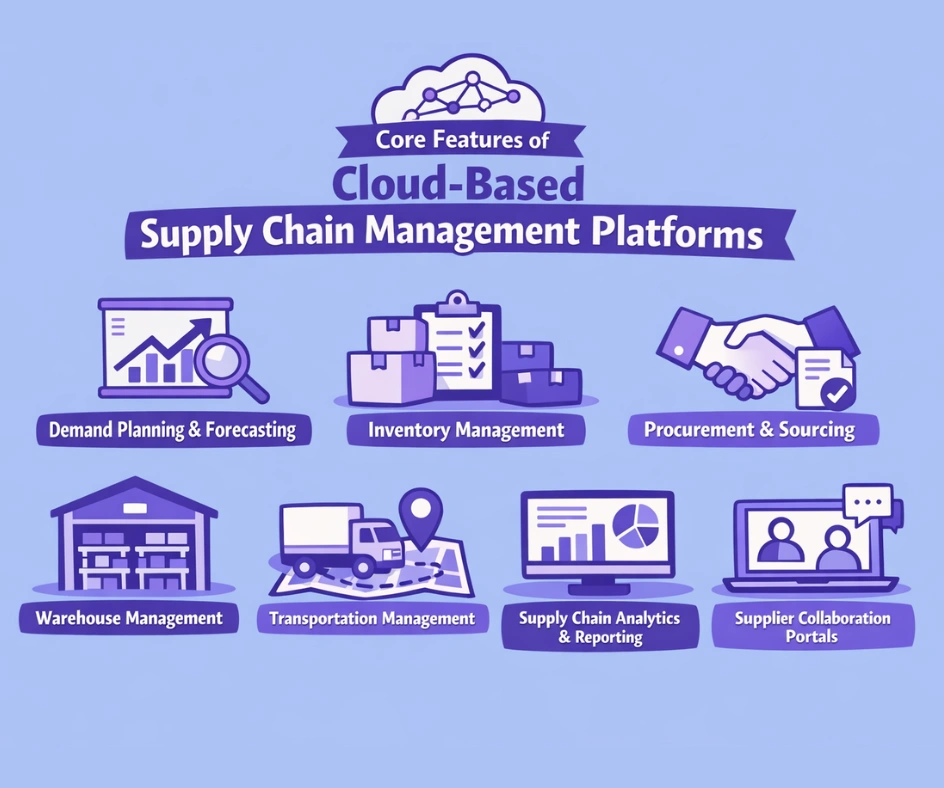
1. Demand Planning and Forecasting
This feature uses historical sales data, market trends, and sometimes external factors like weather and economic indicators to predict future demand. Cloud platforms use machine learning algorithms to make these predictions more accurate over time. This helps companies avoid both overproduction and stockouts, saving money and keeping customers happy.
2. Inventory Management
Cloud-based inventory management gives businesses real-time visibility into stock levels across all their warehouses and distribution centers. It supports automatic reorder points, safety stock calculations, and multi-location inventory tracking. This means a company can always know exactly how much stock it has, where it is, and when it needs to be replenished. Choosing the right inventory management software is what makes this level of visibility actionable, particularly for businesses operating across multiple locations with varying demand patterns.
3. Procurement and Sourcing
Cloud SCM platforms help streamline the purchasing process by automating purchase orders, managing supplier relationships, tracking supplier performance, and comparing quotes from multiple vendors. Some platforms also include features for strategic sourcing, where companies can analyze spending patterns and negotiate better deals with their suppliers.
4. Warehouse Management
Warehouse management modules help businesses optimize the layout of their warehouses, manage inbound and outbound shipments, track items using barcodes or RFID tags, and assign tasks to warehouse workers. Cloud-based warehouse management systems are especially useful for companies with multiple warehouses, since all data is centralized and accessible in real time.
5. Transportation Management
This feature helps companies plan and optimize their shipping routes, select the best carriers, track shipments in real time, and manage freight costs. Cloud-based transportation management systems can handle multiple modes of transport, including road, rail, sea, and air, making them ideal for companies with complex logistics networks.
6. Supply Chain Analytics and Reporting
Analytics tools within cloud SCM platforms provide detailed insights into supply chain performance. Companies can track key performance indicators like order fill rates, delivery times, inventory turnover, and supplier lead times. These insights help managers identify bottlenecks, spot trends, and make data-driven decisions to improve efficiency.
7. Supplier Collaboration Portals
Many cloud supply chain management platforms include portals where suppliers can log in to view purchase orders, update delivery schedules, submit invoices, and communicate with the buyer’s team. This improves collaboration and reduces the back-and-forth communication that often slows down the procurement process.
Top Cloud SCM Platforms: Feature Comparison
| Platform | Key Strengths | Best Suited For |
|---|---|---|
| Oracle Cloud SCM | End to end cloud native platform with AI-driven demand forecasting, multi-channel fulfillment, and embedded IoT tracking | Large enterprises with complex global supply chains |
| SAP Integrated Business Planning | Strong integration with SAP ERP modules, deep customization options, predictive analytics powered by SAP HANA | Large enterprises are already using SAP ecosystem products |
| Blue Yonder Platform | Machine learning based supply chain optimization, real-time visibility, lifecycle pricing, and demand management | Retail, manufacturing, and logistics-focused companies |
| Kinaxis Maestro | Concurrent planning across sales, operations, and finance with AI-powered analytics and scenario modeling | Mid to large enterprises needing rapid response planning |
| Coupa Supply Chain | Unified business spend management with supply chain collaboration, procurement, and finance in a single platform | Companies focusing on procurement and spend optimization |
| Manhattan Associates | Industry-leading warehouse management, transportation optimization, and omnichannel inventory visibility | Retail and distribution companies with heavy warehouse operations |
| Infor Nexus | Real-time supply chain visibility, advanced analytics, order management, and risk monitoring tools | Companies needing strong multi-enterprise collaboration tools |
How AI and Machine Learning Are Changing Cloud SCM
Artificial intelligence and machine learning have become two of the most important technologies shaping the future of cloud-based supply chain management. These technologies are not just add-ons or fancy features. They are fundamentally changing how companies predict demand, manage inventory, optimize routes, and respond to disruptions.
Gartner has identified Composite AI as one of the top supply chain technology trends. This means that instead of relying on a single AI technique, modern cloud SCM platforms are combining multiple AI methods, including machine learning, natural language processing, and optimization algorithms, to solve complex supply chain problems. For example, a cloud platform might use one AI model to forecast demand, another to optimize warehouse operations, and a third to plan transportation routes, all working together in a connected system.
Demand sensing is one area where AI is making a big difference. Traditional demand forecasting relies mostly on historical sales data. But AI-powered tools in cloud SCM platforms can analyze much more than just past sales. The development of these intelligent tools means they can now look at social media trends, weather patterns, economic indicators, competitor activity, and even news events to create more accurate forecasts. This is especially valuable for companies in industries like retail, food and beverages, and consumer electronics, where demand can change very quickly.
Another important application is predictive maintenance within supply chains. Cloud platforms integrated with IoT sensors on machinery, delivery vehicles, and warehouse equipment can use AI to predict when something is about to break down. This allows companies to schedule maintenance before a breakdown happens, avoiding costly downtime and delays. Cloud computing enables supply chain companies to consolidate their physical infrastructure into a cloud-based maintenance dashboard, covering equipment like conveyor systems, water or energy systems, and other critical assets.
Gartner also predicts that by 2028, 25 percent of supply chain KPI reporting will be powered by GenAI models, showing just how deeply AI is becoming embedded in supply chain management operations.
Recommended Reading:
Benefits of Using Cloud-Based Supply Chain Management Platforms
The move to cloud supply chain management platforms is driven by a long list of tangible benefits. Let us go through the most important ones that businesses experience after making the switch.
1. Lower Upfront Costs and Pay as You Go Pricing
One of the most attractive benefits of cloud SCM software is the subscription-based pricing model. Instead of spending hundreds of thousands of dollars on software licenses and hardware, companies pay a monthly or annual fee that covers everything, including hosting, maintenance, updates, and support. This makes cloud supply chain management accessible even to small and medium-sized businesses that might not have the budget for traditional enterprise software.
2. Real-Time Visibility Across the Entire Supply Chain
Cloud platforms provide a single dashboard where managers can see everything happening in their supply chain. From raw material procurement to finished goods delivery, every step is visible in real time. This level of visibility helps identify problems early, reduce delays, and improve customer satisfaction. PwC experts have noted that cloud-based solutions enable real-time data sharing and collaboration across global networks, with more advanced analytics and predictive modelling capabilities compared to older systems.
3. Faster Implementation and Easy Updates
Traditional SCM software can take months or even years to implement fully. Cloud-based platforms, on the other hand, can be deployed in weeks. Since the software runs on the provider’s servers, there is no need for lengthy hardware installations or custom server configurations. Updates are also automatic. The provider releases new features and security patches regularly, and users get access to them without any downtime or manual effort.
4. Better Collaboration Between Partners
Supply chains involve multiple parties, including suppliers, manufacturers, distributors, logistics providers, and retailers. Cloud-based supply chain management platforms create a shared digital space where all these parties can access the same information, communicate directly, and coordinate their activities. This reduces miscommunication, eliminates data silos, and helps everyone work toward common goals.
5. Business Flexibility and Growth Support
Cloud platforms can grow with a business. If a company expands into new markets, opens new warehouses, or adds new product lines, the cloud platform can be expanded to support these changes without requiring a complete overhaul of the system. Resources can be added or removed based on current needs, and businesses only pay for what they actually use.
6. Stronger Disaster Recovery and Data Protection
Cloud providers store data across multiple geographically distributed servers. This means that even if one data center experiences an outage due to a natural disaster, power failure, or cyberattack, the data is still safe and accessible from another location. Cloud platforms also use advanced encryption methods, multi-factor authentication, and regular security audits to protect sensitive supply chain data.
Real World Applications of Cloud SCM Platforms
Cloud-based supply chain management is not just a theoretical concept. Companies across different industries are already using cloud SCM platforms to transform their operations. Here are some real-world applications that show how cloud technology is being used in supply chain management today.
In the retail industry, companies are using cloud platforms to manage omnichannel fulfillment. This means a customer can order online and pick up in store, or return an item bought online at a physical store. Cloud SCM platforms make this possible by providing a unified view of inventory across all channels, whether it is an e-commerce warehouse, a physical store, or a third-party fulfillment center.
In manufacturing, cloud platforms are being used for production planning and supplier collaboration. Manufacturers can share demand forecasts with their suppliers through the cloud, allowing suppliers to adjust their production schedules accordingly. This reduces lead times, prevents raw material shortages, and keeps the production line running smoothly.
In the food and beverage industry, cloud SCM platforms help companies track the journey of products from farm to table. With cloud-based traceability tools, companies can quickly identify the source of a contaminated product and issue targeted recalls instead of pulling entire product lines from shelves. Walmart, for example, has used blockchain and cloud technology together to track the movement of food products from farms to stores, enabling rapid identification and removal of unsafe batches.
In the pharmaceutical industry, cloud platforms are used to maintain strict compliance with regulations. Medicines need to be stored and transported at specific temperatures, and cloud platforms with IoT integration can monitor these conditions in real time and send alerts if something goes wrong.
In the automotive industry, cloud SCM platforms help manage complex supply chains that involve thousands of parts from hundreds of suppliers spread across the globe. Real-time visibility into supplier operations helps automakers anticipate delays and switch to alternative suppliers when needed.
Cloud SCM vs On Premise SCM: A Detailed Comparison
| Factor | Cloud Based SCM | On Premise SCM |
|---|---|---|
| Initial Cost | Low (subscription-based, no hardware purchase needed) | High (requires servers, licenses, and IT infrastructure) |
| Deployment Time | Weeks to a few months | Several months to over a year |
| Maintenance | Handled by the cloud provider (automatic updates) | Handled by in house IT team (manual upgrades) |
| Accessibility | Accessible from anywhere with an internet connection | Accessible only from the company’s internal network |
| Growth Flexibility | Can be easily expanded by adding modules or users | Requires additional hardware and software purchases |
| Data Security | Managed by the provider with encryption, backups, and certifications | Managed internally with full control over security protocols |
| Customization | Configuration-based (limited deep customization) | Highly customizable to specific business workflows |
| Integration | Pre-built connectors for popular ERP, CRM, and third-party tools | Custom integrations needed, often requiring specialized developers |
Challenges in Adopting Cloud-Based Supply Chain Management
While the benefits of cloud SCM platforms are clear, moving to the cloud is not without its challenges. Businesses need to be aware of these hurdles before making the transition so they can plan accordingly and avoid costly mistakes.
1. Data Migration Complexity
Moving years of supply chain data from an old on-premises system to a new cloud platform is not a simple copy-and-paste job. Data needs to be cleaned, formatted, validated, and mapped to the new system’s structure. Any errors during migration can lead to incorrect inventory counts, mismatched orders, and other operational problems. Companies often need specialized consultants or dedicated teams to manage this process.
2. Integration with Existing Systems
Most businesses do not operate their supply chain in isolation. It is connected to their ERP system, accounting software, CRM, e-commerce platform, and various other tools. Making sure the new cloud SCM platform works smoothly with all these existing systems can be tricky, especially when some of these systems are legacy products built on outdated technology.
3. Internet Dependency
Cloud platforms need a stable internet connection to function properly. In regions where internet connectivity is unreliable, this can be a major concern. Even in developed countries, network outages can disrupt access to the platform, which could impact critical supply chain operations like order processing and shipment tracking.
Recommended Reading:
The Role of IoT in Cloud Supply Chain Management Platforms
The Internet of Things (IoT) is playing an increasingly important role in making cloud-based SCM platforms more powerful and practical. IoT refers to physical devices like sensors, GPS trackers, RFID tags, and smart cameras that are connected to the internet and can collect and transmit data in real time.
When IoT devices are connected to a cloud supply chain management platform, they create a live digital picture of the entire supply chain. For example, temperature sensors placed inside a refrigerated truck can send data to the cloud platform every few minutes. If the temperature goes above the safe limit, the platform can automatically send an alert to the logistics team, who can then take corrective action before the goods are damaged.
Similarly, GPS trackers on shipping containers allow companies to monitor the exact location of their shipments at all times. The development of this tracking infrastructure feeds data into the cloud platform’s analytics engine, which can predict delivery times, identify potential delays, and suggest alternative routes if needed.
In warehouses, IoT sensors can monitor stock levels on shelves and automatically trigger reorder alerts when inventory drops below a set threshold. This eliminates the need for manual stock counts and reduces the chances of running out of key products. The combination of IoT data and cloud-based analytics creates a feedback loop that continuously improves supply chain performance.
Blockchain Integration with Cloud SCM Platforms
Blockchain technology is emerging as a powerful complement to cloud-based supply chain management. While cloud platforms provide the infrastructure for storing and processing supply chain data, blockchain adds a layer of trust and transparency that traditional databases cannot match.
In a blockchain-based supply chain, every transaction, from the sourcing of raw materials to the final delivery, is recorded on a distributed ledger that cannot be changed or tampered with. The development of this technology creates a permanent, verifiable history of every product’s journey through the supply chain. Companies can use this to prove the authenticity of their products, track where goods came from, and ensure compliance with ethical sourcing standards.
Smart contracts, which are self-executing agreements coded on the blockchain, can also automate many supply chain processes. For instance, a smart contract can be set up to automatically release payment to a supplier once a shipment reaches its destination and passes a quality check. This removes the need for manual invoicing and payment processing, speeds up transactions, and reduces the risk of disputes.
The blockchain supply chain market, valued at approximately USD 3.25 billion in 2025, is expected to grow at a CAGR of 59.8 percent and reach USD 21.29 billion by 2029. This rapid growth shows how quickly businesses are adopting blockchain alongside their cloud SCM platforms to build more transparent and trustworthy supply chains.
Blockchain-Powered Supply Chain Solutions in the Real World
The following projects show how blockchain architecture is already being used across logistics, supply chain tracking, and decentralized infrastructure. Each project demonstrates the same principles of transparency, traceability, and automation discussed throughout this article, from smart contract-based tracking to community-driven governance and multi-party collaboration.
🔗
Everscale Network: High-Performance Blockchain Ecosystem
Built a highly performant blockchain ecosystem capable of handling over 100,000 transactions per second using sharding technology. The platform supports smart contracts, decentralized data storage, and multi-party verification, making it an ideal backbone for supply chain tracking applications that require speed, transparency, and fault tolerance across global networks.
Build Your Cloud-Ready Supply Chain Solution Today:
Our specialized team at Nadcab Labs brings deep blockchain and cloud technology expertise to supply chain projects. From smart contract automation and real-time tracking systems to multi-party data sharing platforms, we build solutions designed for transparency, performance, and long term operational growth. Whether you need a traceability system, logistics optimization tool, or complete supply chain platform, we deliver what works.
How to Choose the Right Cloud SCM Platform for Your Business
With so many cloud-based supply chain management platforms available in the market, choosing the right one can feel overwhelming. However, by focusing on a few key factors, businesses can narrow down their options and find a platform that fits their specific needs.
1. Understand Your Core Requirements
Before looking at any platform, make a clear list of what your supply chain actually needs. Do you need better demand forecasting? Are you struggling with warehouse management? Is transportation optimization your biggest challenge? Different platforms have different strengths, and knowing your priorities will help you focus on the ones that matter most.
2. Check Integration Capabilities
Make sure the platform can connect with the tools you are already using. If you are running SAP ERP, a platform with pre-built SAP connectors will save you a lot of time and effort. If you are using Salesforce for customer management, check whether the cloud SCM platform offers integration with Salesforce.
3. Evaluate the Provider’s Track Record
Look at the provider’s history. How long have they been in the market? What industries do they serve? Do they have case studies or customer testimonials? A provider with a strong track record in your industry is more likely to understand your challenges and offer practical solutions.
4. Consider Total Cost of Ownership
Do not just look at the subscription price. Factor in the cost of implementation, data migration, training, customization, and ongoing support. Some platforms may have a lower subscription fee but charge extra for features that others include as standard. Get a full cost breakdown before making a decision.
5. Look at User Experience and Training Support
The best platform in the world is useless if your team cannot use it properly. Check how intuitive the interface is. Does the provider offer training materials, tutorials, or on-site training sessions? A platform with a steep learning curve will slow down adoption and reduce ROI.
6. Test Before You Commit
Most cloud SCM providers offer free trials or demos. Take advantage of these. Have your team use the platform for a test period to see if it meets your needs in practice, not just on paper. Pay attention to performance speed, reporting quality, and how easy it is to navigate the system.
The Future of Cloud-Based Supply Chain Management Platforms
The cloud SCM landscape is constantly evolving, and several emerging trends are set to shape its future in the coming years.
One major trend is the rise of autonomous supply chains. With advances in AI, IoT, and robotics, some companies are working toward supply chains that can largely run themselves with minimal human intervention. The development of these autonomous systems has been led by companies like Amazon, which has invested over USD 25 billion in robotics and automation for its warehouses and fulfillment centers. These autonomous systems will rely heavily on cloud platforms to coordinate their operations, share data, and make real-time decisions.
Another trend is the growing emphasis on sustainability tracking. Consumers and regulators are increasingly demanding that companies prove their environmental and social responsibility. Cloud SCM platforms are adding features that allow companies to track their carbon footprint, monitor sustainable sourcing practices, and generate sustainability reports. Oracle Cloud SCM, for instance, already includes tools for green procurement, waste reduction, and carbon footprint tracking.
Multi-cloud and hybrid cloud strategies are also becoming more common. Instead of relying on a single cloud provider, many companies are spreading their supply chain operations across multiple cloud platforms to reduce risk and improve performance. Some are also using hybrid models, keeping sensitive data on private clouds while running less critical workloads on public clouds.
Edge computing is another technology that will complement cloud SCM in the future. The development of edge computing processes data closer to where it is generated, such as on a factory floor or inside a delivery truck. This reduces latency and allows for faster decision-making in time-sensitive situations. Gartner predicts that by 2027, 80 percent of manufacturing operations management solutions will be cloud native and edge-driven.
Finally, the integration of digital twins with cloud SCM platforms is gaining traction. A digital twin is a virtual replica of a physical supply chain that allows companies to simulate different scenarios and test changes before implementing them in the real world. The development of digital twin technology relies on cloud platforms to provide the computing power needed to run these complex simulations, helping companies make better strategic decisions with less risk.
Final Thoughts
Cloud-based supply chain management platforms have moved from being a nice-to-have option to a must-have tool for businesses that want to stay competitive in today’s fast-moving global economy. The numbers support this shift. The cloud SCM market is growing at a rapid pace, with the global market projected to reach USD 51.15 billion by 2029. Companies like Oracle, SAP, Blue Yonder, and Kinaxis are leading the way with platforms that offer everything from AI-powered demand forecasting to real-time shipment tracking and blockchain-based traceability.
The benefits are clear. Lower costs, faster deployment, real-time visibility, better collaboration, and stronger disaster recovery capabilities. But the transition is not without challenges. Data migration, integration with legacy systems, employee training, and regulatory compliance all need careful attention. Companies that invest in planning, change management, and employee development alongside the technology itself will see the best results.
Looking ahead, the future of cloud supply chain management is exciting. Autonomous supply chains, AI-driven analytics, IoT integration, blockchain transparency, edge computing, and digital twins are all coming together to create supply chains that are smarter, faster, and more responsive than anything we have seen before. For businesses that have not yet made the move to a cloud supply chain management platform, now is the time to start exploring the options and taking the first steps toward a more connected and intelligent supply chain.
Frequently Asked Questions
Q1.What is a cloud-based SCM platform?
A cloud-based SCM platform is a supply chain management software hosted on remote cloud servers. It allows businesses to plan, monitor, and manage all supply chain operations online using a subscription-based model, without needing to install or maintain software on their own computers or servers.
Q2.How does cloud SCM differ from on premise SCM?
Cloud SCM runs on the provider’s servers and is accessed through the internet, while on-premises SCM is installed on a company’s own hardware. Cloud SCM offers lower upfront costs, faster deployment, automatic updates, and remote accessibility, whereas on-premises SCM provides more control over customization and data storage.
Q3.Which industries benefit most from cloud supply chain management?
Industries like retail, manufacturing, food and beverages, pharmaceuticals, automotive, and logistics benefit the most. Any business that manages complex supply chains with multiple suppliers, warehouses, and distribution points can gain value from cloud-based supply chain management platforms.
Q4.Is cloud SCM software safe for storing sensitive data?
Yes, reputable cloud SCM providers use strong security measures, including data encryption, multi-factor authentication, role-based access controls, and regular security audits. Major providers like Oracle and SAP also hold certifications such as ISO 27001 and SOC 2, which ensure strict data protection standards are followed.
Q5.Can small businesses afford cloud-based SCM platforms?
Yes. Cloud SCM platforms typically work on a subscription model, which means small businesses can start with basic features at a lower cost and add more modules as they grow. This pay-as-you-go approach makes cloud supply chain management much more affordable compared to traditional on-premises solutions.
Q6.How long does it take to implement a cloud SCM platform?
Implementation timelines vary depending on the complexity of the business and the chosen platform. Simple implementations can be completed in a few weeks, while more complex deployments involving multiple integrations, data migration, and custom configurations may take three to six months.
Explore Services
Related Services
Reviewed by

Aman Vaths
Founder of Nadcab Labs
Aman Vaths is the Founder & CTO of Nadcab Labs, a global digital engineering company delivering enterprise-grade solutions across AI, Web3, Blockchain, Big Data, Cloud, Cybersecurity, and Modern Application Development. With deep technical leadership and product innovation experience, Aman has positioned Nadcab Labs as one of the most advanced engineering companies driving the next era of intelligent, secure, and scalable software systems. Under his leadership, Nadcab Labs has built 2,000+ global projects across sectors including fintech, banking, healthcare, real estate, logistics, gaming, manufacturing, and next-generation DePIN networks. Aman’s strength lies in architecting high-performance systems, end-to-end platform engineering, and designing enterprise solutions that operate at global scale.