Ai Overview
In May 2026, multiple cryptocurrency exchanges launched perpetual futures contracts tied to SpaceX — a private company that has not yet gone public. 75 trillion to over $2 trillion — which would make its IPO one of the largest in financial history. SpaceX also holds 8,285 Bitcoin in Coinbase Prime custody, a fact that will appear in its public filings for the first time when the S-1 prospectus is filed.
In May 2026, multiple cryptocurrency exchanges launched perpetual futures contracts tied to SpaceX — a private company that has not yet gone public. Binance launched its SPCXUSDT Pre-IPO Perpetual on May 21, 2026. Hyperliquid listed a SpaceX synthetic derivative on May 18. Bitget followed with its own SPCXUSDT contract shortly after. This is not a coincidence. It reflects a deliberate shift by crypto derivatives platforms into pre-IPO trading, a market that has historically been accessible only to institutional investors and venture capital firms. This blog explains exactly what SpaceX futures are, how they work, why exchanges are launching them now, and what the risks are for traders.
Key Takeaways
- What They Are: SpaceX futures are synthetic perpetual contracts that let traders take positions on SpaceX’s implied valuation before the company lists on a public stock exchange.
- No Actual Shares: These contracts do not represent ownership of SpaceX shares. Traders are betting on the expected price of the underlying stock through a derivative instrument — no real equity changes hands.
- First Mover: Hyperliquid launched the SPCX contract on May 18, 2026, drawing $33 million in 24-hour volume and $21.8 million in open interest in its first session. SPCX hit $216 within hours before settling at $202.89.
- Binance Followed: Binance announced its SPCXUSDT Pre-IPO Perpetual on May 21, 2026, settled in USDT and built on the same perpetual futures infrastructure used for crypto assets.
- Bitget Also Listed: Bitget launched its own SPCXUSDT contract with up to 5x leverage, targeting retail traders who want early pre-IPO exposure to the Nasdaq-bound company.
- Valuation Context: SpaceX is expected to debut at a valuation of $1.75 trillion to over $2 trillion, making it one of the most anticipated IPOs in modern financial history.
- Bitcoin Treasury: SpaceX holds 8,285 Bitcoin in Coinbase Prime custody — a detail that gives crypto-native traders additional reason to follow the company’s public listing closely.
- Democratizing Access: Pre-IPO price discovery has historically been limited to institutional investors. These contracts give retail traders the first open, accessible way to trade SpaceX valuation expectations before the IPO.
- Real Risk Exists: If SpaceX delays or cancels its IPO, contracts will be delisted and settled according to each exchange’s stated process. Traders carry exposure to both price movement and IPO timeline uncertainty.
What Are SpaceX Futures Contracts?
SpaceX futures on crypto exchanges are synthetic perpetual contracts. A synthetic perpetual means no actual SpaceX shares change hands. Instead, the contract tracks a reference price for SpaceX’s implied stock valuation — derived from private funding round data, announced IPO price ranges, and other publicly available pricing signals. Traders take long or short positions on this reference price using margin, and the contract settles in stablecoins (typically USDT).
Perpetual futures have no expiry date, unlike traditional futures contracts that settle on a fixed date. Traders hold positions open as long as they post sufficient margin and pay or receive funding rates — periodic payments between long and short position holders that keep the contract price anchored close to the reference valuation. This structure is already widely used in crypto derivatives markets for assets like Bitcoin and Ethereum. Exchanges are applying the same infrastructure to pre-IPO company valuations. For a technical breakdown of how this infrastructure is built, the crypto derivatives exchange guide explains perpetual contract mechanics, funding rate systems, and oracle-based price feeds in detail.
Once SpaceX begins trading on a public exchange (currently expected to be the Nasdaq), the contracts will transition from tracking the implied pre-IPO valuation to reflecting live market performance. If the IPO is delayed or canceled, exchanges have stated they will provide advance notice and settle contracts according to a transparent process.[1]
Why SpaceX? Why Now?
SpaceX Is the Largest Private Company by Valuation
Space Exploration Technologies Corp (SpaceX), founded by Elon Musk, is one of the most closely watched companies in global markets. It is expected to debut at a valuation of $1.75 trillion to over $2 trillion — which would make its IPO one of the largest in financial history. It holds contracts with NASA, the US Department of Defense, and commercial satellite operators globally. Its Starlink satellite internet division generated $8.6 billion in revenue in 2024. This scale and visibility makes SpaceX the ideal first listing for exchanges experimenting with pre-IPO derivatives. The name alone generates immediate user interest and trading activity.
SpaceX also holds 8,285 Bitcoin in Coinbase Prime custody, a fact that will appear in its public filings for the first time when the S-1 prospectus is filed. This Bitcoin position — which will require fair-value accounting under FASB rules that took effect in late 2025 — gives crypto-native traders an additional direct link between SpaceX’s financial position and the digital asset market.[2]
Pre-IPO Markets Have Been Closed to Most Traders
Historically, pre-IPO price discovery happens behind closed doors. Venture capital firms, hedge funds, and accredited investors with minimum investment thresholds of $100,000 or more have been the only participants who could take positions on private company valuations before public listing. Retail traders have had no mechanism to express a view on SpaceX’s valuation before its IPO, regardless of how informed that view might be. Pre-IPO perpetual futures change this. A trader with any amount of capital can now go long or short on SpaceX’s implied valuation through a standard derivatives interface — with no brokerage account, no accreditation requirement, and no minimum investment above the margin required for the position.
Exchanges Are Competing for a New Product Category
The speed with which Hyperliquid, Binance, and Bitget all listed SpaceX contracts within days of each other reflects competitive pressure for a new category: pre-IPO derivatives. Exchanges that establish early market share in this product type gain liquidity advantages that compound over time. High open interest on the first mover’s contract creates tighter spreads and better execution, which attracts more traders, which deepens liquidity further. Hyperliquid’s SPCX contract drew $33 million in daily volume and $21.8 million in open interest on its first session — numbers that justify rapid competitive responses from larger platforms. Binance followed within three days of Hyperliquid’s launch.[3]
Which Exchanges Have Launched SpaceX Futures: May 2026
| Exchange | Contract Ticker | Launch Date | Settlement | Max Leverage | Type |
|---|---|---|---|---|---|
| Hyperliquid | SPCX | May 18, 2026 | USDC | Not disclosed | Synthetic perpetual (DEX) |
| Binance | SPCXUSDT | May 21, 2026 | USDT | Not disclosed | Pre-IPO perpetual (CEX) |
| Bitget | SPCXUSDT | May 22, 2026 | USDT | 5x | Pre-IPO derivative (CEX) |
How SpaceX Pre-IPO Perpetuals Work in Practice
Price Discovery Before the IPO
Before SpaceX’s public debut, the contract price reflects publicly available pricing signals — private funding round valuations, leaked IPO price ranges, and market sentiment. An oracle feeds this reference price into the contract, and the market’s collective long and short positions create a live valuation estimate. This makes the contract a real-time gauge of what traders think SpaceX will be worth when it lists.
Funding rates keep the contract anchored. If the contract trades significantly above the reference valuation (more longs than shorts), funding rates become positive — long holders pay short holders periodically, discouraging excessive premium over the reference price. If the contract trades below (more shorts), short holders pay long holders. This mechanism is the same one used in perpetual Bitcoin and Ethereum futures on every major crypto exchange.[4]
Settlement After the IPO
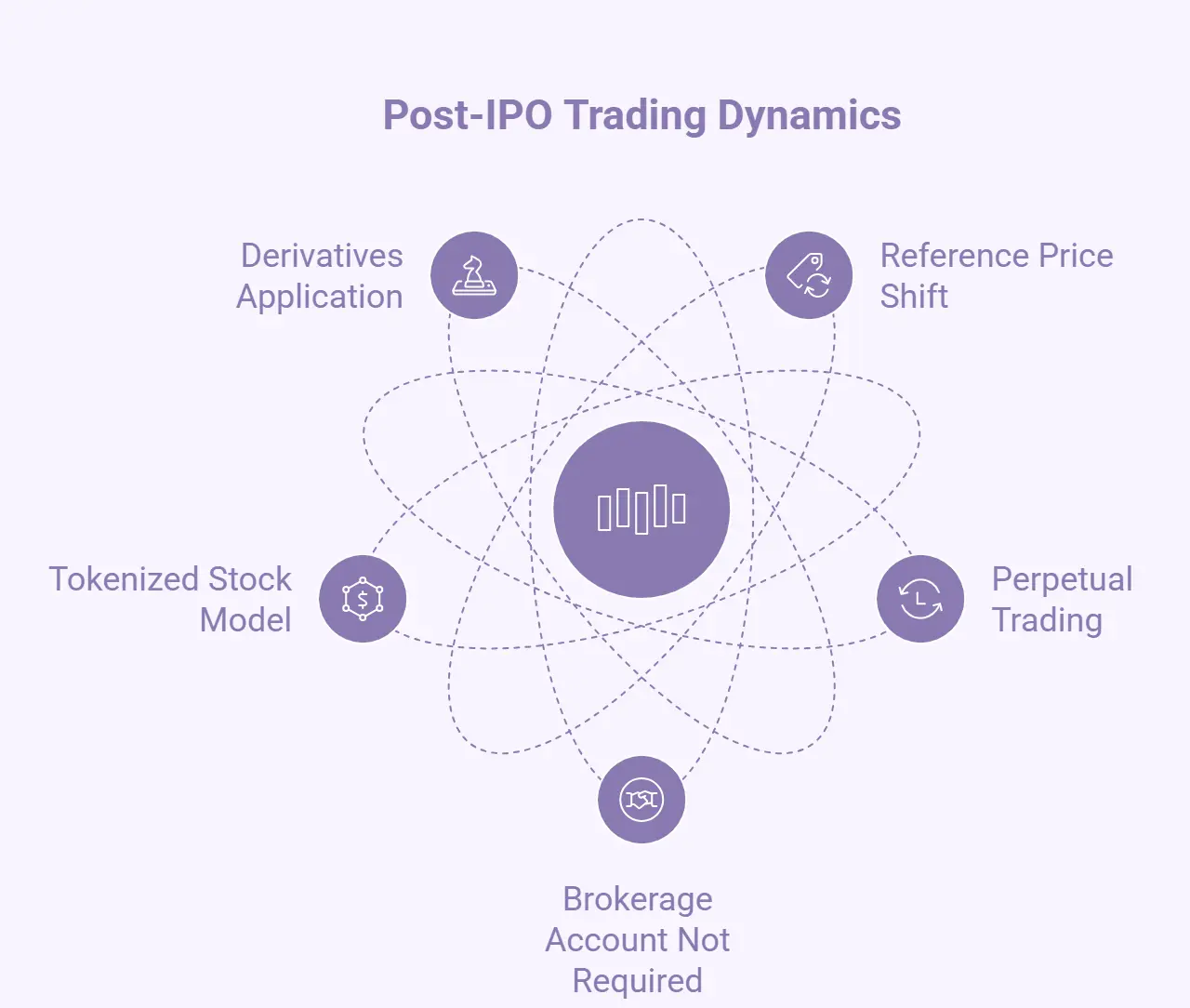
Once SpaceX begins trading on the Nasdaq, the reference price for these contracts switches from implied pre-IPO valuation to the live stock price. The contract continues to trade as a stock-linked perpetual, giving traders ongoing exposure to SpaceX’s public market performance without needing a brokerage account. This is the tokenized stock trading model applied through derivatives — using cryptocurrency exchange infrastructure to provide exposure to traditional equity markets.
What Happens if the IPO Is Delayed or Canceled
Both Binance and Hyperliquid have stated that in the event of an IPO delay or cancellation, they will provide advance notice and settle contracts through a transparent process. The specific settlement price and method vary by exchange and are disclosed in the contract specifications. Traders considering these products should read the exchange’s specific delisting and settlement terms before opening a position — IPO delays are a real possibility for any private company.[5]
What This Means for the Crypto Derivatives Market
SpaceX futures are not an isolated product launch. They represent a strategic direction that multiple major exchanges are now pursuing simultaneously: using crypto derivatives exchange development infrastructure to create market access for assets that traditional finance restricts to institutional participants. Binance’s head of spot and derivatives explicitly described this as part of its “financial super app” vision — offering access to financial opportunities that have traditionally been hard to reach for retail users.
Pre-IPO Derivatives as a Product Category
Binance has stated that additional pre-IPO perpetual listings will follow SpaceX. This suggests a pipeline of contracts tied to other high-profile private companies that are expected to go public. Any company in a late-stage IPO process with significant public interest — whether in technology, defense, energy, or biotech — becomes a candidate for the same treatment. The SpaceX launch is the proof of concept. If open interest and volume sustain across multiple exchanges, the product category becomes a permanent feature of crypto derivatives markets.
Competition Between CEX and DEX for Pre-IPO Flow
The fact that Hyperliquid — a decentralized exchange — launched SpaceX futures three days before Binance demonstrates that DEX platforms can move faster on novel products than centralized exchanges with larger compliance and review processes. Hyperliquid’s HYPE token rose 7% in the 24 hours after the SPCX listing, reflecting how directly these product launches now affect exchange-native token valuations. This creates a new competitive dynamic between CEX and DEX platforms for who captures pre-IPO trading flow first.[6]
Key Risks Traders Should Understand
No Ownership of SpaceX Shares
This is the most important point. Holding a long position in SPCXUSDT does not mean you own SpaceX equity. You hold a derivative contract. If SpaceX’s IPO is delayed by two years, your contract either continues at prevailing funding rates or gets delisted and settled — depending on the exchange’s terms. You have no shareholder rights, no claim on SpaceX assets, and no direct relationship with the company.
IPO Delay Risk
SpaceX has been described as a potential IPO candidate for years without listing. Company leadership controls the timing. If market conditions change, regulatory review extends, or leadership decides to remain private longer, the IPO may not happen on any expected timeline. All pre-IPO derivatives carry this structural uncertainty, which does not exist in derivatives tied to already-public assets.
Valuation Reference Risk
Before the IPO, the contract’s reference price is based on implied valuations from private market data and public signals — not a verified market price from a public exchange. This means the reference price can shift based on new funding rounds, leaked filings, or sentiment changes in a way that differs from how public stock prices move. Traders should understand that pre-IPO reference prices are estimates, not confirmed valuations.
📌 Market Development to Watch (May 2026)
SpaceX’s S-1 filing is expected to disclose its 8,285 Bitcoin treasury position for the first time under FASB’s updated fair-value accounting rules for digital assets, which took effect in late 2025. This Bitcoin disclosure will create a direct on-chain link between SpaceX’s public financial documents and the crypto markets. It also raises the possibility of SpaceX’s stock price being influenced by Bitcoin price movements — and vice versa — once the company is publicly listed. Traders in SPCX futures should factor this potential correlation into their position management as the IPO timeline clarifies.
Build a Crypto Derivatives Exchange Platform
Nadcab Labs develops crypto derivatives exchange platforms with perpetual futures infrastructure, oracle-based price feeds, funding rate engines, margin systems, and pre-IPO contract support — built for both centralized and decentralized exchange architectures.
Frequently Asked Questions
Q1.What are SpaceX futures on crypto exchanges?
SpaceX futures on crypto exchanges are synthetic perpetual contracts that let traders take long or short positions on SpaceX’s implied valuation before the company lists on a public stock exchange. They are settled in stablecoins (USDT or USDC) and do not represent actual ownership of SpaceX shares. Binance, Hyperliquid, and Bitget all launched versions of this contract in May 2026.
Q2.Do SpaceX futures give you real shares?
No. SpaceX futures on crypto exchanges are derivative contracts — not equity. Holding a long position does not mean you own SpaceX stock, have shareholder rights, or have any direct claim on the company. You are trading a contract that tracks the implied pre-IPO valuation of SpaceX. Once the company goes public, the contract transitions to track the live stock price, but still does not represent actual share ownership.
Q3.Which exchange first listed SpaceX futures?
Hyperliquid, a decentralized exchange, was the first platform to list SpaceX futures on May 18, 2026 under the ticker SPCX. The contract drew $33 million in 24-hour trading volume and $21.8 million in open interest in its first session. Binance followed with its SPCXUSDT Pre-IPO Perpetual on May 21, and Bitget listed its own SPCXUSDT contract on May 22, 2026.
Q4.What happens to SpaceX futures after the IPO?
Once SpaceX begins trading on a public exchange (expected to be the Nasdaq), the pre-IPO perpetual contracts transition from tracking implied valuation to reflecting live market performance. The contracts continue to trade as stock-linked perpetuals. If the IPO is delayed or canceled, exchanges have stated they will provide advance notice and settle contracts through a disclosed process — specific terms vary by platform.
Q5.How is SpaceX's pre-IPO valuation determined?
Before the IPO, the contract’s reference price is based on publicly available pricing signals: private funding round valuations, announced IPO price ranges, secondary market transaction data, and public information about the company. An oracle feeds this reference price into the perpetual contract. SpaceX is currently expected to debut at a valuation between $1.75 trillion and over $2 trillion based on these pre-IPO signals.
Explore Services
Related Services
Reviewed by

Aman Vaths
Founder of Nadcab Labs
Aman Vaths is the Founder & CTO of Nadcab Labs, a global digital engineering company delivering enterprise-grade solutions across AI, Web3, Blockchain, Big Data, Cloud, Cybersecurity, and Modern Application Development. With deep technical leadership and product innovation experience, Aman has positioned Nadcab Labs as one of the most advanced engineering companies driving the next era of intelligent, secure, and scalable software systems. Under his leadership, Nadcab Labs has built 2,000+ global projects across sectors including fintech, banking, healthcare, real estate, logistics, gaming, manufacturing, and next-generation DePIN networks. Aman’s strength lies in architecting high-performance systems, end-to-end platform engineering, and designing enterprise solutions that operate at global scale.