Ai Overview
Structs in smart contracts represent one of the most powerful features available to blockchain developers building sophisticated decentralized applications. A struct is a custom data type that allows you to group multiple related variables under a single name, creating organized and logical data structures. Our agency has spent over eight years implementing structs in smart contracts for enterprise clients across the USA, UK, UAE, and Canada.
Key Takeaways
- Structs in smart contracts group related variables into custom data types, improving code organization and reducing complexity in blockchain applications.
- Proper struct design enables gas optimization by packing smaller variables together, potentially saving 20 to 40 percent on storage costs.
- Memory structs are temporary and cheaper while storage structs persist permanently on the blockchain with higher gas requirements.
- Combining structs with mappings creates efficient key-value data stores for managing users, assets, and transactions in DeFi protocols.
- Nested structs enable complex data modeling but require careful design to avoid excessive gas consumption and code complexity.
- Upgradeable contracts require special struct handling with storage gaps and append-only modifications to prevent data corruption.
- Security vulnerabilities can arise when structs hold critical data without proper access controls and validation mechanisms implemented.
- Enterprise blockchain projects in USA, UK, UAE, and Canada rely on well-structured data models for regulatory compliance.
- Choosing between structs, mappings, and arrays depends on access patterns, iteration requirements, and gas optimization priorities.
- Future-proof struct design anticipates protocol evolution while maintaining backward compatibility across contract versions and upgrades.
Understanding Structs in Smart Contracts
Structs in smart contracts represent one of the most powerful features available to blockchain developers building sophisticated decentralized applications. A struct is a custom data type that allows you to group multiple related variables under a single name, creating organized and logical data structures. When working with smart contract code, structs enable developers to model real-world entities like users, orders, assets, and transactions in ways that mirror actual business logic.
Our agency has spent over eight years implementing structs in smart contracts for enterprise clients across the USA, UK, UAE, and Canada. This experience has revealed that proper struct design fundamentally impacts contract maintainability, gas efficiency, and long-term scalability. Whether you are building DeFi protocols, NFT marketplaces, or supply chain solutions, understanding structs is essential for creating production-ready blockchain applications.
Unlike primitive data types that store single values, structs can contain multiple fields of different types including addresses, integers, booleans, strings, and even other structs. This flexibility makes them indispensable for organizing complex state data in ways that remain readable and maintainable as codebases grow.
How Structs Improve Code Readability and Maintainability
Code readability directly impacts security audit efficiency and long-term maintenance costs. Structs in smart contracts transform scattered variables into self-documenting data models that clearly express business intent. When auditors review contracts for clients in the UK or USA, well-organized structs significantly reduce the time required to understand data flows and identify potential vulnerabilities.
Consider the difference between passing six separate parameters to a function versus passing a single struct. The struct approach eliminates parameter ordering errors, makes function signatures cleaner, and enables IDEs to provide better autocomplete suggestions. These improvements compound across large codebases where functions may be called from dozens of locations.
Maintainability extends beyond initial implementation to ongoing protocol updates. When new features require additional data fields, adding members to existing structs is cleaner than creating new mappings. Teams working across time zones in Canada, UAE, and Europe can collaborate more effectively when code structure follows intuitive patterns.

Defining and Initializing Structs in Solidity
Mastering struct syntax and initialization patterns is fundamental for effective Structs in Smart Contracts creation.
Definition Syntax
- Use struct keyword with descriptive name
- Define members with type and identifier
- Place definitions at contract level
- Group logically related data fields
Initialization Methods
- Positional arguments in order declared
- Named arguments for clarity
- Default initialization with zero values
- Memory or storage location specifier
Best Practices
- Use meaningful member names
- Order by data type size for packing
- Document each field purpose
- Consider future extensibility needs
Structs vs Mappings vs Arrays: Choosing the Right Data Structure
Selecting appropriate data structures requires understanding the tradeoffs between structs, mappings, and arrays. Each serves different purposes and combining them strategically creates efficient state management patterns for enterprise blockchain applications.
| Feature | Structs | Mappings | Arrays |
|---|---|---|---|
| Primary Use | Group related data | Key-value lookups | Ordered collections |
| Iteration | Not directly | Not possible | Fully supported |
| Gas Efficiency | High with packing | O(1) access | O(n) for search |
| Size Tracking | Manual | Not built-in | .length property |
| Memory Support | Full support | Storage only | Full support |
Designing Complex Data Models Using Structs
Complex blockchain applications require sophisticated data models that accurately represent business domains. Structs in smart contracts enable developers to create hierarchical data structures that mirror real-world relationships between entities. Financial protocols serving clients in London, New York, and Dubai often model positions, portfolios, and risk parameters using interconnected struct definitions.
Effective data modeling starts with identifying core entities and their relationships. A decentralized exchange might define structs for Order, Trade, and Position, each containing relevant fields. The Order struct could include price, amount, maker address, and expiration timestamp. These definitions become the vocabulary that the entire codebase uses to discuss and manipulate data.
Enterprise clients increasingly demand data models that support regulatory compliance. Structs can include fields for KYC status, jurisdiction codes, and compliance timestamps that auditors and regulators can verify. This approach has become standard for protocols operating under SEC, FCA, and DFSA oversight.
Nested Structs for Advanced Structs in Smart Contracts Logic
Nested structs enable modeling hierarchical relationships where one entity contains another. A Portfolio struct might contain an array of Position structs, each Position containing asset details and risk metrics. This composition pattern creates clear ownership relationships and logical groupings that simplify complex business logic implementation.
However, nested structs require careful consideration of gas implications. Deeply nested structures can significantly increase storage and retrieval costs. Our experience with enterprise clients suggests limiting nesting to two or three levels maximum. Beyond that, the complexity and gas costs typically outweigh organizational benefits.
Real-world implementations often use a hybrid approach combining nested structs with mappings. Rather than nesting deeply, a parent struct might store identifiers that map to child structs stored separately. This pattern maintains logical relationships while optimizing storage access patterns for high-frequency operations.
Memory vs Storage Structs: Performance and Gas Implications
Understanding the difference between memory and storage locations for structs is crucial for gas optimization. This distinction affects both performance and cost, making it one of the most important concepts for developers working with structs in smart contracts.
| Aspect | Memory Structs | Storage Structs |
|---|---|---|
| Persistence | Temporary, function scope | Permanent, blockchain state |
| Gas Cost Read | 3 gas per word | 2100 gas cold, 100 warm |
| Gas Cost Write | 3 gas per word | 20000 new, 5000 update |
| Assignment Behavior | Creates copy | Creates reference |
| Best Use Case | Temporary calculations | Persistent state data |
Best Practices for Struct Design in Large-Scale dApps
1. Plan Data Requirements
Document all data fields needed before writing code. Consider future requirements and potential protocol upgrades.
2. Optimize Variable Ordering
Arrange struct members by size to minimize storage slots used. Group smaller types together for packing.
3. Use Meaningful Names
Choose descriptive struct and member names that clearly communicate purpose without requiring comments.
4. Validate All Inputs
Implement validation logic when populating struct fields to prevent invalid state from entering the system.
5. Consider Access Patterns
Design structs based on how data will be read and written. Frequently accessed fields should be optimized.
6. Document Thoroughly
Add NatSpec comments explaining struct purpose, member meanings, and any constraints or invariants.
7. Test Edge Cases
Write comprehensive tests covering maximum values, empty states, and boundary conditions for all struct operations.
8. Plan for Upgrades
Reserve storage gaps and design structs to allow safe additions without breaking existing storage layouts.
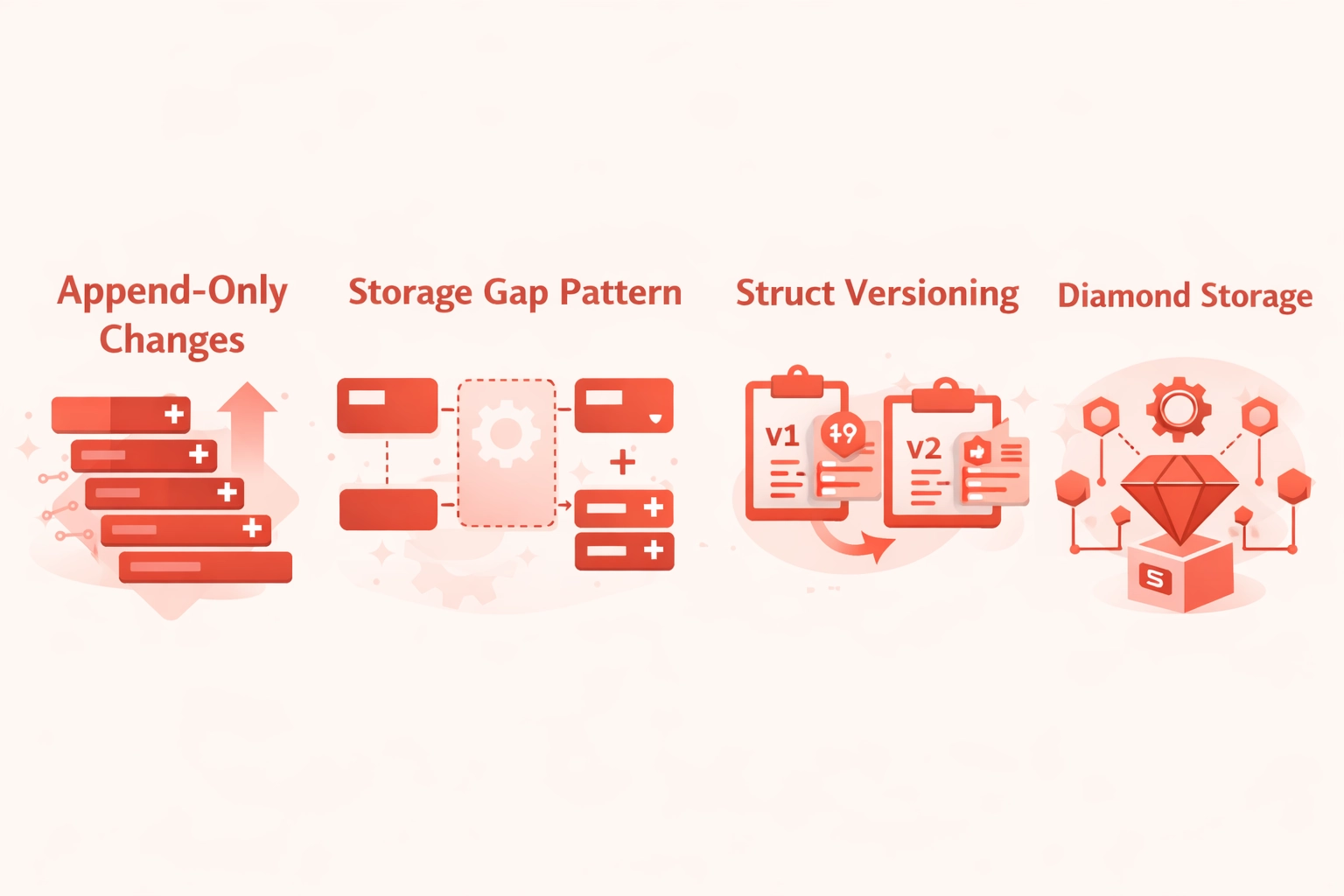
Structs in Upgradeable and Modular Structs in Smart Contracts Systems
Selecting the right upgrade strategy ensures struct compatibility across contract versions while maintaining data integrity.
Append-Only Changes
Only add new members at the end of existing structs. Never remove, rename, or reorder existing fields to preserve storage layout.
Storage Gap Pattern
Reserve empty storage slots using fixed-size arrays. This creates space for future struct expansion without affecting other variables.
Struct Versioning
Include version fields in structs to handle migration logic. Different versions can be processed appropriately during upgrades.
Diamond Storage
Use EIP-2535 diamond pattern with isolated storage per facet. Each facet manages its own struct storage independently.
Common Mistakes Developers Make When Using Structs
Even experienced developers encounter pitfalls when working with structs in smart contracts. One frequent mistake is forgetting that assigning a storage struct to a memory variable creates a copy, not a reference. Modifications to the memory copy do not persist unless explicitly written back to storage. This behavior has caused numerous bugs in production Structs in Smart Contracts.
Another common error involves returning large structs from external functions. While this works technically, it consumes significant gas for encoding and decoding. Returning only necessary fields or using separate getter functions for individual members often proves more efficient for Structs in Smart Contracts handling frequent queries.
Developers also frequently create overly complex nested structures that become difficult to test and audit. During security reviews for clients in the USA and UAE, we regularly recommend flattening deeply nested structs or using mapping indirection to simplify data access patterns while maintaining logical relationships.
Security Considerations When Structs Hold Critical Data
Protecting sensitive data stored in structs requires comprehensive security measures throughout the contract lifecycle.
Principle 1: Implement access controls for all functions that modify struct data to prevent unauthorized changes.
Principle 2: Validate all input values before storing in structs to prevent invalid state from entering the system.
Principle 3: Use checks-effects-interactions pattern when struct modifications precede external calls to prevent reentrancy.
Principle 4: Consider privacy implications as all struct data is publicly readable on the blockchain despite visibility modifiers.
Principle 5: Implement struct existence checks before reading to handle uninitialized or deleted struct scenarios gracefully.
Principle 6: Use timelock mechanisms for critical struct modifications in governance and financial protocol contexts.
Principle 7: Emit events when struct data changes to enable off-chain monitoring and security alert systems.
Principle 8: Conduct formal verification for structs holding high-value data in protocols managing significant assets.
Future-Proof Smart Contracts with Well-Designed Structs
Building future-proof Structs in Smart Contracts requires anticipating protocol evolution while maintaining backward compatibility. Well-designed structs serve as the foundation for systems that can adapt to changing requirements without requiring complete rewrites or risky data migrations. This approach has proven invaluable for long-running protocols serving users across the USA, UK, UAE, and Canada.
| Strategy | Implementation | Benefit |
|---|---|---|
| Extensible Fields | bytes32 for flexible data encoding | Store varied data types without struct changes |
| Version Tracking | uint8 version field in structs | Handle different struct versions gracefully |
| Metadata Mapping | Separate mapping for extra data | Add attributes without struct modification |
| Interface Abstraction | Define struct access through interfaces | Decouple implementation from usage |
| Documentation | NatSpec and design rationale | Enable informed future modifications |
Struct Design Compliance and Governance Checklist
Code Quality
- Struct naming follows conventions
- All members documented with NatSpec
- Variable ordering optimized for packing
Security Review
- Access controls verified for all setters
- Input validation implemented
- Reentrancy patterns checked
Upgrade Safety
- Storage gaps included for expansion
- No field removals or reordering
- Version tracking implemented
Testing Coverage
- Unit tests for all struct operations
- Edge cases and boundaries tested
- Gas consumption benchmarked
Build Scalable Structs in Smart Contracts with Expert Struct Design!
Partner with our experienced team to create production-ready blockchain applications using optimized struct patterns and security best practices.
Frequently Asked Questions
Q1.1. What are structs in smart contracts and why are they used?
Structs in smart contracts are custom data types that group related variables together under a single name. They help organize complex data like user profiles, orders, or assets into logical units. Structs improve code readability, reduce errors, and make Structs in Smart Contracts easier to maintain and scale for enterprise blockchain applications.
Q2.2. How do you define a struct in Solidity?
In Solidity, structs are defined using the struct keyword followed by a name and curly braces containing member variables. Each member has a type and name. Structs can contain various data types including addresses, integers, booleans, and even other structs, enabling complex data modeling for decentralized applications.
Q3.3. What is the difference between memory and storage structs?
Storage structs persist on the blockchain permanently and cost more gas to modify. Memory structs exist temporarily during function execution and are cheaper to use. Choosing between them impacts gas costs significantly. Storage is used for permanent state while memory handles temporary calculations during transactions.
Q4.4. Can structs contain mappings or arrays in Solidity?
Structs can contain arrays but have limitations with mappings. Mappings inside structs cannot be created in memory, only in storage. This restriction affects how developers design data models. Arrays within structs work normally but increase complexity and gas costs when manipulating nested data structures.
Q5.5. How do structs help with gas optimization in smart contracts?
Properly designed structs optimize gas by packing smaller variables together in single storage slots. Solidity stores variables in 32-byte slots, so arranging uint8, bool, and address types consecutively reduces storage operations. This technique can save substantial gas costs in Structs in Smart Contracts processing thousands of transactions.
Q6.6. What are common mistakes when using structs in smart contracts?
Common mistakes include inefficient variable ordering causing excess storage slots, returning large structs from external functions, not using memory keyword appropriately, and creating deeply nested structs that complicate code. Developers also often forget that struct assignments create copies in memory, leading to unexpected behavior.
Q7.7. Are structs supported in upgradeable smart contracts?
Structs work in upgradeable Structs in Smart Contracts but require careful planning. Adding new members to existing structs can corrupt storage layout. Best practices include adding new variables only at the end, using storage gaps, and never removing or reordering existing struct members to maintain compatibility across upgrades.
Explore Services
Related Services
Reviewed by

Aman Vaths
Founder of Nadcab Labs
Aman Vaths is the Founder & CTO of Nadcab Labs, a global digital engineering company delivering enterprise-grade solutions across AI, Web3, Blockchain, Big Data, Cloud, Cybersecurity, and Modern Application Development. With deep technical leadership and product innovation experience, Aman has positioned Nadcab Labs as one of the most advanced engineering companies driving the next era of intelligent, secure, and scalable software systems. Under his leadership, Nadcab Labs has built 2,000+ global projects across sectors including fintech, banking, healthcare, real estate, logistics, gaming, manufacturing, and next-generation DePIN networks. Aman’s strength lies in architecting high-performance systems, end-to-end platform engineering, and designing enterprise solutions that operate at global scale.