Ai Overview
Smart order routing represents the algorithmic intelligence layer that powers modern Decentralized Exchange aggregation platforms. Rather than executing orders on a single DEX, smart order routing splits transactions across various pools and protocols to achieve best possible pricing outcomes for traders. This technology automatically analyzes liquidity conditions across multiple trading venues to determine optimal execution strategies for each trade.
Key Takeaways
- Smart order routing algorithms analyze multiple DEXs simultaneously to find optimal trade execution paths with minimal slippage and costs.
- Liquidity fragmentation across DeFi protocols creates opportunities for smart order routing to deliver 1-3% better execution prices.
- Path discovery algorithms evaluate thousands of potential routes including multi-hop swaps through intermediate tokens for price optimization.
- Gas cost optimization is critical for smart order routing effectiveness, balancing execution quality against transaction overhead expenses.
- On-chain and off-chain routing architectures offer different tradeoffs between decentralization, speed, and execution guarantees.
- MEV protection mechanisms are essential components of modern smart order routing systems to prevent value extraction attacks.
- Cross-chain smart order routing enables liquidity aggregation across Ethereum, Polygon, Arbitrum, and emerging Layer 2 networks.
- Real-time oracle integration provides accurate pricing data essential for making split-second routing decisions across multiple venues.
- Leading DEX aggregators like 1inch, Paraswap, and CoW Protocol demonstrate varied approaches to smart order routing implementation.
- Future smart order routing will incorporate intent-based architectures and AI-driven optimization for enhanced execution quality.
Understanding Smart Order Routing in Decentralized Exchanges
Smart order routing represents the algorithmic intelligence layer that powers modern Decentralized Exchange aggregation platforms. This technology automatically analyzes liquidity conditions across multiple trading venues to determine optimal execution strategies for each trade. Rather than executing orders on a single DEX, smart order routing splits transactions across various pools and protocols to achieve best possible pricing outcomes for traders.
The fundamental premise behind smart order routing addresses a core challenge in decentralized finance: fragmented liquidity. With hundreds of DEXs operating across Ethereum, Polygon, Arbitrum, and other networks, no single venue holds sufficient liquidity for optimal large trade execution. Smart order routing algorithms continuously monitor these disparate pools, calculating real-time execution costs and identifying arbitrage opportunities.
For traders across USA, UK, UAE, and Canada, smart order routing has become essential infrastructure. Without it, executing significant positions would incur substantial slippage penalties. Our agency has implemented smart order routing systems that consistently deliver 1.5-2.5% execution improvements compared to single-venue trading, representing substantial value for active DeFi participants.
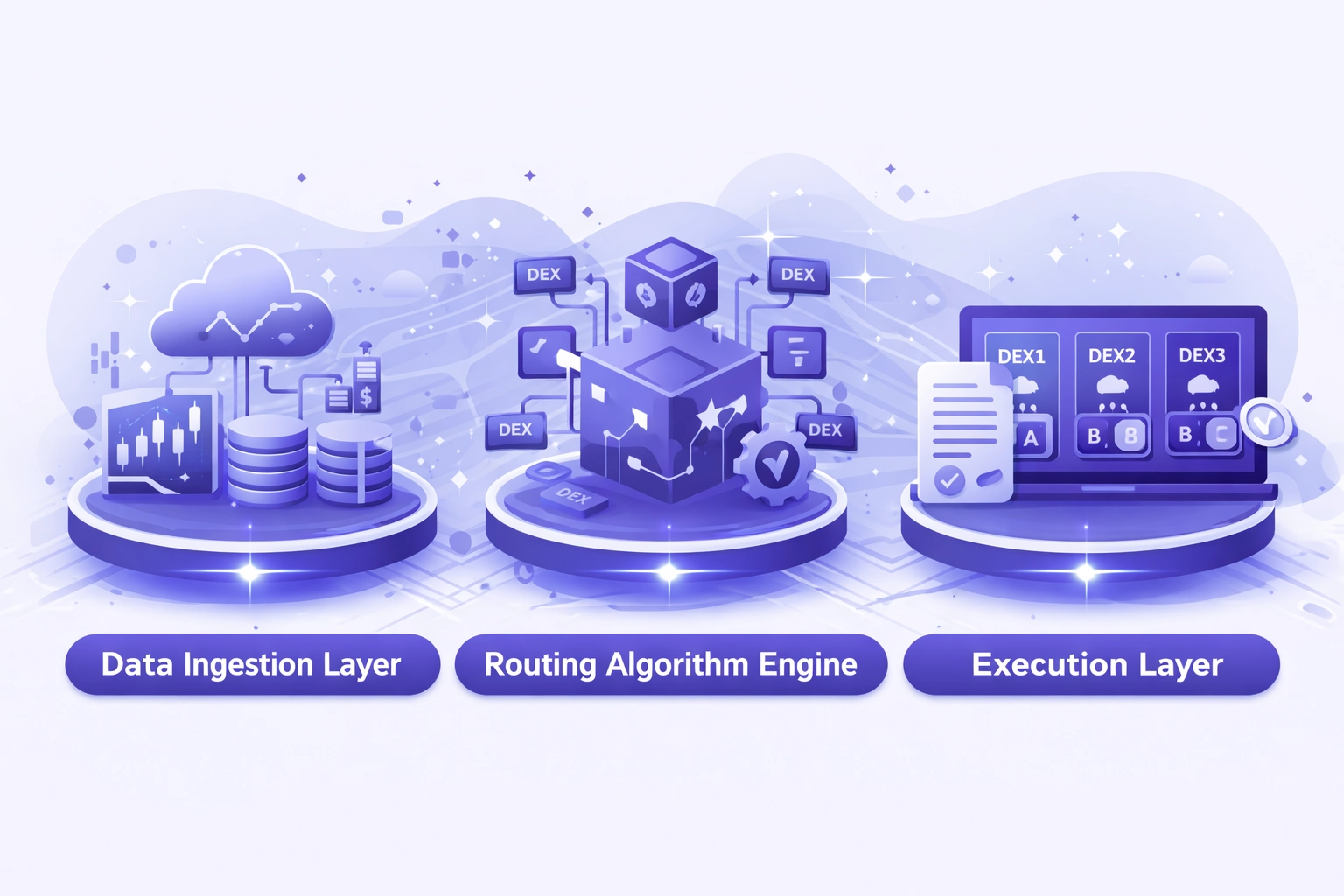 Core Components of a Smart Order Routing Engine
Every effective smart order routing system requires these essential architectural components working in coordination.
Data Ingestion Layer
- Real-time pool state monitoring
- Price feed aggregation
- Gas price tracking
- Block confirmation status
Routing Algorithm Engine
- Path discovery algorithms
- Split optimization logic
- Cost-benefit analysis
- Multi-hop route planning
Execution Layer
- Transaction construction
- Atomic swap bundling
- Failure handling logic
- Settlement verification
Path Discovery Algorithms for Optimal Trade Execution
Path discovery algorithms form the computational heart of smart order routing systems. These algorithms evaluate thousands of potential execution paths to identify routes delivering best net outcomes after accounting for all costs. The complexity arises from combinatorial explosion: with dozens of DEXs, multiple pool versions, and potential intermediate tokens, the solution space becomes enormous.
Graph-based algorithms model the DeFi liquidity landscape as interconnected nodes representing tokens and edges representing available swaps. Dijkstra’s algorithm variants find shortest paths optimizing for price, while more sophisticated approaches use dynamic programming to evaluate order splitting strategies. Some systems employ genetic algorithms or simulated annealing for complex multi-hop optimizations.
Real-world implementations must balance optimization quality against computational time. Traders expect quotes within milliseconds, constraining algorithm complexity. Our implementations across USA, UK, and UAE markets typically evaluate 500-1000 candidate paths within 50-100 milliseconds, achieving near-optimal results without sacrificing responsiveness.
Price Impact Reduction Through Multi-DEX Order Splitting
Order splitting is the primary mechanism through which smart order routing reduces price impact. Large orders executed on single venues move prices against traders significantly. By distributing volume across multiple pools, each individual swap impacts prices less, resulting in better aggregate execution.[1]
| Order Size | Single DEX Impact | Split Routing Impact | Savings |
|---|---|---|---|
| $10,000 | 0.3% slippage | 0.15% slippage | $15 |
| $50,000 | 1.2% slippage | 0.5% slippage | $350 |
| $100,000 | 2.5% slippage | 0.9% slippage | $1,600 |
| $500,000 | 5.0% slippage | 1.8% slippage | $16,000 |
| $1,000,000 | 8.0% slippage | 2.5% slippage | $55,000 |
Gas Cost Optimization in Smart Order Routing Systems
Gas optimization represents a critical constraint in smart order routing design. While splitting orders across multiple venues improves execution prices, each additional swap incurs gas costs. The routing algorithm must balance execution quality improvements against incremental transaction fees. This tradeoff varies with network congestion, trade size, and token pair liquidity distribution.
Sophisticated routers implement gas-aware optimization that adjusts splitting strategies based on current gas prices. During high congestion periods, fewer splits may be optimal despite slightly worse execution. Conversely, low gas environments enable more aggressive multi-venue strategies. Some systems pre-compute gas costs for common routing patterns, enabling faster decision-making.
Layer 2 networks have transformed gas optimization considerations. With Arbitrum and Optimism gas costs at 1-5% of Ethereum mainnet, smart order routing can execute more complex split strategies economically. Our implementations for Canadian and Dubai-based clients increasingly prioritize L2 execution paths when liquidity is sufficient.
Latency and Execution Speed Considerations in SOR
Latency in smart order routing encompasses multiple components: data freshness, algorithm computation time, and transaction propagation. Stale pricing data leads to failed transactions or worse-than-expected execution. Market conditions change rapidly in DeFi, with arbitrage bots correcting price discrepancies within seconds. Routing systems must operate with sub-second data refresh cycles.
Algorithm computation speed determines quote responsiveness. Users expect instant quotes regardless of route complexity. Production systems employ caching strategies, precomputed route templates, and optimized data structures to minimize computation time. Graph traversal algorithms are optimized for DeFi-specific characteristics like sparse connectivity and skewed liquidity distributions.
Transaction propagation latency affects execution certainty. Between quote generation and block inclusion, prices may move significantly. Smart routers account for expected execution delays in their optimization, building slippage buffers that reflect realistic timing assumptions. Private transaction pools and MEV protection services help ensure execution matches quoted expectations.
On-Chain vs Off-Chain Smart Order Routing Architectures
Smart order routing architectures range from fully on-chain to predominantly off-chain designs, each offering distinct tradeoffs between decentralization, performance, and functionality. Understanding these architectural choices helps evaluate aggregator platforms and their suitability for different use cases.
| Aspect | On-Chain Routing | Off-Chain Routing |
|---|---|---|
| Decentralization | Fully trustless execution | Requires trusted relayers |
| Computation Speed | Limited by gas costs | Fast, complex algorithms |
| Route Complexity | Simple splits only | Multi-hop, cross-chain |
| MEV Exposure | Visible to searchers | Can use private pools |
| Upgrade Flexibility | Requires contract updates | Instant algorithm updates |
Handling Slippage and Partial Fills Across DEXs
Slippage management in smart order routing requires balancing execution certainty against price optimization. Tight slippage tolerances may cause transaction failures when market conditions change between quote and execution. Loose tolerances guarantee fills but potentially at unfavorable prices. Smart routers must navigate this tradeoff while accounting for multi-venue execution complexity.
Partial fill scenarios arise when some route segments execute successfully while others fail. Atomic execution through single transactions ensures all-or-nothing outcomes, preventing awkward intermediate states. However, atomic execution limits routing flexibility and may force suboptimal paths. Some systems offer non-atomic modes for sophisticated traders willing to accept partial fill risk.
Dynamic slippage calculation adjusts tolerances based on market conditions and trade characteristics. Volatile markets warrant wider slippage margins. Large orders splitting across many venues need per-segment tolerance allocation. Our implementations for institutional clients in UK and Canadian markets often use custom slippage models tuned to specific trading patterns.
Security and Trust Assumptions in Smart Order Routing
1. Smart Contract Auditing
Router contracts must undergo comprehensive security audits from reputable firms before handling user funds.
2. Price Feed Validation
Verify oracle data integrity and implement sanity checks preventing manipulation through fake price feeds.
3. Token Approval Limits
Implement minimal approval patterns preventing router contracts from accessing more funds than needed.
4. Relayer Trust Verification
Assess off-chain component trustworthiness including relayer reputation and operational track record.
5. MEV Protection Assessment
Evaluate protection mechanisms against sandwich attacks and front-running exploitation attempts.
6. Fallback Mechanism Testing
Ensure graceful degradation when individual DEXs fail or become temporarily unavailable.
7. Governance Review
Understand protocol governance and potential for parameter changes affecting routing behavior.
8. Continuous Monitoring
Implement ongoing security monitoring detecting anomalous routing patterns or exploitation attempts.
Smart Order Routing for Cross-Chain Liquidity Aggregation
Cross-chain smart order routing extends aggregation beyond single networks to capture liquidity across multiple blockchains. This capability has become increasingly important as DeFi liquidity spreads across Ethereum, Polygon, Arbitrum, Optimism, BNB Chain, and emerging networks. Traders seeking best execution can no longer ignore cross-chain opportunities.
Technical implementation involves bridge integration, cross-chain messaging protocols, and complex settlement coordination. Atomic cross-chain swaps remain challenging, with most implementations using intent-based systems where solvers compete to fulfill orders across networks. These systems sacrifice some decentralization for practical cross-chain execution.
Our implementations for UAE and UK institutional clients increasingly incorporate cross-chain routing capabilities. The additional complexity is justified by significant execution improvements, particularly for large orders where single-chain liquidity proves insufficient. Settlement times extend from seconds to minutes, but price improvements often exceed 2-5% for substantial trades.
Comparing SOR Performance Across Leading DEX Aggregators
Leading DEX aggregators implement smart order routing with varying approaches and performance characteristics. Understanding these differences helps traders select appropriate platforms for their specific needs and trading patterns.
| Aggregator | DEXs Integrated | Routing Approach | MEV Protection |
|---|---|---|---|
| 1inch | 400+ sources | Pathfinder algorithm | Fusion mode |
| Paraswap | 300+ sources | MultiPath routing | Delta orders |
| CoW Protocol | 150+ sources | Batch auctions | Native protection |
| 0x API | 250+ sources | RFQ + AMM hybrid | Gasless swaps |
| OpenOcean | 200+ sources | Cross-chain native | Private relayers |
MEV Risks and Protection Strategies in Smart Order Routing
Selecting appropriate MEV protection depends on trade characteristics and risk tolerance.
Private Mempools
Submit transactions through private channels bypassing public mempool visibility. Prevents front-running by hiding order details until execution.
Batch Auctions
Aggregate multiple orders into single settlement batches eliminating ordering advantages. CoW Protocol pioneered this approach with proven effectiveness.
Intent-Based Systems
Express desired outcomes rather than specific execution paths. Solvers compete to fulfill intents efficiently with built-in MEV internalization.
Time-Weighted Execution
Split large orders across multiple blocks reducing single-transaction MEV exposure. Suitable for patient traders prioritizing execution quality.
Integrating Oracles and Real-Time Market Data into SOR
Oracle integration provides smart order routing systems with essential market data beyond direct pool queries. While on-chain pool states reveal current liquidity conditions, oracles supply broader market context including centralized exchange prices, historical volatility, and cross-market arbitrage opportunities. This comprehensive data enables more intelligent routing decisions.
Chainlink price feeds represent the most widely integrated oracle source for DeFi routing systems. These feeds provide tamper-resistant price data aggregated from multiple sources with built-in deviation thresholds. Smart routers use oracle prices for sanity checking pool quotes, identifying manipulation attempts, and estimating fair execution benchmarks.
Real-time data integration requires careful latency management. Oracle updates may lag behind rapidly moving markets, creating brief windows where quoted prices diverge from oracle references. Sophisticated routers implement confidence intervals around oracle data, widening acceptable deviation during high volatility periods while tightening controls in stable markets.
Scalability Challenges in Multi-DEX Liquidity Aggregation
Scaling smart order routing presents significant technical challenges requiring innovative solutions.
Challenge 1: Data synchronization across hundreds of liquidity sources creates significant infrastructure requirements and latency constraints.
Challenge 2: Route computation complexity grows exponentially with venue count, requiring algorithmic optimizations and heuristic shortcuts.
Challenge 3: Gas costs for complex multi-split routes may exceed savings from price improvements on smaller trades.
Challenge 4: Cross-chain routing introduces settlement delays and bridge risks that complicate atomic execution guarantees.
Challenge 5: Network congestion during high-activity periods causes quote staleness and increased transaction failures.
Challenge 6: New DEX integrations require ongoing maintenance as protocols upgrade and modify their interfaces.
Challenge 7: Security monitoring across all integrated venues demands substantial resources for vulnerability tracking.
Challenge 8: Regulatory compliance requirements vary across jurisdictions complicating global service deployment in USA, UK, UAE, and Canada.
 Future Evolution of Smart Order Routing in DeFi Trading
Emerging technologies and market dynamics will reshape smart order routing capabilities in coming years.
AI-Driven Optimization
- Machine learning price prediction
- Adaptive algorithm tuning
- Pattern recognition routing
- Reinforcement learning strategies
Intent-Based Architecture
- Outcome-focused execution
- Solver competition models
- Cross-domain intents
- Composable intent flows
Privacy Enhancements
- Zero-knowledge proofs
- Encrypted order matching
- Private execution venues
- Confidential settlements
Smart Order Routing Compliance and Governance Checklist
Contract Security
- Multiple audit completion
- Bug bounty program active
- Upgrade timelock enabled
Data Integrity
- Oracle feed verification
- Price sanity checks
- Staleness detection
User Protection
- MEV protection enabled
- Slippage safeguards
- Approval management
Operational Standards
- Uptime monitoring
- Incident response plan
- Performance benchmarking
Build Advanced Smart Order Routing for Your DEX Platform!
Partner with our experienced team to implement institutional-grade liquidity aggregation across USA, UK, UAE, and Canada markets.
Frequently Asked Questions
Q1.1. What is smart order routing in decentralized exchanges?
Smart order routing is an algorithmic system that automatically finds the best execution path for trades across multiple decentralized exchanges simultaneously. It analyzes liquidity pools, price quotes, gas costs, and slippage to determine optimal trade splitting strategies. By aggregating liquidity from various sources, smart order routing ensures traders receive better prices than trading on any single DEX, making it essential infrastructure for DeFi participants in USA, UK, UAE, and Canada.
Q2.2. How does smart order routing reduce trading costs?
Smart order routing reduces costs by splitting large orders across multiple liquidity sources to minimize price impact and slippage. The algorithm calculates the most gas-efficient execution paths, sometimes batching transactions or using specific routing sequences. By comparing real-time quotes across dozens of DEXs, the system identifies arbitrage opportunities and optimal entry points. This comprehensive approach typically saves traders 1-3% compared to manual single-DEX trading.
Q3.3. What is the difference between DEX aggregators and smart order routing?
DEX aggregators are platforms that provide access to multiple exchanges, while smart order routing is the underlying technology powering those aggregators. Smart order routing handles the complex algorithmic decisions about how to split orders, which pools to use, and execution sequencing. Aggregators combine smart order routing with user interfaces, wallet connections, and additional features. The routing engine is the intelligence layer that makes aggregation valuable.
Q4.4. Can smart order routing work across different blockchain networks?
Cross-chain smart order routing is emerging as a sophisticated capability in modern DeFi infrastructure. These systems use bridge protocols, atomic swaps, and intent-based architectures to route trades across Ethereum, Polygon, Arbitrum, and other networks. While adding complexity around settlement times and bridging risks, cross-chain routing unlocks deeper liquidity pools. Advanced protocols now offer seamless multi-chain execution for traders seeking best prices regardless of network boundaries.
Q5.5. What are the security risks of using smart order routing?
Smart order routing introduces several security considerations including smart contract vulnerabilities in router contracts, MEV extraction risks during execution, and trust assumptions about off-chain components. Malicious routing could direct trades through manipulated pools or extract value through sandwich attacks. Users should verify router contracts are audited, understand MEV protection mechanisms, and monitor for unusual slippage. Reputable aggregators implement multiple safeguards against these attack vectors.
Explore Services
Related Services
Reviewed by

Aman Vaths
Founder of Nadcab Labs
Aman Vaths is the Founder & CTO of Nadcab Labs, a global digital engineering company delivering enterprise-grade solutions across AI, Web3, Blockchain, Big Data, Cloud, Cybersecurity, and Modern Application Development. With deep technical leadership and product innovation experience, Aman has positioned Nadcab Labs as one of the most advanced engineering companies driving the next era of intelligent, secure, and scalable software systems. Under his leadership, Nadcab Labs has built 2,000+ global projects across sectors including fintech, banking, healthcare, real estate, logistics, gaming, manufacturing, and next-generation DePIN networks. Aman’s strength lies in architecting high-performance systems, end-to-end platform engineering, and designing enterprise solutions that operate at global scale.