Ai Overview
Smart contracts are self-executing programs that run on blockchain networks, automatically enforcing rules and processing transactions without intermediaries. Chainlink is the dominant oracle network, securing over $75 billion in DeFi value across hundreds of protocols. Storing 1KB of data on Ethereum costs approximately $15 to $50 depending on gas prices. The Ronin Bridge hack in 2022 resulted in $625 million stolen through compromised validator keys on backend infrastructure.
Introduction to Smart Contracts and Backend Integration
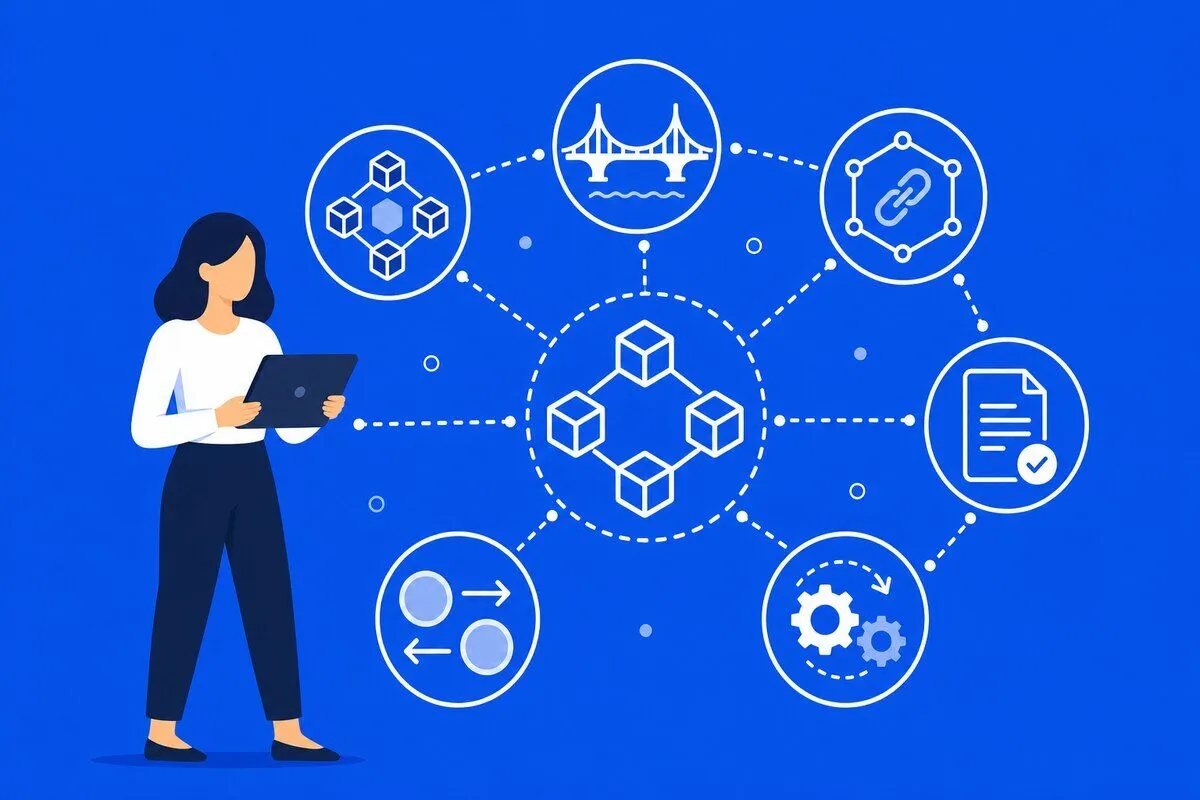
Smart contracts are self-executing programs that run on blockchain networks, automatically enforcing rules and processing transactions without intermediaries. They are powerful, but they do not work in isolation. Every real-world blockchain application needs traditional backend systems to handle things like user management, data storage, notifications, analytics, and integrations with external services. Understanding how smart contract service connect with these backend systems is the foundation of building production-grade decentralized applications.
The challenge is that blockchain and traditional server environments operate on fundamentally different principles. Blockchains are decentralized, deterministic, and permanent. Backend servers are centralized, flexible, and mutable. When smart contracts connect with backend systems, you are essentially bridging two very different computing paradigms. This requires careful architecture decisions about data flow, synchronization, security, and error handling to make the two worlds work together seamlessly.
Our agency has been building blockchain applications with robust backend integrations for over eight years. We have smart contracts connect to payment systems, CRM platforms, analytics engines, identity providers, and dozens of other backend services across DeFi, NFT, supply chain, and enterprise projects. This guide shares practical lessons from real deployments about how smart contracts connect with backend infrastructure and what it takes to make those connections reliable, secure, and performant in production environments.
Why Backend Systems Matter in Blockchain Apps
02
Many people think of blockchain apps as purely on-chain systems, but that is far from reality. Even the simplest decentralized application (dApp) needs backend services for essential functions that blockchains are not designed to handle. User authentication typically requires traditional auth servers. File storage needs off-chain solutions like IPFS or AWS S3 because storing files on-chain is prohibitively expensive. Email and push notifications require backend services. Analytics and monitoring run on traditional servers. These backend systems are what make blockchain applications actually usable.
The way smart contracts connect with these backend services determines the overall performance, security, and user experience of your application. A poorly designed integration layer creates latency, data inconsistencies, and security vulnerabilities. A well-designed one makes the blockchain complexity invisible to users while ensuring that on-chain and off-chain systems stay perfectly synchronized. The backend is where you handle the messy real-world complexity that smart contracts alone cannot manage.
Real-world example: Uniswap, one of the largest decentralized exchanges, processes trades entirely through smart contracts. But its user interface is served from backend servers. Token metadata comes from off-chain APIs. Price charts pull from The Graph indexing service. Gas estimation runs through backend calculations. The “decentralized” exchange actually relies on dozens of backend services that smart contracts connect to for the complete user experience.
How Smart Contracts Communicate with Off-Chain Systems
Smart contracts communicate with off-chain systems through a set of well-defined patterns that have become industry standards over the past several years. The most common pattern is event-driven communication, where smart contracts emit events during execution that backend listeners detect and act upon. The second major pattern is transaction-based communication, where backend services initiate interactions by sending signed transactions to smart contract functions. The third pattern uses oracle services to bring external data into the contract environment.
Each of these communication patterns serves a different purpose. Events flow from blockchain to backend. Transactions flow from backend to blockchain. Oracles bring external world data into the blockchain. In practice, most applications use all three patterns together to create a complete bidirectional communication layer between their smart contracts and backend systems. Understanding when and how smart contracts connect through each pattern is essential for designing reliable integration architectures.
| Communication Pattern | Direction | Used For | Key Tools |
|---|---|---|---|
| Event Emission | Blockchain → Backend | Notifications, DB updates, triggers | ethers.js, The Graph, Alchemy |
| Transactions | Backend → Blockchain | State changes, fund transfers | web3.js, Hardhat, Foundry |
| Oracle Requests | External → Blockchain | Price feeds, API data, randomness | Chainlink, Band Protocol, API3 |
| Read Calls | Backend → Blockchain (read-only) | Balance checks, state queries | Infura, Alchemy, QuickNode |
Role of APIs in Smart Contract Integration
APIs are the universal language that lets different software systems talk to each other, and they play a critical role in how smart contracts connect with backend infrastructure. On the backend side, you build REST or GraphQL APIs that your frontend and other services call to interact with your smart contracts. These APIs abstract the blockchain complexity, handling wallet management, transaction signing, gas estimation, and error handling behind clean endpoints that non-blockchain services can consume easily.
Node infrastructure providers like Alchemy and Infura expose JSON-RPC APIs that let your backend communicate with blockchain nodes without running your own infrastructure. The Graph provides a GraphQL API for querying indexed blockchain data efficiently. Block explorer APIs from Etherscan provide transaction and contract verification endpoints. All of these API layers work together to create the communication infrastructure that lets smart contracts connect with the broader application ecosystem. Your backend API design determines how cleanly these pieces integrate.
Using Oracles to Fetch External Data
05
Oracles solve one of blockchain’s most fundamental limitations: the inability to access external data. Smart contracts live in a sealed, deterministic environment where every node must produce identical results. If a contract could call an external API directly, different nodes might get different responses, breaking consensus. Oracles solve this by running off-chain infrastructure that fetches external data and delivers it to smart contracts through on-chain transactions. When smart contracts connect to real-world data through oracles, entirely new categories of applications become possible.
Chainlink is the dominant oracle network, securing over $75 billion in DeFi value across hundreds of protocols. It uses a decentralized network of node operators who independently fetch and validate data before delivering it on-chain. This prevents single points of failure and data manipulation. Other oracle solutions include Band Protocol (cross-chain focused), API3 (first-party oracle networks), and Pyth Network (high-frequency financial data). Real-world example: Aave, one of the largest DeFi lending protocols, relies on Chainlink price oracles to determine collateral values. If those oracle feeds were compromised, billions in user funds could be liquidated incorrectly.
Event Listeners and Real-Time Updates
Event listeners are the primary mechanism that enables real-time communication from blockchain smart contracts to backend systems. In Solidity, developers define events within smart contracts that get emitted during function execution. For example, an ERC-20 token contract emits a Transfer event every time tokens move between addresses. Backend services subscribe to these events through WebSocket connections to blockchain nodes, receiving instant notifications whenever the subscribed events fire on-chain.
When a backend listener catches an event, it triggers predefined workflows. A Transfer event might update the user’s balance in the database, send a notification to the recipient, log the transaction for analytics, and trigger downstream business logic. This event-driven architecture is how most production applications maintain synchronization between their blockchain and backend states. Smart contracts connect to the broader application through events more frequently than through any other mechanism.
The biggest operational challenge with event listeners is handling reliability. According to CoinsBench Blogs, Blockchain nodes can disconnect, listeners can crash, and events can be missed during node synchronization or chain reorganizations. Production systems need robust listener infrastructure with automatic reconnection, missed event recovery through historical log scanning, and idempotent processing to handle duplicate events safely. Tools like The Graph handle much of this complexity by providing a reliable indexing and query layer that smooths out the rough edges of direct event listening.
Handling User Authentication with Backend Services
Authentication in blockchain applications is fundamentally different from traditional web apps. Instead of username-password combinations, users authenticate by proving ownership of their blockchain wallet through cryptographic signatures. The standard flow goes like this: the backend generates a random nonce (unique message), the user signs it with their wallet (MetaMask, WalletConnect), the backend verifies the signature to confirm the wallet owner is who they claim to be, and then issues a session token (typically JWT) for subsequent API calls. This is how smart contracts connect user identity to backend services.
The backend handles the entire authentication flow: generating nonces, verifying signatures using ecrecover, creating and managing JWT tokens, and linking wallet addresses to user profiles in the database. Once authenticated, users can interact with both traditional API endpoints and blockchain functions through the same session. The backend acts as a coordinator, determining which operations need on-chain transactions (like token transfers) and which can be handled off-chain (like updating profile settings). This hybrid authentication model is standard across dApps like OpenSea, Aave, and Uniswap.
Storing Data On-Chain vs Off-Chain
08
Data storage strategy is one of the most important architecture decisions when smart contracts connect with backend systems. On-chain storage is permanent, transparent, and tamper-proof, but it is extremely expensive. Storing 1KB of data on Ethereum costs approximately $15 to $50 depending on gas prices. Off-chain storage in traditional databases is fast, cheap, and flexible, but it does not provide the same immutability and transparency guarantees. The vast majority of production blockchain applications use a hybrid approach that puts the right data in the right place.
The general rule is: store essential state data on-chain and everything else off-chain. Token balances, ownership records, approval states, and critical financial calculations belong on the blockchain. User profiles, metadata, images, documents, activity logs, and analytics data belong in off-chain databases. The bridge between these two storage layers is where smart contracts connect to backend systems through events, IPFS hashes stored on-chain, and database records indexed by on-chain identifiers like transaction hashes and block numbers.
| Factor | On-Chain Storage | Off-Chain Storage |
|---|---|---|
| Cost | Very expensive ($15-50+ per KB) | Very cheap (fractions of a cent) |
| Speed | Slow (block confirmation times) | Fast (milliseconds) |
| Immutability | Permanent and tamper-proof | Mutable, can be changed |
| Transparency | Publicly visible to anyone | Private, access-controlled |
| Best For | Balances, ownership, approvals | Profiles, metadata, analytics |
Middleware in Smart Contract Architecture
Middleware is the glue layer that makes it practical for smart contracts connect with complex backend systems without forcing either side to know the details of the other. In blockchain architecture, middleware handles transaction management (nonce tracking, gas estimation, retry logic), data transformation (converting between blockchain data formats and API-friendly JSON), event processing (filtering, batching, and routing events to appropriate handlers), and error recovery (handling failed transactions, chain reorganizations, and network outages).
Without middleware, your backend code directly interacts with blockchain nodes, which creates tightly coupled, fragile, and hard-to-maintain systems. With a properly designed middleware layer, your backend services call simple, clean interfaces like “transferTokens(recipient, amount)” while the middleware handles all the blockchain complexity underneath: building the transaction object, estimating gas, managing nonces, signing with the appropriate key, submitting to the network, monitoring for confirmation, handling retries on failure, and emitting success or failure events back to the calling service.
Real-world example: A supply chain tracking platform we built used a custom Node.js middleware service that managed all blockchain interactions. The inventory management system simply called REST API endpoints. The middleware translated those calls into smart contract transactions, tracked their confirmation, and updated the inventory system with results. The inventory team never needed to understand blockchain at all because the middleware abstracted it completely. This separation of concerns made the system much easier to maintain and debug when issues arose.
Three Pillars of Smart Contract Backend Integration
Communication Layer
- Event listeners for blockchain-to-backend flow
- Signed transactions for backend-to-blockchain
- Oracle integration for external data feeds
- WebSocket connections for real-time updates
Data Management
- Hybrid on-chain and off-chain storage
- IPFS for decentralized file hosting
- Database synchronization with chain state
- Indexing services for efficient queries
Security Infrastructure
- HSM-based private key management
- Encrypted API communications (TLS)
- Input validation on all integration points
- Transaction signing with multi-sig support
Security Considerations in Backend Connections
Security is the most critical concern when smart contracts connect with backend systems because every integration point creates a potential attack vector. The most dangerous vulnerability is private key exposure. Backend servers that sign blockchain transactions must store private keys, and if those keys are compromised, attackers can drain all funds controlled by those keys. This is not theoretical. The Ronin Bridge hack in 2022 resulted in $625 million stolen through compromised validator keys on backend infrastructure.
Production systems must use hardware security modules (HSMs) or cloud key management services (AWS KMS, Google Cloud KMS) for private key storage. Keys should never exist in plaintext in code, environment variables, or configuration files. Beyond key management, backend connections need encrypted communications (TLS for all API calls), input validation on all data flowing between systems, rate limiting to prevent abuse, monitoring for unusual transaction patterns, and circuit breakers that halt operations if anomalies are detected. Every layer where smart contracts connect to external services needs its own security controls.
Managing Transactions from Backend Servers
11
Backend-initiated blockchain transactions are more complex than they appear because of several challenges unique to blockchain systems. Nonce management is the first hurdle. Every Ethereum transaction requires a sequential nonce, and if your backend sends multiple transactions simultaneously, nonce conflicts can cause failures. Gas estimation must be accurate enough to ensure transactions get included in blocks without overpaying. Transaction confirmation requires monitoring because a submitted transaction is not final until enough blocks have been mined on top of it.
Building a robust transaction management system requires queuing mechanisms, automatic nonce tracking with gap detection, dynamic gas pricing that adjusts to network conditions, confirmation monitoring with timeout handling, and retry logic for failed or stuck transactions. Smart contracts connect more reliably to backend systems when this transaction infrastructure is solid. We typically implement a dedicated transaction manager service that handles all outbound transactions, preventing the rest of the backend from dealing with blockchain complexity.
| Challenge | Impact | Solution |
|---|---|---|
| Nonce Conflicts | Transactions fail or get stuck | Sequential queue with gap detection |
| Gas Price Spikes | Transactions pending or too costly | Dynamic gas oracle with max limits |
| Chain Reorganization | Confirmed transactions get reversed | Wait for 12+ block confirmations |
| Network Outages | Transactions cannot be submitted | Multi-provider fallback with retry logic |
Synchronizing Blockchain and Database Records
Keeping blockchain state and database records in sync is one of the trickiest operational challenges in production blockchain applications. The blockchain is the source of truth for on-chain data, but your users interact with your application through backend APIs that query databases, not the blockchain directly. If your database falls behind the blockchain state (or worse, gets ahead of it), users see incorrect balances, missing transactions, or phantom operations that do not exist on-chain. This synchronization challenge is where most integration bugs live.
The most reliable synchronization pattern is event-sourced architecture where all database state changes are driven by confirmed blockchain events. Your backend listens for events, processes them idempotently (so processing the same event twice produces the same result), and updates database records accordingly. A reconciliation job runs periodically to compare database state against on-chain state and flag any discrepancies. The Graph simplifies this dramatically by providing a pre-indexed, queryable view of blockchain data that your backend can query directly instead of maintaining its own synchronization infrastructure. This is how mature applications ensure their smart contracts connect cleanly to their data layer.
Common Challenges in Integration
Integration between smart contracts and backend systems introduces unique challenges that traditional web applications never face. The most common issues include transaction finality uncertainty (is the transaction really final or could a chain reorganization reverse it?), gas price volatility that makes cost prediction difficult, data format mismatches between blockchain types and standard programming types, handling of failed or reverted transactions, and managing the inherent latency between submitting a transaction and receiving confirmation. Each of these challenges needs its own mitigation strategy.
| Challenge | Root Cause | Best Practice Solution |
|---|---|---|
| Finality Uncertainty | Chain reorgs can reverse transactions | Wait for 12+ confirmations for critical ops |
| Data Sync Drift | Database and chain state diverge | Event-sourced architecture + reconciliation |
| Gas Volatility | Network congestion spikes costs | Dynamic pricing with ceiling limits |
| Key Exposure Risk | Backend server compromise | HSM/KMS storage, never plaintext keys |
| Type Mismatches | Blockchain uses uint256, bytes32, etc. | Strict encoding/decoding with ABI library |
Best Practices for Reliable Communication
14
After building dozens of production blockchain applications, we have distilled our integration experience into a set of best practices that dramatically improve reliability. First, always treat the blockchain as the source of truth and drive all database state changes from confirmed on-chain events, never the other way around. Second, use multiple node providers (Alchemy, Infura, QuickNode) with automatic failover so a single provider outage does not take down your application. Third, implement idempotent event processing so that replaying events during recovery does not create duplicate records or actions.
Fourth, separate read and write operations into different services. Read operations (balance checks, state queries) can use any available node and tolerate brief inconsistencies. Write operations (transactions) need careful nonce management, gas handling, and confirmation tracking. Fifth, implement comprehensive monitoring that tracks transaction success rates, event processing lag, database sync status, and node connectivity health. Sixth, design every integration with graceful degradation in mind. When a backend service fails, the smart contracts should continue functioning normally. When smart contracts connect through well-designed architecture, individual component failures do not cascade into system-wide outages.
Authoritative Standards for Smart Contract Backend Integration
Standard 1: Store all private keys in hardware security modules or cloud KMS solutions. Never store keys in code, environment variables, or configuration files.
Standard 2: Use at minimum two independent node providers with automatic failover to prevent single points of failure in blockchain connectivity.
Standard 3: Implement idempotent event processing for all blockchain event handlers to safely handle replays during recovery and chain reorganization scenarios.
Standard 4: Wait for a minimum of 12 block confirmations before treating any financial transaction as final in your backend database records.
Standard 5: Run automated reconciliation jobs every 6 hours that compare on-chain state against database records and alert on any discrepancies found.
Standard 6: Validate and sanitize all data at every boundary where smart contracts connect to backend services to prevent injection and manipulation attacks.
Future of Hybrid Blockchain Architectures
The way smart contracts connect with backend systems is evolving rapidly, driven by several major trends. Account abstraction (ERC-4337) is fundamentally changing how users interact with blockchain applications by allowing smart contract wallets to replace traditional externally-owned accounts. This eliminates the need for users to manage private keys directly, shifting key management entirely to backend services that handle wallet creation, transaction signing, and gas sponsorship on behalf of users. The backend becomes even more critical in this model.
Chain abstraction is another major trend where middleware layers hide the complexity of multiple blockchains behind unified APIs. Instead of building separate integrations for Ethereum, Polygon, Arbitrum, and Optimism, chain abstraction platforms let your backend interact with all chains through a single interface. Layerzero, Axelar, and Wormhole are building this cross-chain infrastructure. AI-driven monitoring is also emerging, using machine learning to detect unusual transaction patterns, predict gas price movements, and automatically adjust backend parameters for optimal performance.
Real-world example: Biconomy is pioneering the account abstraction space, providing an SDK that lets applications bundle multiple transactions, sponsor gas fees for users, and execute cross-chain operations through a simple backend API. Applications using Biconomy create user experiences where people interact with blockchain without ever seeing wallet popups, gas fees, or transaction confirmations. This represents the future of how smart contracts connect with backend systems: seamlessly, invisibly, and with the user experience of a traditional web application.
Final Thoughts
Smart contracts are powerful tools for automating trusted transactions, but they do not work alone. Every production blockchain application depends on backend systems that handle authentication, data storage, notifications, analytics, and integration with the broader technology ecosystem. Understanding how smart contracts connect with these backend services through events, APIs, oracles, and middleware is what separates prototype dApps from production-grade platforms that serve real users at scale.
The key takeaway from this guide is that integration architecture matters as much as the smart contract code itself. Poorly designed connections between on-chain and off-chain systems create security vulnerabilities, data inconsistencies, and reliability problems that undermine the entire application. Well-designed integrations with proper event-driven synchronization, robust transaction management, secure key storage, and comprehensive monitoring create blockchain applications that users can trust and depend on.
The future is hybrid. Pure on-chain applications are rare. Pure off-chain applications miss the benefits of blockchain transparency and automation. The most successful blockchain projects are those where smart contracts connect seamlessly with traditional backend infrastructure, combining the best of both worlds. As account abstraction, chain abstraction, and AI monitoring continue to mature, these hybrid architectures will become even more powerful, more reliable, and more invisible to end users. That is the direction the industry is heading, and it is where the biggest opportunities lie.
Frequently Asked Questions
Q1.How do smart contracts connect with backend systems?
Smart contracts connect with backend systems through a combination of APIs, event listeners, and middleware layers. When a smart contract emits an event on the blockchain, backend services listen for that event and trigger corresponding actions like updating databases, sending notifications, or processing payments. Backend systems also initiate smart contract interactions by sending signed transactions through web3 libraries like ethers.js or web3.js. This two-way communication forms the backbone of every production blockchain application.
Q2.What are oracles in blockchain and why do smart contracts need them?
Oracles are specialized services that feed external real-world data into blockchain smart contracts. Since smart contracts cannot directly access data outside the blockchain, oracles act as trusted bridges that deliver information like price feeds, weather data, sports scores, or API responses. Chainlink is the most widely used oracle network, securing over $75 billion in value. Without oracles, smart contracts connect only to on-chain data, severely limiting their usefulness for real business applications.
Q3.What is middleware in smart contract architecture?
Middleware in smart contract architecture is a software layer that sits between the blockchain and your traditional backend systems. It handles transaction management, event processing, data transformation, error handling, and retry logic. Middleware abstracts the complexity of direct blockchain interaction so your backend can communicate with smart contracts through simpler, standardized interfaces. Popular middleware solutions include The Graph for indexing blockchain data and custom Node.js services that manage the two-way flow between on-chain and off-chain systems.
Q4.Should I store data on-chain or off-chain?
The decision depends on the data’s purpose and sensitivity. On-chain storage is ideal for critical transactional records, ownership proofs, and financial balances that need immutability and transparency. Off-chain storage suits large files, user profiles, metadata, and frequently updated information because blockchain storage is expensive and slow. Most production applications use a hybrid approach where smart contracts connect to off-chain databases through events and APIs, storing essential hashes on-chain while keeping detailed records in traditional databases.
Q5.How do event listeners work with smart contracts?
Event listeners are backend services that subscribe to specific events emitted by smart contracts on the blockchain. When a smart contract executes a function that includes an event emission (like a Transfer event in an ERC-20 token), the listener detects it and triggers predefined backend actions. These actions might include updating a database, sending email notifications, triggering webhook calls, or initiating follow-up transactions. Event listeners enable real-time synchronization between blockchain state and off-chain systems.
Q6.What security risks exist when smart contracts connect to backends?
The biggest risks include private key exposure on backend servers, man-in-the-middle attacks during API calls, oracle manipulation feeding false data to contracts, replay attacks re-submitting old transactions, and race conditions where backend and blockchain states fall out of sync. When smart contracts connect to external systems, every integration point becomes a potential attack vector. Securing these connections requires encrypted communications, hardware security modules for key storage, input validation, and robust error handling at every touchpoint.
Q7.Can smart contracts directly call external APIs?
No, smart contracts cannot directly call external APIs. The blockchain operates as a deterministic, isolated environment where every node must reach the same result when executing contract code. External API calls would introduce non-deterministic data that breaks consensus. Instead, smart contracts connect to external data through oracles, which are trusted third-party services that fetch API data off-chain and deliver it to the contract through on-chain transactions. This is a fundamental architectural constraint of all blockchain systems.
Q8.What tools help smart contracts connect with backend systems?
The primary tools include web3 libraries (ethers.js, web3.js, web3.py) for blockchain communication, Chainlink oracles for external data feeds, The Graph for indexing and querying blockchain data efficiently, Alchemy and Infura as node infrastructure providers, and Hardhat or Foundry for local testing environments. Backend frameworks like Node.js with Express, Python with Flask, and Go are commonly used to build the server-side services that interact with smart contracts through these libraries and tools.
Explore Services
Related Services
Reviewed by

Aman Vaths
Founder of Nadcab Labs
Aman Vaths is the Founder & CTO of Nadcab Labs, a global digital engineering company delivering enterprise-grade solutions across AI, Web3, Blockchain, Big Data, Cloud, Cybersecurity, and Modern Application Development. With deep technical leadership and product innovation experience, Aman has positioned Nadcab Labs as one of the most advanced engineering companies driving the next era of intelligent, secure, and scalable software systems. Under his leadership, Nadcab Labs has built 2,000+ global projects across sectors including fintech, banking, healthcare, real estate, logistics, gaming, manufacturing, and next-generation DePIN networks. Aman’s strength lies in architecting high-performance systems, end-to-end platform engineering, and designing enterprise solutions that operate at global scale.