Ai Overview
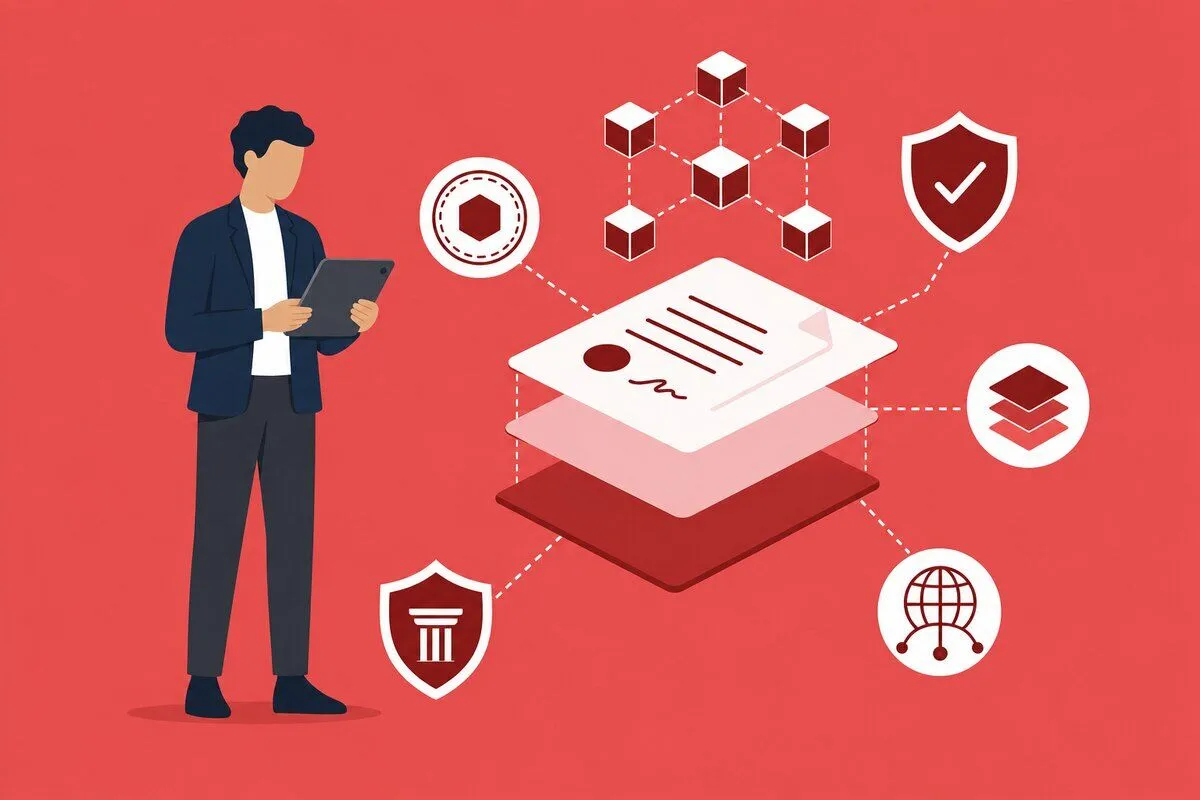
Smart contracts and data privacy laws are two forces that were never designed to work together. Smart contracts are self-executing programs on a blockchain that run automatically when certain conditions are met. They were built with transparency and permanence as core features. For blockchain projects that built their entire system on an architecture incompatible with data privacy laws, these orders can require a complete rebuild at enormous cost and with significant user disruption.
Introduction to Smart Contracts and Data Privacy
01
Smart contracts and data privacy laws are two forces that were never designed to work together. Smart contracts are self-executing programs on a blockchain that run automatically when certain conditions are met. They were built with transparency and permanence as core features. Data privacy laws, on the other hand, were created to give people control over their personal information, including the power to modify, restrict, and delete that information. These two systems operate on fundamentally opposing principles, and the tension between them is one of the biggest challenges facing the blockchain industry today.
The problem is real and growing. As blockchain projects expand beyond simple cryptocurrency transfers into DeFi lending, healthcare records, supply chain tracking, digital identity, and real estate tokenization, they inevitably touch personal data. A DeFi protocol that requires KYC verification handles identity documents. A supply chain system may track worker information. An NFT marketplace records creator and buyer identities. Every one of these interactions brings smart contracts under the scope of data privacy laws, whether the project builders planned for it or not.
Our agency has spent over eight years helping blockchain projects navigate the intersection of smart contracts and data privacy laws. We have seen teams get it right and teams get it very wrong. This guide explains how data privacy laws apply to smart contract service, where the biggest conflicts arise, and what practical strategies you can use to build compliant systems. Whether you are launching a new protocol or auditing an existing one, understanding these regulatory requirements is no longer optional. It is essential for survival.
Why Privacy Regulations Matter in Blockchain
Many blockchain builders initially believed that decentralization would place their projects beyond the reach of traditional regulations. That belief was wrong. Data privacy laws like GDPR do not care whether your system is centralized or decentralized. They care about whether personal data is being processed. If your smart contract handles any information that can identify a real person, directly or indirectly, you are subject to data privacy laws in whatever jurisdiction that person resides.
The stakes are enormous. GDPR fines have already reached hundreds of millions of euros against tech companies. Meta was fined 1.2 billion euros in 2023 for improper data transfers. Amazon received a 746 million euro fine in 2021. While no major blockchain project has faced a landmark GDPR fine yet, regulators are paying increasing attention to crypto and Web3 platforms. The French data protection authority (CNIL) and the European Data Protection Board have both published guidance specifically addressing blockchain and data privacy laws.
Beyond fines, ignoring data privacy laws carries reputational and operational risks. Institutional investors and enterprise partners require privacy compliance before working with blockchain projects. App stores can remove non-compliant applications. Users increasingly choose platforms that protect their data. Projects that build privacy into their architecture from the start gain a competitive advantage, while those that treat it as an afterthought face expensive redesigns and legal exposure that can threaten their existence.
SEC 03
Overview of Major Data Privacy Laws
Understanding which data privacy laws affect your smart contract project requires knowing the major regulations and their geographic reach. The regulatory landscape has expanded dramatically since GDPR launched in 2018. Today, over 150 countries have enacted some form of data protection legislation, and new laws continue to emerge every year. Each regulation has its own requirements, enforcement mechanisms, and penalties, but they all share a common goal: giving individuals control over how their personal information is collected, processed, and shared.
The most impactful data privacy laws for blockchain projects are GDPR (covering all EU and EEA residents), CCPA/CPRA (covering California residents), LGPD (Brazil’s comprehensive privacy law), PIPL (China’s personal information protection law), and the UK Data Protection Act. Each law defines personal data slightly differently, but all include information that can identify a person. Since blockchain projects typically serve global user bases, compliance with multiple data privacy laws simultaneously is the norm, not the exception.
| Privacy Law | Region | Key Requirement | Max Penalty |
|---|---|---|---|
| GDPR | EU / EEA | Consent, erasure, data minimization | 4% revenue or 20M euros |
| CCPA / CPRA | California, USA | Opt-out rights, data disclosure | $7,500 per violation |
| LGPD | Brazil | Consent, purpose limitation | 2% revenue or 50M reais |
| PIPL | China | Separate consent, data localization | 5% revenue or 50M yuan |
| UK DPA 2018 | United Kingdom | GDPR-aligned with UK variations | 4% revenue or 17.5M GBP |
How Smart Contracts Process Personal Information
04
Smart contracts process personal information more often than most builders realize. Every interaction with a smart contract is associated with a wallet address. European regulators have clarified that wallet addresses qualify as pseudonymous data under data privacy laws, meaning they are personal data because they can potentially be linked back to a real person through chain analysis, exchange records, or IP address correlation. This single determination brings most blockchain activity under the scope of data privacy laws.
Beyond wallet addresses, smart contracts commonly process other categories of personal data. DeFi lending protocols collect KYC information (names, addresses, identity documents). Healthcare dApps may store patient records or medical data hashes. Supply chain contracts might record employee information. Token sale contracts gather investor details for compliance purposes. Real estate tokenization platforms handle buyer and seller identities. Each of these data types has specific protection requirements under different data privacy laws.
Real-world example: The Ethereum Name Service (ENS) links human-readable names (like “alice.eth”) to wallet addresses. This creates an even more direct connection between blockchain activity and real identities than wallet addresses alone. When someone registers an ENS name that matches their real name, every transaction from that wallet becomes personally identifiable. ENS has acknowledged this challenge and has begun exploring privacy-preserving alternatives that comply with data privacy laws while maintaining the service’s utility for millions of users.
The Conflict Between Immutability and the Right to Erasure
This is the biggest head-on collision between blockchain technology and data privacy laws. Blockchains are designed to be immutable, meaning once data is written, it cannot be modified or deleted. GDPR Article 17 gives individuals the right to erasure, meaning they can demand that their personal data be deleted. These two principles are fundamentally incompatible when personal data is stored directly on a blockchain. You simply cannot delete data from an immutable ledger, period.
The practical solution that has emerged from years of regulatory discussion and real-world implementation is the hybrid approach. Personal data is stored off-chain in traditional databases that support modification and deletion. The blockchain stores only references, hashes, or encrypted pointers to the off-chain data. When a user exercises their right to erasure, the off-chain data is deleted, making the on-chain reference meaningless since it points to nothing. This satisfies data privacy laws because the personal data itself has been effectively erased, even though the hash remains on-chain.
Real-world example: Alastria, a Spanish blockchain consortium backed by major companies including Telefonica and Santander, built their entire identity system around this hybrid model. Personal identity attributes are stored in off-chain data stores controlled by the user. The Alastria blockchain only stores verifiable credential proofs. When a user wants their data deleted, the off-chain records are purged and the on-chain proofs become cryptographically useless. This approach has been reviewed and accepted by Spanish data protection authorities as compliant with GDPR and other data privacy laws.
SEC 06
GDPR Requirements Explained Simply
GDPR is the most influential data privacy law for blockchain projects because of its extraterritorial reach. It applies not just to companies based in the EU, but to any organization that processes data of EU residents, regardless of where the organization is located. According to Privacy Matter News, Since most blockchain projects have a global user base, GDPR compliance is effectively mandatory. The good news is that understanding GDPR requirements is not as complicated as many people think, even when applying them to smart contracts.
At its core, GDPR requires six things from any data processor: lawful basis for processing (typically consent or legitimate interest), purpose limitation (only use data for stated purposes), data minimization (collect only what you need), accuracy (keep data correct and up to date), storage limitation (do not keep data longer than necessary), and integrity and confidentiality (protect data with appropriate security measures). Each of these requirements has specific implications for how smart contracts should be designed and deployed.
| GDPR Principle | Traditional System | Smart Contract Challenge | Practical Solution |
|---|---|---|---|
| Right to Erasure | Delete from database | Blockchain is immutable | Store personal data off-chain |
| Data Minimization | Collect less data | On-chain data is permanent | Use ZK proofs and hashes only |
| Consent | Cookie banner, opt-in form | Wallet connect is not consent | On-chain consent registry |
| Data Portability | Export CSV/JSON file | On-chain data is public anyway | Standardized export tools |
| Data Controller | Clear: the company | Unclear in decentralized systems | DAO or deployer as controller |
Data Minimization in Smart Contract Design
07
Data minimization is one of the most practical principles from data privacy laws that smart contract designers can implement immediately. The idea is straightforward: only collect and store the minimum amount of personal data needed to accomplish a specific purpose. In blockchain terms, this means asking yourself before every design decision: does this data really need to be on-chain? In the vast majority of cases, the answer is no, and the data can be handled off-chain while the smart contract stores only a verification reference.
Zero-knowledge proofs (ZKPs) are the most powerful tool for data minimization in smart contracts. Instead of storing a user’s date of birth on-chain to verify they are over 18, a ZK proof can confirm “this user is over 18” without revealing their actual age or birth date. Instead of storing a credit score on-chain for a DeFi lending decision, a ZK proof can confirm “this user’s credit score exceeds 700” without exposing the exact number. ZKPs enable smart contracts to verify facts while maintaining full compliance with data privacy laws.
Real-world example: Polygon ID (formerly Iden3) built an entire identity verification system around zero-knowledge proofs specifically to comply with data privacy laws. Users generate ZK proofs of their identity attributes locally on their device and present these proofs to smart contracts for verification. The smart contract never sees the underlying personal data at all. Polygon ID has been adopted by major protocols including Aave for institutional KYC verification, proving that data minimization and regulatory compliance can work together in production blockchain systems.
On-Chain vs Off-Chain Data Storage
The decision of what goes on-chain versus off-chain is the single most important architectural choice for privacy compliance in smart contracts. On-chain data is permanent, public (on most blockchains), and accessible to everyone. Off-chain data lives in traditional databases, IPFS, or other storage systems where access controls, encryption, and deletion are possible. Data privacy laws essentially require that personal information stays off-chain unless there is a compelling and justified reason to put it on a public, immutable ledger.
The hybrid model has become the standard architecture for privacy-compliant smart contracts. Transaction hashes, verification proofs, and non-identifiable metadata go on-chain. Personal data, identity documents, KYC records, and any directly identifiable information go off-chain. The smart contract references the off-chain data through a hash or pointer, verifying integrity without exposing content. If a user exercises their right to deletion under data privacy laws, the off-chain data is removed and the on-chain hash becomes a meaningless reference.
| Data Type | On-Chain? | Off-Chain? | Privacy Law Impact |
|---|---|---|---|
| Transaction hashes | Yes (safe) | Optional backup | Low risk, non-identifiable alone |
| Wallet addresses | Unavoidable | Mapping tables | Medium risk, pseudonymous |
| Names, emails | Never | Yes (encrypted) | High risk, directly identifiable |
| KYC documents | Never | Yes (secure vault) | Very high risk, sensitive data |
| ZK proofs | Yes (safe) | Optional | Very low risk, privacy-preserving |
SEC 09
Using Encryption to Protect Sensitive Information
Encryption is a powerful tool for reducing privacy risk in smart contracts, even though it does not eliminate compliance requirements entirely. When data must be stored on-chain or shared between parties, encrypting it before writing to the blockchain ensures that only authorized parties with the decryption key can access the actual content. To everyone else, the data looks like random characters with no meaning. This approach is especially useful for smart contracts that handle financial records, health data, or identity verification where data privacy laws require strong protection measures.
There are several encryption approaches relevant to smart contracts. Symmetric encryption (AES-256) works well for data that a single party needs to access. Asymmetric encryption (RSA, elliptic curve) enables secure communication between two parties. Homomorphic encryption allows computations on encrypted data without decrypting it first, which is revolutionary for smart contracts that need to process sensitive inputs. Secure multi-party computation (SMPC) lets multiple parties jointly compute results without any single party seeing the full input data from all others.
Real-world example: Secret Network is a blockchain built specifically around encrypted smart contracts (called “secret contracts”). All input data, output data, and contract state are encrypted by default. Validators process transactions inside Trusted Execution Environments (TEEs) where even the node operators cannot see the data being processed. Secret Network has been used to build privacy-preserving DeFi platforms, NFT marketplaces with hidden metadata, and voting systems where vote contents remain confidential. This architecture demonstrates how encryption can enable full smart contract functionality while maintaining compliance with data privacy laws.
Three Privacy Technology Pillars for Compliant Smart Contracts
Zero-Knowledge Proofs
- Verify facts without revealing underlying data
- Enable age, credit, and identity checks privately
- Satisfy data minimization under GDPR
- Polygon ID and zkSync lead adoption
Advanced Encryption
- Homomorphic encryption for on-chain computation
- Secure multi-party computation for shared secrets
- TEE-based processing in Secret Network
- AES-256 and elliptic curve for data at rest
Hybrid Architecture
- Personal data stored in off-chain databases
- On-chain hashes for integrity verification
- Supports right to erasure compliance
- IPFS with encryption for decentralized storage
Managing User Consent on Blockchain
10
Consent management is one of the trickiest aspects of complying with data privacy laws in blockchain systems. Under GDPR, consent must be freely given, specific, informed, and unambiguous. The user must actively agree to each specific purpose for which their data will be processed. Connecting a wallet to a dApp is not consent. Signing a transaction is not consent. These are technical actions, not informed agreements about data processing. Projects need separate, explicit consent mechanisms that explain exactly what data is being collected and how it will be used.
Even more challenging, GDPR requires that consent be withdrawable at any time. If a user consents to having their data processed today and revokes that consent tomorrow, the project must stop processing their data and delete it upon request. This creates an interesting design challenge for smart contracts: how do you build a consent system that is transparent and verifiable (ideal for blockchain) while also supporting withdrawal (which conflicts with immutability)? The answer, once again, involves hybrid architectures where consent records link to off-chain data that can be modified or deleted.
Real-world example: Civic, a blockchain identity verification platform, built an on-chain consent registry where users control exactly which data attributes they share with each requesting party. When a DeFi protocol requests identity verification, the user’s Civic wallet presents only the minimum required proof (such as “verified adult” or “non-sanctioned address”) without exposing full identity details. Users can revoke access to specific requesters at any time through the Civic app. This granular, user-controlled consent model aligns directly with data privacy laws while leveraging blockchain for transparency and audit trails.
Cross-Border Data Transfer Challenges
Cross-border data transfers are a compliance nightmare for blockchain projects because of how public blockchains work. When you submit a transaction to the Ethereum network, that transaction is broadcast to nodes in every country where Ethereum nodes operate. If that transaction contains any personal data (even a wallet address linked to an EU resident), it has technically been transferred to every jurisdiction with an Ethereum node. Under data privacy laws like GDPR, each of these transfers needs a legal basis, such as Standard Contractual Clauses or an adequacy decision.
The practical reality is that regulators have not yet fully resolved how cross-border transfer rules apply to decentralized networks. The European Data Protection Board acknowledged this challenge in their 2023 guidance, noting that traditional transfer mechanisms were not designed for blockchain architectures. Some legal scholars argue that since blockchain data is pseudonymous and publicly accessible anyway, the transfer restrictions should not apply with the same force. Others maintain that any personal data transfer, regardless of medium, requires full compliance.
| Transfer Mechanism | Works for Blockchain? | Practical Notes |
|---|---|---|
| Adequacy Decision | Limited | Only covers specific countries, not global networks |
| Standard Contractual Clauses | Difficult | Requires contract with every node operator |
| Binding Corporate Rules | Not applicable | Only works within a single corporate group |
| Encryption + Off-Chain | Best option | Keep personal data off public chains entirely |
SEC 12
Risks of Non-Compliance for Projects
The risks of ignoring data privacy laws go far beyond financial penalties, although those penalties are severe enough on their own. GDPR enforcement has generated over 4.5 billion euros in total fines since its enactment. The largest individual fine was 1.2 billion euros against Meta in 2023 for improper cross-border data transfers to the United States. While blockchain projects have not yet received fines of this magnitude, the regulatory framework clearly allows it, and enforcement attention is shifting toward the crypto industry with increasing speed.
Operational disruption is often more damaging than fines. Data protection authorities can order projects to stop processing data entirely, effectively shutting down services for users in their jurisdiction. Forced geo-blocking, mandatory architecture changes, and mandatory data deletion orders can fundamentally alter a project’s business model. For blockchain projects that built their entire system on an architecture incompatible with data privacy laws, these orders can require a complete rebuild at enormous cost and with significant user disruption.
Real-world example: Worldcoin (now World) faced investigations from multiple data protection authorities including those in Germany, France, Portugal, Kenya, and South Korea for collecting biometric data (iris scans) without adequate consent and compliance with local data privacy laws. Several countries ordered temporary suspensions of data collection. The project was forced to redesign its data processing approach, implement local data deletion capabilities, and enhance consent mechanisms. This case demonstrates how even well-funded projects backed by prominent founders face serious consequences when data privacy laws are not prioritized from the start.
Designing Privacy-First Smart Contracts
13
Privacy-first smart contract design means building compliance into the architecture from the very beginning rather than trying to bolt it on later. This approach is called “privacy by design” and it is actually required by GDPR Article 25. The principle states that data protection must be embedded into the design and architecture of systems, not added as an afterthought. For smart contracts, this means every function, every state variable, and every event emission should be evaluated through the lens of data privacy laws before writing a single line of code.
The practical framework for privacy-first smart contract design follows five steps. First, conduct a Data Protection Impact Assessment (DPIA) to identify all personal data flows. Second, apply data minimization by removing every unnecessary data element from on-chain storage. Third, implement the hybrid architecture with off-chain personal data and on-chain verification proofs. Fourth, build consent management and data subject rights handling into the system. Fifth, establish monitoring, auditing, and incident response procedures that maintain ongoing compliance with data privacy laws.
Real-world example: Aave, one of the largest DeFi lending protocols, worked with Polygon ID to implement privacy-preserving KYC for institutional users. Instead of storing KYC documents on-chain (which would violate every data privacy law in existence), Aave uses zero-knowledge proofs to verify that a user has completed KYC through an approved provider without ever seeing or storing the documents themselves. The smart contract only knows “this wallet is KYC verified” without knowing who the person is. This design satisfies institutional compliance requirements while maintaining user privacy under data privacy laws.
Role of Audits and Legal Reviews
Regular privacy audits and legal reviews are not optional extras for blockchain projects. They are essential safety nets that catch compliance gaps before regulators do. A privacy audit examines how your smart contracts handle personal data, verifies that your technical controls are working correctly, and identifies areas where your implementation may fall short of requirements under data privacy laws. Legal reviews assess whether your terms of service, privacy policies, and data processing agreements accurately reflect what your system actually does.
The audit process for privacy-compliant smart contracts should cover several specific areas. Data flow mapping verifies that personal data follows the documented paths and does not leak into unexpected on-chain storage. Consent mechanism testing confirms that user agreements meet the “freely given, specific, informed, and unambiguous” standard required by GDPR. Encryption validation ensures that cryptographic protections are properly implemented and that key management is secure. Deletion capability testing verifies that erasure requests can be fully executed across all data stores.
Our recommendation based on eight years of working with blockchain projects: schedule comprehensive privacy audits at least twice per year, plus additional reviews whenever you make significant changes to data handling. Engage both technical auditors (who understand smart contract code and blockchain architecture) and legal reviewers (who understand the specific requirements of data privacy laws in your target jurisdictions). The cost of regular auditing is a fraction of the cost of regulatory enforcement, forced redesigns, or user trust destruction that follows a privacy incident.
Industry Standards for Privacy-Compliant Smart Contracts
Standard 1: Conduct a Data Protection Impact Assessment (DPIA) before deploying any smart contract that processes personal data of EU residents.
Standard 2: Store all directly identifiable personal data off-chain, keeping only cryptographic hashes or ZK proofs as on-chain references.
Standard 3: Implement explicit consent collection mechanisms separate from wallet connection flows, with granular per-purpose consent options.
Standard 4: Build automated data subject request handling that processes erasure, access, and portability requests within the 30-day GDPR deadline.
Standard 5: Encrypt all personal data at rest and in transit using AES-256 minimum, with documented key management procedures and rotation schedules.
Standard 6: Maintain breach notification capability to alert authorities within 72 hours and affected users without undue delay as required by GDPR.
✓
Data Protection Impact Assessment completed and documented before any smart contract deployment
✓
No directly identifiable personal data stored on-chain, only hashes, proofs, or encrypted references
✓
Explicit consent mechanism separate from wallet connect with per-purpose granularity and withdrawal options
✓
Data subject rights handling system for erasure, access, correction, and portability requests within 30 days
✓
Privacy policy and terms of service reviewed by legal counsel covering blockchain-specific data processing details
✓
Cross-border data transfer mechanisms documented for all jurisdictions where blockchain nodes operate
✓
Breach notification procedure tested and ready for 72-hour authority notification and user communication
✓
Semi-annual privacy audit scheduled with both technical blockchain auditors and regulatory legal reviewers
SEC 15
Future of Data Privacy in Web3 Systems
The future of data privacy in Web3 is moving toward native privacy rather than bolted-on compliance. Next-generation blockchain architectures are being built from the ground up with privacy as a core feature, not an afterthought. Networks like Aztec (which brings programmable privacy to Ethereum), Namada (privacy for interchain assets), and Penumbra (private DeFi) demonstrate that the industry is taking data privacy laws seriously and building technical solutions that make compliance the default behavior for smart contracts and their users.
Zero-knowledge proof technology is advancing rapidly and will play an even larger role in privacy-compliant smart contracts. ZK-rollups like zkSync and Scroll already process transactions with built-in privacy capabilities. As ZK proof generation becomes faster and cheaper, more smart contracts will adopt ZK-based verification for identity checks, compliance attestations, and data validation. The ultimate goal is a system where smart contracts can verify anything about a user (identity, creditworthiness, regulatory status) without ever accessing or storing any personal data at all.
Regulatory frameworks will continue to evolve as well. The EU AI Act, Digital Services Act, and Data Act all have implications for blockchain systems. India’s Digital Personal Data Protection Act (2023) added another major jurisdiction to the compliance landscape. US states continue passing their own privacy laws, with over 15 states now having comprehensive data privacy legislation. Smart contract projects that invest in flexible, modular privacy architectures today will be best positioned to adapt as new data privacy laws emerge in the years ahead.
The projects that will thrive in this environment are those that view privacy compliance not as a burden but as a competitive advantage. Users increasingly value and choose platforms that protect their data. Institutional investors and enterprise partners require it. Regulators reward proactive compliance with lighter enforcement. By building privacy-first smart contracts today, you position your project for sustainable growth in a world where data privacy laws will only get stricter, more numerous, and more aggressively enforced across every jurisdiction globally.
Final Thoughts
FINAL
Smart contracts and data privacy laws exist in an uneasy but navigable relationship. The core tension between blockchain immutability and the right to erasure is real, but practical solutions exist. Hybrid architectures that store personal data off-chain while keeping verification proofs on-chain satisfy both the transparency benefits of blockchain and the data protection requirements of regulations like GDPR, CCPA, and LGPD. Zero-knowledge proofs and advanced encryption technologies make this approach increasingly powerful and efficient.
The key takeaway from this entire guide is that privacy compliance must be designed in from the start, not added later. Every smart contract project should begin with a data classification exercise, implement data minimization principles, build consent management systems, and establish ongoing audit and review processes. The projects that treat data privacy laws as a core architectural requirement rather than a legal checkbox will build more trustworthy products that attract more users and avoid the costly enforcement actions that destroy competitors.
Whether you are building a DeFi protocol, an NFT marketplace, a supply chain system, or any other blockchain application, the principles in this guide apply. Classify your data, minimize what goes on-chain, encrypt everything sensitive, manage consent properly, plan for cross-border compliance, audit regularly, and stay current with evolving regulations. Data privacy laws will only grow stricter and more widespread in the years ahead. The teams that embrace privacy-first smart contract design today will be the ones that build lasting, compliant, and trusted platforms in the Web3 ecosystem.
Frequently Asked Questions
Q1.Do data privacy laws apply to blockchain and smart contracts?
Yes, data privacy laws like GDPR, CCPA, and LGPD apply to blockchain systems whenever personal data is involved. Even though blockchain is decentralized, if a smart contract processes or stores information that can identify a person directly or indirectly, it falls under regulatory scope. Courts in Europe have confirmed that hashed wallet addresses can qualify as personal data. Projects that ignore this connection between data privacy laws and smart contracts face significant legal and financial penalties.
Q2.Can you delete personal data from a blockchain?
Technically, you cannot delete data from an immutable blockchain. This creates a direct conflict with data privacy laws like GDPR that grant users the right to erasure (also called the right to be forgotten). The practical solution is to store personal data off-chain in traditional databases where it can be deleted, while keeping only non-identifiable references or hashes on-chain. This hybrid architecture lets smart contracts function properly while respecting data privacy laws.
Q3.What is GDPR and how does it affect smart contracts?
GDPR (General Data Protection Regulation) is the European Union’s comprehensive data privacy law that governs how organizations collect, process, and store personal information. It affects smart contracts because any on-chain activity involving EU residents’ personal data triggers GDPR compliance requirements. Key obligations include obtaining clear consent, enabling data portability, allowing data deletion, and appointing data controllers. Fines can reach 4% of annual global revenue or 20 million euros for violations.
Q4.Who is the data controller when using smart contracts?
Identifying the data controller in blockchain systems is one of the hardest challenges under data privacy laws. In traditional systems, the company running the database is clearly the controller. In decentralized networks, responsibility might fall on the protocol deployer, the DAO governance body, node operators, or even individual users depending on the setup. European regulators suggest that whoever determines the purpose and means of data processing is the controller, even in decentralized environments.
Q5.What is data minimization in smart contract design?
Data minimization is a core principle of data privacy laws that requires organizations to collect and process only the minimum personal data needed for a specific purpose. In smart contract design, this means avoiding storing personal information on-chain whenever possible. Instead of recording a user’s full identity, a privacy-focused smart contract stores only cryptographic proofs, hashed identifiers, or zero-knowledge proofs that verify facts without revealing underlying personal data to anyone on the network.
Q6.Can encryption solve blockchain privacy compliance issues?
Encryption helps but does not fully solve compliance issues under data privacy laws. Encrypting personal data before writing it on-chain reduces exposure significantly. However, regulators consider encrypted personal data still personal data because it can theoretically be decrypted. The strongest approach combines encryption with off-chain storage, zero-knowledge proofs, and proper access controls. Homomorphic encryption and secure multi-party computation are emerging technologies that may eventually enable on-chain privacy compliance.
Q7.7 What happens if a blockchain project violates data privacy laws?
Violations of data privacy laws carry severe consequences for blockchain projects. Under GDPR, fines reach up to 20 million euros or 4% of global annual turnover. Beyond fines, projects face operational restrictions that can force them to cease processing EU user data entirely. Class-action lawsuits from affected users add further financial risk. Reputational damage often proves the costliest outcome, as institutional partners and users lose trust in projects that fail to protect personal information properly.
Q8.How do cross-border transfers work with blockchain data privacy?
Cross-border data transfers are especially tricky for blockchain because nodes exist in multiple countries simultaneously. Under data privacy laws, transferring personal data outside certain jurisdictions (like the EU) requires legal mechanisms such as Standard Contractual Clauses, adequacy decisions, or binding corporate rules. Since a public blockchain broadcasts data to nodes worldwide, every transaction involving personal data could technically be a cross-border transfer, requiring compliance with data privacy laws in every jurisdiction involved.
Explore Services
Related Services
Reviewed by

Aman Vaths
Founder of Nadcab Labs
Aman Vaths is the Founder & CTO of Nadcab Labs, a global digital engineering company delivering enterprise-grade solutions across AI, Web3, Blockchain, Big Data, Cloud, Cybersecurity, and Modern Application Development. With deep technical leadership and product innovation experience, Aman has positioned Nadcab Labs as one of the most advanced engineering companies driving the next era of intelligent, secure, and scalable software systems. Under his leadership, Nadcab Labs has built 2,000+ global projects across sectors including fintech, banking, healthcare, real estate, logistics, gaming, manufacturing, and next-generation DePIN networks. Aman’s strength lies in architecting high-performance systems, end-to-end platform engineering, and designing enterprise solutions that operate at global scale.