Ai Overview
If you have ever used a major cryptocurrency exchange, you have encountered the moment after depositing funds where you realize you cannot trade immediately. Your assets sit in one account (the funding wallet), and you need to transfer them to another account (the trading wallet) before you can place an order. This experience is the Funding Account vs Trading Account in Crypto Exchanges distinction in action, and it exists by design.
Key Takeaways
- The Funding Account vs Trading Account difference is fundamental to exchange architecture: funding accounts handle deposits, withdrawals, and secure asset storage, while trading accounts hold balances actively committed to market operations.
- This separation exists for three critical reasons: enhanced security (isolating stored funds from trading risks), regulatory compliance (meeting fund segregation requirements), and risk management (preventing liquidation events from affecting non-trading assets).
- Internal transfers between funding and trading accounts happen instantly on the exchange’s internal ledger without blockchain transactions, making them free and immediate while maintaining accurate balance accounting.
- Crypto exchange account types typically include a funding/main wallet, spot trading account, margin account, futures/derivatives account, and earn/staking account, each with distinct functionality and risk parameters.
- The multi-wallet architecture behind Funding vs Trading Accounts in Exchanges integrates hot wallet, cold wallet, and internal ledger systems to balance security, performance, and user experience.
- Withdrawals typically can only be initiated from the funding account, adding an intentional security layer that prevents accidental withdrawals of funds committed to open positions or pending orders.
- Modern exchange wallet architecture uses real-time balance updates, atomic transactions, and comprehensive audit trails to ensure ledger accuracy across all account types simultaneously.
- Choosing the right fund structure for an exchange requires balancing scalability, security, regulatory compliance, and user experience, with the separated model increasingly becoming the industry standard for professional platforms.
Funding Account vs Trading Account in Crypto Exchanges: An Overview
If you have ever used a major cryptocurrency exchange, you have encountered the moment after depositing funds where you realize you cannot trade immediately. Your assets sit in one account (the funding wallet), and you need to transfer them to another account (the trading wallet) before you can place an order. This experience is the Funding Account vs Trading Account in Crypto Exchanges distinction in action, and it exists by design.
This separation is not a UX inconvenience. It is a deliberate architectural choice that serves security, compliance, and risk management objectives that are central to how professional crypto exchanges operate. Understanding this distinction matters whether you are a trader trying to navigate your account structure efficiently, or a platform operator designing the wallet architecture for a new exchange.
The concept of segregating funds into different functional accounts is borrowed from traditional finance, where brokerage accounts, settlement accounts, and custody accounts serve distinct purposes. In crypto, the same principles apply, but the implementation is shaped by the unique characteristics of digital assets: blockchain-based deposits and withdrawals, real-time trading, leverage products, and the need for both hot and cold storage. This guide provides a comprehensive breakdown of how these accounts work, why they are separated, and how the technical architecture behind them supports secure, compliant exchange operations.
What is a Funding Account in a Crypto Exchange?
A funding account (also referred to as the main wallet, deposit wallet, or master account) is the primary entry and exit point for assets on a crypto exchange. When you deposit cryptocurrency from an external wallet or fiat from a bank account, those funds arrive in your funding account. When you withdraw, the funds must originate from this account. The funding account is the secure storage layer that holds assets not currently committed to any trading activity.
The funding account interfaces directly with the exchange’s deposit and withdrawal infrastructure, including blockchain node connections for crypto transactions and payment processor integrations for fiat transfers. It represents the user’s “vault,” where assets are held with the highest level of security the platform offers.
Role of Funding Wallet in Deposit and Withdrawal System
The funding wallet serves as the gateway between the external blockchain world and the exchange’s internal systems. For deposits, the exchange generates a unique blockchain address tied to the user’s funding account. When funds arrive at that address and receive sufficient confirmations, the internal ledger credits the user’s funding balance. For withdrawals, the user initiates a request from their funding account, which passes through security checks (2FA, withdrawal whitelist, anti-fraud screening) before the exchange broadcasts the blockchain transaction.
This design means the funding wallet is the only account type that interacts with external blockchain transactions. All other crypto exchange account types (trading, margin, futures, earn) operate entirely within the exchange’s internal ledger. This isolation is a critical security feature: it reduces the attack surface by limiting the number of systems that need direct blockchain connectivity.
How Funding Accounts Support Secure Fund Management
Funding accounts support secure fund management through several mechanisms. First, they are backed by the exchange’s tiered wallet architecture, where the majority of user funds are held in offline cold storage. The funding account balance you see on screen is maintained on the internal ledger, while the actual crypto assets backing that balance are distributed across hot and cold wallets according to the exchange’s security policy. Second, funding accounts enforce withdrawal controls (limits, delays, multi-factor authentication) that protect against unauthorized access. Third, the separation of funding from trading means that trading losses, including leveraged liquidations, cannot touch funds that are securely stored in the funding account.
What is a Trading Account in a Crypto Exchange?
A trading account holds the balance that is actively available for placing and executing trades on the exchange. Depending on the platform, there may be multiple trading account types: a spot trading account for buying and selling at market prices, a margin account for leveraged spot trading, a futures account for derivatives contracts, and possibly additional specialized accounts. Each trading account connects to the matching engine and order management system, enabling the user to participate in the exchange’s markets.
The trading account balance represents funds that are “at work” in the market. These funds may be committed to open orders, held as margin for leveraged positions, or available as free balance for new trades. The trading account balance fluctuates in real time as orders are filled, positions gain or lose value, and fees are deducted.
Spot Trading Account vs Funding Wallet
The Funding Account vs Trading Account difference becomes clearest when comparing the funding wallet to a spot trading account. The funding wallet holds assets passively, while the spot trading account holds assets that can be immediately used to place buy and sell orders. Funds in the spot trading account are available to the matching engine, meaning they can be locked by open orders and converted between assets when trades execute. The funding wallet, by contrast, has no connection to the trading engine and cannot be used for order placement.
How Trading Accounts Connect to the Matching Engine
Trading accounts are directly integrated with the exchange’s matching engine and order management system. When a user places an order, the system first checks the trading account balance to ensure sufficient funds are available, locks the required amount (order reservation), and submits the order to the matching engine. When the order is matched and a trade executes, the system atomically updates the trading account balance: debiting the asset sold and crediting the asset purchased, minus applicable fees. This tight integration between the trading account and the matching engine is what enables real-time trading. For detailed insight into these integrations, the exchange API integration guide covers the technical connectivity layer.
Key Differences Between Funding Account and Trading Account
Purpose and Functionality Comparison
Asset Storage vs Active Trading Balance
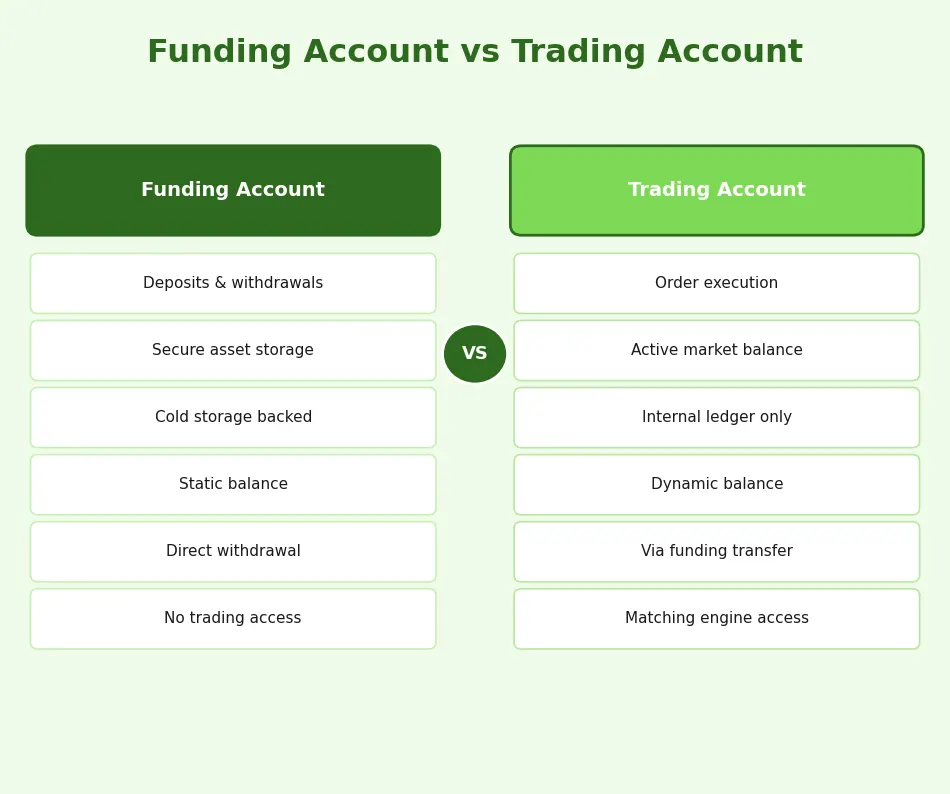
The core Funding Account vs Trading Account difference lies in their purpose. The funding account is designed for asset storage and external transfers. Its primary functions are receiving deposits, processing withdrawals, and holding assets securely. The trading account is designed for active market participation. Its functions include order placement, position management, margin allocation, and real-time balance updates based on market activity. One stores, the other trades. This distinction is the foundation of the multi-account architecture used by modern exchanges.
Exchange Balance Segregation Explained
Balance segregation means that each account type maintains its own independent balance. A user might have 5 BTC in their funding account, 2 BTC in their spot trading account, and 1 BTC in their futures account, for a total of 8 BTC across all crypto exchange account types. Each balance is tracked separately on the internal ledger, and funds must be explicitly transferred between accounts. This segregation ensures that each account’s balance accurately reflects its specific purpose and risk profile.
Funding Account vs Trading Account Comparison
| Feature | Funding Account | Trading Account |
|---|---|---|
| Primary Purpose | Deposit, withdrawal, secure storage | Order placement, trade execution |
| Blockchain Access | Yes (deposits and withdrawals) | No (internal ledger only) |
| Matching Engine | Not connected | Directly integrated |
| Balance Behavior | Static (changes with deposits/withdrawals/transfers) | Dynamic (changes with every trade/position) |
| Risk Exposure | Minimal (platform risk only) | Active (market risk, liquidation risk) |
| Security Layer | Cold storage backed, withdrawal controls | Internal ledger, order validation |
| Withdrawal Access | Yes (direct) | No (must transfer to funding first) |
Internal Wallet Transfer Mechanism
How Internal Transfers Work in Crypto Exchanges
Internal transfers between funding and trading accounts are processed entirely on the exchange’s internal ledger system. No blockchain transaction occurs. The system atomically debits one account and credits another, ensuring that the total user balance remains consistent throughout the operation. These transfers are instant (typically sub-second), free of charge, and recorded in the user’s transaction history for transparency and auditability.
The internal ledger uses database transactions with ACID (Atomicity, Consistency, Isolation, Durability) properties to guarantee that transfers are processed correctly even under concurrent load. If the system fails mid-transfer (due to a power outage or server crash, for example), the ACID guarantees ensure that either the full transfer is completed or it is rolled back entirely, preventing any inconsistency in account balances.
Moving Funds from Funding to Trading Account
The typical flow for moving funds from funding to trading is straightforward: the user selects the asset, enters the amount, confirms the transfer, and the balance appears in their trading account immediately. Behind the scenes, the system validates that the user has sufficient balance in the funding account, locks the amount, updates the internal ledger with a debit on the funding account and a credit on the trading account, and releases the lock. The entire operation takes milliseconds and is designed to be frictionless while maintaining complete accuracy.
Fund Transfer Lifecycle
| Step | Action | System Component | Outcome |
|---|---|---|---|
| 1. Deposit | User sends crypto to exchange address | Blockchain node, deposit monitor | Funds credited to funding account |
| 2. Internal Transfer | User transfers from funding to trading | Internal ledger system | Trading account balance updated instantly |
| 3. Trade | User places and executes orders | Matching engine, order book | Trading balance fluctuates with market |
| 4. Return Transfer | User transfers from trading to funding | Internal ledger system | Funds secured in funding account |
| 5. Withdrawal | User initiates withdrawal from funding | Withdrawal engine, blockchain broadcast | Crypto sent to external wallet |
Principle: The separation between Funding vs Trading Accounts in Exchanges is not a limitation. It is a security feature. By requiring explicit transfers between accounts, the architecture prevents accidental exposure of stored assets to trading risks and creates a clear audit trail of every fund movement within the platform.
Why Crypto Exchanges Separate Funding and Trading Accounts
Security Benefits of Multi-Wallet Crypto Exchange Systems
Hot Wallet and Cold Wallet Integration
The Funding Account vs Trading Account in Crypto Exchanges separation aligns naturally with the hot-cold wallet architecture. Funding accounts, which handle external deposits and withdrawals, interface with the hot wallet system (internet-connected wallets that process blockchain transactions) and are backed by cold storage (offline wallets holding the majority of reserves). Trading accounts operate entirely within the internal ledger and have no direct connection to either hot or cold wallets. This layered architecture means a compromise of the hot wallet affects only the small percentage of funds needed for operational liquidity, not the entire user base’s assets.
Internal Ledger System and User Balance Management
The internal ledger is the centralized accounting system that tracks every balance across all crypto exchange account types, similar to structured Bookkeeping services. It records every deposit, withdrawal, internal transfer, trade, fee deduction, and position update as an immutable sequence of entries. The ledger uses double-entry bookkeeping principles: every debit to one account has a corresponding credit to another, ensuring that the system’s total assets always balance. This ledger integrity is what allows the exchange to maintain accurate, real-time balances across potentially millions of user accounts simultaneously.
Compliance and User Asset Protection
Fund Segregation in Crypto Platforms
Fund segregation is a regulatory concept that requires financial intermediaries to keep client assets separate from operational assets. In the crypto exchange context, this extends to keeping non-trading assets separate from trading-exposed assets. The Funding Account vs Trading Account difference directly supports this requirement by creating a clear boundary between funds that are at rest (funding account) and funds that are at risk in the market (trading account). Regulators in major financial markets increasingly expect this level of segregation as a condition for licensing.
Regulatory Compliance for Crypto Exchanges
Regulatory frameworks across major financial centers require exchanges to demonstrate proper fund management, asset segregation, and accounting controls. The multi-account architecture provides the technical infrastructure to meet these requirements: separate balances for different purposes, complete audit trails for every fund movement, and clear boundaries that prevent co-mingling of assets. Exchanges seeking licenses must typically demonstrate that their account architecture supports regulatory reporting, proof-of-reserves attestations, and third-party auditing. For a broader perspective on exchange compliance obligations, the crypto exchange platform guide covers the compliance integration process.
Technical Architecture Behind Crypto Exchange Wallet Systems
Crypto Exchange Architecture and Wallet Modules
Backend Design for Funding and Trading Accounts
The backend architecture for Funding vs Trading Accounts in Exchanges is built around a modular design where each account type is managed by a dedicated service within the exchange’s microservices architecture. The funding service handles deposit address generation, blockchain transaction monitoring, withdrawal processing, and balance management. The trading service manages order validation, balance locking, trade settlement, and real-time P&L calculations. Both services read from and write to the central internal ledger, ensuring consistency. The exchange architecture guide provides a detailed view of how these modules interact within the broader platform.
Real-Time Balance Updates and Ledger Accuracy
Real-time balance accuracy is non-negotiable in exchange operations. Every trade execution, fee deduction, funding rate settlement, and position update must be reflected instantly in the user’s account balance. The system achieves this through event-driven architecture: each trade or operation generates an event that triggers balance updates across all affected accounts. The internal ledger processes these events in strict order, maintaining consistency even when thousands of events occur simultaneously.
Ledger accuracy is verified through continuous reconciliation processes that compare internal ledger totals against actual blockchain holdings (for crypto) and bank account balances (for fiat). Any discrepancy triggers immediate investigation. This reconciliation is a critical part of the exchange’s operational procedures and a key component of its regulatory compliance posture.
Secure Crypto Exchange Platform Structuring
Risk Management and Asset Control Mechanisms
Risk management in the context of Funding Account vs Trading Account in Crypto Exchanges operates at multiple levels. At the funding account level, risk controls include withdrawal limits, cooldown periods for new addresses, anti-fraud monitoring, and multi-factor authentication. At the trading account level, risk controls include pre-trade margin checks, position limits, real-time liquidation engines, and insurance fund coverage. The separation of accounts ensures that these distinct risk management systems operate independently, with funding security never compromised by trading risk events.
Best Practices for Exchange Fund Structure
Best practices for structuring Funding vs Trading Accounts in Exchanges include implementing atomic internal transfers with full ACID compliance, maintaining separate database schemas for each account type to prevent accidental cross-contamination, running continuous reconciliation between internal ledger totals and actual reserves, providing clear user interfaces that make the transfer process intuitive, and supporting sub-accounts for institutional clients who need to manage multiple strategies independently. Teams building crypto exchanges must implement these practices from the architecture phase to ensure long-term operational integrity.
Full Account Types Comparison
| Account Type | Purpose | Risk Level | Withdrawal Access |
|---|---|---|---|
| Funding | Deposit, withdrawal, storage | Minimal (platform risk) | Direct |
| Spot Trading | Buy/sell at market prices | Market price risk | Via funding transfer |
| Margin | Leveraged spot trading | Amplified (liquidation risk) | Via funding transfer |
| Futures | Derivatives contracts | High (leverage + funding rates) | Via funding transfer |
| Earn/Staking | Yield generation | Smart contract/counterparty risk | Via funding transfer (may have lockup) |
How to Choose the Right Fund Structure for a Secure Crypto Exchange
Exchange Wallet Module Structuring Considerations
Choosing the right fund structure depends on the exchange’s product scope, regulatory environment, target market, and technical capabilities. Exchanges offering only spot trading may use a simpler two-account model (funding + spot trading). Platforms offering margin, futures, options, and earn products need a more comprehensive multi-account system. The architecture must be designed for the full product roadmap, not just current offerings, to avoid expensive re-architecture later.
Fund Structure Selection Framework
| Criteria | Unified Balance | Two-Account | Multi-Account |
|---|---|---|---|
| Best For | Simple swap platforms | Spot-only exchanges | Full-service platforms |
| Security | Basic | Good segregation | Maximum isolation |
| Compliance | May not meet requirements | Meets most standards | Exceeds standards |
| Complexity | Low | Moderate | High |
For organizations evaluating architecture decisions, working with experienced cryptocurrency exchange engineering teams ensures that the fund structure is designed correctly from inception, avoiding costly re-architecture as the product scope expands.
Scalability and Performance Optimization
Scalability in the account system means maintaining sub-millisecond transfer and balance update performance as the number of users, accounts, and concurrent operations grows. Techniques include database sharding (distributing account data across multiple database servers), caching hot data (frequently accessed balances) in memory, using event sourcing for the internal ledger (storing events rather than current state), and implementing read replicas to separate query load from write load. The system must support millions of internal transfers per day without degradation.
Build a Secure Crypto Exchange with Advanced Fund Management
We build secure crypto exchanges with advanced funding and trading account systems, seamless wallet integration, and scalable architecture tailored for growth.
Security Mechanisms for User Fund Protection
Security mechanisms for protecting user funds across all crypto exchange account types include multi-signature wallet controls requiring multiple key holders to authorize large movements, timelocked transactions that impose mandatory delays on high-value withdrawals, rate limiting on internal transfers to prevent rapid fund extraction in case of account compromise, anomaly detection systems that flag unusual transfer patterns, and mandatory 2FA for all fund movements. These mechanisms operate across the entire Funding Account vs Trading Account architecture, creating layered protection that addresses threats at every level.
The combination of account segregation, robust internal ledger systems, comprehensive security controls, and regulatory compliance creates the foundation of a trustworthy exchange platform. As the industry continues to mature and regulatory expectations increase, the Funding Account vs Trading Account difference will remain a fundamental architectural feature of professional crypto exchanges worldwide.
Key Insight: The Funding Account vs Trading Account in Crypto Exchanges separation reflects a mature understanding of how financial platforms must be built. It is not about adding complexity for its own sake. It is about creating clear boundaries that protect user assets, satisfy regulatory requirements, and enable the exchange to scale its product offerings without compromising the integrity of its fund management. Every successful exchange in the coming years will build on this foundation.
Frequently Asked Questions
Q1.What is the difference between a funding account and a trading account on a crypto exchange?
A funding account is the primary wallet where users deposit and withdraw cryptocurrency or fiat currency on an exchange. It serves as the secure storage layer for assets that are not actively being traded. A trading account, by contrast, holds the balance that is actively committed to market operations like spot trading, margin trading, or derivatives positions. Users must transfer funds from the funding account to the trading account before placing orders, creating a clear separation between stored assets and active trading capital.
Q2.Why do crypto exchanges separate funding and trading accounts?
Crypto exchanges separate these accounts for three critical reasons: security, compliance, and risk management. Segregating funds ensures that assets not being actively traded are insulated from trading-related risks such as liquidation or margin calls. It also allows the exchange to implement different security policies for each account type, with funding accounts benefiting from cold storage protection. From a compliance perspective, this separation supports fund segregation requirements imposed by financial regulators across major markets.
Q3.How do I transfer funds from my funding account to my trading account?
Transferring funds between accounts is typically an instant, internal operation within the exchange. You navigate to the transfer or wallet section, select the asset you want to move, specify the amount, choose the source (funding) and destination (trading) accounts, and confirm. The transfer happens on the exchange’s internal ledger without any blockchain transaction, so it is free and instantaneous. The reverse process works identically when moving funds from trading back to funding.
Q4.Can I withdraw directly from my trading account?
On most exchanges that implement the funding-trading separation, withdrawals can only be initiated from the funding account. This means you must first transfer assets from your trading account back to your funding account, and then process the withdrawal from there. This design is intentional as it prevents accidental withdrawals of funds that are committed to open positions or pending orders, and adds an extra layer of security to the withdrawal process.
Q5.What crypto exchange account types are available on major platforms?
Major crypto exchanges typically offer multiple account types: a funding account (also called main wallet or deposit wallet) for deposits and withdrawals, a spot trading account for buying and selling assets at market prices, a margin trading account for leveraged spot trading, a futures or derivatives account for trading contracts, and sometimes an earn or staking account for yield-generating products. Each account type serves a specific purpose and has its own balance, risk parameters, and functionality.
Q6.Is my money safe in a funding account?
Funding accounts typically have the strongest security protections on the exchange because they are closest to the cold storage layer. Assets in funding accounts are generally covered by the exchange’s insurance fund and reserve policies. However, safety ultimately depends on the exchange’s security practices, including hot/cold wallet architecture, multi-signature controls, proof-of-reserves attestations, and regulatory compliance. Always verify the exchange’s security credentials before depositing significant funds.
Explore Services
Related Services
Reviewed by

Aman Vaths
Founder of Nadcab Labs
Aman Vaths is the Founder & CTO of Nadcab Labs, a global digital engineering company delivering enterprise-grade solutions across AI, Web3, Blockchain, Big Data, Cloud, Cybersecurity, and Modern Application Development. With deep technical leadership and product innovation experience, Aman has positioned Nadcab Labs as one of the most advanced engineering companies driving the next era of intelligent, secure, and scalable software systems. Under his leadership, Nadcab Labs has built 2,000+ global projects across sectors including fintech, banking, healthcare, real estate, logistics, gaming, manufacturing, and next-generation DePIN networks. Aman’s strength lies in architecting high-performance systems, end-to-end platform engineering, and designing enterprise solutions that operate at global scale.