Ai Overview
The foundational architecture of real estate tokenization standards depends critically on selecting appropriate token standards that define how property ownership rights are represented, transferred, and governed on blockchain networks. Fungibility determines whether individual tokens are interchangeable or possess unique characteristics, profoundly affecting liquidity, pricing, and investor experience.
Key Takeaways
- Real estate tokenization standards determine how property ownership rights are represented on blockchain, with ERC-20 enabling fungible fractional shares, ERC-721 creating unique property tokens, and ERC-3643 providing compliant security token infrastructure.
- ERC-20 tokens offer maximum liquidity and secondary market compatibility for fractional real estate ownership but require external compliance systems to meet regulatory requirements in USA, UK, UAE, and Canada markets.
- ERC-721 non-fungible tokens maintain property-specific identity and metadata ideal for unique assets, though liquidity constraints and compliance complexity limit their use in institutional real estate tokenization projects.
- ERC-3643 represents the industry-leading standard for regulated real estate tokens, incorporating on-chain identity verification, transfer restrictions, jurisdictional controls, and corporate action support essential for institutional adoption and regulatory compliance.
- Compliance capabilities distinguish tokenization standards, with ERC-3643 providing native regulatory controls including investor accreditation verification, holding period enforcement, and geographic restrictions that ERC-20 and ERC-721 lack without external systems.
- Hybrid approaches combining multiple standards are emerging, using ERC-721 for underlying property representation while issuing ERC-20 or ERC-3643 tokens for fractional ownership, balancing uniqueness, compliance, and liquidity objectives.
- Standard selection criteria for real estate tokenization standards projects include regulatory requirements, target investor types, liquidity objectives, property characteristics, operational complexity, and long-term governance needs determining optimal technical framework.
- Secondary market compatibility varies significantly across standards, with ERC-20 tokens trading on standard exchanges, ERC-721 requiring specialized NFT marketplaces, and ERC-3643 operating on compliant security token exchanges with integrated KYC/AML verification.
Token Standard Classification for Real Estate Assets
The foundational architecture of real estate tokenization standards depends critically on selecting appropriate token standards that define how property ownership rights are represented, transferred, and governed on blockchain networks. Token standards establish the technical protocols, smart contract interfaces, and operational rules governing digital securities representing real estate assets. Over eight years of experience implementing real estate tokenization standards projects across the United States, United Kingdom, United Arab Emirates, and Canada has demonstrated that standard selection profoundly affects regulatory compliance, investor accessibility, secondary market liquidity, and long-term operational sustainability of tokenized property offerings.
Real estate tokenization standards evolved from simple fungible token implementations to sophisticated compliant security token frameworks addressing the complex regulatory landscape governing property securities. Early tokenization projects leveraged ERC-20, the ubiquitous Ethereum fungible token standard, to represent fractional property ownership through interchangeable shares. As the industry matured, ERC-721 non-fungible tokens emerged for representing unique properties maintaining individual asset identity. Most recently, ERC-3643 (formerly ERC-1400) established purpose-built security token standards incorporating regulatory compliance mechanisms essential for institutional real estate tokenization in regulated markets.[1]
The classification of real estate tokenization standards centers on three fundamental dimensions: fungibility determining whether tokens are interchangeable or unique, compliance capabilities defining regulatory controls embedded in token logic, and operational features supporting corporate actions, distributions, and governance. ERC-20 excels at fungibility enabling liquid secondary markets but requires external compliance infrastructure. ERC-721 provides uniqueness ideal for individual property representation but faces liquidity constraints. ERC-3643 combines fungibility with native compliance controls specifically designed for security tokens subject to regulatory oversight, making it increasingly the standard of choice for institutional real estate offerings.
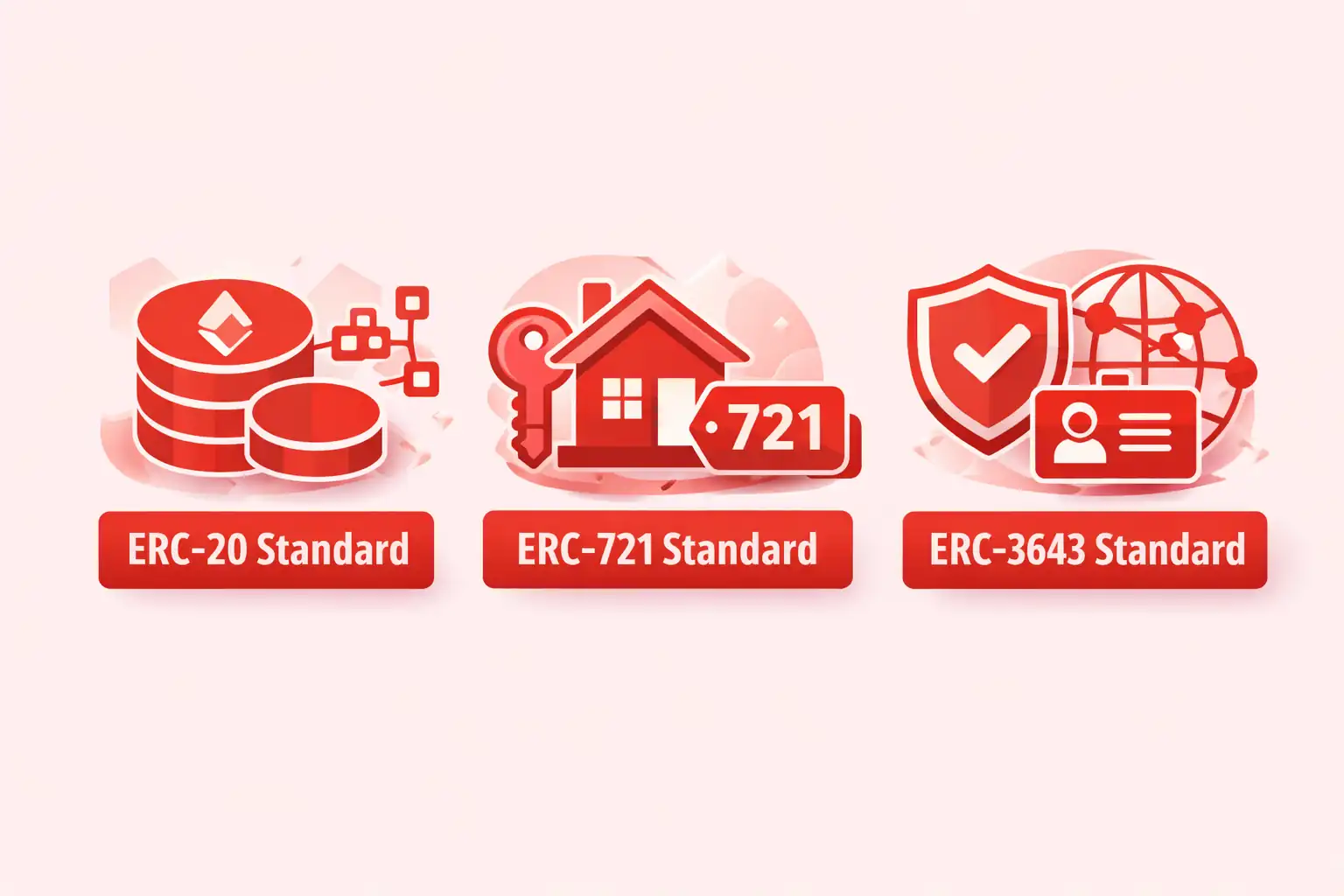
Real Estate Tokenization Standards Overview
ERC-20 Standard
- Fungible tokens with identical interchangeable units
- Maximum liquidity and exchange compatibility
- Fractional ownership representation
- External compliance systems required
- Simple implementation and broad adoption
- Limited regulatory control features
ERC-721 Standard
- Non-fungible tokens for unique properties
- Individual asset identity and metadata
- Property-specific characteristics preserved
- Limited liquidity due to uniqueness
- Complex compliance implementations
- Specialized marketplace requirements
ERC-3643 Standard
- Compliant security tokens with built-in controls
- On-chain identity and KYC integration
- Transfer restrictions and jurisdictional limits
- Corporate actions and distributions support
- Institutional-grade compliance automation
- Regulatory approval facilitation
Regulatory considerations fundamentally shape token standard selection for real estate tokenization standards projects. Securities regulators in major markets including the SEC in the United States, FCA in the United Kingdom, VARA and DFSA in UAE’s Dubai, and provincial securities commissions in Canada increasingly require demonstrable compliance mechanisms for tokenized real estate offerings. These requirements favor standards with native compliance capabilities like ERC-3643 over generic standards requiring external compliance layers. However, the choice ultimately depends on specific project characteristics including property type, investor demographics, offering structure, and jurisdictional regulatory framework applicable to the tokenization.
The technical architecture underlying each real estate tokenization standard determines not only immediate functionality but also long-term operational capabilities, upgrade pathways, and interoperability with evolving blockchain infrastructure. ERC-20’s simplicity enables straightforward implementation and broad wallet support but limits sophisticated compliance and governance features. ERC-721’s metadata capabilities support rich property information but complicate fractional ownership structures. ERC-3643’s comprehensive framework addresses security token requirements comprehensively but demands more complex implementation and specialized infrastructure. Understanding these architectural tradeoffs informs strategic decisions aligning technical frameworks with business objectives and regulatory requirements.
Fungible vs Non-Fungible vs Compliant Token Models
The fundamental distinction between fungible, non-fungible, and compliant token models shapes every aspect of real estate tokenization standards from initial offering structure through secondary market operations and long-term asset management. Fungibility determines whether individual tokens are interchangeable or possess unique characteristics, profoundly affecting liquidity, pricing, and investor experience. Compliance capabilities determine whether regulatory controls are embedded in token logic or managed through external systems, influencing regulatory approval processes, operational complexity, and institutional adoption prospects in regulated markets.
Fungible real estate tokenization standards like ERC-20 create tokens where each unit represents an identical fractional ownership interest in property assets, enabling interchangeable trading similar to traditional securities. An investor holding 100 ERC-20 tokens representing fractional ownership in a commercial office building holds economically identical positions to any other investor holding 100 tokens of the same issuance. This fungibility enables liquid secondary markets through standardized trading on exchanges, tight bid-ask spreads reflecting uniform valuation, and efficient price discovery mechanisms. Fungible tokens work best for pooled property portfolios, fractional ownership structures, and scenarios where investors prioritize liquidity over specific property selection.
Non-fungible real estate tokenization standards through ERC-721 creates unique tokens where each represents a distinct property with specific characteristics, location, valuation, and ownership history. An ERC-721 token representing a luxury apartment in Dubai Marina differs fundamentally from one representing a commercial property in London’s financial district, despite both being real estate tokens on the same blockchain. This uniqueness maintains property-specific identity essential for scenarios where individual asset characteristics matter, including whole property ownership transfers, unique real estate assets, and situations requiring detailed property-level metadata preservation. However, non-fungibility creates liquidity challenges as each token requires individual buyer-seller matching and valuation rather than uniform market pricing.
Compliant token models represented by ERC-3643 combine fungibility benefits with sophisticated regulatory control mechanisms purpose-built for security tokens. These standards embed compliance requirements directly into token smart contracts, automatically enforcing investor eligibility criteria, transfer restrictions, jurisdictional limitations, and regulatory reporting obligations without requiring external enforcement systems. Compliant tokens maintain fungibility enabling liquid secondary markets while ensuring all transfers comply with applicable securities regulations, making them ideal for institutional real estate offerings in regulated markets where regulatory compliance represents a critical project requirement rather than optional enhancement.
The selection between fungible, non-fungible, and compliant token models depends fundamentally on project objectives balancing liquidity, property identity, regulatory compliance, and operational complexity. Projects prioritizing maximum liquidity for retail investors often choose fungible ERC-20 tokens with external compliance systems. Unique high-value properties where maintaining individual asset identity justifies liquidity tradeoffs may employ ERC-721 non-fungible tokens. Institutional offerings targeting regulated investors in markets with strict securities laws increasingly adopt ERC-3643 compliant tokens combining fungibility with native regulatory controls. Many sophisticated projects employ hybrid approaches combining multiple standards to optimize across competing objectives.
ERC-20 Structure for Fractional Real Estate Ownership
ERC-20 represents the most widely adopted token standard in blockchain ecosystems, establishing a simple yet powerful framework for creating fungible tokens representing fractional ownership interests in real estate assets. Originally designed for utility tokens, ERC-20’s fungibility characteristics naturally extend to representing fractional property ownership where multiple investors hold economically identical shares in underlying real estate. The standard defines a minimal interface including balance tracking, transfer capabilities, and approval mechanisms enabling token holders to authorize third parties like exchanges or escrow contracts to move tokens on their behalf.
The technical architecture of ERC-20 real estate tokens centers on a smart contract maintaining a mapping of Ethereum addresses to token balances, with each token representing a fractional ownership stake in the property or property portfolio backing the issuance. Total token supply corresponds to complete property ownership, with individual tokens representing proportional fractional interests. For example, a $10 million commercial property tokenized through 10 million ERC-20 tokens at $1 per token enables investors to purchase positions ranging from single tokens to substantial holdings, with each token representing 0.00001% ownership in the underlying asset.
Core ERC-20 Functions for Real Estate Tokenization Standards
Balance and Supply Management
totalSupply(): Returns total token supply representing complete property ownership.
balanceOf(address): Returns token balance for specific investor address showing their fractional ownership stake. These functions enable transparent ownership verification and proportional calculation of rights including voting power and distribution entitlements. Real estate implementations often use immutable total supply fixed at token deployment representing stable property ownership fractionalization.
Transfer and Transaction Functions
transfer(to, amount): Enables token holders to send tokens to other addresses, facilitating secondary market sales and peer-to-peer transfers.
transferFrom(from, to, amount): Allows approved third parties like exchanges or escrow contracts to move tokens, enabling atomic swap operations and exchange integration. Real estate applications may add compliance checks ensuring transfers comply with securities regulations before execution.
Approval and Allowance Mechanism
approve(spender, amount): Authorizes third party contracts or addresses to transfer specified token amounts on behalf of the owner, essential for exchange trading and automated market maker integration.
allowance(owner, spender): Returns approved amount that spender can transfer from owner’s balance. This approval mechanism enables complex DeFi integrations and exchange operations while maintaining owner control over unauthorized transfers.
Event Emission for Transparency
Transfer Events: Emitted on every token transfer, creating blockchain records enabling transparent ownership tracking and transaction history reconstruction.
Approval Events: Document authorization grants for transparency and audit trails. These events enable block explorers, analytics platforms, and compliance systems to monitor token activity, detect suspicious patterns, and generate regulatory reports demonstrating transaction transparency essential for securities compliance.
Real estate tokenization standards implementations typically extend the basic ERC-20 interface with additional functions supporting property-specific operations including distribution mechanisms for rental income, voting capabilities for governance decisions, and potentially compliance checks restricting transfers to verified investors. These extensions maintain ERC-20 compatibility ensuring tokens remain tradable on standard exchanges and compatible with existing wallets while adding real estate-specific functionality. Common extensions include dividend payment functions calculating and distributing proportional rental yields, redemption mechanisms enabling token holders to claim property sale proceeds, and investor registry integrations linking token ownership to verified identities for compliance purposes.
Choose the Right Real Estate Tokenization Standards
Partner with tokenization experts to select optimal real estate tokenization standards for your property offering, ensuring regulatory compliance and investor success.
The simplicity of ERC-20 for real estate tokenization standards creates both advantages and limitations in practical implementations. Advantages include universal wallet support as virtually all Ethereum wallets handle ERC-20 tokens, broad exchange compatibility enabling listing on decentralized and centralized trading platforms, extensive developer familiarity accelerating implementation and integration, and mature tooling ecosystems providing audited contract templates and testing frameworks. However, limitations include lack of native compliance features requiring external verification systems, absence of standardized distribution or governance mechanisms necessitating custom implementations, and potential regulatory ambiguity as basic ERC-20 tokens lack clear security token characteristics regulators expect for property securities.
Successful ERC-20 real estate tokenization standards projects implement comprehensive external compliance layers addressing the standard’s inherent limitations. These layers typically include investor verification systems confirming accreditation status before allowing token purchases, transfer restrictions preventing non-compliant sales through blacklist or whitelist mechanisms, and compliance monitoring detecting and potentially reversing unauthorized transfers. While these external systems add operational complexity and potential failure points, they enable ERC-20 tokens to operate within regulated frameworks in markets including the United States, United Kingdom, UAE, and Canada where securities laws govern tokenized real estate offerings regardless of underlying technical standards employed.
Ownership Representation Model in ERC-20 Tokens
The ownership representation model underlying ERC-20 real estate tokens determines how property rights, economic interests, and governance powers map to digital tokens recorded on blockchain networks. Understanding this mapping is essential for investors, regulators, and project sponsors as it defines the precise legal and economic relationship between token holdings and underlying real estate assets. The representation model affects everything from investor rights and tax treatment to regulatory classification and enforcement mechanisms in disputes or insolvency scenarios.
Most ERC-20 real estate implementations employ an indirect ownership structure where tokens represent economic interests in a special purpose vehicle (SPV) or limited liability company (LLC) that directly owns the property. This structure creates a legal entity layer between token holders and physical assets, providing liability protection, simplifying title transfer mechanics, and enabling traditional property management and financing operations. Token holders become economic beneficiaries of the SPV entitled to proportional distributions of rental income and sale proceeds, with governance rights typically granted through token-weighted voting mechanisms rather than direct property control.
ERC-20 Real Estate Ownership Structures
SPV Entity Structure
- Property held by dedicated legal entity
- Tokens represent membership or economic interests
- Liability protection for token holders
- Traditional financing compatibility
- Clear regulatory classification
- Established legal precedents
Trust-Based Structure
- Property held in trust for token beneficiaries
- Trustee manages asset on behalf of holders
- Clear fiduciary obligations
- Favorable tax treatment in some jurisdictions
- Established trust law framework
- Potential regulatory advantages
Direct Ownership Rights
- Tokens directly represent property rights
- Complex title and recording implications
- Limited liability challenges
- Potential regulatory ambiguity
- Simpler conceptual ownership model
- Emerging legal frameworks required
Hybrid Tokenization Approach
- NFT for property, ERC-20 for fractions
- Multiple legal layers for optimization
- Balances liquidity and uniqueness
- Complex but flexible structure
- Regulatory tailoring possible
- Requires advanced legal design
REIT-Linked Token Model
- Tokens linked to REIT ownership interests
- Regulated income distribution structure
- Investor familiarity and trust
- Clear compliance frameworks
- Lower regulatory uncertainty
- Institutional adoption friendly
DAO-Governed Ownership
- Token holders participate in governance
- On-chain voting for property decisions
- Transparent management operations
- Community-driven asset control
- Experimental regulatory landscape
- High decentralization potential
The economic rights embedded in ERC-20 real estate tokens typically include proportional distribution rights to rental income net of operating expenses, pro-rata participation in property sale proceeds, and potentially preferential liquidation rights or return hurdles depending on offering structure. These economic rights are generally defined in legal documentation including operating agreements, subscription agreements, and offering memoranda rather than encoded directly in ERC-20 smart contracts which lack standardized mechanisms for complex economic arrangements. The disconnect between legal documentation and smart contract functionality creates potential ambiguity requiring clear documentation and potentially manual enforcement of certain rights not automated on-chain.
Governance rights associated with ERC-20 real estate tokens enable token holders to participate in major decisions affecting property management, capital improvements, refinancing, or sale transactions. Common governance mechanisms include token-weighted voting where voting power corresponds proportionally to token holdings, proposal systems enabling token holders to suggest actions for community consideration, and multi-signature arrangements requiring supermajority approval for significant decisions. While governance frameworks can be implemented through smart contracts interfacing with ERC-20 tokens, the basic standard provides no native governance capabilities requiring custom development for each project’s specific governance requirements.
The legal enforceability of token-based ownership depends critically on jurisdiction-specific property law, securities regulation, and contractual frameworks linking digital tokens to legal ownership rights. In traditional property systems across the United States, United Kingdom, UAE, and Canada, property ownership transfers typically require formal deeds, title recordings, and regulatory notifications that blockchain token transfers alone cannot satisfy. Successful real estate tokenization standards projects therefore implement comprehensive legal structures ensuring token transfers trigger or evidence corresponding legal ownership changes, whether through automated systems, manual processing triggered by blockchain events, or periodic reconciliation procedures maintaining alignment between on-chain token holdings and off-chain legal records.
Dividend and Rental Yield Distribution Using ERC-20
Distribution of rental income, property sale proceeds, and other economic benefits to ERC-20 token holders represents a critical operational function determining investor returns and satisfaction. While the basic ERC-20 standard provides no native distribution mechanisms, real estate implementations employ various approaches ranging from manual distributions to sophisticated smart contract automation. The distribution mechanism selected affects operational overhead, investor experience, tax treatment, and regulatory compliance requirements across jurisdictions where token holders reside.
Manual distribution approaches involve property managers or token issuers calculating proportional entitlements based on token holdings at distribution record dates, then manually transferring cryptocurrency, stablecoins, or fiat currency to token holder addresses. This manual process provides maximum flexibility for complex distribution formulas, accommodates tax withholding requirements varying by investor jurisdiction, and enables easy adjustment for special circumstances or corrections. However, manual distributions scale poorly as token holder counts grow, introduce operational errors risks, create timing delays between calculation and payment, and require substantial administrative overhead managing distribution logistics across potentially thousands of investors.
Rental Income Distribution Mechanisms
Snapshot-Based Distribution
Records token holder balances at specific block height, then distributes funds proportionally to recorded addresses. Advantages include straightforward calculation, clear record date preventing manipulation, and manageable gas costs for reasonable holder counts. Challenges include excluding transactions after snapshot, requiring holders maintain same addresses, and potentially high gas costs if distributing to thousands of addresses. Commonly implemented through custom smart contract functions iterating through holder lists and transferring calculated amounts.
Claim-Based Distribution
Deposits distribution funds into smart contract where token holders individually claim their proportional shares. Token holders pay their own gas fees for claiming transactions, distributing transaction costs across beneficiaries rather than concentrating on issuer. Enables holders to claim on their preferred schedules, reduces issuer gas costs significantly, and provides cleaner accounting. Disadvantages include requiring holders to actively claim rather than receiving automatic payments, potential for unclaimed distributions, and user experience friction.
Streaming Payment Distribution
Implements continuous distribution where rental income flows to token holders in real-time or near-real-time proportional to holdings. Advantages include constant liquidity for holders, immediate reflection of property performance, and smoother investor experience. Implementation complexity increases substantially requiring streaming payment protocols, state management tracking accumulated distributions, and gas optimization preventing excessive transaction costs. Emerging solutions like Sablier enable streaming implementations becoming more practical.
Layer-2 Distribution Solutions
Utilizes layer-2 scaling solutions like Polygon, Arbitrum, or Optimism for cost-effective distributions to large holder bases. Dramatically reduces gas costs enabling frequent distributions and broader holder reach. Requires token issuance on layer-2 networks or bridging mechanisms, introduces additional technical complexity, and may create user experience friction for holders unfamiliar with layer-2 operations. Increasingly common for high-frequency distributions or projects with thousands of holders where mainnet gas costs prove prohibitive.
Stablecoin vs Cryptocurrency Distribution
Distributions may utilize stablecoins like USDC providing dollar-denominated value, or cryptocurrencies like ETH exposing holders to price volatility. Stablecoins offer predictable value matching traditional rental income expectations and simplifying accounting, while cryptocurrencies provide native blockchain compatibility. Tax treatment varies by jurisdiction with stablecoin distributions potentially qualifying for favorable treatment. Best practice often involves offering holder choice of distribution currency through smart contract configuration or conversion services.
Tax withholding and reporting requirements significantly complicate distribution mechanisms for real estate tokens with international holder bases. Token holders may be subject to withholding taxes in property jurisdiction, residence jurisdiction, or both depending on complex international tax treaties and local regulations. Issuers distributing to holders across United States, United Kingdom, UAE, and Canada must navigate varying withholding rates, reporting obligations, and documentation requirements. Some projects implement distribution contracts with configurable withholding rates based on holder jurisdiction determined through KYC processes, while others distribute gross amounts and leave tax compliance to individual holders with appropriate documentation and warnings.
Distribution frequency represents another operational decision balancing investor expectations, administrative overhead, and cost efficiency. Monthly distributions mirror traditional rental payment schedules and meet investor expectations for regular income, but create substantial operational and gas cost burdens especially for large holder bases. Quarterly distributions reduce overhead while maintaining reasonable payment frequency. Annual distributions minimize operational costs but may disappoint investors expecting regular income streams. The optimal frequency depends on property cash flow patterns, holder demographics, and cost-benefit analysis of distribution expenses versus investor satisfaction improvements from more frequent payments.
Emerging distribution innovations include automated market makers enabling token holders to immediately convert distribution claims to preferred currencies, integration with DeFi protocols allowing holders to collateralize future distribution rights, and sophisticated accounting systems providing detailed distribution breakdowns including property operating expenses, financing costs, and reserve allocations. These innovations enhance investor experience and create additional value from tokenized real estate beyond simple fractional ownership, though they introduce implementation complexity and potential regulatory considerations requiring careful legal and technical design aligned with applicable securities regulations governing distribution of investment returns.
ERC-20 Limitations in Property Identity and Compliance
Despite its widespread adoption and technical simplicity, ERC-20 presents significant limitations when applied to real estate tokenization standards particularly regarding property identity preservation and regulatory compliance. These limitations have driven industry evolution toward specialized standards like ERC-3643 specifically designed for security tokens, though ERC-20 remains popular for projects prioritizing liquidity and simplicity over advanced compliance features. Understanding ERC-20’s constraints enables informed decisions about when the standard suffices versus when more sophisticated alternatives provide necessary capabilities for specific real estate tokenization standards objectives.
Property identity limitations arise from ERC-20’s fungibility model where all tokens are identical and interchangeable, erasing property-specific characteristics essential for many real estate applications. A token representing fractional ownership in a Dubai Marina luxury apartment is technically identical to one representing a London commercial office if both use the same ERC-20 contract, despite vastly different property characteristics, valuations, risks, and regulatory treatments. This fungibility creates challenges for scenarios requiring property-specific tracking including individual property performance reporting, selective sales of properties within portfolios, separate financing arrangements for different assets, and property-level tax accounting across diverse jurisdictions.
Critical ERC-20 Limitations for Real Estate
No Native Compliance Controls
- No built-in investor verification mechanisms
- Cannot enforce accreditation requirements on-chain
- Lacks transfer restriction capabilities
- No jurisdictional control features
- Requires external compliance layer
- Potential regulatory gaps and enforcement challenges
Property Identity Loss
- Fungibility erases property-specific characteristics
- Cannot distinguish between different properties
- Complicates portfolio management and reporting
- Limits selective property dispositions
- Challenges for property-level accounting
- Metadata limitations for detailed information
Limited Corporate Action Support
- No standardized dividend distribution
- Lacks voting mechanism standards
- No built-in governance frameworks
- Requires custom implementation for each action
- Inconsistent holder experiences across projects
- Complex integration with traditional systems
Regulatory Classification Ambiguity
- Unclear security token classification
- May be treated as utility tokens incorrectly
- Compliance burden on external systems
- Regulatory skepticism in some jurisdictions
- Limited institutional acceptance
- Potential enforcement risks
Secondary Market Restrictions
- No built-in controls for resale eligibility
- Risk of unauthorized peer-to-peer transfers
- Difficult to enforce lock-up periods
- Limited support for regulated exchanges
- High risk of compliance violations
- Manual intervention often required
Scalability and Upgrade Constraints
- Contract upgrades require token migration
- Risky changes post-investment
- Governance disputes over upgrades
- Hard to adapt to regulatory changes
- Operational risk at scale
- Long-term maintenance challenges
Compliance limitations represent the most significant barrier to institutional ERC-20 real estate tokenization standards adoption. The standard provides no mechanisms for verifying investor identity, enforcing accreditation requirements, restricting transfers based on eligibility criteria, or implementing holding period lockups required by many securities regulations. All compliance enforcement must occur through external systems including investor whitelists, transfer restriction smart contracts wrapping ERC-20 tokens, or manual verification before approving transactions. These external compliance layers create additional attack surfaces, potential circumvention risks, and operational complexity that specialized security token standards address through native compliance integration.
Investor eligibility verification challenges exemplify ERC-20 compliance limitations. Securities regulations in United States, United Kingdom, UAE, and Canada often restrict real estate token offerings to accredited or qualified investors meeting income, net worth, or sophistication criteria. ERC-20 provides no native mechanisms for linking wallet addresses to verified investor identities or enforcing eligibility requirements on token transfers. Projects must implement separate identity registries, transfer approval processes, or platform-mediated transactions ensuring only eligible investors can acquire tokens. These workarounds add friction, create potential compliance gaps if circumvented through direct transfers, and require continuous monitoring ensuring ongoing compliance as tokens circulate through secondary markets.
Despite these limitations, ERC-20 remains viable for certain real estate tokenization standards scenarios particularly projects targeting experienced cryptocurrency investors comfortable with technical complexity, offerings in jurisdictions with minimal securities regulation, or situations where external compliance systems sufficiently address regulatory requirements. The standard’s advantages including universal exchange support, broad developer familiarity, and maximum liquidity potential may outweigh compliance limitations for specific use cases. However, the industry trend clearly favors specialized security token standards like ERC-3643 for institutional real estate offerings where regulatory compliance represents a critical requirement rather than optional enhancement, particularly in heavily regulated markets demanding demonstrable compliance automation and investor protection mechanisms.
ERC-721 Token Design for Unique Real Estate Assets
ERC-721 established the non-fungible token (NFT) standard enabling unique digital assets where each token possesses distinct characteristics and identity separate from all others. Applied to real estate tokenization standards, ERC-721 enables representing individual properties as unique tokens maintaining property-specific attributes, ownership history, and metadata impossible with fungible standards. This uniqueness aligns naturally with real estate’s inherent heterogeneity where each property has distinct location, characteristics, valuation, and legal status making one-to-one property representation conceptually appealing for certain tokenization applications.
The technical architecture of ERC-721 centers on unique token IDs where each minted token receives a distinct identifier differentiating it from all other tokens in the contract. For real estate applications, token IDs typically map to specific properties with metadata including property addresses, legal descriptions, valuations, images, documents, and ownership history stored on-chain or referenced through IPFS or other decentralized storage systems. The standard defines functions for minting new tokens, transferring ownership, approving operators to manage tokens, and querying token metadata enabling wallets and marketplaces to display property information and facilitate transactions.
Core ERC-721 Functions for Property Representation
Token Ownership and Balance Queries
ownerOf(tokenId): Returns current owner address for specific property token enabling ownership verification and transfer validation.
balanceOf(owner): Returns count of properties owned by address useful for portfolio display and ownership statistics. Unlike ERC-20 where balance indicates identical units, ERC-721 balance simply counts unique properties owned without indicating total value or characteristics requiring individual token examination.
Property Transfer Functions
transferFrom(from, to, tokenId): Transfers specific property token between addresses enabling ownership changes, sales, and gifting.
safeTransferFrom(from, to, tokenId): Safe transfer variant verifying recipient can receive NFTs preventing accidental loss to incompatible addresses. Real estate implementations often add compliance checks ensuring transfers comply with applicable regulations and both parties meet eligibility requirements before executing property ownership changes.
Operator and Marketplace Approval
approve(operator, tokenId): Authorizes specific address to transfer particular property token enabling marketplace listings and escrow arrangements.
setApprovalForAll(operator, approved): Grants or revokes operator permission to manage all owner’s property tokens useful for portfolio-level marketplace integrations. These approval mechanisms enable NFT marketplaces, auction platforms, and real estate platforms to facilitate property sales while owners retain custody until transaction completion.
Metadata and Information Retrieval
tokenURI(tokenId): Returns URI pointing to property metadata typically JSON files containing detailed information including images, descriptions, legal documents, valuation history, and property characteristics. Metadata standards like OpenSea’s enable rich property representation in marketplaces and wallets. Real estate implementations often use IPFS for decentralized metadata storage ensuring information persistence independent of centralized servers maintaining property data availability throughout token lifecycle.
Real estate-specific ERC-721 implementations typically extend the basic standard with property-relevant functionality including document attestation linking legal property documents to tokens, condition reporting tracking property inspections and maintenance, valuation updates recording professional appraisals and market values, and potentially rental income distribution mechanisms for income-producing properties. Extensions like ERC-721 Enumerable provide additional functions for discovering all tokens owned by address or existing in contract, useful for portfolio management and analytics platforms displaying comprehensive property holdings across multiple owners or projects.
The primary advantage of ERC-721 for real estate tokenization standards lies in maintaining property-specific identity and characteristics throughout ownership lifecycle. Each property retains unique attributes, history, and metadata distinguishing it from all other tokenized properties enabling property-level tracking, selective transactions, and detailed record-keeping impossible with fungible tokens. This uniqueness particularly benefits scenarios including individual luxury property sales to single buyers, unique asset portfolios where property characteristics vary substantially, and situations requiring detailed property-level reporting for tax, accounting, or regulatory purposes. NFT real estate tokens naturally represent whole property ownership rather than fractional interests though hybrid structures combining ERC-721 properties with fungible fractional tokens are emerging.
However, ERC-721’s uniqueness creates significant liquidity limitations as each property token requires individual buyer-seller matching rather than uniform market trading. Buyers must evaluate specific properties considering location, condition, tenancy, financing, and countless other factors creating transaction friction and limiting secondary market depth. Price discovery becomes challenging without comparable sales and market making infeasible due to heterogeneous assets. These liquidity constraints make ERC-721 less suitable for investors prioritizing liquidity and fungibility, though specialized NFT marketplaces focusing on real estate are emerging to address these challenges through improved discovery, valuation tools, and transaction facilitation mechanisms tailored to property-specific characteristics.
Property-Level Ownership Mapping with ERC-721
The one-to-one mapping between ERC-721 tokens and physical properties establishes a direct digital-physical correspondence enabling transparent ownership tracking, simplified transfer mechanics, and property-specific rights management. This mapping architecture fundamentally differs from fungible token approaches where tokens represent fractional interests in pooled assets rather than specific properties. Understanding the technical implementation and legal framework supporting property-level token mapping is essential for effective ERC-721 real estate tokenization standards aligned with regulatory requirements and operational realities across different jurisdictions.
The technical mapping process begins with minting ERC-721 tokens corresponding to specific properties, typically assigning token IDs based on property identifiers like addresses, legal descriptions, or parcel numbers. Metadata associated with each token ID contains comprehensive property information including location, legal description, square footage, property type, zoning, tax assessments, images, and links to legal documents. This metadata may be stored directly on-chain for small datasets, more commonly stored in IPFS or Arweave for larger files with on-chain content hashes ensuring integrity, or maintained in centralized databases with blockchain records pointing to canonical information sources.
| Property Attribute | Storage Method | Immutability Level | Update Considerations |
|---|---|---|---|
| Token ID and Property Address | On-chain smart contract storage | Immutable after minting | Cannot change property mapped to token ID without burning and reminting |
| Legal Description and Deed References | IPFS with on-chain content hash | Effectively immutable | New IPFS files with updated hashes for corrections, original remains accessible |
| Property Images and Visual Media | IPFS or Arweave for permanent storage | Permanent but versioned | Add new images with timestamps, maintain history of property appearance |
| Current Valuation and Appraisals | Off-chain database with on-chain attestations | Frequently updated | Regular professional appraisals stored with blockchain timestamps proving valuation dates |
| Tenancy and Lease Information | Encrypted off-chain with access control | Dynamic and confidential | Updates as leases change, privacy protected, access granted to token owner |
| Maintenance and Inspection History | Append-only log with blockchain anchoring | Historical record maintained | New entries added with proof of work performed, complete history preserved |
| Ownership Transaction History | On-chain blockchain event logs | Permanently recorded | Automatic through ERC-721 Transfer events, complete provenance available |
| Liens, Encumbrances, and Restrictions | On-chain flags with off-chain documentation | Updated as status changes | Liens recorded when filed, cleared when satisfied, preventing transfers when active |
Legal ownership mapping represents the critical challenge linking blockchain token holdings to legally recognized property ownership rights. In most jurisdictions including United States, United Kingdom, UAE, and Canada, property ownership transfers require formal legal processes including deed execution, title searches, title insurance, and public recording that blockchain transactions alone cannot satisfy. Successful ERC-721 real estate implementations therefore employ legal structures where token ownership corresponds to beneficial ownership interests in entities holding legal title, or implement automated systems triggering legal ownership transfers when token transfers occur on-chain subject to appropriate verification and recording procedures.
Ownership verification and provenance tracking represent significant advantages of property-level ERC-721 mapping. Complete ownership history is permanently recorded through blockchain Transfer events creating immutable provenance records more reliable than traditional title systems subject to fraud, error, or incomplete recordkeeping. This transparency enables buyers to verify property ownership history, validate seller claims, and potentially reduce title insurance costs through blockchain-based title verification. However, realizing these benefits requires comprehensive integration between blockchain records and traditional property systems ensuring alignment between on-chain token ownership and off-chain legal reality across different jurisdictional property recording systems.
Property-level mapping enables sophisticated automation opportunities including smart contract escrow holding property tokens pending closing conditions, automated rent collection and distribution linked to specific properties, property-specific financing arrangements where tokens serve as collateral, and selective portfolio transactions where individual properties can be sold without affecting others. These capabilities distinguish ERC-721 from fungible tokenization approaches unable to differentiate between properties, creating operational advantages for portfolio management, selective transactions, and property-specific rights enforcement though implementation complexity increases substantially compared to simpler fungible token structures.
Title, Deed, and Metadata Handling in ERC-721
The integration of traditional property documentation including titles, deeds, and comprehensive property information with ERC-721 token metadata represents a critical technical and legal challenge determining whether tokenized property systems provide meaningful improvements over conventional recording systems. Effective metadata handling ensures property information remains accessible, verifiable, and legally enforceable throughout token lifecycle while leveraging blockchain’s transparency and immutability advantages. The approach to title and deed management fundamentally affects regulatory acceptance, practical utility, and institutional adoption prospects for ERC-721 real estate tokens.
Title representation in ERC-721 systems typically follows one of several approaches balancing technical feasibility, legal enforceability, and operational practicality. The token-as-evidence approach treats ERC-721 tokens as evidence of ownership interests recorded in traditional legal systems, with token transfers triggering conventional deed recordings maintaining legal primacy of traditional title systems. The token-as-title approach attempts to establish blockchain records as primary evidence of ownership requiring substantial legal framework development and jurisdictional acceptance unlikely in most markets currently. Hybrid approaches combine blockchain transparency with traditional legal structures maintaining legal ownership in entities controlled by token holders, providing blockchain benefits while ensuring legal certainty under existing property law frameworks.
ERC-721 Property Metadata Architecture
Core Property Information
- Property address and legal description
- Parcel number and tax assessor ID
- Square footage and lot dimensions
- Property type and zoning classification
- Year built and structural characteristics
- Primary images and visual representations
Legal Documentation
- Title insurance policies and commitments
- Deed recordings and chain of title
- Survey documents and boundary descriptions
- Easements, covenants, and restrictions
- Zoning compliance and permits
- Environmental assessments and disclosures
Financial Information
- Current market valuation and appraisals
- Purchase price and transaction history
- Property tax assessments and payments
- Rental income and expense records
- Financing and mortgage information
- Insurance coverage and premium details
Operational Data
- Tenant information and lease agreements
- Maintenance records and work orders
- Inspection reports and condition assessments
- Utility accounts and service providers
- Property management contact information
- Emergency procedures and access details
Compliance & Regulatory Data
- Local and national regulatory filings
- AML and KYC verification references
- Ownership eligibility constraints
- Jurisdiction-specific compliance notes
- Audit and inspection certificates
- Ongoing regulatory reporting records
Lifecycle & Event History
- Renovation and capital improvement events
- Ownership transfers and sale records
- Lease renewals and tenant turnover
- Insurance claims and settlements
- Regulatory changes impacting the asset
- Historical performance milestones
Deed handling mechanisms vary based on jurisdictional requirements and project objectives. Some implementations store complete deed documents in IPFS with content hashes recorded on-chain ensuring document integrity and permanent availability. Others maintain deeds in traditional recording systems with blockchain records referencing official recording information including book, page, and document numbers. Advanced implementations may employ digital signatures on deeds themselves linking physical legal documents to blockchain tokens through cryptographic proofs, though acceptance of such digitally signed deeds varies substantially across jurisdictions with some embracing digital recording while others require traditional wet signatures and physical document filing.
Metadata update procedures require careful design balancing immutability benefits with practical need for information updates as property characteristics change. Completely immutable metadata ensures historical record preservation but prevents reflection of property improvements, condition changes, or updated valuations. Mutable metadata enables current information but risks manipulation and reduces trust in blockchain records. Hybrid approaches store core immutable property identifiers on-chain while maintaining updateable operational information off-chain with blockchain attestations proving update authority and timing, creating verifiable history of property information changes without compromising core identity stability.
Privacy considerations complicate metadata handling as certain property information may be confidential including tenant personal information, financial details, or security-sensitive operational data. Public blockchain transparency conflicts with privacy requirements demanding careful information architecture decisions. Common approaches include storing sensitive information off-chain with access controls limiting visibility to authorized parties like property owners, encrypting sensitive metadata with keys available only to token holders, or implementing zero-knowledge proofs enabling verification of property attributes without revealing underlying sensitive data. Balancing transparency benefits with legitimate privacy needs remains an ongoing challenge in ERC-721 real estate implementations across different jurisdictional privacy regulations.
Transferability and Liquidity Constraints of ERC-721
The inherent non-fungibility of ERC-721 tokens creates fundamental liquidity challenges distinguishing NFT real estate from fungible token approaches. Each property’s uniqueness requires individual buyer-seller matching, property-specific valuation, and tailored due diligence creating transaction friction and limiting secondary market depth. Understanding these liquidity constraints and emerging solutions addressing them is essential for realistic expectations and appropriate use case selection when considering ERC-721 for real estate tokenization standards projects compared to more liquid fungible alternatives.
Price discovery represents a primary liquidity challenge for non-fungible real estate tokens as each property requires individual valuation based on specific characteristics, condition, location, and market conditions. Unlike fungible tokens where uniform market prices emerge through high-frequency trading and deep liquidity pools, ERC-721 property tokens lack comparable references requiring buyers and sellers to negotiate prices based on appraisals, comparable sales analysis, and individual judgments of value. This valuation complexity increases transaction costs, lengthens sales timelines, and creates information asymmetries where sellers may know more about property condition than buyers can verify through limited due diligence processes.
Market making for non-fungible tokens faces fundamental challenges compared to fungible assets as market makers cannot easily maintain inventory of diverse unique properties without substantial capital requirements and property-specific expertise. Traditional market making strategies relying on simultaneous bid and ask offers at small spreads become impractical when each asset requires individual valuation, due diligence, and buyer matching. Some specialized platforms attempt to provide liquidity through instant purchase offers at discounts to market value or guaranteed sale mechanisms, though these services typically apply only to standardized property categories with sufficient transaction history enabling reliable automated valuation.
Hybrid models combining ERC-721 unique property representation with fungible fractional ownership tokens represent an emerging approach addressing liquidity constraints while maintaining property identity benefits. These structures employ ERC-721 tokens representing underlying properties with ERC-20 or ERC-3643 tokens representing fractional ownership shares in specific properties. This architecture preserves property-specific metadata and identity through the NFT layer while enabling liquid secondary trading through fungible fraction tokens, balancing competing objectives of uniqueness and liquidity. Implementation complexity increases substantially requiring coordination between multiple token contracts and careful legal structuring ensuring fractional tokens correctly map to underlying property rights.
The appropriate assessment of ERC-721 liquidity constraints recognizes that not all real estate investments prioritize immediate liquidity. High-net-worth investors purchasing unique luxury properties, institutional buyers acquiring specific strategic assets, or investors with long investment horizons may find ERC-721’s unique representation advantages outweigh liquidity limitations. However, retail investors seeking liquid real estate exposure, strategies relying on active trading, or investors prioritizing exit flexibility generally find fungible token structures more suitable. Successful ERC-721 implementations target use cases where property uniqueness provides sufficient value to justify accepting reduced liquidity compared to fungible alternatives, while implementing whatever liquidity enhancement mechanisms prove feasible given project constraints and objectives.
ERC-3643 Architecture for Regulated Real Estate Tokens
ERC-3643, formerly known as ERC-1400, represents the purpose-built token standard specifically designed for regulated security tokens incorporating comprehensive compliance mechanisms addressing requirements of tokenized real estate offerings in regulated markets. Developed through collaboration between industry participants and regulatory stakeholders, ERC-3643 embeds identity verification, transfer restrictions, and corporate action support directly into token smart contracts, eliminating reliance on external compliance systems and creating native regulatory automation. This standard has emerged as the preferred choice for institutional real estate tokenization standards projects in jurisdictions with strict securities regulations including United States, United Kingdom, UAE, and Canada.
The technical architecture of ERC-3643 extends the basic ERC-20 fungible token framework with sophisticated compliance layers enabling automated enforcement of regulatory requirements without manual intervention. The standard introduces identity registries linking wallet addresses to verified investor identities complete with KYC documentation and eligibility attributes, compliance modules defining transfer restriction rules based on investor characteristics and jurisdictional requirements, and trusted issuer frameworks establishing authority structures for identity verification and compliance attestations. This layered architecture separates concerns between token ownership, identity management, and compliance rules, enabling flexible configuration for diverse regulatory environments while maintaining consistent security token functionality.
Core ERC-3643 Architectural Components
Identity Registry System
Maintains mapping between wallet addresses and verified investor identities including KYC documentation, accreditation status, country of residence, and investor type classification. Identity registries are operated by trusted claim issuers authorized to verify and attest to investor attributes. Multiple claim types can be defined including accreditation status, jurisdiction, AML clearance, and custom attributes specific to offering requirements. Registry enables on-chain verification of investor eligibility without exposing private personal information publicly on blockchain, balancing transparency with privacy through attribute verification rather than identity disclosure.
Transfer Compliance Modules
Implement configurable rules governing token transfers including investor eligibility requirements, maximum investor counts, concentration limits preventing excessive holdings by single investors, holding period lockups, jurisdictional restrictions limiting transfers to specific countries, and trading hour constraints if required by regulations. Compliance checks execute automatically before transfer completion, preventing non-compliant transactions at protocol level rather than relying on off-chain enforcement. Rules can be updated as regulatory requirements evolve enabling long-term compliance adaptation without token migration or reissuance.
Compliance Claims and Attributes
Define specific investor attributes required for token holding and transferability including accredited investor status, qualified purchaser designation, professional investor classification, country-specific eligibility, sector expertise for specialized offerings, and temporal claims like KYC refresh dates. Claims are issued by trusted claim issuers and cryptographically linked to wallet addresses. Claim system enables fine-grained eligibility control matching complex regulatory frameworks requiring different investor qualification criteria for initial purchases, secondary transfers, and cross-border transactions.
Trusted Agent Framework
Establishes roles for various parties managing token operations including token issuers controlling token supply and contract parameters, claim issuers verifying investor identities and attributes, compliance agents updating rules and managing restrictions, and potentially recovery agents enabling recovery of lost tokens under specified circumstances. Agent framework provides governance structure ensuring appropriate parties control sensitive functions while maintaining separation of duties preventing unilateral misuse. Multi-signature requirements can be implemented for critical agent operations providing additional security and accountability.
Corporate Actions Infrastructure
Provides standardized mechanisms for dividend distributions, voting rights management, token splits or consolidations, redemptions, and other corporate actions affecting token holders. Distribution functions enable proportional payment of rental income or property sale proceeds with configurable tax withholding based on investor jurisdiction. Voting mechanisms support governance decisions including property management, capital improvements, or sale authorization with token-weighted or per-holder voting as appropriate. Corporate action infrastructure reduces implementation complexity and ensures consistent holder experiences across different ERC-3643 tokens.
Transfer restriction capabilities represent ERC-3643’s most significant advantage over basic token standards, enabling automated enforcement of regulatory requirements that would otherwise demand manual verification and intervention. Common transfer restrictions implemented through ERC-3643 include accreditation requirements ensuring only accredited or qualified investors can purchase tokens, holding period lockups preventing transfers for specified periods after purchase satisfying restricted security holding requirements, maximum investor count limits ensuring offerings remain within exemption thresholds, geographic restrictions preventing transfers to investors in jurisdictions where offerings are not registered or exempt, and concentration limits preventing excessive ownership consolidation when regulations cap individual holdings.
The identity registry architecture balances transparency and privacy by verifying investor attributes on-chain without publicly exposing personal information. Rather than storing names, addresses, or identification numbers on public blockchains, the system maintains cryptographic attestations that investors possess required attributes verified by trusted claim issuers. This approach enables smart contracts to verify investor eligibility automatically while protecting sensitive personal information, addressing privacy concerns that would make traditional KYC data exposure on public blockchains unacceptable in many jurisdictions. The separation of identity verification (handled by claim issuers) from token operations (executed by smart contracts) creates clean responsibility divisions and enables specialized identity providers to serve multiple token issuances.
Regulatory acceptance of ERC-3643 has grown substantially as securities regulators recognize the standard’s comprehensive compliance capabilities addressing their core concerns about investor protection, fraud prevention, and market integrity. The ability to program regulatory requirements directly into token logic, creating automatic enforcement impossible to circumvent without obvious blockchain violations, appeals to regulators comfortable with compliance automation providing stronger controls than manual systems subject to human error or intentional circumvention. However, regulatory frameworks continue evolving and ERC-3643 implementations must remain adaptable to changing requirements through flexible compliance modules enabling rule updates without fundamental token redesign or migration to new smart contracts.
On-Chain Identity and KYC Integration in ERC-3643
The integration of identity verification and KYC processes with blockchain operations represents one of ERC-3643’s most innovative and complex features, enabling compliant security token operations while protecting investor privacy and maintaining regulatory compliance. The on-chain identity framework establishes verifiable credentials linking wallet addresses to off-chain identity verification processes conducted by trusted parties, creating a decentralized identity management system specifically tailored to regulated security token requirements. Understanding this architecture is essential for implementing ERC-3643 real estate tokens that meet institutional compliance standards across diverse regulatory jurisdictions.
The identity verification workflow begins with investors completing traditional KYC processes through authorized claim issuers who verify identity documents, conduct sanctions screening, assess accreditation status, and document investor eligibility according to applicable regulations. Once verification completes satisfactorily, claim issuers issue cryptographic attestations called claims linking the investor’s wallet address to verified attributes without exposing underlying personal information on public blockchains. These claims are stored in on-chain identity registries maintained by ERC-3643 token contracts, enabling smart contracts to verify investor eligibility during token transfers through cryptographic proof verification rather than accessing private information.
ERC-3643 KYC Integration Architecture
Claim Types and Structure
- Identity verified claim confirming KYC completion
- Accreditation status claim for qualified investors
- Jurisdiction claim indicating country of residence
- AML clearance claim showing sanctions screening
- Expiration timestamps requiring periodic refresh
- Custom claims for offering-specific requirements
Trusted Claim Issuer Network
- Licensed KYC providers conducting verification
- Broker-dealers performing investor qualification
- Law firms providing legal opinions on status
- Third-party identity verification services
- Issuer in-house compliance teams
- Multiple issuers creating redundancy and choice
Privacy Protection Mechanisms
- No personal information stored on public blockchain
- Cryptographic attestations verify attributes only
- Zero-knowledge proofs for selective disclosure
- Off-chain personal data storage with access controls
- Compliance with GDPR and privacy regulations
- Investor consent and data usage transparency
Claim Lifecycle Management
- Initial claim issuance after verification
- Periodic refresh addressing changing circumstances
- Revocation procedures for invalid claims
- Expiration handling requiring re-verification
- Transfer of claims to new wallet addresses
- Audit trails documenting claim history
On-Chain Access Control Logic
- Smart contracts validate claims before transfers
- Automatic rejection of non-compliant wallets
- Role-based permissions for issuers and agents
- Real-time compliance checks at execution
- Eliminates manual compliance intervention
- Ensures continuous regulatory enforcement
Cross-Jurisdiction Compliance Handling
- Country-specific eligibility enforcement
- Dynamic rule updates per jurisdiction
- Restriction of sanctioned regions
- Investor segmentation by regulatory regime
- Supports global real estate offerings
- Future-proof compliance adaptability
Claim issuer authorization and governance represent critical aspects of ERC-3643 identity integration as the security and integrity of the entire system depends on reliable identity verification by trusted parties. Token issuers designate authorized claim issuers who may verify investor identities and issue claims, typically selecting established KYC providers, licensed broker-dealers, law firms, or internal compliance teams meeting specified standards. Multi-claim-issuer architectures provide redundancy and choice enabling investors to select preferred verification providers while ensuring token issuers maintain control over who can authorize investor eligibility. This distributed trust model balances decentralization benefits with necessary quality controls ensuring verification meets regulatory standards.
The practical KYC process for investors participating in ERC-3643 real estate offerings typically involves completing identity verification through authorized claim issuer platforms providing government ID verification, address confirmation, sanctions screening, accreditation documentation, and any offering-specific requirements. Upon successful verification, investors receive cryptographic claims signed by the claim issuer and recorded in the token’s identity registry. These claims enable investors to participate in token offerings and transfer tokens in secondary markets, with smart contracts automatically verifying claim validity during transfer attempts. The investor experience resembles traditional securities offerings with added benefit of claims being portable across multiple ERC-3643 offerings using the same identity infrastructure.
Periodic claim refresh requirements address the reality that investor circumstances change over time potentially affecting eligibility for continued token holding. Regulations often require periodic KYC updates typically annually or bi-annually ensuring investor information remains current and eligibility persists. ERC-3643 implements claim expiration timestamps requiring investors to refresh verifications before expiry dates or face restrictions on token transfers until updated claims are obtained. This refresh requirement creates ongoing operational obligations for claim issuers and investors but ensures compliance with evolving regulatory expectations regarding ongoing investor monitoring and suitability verification throughout investment lifecycle rather than only at initial purchase.
Cross-border identity considerations complicate ERC-3643 implementations serving international investor bases across United States, United Kingdom, UAE, and Canada as different jurisdictions impose varying KYC requirements, privacy regulations, and investor eligibility criteria. Claim structures must accommodate jurisdictional variations through flexible attribute definitions enabling verification of diverse eligibility criteria without requiring separate identity systems for each market. International claim issuers with multi-jurisdictional capabilities provide advantages enabling streamlined verification across borders while maintaining compliance with local regulations in each market. However, the complexity of managing diverse regulatory requirements across multiple jurisdictions represents one of ERC-3643’s most challenging implementation aspects requiring substantial legal and operational expertise.
Transfer Restrictions and Jurisdictional Controls
Transfer restriction capabilities embedded in ERC-3643 enable automated enforcement of regulatory requirements governing security token transfers, creating programmatic compliance impossible to circumvent without obvious blockchain violations. These restrictions address diverse regulatory frameworks across major markets including SEC regulations in United States, FCA requirements in United Kingdom, VARA and DFSA rules in UAE’s Dubai, and provincial securities regulations in Canada. Understanding available restriction mechanisms and appropriate configuration for specific regulatory environments is essential for compliant ERC-3643 real estate tokenization standards implementations meeting institutional standards.
The transfer restriction framework operates through compliance modules that examine proposed token transfers before execution, verifying all applicable rules are satisfied before allowing transactions to proceed. Restriction logic can evaluate numerous factors including sender and recipient identity claims, holding periods since token acquisition, current token distribution statistics, transfer timing, and transaction amounts. If any restriction is violated, transfers are automatically rejected at protocol level with error messages indicating specific compliance failures. This automated enforcement eliminates reliance on manual compliance reviews, reduces regulatory risk from inadvertent violations, and creates transparent rule-based systems where all parties understand permitted and prohibited transfers.
| Restriction Type | Regulatory Purpose | Implementation Method | Jurisdictional Applications |
|---|---|---|---|
| Investor Accreditation Requirements | Ensure only qualified investors meeting income, net worth, or sophistication criteria can purchase tokens | Verify recipient possesses accredited investor claim before allowing transfer completion | USA Regulation D, UK sophisticated investor rules, Canada accredited investor definitions |
| Holding Period Lockups | Satisfy restricted security holding requirements preventing immediate resale after initial purchase | Track token acquisition timestamps and prevent transfers until minimum holding period elapses | USA Rule 144 holding periods, UK restricted securities rules, general securities law requirements |
| Maximum Investor Count Limits | Maintain offering within registration exemption thresholds limiting total investor numbers | Count unique token holder addresses and reject transfers creating new holders above limits | USA Section 12(g) thresholds, Regulation D investor limits, various jurisdictional caps |
| Geographic Jurisdiction Restrictions | Limit token transfers to permitted jurisdictions where offerings are registered or exempt | Verify recipient jurisdiction claim matches approved countries before allowing transfer | Cross-border offerings, Regulation S offshore restrictions, country-specific exemptions |
| Concentration Limits | Prevent excessive ownership concentration when regulations cap individual holdings percentages | Calculate resulting ownership percentage after transfer and reject if exceeding configured limits | REIT ownership concentration rules, beneficial ownership reporting thresholds, anti-manipulation rules |
| Trading Hour Restrictions | Limit trading to specific hours if regulations require market hours enforcement | Check transaction timestamp against permitted trading windows before allowing execution | Exchange operating hour requirements, jurisdictional trading time rules, specific offering terms |
| Sanctions and Prohibited Persons | Prevent token transfers to sanctioned individuals or entities violating AML/CFT regulations | Verify recipient not flagged as sanctioned entity through AML clearance claims | OFAC sanctions (USA), UK financial sanctions, UAE AML regulations, global terrorism lists |
| Minimum Investment Amounts | Enforce minimum purchase or holding amounts when regulations or offering terms require | Verify recipient ending balance meets minimum thresholds after transfer completion | Offering-specific minimums, qualified purchaser thresholds, regulatory minimum investment rules |
Jurisdictional controls enable fine-grained geographic restrictions essential for cross-border real estate tokenization standards offerings navigating complex multi-jurisdictional regulatory landscapes. Token issuers can configure approved jurisdictions where transfers are permitted, typically corresponding to countries where offerings are registered or qualify for exemptions. Transfer logic verifies both sender and recipient possess jurisdiction claims indicating residence in approved countries before allowing transactions, preventing inadvertent securities law violations from cross-border transfers into prohibited jurisdictions. This geographic control proves particularly valuable for international real estate offerings spanning United States, United Kingdom, UAE, and Canada markets where regulatory frameworks differ substantially requiring jurisdiction-specific compliance approaches.
Implement Real Estate Tokenization Standards
Deploy ERC-20, ERC-721, or ERC-3643 real estate tokenization standards with comprehensive technical support, compliance automation, and institutional-grade infrastructure.
Dynamic restriction updates enable issuers to modify transfer rules as regulatory requirements evolve or offering terms change without requiring token migration or reissuance. Compliance modules can be updated through privileged functions controlled by compliance agents or multi-signature governance mechanisms, enabling rule modifications like adding approved jurisdictions, updating holding period requirements, or adjusting investor count limits. This flexibility ensures long-term regulatory adaptation as laws change or as secondary market regulations differ from initial offering requirements. However, update capabilities must be carefully governed preventing arbitrary rule changes that could unfairly restrict investor liquidity or modify economic terms without appropriate authorization and transparency.
The transparency of transfer restrictions represents both advantage and potential limitation of ERC-3643 implementations. All restriction rules are visible through smart contract code examination, creating transparency about compliance requirements and enabling investors to verify rules match offering documents. However, sophisticated investors might potentially identify rule gaps or edge cases enabling circumvention attempts requiring careful rule design and ongoing monitoring. The immutable blockchain record of transfer attempts and rejections creates valuable compliance audit trails demonstrating enforcement effectiveness to regulators, though it also creates permanent records of compliance violations potentially creating regulatory exposure if systematic patterns suggest intentional circumvention attempts or inadequate rule design.
Fractional Real Estate Issuance Using ERC-3643
ERC-3643’s fungibility combined with comprehensive compliance capabilities makes it ideal for fractional real estate offerings enabling multiple investors to hold identical shares in property assets while maintaining regulatory compliance through automated controls. This application represents the sweet spot for ERC-3643 adoption, combining liquidity benefits of fungible tokens with institutional-grade compliance meeting securities law requirements across major markets. Understanding how to structure fractional offerings using ERC-3643 and optimize token economics for real estate assets enables sponsors to design offerings maximizing investor appeal while ensuring regulatory compliance and operational sustainability.
Token supply determination for fractional real estate ERC-3643 offerings involves balancing price per token, minimum investment amounts, and practical divisibility considerations. Common approaches include fixed supply equal to property value in dollars or other currency units creating $1 per token pricing simple for investors to understand, supplies enabling minimum investments matching regulatory or practical thresholds like $1,000 or $10,000, or arbitrary round numbers like 1 million or 10 million tokens providing sufficient divisibility for diverse investment sizes. Token decimals (typically 18 in Ethereum) enable fractional token holdings supporting micro-investments though practical considerations often establish minimum purchase amounts preventing excessively small holdings creating operational overhead disproportionate to economic value.
Fractional ERC-3643 Real Estate Structure
Legal Entity Structure
Property held in special purpose vehicle (SPV) or limited liability company (LLC) providing liability protection and legal ownership clarity. ERC-3643 tokens represent economic interests in SPV, typically structured as membership interests, profit interests, or beneficial ownership depending on jurisdiction and tax optimization objectives. Legal structure documented through operating agreements defining token holder rights, governance mechanisms, distribution formulas, and relationship between on-chain token holdings and legal ownership rights. Multiple-property portfolios may use single SPV with tokens representing fractional interests in entire portfolio, or separate SPVs per property with dedicated token issuances maintaining property-specific identity.
Token Offering Mechanics
Initial token distribution typically through private placement to accredited investors using Regulation D, Regulation A+, or equivalent exemptions in other jurisdictions. Offering process includes investor verification through claim issuers, subscription agreement execution, capital contribution, and token minting and transfer to verified investor addresses. Tokens may be issued all at once or in tranches as capital raises progress. Smart contract minting functions controlled by token issuer enable controlled supply expansion if additional capital raises occur post-initial offering, subject to compliance with securities regulations governing secondary offerings and appropriate governance approvals from existing token holders.
Economic Rights Definition
Token holders entitled to proportional distributions of net rental income after operating expenses, debt service, and reserve allocations. Distribution frequency typically monthly or quarterly matching traditional real estate investment patterns. Property appreciation captured through token value increases in secondary markets or proportional participation in property sale proceeds. Preferred returns, waterfalls, or promote structures may be implemented through smart contract distribution logic or legal documents depending on offering complexity. Tax obligations flow through to token holders typically as partnership income requiring K-1 distribution and individual tax filings by investors.
Governance and Voting Rights
Major decisions including property sale, significant capital improvements, refinancing, or manager replacement subject to token holder voting weighted proportionally to holdings. Voting typically implemented through ERC-3643 governance extensions or separate governance smart contracts interfacing with token contracts. Sponsor or property manager may retain certain operating decisions while significant strategic matters require holder approval. Voting thresholds defined in offering documents typically requiring simple majority for routine matters and supermajority (66% or 75%) for fundamental changes. Emergency decisions may have expedited voting procedures or sponsor authority subject to subsequent ratification.
Secondary Market and Liquidity
After holding period expiration, tokens tradable on compliant security token exchanges integrating ERC-3643 identity and compliance infrastructure. Trading subject to ongoing transfer restrictions ensuring buyers meet eligibility requirements. Market making or liquidity provision may be arranged through specialized market makers familiar with security tokens. Redemption rights may be offered enabling token holders to sell back to issuer or SPV under specified circumstances, typically at net asset value minus discount. Lock-up periods during which no transfers permitted typically range from 6-12 months for US Regulation D offerings aligning with Rule 144 holding periods.
Distribution automation represents a key advantage of ERC-3643 fractional real estate structures over traditional fractional ownership vehicles. Smart contract distribution functions enable proportional rental income payments to all token holders simultaneously, calculating exact amounts based on current holdings and executing transfers in single transactions. This automation eliminates manual distribution processing reducing administrative overhead while ensuring accurate proportional calculations. Distribution can occur in stablecoins providing dollar-denominated income familiar to traditional real estate investors, or cryptocurrency accommodating crypto-native investors. Tax withholding for international holders can be implemented through smart contract logic or handled off-chain with gross-up payments and subsequent tax remittances depending on offering structure and jurisdictional requirements.
Portfolio construction using ERC-3643 enables sponsors to create diversified real estate token offerings spanning multiple properties, asset types, or geographic regions. Single token issuances can represent entire portfolios providing instant diversification benefits to investors unable to achieve geographic or asset type diversification through individual property ownership. Alternatively, sponsors can issue separate ERC-3643 tokens for each property enabling investors to construct customized portfolios based on individual preferences and risk tolerances. The optimal approach depends on target investor sophistication, desired liquidity characteristics, and operational complexity tolerance with portfolio tokens simplifying operations at the cost of limiting investor customization flexibility.
Exit mechanisms for fractional ERC-3643 real estate offerings require careful design balancing investor liquidity needs with property holding period requirements and economic optimization. Secondary market trading after lock-up expiration provides primary exit path, though liquidity depends on active markets and buyer interest. Sponsor buyback programs offering periodic redemption opportunities at net asset value provide liquidity safety valves though they create cash demands on SPVs. Eventual property sales distribute proceeds proportionally to token holders, effectively liquidating investments though timing depends on property performance and market conditions rather than individual investor preferences. Well-designed offerings combine multiple exit mechanisms providing flexibility while managing sponsor obligations and preserving property value through preventing forced sales during unfavorable market conditions.
Corporate Actions Support in ERC-3643 Tokens
Corporate actions including dividend distributions, voting, token splits, and redemptions represent essential operational capabilities for real estate security tokens managed throughout asset lifecycles. ERC-3643 provides standardized frameworks supporting these actions through well-defined smart contract interfaces enabling consistent implementation across different token issuances and compatible platform integrations. Understanding corporate action capabilities and implementation approaches enables sponsors to design operational processes meeting investor expectations while maintaining regulatory compliance and operational efficiency across multi-year property holding periods.
Dividend distribution mechanisms in ERC-3643 enable automated proportional payments to token holders matching traditional real estate investment income distributions. Standard implementation involves depositing distribution funds into smart contract distribution modules, taking holder balance snapshots at record dates determining proportional entitlements, and enabling holders to claim allocated amounts or automatically distributing to all holders depending on chosen approach. Distribution smart contracts track claimed versus unclaimed amounts, handle tax withholding if implemented on-chain, and maintain audit trails of all distribution activities. Advanced implementations support tiered distributions with preferred returns, carry structures, or other complex allocation formulas encoded in smart contract logic automatically calculating correct payments based on offering terms.
ERC-3643 Corporate Actions Framework
Dividend Distribution
- Proportional rental income distributions
- Snapshot-based or claim-based mechanisms
- Stablecoin or cryptocurrency payments
- Automated calculation and execution
- Tax withholding integration when required
- Comprehensive distribution audit trails
Voting and Governance
- Token-weighted or per-holder voting
- On-chain proposal creation and tracking
- Configurable approval thresholds
- Timelock periods for vote execution
- Delegation mechanisms for proxy voting
- Transparent voting results and history
Token Splits and Consolidations
- Proportional token supply adjustments
- Maintaining economic value per holder
- Adjusting minimum investment thresholds
- Decimal place optimization
- Automatic holder balance updates
- Historical record preservation
Redemption and Buyback
- Voluntary or mandatory redemption mechanisms
- Net asset value calculation methodologies
- Periodic redemption windows
- Buyback program automation
- Token burning after redemption
- Liquidity management for redemptions
Asset Sale and Liquidation Events
- On-chain approval of property sale decisions
- Distribution of sale proceeds to holders
- Settlement logic for closing events
- Regulatory checks before liquidation
- Final reporting and disclosures
- Orderly wind-down execution
Forced Actions and Regulatory Triggers
- Court-ordered or regulator-mandated actions
- Automatic suspension of transfers
- Emergency governance procedures
- Compliance-driven redemptions
- Investor notification requirements
- Full audit and traceability of actions
Voting and governance capabilities enable token holders to participate in major decisions affecting their investments through transparent on-chain processes creating verifiable records of proposals, votes, and outcomes. Governance implementations typically support proposal creation by token holders or designated governance participants, discussion periods enabling deliberation, voting windows during which holders can cast votes weighted by holdings or equally per holder depending on governance model, and automatic execution of approved proposals after timelock periods. Common voting topics for real estate tokens include property sale authorization, significant capital improvement approvals, property manager replacement, distribution policy changes, and amendments to governance structures themselves subject to supermajority approval thresholds.
Token splits and reverse splits enable issuers to adjust token supply and per-token pricing optimizing for practical considerations while maintaining proportional economic interests. Forward splits increase token supply and reduce per-token price potentially improving accessibility for smaller investors or enabling lower minimum investment amounts. Reverse splits consolidate tokens reducing supply and increasing per-token price potentially meeting minimum price requirements for exchange listings or reducing operational complexity from excessive fractional holdings. ERC-3643 split implementations automatically adjust holder balances proportionally preserving economic value while updating token supply and pricing characteristics documented through blockchain events creating transparent records of corporate actions affecting token economics.[2]
Redemption and buyback mechanisms provide liquidity options for token holders enabling exit opportunities independent of secondary market trading. Periodic redemption windows enable holders to tender tokens to issuers or SPVs at calculated net asset values minus appropriate discounts reflecting redemption costs and illiquidity. Mandatory redemptions may occur upon property sales distributing proceeds to token holders and effectively liquidating investments. Buyback programs enable issuers to repurchase tokens in open markets or through tender offers managing token supply and potentially supporting token prices during market weakness. All redemption mechanisms require careful cash management ensuring SPVs maintain sufficient liquidity for redemptions without forcing property sales or operational disruptions, often implementing caps on redemption amounts per period protecting remaining holders from forced liquidations.
Corporate action notification and documentation requirements ensure token holders receive appropriate information about upcoming actions enabling informed participation in votes or decisions about redemption opportunities. Best practices include on-chain announcements through events and off-chain communications via email, platform dashboards, or investor portals. Documentation includes detailed explanations of proposed actions, financial impacts, management recommendations, and procedural information about participation deadlines and mechanics. Compliance with securities regulations governing proxy solicitations, tender offers, and other corporate actions requires legal review ensuring notifications meet disclosure requirements in all relevant jurisdictions where token holders reside across diverse regulatory frameworks in United States, United Kingdom, UAE, and Canada markets.
Compliance Comparison – ERC-20 vs ERC-721 vs ERC-3643
Comprehensive comparison of compliance capabilities across ERC-20, ERC-721, and ERC-3643 standards reveals fundamental differences determining suitability for regulated real estate tokenization standards in institutional markets. While all three standards can theoretically support compliant offerings through external systems or custom implementations, their native compliance features vary dramatically affecting implementation complexity, operational overhead, regulatory acceptance, and long-term sustainability. Understanding these differences enables informed standard selection aligned with specific project requirements and regulatory environments.
| Compliance Feature | ERC-20 | ERC-721 | ERC-3643 |
|---|---|---|---|
| Identity Verification Integration | No native support; requires external KYC systems and manual verification before allowing token purchases or transfers | No native support; custom implementation needed for each project linking NFT ownership to verified identities | Native identity registry linking addresses to verified attributes through trusted claim issuers providing on-chain verification |
| Transfer Restriction Capabilities | Requires wrapper contracts or external approval systems; no built-in transfer restriction logic in base standard | Can implement custom transfer restrictions in individual contracts but no standardized approach across NFTs | Comprehensive compliance module framework enabling automated enforcement of investor eligibility, holding periods, jurisdictions |
| Accreditation Verification | Manual verification required; whitelist addresses after confirming accreditation through off-chain processes | Manual verification for each property transfer; no standardized accreditation claim system | Accreditation status claims issued by trusted verifiers enabling automatic enforcement of investor qualification requirements |
| Jurisdictional Controls | Geographic restrictions implemented through external systems tracking investor locations and blocking prohibited jurisdictions | Custom implementation per project with inconsistent enforcement mechanisms across different property tokens | Jurisdiction claims enable automatic geographic restriction enforcement preventing transfers to prohibited countries |
| Corporate Actions Support | Custom implementation required for each action; no standardized dividend, voting, or redemption mechanisms | Complex implementations needed for distributions to NFT holders; no standard corporate action frameworks | Standardized interfaces for dividends, voting, token actions enabling consistent implementation and platform compatibility |
| Regulatory Acceptance | Moderate acceptance with skepticism about external compliance systems; requires demonstrating comprehensive controls | Limited acceptance for regulated offerings; concerns about liquidity, compliance complexity, and investor protection | Growing regulatory acceptance as purpose-built security token standard; demonstrated compliance automation features |
| Institutional Adoption | Moderate adoption for projects prioritizing liquidity over native compliance; requires substantial compliance infrastructure | Limited institutional adoption due to liquidity constraints and compliance complexity for unique asset representations | Increasing institutional adoption as standard of choice for regulated real estate tokens meeting compliance requirements |
| Implementation Complexity | Low for basic tokens; high when adding comprehensive compliance requiring extensive external systems and custom code | Moderate for basic NFTs; very high for compliant implementations requiring custom solutions for each project | High initial implementation but comprehensive framework reduces long-term complexity through standardized compliance |
The compliance comparison reveals ERC-3643’s substantial advantages for real estate tokenization standards projects where regulatory compliance represents a critical requirement rather than optional enhancement. Native identity integration, transfer restrictions, and corporate action support reduce implementation complexity, improve regulatory acceptance, and enable consistent investor experiences across offerings. However, ERC-3643’s sophistication creates higher initial implementation barriers and requires specialized expertise compared to simpler standards, potentially deterring sponsors prioritizing speed to market or operating in less regulated environments where comprehensive compliance infrastructure provides limited value relative to costs.
ERC-20’s continued relevance for real estate tokenization standards stems from universal exchange compatibility, maximum liquidity potential, and implementation simplicity for projects accepting external compliance management complexity. Retail-focused offerings prioritizing broad investor access and liquid secondary trading may find ERC-20 advantages outweigh compliance limitations if sponsors can implement robust external verification and restriction systems meeting regulatory requirements. However, the trend clearly favors ERC-3643 for institutional offerings where regulatory compliance automation, investor protection mechanisms, and specialized security token infrastructure justify higher implementation costs and reduced exchange compatibility compared to ubiquitous ERC-20 support.
ERC-721’s limited adoption for fractional real estate tokenization standards reflects fundamental liquidity constraints and compliance implementation challenges outweighing unique property representation benefits for most use cases. However, specific scenarios including whole property ownership transfers, unique luxury asset tokenization, or hybrid structures using NFTs for underlying properties with fungible fractional tokens may find ERC-721 advantageous. The emerging pattern combines ERC-721 property representations with ERC-3643 fractional tokens attempting to capture benefits across multiple standards while accepting increased implementation complexity from managing multiple token contracts with coordinated compliance frameworks.
Selection Criteria for Real Estate Tokenization Standards Projects
Selecting the optimal token standard for real estate tokenization standards projects requires systematic evaluation across multiple dimensions balancing technical capabilities, regulatory requirements, investor demographics, liquidity objectives, operational complexity, and long-term governance needs. The decision profoundly affects project success, regulatory acceptance, investor satisfaction, and operational sustainability throughout multi-year asset lifecycles. A structured decision framework ensures standard selection aligns with specific project characteristics and strategic objectives rather than defaulting to familiar standards or following industry trends without critical evaluation of applicability to unique circumstances.
The standard selection process should begin by clearly defining project objectives across key dimensions including regulatory compliance requirements, target investor characteristics, desired liquidity levels, property identity needs, operational complexity tolerance, and budgetary constraints. These foundational definitions create the framework for evaluating whether ERC-20’s simplicity and liquidity, ERC-721’s uniqueness preservation, or ERC-3643’s compliance automation best serves project needs. Mixed objectives may indicate hybrid approaches combining multiple standards, though implementation complexity increases substantially requiring careful cost-benefit analysis weighing potential advantages against operational overhead from managing multiple token contracts with coordinated compliance systems.
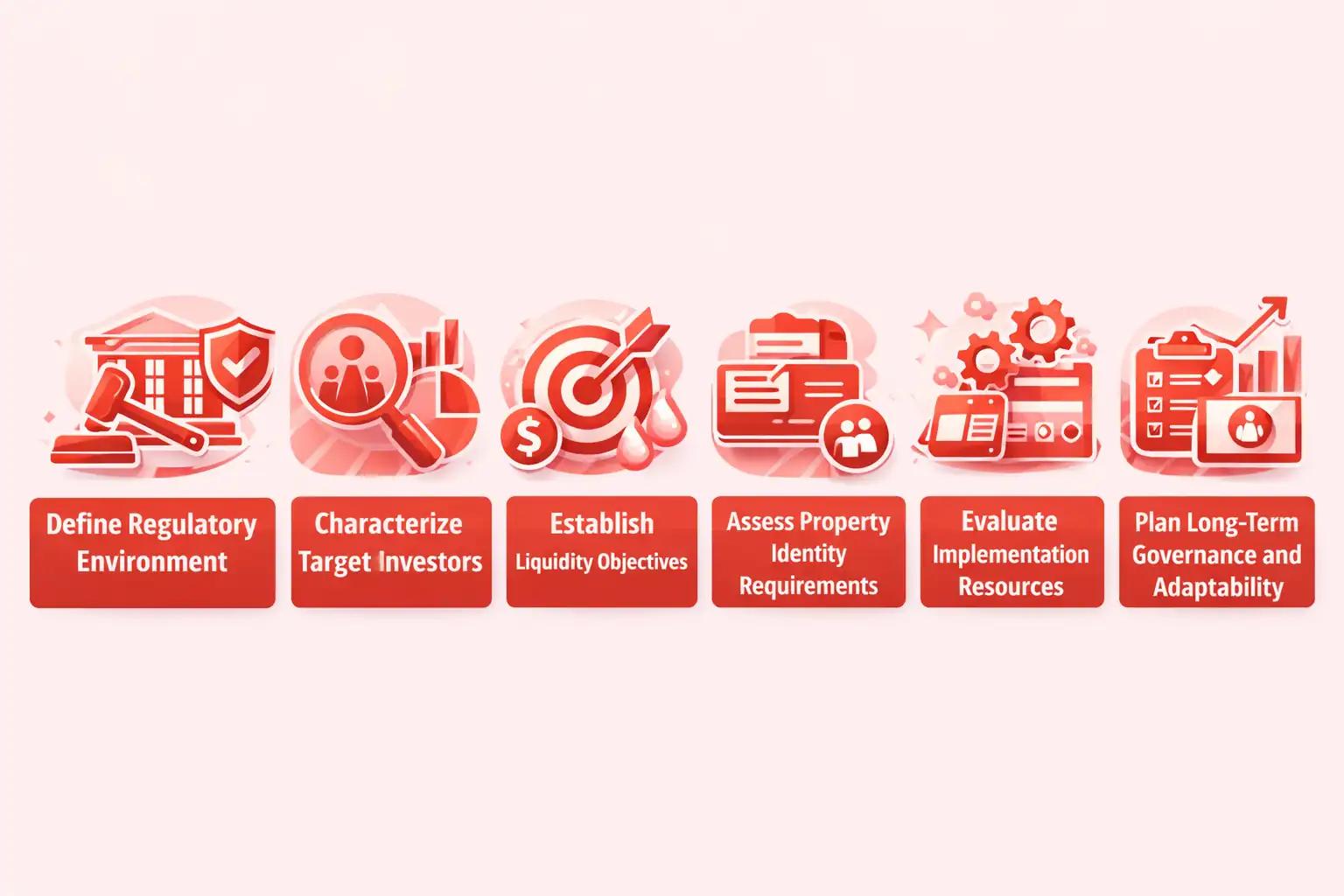
6 Step Token Standard Selection Framework
Step 1: Define Regulatory Environment
Assessment: Identify all applicable jurisdictions where property is located, sponsors operate, and investors reside. Document specific regulatory frameworks including SEC rules in USA, FCA requirements in UK, VARA/DFSA regulations in UAE Dubai, and provincial securities laws in Canada. Determine whether offerings qualify for registration exemptions or require full registration.
Decision Impact: Heavily regulated environments with strict investor eligibility, transfer restrictions, and ongoing reporting requirements strongly favor ERC-3643. Less regulated jurisdictions or offerings with minimal compliance requirements may use ERC-20 or ERC-721 with simpler external compliance systems.
Step 2: Characterize Target Investors
Assessment: Define investor demographics including accreditation requirements (accredited, qualified, professional, retail), geographic distribution, investment sizes, holding period expectations, and liquidity preferences. Assess investor technical sophistication with blockchain technology and comfort with different token types.
Decision Impact: Institutional investors and regulated entities typically require ERC-3643 compliance automation. Crypto-native retail investors may prefer ERC-20 liquidity and exchange accessibility. High-net-worth individuals purchasing unique properties may accept ERC-721 liquidity constraints for property-specific benefits.
Step 3: Establish Liquidity Objectives
Assessment: Determine liquidity importance for project success including investor expectations for exit options, target holding periods, desired secondary market depth, and acceptable bid-ask spreads. Evaluate exchange listing objectives considering security token exchanges, standard DEXs, or NFT marketplaces.
Decision Impact: Maximum liquidity objectives favor ERC-20 or ERC-3643 fungible tokens enabling deep markets and tight spreads. Unique property representation requiring property-specific identity suggests ERC-721 despite liquidity tradeoffs. Long holding periods with limited secondary trading reduce liquidity importance enabling greater flexibility in standard selection.
Step 4:
Assess Property Identity Requirements
Assessment: Evaluate whether maintaining property-specific characteristics, individual property ownership tracking, or selective property transactions within portfolios provides sufficient value to justify uniqueness benefits. Consider property heterogeneity across portfolio and importance of property-level financial reporting, legal separation, or independent dispositions.
Decision Impact: Strong property identity requirements with heterogeneous assets favor ERC-721 unique representations or hybrid structures. Homogeneous property portfolios or fractional offerings where investors don’t select specific properties work well with fungible ERC-20 or ERC-3643 tokens pooling properties without individual identity preservation.
Step 5: Evaluate Implementation Resources
Assessment: Determine available budget for development, legal structuring, compliance systems, and ongoing operations. Assess technical team capabilities including blockchain development expertise, smart contract security knowledge, and compliance system integration experience. Consider timeline pressures and speed-to-market requirements.
Decision Impact: Limited resources and urgent timelines favor simpler ERC-20 implementations with external compliance. Adequate resources and longer timelines enable comprehensive ERC-3643 deployments with native compliance. Very high implementation budgets enable sophisticated hybrid approaches combining multiple standards optimizing across competing objectives.
Step 6: Plan Long-Term Governance and Adaptability
Assessment: Project future requirements including potential regulatory changes, investor demographic evolution, secondary market development, and technological advancements affecting tokenization. Consider upgrade mechanisms, migration possibilities, and governance frameworks enabling adaptation to changing circumstances over multi-year holding periods.
Decision Impact: Long-term adaptability needs favor ERC-3643’s configurable compliance modules enabling rule updates without token migration. Short-term projects with defined exit timelines can accept less flexible standards. Governance requirements including voting and corporate actions support favor ERC-3643 standardized frameworks over custom implementations required for other standards.
The decision framework should produce a preliminary standard recommendation, which then undergoes validation through structured stakeholder consultation. This includes legal counsel reviewing regulatory implications and jurisdictional compliance, technical teams assessing implementation feasibility, security, and scalability, and target investors providing input on usability, liquidity expectations, and risk tolerance. Final standard selection should be approved only after alignment across regulatory, technical, and market considerations is achieved, ensuring the chosen token standard supports long-term operational sustainability and investor confidence.
Real estate tokenization standards fundamentally shape project success, regulatory compliance, and investor experience. ERC-20 enables liquid fractional trading, ERC-721 preserves property identity, and ERC-3643 provides institutional-grade compliance automation. Strategic standard selection aligned with regulatory requirements, target demographics, and liquidity objectives determines whether tokenization delivers transformative benefits or creates operational complexity without commensurate value in global real estate markets.
People Also Ask
Q1.1. What are real estate tokenization standards and why do they matter?
Real estate tokenization standards are technical protocols and frameworks that define how property ownership rights are represented, transferred, and managed as digital tokens on blockchain networks. These standards matter because they determine security features, regulatory compliance capabilities, investor protections, and interoperability with exchanges and wallets. The three primary standards are ERC-20 for fungible fractional ownership, ERC-721 for unique property representations, and ERC-3643 for compliant security tokens with built-in regulatory controls essential for institutional adoption.
Q2.2. What is the difference between ERC-20 and ERC-721 for real estate tokens?
ERC-20 creates fungible tokens where each unit is identical and interchangeable, ideal for fractional ownership where multiple investors own identical shares in a property pool. ERC-721 creates non-fungible tokens where each token is unique, suitable for representing individual properties with distinct characteristics, locations, and values. ERC-20 enables liquid secondary markets through uniform token trading, while ERC-721 maintains property-specific identity and metadata but faces liquidity challenges due to uniqueness requiring buyers interested in specific assets.
Q3.3. Why is ERC-3643 considered best for regulated real estate tokenization standards?
ERC-3643 is purpose-built for security tokens requiring regulatory compliance, incorporating on-chain identity verification, transfer restrictions based on investor eligibility, jurisdictional controls, and support for corporate actions like dividend distributions. Unlike ERC-20 and ERC-721 which require external compliance layers, ERC-3643 embeds compliance directly into token logic, automatically enforcing accreditation requirements, holding periods, and geographic restrictions. This native compliance makes ERC-3643 ideal for institutional real estate offerings in regulated markets including USA, UK, UAE, and Canada.
Q4.4. Can you use multiple token standards for the same real estate project?
Yes, hybrid approaches combining standards are increasingly common, using ERC-721 to represent the unique underlying property while issuing ERC-20 or ERC-3643 tokens representing fractional ownership shares in that property. This structure maintains property-specific identity through the NFT while enabling liquid fractional trading through fungible tokens. Another approach uses ERC-721 for whole property ownership with ERC-3643 for compliant fractional shares, balancing uniqueness, compliance, and liquidity based on specific project requirements and target investor demographics.
Q5.5. How do real estate tokenization standards handle dividend distributions?
ERC-20 tokens can distribute rental income and profits proportionally to all token holders through smart contract functions or off-chain calculations, though the standard doesn’t mandate specific distribution mechanisms. ERC-3643 includes native support for corporate actions including dividend distributions, enabling automated proportional payments with tax withholding and regulatory reporting. ERC-721 tokens representing whole properties require custom implementations for distributions, typically through escrow contracts or manual processes since the standard focuses on unique asset representation rather than financial operations.
Q6.6. What compliance features are built into ERC-3643 that other standards lack?
ERC-3643 incorporates identity registries linking wallet addresses to verified investor identities, transfer restriction modules enforcing eligibility requirements, compliance claims defining permitted investor categories, and trusted issuer frameworks managing verification processes. These features enable automatic enforcement of accreditation status, holding period compliance, maximum investor counts, and jurisdictional restrictions directly on-chain. ERC-20 and ERC-721 lack these native compliance capabilities, requiring external verification systems and manual enforcement creating regulatory gaps and operational complexity in regulated real estate offerings.
Q7.7. Which token standard provides better liquidity for real estate investments?
ERC-20 provides superior liquidity for real estate investments due to fungibility enabling uniform trading on decentralized and centralized exchanges without requiring buyers interested in specific properties. Token interchangeability creates deeper liquidity pools and tighter bid-ask spreads comparable to traditional securities. ERC-3643 maintains fungibility benefits while adding compliance automation. ERC-721’s uniqueness creates liquidity challenges as each token requires individual valuation and buyer-seller matching for specific properties, though specialized NFT marketplaces are improving liquidity for unique real estate tokens.
Q8.8. How do tokenization standards differ across USA, UK, UAE, and Canada regulations?
All three standards can be used in USA, UK, UAE, and Canada, but regulatory requirements influence standard selection and implementation details. USA SEC regulations favor ERC-3643 for compliant security token offerings with built-in transfer restrictions. UK FCA frameworks emphasize investor protection features available in ERC-3643. UAE’s VARA and DFSA regulations in Dubai require robust compliance controls best supported by ERC-3643. Canada’s provincial securities regulations similarly benefit from ERC-3643’s native compliance capabilities, though all standards can be adapted with external compliance layers meeting jurisdictional requirements.
Q9.9. Can real estate tokens be upgraded or migrated to different standards?
Yes, token migration between standards is possible but complex, requiring new smart contract deployment, investor communication, regulatory approval in many jurisdictions, and coordinated token exchange processes. Projects initially using ERC-20 may migrate to ERC-3643 as compliance requirements evolve or institutional investors demand enhanced regulatory features. Migration involves distributing new compliant tokens in exchange for original tokens, updating wallet integrations, exchange listings, and legal documentation. Upgradeable proxy patterns enable contract logic updates without full migration, though fundamental standard changes typically require complete redeployment.
Q10.10. What determines which tokenization standard to choose for a real estate project?
Standard selection depends on regulatory requirements, target investor demographics, liquidity objectives, property characteristics, and operational complexity tolerance. ERC-3643 suits regulated offerings targeting institutional investors in compliant jurisdictions requiring built-in transfer restrictions. ERC-20 works for projects prioritizing maximum liquidity with external compliance management. ERC-721 fits unique property representations where maintaining individual asset identity matters more than fungibility. Factors include securities law compliance needs, desired secondary market venues, investor accreditation requirements, jurisdictional controls, and long-term governance capabilities determining optimal standard alignment with project goals.
Explore Services
Related Services
Reviewed by

Aman Vaths
Founder of Nadcab Labs
Aman Vaths is the Founder & CTO of Nadcab Labs, a global digital engineering company delivering enterprise-grade solutions across AI, Web3, Blockchain, Big Data, Cloud, Cybersecurity, and Modern Application Development. With deep technical leadership and product innovation experience, Aman has positioned Nadcab Labs as one of the most advanced engineering companies driving the next era of intelligent, secure, and scalable software systems. Under his leadership, Nadcab Labs has built 2,000+ global projects across sectors including fintech, banking, healthcare, real estate, logistics, gaming, manufacturing, and next-generation DePIN networks. Aman’s strength lies in architecting high-performance systems, end-to-end platform engineering, and designing enterprise solutions that operate at global scale.