Ai Overview
Multi-chain Web3 applications deploy across multiple blockchains independently, while cross-chain apps enable active data and asset transfer between those chains. Cross-chain bridges remain the most frequently exploited attack surface in Web3, with over USD 2. LayerZero, Chainlink CCIP, and Axelar are the leading cross-chain messaging protocols enabling arbitrary data transfer between EVM-compatible chains in 2026.
✓Key Takeaways
- 01.Multi-chain Web3 applications deploy across multiple blockchains independently, while cross-chain apps enable active data and asset transfer between those chains.
- 02.Cross-chain bridges remain the most frequently exploited attack surface in Web3, with over USD 2.5 billion lost to bridge exploits since 2021.
- 03.LayerZero, Chainlink CCIP, and Axelar are the leading cross-chain messaging protocols enabling arbitrary data transfer between EVM-compatible chains in 2026.
- 04.Cosmos IBC enables over 100 sovereign blockchains to communicate natively without bridge smart contracts, representing the most mature interoperability standard.
- 05.Chain abstraction is emerging as the UX solution to multi-chain complexity, hiding network selection from users while routing transactions to the optimal chain.
- 06.Cross-chain DeFi protocols that aggregate liquidity from multiple chains consistently outperform single-chain alternatives on depth and price execution quality.
- 07.Modular blockchain architecture, separating execution, settlement, and data availability layers, is becoming the dominant design pattern for scalable multi-chain Web3 applications.
- 08.Multi-chain NFT ecosystems allow digital assets to move between Ethereum, Solana, and Polygon without wrapping, preserving provenance and reducing friction.
- 09.AI-driven cross-chain automation agents are beginning to optimise yield, rebalance positions, and execute arbitrage across chains without manual user intervention.
- 10.Regulatory clarity on cross-chain asset flows is advancing in the UK and UAE, making compliant multi-chain Web3 applications increasingly viable for institutional adoption.
The blockchain industry began with a single premise: one chain, one truth. Bitcoin established this model, Ethereum expanded it, and for several years the assumption was that a single dominant blockchain would eventually capture the majority of decentralized activity. That assumption has been thoroughly overturned. In 2026, the Web3 landscape is fundamentally multi-chain, with hundreds of Layer-1 and Layer-2 networks serving distinct user bases, economic niches, and technical requirements. Web3 applications built on a single chain today face a structural disadvantage: they are accessible only to users and capital native to that network, cutting them off from the vast majority of global on-chain activity.
Our agency has spent over eight years building blockchain infrastructure for clients across the USA, UK, UAE, and Canada, and the shift from single-chain to multi-chain thinking has been the single most consequential architectural change we have navigated in that time. This guide provides the definitive practitioner perspective on multi-chain and cross-chain Web3 applications: what they are, how they work, where they create value, where they introduce risk, and what the next phase of their evolution looks like.
Evolution of Web3 from Single-Chain to Multi-Chain Ecosystems
The evolution from single-chain to multi-chain ecosystems followed the same pattern as the evolution of the internet from closed networks to the open web. Early blockchain applications were entirely Ethereum-native: wallets, tokens, DEXs, and lending protocols all lived on the same network and shared the same state. This created composability within a single ecosystem, but it also concentrated risk, congested the network during peak usage, and made gas fees prohibitively expensive for smaller transactions.
The emergence of Binance Smart Chain in 2020, Polygon’s scaling solution in 2021, and the proliferation of Ethereum Layer-2 networks through 2023 to 2026 established the current reality: users and capital are distributed across dozens of active networks. The total value locked across all chains in 2026 is spread across Ethereum mainnet, its Layer-2 ecosystem, Solana, BNB Chain, Avalanche, Cosmos chains, Polkadot parachains, and numerous application-specific chains. Multi-chain Web3 applications are not a future aspiration; they are the present operational requirement for any protocol that wants meaningful reach.
Why Interoperability Is Important for Decentralized Platforms?
Interoperability is to blockchains what HTTP is to the internet. Without it, each chain is an island with its own users, liquidity, and governance, incapable of interacting with the broader ecosystem. Interoperable Web3 platforms break down these silos, enabling capital to flow to its highest-value use regardless of which chain it originates on, and enabling users to access any application from any network without managing multiple wallets, gas tokens, and bridge workflows manually.
The economic case for interoperability is straightforward: fragmented liquidity means worse prices, higher slippage, and reduced market efficiency for every participant. The user experience case is equally clear: multi-chain complexity is the single biggest barrier to mainstream Web3 adoption in consumer markets across the USA, UK, and Canada. Interoperability infrastructure that abstracts this complexity will be the unlock for the next wave of Web3 user growth. For institutional participants in the UAE and UK that are evaluating Web3 platforms for treasury management and settlement, interoperability with existing infrastructure is a non-negotiable requirement.
What Are Multi-Chain Web3 Applications?
Multi-chain Web3 applications are protocols that deploy independent instances of their smart contracts across two or more blockchains simultaneously. Each deployment is self-contained: it has its own liquidity, its own user base, and its own state. There is no inherent communication requirement between these deployments, though many protocols add cross-chain messaging on top of their multi-chain deployments to share state or governance signals.
A real-world example is Aave, which operates separate lending markets on Ethereum, Arbitrum, Optimism, Polygon, and other chains. Each market functions independently with its own liquidity pools and risk parameters. Users on Polygon can borrow and lend without ever touching Ethereum mainnet, benefiting from lower gas costs. This is classic multi-chain architecture. The key engineering challenge is maintaining consistent risk parameters, governance decisions, and protocol upgrades across all deployments simultaneously, which requires robust deployment and monitoring infrastructure.
What Are Cross-Chain Web3 Applications?
Cross-chain Web3 applications go beyond multi-chain deployment by actively enabling communication, asset transfers, and shared state between chains. A user interacting with a cross-chain dApp can initiate an action on Chain A that automatically triggers a corresponding action on Chain B, without manual bridging or wallet switching. Cross-chain dApp development requires messaging infrastructure that can pass authenticated messages between chains reliably and with acceptable latency.
Stargate Finance is an example of a cross-chain application. It enables users to transfer stable assets directly from any supported chain to any other supported chain in a single transaction, with guaranteed finality on the destination chain. The underlying infrastructure uses LayerZero’s messaging protocol to pass transfer confirmations across chains. This is qualitatively different from multi-chain architecture: the chains are not just co-existing deployments but actively communicating components of a unified system. Cross-chain Web3 applications require significantly more security analysis than multi-chain deployments because every bridge or messaging point is a potential exploit vector.
Key Differences Between Multi-Chain and Cross-Chain Models
Multi-Chain vs Cross-Chain: Architecture Comparison
Multi-Chain Model
- Independent deployments per chain
- No real-time inter-chain communication
- Lower attack surface and risk
- Simpler smart contract logic
- Manual governance synchronisation
- Example: Aave, Uniswap v3
Cross-Chain Model
- Active messaging between chain deployments
- Unified state across multiple networks
- Greater user experience continuity
- Complex bridge and oracle dependencies
- Automated governance propagation
- Example: Stargate, Chainlink CCIP apps
Hybrid Omnichain Model
- Multi-chain deployment as foundation
- Cross-chain messaging for key flows
- Selective communication of governance
- Chain abstraction at UX layer
- Highest complexity, maximum reach
- Emerging standard for 2026 protocols
Blockchain Bridges and Cross-Chain Messaging
Blockchain bridges are the foundational infrastructure for cross-chain Web3 applications. At their simplest, they lock assets on one chain and mint equivalent wrapped representations on another, enabling value to move across chain boundaries. Asset bridges like Hop Protocol and Across enable fast, low-cost token transfers between Ethereum and its Layer-2 networks by using liquidity providers who front capital on the destination chain and are reimbursed from the source chain after proof of intent is verified.
More powerful than simple asset bridges are general-purpose cross-chain messaging protocols. LayerZero, Chainlink’s Cross-Chain Interoperability Protocol (CCIP), and Axelar all enable smart contracts on one chain to send arbitrary messages to contracts on another chain, triggering any function call on the destination. This capability unlocks cross-chain governance, cross-chain lending, cross-chain order books, and omnichain NFTs. CCIP in particular has gained significant traction in the UK and UAE institutional market due to Chainlink’s reputation and the protocol’s defence-in-depth security model.[1]
Relay Protocols and Atomic Swaps
Relay protocols use a network of off-chain actors called relayers or validators to observe events on one chain and transmit proofs or signed messages to destination chains. The security model of a relay protocol is determined by the assumptions about these relayers: some require a trusted multi-sig, others use decentralised validator sets, and the most advanced use cryptographic proofs such as zero-knowledge proofs or optimistic fraud proofs that allow destination chains to verify source chain events without trusting any intermediary.
Atomic swaps offer an alternative to bridge-based interoperability for token exchanges. Using Hash Time-Lock Contracts (HTLCs), two parties can swap assets on different chains without any trusted intermediary. If either party fails to fulfil their side of the exchange within the time lock, the swap reverts automatically. Atomic swaps are trustless and elegant but have practical limitations: they require both parties to be online simultaneously, they are slow relative to bridges, and they do not support arbitrary message passing. They remain most useful for direct peer-to-peer asset exchanges in privacy-conscious use cases.
Layer-0 Networks: Polkadot and Cosmos
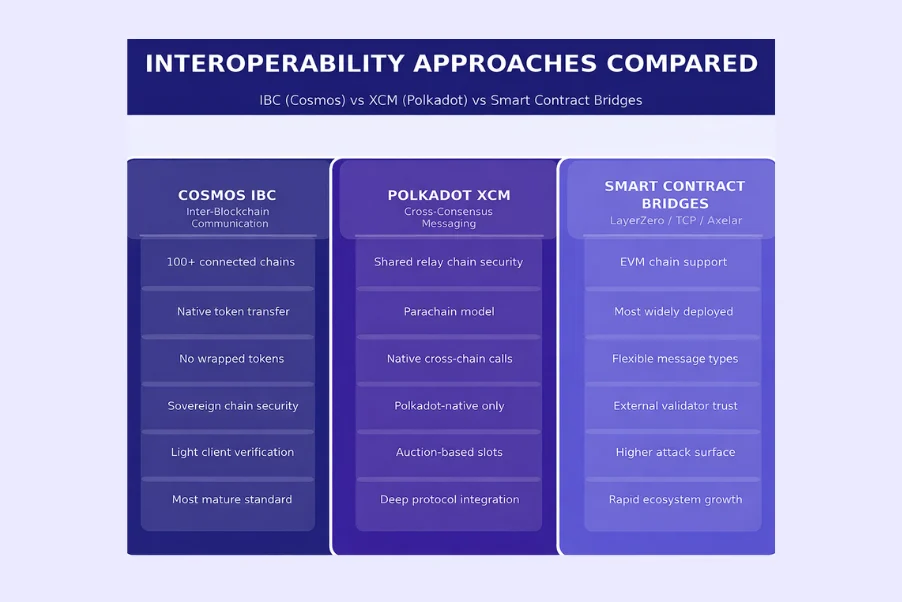
Layer-0 networks take a fundamentally different approach to interoperability. Rather than adding bridge infrastructure on top of independently designed blockchains, they provide a shared foundation that enables interoperability by design. Polkadot’s relay chain connects sovereign parachains, each of which can have its own consensus, token economy, and governance while sharing Polkadot’s security and communicating via its Cross-Chain Message Passing (XCM) protocol. This architecture eliminates the need for smart-contract-based bridges between connected chains, removing a major attack surface.
Cosmos implements interoperability through the Inter-Blockchain Communication (IBC) protocol, which enables any two IBC-compatible chains to establish authenticated communication channels. With over 100 chains connected via IBC in 2026, including Osmosis, Celestia, Injective, and dYdX, Cosmos represents the most extensive native interoperability ecosystem in operation. IBC does not rely on wrapped tokens or external bridges; assets transferred via IBC retain their native representation on both chains via the IBC token standard, significantly reducing the complexity and risk associated with cross-chain asset management.
Expanding Liquidity Across Multiple Chains
Liquidity fragmentation is the central economic challenge of multi-chain ecosystems. When a DeFi protocol deploys separately on Ethereum, Arbitrum, Polygon, and BNB Chain, its liquidity is divided across four pools rather than concentrated in one. Each pool is shallower, trades execute with more slippage, and capital utilisation is lower than in a unified single-chain deployment. The business case for multi-chain expansion must account for this trade-off: does the additional user reach and fee revenue from new chains outweigh the efficiency cost of fragmented liquidity?
Cross-chain liquidity aggregation protocols have emerged to address this trade-off. Protocols like Chainflip and Thorchain maintain a single global liquidity pool that serves users across multiple chains, routing cross-chain swap requests through their internal accounting without requiring traditional bridging. This approach preserves the economic benefits of concentrated liquidity while enabling multi-chain access. For DeFi protocols targeting institutional participants in the UAE and UK, cross-chain liquidity aggregation is increasingly a competitive requirement rather than a differentiating feature.
Modular Blockchain Architecture for dApps
Modular blockchain architecture separates the three core functions of a blockchain into distinct, independently optimised layers: execution, where transactions are processed; settlement, where finality is established; and data availability, where transaction data is stored and made accessible for verification. This separation allows each layer to scale and optimise independently, and it enables application teams to assemble custom chains from best-in-class components rather than accepting the trade-offs of a single monolithic chain. Celestia provides data availability, Ethereum provides settlement, and custom execution environments handle application-specific logic. This modular approach is now the dominant architectural pattern for sophisticated cross-chain dApp engineering teams building at scale.
Authoritative Principles for Multi-Chain Web3 Architecture
Principle 1: Multi-chain deployments must maintain consistent risk parameters and governance signals across all chains to prevent arbitrage and inconsistent user outcomes.
Principle 2: Every bridge integration must undergo an independent security audit before launch and a re-audit following any significant upgrade or parameter change.
Principle 3: Cross-chain applications must implement circuit breakers that pause bridge interactions automatically when anomalous transaction volumes or price deviations are detected.
Principle 4: Liquidity caps on bridge contracts must be enforced and reviewed quarterly; no single bridge should hold more than 10% of the total protocol TVL without exceptional justification.
Principle 5: Chain abstraction implementations must not introduce new custodial risks; users must retain ultimate control over their assets at every step of cross-chain routing.
Principle 6: Cross-chain governance proposals must include impact assessments for every chain affected and require approval from governance participants across all deployed chains.
Principle 7: Message replay attacks must be prevented by including unique nonces and chain IDs in every cross-chain message payload and verifying them on the destination chain.
Principle 8: All cross-chain applications targeting UK, UAE, or Canadian institutional users must maintain complete on-chain records of cross-chain asset flows for regulatory reporting purposes.
Improved Scalability and Performance
Scalability is the most immediate benefit of multi-chain architecture for high-volume Web3 applications. A single Ethereum mainnet deployment processing thousands of transactions per hour faces gas fee spikes that price out smaller participants, particularly users in emerging markets and users making frequent micro-transactions. By distributing load across Layer-2 networks and alternative Layer-1 chains, multi-chain protocols can serve different user segments at the cost and throughput profile appropriate to their needs.
Performance improvements from multi-chain architecture are not purely about transaction throughput. Network-level diversification also improves resilience: if one chain experiences congestion, a validator incident, or a governance crisis, users can migrate their activity to alternative deployments. This redundancy is particularly valuable for mission-critical Web3 applications in financial services, where downtime or degraded performance has direct monetary consequences for users across the USA, UK, and UAE.
Greater Liquidity and Asset Mobility
Asset mobility is the killer feature of cross-chain Web3 applications. When assets can move freely between chains, capital naturally flows toward its highest-value use. A liquidity provider who holds USDC can provide liquidity on whichever chain currently offers the best yield, without being locked into a single network. This capital efficiency benefit compounds over time: chains and protocols that offer the best opportunities attract more capital, which deepens liquidity, which improves execution quality, which attracts more users. Cross-chain asset mobility is therefore not just a convenience feature but a structural driver of DeFi market efficiency. In Canada and the UK, institutional fund managers are increasingly exploring cross-chain yield strategies that were impossible just two years ago.
Cross-Chain Web3 Application Use Cases in Production
Cross-Chain DeFi Platforms
Protocols like Thorchain and Chainflip enable native cross-chain swaps between Bitcoin, Ethereum, and other Layer-1 assets without wrapped tokens. Users in the USA and UK access deep liquidity across chains in a single seamless transaction.
Multi-Chain NFT and Gaming Ecosystems
NFT projects use LayerZero’s ONFT standard to allow tokens to move natively between Ethereum, Polygon, and BNB Chain. Gaming ecosystems enable in-game assets earned on one chain to be used across games on different chains, unifying player economies.
Interoperable DAO Governance
DAOs deployed across multiple chains use cross-chain governance protocols to aggregate votes from token holders on all networks into a single binding decision. UAE-based Web3 foundations increasingly use multi-chain DAO structures to include token holders across global networks.
Web3 Identity and Credential Systems
Decentralized identity platforms use cross-chain credential verification so that a KYC verification completed on one chain is valid across all connected chains without repeating the identity process. This is critical for compliant multi-chain DeFi serving institutional users in the UK and Canada.
Before committing to a multi-chain or cross-chain architecture, teams must systematically evaluate three dimensions of readiness. Our agency applies the following three-step assessment before making any cross-chain architecture recommendation for clients in the USA, UK, UAE, and Canada.
Three-Step Cross-Chain Architecture Assessment
Security Threat Modelling
- Map all trust assumptions in each bridge
- Identify concentrated value exposure points
- Assess validator set decentralisation
- Design circuit breaker mechanisms
Chain Compatibility Audit
- Verify EVM compatibility per target chain
- Test messaging protocol on all target networks
- Validate gas token handling across chains
- Confirm oracle availability per chain
Regulatory and Compliance Review
- Map cross-chain asset flows to travel rule
- Assess jurisdiction of each deployed chain
- Confirm AML obligations per market
- Document cross-chain governance accountability
Security Risks in Cross-Chain Bridges
Bridge security is the most critical unsolved challenge in cross-chain Web3 engineering. The fundamental problem is that bridges must lock large amounts of value in smart contracts that validate state from external chains. If the validation mechanism can be manipulated, tricked by a compromised validator set, or exploited through a logic error, the locked funds can be drained. The Ronin bridge hack of USD 625 million, the Wormhole exploit of USD 320 million, and the Nomad bridge drain of USD 190 million all share a common root cause: insufficient security at the trust boundary between chains.
The industry response to these exploits has been meaningful but not yet sufficient. Multi-layer validation models require multiple independent validator sets to agree before a message is accepted. Time-locks give monitoring systems time to detect and pause anomalous transactions before they finalise. Liquidity caps limit the maximum damage from any single exploit. Zero-knowledge proof-based bridges, where destination chains verify source chain state mathematically rather than by trusting validators, represent the most secure long-term solution but are currently limited to specific route pairs due to the high cost of ZK proof generation.
Scalability and Network Compatibility Issues
Not all blockchains are created equal, and cross-chain Web3 applications must navigate significant compatibility challenges. Chains differ in their consensus mechanisms, finality guarantees, block times, and smart contract execution environments. A cross-chain message passing protocol designed for fast-finality chains may behave unexpectedly on probabilistic-finality chains where the probability of reorganisation remains material for several blocks after a transaction is included. Cross-chain dApp teams must explicitly model these finality differences and implement conservative confirmation thresholds that account for the weakest-finality chain in their ecosystem.
| Checklist Item | Category | Priority |
|---|---|---|
| Bridge contracts audited by at least two independent firms | Security | Critical |
| Circuit breakers with automatic pause on anomaly detection | Security | Critical |
| Liquidity caps per bridge route reviewed quarterly | Risk Management | High |
| Cross-chain governance votes require quorum from all chain communities | Governance | High |
| Travel rule compliance for cross-chain asset flows above thresholds | Compliance | High |
| Replay attack prevention via nonces and chain IDs in all messages | Security | Medium |
| Monthly monitoring review of all cross-chain transaction anomalies | Operations | Medium |
Three Defining Trends Shaping Multi-Chain Web3 in 2026 and Beyond
Omnichain Apps and Chain Abstraction
- Single interface spans all chains
- Intent-based transaction routing
- Gas payment abstracted from users
- Account unification across networks
- No chain selection required by users
AI-Driven Cross-Chain Automation
- AI agents monitor yield across chains
- Automated cross-chain rebalancing
- Predictive bridge routing optimisation
- Anomaly detection across chain state
- Natural language cross-chain transactions
Next-Phase Interoperability Standards
- ZK-verified bridge standard adoption
- Universal cross-chain identity layer
- Regulatory-grade cross-chain reporting
- IBC expansion to EVM chains
- On-chain compliance attestations
Omnichain Applications and Chain Abstraction
Omnichain applications represent the convergence of multi-chain deployment and cross-chain communication into a unified user experience. The defining characteristic of an omnichain application is that users interact with a single interface without awareness of which chain is executing their transaction. The application handles routing, gas payment, and cross-chain coordination transparently. This abstraction is becoming technically feasible through a combination of intent-based architectures, where users express what they want rather than how to achieve it, and solver networks that compete to fulfill those intents across available chains at the best price and speed.
ERC-4337 account abstraction on Ethereum and its Layer-2 networks enables gas sponsorship, batched transactions, and session keys that make cross-chain interactions feel as simple as traditional web application interactions. Combined with NEAR’s chain abstraction protocol and projects like Particle Network, the infrastructure for truly chain-agnostic Web3 applications is being assembled in 2026 and will define the mainstream user experience of the next wave of Web3 adoption across the UK, UAE, and Canada.
The Next Phase of Web3 Interoperability
The next phase of Web3 interoperability infrastructure will be defined by two concurrent developments: the maturation of ZK-proof-based bridges that eliminate validator trust assumptions entirely, and the emergence of regulatory-grade cross-chain compliance infrastructure. The first development makes cross-chain applications as secure as same-chain applications. The second makes them viable for institutional adoption at scale in markets with clear regulatory frameworks.
For teams building cross-chain Web3 applications targeting UK, UAE, and Canadian institutional users in 2026, the strategic imperative is to invest in security-first bridge architectures now, adopt emerging interoperability standards as they mature, and embed regulatory compliance into cross-chain asset flows from the protocol level rather than as an afterthought. The competitive landscape for Web3 interoperability infrastructure is maturing rapidly, and the teams that establish themselves as the trusted interoperability layer for regulated multi-chain applications will define the next phase of decentralised finance infrastructure globally.
Ready to Build Multi-Chain and Cross-Chain Web3 Applications?
Our team designs secure, interoperable Web3 architectures for DeFi, NFT, and enterprise protocols across all major chains.
Frequently Asked Questions
Q1.What is the difference between multi-chain and cross-chain Web3 applications?
Multi-chain Web3 applications are deployed independently across multiple blockchains, with each chain running a separate instance of the protocol. Cross-chain Web3 applications go further by enabling active communication, asset transfers, and data sharing between those chains in real time. Multi-chain focuses on reach and redundancy, while cross-chain focuses on interoperability. Most mature DeFi protocols in the USA and UK now combine both approaches to maximise user access and capital efficiency across their target networks.
Q2.Why is cross-chain interoperability important for Web3?
Cross-chain interoperability removes the artificial barriers that isolate liquidity, users, and assets within individual blockchain silos. Without it, a user on Ethereum cannot directly interact with a protocol on Avalanche or BNB Chain without using centralised exchanges. Interoperable Web3 platforms allow capital and information to flow freely across networks, improving price efficiency, reducing fragmentation, and giving users in the UAE, Canada, and globally access to the best-available yield and services regardless of which chain they are natively on.
Q3.What are blockchain bridges and how do they work?
Blockchain bridges are protocols that allow assets and data to move between two separate blockchains. They work by locking assets on the source chain and minting equivalent wrapped representations on the destination chain. When the user wants to return, the wrapped assets are burned and the original assets are released. Cross-chain messaging bridges like LayerZero and CCIP extend this further by enabling arbitrary data and contract calls to pass between chains, enabling far richer cross-chain dApp development than simple asset bridging.
Q4.What are the security risks of cross-chain bridges?
Cross-chain bridges are one of the most frequently exploited components in Web3. Billions of dollars have been lost in bridge hacks including Ronin, Wormhole, and Nomad. The core risk is that bridges concentrate large amounts of locked value in a relatively small set of smart contracts or validator sets, creating high-value targets. Security risks include validator compromise, oracle manipulation, logic errors in the bridge contract, and replay attacks. Protocols building cross-chain Web3 applications must conduct thorough audits and implement time-locks, multi-sig controls, and circuit breakers on all bridge interactions.
Q5.What is chain abstraction and why does it matter?
Chain abstraction is the design philosophy of hiding blockchain complexity from end users so they can interact with Web3 applications without knowing or caring which chain they are on. It matters because most users in the USA, UK, and Canada are not technical; they want fast, cheap transactions and access to features, not exposure to the operational complexity of multi-chain ecosystems. Chain abstraction achieves this through account aggregation, gas sponsorship, unified RPC layers, and intent-based transaction routing that automatically selects the optimal execution chain behind the scenes.
Q6.What is a Layer-0 blockchain and how does it enable interoperability?
A Layer-0 blockchain is a foundational networking layer that sits beneath Layer-1 chains and provides shared consensus and communication infrastructure. Polkadot and Cosmos are the leading Layer-0 examples. Polkadot uses a relay chain and parachain architecture where all connected chains share security and can communicate natively. Cosmos uses the Inter-Blockchain Communication (IBC) protocol to enable sovereign chains to exchange data with each other directly. Both eliminate the trust assumptions and smart contract complexity required by external bridges, making them more secure and efficient for cross-chain dApp development.
Explore Services
Related Services
Reviewed by

Aman Vaths
Founder of Nadcab Labs
Aman Vaths is the Founder & CTO of Nadcab Labs, a global digital engineering company delivering enterprise-grade solutions across AI, Web3, Blockchain, Big Data, Cloud, Cybersecurity, and Modern Application Development. With deep technical leadership and product innovation experience, Aman has positioned Nadcab Labs as one of the most advanced engineering companies driving the next era of intelligent, secure, and scalable software systems. Under his leadership, Nadcab Labs has built 2,000+ global projects across sectors including fintech, banking, healthcare, real estate, logistics, gaming, manufacturing, and next-generation DePIN networks. Aman’s strength lies in architecting high-performance systems, end-to-end platform engineering, and designing enterprise solutions that operate at global scale.