Ai Overview
An NFT marketplace is a digital platform where people can create (mint), list, buy, and sell non-fungible tokens. The type you choose will determine your audience, the technology stack, the smart contract logic, and your revenue model. Most platforms spend between 1,000 and 5,000 dollars per month on maintenance, depending on scale. A security audit from a reputable firm typically costs between 5,000 and 50,000 dollars, depending on the complexity of the contracts being reviewed.
Key Takeaways
- The global NFT market was valued at around 48.74 billion dollars in 2025 and is projected to reach 703.47 billion dollars by 2034, growing at a CAGR of 34.53 percent, showing the enormous long-term opportunity for those who decide to develop an NFT platform today.[1]
- OpenSea captured roughly 90 percent of Ethereum NFT trading volume by October 2024 and hosted over 80 million NFTs, which tells you exactly how much traffic a well-built NFT marketplace can attract over time.
- NFT marketplace development costs range from 30,000 to 150,000 dollars or more, depending on features like multi-chain support, smart contract complexity, and UI design, with basic platforms starting at around 30,000 to 50,000 dollars.[2]
- Gaming NFTs account for approximately 25 percent of total NFT trading volume in 2025, with the gaming NFT sector valued at around 471.90 billion dollars and projected to grow to 942.58 billion dollars by 2029.
- Smart contracts are the backbone of every NFT marketplace, handling ownership transfers, royalty payments to creators, auction logic, and permanent blockchain recording without any middlemen involved in the process.
- Ethereum powers approximately 62 percent of all NFT transactions, while Solana handles around 18 percent of NFT traffic in 2025, offering faster speeds and lower fees as a strong alternative for marketplace builders.[3]
- Security threats are a real concern in this space, with over 100 million dollars worth of NFTs stolen between July 2021 and July 2022, making robust smart contract audits and multi-factor authentication essential for any NFT marketplace.
The idea of owning something digital, truly and provably, was once considered impossible. Today, it is the foundation of a market that sits at 48.74 billion dollars and is heading toward 703.47 billion by 2034. NFTs made this possible, and the platforms that enable people to buy, sell, and create these tokens are called NFT marketplaces.
If you are a business owner, developer, or entrepreneur wondering how to get into this space, you have landed on the right page. This guide walks you through the full process and the NFT marketplace development solutions required to build a functional platform, from understanding what the platform actually does to the technology choices, features, costs, and every step in between. Nothing here is filler. Everything covered is directly useful to someone who actually wants to build an NFT marketplace that works.
What Is an NFT Marketplace and Why Does It Matter?
An NFT marketplace is a digital platform where people can create (mint), list, buy, and sell non-fungible tokens. Think of it as an online store, but instead of physical products, it deals in unique digital assets. These assets could be digital art, gaming items, music files, virtual land, event tickets, or even tokenized real-world property.
Every transaction on a blockchain NFT marketplace is recorded on a public ledger. This means anyone can verify who owns a particular NFT, when it was created, and how many times it has changed hands. There is no central authority controlling the records, which is what makes the system trustworthy and tamper-proof.
The marketplace earns money by charging a small percentage fee on every transaction. OpenSea, for instance, charges 2.5 percent per sale. Other revenue models include listing fees, subscription access, and royalty splits with creators.
The numbers tell a clear story. As of 2025, Ethereum still powers about 62 percent of all NFT transactions. The global user base crossed 11.64 million in 2025 and is expected to reach over 16 million by 2028. NFT-based ticketing now covers 5.3 percent of major US venue ticket sales. The gaming NFT market is valued at around 471.90 billion dollars with projections of 942.58 billion by 2029. These are not speculative numbers. They represent real activity on real platforms.
NFT Marketplace Development Guide
Types of NFT Marketplaces You Can Build
Before you begin the NFT marketplace building process, you need to decide what kind of platform you want to create. The type you choose will determine your audience, the technology stack, the smart contract logic, and your revenue model. There are four main categories.
1. Open NFT Marketplaces
These platforms accept any NFT from any creator without needing approval. OpenSea and Rarible are the best-known examples. Anyone can connect a wallet, upload a file, and mint an NFT. The advantage is volume and variety. The challenge is managing quality and avoiding counterfeit listings. If you want to build an NFT marketplace that caters to the widest possible audience, this is your model.
2. Curated Art Marketplaces
These platforms invite specific artists or require an application process before anyone can list work. SuperRare and Foundation follow this approach. The result is higher-quality content and a gallery-like feel. Buyers tend to spend more per piece. Fewer sellers mean fewer listings, but each one carries more weight.
3. Gaming and Metaverse NFT Platforms
These are built around in-game assets, characters, virtual land, or metaverse items. Axie Infinity is a well-known example. Gaming NFTs account for about 25 percent of all NFT trading volume. Building for this category requires handling high transaction volumes with low fees, which often points toward blockchains like Solana or Immutable X over Ethereum.
4. Niche and Industry-Specific Marketplaces
Some of the most interesting opportunities right now sit in vertical markets. Music NFT platforms like Sound.xyz allow artists to sell directly to fans. Real estate NFT platforms let people buy fractional ownership of property. Sports NFT marketplaces like NBA Top Shot trade moments and cards. Domain name platforms like Unstoppable Domains sell blockchain-based web addresses. Each of these has a defined user base that is easier to reach and retain than a general audience.
Choosing the Right Blockchain for Your NFT Marketplace
This decision shapes everything else. The blockchain you build on determines transaction speed, cost for users, the developer tools available to you, and who your potential user base is. There is no single best choice. Here is a breakdown of the main options.
1. Ethereum
Ethereum powers around 62 percent of all NFT transactions globally. It has the largest base of NFT collectors, the best liquidity, and the most mature developer tooling. The main drawback is gas fees, which can spike during high-traffic periods and make small transactions expensive. If you are building for high-value art or collectibles where users are comfortable paying more, Ethereum is the right foundation.
2. Solana
Solana handles around 18 percent of NFT traffic in 2025. It processes thousands of transactions per second with fees measured in fractions of a cent. Magic Eden built a successful business here by targeting users who prioritize speed and cost. The tradeoff is a smaller collector base compared to Ethereum and occasional network stability issues.
3. Polygon
Polygon is a Layer 2 solution that runs on top of Ethereum, offering compatibility with Ethereum tools while bringing fees down significantly. Starbucks and Nike both chose Polygon for their NFT initiatives. If you want Ethereum’s ecosystem without the gas costs, Polygon is a practical middle ground.
4. Binance Smart Chain (BSC)
BSC offers low fees and fast transactions, and it has a large user base through the Binance ecosystem. PancakeSwap operates an NFT marketplace here. It is a good choice when your target audience overlaps with BNB token holders or when you want access to a large pool of crypto-active users outside of Ethereum.
5. Tezos and Other Alternatives
Tezos is popular with artists who care about lower fees and a smaller environmental footprint. Cardano and Flow also have established NFT communities. These are worth considering if your niche audience already has a presence on these networks.
What id Treasure NFT? Is it Real or Fake?
Step-by-Step Process to Develop NFT Marketplace
This is the heart of this guide. The NFT marketplace building process has several distinct stages, and skipping or rushing any one of them typically leads to problems after launch. Here is how to move through each one correctly.
Step 1: Define Your Niche, Audience, and Business Model
Start by answering three questions. Who are you building this for? What type of NFT will your platform specialize in? How will your platform make money? These decisions shape everything that follows.
Your niche determines your smart contract requirements, your marketing strategy, and which blockchain fits best. A gaming marketplace has very different needs from a curated art platform. Your business model, whether transaction fees, listing fees, subscriptions, or royalty splits, determines how the platform is structured at a technical level.
Do competitive research. Study what OpenSea, Blur, Rarible, SuperRare, and Magic Eden do well and where they fall short. Look for gaps. Build NFT marketplace software that solves a real problem rather than just copying what already exists.
Step 2: Select Your Blockchain and Token Standards
Once you know your niche, pick the blockchain that fits it. Use the comparison from the previous section as your guide. After choosing the blockchain, decide on the token standard you will support.
ERC-721 is the standard for unique, one-of-a-kind NFTs. It is what most art and collectible platforms use. ERC-1155 supports both fungible and non-fungible tokens in a single contract, which makes it popular for gaming because players often need multiple copies of the same in-game item. SPL Token Standard is the equivalent of Solana. Your smart contract developers will need to know which of these you are targeting from the very beginning of development.
Step 3: Plan Your Core Features
Write down every feature your platform needs before a single line of code is written. A well-planned feature list prevents scope creep and cost overruns. Here is what every blockchain NFT marketplace needs at a minimum.
NFT Minting: Users must be able to upload files and create NFTs directly on your platform. This should support common file formats, including images, audio, video, and 3D files where relevant. Lazy minting, where the NFT is only recorded on-chain when it sells rather than when it is created, reduces costs for creators and lowers the barrier to participation.
Wallet Integration: Your platform must connect to wallets like MetaMask, Trust Wallet, Phantom (for Solana), and WalletConnect. Wallet integration is how users prove ownership and sign transactions without needing a traditional account and password.
Buying and Selling: Support fixed-price listings and auction formats. Dutch auctions (price starts high and drops) and English auctions (price rises with each bid) are both common. Give users a clear transaction history and real-time confirmation.
Search and Discovery: Users need to find what they are looking for. Build category filters, price range filters, blockchain filters, and a trending section. Strong search and filtering become more important as your catalog grows.
Creator Profiles and Portfolios: Allow creators to build a page that showcases their work. This builds community and keeps creators coming back.
Royalty Management: Smart contracts should automatically send a percentage of every secondary sale back to the original creator. The ERC-2981 standard makes this straightforward to implement on Ethereum-based platforms.
Analytics Dashboard: Show users their portfolio value, transaction history, and earnings. Show admins platform-wide data on volume, active wallets, and top-selling collections.
Step 4: Choose Your Tech Stack
The technology stack is the collection of tools, frameworks, and languages used to build the platform. Here is what a standard build looks like when you develop NFT marketplace from scratch.
Frontend: React.js or Next.js are the most common choices. They are fast, well-supported, and work well with Web3 libraries like ethers.js and web3.js that handle blockchain interactions from the browser side.
Backend: Node.js with Express is a popular choice. Python with Django or FastAPI also works well. The backend handles user accounts, off-chain data, notifications, and communication between the frontend and the blockchain.
Smart Contracts: Solidity for Ethereum and EVM-compatible chains. Rust with the Anchor framework for Solana. Tools like Hardhat, Truffle, and Remix are used for writing, testing, and deploying smart contracts.
Database: MongoDB or PostgreSQL for off-chain data. The blockchain stores ownership records, but user profiles, notification preferences, and platform metadata live in a traditional database.
Decentralized Storage: NFT metadata and media files should not be stored on a centralized server that can go offline. IPFS (InterPlanetary File System) and Arweave are the standard choices. IPFS distributes files across many nodes, so no single point of failure can make your NFTs disappear.
Blockchain Node Access: Infura or Alchemy are used to interact with the Ethereum network without running your own full node, which would be expensive and complex to maintain.
Step 5: Design the User Interface
The biggest reason people leave a platform after their first visit is a confusing or visually poor interface. NFT buyers and creators are used to the polished experience of mainstream apps. Your platform has to meet that bar.
Good UI for a blockchain NFT marketplace means clear wallet connection flows, simple minting forms, easy-to-read listing pages with all NFT metadata visible, and a checkout process that does not feel foreign even to users who are new to crypto. Responsive design for mobile is not optional since a large portion of crypto users access platforms on their phones.
Build a working prototype and test it with real users before development begins. Wireframes and mockups are cheap to adjust. Features coded into production are expensive to change.
Best Blockchain for NFT Marketplace
Step 6: Develop and Audit Smart Contracts
Smart contracts are the most critical technical component. They handle minting logic, ownership transfers, royalty distributions, and auction mechanics automatically once deployed. Because smart contracts are immutable after deployment, any bug in the code becomes a permanent vulnerability unless the contract is replaced.
Development with Solidity for Ethereum should follow standard practices, including using OpenZeppelin contract libraries, which provide tested and community-reviewed building blocks. After writing contracts, test them thoroughly using Hardhat or Truffle testing frameworks.
Smart contract security audits are not optional for a platform handling real money. Firms like CertiK and OpenZeppelin offer professional audit services. Over 100 million dollars worth of NFTs were stolen between July 2021 and July 2022, with individual scam incidents averaging around 300,000 dollars. Most of these attacks exploited smart contract weaknesses or approval phishing. A proper audit before launch is a fraction of what a breach would cost.
Step 7: Build the Backend and Integrate APIs
The backend is the engine behind your platform. It connects your frontend interface to the blockchain, manages user data, and powers features that do not need to live on-chain.
Key integrations at this stage include blockchain node providers (Infura or Alchemy), decentralized storage (IPFS), payment gateways for fiat on-ramp options, email or push notification services, and analytics tools. APIs from services like Moralis or The Graph can simplify querying blockchain data without building everything from scratch.
Step 8: Implement Security Measures
Security for an NFT platform goes beyond smart contracts. The entire infrastructure needs to be hardened.
Multi-Factor Authentication (MFA): Protect user accounts from unauthorized access.
HTTPS and SSL: All data in transit must be encrypted.
Rate Limiting: Prevent bots from overwhelming your APIs or minting tools.
KYC/AML Compliance: Many jurisdictions now require identity verification for NFT platforms to prevent money laundering. Build this in from the start rather than retrofitting it later.
Regular Penetration Testing: Schedule ongoing security checks after launch, not just before it. Threats evolve, and your defenses need to as well.
Step 9: Test Everything Before Launch
Testing is where problems get found before real money is at risk. Run unit tests on smart contracts to check individual functions. Run integration tests to verify that the frontend, backend, and blockchain all communicate correctly. Use testnets (Ethereum’s Goerli or Sepolia, for example) to simulate real transactions without spending real cryptocurrency. Conduct load testing to see how the platform handles traffic spikes. Get real users involved in beta testing and collect feedback before the public launch.
Step 10: Deploy and Maintain
Once testing passes, it is time to deploy. Smart contracts go live on the main blockchain network. The frontend and backend are deployed to the cloud infrastructure. DNS records are updated, and the platform goes public.
Post-launch, budget for ongoing maintenance. Server hosting, bug fixes, security monitoring, and customer support are ongoing costs. Most platforms spend between 1,000 and 5,000 dollars per month on maintenance, depending on scale. NFT marketplace standards and user expectations also change over time, so plan for regular feature updates.
NFT Marketplace Development Costs
| Development Component | Cost Range | Key Considerations |
|---|---|---|
| Basic Platform Features | $30,000 – $50,000 | User authentication, NFT minting, buying/selling functionality, basic wallet integration |
| Advanced Platform Features | $100,000 – $150,000+ | Custom smart contracts, multi-chain support, advanced analytics, decentralized storage, royalty management |
| UI/UX Design | $5,000 – $20,000 | Simple interface vs. custom-branded design with intricate elements |
| Blockchain Integration | $10,000 – $20,000 | Ethereum most common, alternatives like Solana or BSC may vary |
| Smart Contract Development | Included in platform costs | Token standards (ERC-721, ERC-1155), security audits, testing |
| Security Implementation | $5,000 – $15,000 | Encryption, multi-factor authentication, and regular security audits |
| Ongoing Maintenance | $1,000 – $5,000/month | Server hosting, updates, customer support, security monitoring |
What Drives the Cost When You Build an NFT Marketplace?
The numbers in the table above are ranges, not fixed prices. Several factors push costs up or down, and understanding them helps you plan your budget more accurately.
1. Feature Complexity
A basic platform with minting, buying, selling, and wallet connection costs far less than one with multi-chain support, advanced auction mechanics, creator royalty dashboards, governance token voting, and AI-powered discovery. Every feature added extends development time, which directly adds to cost.
2. Number of Blockchains Supported
Supporting one blockchain is straightforward. Supporting three or four requires separate smart contract deployments, cross-chain bridge integrations, and more thorough testing across different network environments. Multi-chain support is valuable for reaching wider audiences, but adds real cost.
3. Smart Contract Audit Requirements
A security audit from a reputable firm typically costs between 5,000 and 50,000 dollars, depending on the complexity of the contracts being reviewed. This is non-negotiable for any platform that will handle real user funds.
4. Development Team Location and Experience
Hourly rates vary significantly by geography. A senior blockchain developer in North America or Western Europe may charge 150 to 250 dollars per hour. Development teams in South or Southeast Asia may charge 30 to 80 dollars per hour with comparable output if the team is experienced. The key is verifying actual blockchain development credentials, not just general software development experience.
5. Custom vs. White-Label Approach
White-label NFT marketplace software lets you launch a platform much faster by customizing an existing codebase rather than writing everything from scratch. This lowers upfront cost but limits how different your platform can be from competitors. Custom development from scratch gives you full control but requires a larger investment. Most serious platforms choose custom development to stand out in a competitive market.
Recommended Tech Stack for NFT Marketplace Development
| Layer | Recommended Tools | Purpose |
|---|---|---|
| Frontend | React.js, Next.js, ethers.js, web3.js | User interface, wallet connection, blockchain interaction from the browser |
| Backend | Node.js, Express, Python/Django | API management, user data, notifications, off-chain logic |
| Smart Contracts | Solidity (Ethereum), Rust/Anchor (Solana), Hardhat, Truffle | Minting, ownership transfer, royalties, and auction logic |
| Database | MongoDB, PostgreSQL | User profiles, off-chain metadata, platform analytics |
| Decentralized Storage | IPFS, Arweave | NFT media and metadata storage without a central server dependency |
| Blockchain Node Access | Infura, Alchemy | Interact with the blockchain network without running your own node |
| Security | CertiK, OpenZeppelin (Audit Tools) | Smart contract auditing, vulnerability testing before deployment |
How NFTs Are Created, Minted & Sold
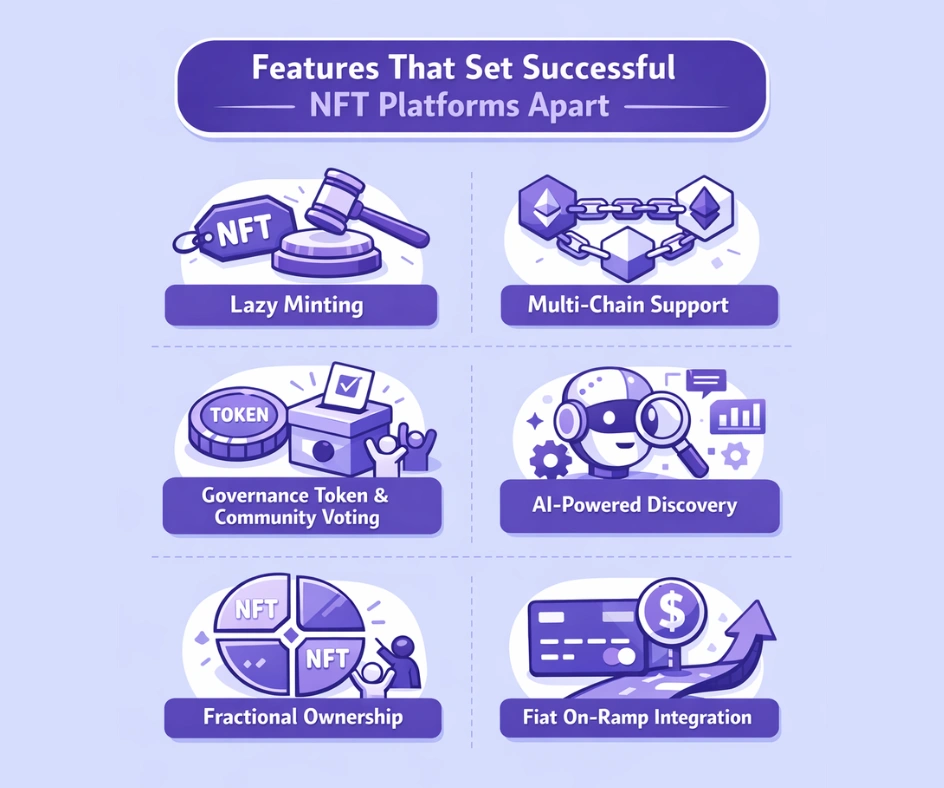
Advanced Features That Set Successful NFT Platforms Apart
Once the core features are working, these additions help you stand out in a crowded market and build a loyal user base.
1. Lazy Minting
With lazy minting, an NFT is not recorded on the blockchain until someone actually buys it. The creator lists the item for free, and the buyer pays the gas fee at the time of purchase. OpenSea popularized this feature, and it dramatically lowers the barrier for new creators who do not want to pay upfront fees that might never be recovered if the NFT does not sell.
2. Multi-Chain Support
Letting users mint and trade NFTs across multiple blockchains within a single platform increases your total addressable market. Someone who prefers Solana for its low fees does not have to leave your platform just because you launched on Ethereum. OpenSea moved to multi-chain support and captured users from multiple blockchain communities as a result.
3. Governance Token and Community Voting
Rarible introduced the RARI governance token, which gives users voting rights on platform decisions, including fee changes and new features. This approach builds genuine community ownership and loyalty. Users who have a say in a platform’s direction are more likely to stay on it and promote it.
4. AI-Powered Discovery
AI algorithms can analyze a user’s browsing history, purchase patterns, and wallet holdings to surface NFTs they are likely to find interesting. This is the same principle that makes streaming platform recommendations effective. In a marketplace with millions of NFTs, helping users find relevant work is a meaningful competitive advantage.
5. Fractional Ownership
Some high-value NFTs, like rare digital art or virtual real estate, are priced beyond what individual buyers can afford. Fractional ownership splits a single NFT into many smaller tokens that can be individually purchased and traded. Decentraland Foundation released an open-source protocol for this in March 2025, enabling fractional ownership of virtual land parcels. This feature opens high-value assets to a much broader pool of buyers.
6. Fiat On-Ramp Integration
Not every potential buyer owns cryptocurrency. Fiat on-ramp integrations let users pay with a credit card or bank transfer and receive crypto or complete NFT purchases directly in traditional currency. This feature is one of the most powerful tools for bringing non-crypto users into your platform.
NFT Marketplace Implementations Built in the Real World
The following projects show how NFT marketplace principles are being applied across gaming, digital assets, and decentralized finance. Each one reflects the same architecture concepts covered in this guide, from smart contract automation to token economies and community governance.
💧
BendDAO: NFT Liquidity and Lending Marketplace
Developed a decentralized NFT marketplace that goes beyond simple trading by introducing NFT-backed lending. Users can use their NFTs as collateral to borrow crypto, adding real financial utility to digital assets. The platform demonstrates how smart contracts can automate not just ownership transfers but complex financial instruments built around NFT ownership.
Common Mistakes to Avoid When You Develop an NFT Platform
Most failed NFT marketplace launches share common problems. Knowing what to avoid is as useful as knowing what to do.
1. Skipping the Smart Contract Audit
This is the single most dangerous shortcut. Smart contracts that have not been audited by a qualified firm have caused losses worth tens of millions of dollars. No matter how tight the development timeline, do not skip this step.
2. Building Without a Clear Niche
A platform that tries to serve everyone often ends up serving no one well. OpenSea has a first-mover advantage that you cannot replicate with a general marketplace built today. Focus on a specific category, audience, or use case and build the best possible experience for that group before expanding.
3. Ignoring Mobile Users
A significant portion of crypto users access platforms on mobile phones. A desktop-only platform or one with poor mobile performance will lose these users to competitors that took mobile design seriously.
4. Underestimating Regulatory Requirements
NFT regulations are evolving quickly. Anti-money laundering (AML) and Know Your Customer (KYC) requirements now apply to NFT platforms in many jurisdictions. Gemini Trust implemented mandatory KYC across its NFT marketplace in August 2024 in response to global regulatory directives. Build compliance infrastructure early, not as an afterthought.
5. Neglecting Post-Launch Marketing
Technology alone does not bring users to a new platform. You need a launch strategy that includes creator outreach, community building, social media presence, and possibly strategic partnerships. The NFT community is deeply social. Platforms that ignore community building typically fail to gain traction, no matter how technically good they are.
What Is an NFT Marketplace? How It Works End-to-End
How NFT Marketplaces Make Money: Revenue Models Explained
Understanding how a platform earns is central to how it is designed and operated. There are several proven models in use across successful platforms.
1. Transaction Fees
This is the most common model. A percentage of every sale goes to the platform. OpenSea charges 2.5 percent per transaction. Blur charges lower fees and competes on volume from professional traders. For a high-volume marketplace, even a 1 to 2 percent fee can generate substantial revenue.
2. Listing Fees
Some platforms charge creators a fee to list their NFTs. This is less common since it creates friction for onboarding new creators, but it can work on highly curated platforms where exclusivity justifies the cost.
3. Premium Subscriptions
Offer a free tier with basic features and a paid tier with advanced analytics, priority listing, reduced fees, or exclusive access to drops. This model creates predictable monthly recurring revenue that is not tied to trading volume fluctuations.
4. White-Label Services
Platforms like Mintable and Rarible SDK allow brands and creators to launch their own branded NFT storefronts on top of the core marketplace infrastructure. The parent platform earns by licensing the technology to these third-party stores.
5. Creator Royalty Splits
Some platforms take a small portion of the royalties generated on their network. If your platform processes a high volume of secondary sales, this can be a meaningful revenue stream on top of transaction fees.
Legal Compliance When You Build an NFT Marketplace
Legal requirements for NFT platforms vary by country, but there are areas that almost every serious platform needs to address.
1. KYC and AML Compliance
Know Your Customer and Anti-Money Laundering regulations require platforms to verify user identities and monitor transactions for suspicious activity. This typically means integrating a third-party identity verification service. Binance launched a mandatory KYC implementation across its NFT marketplace in August 2024. If Binance, one of the largest crypto companies in the world, is doing this, smaller platforms need to take note.
2. Intellectual Property Rights
Minting an NFT does not automatically transfer copyright to the buyer. Your platform’s terms of service need to be clear about what rights buyers receive, what creators retain, and how the platform handles reports of IP theft when someone mints content they do not own.
3. Tax Reporting
NFT transactions are treated as taxable events in most jurisdictions. Platforms operating in these regions may be required to provide transaction records to users for tax purposes or to regulators on request. Build the data infrastructure to support this from the start.
4. Securities Law Considerations
Some NFTs, particularly those that promise financial returns, may be classified as securities under certain jurisdictions. If your platform involves fractionalized NFTs or token-based governance, consult legal counsel before launch to ensure you are not accidentally operating as an unregistered securities exchange.
Launch Your NFT Marketplace Platform Today:
Our specialized blockchain team handles everything from smart contract creation to multi-chain integration, ensuring your platform is built for growth, security, and real user experience. Whether you need a curated art marketplace or a gaming NFT platform, we deliver solutions that work for your specific goals.
Final Thoughts
The process to develop an NFT marketplace is not a single action but a series of well-ordered decisions. It starts with understanding what kind of platform you want to build and who you are building it for. It moves through blockchain selection, smart contract development, UI design, security implementation, and testing before arriving at launch. And it continues long after launch with maintenance, updates, and community building.
The market data makes the opportunity clear. The global NFT market is growing at a compound annual rate of over 34 percent. User numbers are rising. Real-world use cases beyond art, including gaming, ticketing, real estate, and identity, are maturing and bringing new audiences into the space. Platforms built today with the right technology and a genuine focus on user experience are well-positioned to capture a meaningful share of this growing market.
What separates the platforms that succeed from those that do not is not just the technology. It is the combination of a focused niche strategy, properly audited smart contracts, a user interface that makes blockchain feel approachable, and a development team that understands both the technical requirements and the business context. Get those four things right, and the rest of the process becomes a matter of careful execution rather than guesswork.
If you are ready to move from planning to building, every step covered in this guide is something that an experienced blockchain development team can help you execute the first time correctly.
Frequently Asked Questions
Q1.How long does it take to develop an NFT marketplace?
A basic NFT marketplace with core features typically takes three to six months to build. A more advanced platform with multi-chain support, custom smart contracts, governance tokens, and advanced UI can take eight to twelve months. The timeline depends heavily on team size, feature scope, and how smoothly the smart contract audit process goes.
Q2.Do I need to write my own smart contracts?
Not necessarily. Libraries like OpenZeppelin provide tested, community-reviewed smart contract templates for ERC-721 and ERC-1155 tokens that you can build on. However, any customization to those templates, including unique auction logic, royalty distribution rules, or governance mechanisms, needs to be written by a qualified Solidity developer and audited before deployment.
Q3.Which blockchain is best for a new NFT marketplace?
It depends on your use case. Ethereum is the first choice for art and high-value collectibles because of its large collector base and liquidity. Solana suits gaming and high-volume applications because of its speed and low fees. Polygon is a good middle ground for projects that want Ethereum compatibility with lower gas costs. There is no single right answer, which is why the blockchain decision should happen after you have defined your niche and audience.
Q4.Is an NFT marketplace profitable?
Yes, when built correctly and focused on a real market need. OpenSea generated approximately 14.68 billion dollars in trading volume in 2024, earning transaction fees on that volume. Smaller, niche platforms can also be profitable at much lower trading volumes if their fee structure and cost base are properly managed. Profitability is harder to achieve with a generic marketplace that has no differentiation from existing platforms.
Q5.What are the biggest security risks when building an NFT marketplace?
The primary risks are smart contract vulnerabilities that allow attackers to drain funds or steal NFTs, phishing attacks that trick users into approving malicious transactions, and centralized infrastructure weaknesses that can be exploited if NFT media or metadata is stored on servers that can be taken down or compromised. Addressing these requires smart contract audits, clear user education about transaction approvals, and decentralized storage for NFT assets.
Q6.Can I build an NFT marketplace without knowing how to code?
You can use white-label NFT marketplace software to launch a platform with minimal technical knowledge. However, any platform serious about differentiation and long-term growth will eventually need custom development. You do not need to code yourself, but you do need to understand the process well enough to evaluate and direct a development team. This guide gives you exactly that foundation.
Explore Services
Related Services
Reviewed by

Aman Vaths
Founder of Nadcab Labs
Aman Vaths is the Founder & CTO of Nadcab Labs, a global digital engineering company delivering enterprise-grade solutions across AI, Web3, Blockchain, Big Data, Cloud, Cybersecurity, and Modern Application Development. With deep technical leadership and product innovation experience, Aman has positioned Nadcab Labs as one of the most advanced engineering companies driving the next era of intelligent, secure, and scalable software systems. Under his leadership, Nadcab Labs has built 2,000+ global projects across sectors including fintech, banking, healthcare, real estate, logistics, gaming, manufacturing, and next-generation DePIN networks. Aman’s strength lies in architecting high-performance systems, end-to-end platform engineering, and designing enterprise solutions that operate at global scale.